Plank with
Forward Arm Lift
Alex Woods, Erik Buckmiller, Glenna
Henderson, Mitch Parkinson
(Spring 2018)
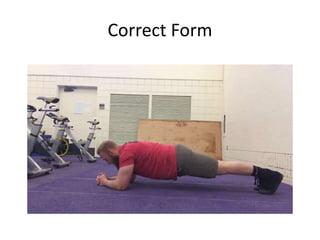
Correct Form
Correct form
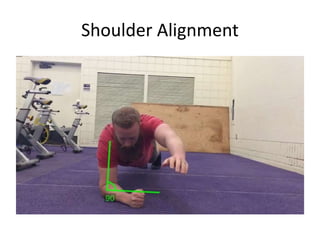
• Elbows under shoulder
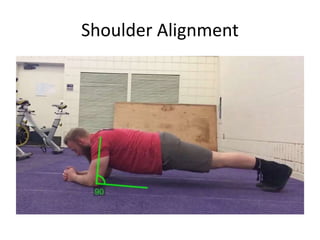
• Shoulder @ 90 degrees
• Hips, knees, neck, ear, and heels all in line
• Look @ ground
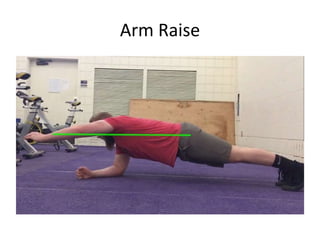
• Lift arm parallel with body
• Keep are straight during lift
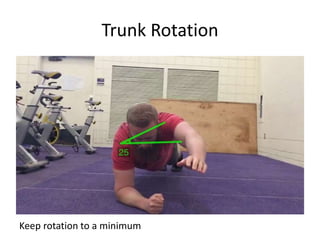
• DO NOT rotate hips
• Keep Core tight
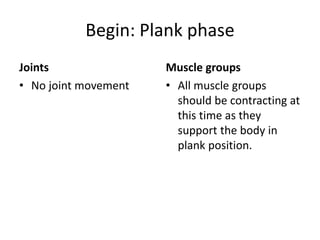
Begin: Plank phase
Joints
• No joint movement
Muscle groups
• All muscle groups
should be contracting at
this time as they
support the body in
plank position.
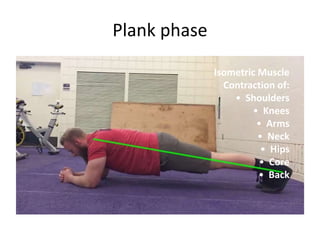
Plank phase
Isometric Muscle
Contraction of:
• Shoulders
• Knees
• Arms
• Neck
• Hips
• Core
• Back
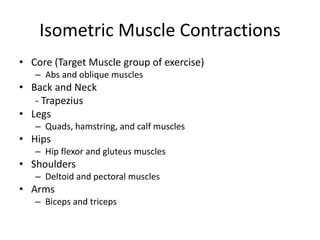
Isometric Muscle Contractions
• Core (Target Muscle group of exercise)
– Abs and oblique muscles
• Back and Neck
- Trapezius
• Legs
– Quads, hamstring, and calf muscles
• Hips
– Hip flexor and gluteus muscles
• Shoulders
– Deltoid and pectoral muscles
• Arms
– Biceps and triceps
Shoulder Alignment
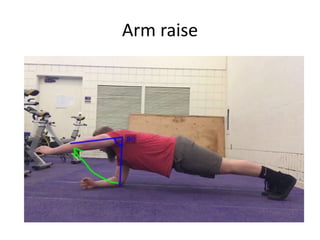
Middle: Forward Arm raise phase
Joints
• Shoulder
– Movement from 90° of
flexion to 170°-180° of
flexion
• Elbow
– Movement from 90° of
flexion to 0° (neutral)
Muscle Groups
• Shoulder Flexors
• Elbow Extenders
Arm raise
Shoulder muscles
Shoulder Flexion
Concentric Contraction
(shorten)
• Direct Movers
– Deltoid
– Pectoralis Major
– Biceps
Eccentric Contraction
(lengthen)
• Counteractive Muscles
– Deltoid
– Lower back
– Pectoralis Major
– triceps
Elbow Muscles
Elbow Extension
Concentric Contraction
(shorten)
• Agonists Muscles
– Triceps
Eccentric Contraction
(lengthen)
• Antagonist Muscles
– Biceps
– Forearm Flexors
– Pronator muscles
Shoulder Alignment
Arm Raise
Trunk Rotation
Keep rotation to a minimum
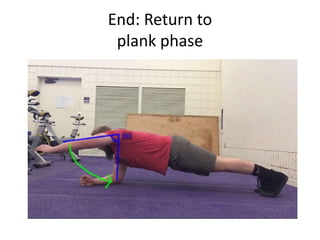
End: Return to
plank phase
Joints
• shoulder
– Movement from 170°-
180° of flexion to 90° of
flexion
• Elbow
– Movement from 0°
(neutral) to 90° of flexion
Muscle Groups
• Shoulder Extenders
• Elbow Flexors
End: Return to
plank phase
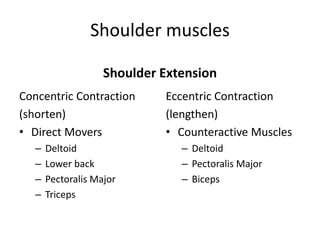
Shoulder muscles
Shoulder Extension
Concentric Contraction
(shorten)
• Direct Movers
– Deltoid
– Lower back
– Pectoralis Major
– Triceps
Eccentric Contraction
(lengthen)
• Counteractive Muscles
– Deltoid
– Pectoralis Major
– Biceps
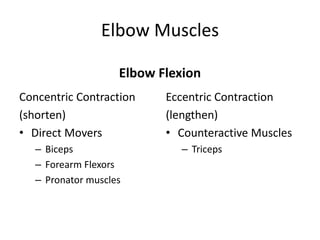
Elbow Muscles
Elbow Flexion
Concentric Contraction
(shorten)
• Direct Movers
– Biceps
– Forearm Flexors
– Pronator muscles
Eccentric Contraction
(lengthen)
• Counteractive Muscles
– Triceps
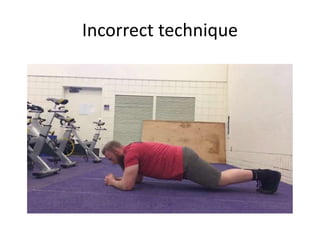
Incorrect technique
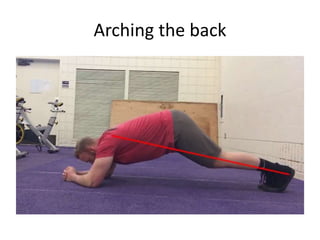
Arching the back
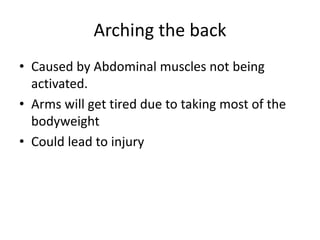
Arching the back
• Caused by Abdominal muscles not being
activated.
• Arms will get tired due to taking most of the
bodyweight
• Could lead to injury
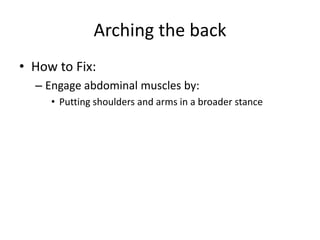
Arching the back
• How to Fix:
– Engage abdominal muscles by:
• Putting shoulders and arms in a broader stance
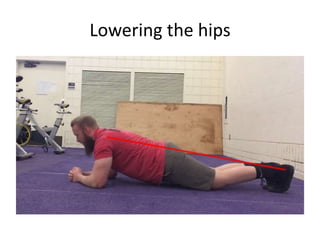
Lowering the hips
Lowering the hips
• Caused by fatigue of the abdominal muscles
and arms
• Makes move less challenging and effective
• Could also lead to injury in the spine
Lowering the hips
• How to Fix:
– Keep butt tucked in; focus on squeezing the
Gluteus Muscles.
– Widen stance of the feet
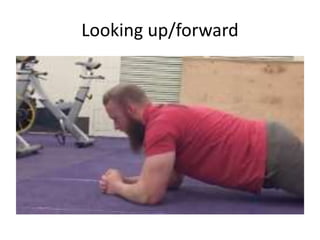
Looking up/forward
Looking up/forward
• Causes incorrect alignment of spine during
exercise
• Could cause strain in the neck
Looking up/forward
• How to Fix:
– Focus on keeping the head and neck aligned with
the body looking straight down at the ground.
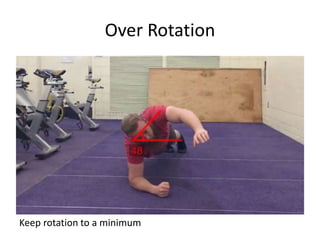
Over Rotation
Keep rotation to a minimum
Over Rotation
• Keep rotation to a minimum
• How to fix:
– Increase distance between feet to minimize hip
and trunk over rotation
references
• Floyd, R. T., & Thompson, C. W. (2018).
Manual of structural kinesiology (19th ed.).
New York, NY: McGraw-Hill Education.
• Biel, A. (2014). Trail guide to the body (5th
Ed.). Boulder, Colorado: Books of Discovery.

Plank with Forward Arm Lift

  • 1.
    Plank with Forward ArmLift Alex Woods, Erik Buckmiller, Glenna Henderson, Mitch Parkinson (Spring 2018)
  • 2.
  • 3.
    Correct form • Elbowsunder shoulder • Shoulder @ 90 degrees • Hips, knees, neck, ear, and heels all in line • Look @ ground • Lift arm parallel with body • Keep are straight during lift • DO NOT rotate hips • Keep Core tight
  • 4.
    Begin: Plank phase Joints •No joint movement Muscle groups • All muscle groups should be contracting at this time as they support the body in plank position.
  • 5.
    Plank phase Isometric Muscle Contractionof: • Shoulders • Knees • Arms • Neck • Hips • Core • Back
  • 6.
    Isometric Muscle Contractions •Core (Target Muscle group of exercise) – Abs and oblique muscles • Back and Neck - Trapezius • Legs – Quads, hamstring, and calf muscles • Hips – Hip flexor and gluteus muscles • Shoulders – Deltoid and pectoral muscles • Arms – Biceps and triceps
  • 7.
  • 8.
    Middle: Forward Armraise phase Joints • Shoulder – Movement from 90° of flexion to 170°-180° of flexion • Elbow – Movement from 90° of flexion to 0° (neutral) Muscle Groups • Shoulder Flexors • Elbow Extenders
  • 9.
  • 10.
    Shoulder muscles Shoulder Flexion ConcentricContraction (shorten) • Direct Movers – Deltoid – Pectoralis Major – Biceps Eccentric Contraction (lengthen) • Counteractive Muscles – Deltoid – Lower back – Pectoralis Major – triceps
  • 11.
    Elbow Muscles Elbow Extension ConcentricContraction (shorten) • Agonists Muscles – Triceps Eccentric Contraction (lengthen) • Antagonist Muscles – Biceps – Forearm Flexors – Pronator muscles
  • 12.
  • 13.
  • 14.
  • 15.
    End: Return to plankphase Joints • shoulder – Movement from 170°- 180° of flexion to 90° of flexion • Elbow – Movement from 0° (neutral) to 90° of flexion Muscle Groups • Shoulder Extenders • Elbow Flexors
  • 16.
  • 17.
    Shoulder muscles Shoulder Extension ConcentricContraction (shorten) • Direct Movers – Deltoid – Lower back – Pectoralis Major – Triceps Eccentric Contraction (lengthen) • Counteractive Muscles – Deltoid – Pectoralis Major – Biceps
  • 18.
    Elbow Muscles Elbow Flexion ConcentricContraction (shorten) • Direct Movers – Biceps – Forearm Flexors – Pronator muscles Eccentric Contraction (lengthen) • Counteractive Muscles – Triceps
  • 19.
  • 20.
  • 21.
    Arching the back •Caused by Abdominal muscles not being activated. • Arms will get tired due to taking most of the bodyweight • Could lead to injury
  • 22.
    Arching the back •How to Fix: – Engage abdominal muscles by: • Putting shoulders and arms in a broader stance
  • 23.
  • 24.
    Lowering the hips •Caused by fatigue of the abdominal muscles and arms • Makes move less challenging and effective • Could also lead to injury in the spine
  • 25.
    Lowering the hips •How to Fix: – Keep butt tucked in; focus on squeezing the Gluteus Muscles. – Widen stance of the feet
  • 26.
  • 27.
    Looking up/forward • Causesincorrect alignment of spine during exercise • Could cause strain in the neck
  • 28.
    Looking up/forward • Howto Fix: – Focus on keeping the head and neck aligned with the body looking straight down at the ground.
  • 29.
  • 30.
    Over Rotation • Keeprotation to a minimum • How to fix: – Increase distance between feet to minimize hip and trunk over rotation
  • 31.
    references • Floyd, R.T., & Thompson, C. W. (2018). Manual of structural kinesiology (19th ed.). New York, NY: McGraw-Hill Education. • Biel, A. (2014). Trail guide to the body (5th Ed.). Boulder, Colorado: Books of Discovery.

Editor's Notes

  • #4 The correct form of a plank is to have your ears, shoulders, hips, and heels in a straight line. This is so you do not cause any stress to the intervertebral disks of your spine. You need to have your elbows directly under your shoulders to prevent any shoulder of elbows problems like impingement, tennis elbow and many others. Your foot position is important as well, make sure they are shoulder width apart and only your toes are touching the ground. Engaging your core is a big part of this exercise because that is the target muscle. Another aspect is to engage your glutes. The glutes are engaged in order to stabilize you. You need to have your neck parallel with the ground and in line with the rest of your spine so you do not cause any cervical nerve root impingement. When you are lifting your arms you need to make sure that your amrs are in lifted to where they are in line in your spine. Make sure that your hips do not rotate too far when you are lifting your arm, they need to stay in the neutral post