Procedural Sedation

By Sandy McLellan, RN, CGRN
Norman Endoscopy Center
primun non nocere
First, Do No Harm
•
•
•
•
•
•

OBJECTIVES

Understand levels of procedural sedation
Know who can administer sedation
Know what your responsibilities are
Know what equipment is needed
Responsibilities in the procedure room
Know the properties of the medications given
for sedation
• Understand synergistic effects of medications
• Patient populations who may be at greater risk
for complications
These patients and their safety
are in our hands
•
•
•
•

We must screen
We must monitor
We must have procedures in place to correct
We must be prudent in our sedation and
zealous in our monitoring
Levels of Sedation

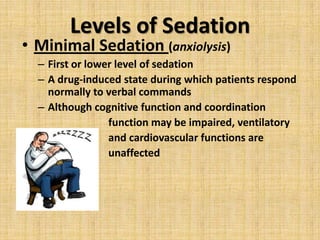
• Minimal Sedation (anxiolysis)

– First or lower level of sedation
– A drug-induced state during which patients respond
normally to verbal commands
– Although cognitive function and coordination
function may be impaired, ventilatory
and cardiovascular functions are
unaffected
Moderate Sedation / Analgesia
• Also called Conscious Sedation
• A drug-induced depression of consciousness
during which patients respond purposefully to
verbal commands, either alone or
accompanied by light tactile stimulation
• No interventions are required to maintain a
patent airway, and spontaneous ventilation is
adequate
• Cardiovascular function is usually maintained.
Deep Sedation / Analgesia
• A drug-induced depression of consciousness
during which patients cannot be easily
aroused by repeated or painful stimulation.
Reflex withdrawal from a painful stimulus is
not considered to be purposeful response
• The ability to independently maintain
ventilatory function may be impaired
• Patients may require assistance in order to
maintain a patent airway
• Spontaneous ventilation may be inadequate
• Cardiovascular function is usually maintained
General Anesthesia
• Deepest level of sedation
• A drug-induced depressed level of consciousness
where patients are NOT arousable, even with
painful stimuli
• Airway often requires intervention and
spontaneous ventilation is often inadequate.
• Cardiovascular function may be impaired.
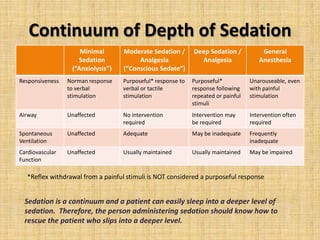
Continuum of Depth of Sedation
Minimal
Sedation
(“Anxiolysis”)

Moderate Sedation /
Analgesia
(“Conscious Sedate”)

Deep Sedation /
Analgesia

General
Anesthesia

Responsiveness

Norman response
to verbal
stimulation

Purposeful* response to
verbal or tactile
stimulation

Purposeful*
response following
repeated or painful
stimuli

Unarouseable, even
with painful
stimulation

Airway

Unaffected

No intervention
required

Intervention may
be required

Intervention often
required

Spontaneous
Ventilation

Unaffected

Adequate

May be inadequate

Frequently
inadequate

Cardiovascular
Function

Unaffected

Usually maintained

Usually maintained

May be impaired

*Reflex withdrawal from a painful stimuli is NOT considered a purposeful response

Sedation is a continuum and a patient can easily sleep into a deeper level of
sedation. Therefore, the person administering sedation should know how to
rescue the patient who slips into a deeper level.
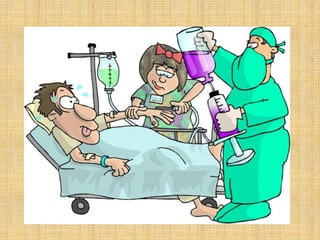
Who Can Administer Sedation?
• Oklahoma Board of Nursing regulates which
nurses can administer sedation in the state of
Oklahoma
– An LPN cannot administer sedation medications but
can monitor a patient who has been sedated
– An trained RN can administer minimal and moderate
sedation under the direction of a licensed physician.
Must maintain current BLS and ACLS certification.
They should not administer deep sedation and the
OBN clearly states that they cannot administer
anesthesia
– Anesthesia can only been administered by licensed
CRNA
What are the responsibilities of
sedation nurse?
• Assessment: VS, LOC, understanding of procedure
• Review patient medical history and medication
list, ensure patient is a candidate for procedure
• Ensure immediate availability of emergency
equipment & medications
• Educate patient of recovery process and home
care
• Verify last oral intake
• Assure vascular access
• Know the properties of medications that will be
given
Intra-Procedure Sedation Nurse
Responsibilities
• Do “time out” just prior to procedure. Utilize Safe
Surgery Checklist to ensure necessary checks have
occurred
• Have no other responsibilities other than monitoring
the patient
• Administer meds by following procedure policy
recommendations, in small, incremental doses, titrate
to effect
• Administer Oxygen as needed/ordered
• VS, LOC at least every 5 minutes
• Document response to
meds, complications, interventions, etc.
Post-procedure Sedation Nurse
Responsibilities
• Ensure all procedural documentation is
completed
• Take patient to recovery room, when stable
• Document patient assessment upon arrival to
recovery room
• Give report to nurse assuming patient’s care
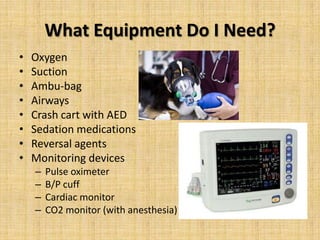
What Equipment Do I Need?
•
•
•
•
•
•
•
•

Oxygen
Suction
Ambu-bag
Airways
Crash cart with AED
Sedation medications
Reversal agents
Monitoring devices
–
–
–
–

Pulse oximeter
B/P cuff
Cardiac monitor
CO2 monitor (with anesthesia)
Medications used for Sedation
•
•
•
•

Versed (midazolam)
Fentanyl (sublimaze)
Demerol (meperidine)
Diprivan (propofol)
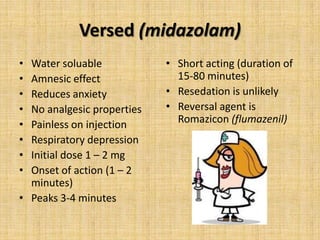
Versed (midazolam)
•
•
•
•
•
•
•
•

Water soluable
Amnesic effect
Reduces anxiety
No analgesic properties
Painless on injection
Respiratory depression
Initial dose 1 – 2 mg
Onset of action (1 – 2
minutes)
• Peaks 3-4 minutes

• Short acting (duration of
15-80 minutes)
• Resedation is unlikely
• Reversal agent is
Romazicon (flumazenil)
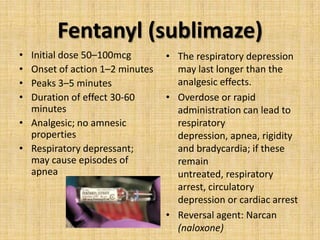
Fentanyl (sublimaze)
•
•
•
•

Initial dose 50–100mcg
Onset of action 1–2 minutes
Peaks 3–5 minutes
Duration of effect 30-60
minutes
• Analgesic; no amnesic
properties
• Respiratory depressant;
may cause episodes of
apnea

• The respiratory depression
may last longer than the
analgesic effects.
• Overdose or rapid
administration can lead to
respiratory
depression, apnea, rigidity
and bradycardia; if these
remain
untreated, respiratory
arrest, circulatory
depression or cardiac arrest
• Reversal agent: Narcan
(naloxone)
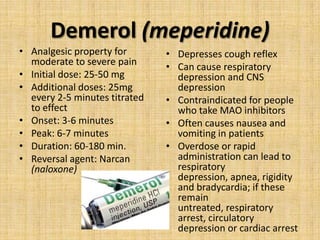
Demerol (meperidine)
• Analgesic property for
moderate to severe pain
• Initial dose: 25-50 mg
• Additional doses: 25mg
every 2-5 minutes titrated
to effect
• Onset: 3-6 minutes
• Peak: 6-7 minutes
• Duration: 60-180 min.
• Reversal agent: Narcan
(naloxone)

• Depresses cough reflex
• Can cause respiratory
depression and CNS
depression
• Contraindicated for people
who take MAO inhibitors
• Often causes nausea and
vomiting in patients
• Overdose or rapid
administration can lead to
respiratory
depression, apnea, rigidity
and bradycardia; if these
remain
untreated, respiratory
arrest, circulatory
depression or cardiac arrest
Diprivan (propofol)
• Loss of consciousness usually occurs
within Peaks in 90 seconds
• Given in procedure atmosphere (short
duration), the effects usually wear off
in 10 to 15 minutes
• No analgesic properties
• No amnesia properties
• Respiratory depressant, frequently
causes apneic episodes that last over
60 seconds.
• Unless totally unconscious they do
not lose their hearing.
• The most significant adverse effect of
propofol is hemodynamic
destabilization. Propofol can
substantially reduce cardiac output

• Expect a drop in BP of 20%
after initial dose from baseline
• SpO2 will drop initially and
then recover
• Can only be administered by
licensed anesthesia person
• There is no reversal agent
SYNERGISTIC EFFECTS
of medications
Synergistic effects
• Combining a sedative such as a
benzodiazepine, an opioid or a anesthetic, can
potentiate the effects of the medications and can
increase the likelihood of adverse
outcomes, including ventilatory depression and
resultant hypoxemia
• The administration of one of the above drugs can
reduce the amount of the second in a different
class that is needed to achieve the desired level
of sedation.
• Keep in mind that medications taken at home can
also potentiate the effects of medications given
during the procedure (i.e. narcotics, CNS
depressants)
Sedation can be risky with certain
patient populations
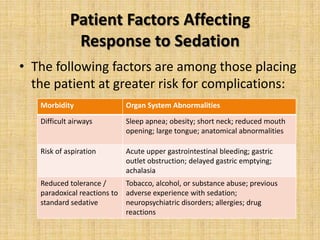
Patient Factors Affecting
Response to Sedation
• The following factors are among those placing
the patient at greater risk for complications:
Morbidity

Organ System Abnormalities

Difficult airways

Sleep apnea; obesity; short neck; reduced mouth
opening; large tongue; anatomical abnormalities

Risk of aspiration

Acute upper gastrointestinal bleeding; gastric
outlet obstruction; delayed gastric emptying;
achalasia

Reduced tolerance /
Tobacco, alcohol, or substance abuse; previous
paradoxical reactions to adverse experience with sedation;
standard sedative
neuropsychiatric disorders; allergies; drug
reactions
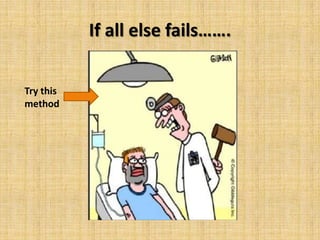
If all else fails…….
Try this
method
Or This..
Or this
Sources
• Use of Sedative Medications in the Intensive Care
Unit, Stanley A. Nasraway Jr., MD., FCCM, Department of
Surgery, Tufts-New England Medical Center, Tufts University
School of Medicine, Boston, Massachusetts
• SGNA, www.sedation.org
• Oklahoma Board of Nursing
• AGA Institute Review of Endoscopic Sedation

Procedural sedation

  • 1.
    Procedural Sedation By SandyMcLellan, RN, CGRN Norman Endoscopy Center
  • 2.
  • 3.
    • • • • • • OBJECTIVES Understand levels ofprocedural sedation Know who can administer sedation Know what your responsibilities are Know what equipment is needed Responsibilities in the procedure room Know the properties of the medications given for sedation • Understand synergistic effects of medications • Patient populations who may be at greater risk for complications
  • 4.
    These patients andtheir safety are in our hands • • • • We must screen We must monitor We must have procedures in place to correct We must be prudent in our sedation and zealous in our monitoring
  • 5.
    Levels of Sedation •Minimal Sedation (anxiolysis) – First or lower level of sedation – A drug-induced state during which patients respond normally to verbal commands – Although cognitive function and coordination function may be impaired, ventilatory and cardiovascular functions are unaffected
  • 6.
    Moderate Sedation /Analgesia • Also called Conscious Sedation • A drug-induced depression of consciousness during which patients respond purposefully to verbal commands, either alone or accompanied by light tactile stimulation • No interventions are required to maintain a patent airway, and spontaneous ventilation is adequate • Cardiovascular function is usually maintained.
  • 7.
    Deep Sedation /Analgesia • A drug-induced depression of consciousness during which patients cannot be easily aroused by repeated or painful stimulation. Reflex withdrawal from a painful stimulus is not considered to be purposeful response • The ability to independently maintain ventilatory function may be impaired • Patients may require assistance in order to maintain a patent airway • Spontaneous ventilation may be inadequate • Cardiovascular function is usually maintained
  • 8.
    General Anesthesia • Deepestlevel of sedation • A drug-induced depressed level of consciousness where patients are NOT arousable, even with painful stimuli • Airway often requires intervention and spontaneous ventilation is often inadequate. • Cardiovascular function may be impaired.
  • 9.
    Continuum of Depthof Sedation Minimal Sedation (“Anxiolysis”) Moderate Sedation / Analgesia (“Conscious Sedate”) Deep Sedation / Analgesia General Anesthesia Responsiveness Norman response to verbal stimulation Purposeful* response to verbal or tactile stimulation Purposeful* response following repeated or painful stimuli Unarouseable, even with painful stimulation Airway Unaffected No intervention required Intervention may be required Intervention often required Spontaneous Ventilation Unaffected Adequate May be inadequate Frequently inadequate Cardiovascular Function Unaffected Usually maintained Usually maintained May be impaired *Reflex withdrawal from a painful stimuli is NOT considered a purposeful response Sedation is a continuum and a patient can easily sleep into a deeper level of sedation. Therefore, the person administering sedation should know how to rescue the patient who slips into a deeper level.
  • 10.
    Who Can AdministerSedation? • Oklahoma Board of Nursing regulates which nurses can administer sedation in the state of Oklahoma – An LPN cannot administer sedation medications but can monitor a patient who has been sedated – An trained RN can administer minimal and moderate sedation under the direction of a licensed physician. Must maintain current BLS and ACLS certification. They should not administer deep sedation and the OBN clearly states that they cannot administer anesthesia – Anesthesia can only been administered by licensed CRNA
  • 12.
    What are theresponsibilities of sedation nurse? • Assessment: VS, LOC, understanding of procedure • Review patient medical history and medication list, ensure patient is a candidate for procedure • Ensure immediate availability of emergency equipment & medications • Educate patient of recovery process and home care • Verify last oral intake • Assure vascular access • Know the properties of medications that will be given
  • 13.
    Intra-Procedure Sedation Nurse Responsibilities •Do “time out” just prior to procedure. Utilize Safe Surgery Checklist to ensure necessary checks have occurred • Have no other responsibilities other than monitoring the patient • Administer meds by following procedure policy recommendations, in small, incremental doses, titrate to effect • Administer Oxygen as needed/ordered • VS, LOC at least every 5 minutes • Document response to meds, complications, interventions, etc.
  • 14.
    Post-procedure Sedation Nurse Responsibilities •Ensure all procedural documentation is completed • Take patient to recovery room, when stable • Document patient assessment upon arrival to recovery room • Give report to nurse assuming patient’s care
  • 15.
    What Equipment DoI Need? • • • • • • • • Oxygen Suction Ambu-bag Airways Crash cart with AED Sedation medications Reversal agents Monitoring devices – – – – Pulse oximeter B/P cuff Cardiac monitor CO2 monitor (with anesthesia)
  • 16.
    Medications used forSedation • • • • Versed (midazolam) Fentanyl (sublimaze) Demerol (meperidine) Diprivan (propofol)
  • 18.
    Versed (midazolam) • • • • • • • • Water soluable Amnesiceffect Reduces anxiety No analgesic properties Painless on injection Respiratory depression Initial dose 1 – 2 mg Onset of action (1 – 2 minutes) • Peaks 3-4 minutes • Short acting (duration of 15-80 minutes) • Resedation is unlikely • Reversal agent is Romazicon (flumazenil)
  • 19.
    Fentanyl (sublimaze) • • • • Initial dose50–100mcg Onset of action 1–2 minutes Peaks 3–5 minutes Duration of effect 30-60 minutes • Analgesic; no amnesic properties • Respiratory depressant; may cause episodes of apnea • The respiratory depression may last longer than the analgesic effects. • Overdose or rapid administration can lead to respiratory depression, apnea, rigidity and bradycardia; if these remain untreated, respiratory arrest, circulatory depression or cardiac arrest • Reversal agent: Narcan (naloxone)
  • 20.
    Demerol (meperidine) • Analgesicproperty for moderate to severe pain • Initial dose: 25-50 mg • Additional doses: 25mg every 2-5 minutes titrated to effect • Onset: 3-6 minutes • Peak: 6-7 minutes • Duration: 60-180 min. • Reversal agent: Narcan (naloxone) • Depresses cough reflex • Can cause respiratory depression and CNS depression • Contraindicated for people who take MAO inhibitors • Often causes nausea and vomiting in patients • Overdose or rapid administration can lead to respiratory depression, apnea, rigidity and bradycardia; if these remain untreated, respiratory arrest, circulatory depression or cardiac arrest
  • 21.
    Diprivan (propofol) • Lossof consciousness usually occurs within Peaks in 90 seconds • Given in procedure atmosphere (short duration), the effects usually wear off in 10 to 15 minutes • No analgesic properties • No amnesia properties • Respiratory depressant, frequently causes apneic episodes that last over 60 seconds. • Unless totally unconscious they do not lose their hearing. • The most significant adverse effect of propofol is hemodynamic destabilization. Propofol can substantially reduce cardiac output • Expect a drop in BP of 20% after initial dose from baseline • SpO2 will drop initially and then recover • Can only be administered by licensed anesthesia person • There is no reversal agent
  • 22.
  • 23.
    Synergistic effects • Combininga sedative such as a benzodiazepine, an opioid or a anesthetic, can potentiate the effects of the medications and can increase the likelihood of adverse outcomes, including ventilatory depression and resultant hypoxemia • The administration of one of the above drugs can reduce the amount of the second in a different class that is needed to achieve the desired level of sedation. • Keep in mind that medications taken at home can also potentiate the effects of medications given during the procedure (i.e. narcotics, CNS depressants)
  • 24.
    Sedation can berisky with certain patient populations
  • 25.
    Patient Factors Affecting Responseto Sedation • The following factors are among those placing the patient at greater risk for complications: Morbidity Organ System Abnormalities Difficult airways Sleep apnea; obesity; short neck; reduced mouth opening; large tongue; anatomical abnormalities Risk of aspiration Acute upper gastrointestinal bleeding; gastric outlet obstruction; delayed gastric emptying; achalasia Reduced tolerance / Tobacco, alcohol, or substance abuse; previous paradoxical reactions to adverse experience with sedation; standard sedative neuropsychiatric disorders; allergies; drug reactions
  • 26.
    If all elsefails……. Try this method
  • 27.
  • 28.
    Sources • Use ofSedative Medications in the Intensive Care Unit, Stanley A. Nasraway Jr., MD., FCCM, Department of Surgery, Tufts-New England Medical Center, Tufts University School of Medicine, Boston, Massachusetts • SGNA, www.sedation.org • Oklahoma Board of Nursing • AGA Institute Review of Endoscopic Sedation