

Welcome to our
Presentation
2
8 puzzle problem
 What is 8 puzzle Problem?
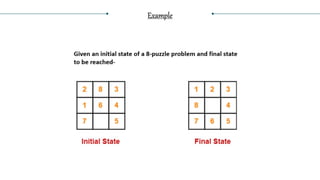
The 8-puzzle problem is a puzzle invented and popularized by
Noyes Palmer Chapman in the 1870s. It is played on a 3-by-3
grid with 8 square blocks labeled 1 through 8 and a blank
square.
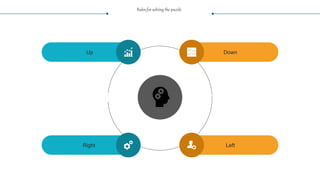
Rules for solving the puzzle
Down
Left
Up
Right
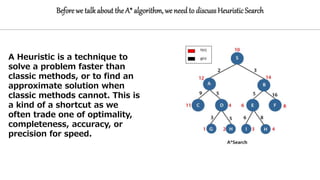
Before we talk about the A* algorithm, we need to discussHeuristic Search
A Heuristic is a technique to
solve a problem faster than
classic methods, or to find an
approximate solution when
classic methods cannot. This is
a kind of a shortcut as we
often trade one of optimality,
completeness, accuracy, or
precision for speed.
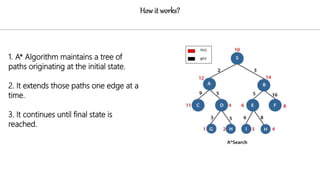
How it works?
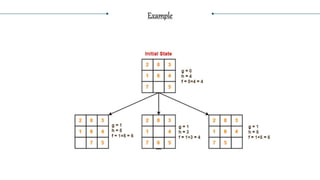
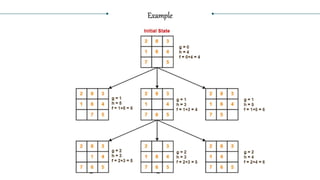
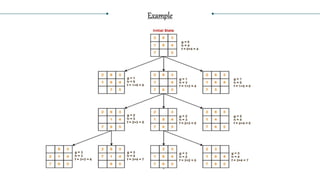
1. A* Algorithm maintains a tree of
paths originating at the initial state.
2. It extends those paths one edge at a
time.
3. It continues until final state is
reached.
Example
Example
Example
Example
Example
Pros
&
Cons
Pros:
 It is complete and optimal.
 It is the best one from other techniques. It is used to solve very complex problems.
 It is optimally efficient, i.e. there is no other optimal algorithm guaranteed to expand fewer nodes than A*.
Cons:
 This algorithm is complete if the branching factor is finite and every action has fixed cost.
 The speed execution of A* search is highly dependent on the accuracy of the heuristic algorithm that is used to compute h (n).
 It has complexity problems.
Important Note
A* Algorithm
is one of the
best path
finding
algorithms.
.
But it does
not
produce the
shortest
path
always.
This is
because it
heavily
depends on
heuristics.
Thank You

Ai 8 puzzle problem

  • 1.
  • 2.
    2 8 puzzle problem What is 8 puzzle Problem? The 8-puzzle problem is a puzzle invented and popularized by Noyes Palmer Chapman in the 1870s. It is played on a 3-by-3 grid with 8 square blocks labeled 1 through 8 and a blank square.
  • 3.
    Rules for solvingthe puzzle Down Left Up Right
  • 4.
    Before we talkabout the A* algorithm, we need to discussHeuristic Search A Heuristic is a technique to solve a problem faster than classic methods, or to find an approximate solution when classic methods cannot. This is a kind of a shortcut as we often trade one of optimality, completeness, accuracy, or precision for speed.
  • 5.
    How it works? 1.A* Algorithm maintains a tree of paths originating at the initial state. 2. It extends those paths one edge at a time. 3. It continues until final state is reached.
  • 6.
  • 7.
  • 8.
  • 9.
  • 10.
  • 11.
    Pros & Cons Pros:  It iscomplete and optimal.  It is the best one from other techniques. It is used to solve very complex problems.  It is optimally efficient, i.e. there is no other optimal algorithm guaranteed to expand fewer nodes than A*. Cons:  This algorithm is complete if the branching factor is finite and every action has fixed cost.  The speed execution of A* search is highly dependent on the accuracy of the heuristic algorithm that is used to compute h (n).  It has complexity problems.
  • 12.
    Important Note A* Algorithm isone of the best path finding algorithms. . But it does not produce the shortest path always. This is because it heavily depends on heuristics.
  • 13.