TRIBOLOGY OF THR
DR. MOHIT PABARI (R3)
DEPARTMENT OF ORTHOPEDICS,
SKH HOSPITAL.
TRIBOLOGY-the study of friction, wear, lubrication, and the design of bearings; the science
of interacting surfaces in relative motion.
Tribology
◦ Wear – types and mode
◦ Lubrication
◦ Friction
Types of bearing
◦ Polyethlyene
◦ Metal
◦ Ceramic
Concerns with different bearing
Introduction
Ideal Bearing
An Articulating Surface That Has
◦ Virtually no wear
◦ Accommodates large head
◦ Debris evokes no host immune response
◦ Exhibits low friction
◦ Generate no noise
◦ Chemically stable in vivo
◦ Tough (resists fracture)
◦ Less susceptible to scratching and 3rd body wear
History
Carnochan – first surgeon who thought hip can be replaced – used wooden
blocks (18th century)
Mould arthroplasty – Smith Peterson (1925)
◦ Used glass
◦ Restore congruous articular surfaces
◦ Glass put on Bleeding cancellous bone
◦ Metaplasia of fibrin clot to fibrocartilage
◦ Very poor longevity
MOM THR
Philip Wilis performed first MOM THR (1938)
Mckee, Wateson and Farrar (1951) used Thompson type of femoral
component and metallic acetabular cup of cobalt chrome alloy
Muller (1951) introduced 1st generation MOM hip arthroplasty
◦ Quality of metal was poor, hence
◦ Friction metal wear
◦ High incidence of loosening and pain
John Charley
Revolutionized Hip Replacement in 1962
Some of his concepts are in practice even today.
He introduced concepts of-
◦ Low friction Torque Arthroplasty
◦ Surgical Alteration of Hip Biomechanics
◦ Lubrication
◦ Material Design
◦ Operating Room Environment
◦ PMMA
Low Frictional Arthroplasty
•Stainless steel head on Polythene Cup
•Lateralization of Trochanter
•Medialization of Acetabulum
•22.2 mm Femoral Head-much smaller then which we usually
remove-hence biggest problem was higher incidence of hip
dislocation
Tribology
Science of interactive surfaces in relative motion
Study of
◦Friction
◦Lubrication
◦Wear
◦Design of bearing material we use in hip
replacement
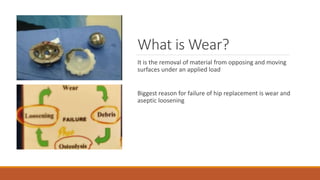
What is Wear?
It is the removal of material from opposing and moving
surfaces under an applied load
Biggest reason for failure of hip replacement is wear and
aseptic loosening
Step 1 : Wear and Osteolysis
Motion between articulating surfaces
Unintended impingement or motion
Leads to formation of Wear Particles
Step 2 : Macrophage Activated
Osteoclastogenesis and Osteolysis
Wear partials ->Macrophage activation and recruitment
Osteolysis by osteolytic factors (cytokines)
◦ TNF – alpha , TGF – beta
◦ Oxide radicals, hydrogen peroxide
◦ Acid phosphatase, Prostaglandins
◦ Interlukins (IL – 1, IL – 6)
Increase RANK and RANKL activation
◦ RANKL mediated bone resorption
Step 3 : Prosthesis Micromotion
Osteolysis surrounding the prosthesis leading to
micromotion
◦Increases particle wear and further prosthesis loosening
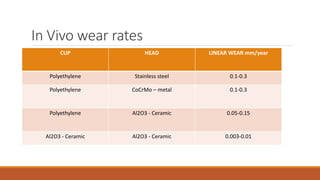
In Vivo wear rates
CUP HEAD LINEAR WEAR mm/year
Polyethylene Stainless steel 0.1-0.3
Polyethylene CoCrMo – metal 0.1-0.3
Polyethylene Al2O3 - Ceramic 0.05-0.15
Al2O3 - Ceramic Al2O3 - Ceramic 0.003-0.01
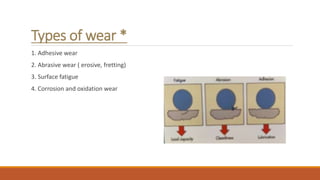
Types of wear *
1. Adhesive wear
2. Abrasive wear ( erosive, fretting)
3. Surface fatigue
4. Corrosion and oxidation wear
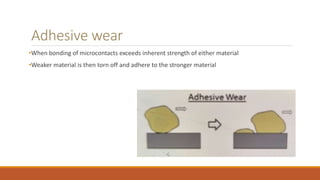
Adhesive wear
•When bonding of microcontacts exceeds inherent strength of either material
•Weaker material is then torn off and adhere to the stronger material
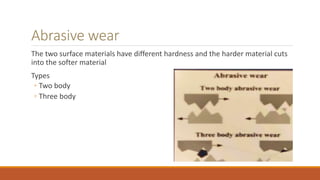
Abrasive wear
The two surface materials have different hardness and the harder material cuts
into the softer material
Types
◦ Two body
◦ Three body
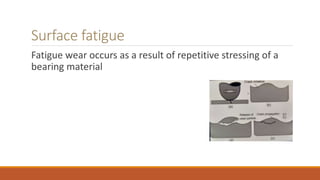
Surface fatigue
Fatigue wear occurs as a result of repetitive stressing of a
bearing material
Modes of wear
Mode 1
◦ Results from motion that occurs between two primary bearing surface
◦ Eg Wear from femoral prosthetic head against acetabular liner
Modes of wear
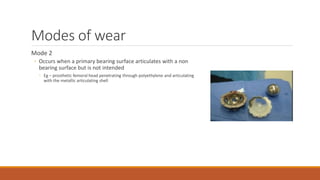
Mode 2
◦ Occurs when a primary bearing surface articulates with a non
bearing surface but is not intended
◦ Eg – prosthetic femoral head penetrating through polyethylene and articulating
with the metallic articulating shell
Modes of wear
Mode 3 ( Third – body wear )
◦ Occurs from entrapped abrasive particles between primary bearing surfaces
◦ Cement, bone, polyethylene or metallic particulates
Modes of wear
Mode 4
◦ Occurs from motion at two secondary or non bearing surface
◦ Eg –
◦ Impingement of prosthetic femoral neck onto the rim of acetabular
component
◦ Fretting at a Morse taper between the prosthetic femoral neck and head
◦ Backside Wear between acetabular shell and backside of polyethylene line
insert
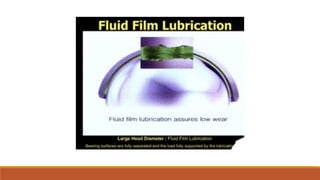
Lubrication
•The thickness of the lubrication film as well as the surface roughness determine
type of lubrication
•Improves longevity of implant
Fluid film lubrication
Bearing Surfaces
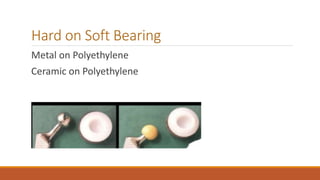
Hard on Soft Bearing
Metal on Polyethylene
Ceramic on Polyethylene
Polyethylene
Discovered in 1935
Viscoelastic and thermoplastic polymer
Long chains of the monomer ethylene
◦ Low density PE – Density 0.910 to 0.940 gmc3 (high volumetric
wear)
◦ High density PE – Density > 0.941 g/cm
◦ UHMWPE – molecular weight > 3 million g/mol
Mainstay of joint replacement over last 40 years
Polyethylene Sterilization
•Historically sterilized by 2.5 mrad of either beam or gamma radiation
•These processes produce free radicals in material, predisposing the
polyethylene to oxidation and rendering it more susceptible to wear.
HXLPE
Preparation
◦ Gamma or electron beam radiation – 10mrad
◦ Subsequent annealing at 150 degrees.
Resulting polymer highly resistant to wear and oxidative degradation
Muratoglu et al.
◦ Wear rate not related to the size of femoral head within 22 to
46mm in diameter->so we started using higher diameter head to
reduce risk of dislocation
HXLPE
Risk
◦ Fatigue cracking, delamination
◦ Lower fracture toughness and tensile strength
◦ Increase bioactivity of wear particles
◦ Implant fracture when a thin liner is used to accommodate a large diameter
head
Modification of HXLPE
◦ Anti-oxidant diffusion, Mechanical deformation
◦ Low dose irradiation with interspersed annealing
◦ Vitamin E
Metal – On - Polyethylene
Benefits
◦ Longest track record of bearing surfaces
◦ Lowest cost
Disadvantages
◦ Higher wear and osteolysis rates compared to MOM and ceramics
◦ Smaller head compared to MOM leads to higher risk of
impingement
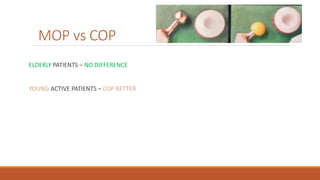
MOP vs COP
ELDERLY PATIENTS – NO DIFFERENCE
YOUNG ACTIVE PATIENTS – COP BETTER
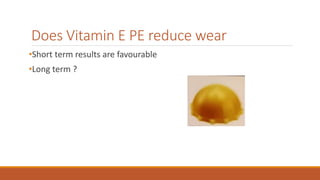
Does Vitamin E PE reduce wear
•Short term results are favourable
•Long term ?
Hard on Hard Bearings
Metal on Metal
Ceramic on Ceramic
Ceramic on Metal
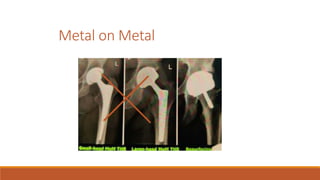
Metal on Metal
Tribology MOM
•Produces lower and smaller wear particles as compared to
MOP bearings (ranging from 2.5 – 5.0 micro / year)
•Has an initial run – in phase of increased wear followed by
steady state wear phase
Benefits of metal on metal
Favors larger diameters ( hence lower wear )
Better wear properties than Metal-on-polyethylene
◦ Lower linear wear rate
◦ Decreased volume of particles
Long in vivo experience
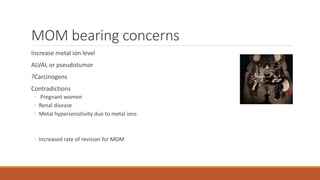
MOM bearing concerns
Increase metal ion level
ALVAL or pseudotumor
?Carcinogens
Contradictions
◦ Pregnant women
◦ Renal disease
◦ Metal hypersensitivity due to metal ions
◦ Increased rate of revision for MOM
Metal on Metal Bearings
The lack of clinical advantage with metal bearings and the
significant downsides to use of MOM mean that this option
should be used in great caution, if at all
◦ The Journal Of Artroplasty Vol 25 No 1 2010 Editorial
Ceramics in THR
1st generation (1970)
◦ Alumina pierre boutin
◦ Low density and very coarse microstructure
2nd generation (1980)
◦ Reduced microstructure and grain size
3rd generation (1990)
◦ Improved mechanical strength
◦ Reduced grain size
◦ Prepared by isostatic pressuring
4th generation (2000)
◦ New alumina – Zirconia – Strontium oxide matrix composition
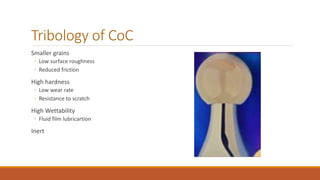
Tribology of CoC
Smaller grains
◦ Low surface roughness
◦ Reduced friction
High hardness
◦ Low wear rate
◦ Resistance to scratch
High Wettability
◦ Fluid film lubricartion
Inert
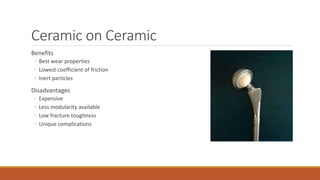
Ceramic on Ceramic
Benefits
◦ Best wear properties
◦ Lowest coefficient of friction
◦ Inert particles
Disadvantages
◦ Expensive
◦ Less modularity available
◦ Low fracture toughness
◦ Unique complications
Unique complications
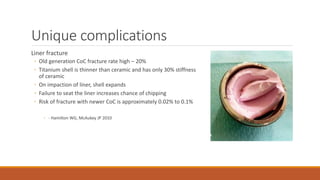
Liner fracture
◦ Old generation CoC fracture rate high – 20%
◦ Titanium shell is thinner than ceramic and has only 30% stiffness
of ceramic
◦ On impaction of liner, shell expands
◦ Failure to seat the liner increases chance of chipping
◦ Risk of fracture with newer CoC is approximately 0.02% to 0.1%
◦ - Hamilton WG, McAukey JP 2010
Any unique complication?
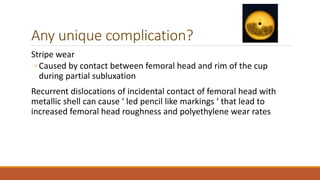
Stripe wear
◦ Caused by contact between femoral head and rim of the cup
during partial subluxation
Recurrent dislocations of incidental contact of femoral head with
metallic shell can cause ‘ led pencil like markings ‘ that lead to
increased femoral head roughness and polyethylene wear rates
Unique Complication - Squeaking
Cause ?
◦ Localised ‘striped wear’
◦ Changes of fluid film lubrication conditions
◦ Femoral head micro – separation
◦ Neck rim impingement
◦ Clinically Often Minor And Revision Indicated Only Occasionally
Unique Complications – Difficulty During
Revision
•Total synovectomy needed
•Liner exchange may not be sufficient as removal may
damage the shell or taper
Unique Complications – Less chance to
customize
•CoC systems have only one head size per cup diameter
•No lateralized liners, elevate rims etc
•Equalizing leg length and maximizing stability is more challenging
Loss of all these options may currently be the most substantial
disadvantage of CoC THA
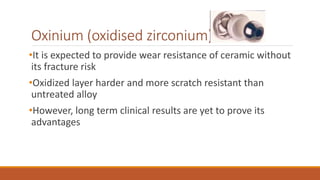
Oxinium (oxidised zirconium)
•It is expected to provide wear resistance of ceramic without
its fracture risk
•Oxidized layer harder and more scratch resistant than
untreated alloy
•However, long term clinical results are yet to prove its
advantages
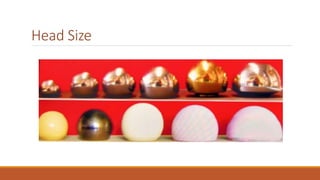
Head Size
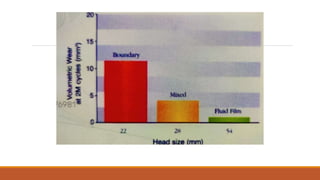
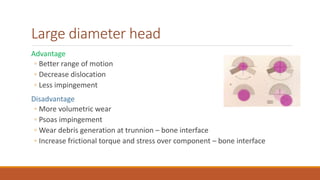
Large diameter head
Advantage
◦ Better range of motion
◦ Decrease dislocation
◦ Less impingement
Disadvantage
◦ More volumetric wear
◦ Psoas impingement
◦ Wear debris generation at trunnion – bone interface
◦ Increase frictional torque and stress over component – bone interface
Conclusion on Head Size
Hard on Soft bearing
◦ Limit be 32/36mm as wear increases with head diameter
Hard on Hard bearings
◦ Head diameter should be limited to < 40mm
◦ Wear not influenced by head diameter
◦ But larger heads found – greater noise
PE tear With LDH
UHMWPE
◦ Wear / Fatigue / Osteolysis
◦ PE Liner < 6mm -- more cup failure
◦ Minimum thickness of poly – 9mm
XLPE
◦ Increased head size doesn’t significantly increase wear of HPE
Fixation options
Primary THR
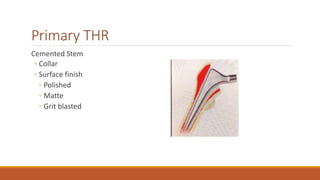
Cemented Stem
◦ Collar
◦ Surface finish
◦ Polished
◦ Matte
◦ Grit blasted
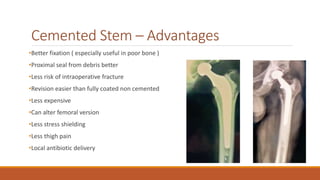
Cemented Stem – Advantages
•Better fixation ( especially useful in poor bone )
•Proximal seal from debris better
•Less risk of intraoperative fracture
•Revision easier than fully coated non cemented
•Less expensive
•Can alter femoral version
•Less stress shielding
•Less thigh pain
•Local antibiotic delivery
Cemented stems - Disadvantages
•Increased operative time
•Technique development
•Greater embolization of fat and marrow elements
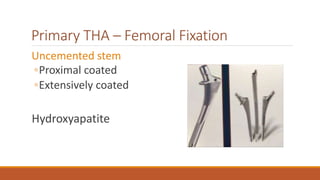
Primary THA – Femoral Fixation
Uncemented stem
◦Proximal coated
◦Extensively coated
Hydroxyapatite
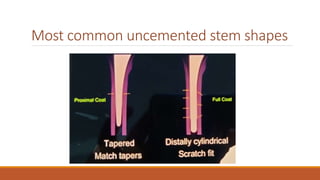
Most common uncemented stem shapes
Cementless stem - Advantages
•Technically easier (v/s cemented) in most cases
•Excellent fixation durability
•Avoids cement mess and ‘THE WAIT’ for cement heading
•More amenable to small incisions
•More familiar to most as experience with cement decreases.
Cementless stems - Disadvantages
•Stiffness
•Stress Shielding
•Greatest if already osteoporotic
•Marked bone loss possible if removal required
•Thigh plane ( likely mechanical mismatch )
•Intraoperative fracture – Risk management vs cemented
•Fibrous fixation – Possible->Pain and early failure
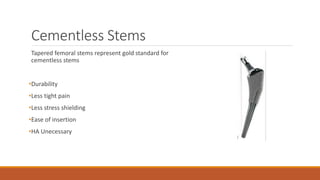
Cementless Stems
Tapered femoral stems represent gold standard for
cementless stems
•Durability
•Less tight pain
•Less stress shielding
•Ease of insertion
•HA Unecessary
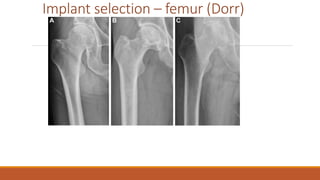
Implant selection – femur (Dorr)
Cemented or uncemented
Cemented versus uncemented fixation through
systematic review and meta-analysis concluded that
cemented THR is similar if not superior to
uncemented THR
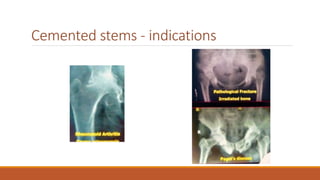
Cemented stems - indications
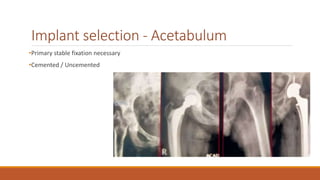
Implant selection - Acetabulum
•Primary stable fixation necessary
•Cemented / Uncemented
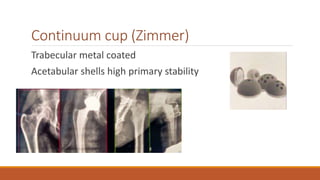
Continuum cup (Zimmer)
Trabecular metal coated
Acetabular shells high primary stability
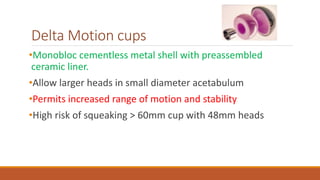
Delta Motion cups
•Monobloc cementless metal shell with preassembled
ceramic liner.
•Allow larger heads in small diameter acetabulum
•Permits increased range of motion and stability
•High risk of squeaking > 60mm cup with 48mm heads
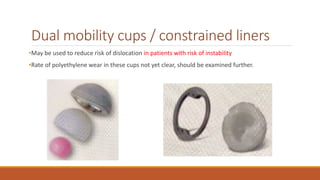
Dual mobility cups / constrained liners
•May be used to reduce risk of dislocation in patients with risk of instability
•Rate of polyethylene wear in these cups not yet clear, should be examined further.
tribology ppt.pptx

tribology ppt.pptx

  • 1.
    TRIBOLOGY OF THR DR.MOHIT PABARI (R3) DEPARTMENT OF ORTHOPEDICS, SKH HOSPITAL.
  • 2.
    TRIBOLOGY-the study offriction, wear, lubrication, and the design of bearings; the science of interacting surfaces in relative motion.
  • 3.
    Tribology ◦ Wear –types and mode ◦ Lubrication ◦ Friction Types of bearing ◦ Polyethlyene ◦ Metal ◦ Ceramic Concerns with different bearing Introduction
  • 4.
    Ideal Bearing An ArticulatingSurface That Has ◦ Virtually no wear ◦ Accommodates large head ◦ Debris evokes no host immune response ◦ Exhibits low friction ◦ Generate no noise ◦ Chemically stable in vivo ◦ Tough (resists fracture) ◦ Less susceptible to scratching and 3rd body wear
  • 5.
    History Carnochan – firstsurgeon who thought hip can be replaced – used wooden blocks (18th century) Mould arthroplasty – Smith Peterson (1925) ◦ Used glass ◦ Restore congruous articular surfaces ◦ Glass put on Bleeding cancellous bone ◦ Metaplasia of fibrin clot to fibrocartilage ◦ Very poor longevity
  • 6.
    MOM THR Philip Wilisperformed first MOM THR (1938) Mckee, Wateson and Farrar (1951) used Thompson type of femoral component and metallic acetabular cup of cobalt chrome alloy Muller (1951) introduced 1st generation MOM hip arthroplasty ◦ Quality of metal was poor, hence ◦ Friction metal wear ◦ High incidence of loosening and pain
  • 7.
    John Charley Revolutionized HipReplacement in 1962 Some of his concepts are in practice even today. He introduced concepts of- ◦ Low friction Torque Arthroplasty ◦ Surgical Alteration of Hip Biomechanics ◦ Lubrication ◦ Material Design ◦ Operating Room Environment ◦ PMMA
  • 8.
    Low Frictional Arthroplasty •Stainlesssteel head on Polythene Cup •Lateralization of Trochanter •Medialization of Acetabulum •22.2 mm Femoral Head-much smaller then which we usually remove-hence biggest problem was higher incidence of hip dislocation
  • 10.
    Tribology Science of interactivesurfaces in relative motion Study of ◦Friction ◦Lubrication ◦Wear ◦Design of bearing material we use in hip replacement
  • 11.
    What is Wear? Itis the removal of material from opposing and moving surfaces under an applied load Biggest reason for failure of hip replacement is wear and aseptic loosening
  • 12.
    Step 1 :Wear and Osteolysis Motion between articulating surfaces Unintended impingement or motion Leads to formation of Wear Particles
  • 13.
    Step 2 :Macrophage Activated Osteoclastogenesis and Osteolysis Wear partials ->Macrophage activation and recruitment Osteolysis by osteolytic factors (cytokines) ◦ TNF – alpha , TGF – beta ◦ Oxide radicals, hydrogen peroxide ◦ Acid phosphatase, Prostaglandins ◦ Interlukins (IL – 1, IL – 6) Increase RANK and RANKL activation ◦ RANKL mediated bone resorption
  • 14.
    Step 3 :Prosthesis Micromotion Osteolysis surrounding the prosthesis leading to micromotion ◦Increases particle wear and further prosthesis loosening
  • 15.
    In Vivo wearrates CUP HEAD LINEAR WEAR mm/year Polyethylene Stainless steel 0.1-0.3 Polyethylene CoCrMo – metal 0.1-0.3 Polyethylene Al2O3 - Ceramic 0.05-0.15 Al2O3 - Ceramic Al2O3 - Ceramic 0.003-0.01
  • 16.
    Types of wear* 1. Adhesive wear 2. Abrasive wear ( erosive, fretting) 3. Surface fatigue 4. Corrosion and oxidation wear
  • 17.
    Adhesive wear •When bondingof microcontacts exceeds inherent strength of either material •Weaker material is then torn off and adhere to the stronger material
  • 18.
    Abrasive wear The twosurface materials have different hardness and the harder material cuts into the softer material Types ◦ Two body ◦ Three body
  • 19.
    Surface fatigue Fatigue wearoccurs as a result of repetitive stressing of a bearing material
  • 20.
    Modes of wear Mode1 ◦ Results from motion that occurs between two primary bearing surface ◦ Eg Wear from femoral prosthetic head against acetabular liner
  • 21.
    Modes of wear Mode2 ◦ Occurs when a primary bearing surface articulates with a non bearing surface but is not intended ◦ Eg – prosthetic femoral head penetrating through polyethylene and articulating with the metallic articulating shell
  • 22.
    Modes of wear Mode3 ( Third – body wear ) ◦ Occurs from entrapped abrasive particles between primary bearing surfaces ◦ Cement, bone, polyethylene or metallic particulates
  • 23.
    Modes of wear Mode4 ◦ Occurs from motion at two secondary or non bearing surface ◦ Eg – ◦ Impingement of prosthetic femoral neck onto the rim of acetabular component ◦ Fretting at a Morse taper between the prosthetic femoral neck and head ◦ Backside Wear between acetabular shell and backside of polyethylene line insert
  • 24.
    Lubrication •The thickness ofthe lubrication film as well as the surface roughness determine type of lubrication •Improves longevity of implant
  • 25.
  • 29.
  • 30.
    Hard on SoftBearing Metal on Polyethylene Ceramic on Polyethylene
  • 31.
    Polyethylene Discovered in 1935 Viscoelasticand thermoplastic polymer Long chains of the monomer ethylene ◦ Low density PE – Density 0.910 to 0.940 gmc3 (high volumetric wear) ◦ High density PE – Density > 0.941 g/cm ◦ UHMWPE – molecular weight > 3 million g/mol Mainstay of joint replacement over last 40 years
  • 32.
    Polyethylene Sterilization •Historically sterilizedby 2.5 mrad of either beam or gamma radiation •These processes produce free radicals in material, predisposing the polyethylene to oxidation and rendering it more susceptible to wear.
  • 33.
    HXLPE Preparation ◦ Gamma orelectron beam radiation – 10mrad ◦ Subsequent annealing at 150 degrees. Resulting polymer highly resistant to wear and oxidative degradation Muratoglu et al. ◦ Wear rate not related to the size of femoral head within 22 to 46mm in diameter->so we started using higher diameter head to reduce risk of dislocation
  • 34.
    HXLPE Risk ◦ Fatigue cracking,delamination ◦ Lower fracture toughness and tensile strength ◦ Increase bioactivity of wear particles ◦ Implant fracture when a thin liner is used to accommodate a large diameter head Modification of HXLPE ◦ Anti-oxidant diffusion, Mechanical deformation ◦ Low dose irradiation with interspersed annealing ◦ Vitamin E
  • 35.
    Metal – On- Polyethylene Benefits ◦ Longest track record of bearing surfaces ◦ Lowest cost Disadvantages ◦ Higher wear and osteolysis rates compared to MOM and ceramics ◦ Smaller head compared to MOM leads to higher risk of impingement
  • 36.
    MOP vs COP ELDERLYPATIENTS – NO DIFFERENCE YOUNG ACTIVE PATIENTS – COP BETTER
  • 37.
    Does Vitamin EPE reduce wear •Short term results are favourable •Long term ?
  • 38.
    Hard on HardBearings Metal on Metal Ceramic on Ceramic Ceramic on Metal
  • 39.
  • 40.
    Tribology MOM •Produces lowerand smaller wear particles as compared to MOP bearings (ranging from 2.5 – 5.0 micro / year) •Has an initial run – in phase of increased wear followed by steady state wear phase
  • 41.
    Benefits of metalon metal Favors larger diameters ( hence lower wear ) Better wear properties than Metal-on-polyethylene ◦ Lower linear wear rate ◦ Decreased volume of particles Long in vivo experience
  • 42.
    MOM bearing concerns Increasemetal ion level ALVAL or pseudotumor ?Carcinogens Contradictions ◦ Pregnant women ◦ Renal disease ◦ Metal hypersensitivity due to metal ions ◦ Increased rate of revision for MOM
  • 43.
    Metal on MetalBearings The lack of clinical advantage with metal bearings and the significant downsides to use of MOM mean that this option should be used in great caution, if at all ◦ The Journal Of Artroplasty Vol 25 No 1 2010 Editorial
  • 44.
    Ceramics in THR 1stgeneration (1970) ◦ Alumina pierre boutin ◦ Low density and very coarse microstructure 2nd generation (1980) ◦ Reduced microstructure and grain size 3rd generation (1990) ◦ Improved mechanical strength ◦ Reduced grain size ◦ Prepared by isostatic pressuring 4th generation (2000) ◦ New alumina – Zirconia – Strontium oxide matrix composition
  • 45.
    Tribology of CoC Smallergrains ◦ Low surface roughness ◦ Reduced friction High hardness ◦ Low wear rate ◦ Resistance to scratch High Wettability ◦ Fluid film lubricartion Inert
  • 46.
    Ceramic on Ceramic Benefits ◦Best wear properties ◦ Lowest coefficient of friction ◦ Inert particles Disadvantages ◦ Expensive ◦ Less modularity available ◦ Low fracture toughness ◦ Unique complications
  • 47.
    Unique complications Liner fracture ◦Old generation CoC fracture rate high – 20% ◦ Titanium shell is thinner than ceramic and has only 30% stiffness of ceramic ◦ On impaction of liner, shell expands ◦ Failure to seat the liner increases chance of chipping ◦ Risk of fracture with newer CoC is approximately 0.02% to 0.1% ◦ - Hamilton WG, McAukey JP 2010
  • 48.
    Any unique complication? Stripewear ◦ Caused by contact between femoral head and rim of the cup during partial subluxation Recurrent dislocations of incidental contact of femoral head with metallic shell can cause ‘ led pencil like markings ‘ that lead to increased femoral head roughness and polyethylene wear rates
  • 49.
    Unique Complication -Squeaking Cause ? ◦ Localised ‘striped wear’ ◦ Changes of fluid film lubrication conditions ◦ Femoral head micro – separation ◦ Neck rim impingement ◦ Clinically Often Minor And Revision Indicated Only Occasionally
  • 50.
    Unique Complications –Difficulty During Revision •Total synovectomy needed •Liner exchange may not be sufficient as removal may damage the shell or taper
  • 51.
    Unique Complications –Less chance to customize •CoC systems have only one head size per cup diameter •No lateralized liners, elevate rims etc •Equalizing leg length and maximizing stability is more challenging Loss of all these options may currently be the most substantial disadvantage of CoC THA
  • 52.
    Oxinium (oxidised zirconium) •Itis expected to provide wear resistance of ceramic without its fracture risk •Oxidized layer harder and more scratch resistant than untreated alloy •However, long term clinical results are yet to prove its advantages
  • 53.
  • 54.
    Large diameter head Advantage ◦Better range of motion ◦ Decrease dislocation ◦ Less impingement Disadvantage ◦ More volumetric wear ◦ Psoas impingement ◦ Wear debris generation at trunnion – bone interface ◦ Increase frictional torque and stress over component – bone interface
  • 55.
    Conclusion on HeadSize Hard on Soft bearing ◦ Limit be 32/36mm as wear increases with head diameter Hard on Hard bearings ◦ Head diameter should be limited to < 40mm ◦ Wear not influenced by head diameter ◦ But larger heads found – greater noise
  • 56.
    PE tear WithLDH UHMWPE ◦ Wear / Fatigue / Osteolysis ◦ PE Liner < 6mm -- more cup failure ◦ Minimum thickness of poly – 9mm XLPE ◦ Increased head size doesn’t significantly increase wear of HPE
  • 57.
  • 58.
    Primary THR Cemented Stem ◦Collar ◦ Surface finish ◦ Polished ◦ Matte ◦ Grit blasted
  • 59.
    Cemented Stem –Advantages •Better fixation ( especially useful in poor bone ) •Proximal seal from debris better •Less risk of intraoperative fracture •Revision easier than fully coated non cemented •Less expensive •Can alter femoral version •Less stress shielding •Less thigh pain •Local antibiotic delivery
  • 60.
    Cemented stems -Disadvantages •Increased operative time •Technique development •Greater embolization of fat and marrow elements
  • 61.
    Primary THA –Femoral Fixation Uncemented stem ◦Proximal coated ◦Extensively coated Hydroxyapatite
  • 62.
  • 63.
    Cementless stem -Advantages •Technically easier (v/s cemented) in most cases •Excellent fixation durability •Avoids cement mess and ‘THE WAIT’ for cement heading •More amenable to small incisions •More familiar to most as experience with cement decreases.
  • 64.
    Cementless stems -Disadvantages •Stiffness •Stress Shielding •Greatest if already osteoporotic •Marked bone loss possible if removal required •Thigh plane ( likely mechanical mismatch ) •Intraoperative fracture – Risk management vs cemented •Fibrous fixation – Possible->Pain and early failure
  • 65.
    Cementless Stems Tapered femoralstems represent gold standard for cementless stems •Durability •Less tight pain •Less stress shielding •Ease of insertion •HA Unecessary
  • 66.
  • 67.
    Cemented or uncemented Cementedversus uncemented fixation through systematic review and meta-analysis concluded that cemented THR is similar if not superior to uncemented THR
  • 68.
    Cemented stems -indications
  • 69.
    Implant selection -Acetabulum •Primary stable fixation necessary •Cemented / Uncemented
  • 70.
    Continuum cup (Zimmer) Trabecularmetal coated Acetabular shells high primary stability
  • 71.
    Delta Motion cups •Monobloccementless metal shell with preassembled ceramic liner. •Allow larger heads in small diameter acetabulum •Permits increased range of motion and stability •High risk of squeaking > 60mm cup with 48mm heads
  • 72.
    Dual mobility cups/ constrained liners •May be used to reduce risk of dislocation in patients with risk of instability •Rate of polyethylene wear in these cups not yet clear, should be examined further.