Natural disasters
Riddhi Patel
Natural disasters are extreme, sudden events caused by environmental factors
that injure people and damage property
o Geological disasters
• Avalanches and landslides
• Earthquakes
• Sinkholes
o Hydrological disasters
• Floods
• Flash Floods
• Tsunami
o Meteorological disasters
• Cyclonic storms
• Blizzards
• Cold waves
• Heat waves
• Droughts
• Thunderstorms
• Tornadoes
Geological disasters
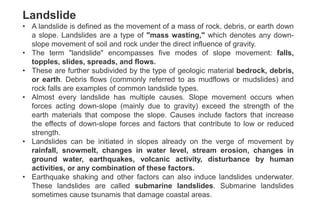
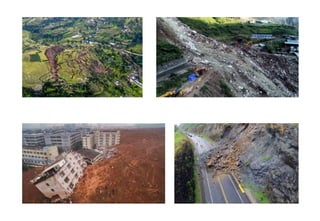
Landslide
• A landslide is defined as the movement of a mass of rock, debris, or earth down
a slope. Landslides are a type of "mass wasting," which denotes any down-
slope movement of soil and rock under the direct influence of gravity.
• The term "landslide" encompasses five modes of slope movement: falls,
topples, slides, spreads, and flows.
• These are further subdivided by the type of geologic material bedrock, debris,
or earth. Debris flows (commonly referred to as mudflows or mudslides) and
rock falls are examples of common landslide types.
• Almost every landslide has multiple causes. Slope movement occurs when
forces acting down-slope (mainly due to gravity) exceed the strength of the
earth materials that compose the slope. Causes include factors that increase
the effects of down-slope forces and factors that contribute to low or reduced
strength.
• Landslides can be initiated in slopes already on the verge of movement by
rainfall, snowmelt, changes in water level, stream erosion, changes in
ground water, earthquakes, volcanic activity, disturbance by human
activities, or any combination of these factors.
• Earthquake shaking and other factors can also induce landslides underwater.
These landslides are called submarine landslides. Submarine landslides
sometimes cause tsunamis that damage coastal areas.
o The major areas affected by landslides in India are divided mainly in
following regions as landslide-prone areas in India. These are based on
landslide hazard zonation:
• The Western Himalayas (in states
of Uttar Pradesh, Uttaranchal,
Himachal Pradesh and Jammu &
Kashmir)
• The Eastern & North-eastern
Himalayas (in states of West
Bengal, Sikkim and Arunachal
Pradesh)
• The Naga-Arakkan Mountain belt
(in states of Nagaland, Manipur,
Mizoram and Tripura)
• The Western Ghats region including
Nilgiris (in states of Maharashtra,
Goa, Karnataka, Kerala & Tamil
Nadu)
• The Plateau margins of the
Peninsular India and Meghalaya
plateau in North-east India.
Earthquakes
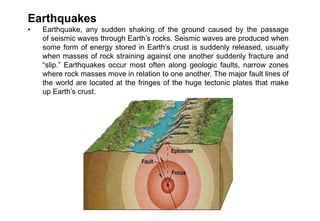
• Earthquake, any sudden shaking of the ground caused by the passage
of seismic waves through Earth’s rocks. Seismic waves are produced when
some form of energy stored in Earth’s crust is suddenly released, usually
when masses of rock straining against one another suddenly fracture and
“slip.” Earthquakes occur most often along geologic faults, narrow zones
where rock masses move in relation to one another. The major fault lines of
the world are located at the fringes of the huge tectonic plates that make
up Earth’s crust.
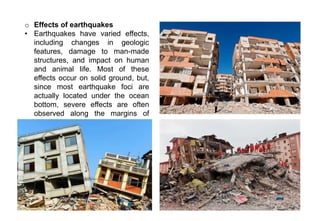
o Effects of earthquakes
• Earthquakes have varied effects,
including changes in geologic
features, damage to man-made
structures, and impact on human
and animal life. Most of these
effects occur on solid ground, but,
since most earthquake foci are
actually located under the ocean
bottom, severe effects are often
observed along the margins of
oceans.
Sinkholes
• Sinkholes are cavities in the ground that form when water erodes an underlying
rock layer.
• Two types of sinkholes exist. One forms when the roof of a cave collapses and
exposes the underground cavern. The second type forms when water dissolves
the rock underneath soil and creates an underground chasm. Without rock to
support it, the soil layer collapses and creates a hole on the surface.
• Sinkholes have both natural and human causes.Manmade sinkholes are
created when city development compromises the structural integrity of
underlying rock. Roads, buildings, and other types of construction may cause
water to collect in certain areas and wash away the supporting rock layer
(especially at low sea levels and after a heavy rainfall).
Hydrological disasters
Floods
• A flood is loosely defined as river discharge exceeding bankfull limitations. It is
also considered a temporary rise of the water level, as in a river or lake or along
a seacoast or wetland, resulting in its spilling over and out of its natural or
artificial confines onto land that is normally dry.
• Effects of Floods:
• Agricultural lands are destroyed due to crops being submerged in water. This
causes a lot of economic loss to farmers.
• They wreck houses, particularly kuccha houses in the villages.
• They cause disruption of all transport and communication.
• There is shortage of drinking water.
• They harm human, animal and plant life.
• They cause a rise in epidemics because of waterlogging. Malaria and diarrhoea
are common diseases during floods.
• They cause decay of organic matter, leading to growth of infection-spreading
germs.
• They affect the ecosystem in a negative way.
• They cause a lot of harm to the economy of the region.
Flash flood
• A flash flood is a rapid
flooding of low-lying areas:
washes, rivers, dry lakes
and depressions. It may
be caused by heavy rain
associated with a severe
thunderstorm, hurricane,
tropical storm, or
meltwater from ice or
snow flowing over ice
sheets or snowfields.
Flash floods may occur
after the collapse of a
natural ice or debris dam,
or a human structure such
as a man-made dam.
Tsunami
• A tsunami is a series of ocean waves that sends surges of water, sometimes
reaching heights of over 100 feet (30.5 meters), onto land. These walls of
water can cause widespread destruction when they crash ashore.
• These awe-inspiring waves are typically caused by large, undersea
earthquakes at tectonic plate boundaries. When the ocean floor at a plate
boundary rises or falls suddenly, it displaces the water above it and launches
the rolling waves that will become a tsunami.
Meteorological disasters
Cyclonic storms
• cyclone is a large scale air mass that rotates around a strong center of low
atmospheric pressure.Cyclones are characterized by inward spiraling winds that
rotate about a zone of low pressure.
Blizzard
A blizzard is a severe snowstorm characterized by strong sustained winds of at
least 56 km/h (35 mph) and lasting for a prolonged period of time-typically three
hours or more. A ground blizzard is a weather condition where snow is not falling
but loose snow on the ground is lifted and blown by strong winds.
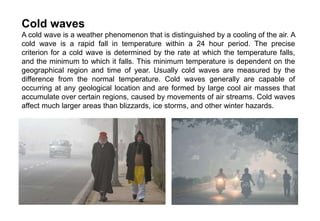
Cold waves
A cold wave is a weather phenomenon that is distinguished by a cooling of the air. A
cold wave is a rapid fall in temperature within a 24 hour period. The precise
criterion for a cold wave is determined by the rate at which the temperature falls,
and the minimum to which it falls. This minimum temperature is dependent on the
geographical region and time of year. Usually cold waves are measured by the
difference from the normal temperature. Cold waves generally are capable of
occurring at any geological location and are formed by large cool air masses that
accumulate over certain regions, caused by movements of air streams. Cold waves
affect much larger areas than blizzards, ice storms, and other winter hazards.
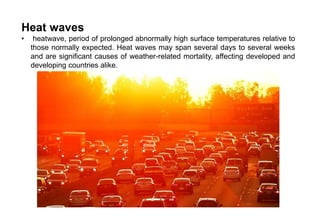
Heat waves
• heatwave, period of prolonged abnormally high surface temperatures relative to
those normally expected. Heat waves may span several days to several weeks
and are significant causes of weather-related mortality, affecting developed and
developing countries alike.
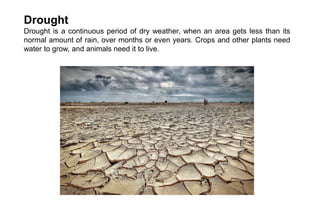
Drought
Drought is a continuous period of dry weather, when an area gets less than its
normal amount of rain, over months or even years. Crops and other plants need
water to grow, and animals need it to live.
Thunderstorms
• Thunderstorms are small, intense weather systems that make strong winds,
heavy rain, lightning, and thunder. Thunderstorms can happen anywhere with
two conditions: the air near the Earth's surface must be warm and moist, and the
atmosphere must be unstable.
Tornadoes
• A tornado is "a violently rotating column of air, in contact with the ground, either
pendant from a cumuliform cloud or underneath a cumuliform cloud, and often
(but not always) visible as a funnel cloud". For a vortex to be classified as a
tornado, it must be in contact with both the ground and the cloud base.
1998 Malpa Landslide
Heavy rainfall caused, Malpa landslide was one of worst landslides in India, at village Malpa in Pithoragarh of
Uttarkhand. Around 380 people were killed when massive landslides washed the entire village along with
Hindu pilgrims of Kailash Mansarovar yatra.
1999 Odisha Cyclone
The 1999 Odisha cyclone also known as super cyclone 05B was the most deadliest tropical cyclone in the
Indian Ocean and most destructive Indian storm since 1971. It caused almost deaths of 15,000 people and
made heavy to extreme damage.
2001 Gujarat Earthquake
The massive earthquake occurred on India’s 51st Republic Day on January 26, 2001 at Bhachau Taluka of
Kutch District of Gujarat. Gujarat earthquake had a magnitude of between 7.6 and 7.7 and killed around
20,000 people.
2002 Indian Heat Wave
India’s heat wave in 2002 at south region killed more than 1000 people, Most of the deaths occurred in state
of Andhra Pradesh. The heat was so intense that birds fell from the sky, ponds and rivers dried up.
2004 Indian Ocean Tsunami
The Indian Ocean earthquake and Tsunami occurred in 2004 at the west coast of Sumatra, killing over
230,000 people in fourteen countries. Indian Ocean Tsunami was one of the deadliest natural disasters in
history of India.
Major natural disasters of India
2007 Bihar Flood
The 2007- 2008 Bihar flood are listed as the worst hit flood in the living memory of Bihar in last 30 years.
Bihar is India’s most flood-prone State, a recurring disaster appears annual basis and destroys thousands of
human lives apart from livestock and assets worth millions.
2005 Mumbai Catastrophes
The 2005 Maharashtra floods was occurred just one month after the June 2005 Gujarat floods, Mumbai the
capital city was most badly affected and witnessed one of its worst catastrophes in the history of India, killing
at least 5,000 people.
2010 Eastern Indian Storm
The Eastern Indian storm was a severe storm struck parts of eastern Indian states,spanning for 30–40
minutes. At least 91 people died in Indian states and Over 91,000 dwellings were destroyed and partially
damaged.
2013 Maharashtra Drought
Drought-in-Maharashtra
Maharashtra state was affected by the region’s worst drought in 40 years,worst-hit areas are Jalna, Jalgaon
and Dhule are also affected by the famine. Millions of people in Maharashtra are at serious risk of hunger
after two years of low rainfall in the region.
2013 Uttarakhand Flash Floods
kedarnath-Disastrous Floods
On June 2013 Uttarakhand received heavy rainfall,massive Landslides due to the large flashfloods, it
suffered maximum damage of houses and structures, killing more than 1000 people, sources claimed the
death toll could be rise up to 5000. Uttarakhand Flash Floods is the most disastrous floods in the history of
India.
• https://www.usgs.gov/faqs/what-a-landslide-and-what-causes-one?qt-
news_science_products=0#qt-news_science_products
• https://exampariksha.com/landslides-in-india-himalayas-geography-study-material-notes/
• https://www.britannica.com/science/earthquake-geology
• http://www.shareyouressays.com/knowledge/9-harmful-effects-of-floods/110978
• https://www.nationalgeographic.com/environment/natural-disasters/tsunamis/
• https://www.britannica.com/science/heat-wave-meteorology
• https://www.britannica.com/science/thunderstorm
• http://www.walkthroughindia.com/lifestyle/top-14-worst-and-major-natural-disasters-of-
india/
Bibliography

Disasters

  • 1.
  • 2.
    Natural disasters areextreme, sudden events caused by environmental factors that injure people and damage property o Geological disasters • Avalanches and landslides • Earthquakes • Sinkholes o Hydrological disasters • Floods • Flash Floods • Tsunami o Meteorological disasters • Cyclonic storms • Blizzards • Cold waves • Heat waves • Droughts • Thunderstorms • Tornadoes
  • 3.
  • 4.
    Landslide • A landslideis defined as the movement of a mass of rock, debris, or earth down a slope. Landslides are a type of "mass wasting," which denotes any down- slope movement of soil and rock under the direct influence of gravity. • The term "landslide" encompasses five modes of slope movement: falls, topples, slides, spreads, and flows. • These are further subdivided by the type of geologic material bedrock, debris, or earth. Debris flows (commonly referred to as mudflows or mudslides) and rock falls are examples of common landslide types. • Almost every landslide has multiple causes. Slope movement occurs when forces acting down-slope (mainly due to gravity) exceed the strength of the earth materials that compose the slope. Causes include factors that increase the effects of down-slope forces and factors that contribute to low or reduced strength. • Landslides can be initiated in slopes already on the verge of movement by rainfall, snowmelt, changes in water level, stream erosion, changes in ground water, earthquakes, volcanic activity, disturbance by human activities, or any combination of these factors. • Earthquake shaking and other factors can also induce landslides underwater. These landslides are called submarine landslides. Submarine landslides sometimes cause tsunamis that damage coastal areas.
  • 6.
    o The majorareas affected by landslides in India are divided mainly in following regions as landslide-prone areas in India. These are based on landslide hazard zonation: • The Western Himalayas (in states of Uttar Pradesh, Uttaranchal, Himachal Pradesh and Jammu & Kashmir) • The Eastern & North-eastern Himalayas (in states of West Bengal, Sikkim and Arunachal Pradesh) • The Naga-Arakkan Mountain belt (in states of Nagaland, Manipur, Mizoram and Tripura) • The Western Ghats region including Nilgiris (in states of Maharashtra, Goa, Karnataka, Kerala & Tamil Nadu) • The Plateau margins of the Peninsular India and Meghalaya plateau in North-east India.
  • 7.
    Earthquakes • Earthquake, anysudden shaking of the ground caused by the passage of seismic waves through Earth’s rocks. Seismic waves are produced when some form of energy stored in Earth’s crust is suddenly released, usually when masses of rock straining against one another suddenly fracture and “slip.” Earthquakes occur most often along geologic faults, narrow zones where rock masses move in relation to one another. The major fault lines of the world are located at the fringes of the huge tectonic plates that make up Earth’s crust.
  • 8.
    o Effects ofearthquakes • Earthquakes have varied effects, including changes in geologic features, damage to man-made structures, and impact on human and animal life. Most of these effects occur on solid ground, but, since most earthquake foci are actually located under the ocean bottom, severe effects are often observed along the margins of oceans.
  • 10.
    Sinkholes • Sinkholes arecavities in the ground that form when water erodes an underlying rock layer. • Two types of sinkholes exist. One forms when the roof of a cave collapses and exposes the underground cavern. The second type forms when water dissolves the rock underneath soil and creates an underground chasm. Without rock to support it, the soil layer collapses and creates a hole on the surface. • Sinkholes have both natural and human causes.Manmade sinkholes are created when city development compromises the structural integrity of underlying rock. Roads, buildings, and other types of construction may cause water to collect in certain areas and wash away the supporting rock layer (especially at low sea levels and after a heavy rainfall).
  • 11.
  • 12.
    Floods • A floodis loosely defined as river discharge exceeding bankfull limitations. It is also considered a temporary rise of the water level, as in a river or lake or along a seacoast or wetland, resulting in its spilling over and out of its natural or artificial confines onto land that is normally dry. • Effects of Floods: • Agricultural lands are destroyed due to crops being submerged in water. This causes a lot of economic loss to farmers. • They wreck houses, particularly kuccha houses in the villages. • They cause disruption of all transport and communication. • There is shortage of drinking water. • They harm human, animal and plant life. • They cause a rise in epidemics because of waterlogging. Malaria and diarrhoea are common diseases during floods. • They cause decay of organic matter, leading to growth of infection-spreading germs. • They affect the ecosystem in a negative way. • They cause a lot of harm to the economy of the region.
  • 14.
    Flash flood • Aflash flood is a rapid flooding of low-lying areas: washes, rivers, dry lakes and depressions. It may be caused by heavy rain associated with a severe thunderstorm, hurricane, tropical storm, or meltwater from ice or snow flowing over ice sheets or snowfields. Flash floods may occur after the collapse of a natural ice or debris dam, or a human structure such as a man-made dam.
  • 15.
    Tsunami • A tsunamiis a series of ocean waves that sends surges of water, sometimes reaching heights of over 100 feet (30.5 meters), onto land. These walls of water can cause widespread destruction when they crash ashore. • These awe-inspiring waves are typically caused by large, undersea earthquakes at tectonic plate boundaries. When the ocean floor at a plate boundary rises or falls suddenly, it displaces the water above it and launches the rolling waves that will become a tsunami.
  • 17.
  • 18.
    Cyclonic storms • cycloneis a large scale air mass that rotates around a strong center of low atmospheric pressure.Cyclones are characterized by inward spiraling winds that rotate about a zone of low pressure.
  • 19.
    Blizzard A blizzard isa severe snowstorm characterized by strong sustained winds of at least 56 km/h (35 mph) and lasting for a prolonged period of time-typically three hours or more. A ground blizzard is a weather condition where snow is not falling but loose snow on the ground is lifted and blown by strong winds.
  • 20.
    Cold waves A coldwave is a weather phenomenon that is distinguished by a cooling of the air. A cold wave is a rapid fall in temperature within a 24 hour period. The precise criterion for a cold wave is determined by the rate at which the temperature falls, and the minimum to which it falls. This minimum temperature is dependent on the geographical region and time of year. Usually cold waves are measured by the difference from the normal temperature. Cold waves generally are capable of occurring at any geological location and are formed by large cool air masses that accumulate over certain regions, caused by movements of air streams. Cold waves affect much larger areas than blizzards, ice storms, and other winter hazards.
  • 21.
    Heat waves • heatwave,period of prolonged abnormally high surface temperatures relative to those normally expected. Heat waves may span several days to several weeks and are significant causes of weather-related mortality, affecting developed and developing countries alike.
  • 22.
    Drought Drought is acontinuous period of dry weather, when an area gets less than its normal amount of rain, over months or even years. Crops and other plants need water to grow, and animals need it to live.
  • 23.
    Thunderstorms • Thunderstorms aresmall, intense weather systems that make strong winds, heavy rain, lightning, and thunder. Thunderstorms can happen anywhere with two conditions: the air near the Earth's surface must be warm and moist, and the atmosphere must be unstable.
  • 24.
    Tornadoes • A tornadois "a violently rotating column of air, in contact with the ground, either pendant from a cumuliform cloud or underneath a cumuliform cloud, and often (but not always) visible as a funnel cloud". For a vortex to be classified as a tornado, it must be in contact with both the ground and the cloud base.
  • 25.
    1998 Malpa Landslide Heavyrainfall caused, Malpa landslide was one of worst landslides in India, at village Malpa in Pithoragarh of Uttarkhand. Around 380 people were killed when massive landslides washed the entire village along with Hindu pilgrims of Kailash Mansarovar yatra. 1999 Odisha Cyclone The 1999 Odisha cyclone also known as super cyclone 05B was the most deadliest tropical cyclone in the Indian Ocean and most destructive Indian storm since 1971. It caused almost deaths of 15,000 people and made heavy to extreme damage. 2001 Gujarat Earthquake The massive earthquake occurred on India’s 51st Republic Day on January 26, 2001 at Bhachau Taluka of Kutch District of Gujarat. Gujarat earthquake had a magnitude of between 7.6 and 7.7 and killed around 20,000 people. 2002 Indian Heat Wave India’s heat wave in 2002 at south region killed more than 1000 people, Most of the deaths occurred in state of Andhra Pradesh. The heat was so intense that birds fell from the sky, ponds and rivers dried up. 2004 Indian Ocean Tsunami The Indian Ocean earthquake and Tsunami occurred in 2004 at the west coast of Sumatra, killing over 230,000 people in fourteen countries. Indian Ocean Tsunami was one of the deadliest natural disasters in history of India. Major natural disasters of India
  • 26.
    2007 Bihar Flood The2007- 2008 Bihar flood are listed as the worst hit flood in the living memory of Bihar in last 30 years. Bihar is India’s most flood-prone State, a recurring disaster appears annual basis and destroys thousands of human lives apart from livestock and assets worth millions. 2005 Mumbai Catastrophes The 2005 Maharashtra floods was occurred just one month after the June 2005 Gujarat floods, Mumbai the capital city was most badly affected and witnessed one of its worst catastrophes in the history of India, killing at least 5,000 people. 2010 Eastern Indian Storm The Eastern Indian storm was a severe storm struck parts of eastern Indian states,spanning for 30–40 minutes. At least 91 people died in Indian states and Over 91,000 dwellings were destroyed and partially damaged. 2013 Maharashtra Drought Drought-in-Maharashtra Maharashtra state was affected by the region’s worst drought in 40 years,worst-hit areas are Jalna, Jalgaon and Dhule are also affected by the famine. Millions of people in Maharashtra are at serious risk of hunger after two years of low rainfall in the region. 2013 Uttarakhand Flash Floods kedarnath-Disastrous Floods On June 2013 Uttarakhand received heavy rainfall,massive Landslides due to the large flashfloods, it suffered maximum damage of houses and structures, killing more than 1000 people, sources claimed the death toll could be rise up to 5000. Uttarakhand Flash Floods is the most disastrous floods in the history of India.
  • 27.
    • https://www.usgs.gov/faqs/what-a-landslide-and-what-causes-one?qt- news_science_products=0#qt-news_science_products • https://exampariksha.com/landslides-in-india-himalayas-geography-study-material-notes/ •https://www.britannica.com/science/earthquake-geology • http://www.shareyouressays.com/knowledge/9-harmful-effects-of-floods/110978 • https://www.nationalgeographic.com/environment/natural-disasters/tsunamis/ • https://www.britannica.com/science/heat-wave-meteorology • https://www.britannica.com/science/thunderstorm • http://www.walkthroughindia.com/lifestyle/top-14-worst-and-major-natural-disasters-of- india/ Bibliography