Strategies in Promoting
Numeracy and Literacy
REYNEL S. REBOLLOS
Presenter
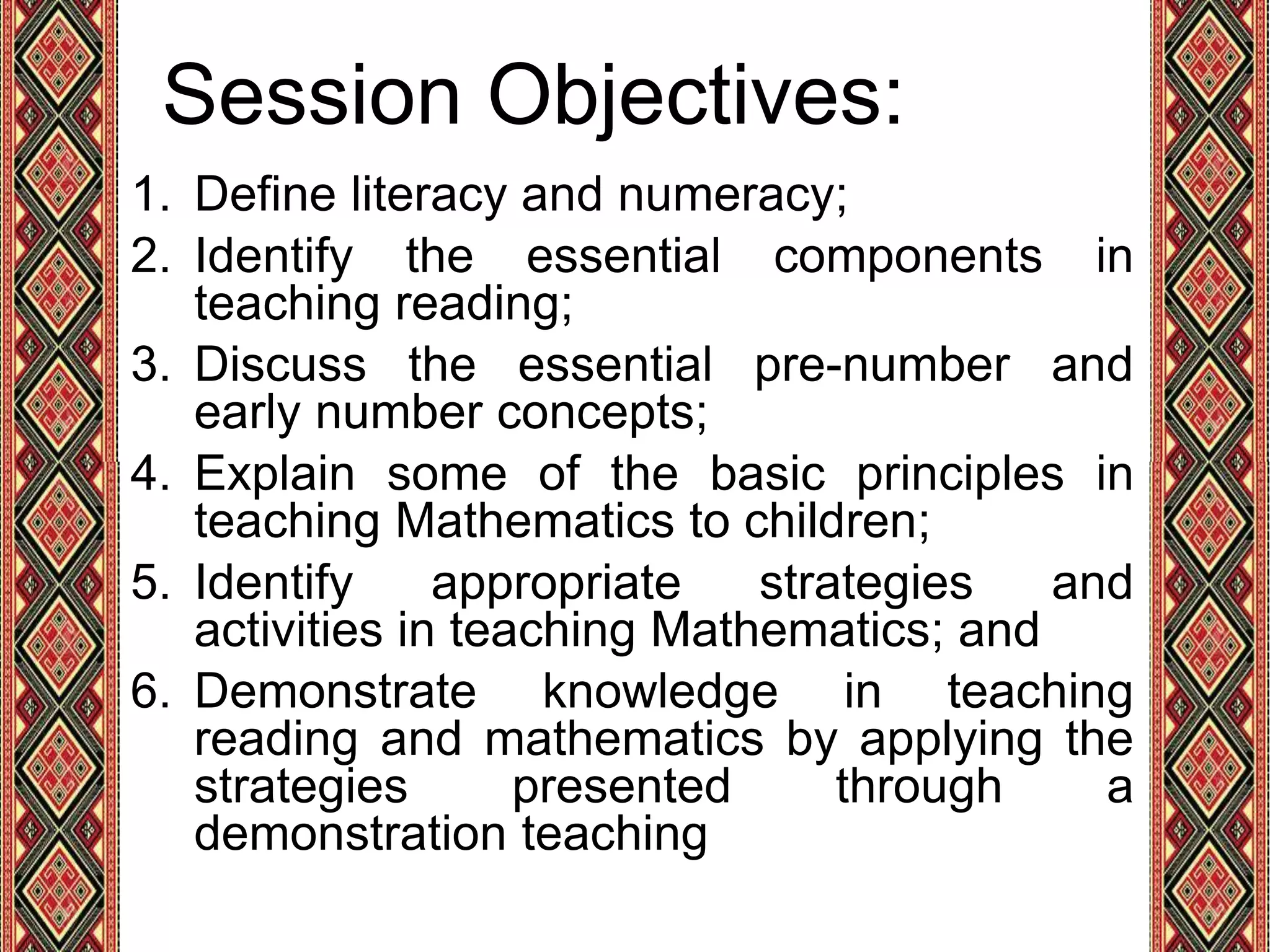
Session Objectives:
1. Define literacy and numeracy;
2. Identify the essential components in
teaching reading;
3. Discuss the essential pre-number and
early number concepts;
4. Explain some of the basic principles in
teaching Mathematics to children;
5. Identify appropriate strategies and
activities in teaching Mathematics; and
6. Demonstrate knowledge in teaching
reading and mathematics by applying the
strategies presented through a
demonstration teaching
Your thoughts
about
LITERACY?
1. How do you ensure that the children under your
care receive variety of opportunities that promote
and develop their literacy skills?
1. What do you think you can do to help improve or
enhance these opportunities?
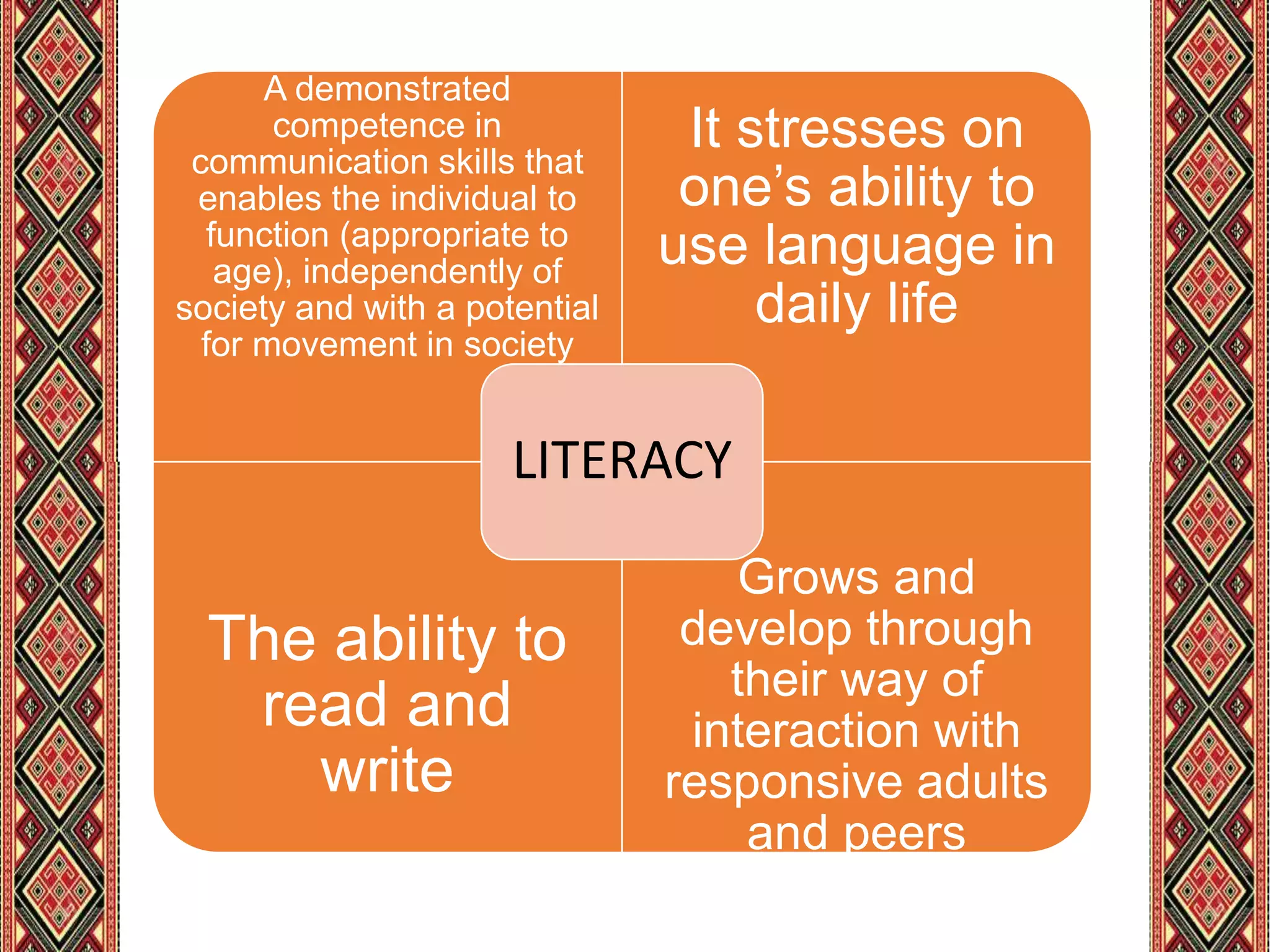
A demonstrated
competence in
communication skills that
enables the individual to
function (appropriate to
age), independently of
society and with a potential
for movement in society
It stresses on
one’s ability to
use language in
daily life
The ability to
read and
write
Grows and
develop through
their way of
interaction with
responsive adults
and peers
LITERACY
Group Activity
Common
Issues in
Teaching
Reading
Essential Components of Proven Reading Activities
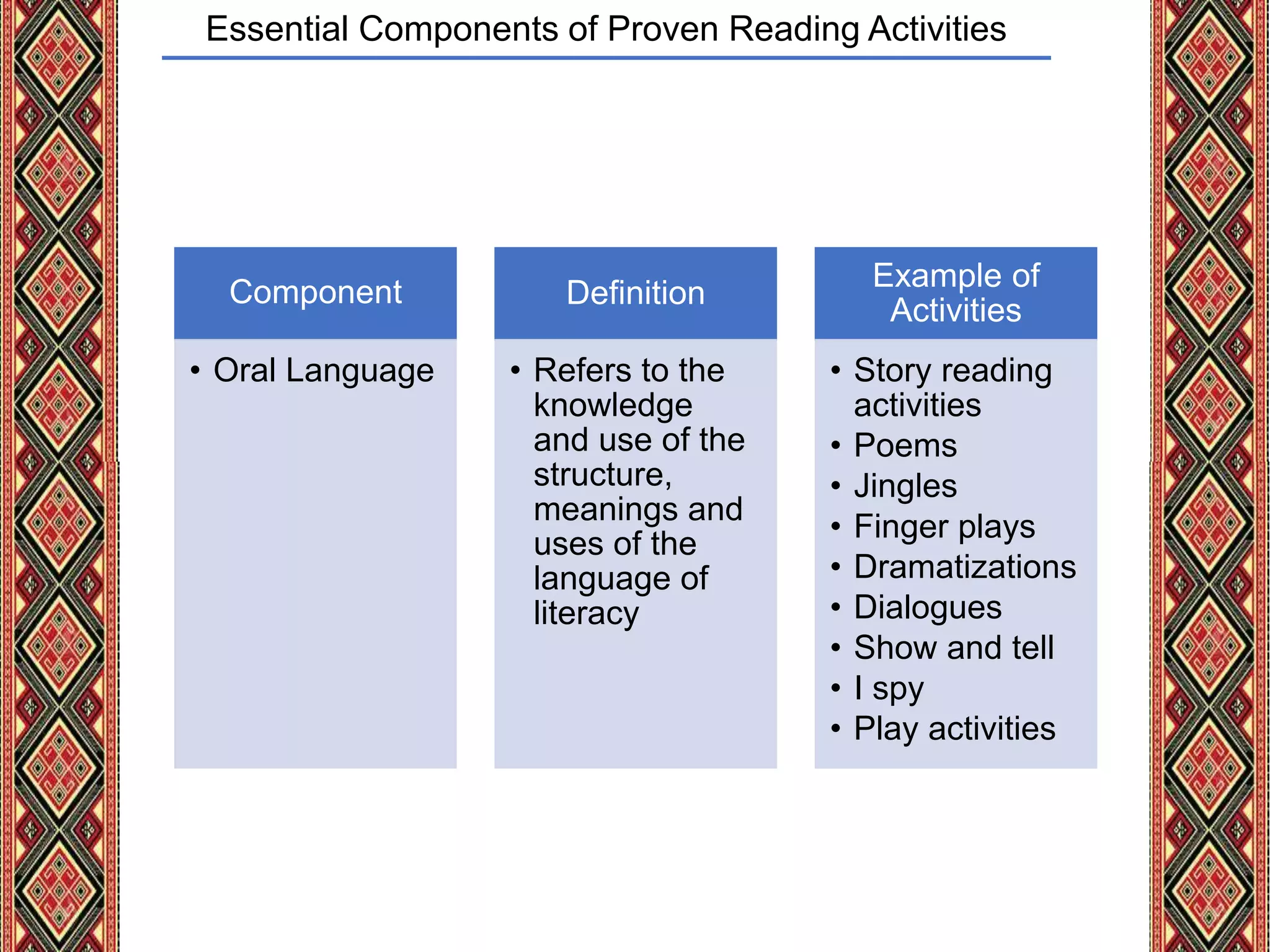
Component
• Oral Language
Definition
• Refers to the
knowledge
and use of the
structure,
meanings and
uses of the
language of
literacy
Example of
Activities
• Story reading
activities
• Poems
• Jingles
• Finger plays
• Dramatizations
• Dialogues
• Show and tell
• I spy
• Play activities
Essential Components of Proven Reading Activities
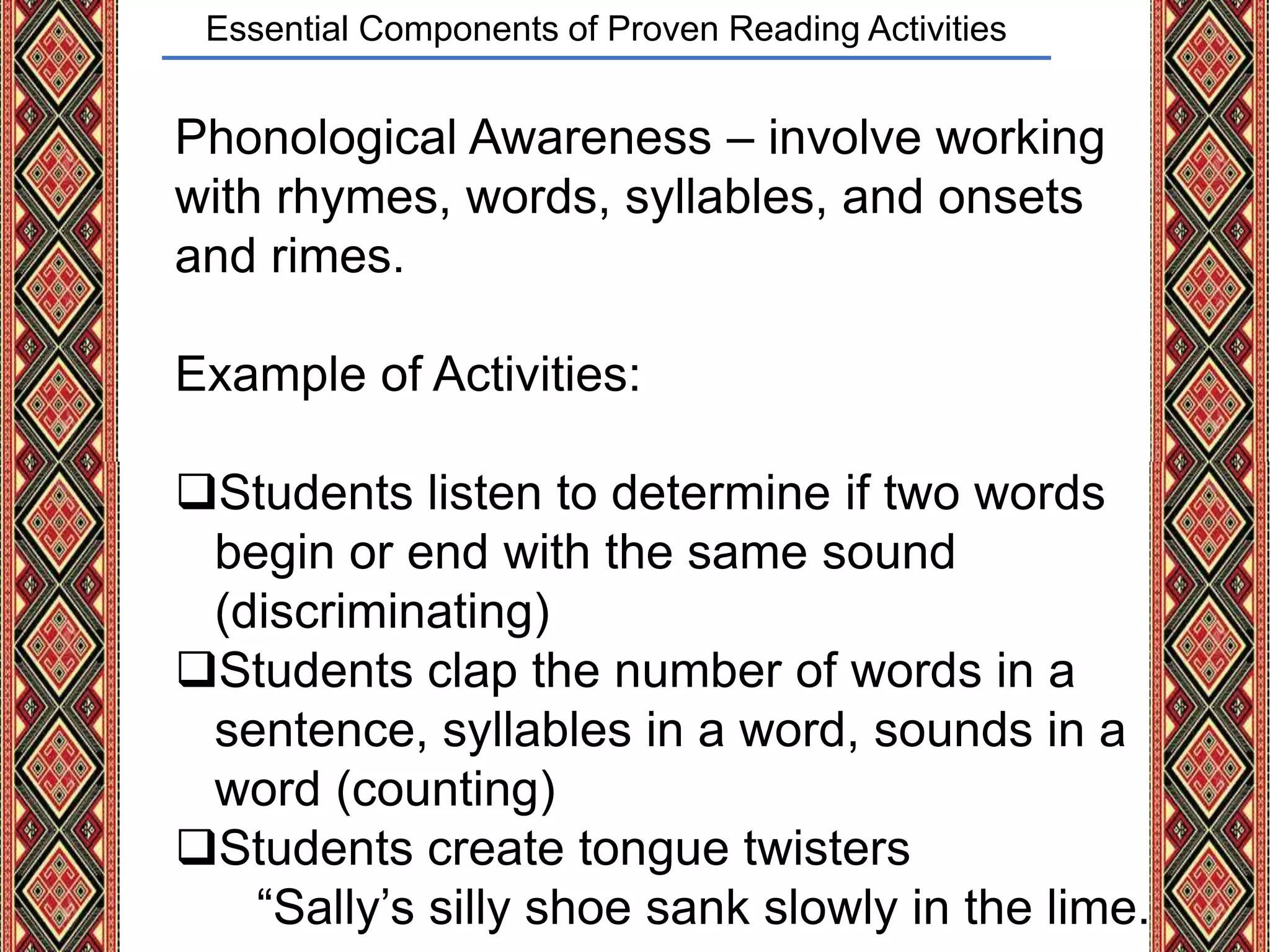
Phonological Awareness – involve working
with rhymes, words, syllables, and onsets
and rimes.
Example of Activities:
Students listen to determine if two words
begin or end with the same sound
(discriminating)
Students clap the number of words in a
sentence, syllables in a word, sounds in a
word (counting)
Students create tongue twisters
“Sally’s silly shoe sank slowly in the lime.
Essential Components of Proven Reading Activities
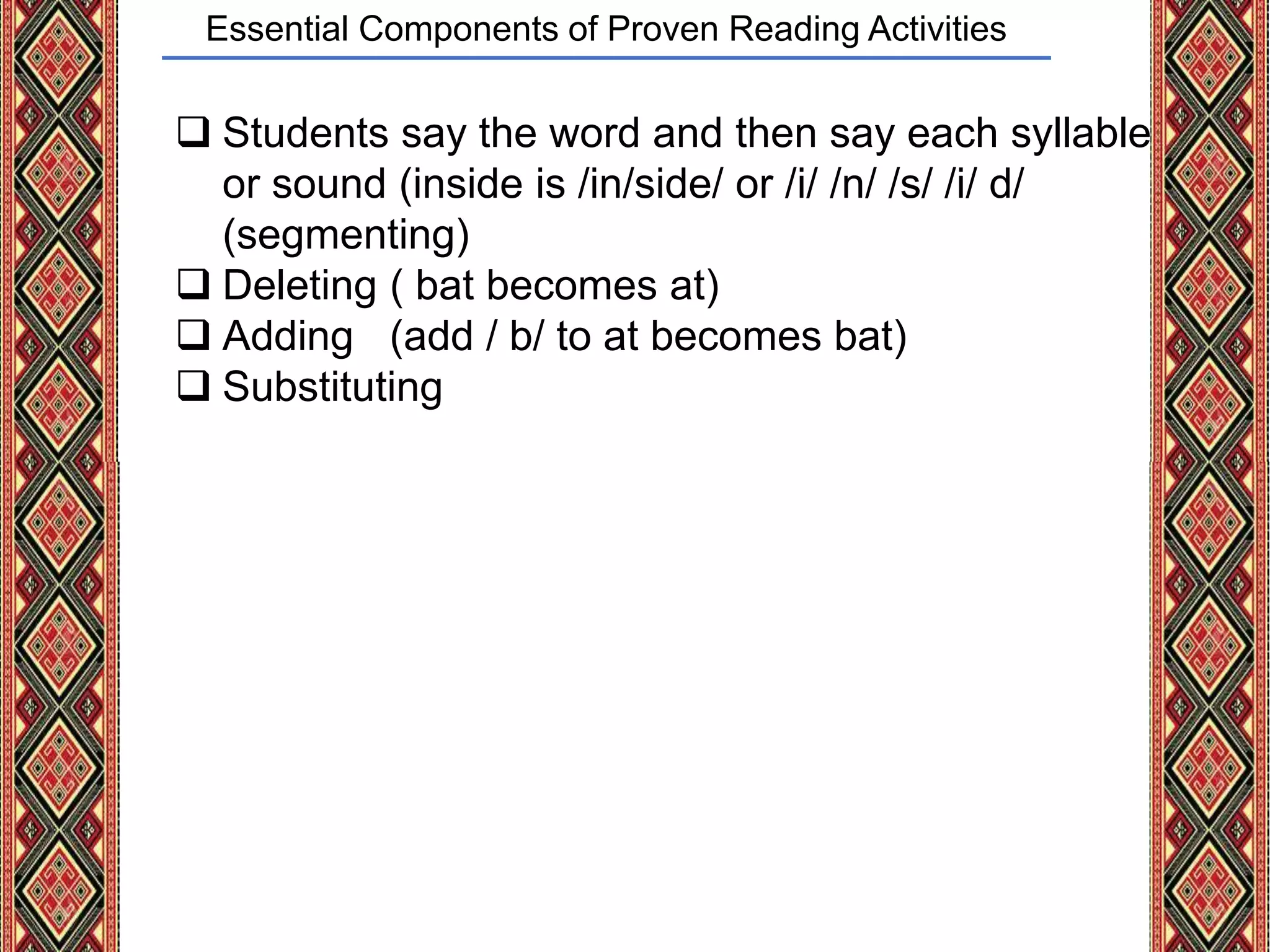
 Students say the word and then say each syllable
or sound (inside is /in/side/ or /i/ /n/ /s/ /i/ d/
(segmenting)
 Deleting ( bat becomes at)
 Adding (add / b/ to at becomes bat)
 Substituting
Essential Components of Proven Reading Activities
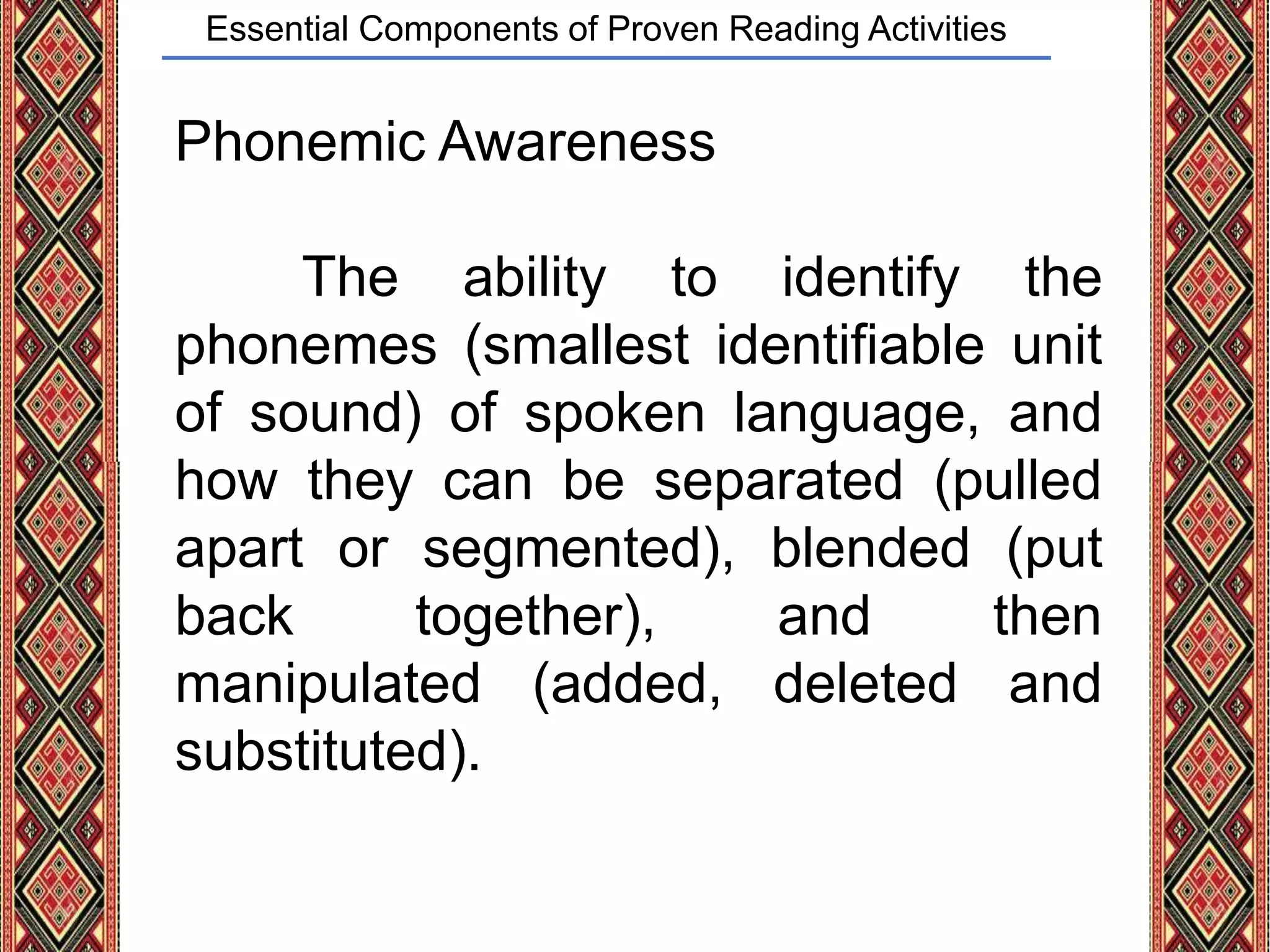
Phonemic Awareness
The ability to identify the
phonemes (smallest identifiable unit
of sound) of spoken language, and
how they can be separated (pulled
apart or segmented), blended (put
back together), and then
manipulated (added, deleted and
substituted).
Essential Components of Proven Reading Activities
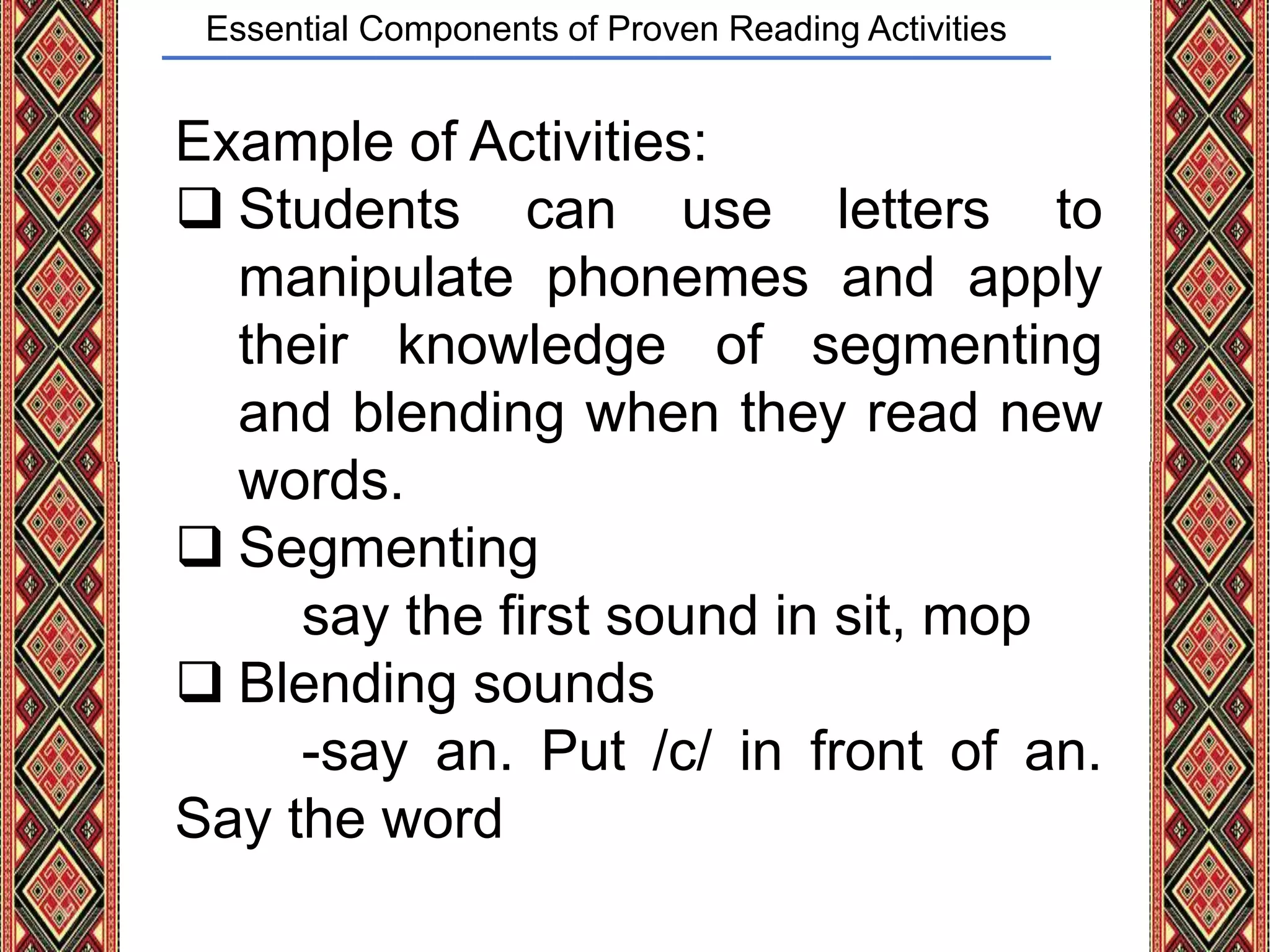
Example of Activities:
 Students can use letters to
manipulate phonemes and apply
their knowledge of segmenting
and blending when they read new
words.
 Segmenting
say the first sound in sit, mop
 Blending sounds
-say an. Put /c/ in front of an.
Say the word
Essential Components of Proven Reading Activities
Example of Activities:
 Students can use letters to
manipulate phonemes and apply
their knowledge of segmenting
and blending when they read new
words.
 Segmenting
say the first sound in sit, mop
 Blending sounds
-say an. Put /c/ in front of an.
Say the word
Essential Components of Proven Reading Activities
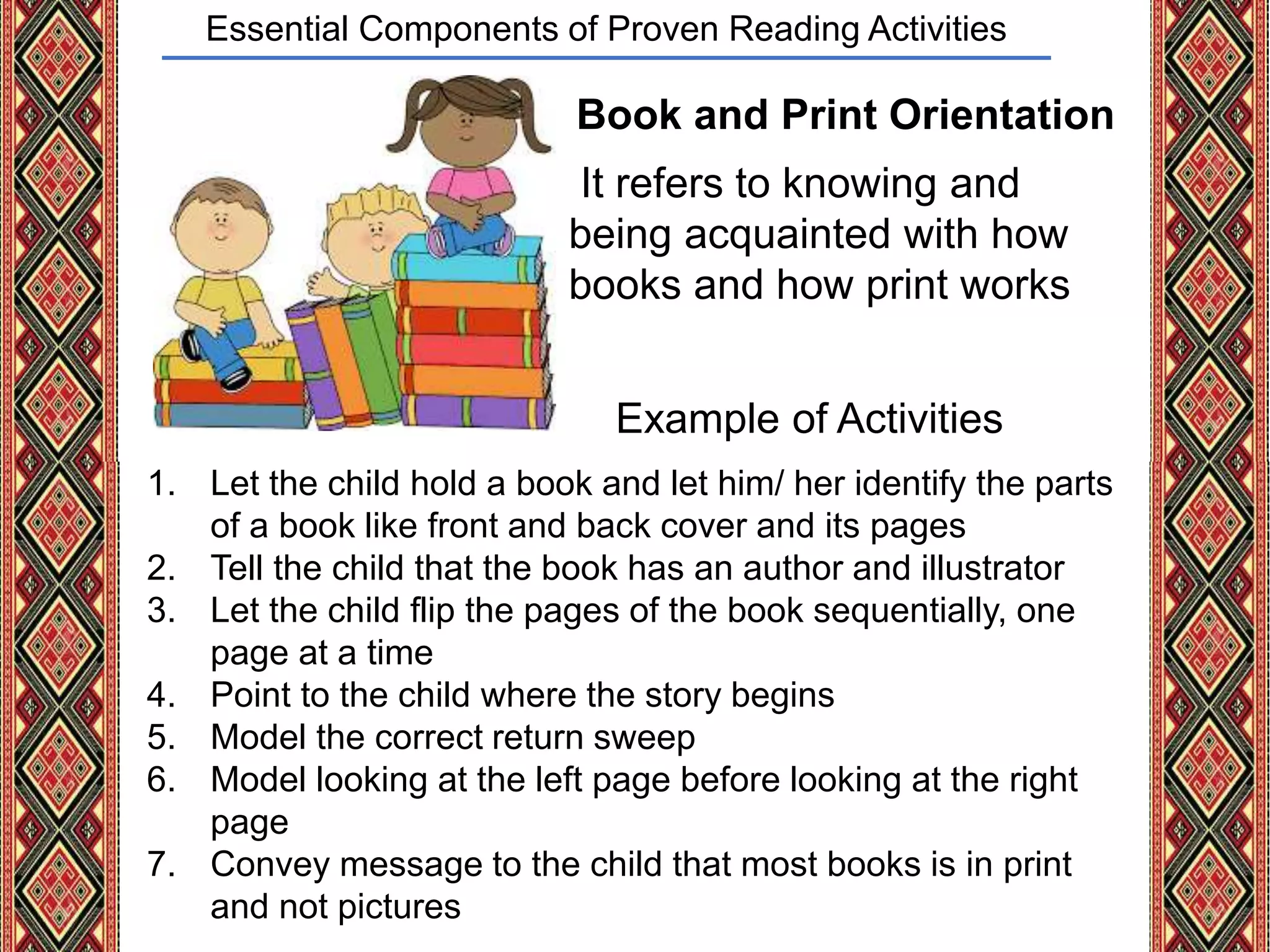
Book and Print Orientation
It refers to knowing and
being acquainted with how
books and how print works
Example of Activities
1. Let the child hold a book and let him/ her identify the parts
of a book like front and back cover and its pages
2. Tell the child that the book has an author and illustrator
3. Let the child flip the pages of the book sequentially, one
page at a time
4. Point to the child where the story begins
5. Model the correct return sweep
6. Model looking at the left page before looking at the right
page
7. Convey message to the child that most books is in print
and not pictures
Essential Components of Proven Reading Activities
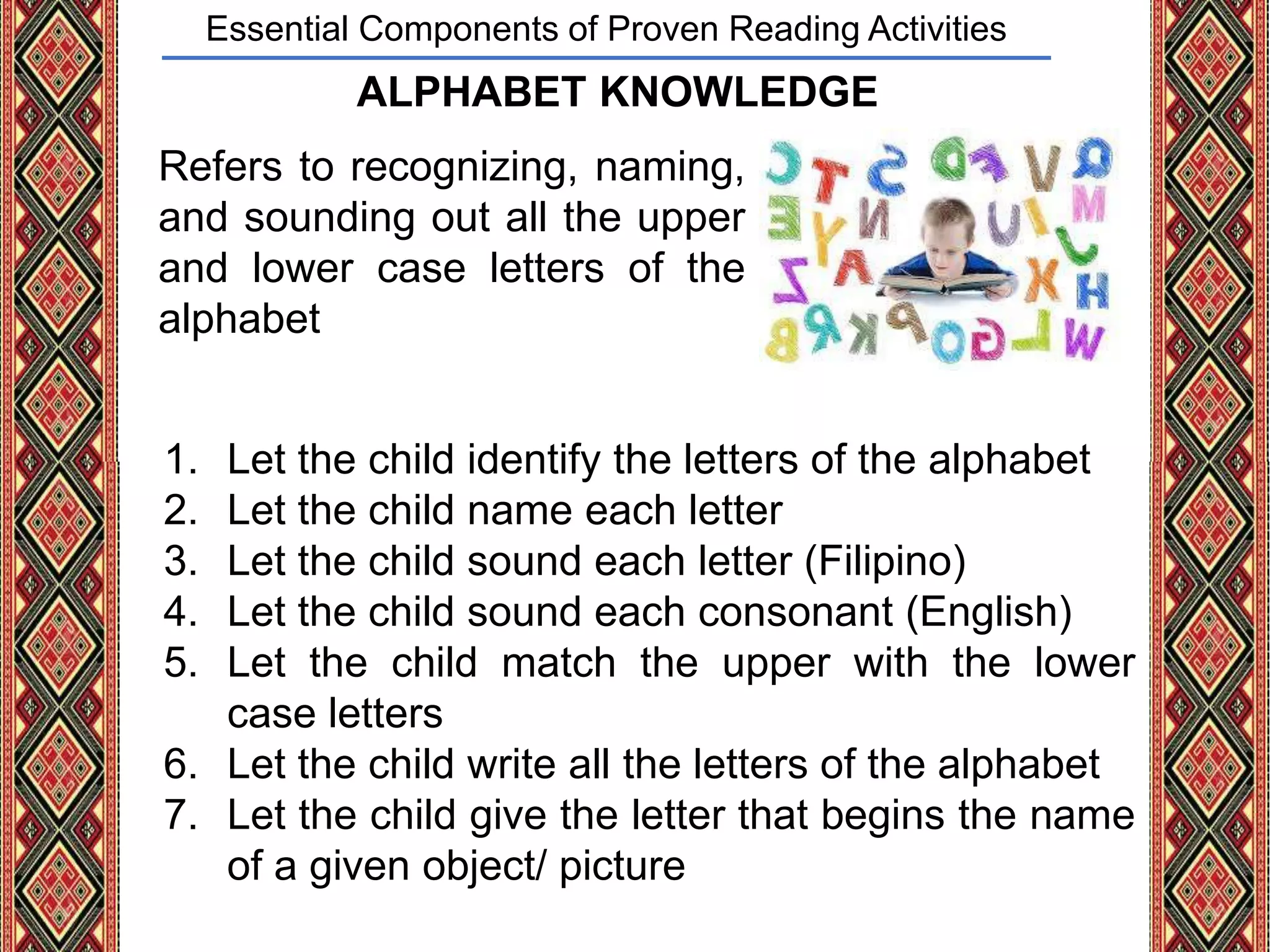
ALPHABET KNOWLEDGE
Refers to recognizing, naming,
and sounding out all the upper
and lower case letters of the
alphabet
1. Let the child identify the letters of the alphabet
2. Let the child name each letter
3. Let the child sound each letter (Filipino)
4. Let the child sound each consonant (English)
5. Let the child match the upper with the lower
case letters
6. Let the child write all the letters of the alphabet
7. Let the child give the letter that begins the name
of a given object/ picture
Essential Components of Proven Reading Activities
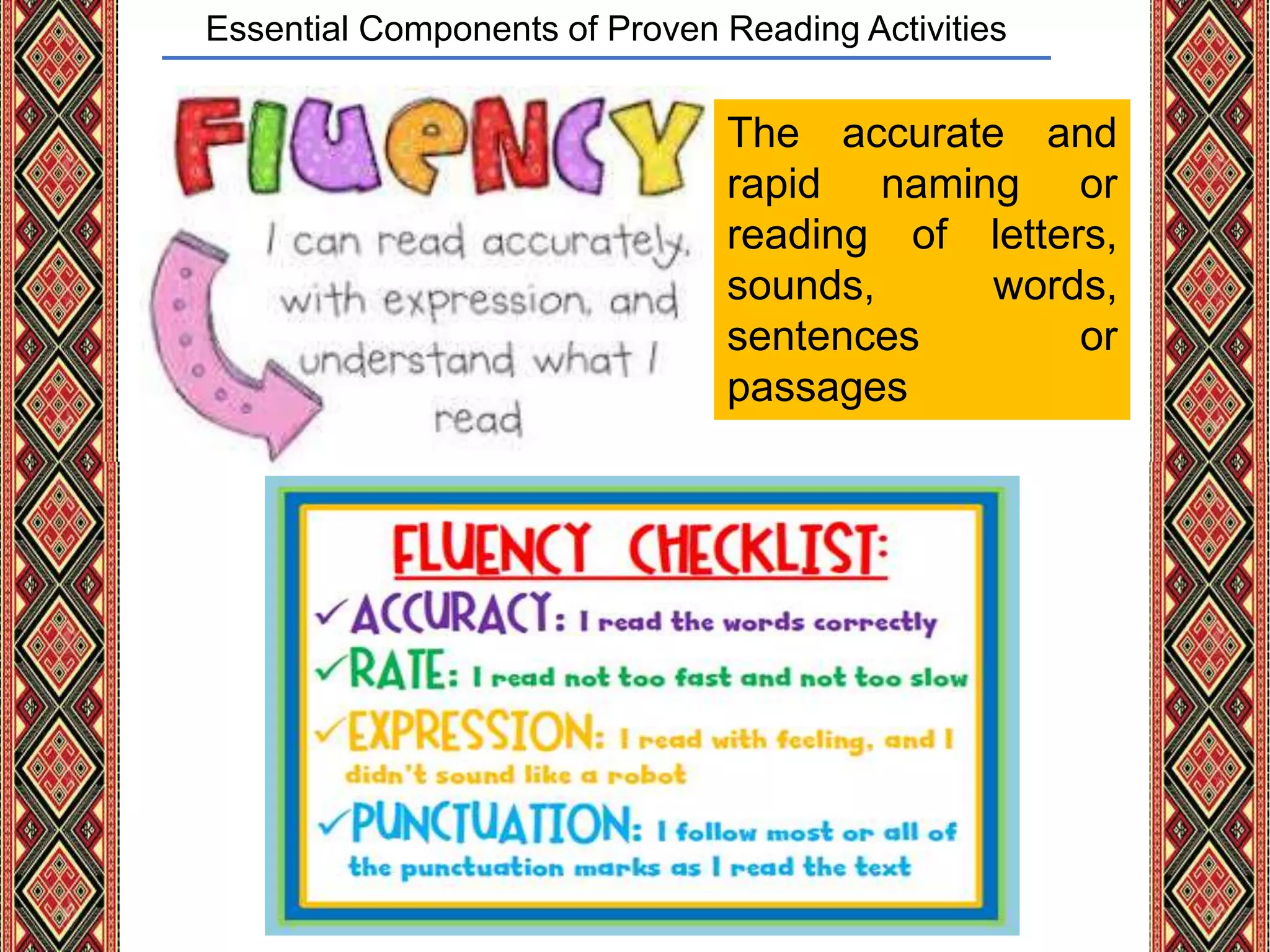
The accurate and
rapid naming or
reading of letters,
sounds, words,
sentences or
passages
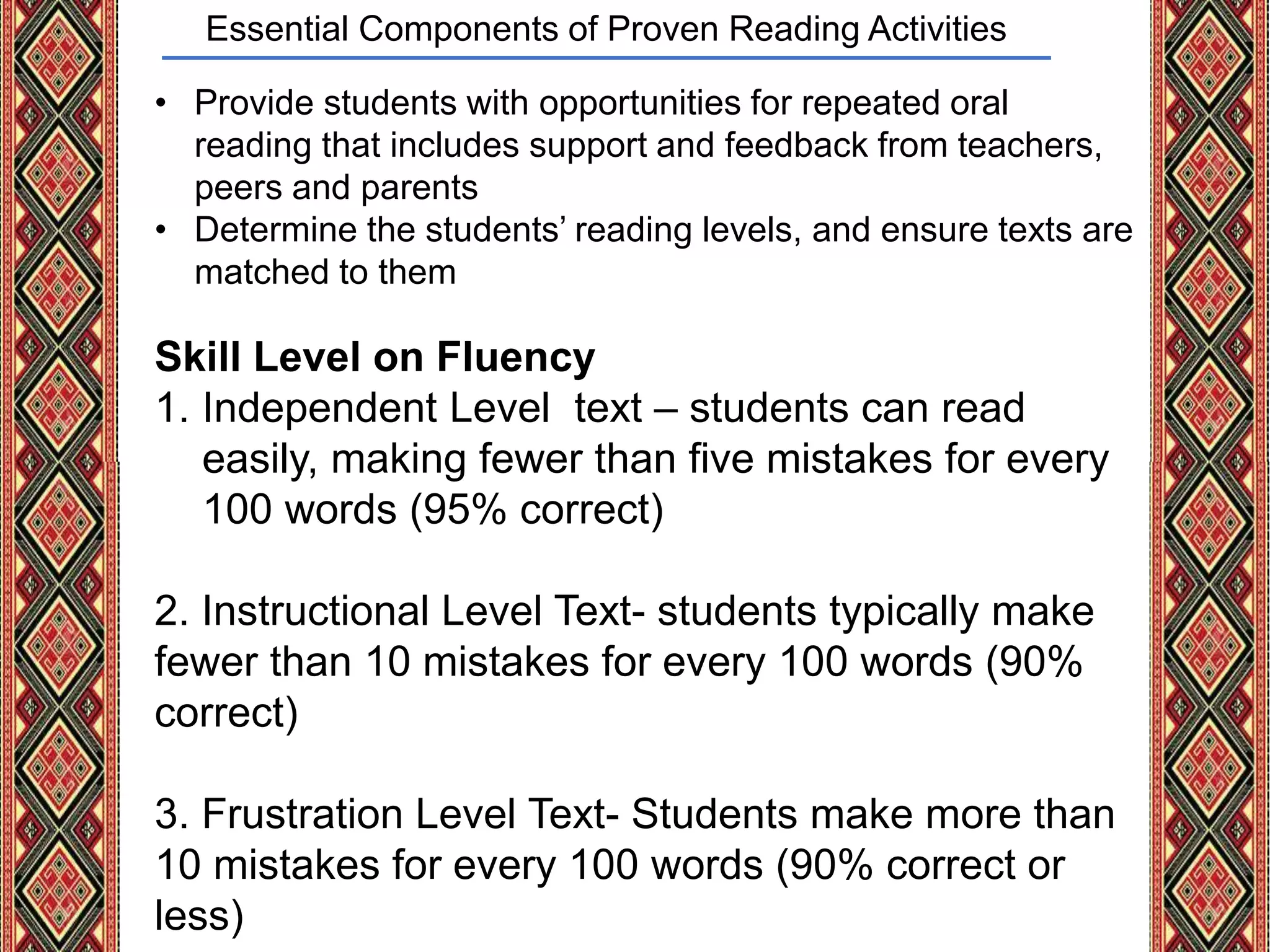
Essential Components of Proven Reading Activities
• Provide students with opportunities for repeated oral
reading that includes support and feedback from teachers,
peers and parents
• Determine the students’ reading levels, and ensure texts are
matched to them
Skill Level on Fluency
1. Independent Level text – students can read
easily, making fewer than five mistakes for every
100 words (95% correct)
2. Instructional Level Text- students typically make
fewer than 10 mistakes for every 100 words (90%
correct)
3. Frustration Level Text- Students make more than
10 mistakes for every 100 words (90% correct or
less)
Essential Components of Proven Reading Activities
Exercises that can improve fluency:
1.Reading with a model reader
2.Choral reading
3.Tape-recorded readings
4.Readers’ theater or reading performances
5.Partner readings
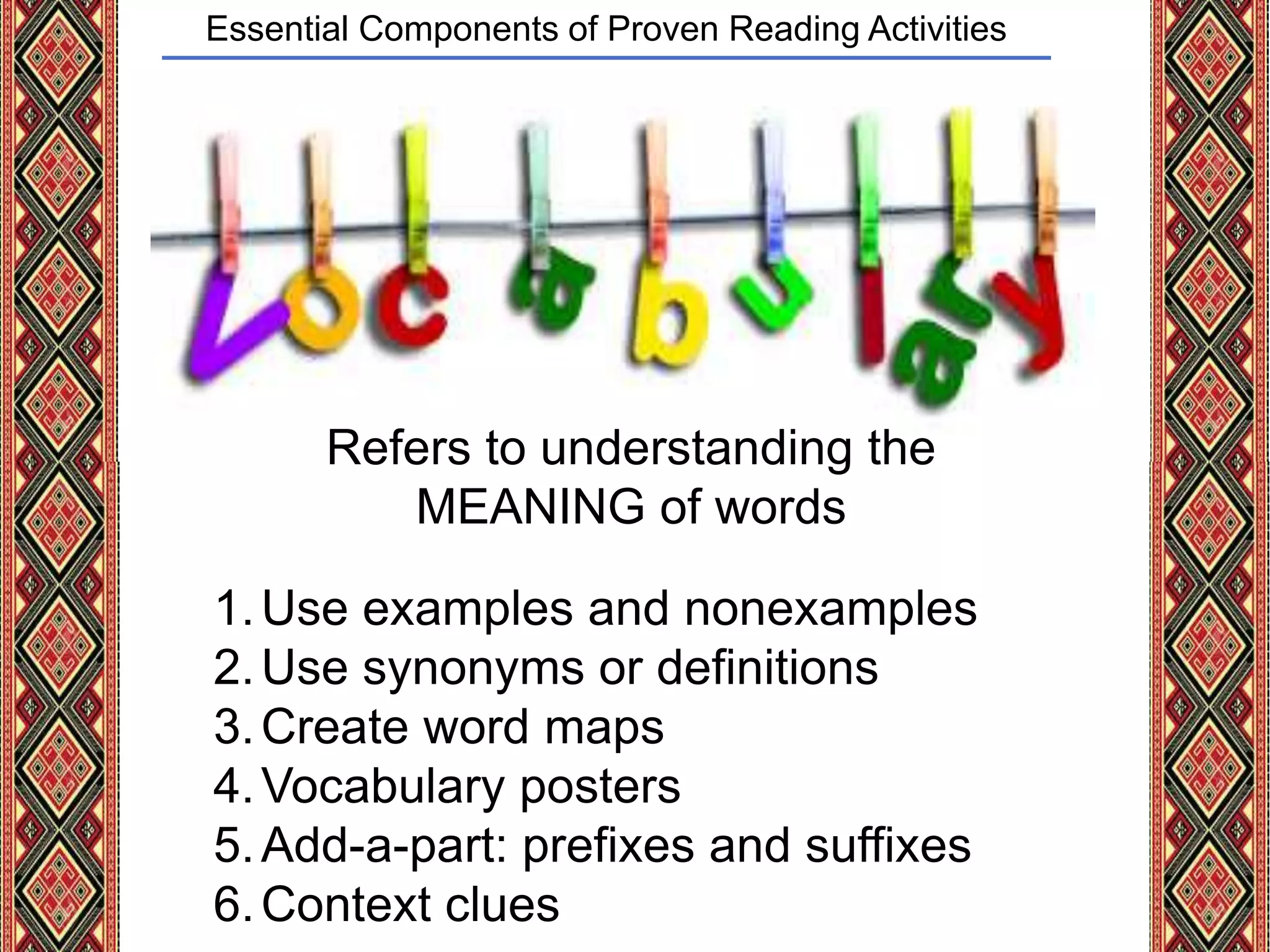
Essential Components of Proven Reading Activities
Refers to understanding the
MEANING of words
1.Use examples and nonexamples
2.Use synonyms or definitions
3.Create word maps
4.Vocabulary posters
5.Add-a-part: prefixes and suffixes
6.Context clues
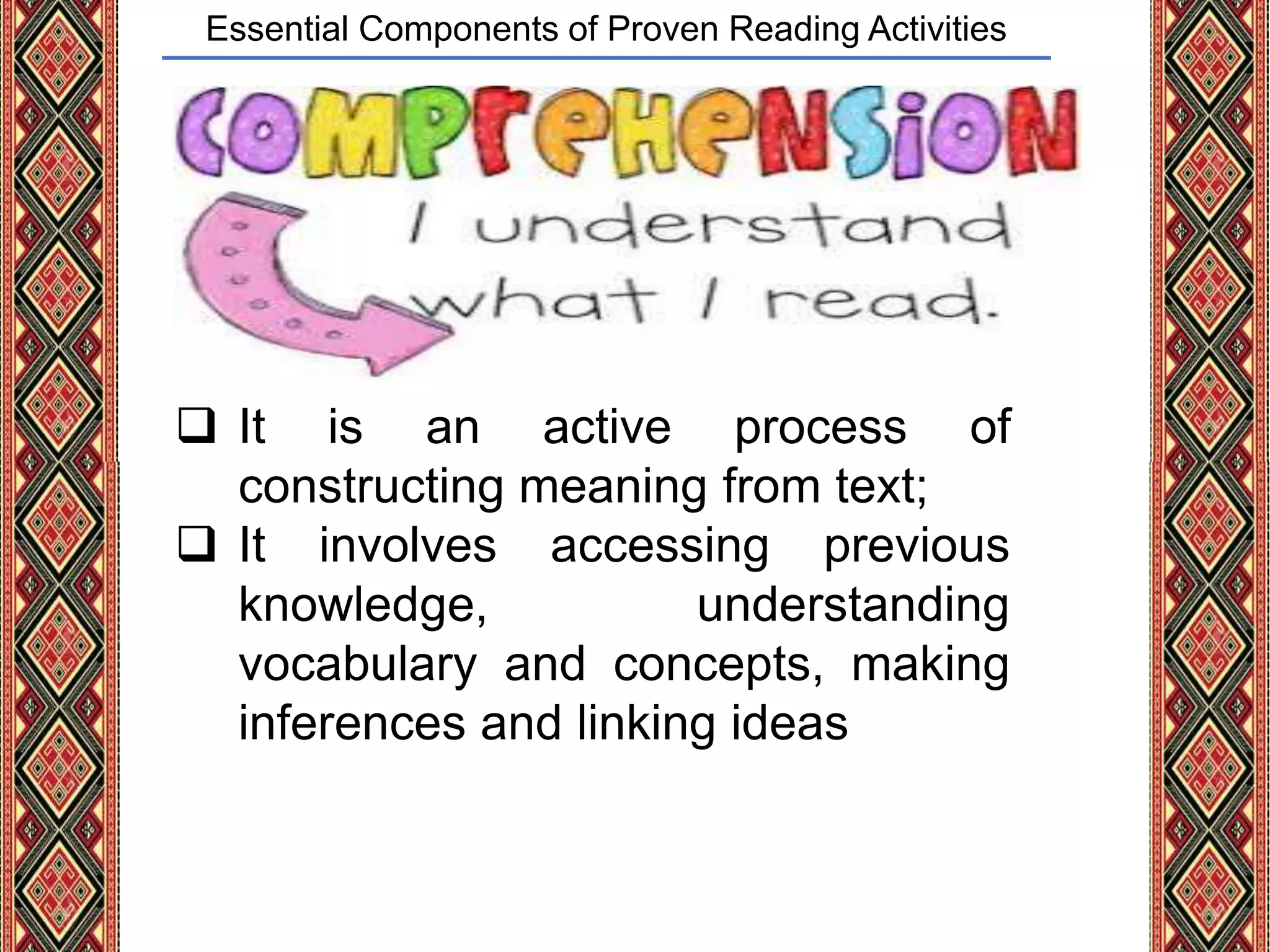
Essential Components of Proven Reading Activities
 It is an active process of
constructing meaning from text;
 It involves accessing previous
knowledge, understanding
vocabulary and concepts, making
inferences and linking ideas
Essential Components of Proven Reading Activities
 Suggested strategies from National
Reading Panel (2000)
1. Provide students with guided practice
and suggestions on how to monitor their
comprehension and adjust how they
read when difficulties arise;
2. Encourage cooperative learning
practices for reading;
3. Use graphic and semantic organizers
that help students draw connections,
relationships and word meanings;
4. Design questions that address the story
structure;
Essential Components of Proven Reading Activities
5. Provide extended feedback and for
student’s responses;
6. Allow students to elaborate on one
another’s responses to questions;
7. Prepare students to ask their own
questions about what they read;
8. Teach students to write key information
about what they’ve read while they are
reading and to summarize these key points
after reading longer passages;
9. Teach students strategies that can be
combined to understand text.
1.How will you transform
your classroom to literacy
rich?
2.What do you think is the
reason why there’s a need
to follow sequence in
teaching reading?
3.Why is there a need to
assess the reading
performance of the
students?
1.How will you transform
your classroom to literacy
rich?
2.What do you think is the
reason why there’s a need
to follow sequence in
teaching reading?
3.Why is there a need to
assess the reading
performance of the
students?
Numeracy is the ability to reason and to apply
simple numerical concepts.
Basic numeracy skills consist of comprehending
fundamental arithmetical operations like addition,
subtraction, multiplication, and division.

strategies in promoting numeracy and literacy

  • 1.
    Strategies in Promoting Numeracyand Literacy REYNEL S. REBOLLOS Presenter
  • 2.
    Session Objectives: 1. Defineliteracy and numeracy; 2. Identify the essential components in teaching reading; 3. Discuss the essential pre-number and early number concepts; 4. Explain some of the basic principles in teaching Mathematics to children; 5. Identify appropriate strategies and activities in teaching Mathematics; and 6. Demonstrate knowledge in teaching reading and mathematics by applying the strategies presented through a demonstration teaching
  • 3.
    Your thoughts about LITERACY? 1. Howdo you ensure that the children under your care receive variety of opportunities that promote and develop their literacy skills? 1. What do you think you can do to help improve or enhance these opportunities?
  • 4.
    A demonstrated competence in communicationskills that enables the individual to function (appropriate to age), independently of society and with a potential for movement in society It stresses on one’s ability to use language in daily life The ability to read and write Grows and develop through their way of interaction with responsive adults and peers LITERACY
  • 5.
  • 6.
    Essential Components ofProven Reading Activities Component • Oral Language Definition • Refers to the knowledge and use of the structure, meanings and uses of the language of literacy Example of Activities • Story reading activities • Poems • Jingles • Finger plays • Dramatizations • Dialogues • Show and tell • I spy • Play activities
  • 7.
    Essential Components ofProven Reading Activities Phonological Awareness – involve working with rhymes, words, syllables, and onsets and rimes. Example of Activities: Students listen to determine if two words begin or end with the same sound (discriminating) Students clap the number of words in a sentence, syllables in a word, sounds in a word (counting) Students create tongue twisters “Sally’s silly shoe sank slowly in the lime.
  • 8.
    Essential Components ofProven Reading Activities  Students say the word and then say each syllable or sound (inside is /in/side/ or /i/ /n/ /s/ /i/ d/ (segmenting)  Deleting ( bat becomes at)  Adding (add / b/ to at becomes bat)  Substituting
  • 9.
    Essential Components ofProven Reading Activities Phonemic Awareness The ability to identify the phonemes (smallest identifiable unit of sound) of spoken language, and how they can be separated (pulled apart or segmented), blended (put back together), and then manipulated (added, deleted and substituted).
  • 10.
    Essential Components ofProven Reading Activities Example of Activities:  Students can use letters to manipulate phonemes and apply their knowledge of segmenting and blending when they read new words.  Segmenting say the first sound in sit, mop  Blending sounds -say an. Put /c/ in front of an. Say the word
  • 11.
    Essential Components ofProven Reading Activities Example of Activities:  Students can use letters to manipulate phonemes and apply their knowledge of segmenting and blending when they read new words.  Segmenting say the first sound in sit, mop  Blending sounds -say an. Put /c/ in front of an. Say the word
  • 12.
    Essential Components ofProven Reading Activities Book and Print Orientation It refers to knowing and being acquainted with how books and how print works Example of Activities 1. Let the child hold a book and let him/ her identify the parts of a book like front and back cover and its pages 2. Tell the child that the book has an author and illustrator 3. Let the child flip the pages of the book sequentially, one page at a time 4. Point to the child where the story begins 5. Model the correct return sweep 6. Model looking at the left page before looking at the right page 7. Convey message to the child that most books is in print and not pictures
  • 13.
    Essential Components ofProven Reading Activities ALPHABET KNOWLEDGE Refers to recognizing, naming, and sounding out all the upper and lower case letters of the alphabet 1. Let the child identify the letters of the alphabet 2. Let the child name each letter 3. Let the child sound each letter (Filipino) 4. Let the child sound each consonant (English) 5. Let the child match the upper with the lower case letters 6. Let the child write all the letters of the alphabet 7. Let the child give the letter that begins the name of a given object/ picture
  • 14.
    Essential Components ofProven Reading Activities The accurate and rapid naming or reading of letters, sounds, words, sentences or passages
  • 15.
    Essential Components ofProven Reading Activities • Provide students with opportunities for repeated oral reading that includes support and feedback from teachers, peers and parents • Determine the students’ reading levels, and ensure texts are matched to them Skill Level on Fluency 1. Independent Level text – students can read easily, making fewer than five mistakes for every 100 words (95% correct) 2. Instructional Level Text- students typically make fewer than 10 mistakes for every 100 words (90% correct) 3. Frustration Level Text- Students make more than 10 mistakes for every 100 words (90% correct or less)
  • 16.
    Essential Components ofProven Reading Activities Exercises that can improve fluency: 1.Reading with a model reader 2.Choral reading 3.Tape-recorded readings 4.Readers’ theater or reading performances 5.Partner readings
  • 17.
    Essential Components ofProven Reading Activities Refers to understanding the MEANING of words 1.Use examples and nonexamples 2.Use synonyms or definitions 3.Create word maps 4.Vocabulary posters 5.Add-a-part: prefixes and suffixes 6.Context clues
  • 18.
    Essential Components ofProven Reading Activities  It is an active process of constructing meaning from text;  It involves accessing previous knowledge, understanding vocabulary and concepts, making inferences and linking ideas
  • 19.
    Essential Components ofProven Reading Activities  Suggested strategies from National Reading Panel (2000) 1. Provide students with guided practice and suggestions on how to monitor their comprehension and adjust how they read when difficulties arise; 2. Encourage cooperative learning practices for reading; 3. Use graphic and semantic organizers that help students draw connections, relationships and word meanings; 4. Design questions that address the story structure;
  • 20.
    Essential Components ofProven Reading Activities 5. Provide extended feedback and for student’s responses; 6. Allow students to elaborate on one another’s responses to questions; 7. Prepare students to ask their own questions about what they read; 8. Teach students to write key information about what they’ve read while they are reading and to summarize these key points after reading longer passages; 9. Teach students strategies that can be combined to understand text.
  • 21.
    1.How will youtransform your classroom to literacy rich? 2.What do you think is the reason why there’s a need to follow sequence in teaching reading? 3.Why is there a need to assess the reading performance of the students?
  • 22.
    1.How will youtransform your classroom to literacy rich? 2.What do you think is the reason why there’s a need to follow sequence in teaching reading? 3.Why is there a need to assess the reading performance of the students?
  • 23.
    Numeracy is theability to reason and to apply simple numerical concepts. Basic numeracy skills consist of comprehending fundamental arithmetical operations like addition, subtraction, multiplication, and division.