Background
 Pioneer Hi-Bred, a DuPont business headquartered in Des Moines, Iowa, is
the world's leading developer and supplier of advanced plant genetics,
agronomic support, and services to farmers.
 Basic Facts
 Founded in 1926 by Henry A. Wallace
 Business operations in more than 90 countries
 More than 70 production locations
 More than 100 research locations
 More than 10,000 employees worldwide
 Pioneer Hi-Bred and its employees share a responsibility to create a safe
and healthy workplace by performing to the highest standards of safety –
every time, everywhere.
 PHI Medchal - India
 Multi crop seed processing plant – Corn, Rice, Millet, Mustard and Sunflower
 High speed and automated machinery for seed drying, conditioning, treating and packaging
 Annually over 30000 MT of seed is handled
 Over 100 workers are engaged for daily operations
Problem and challenges
 Seed handling is a manual process, needing several casual workers
and hamalies. There is a challenge to effectively move the large
quantities of seed for regular operations.
 Safety is utmost priority and one of the core value of the company.
 Due to manual handling few accidents occurred in the plant in the
past while loading and unloading the seed bags to the trucks.
 So, for improving the safety efficiency few support structures are
needed
 Reducing manual intervention through effective material conveying
system is needed.
Objectives
 Support structures are to be designed for safety of the personnel
working on the trucks [like loaders / unloaders – hamalies]. This
requires structural designing and calculation of all the loads that
are required to design the support structures.
 Design an unloading structure for transferring the seeds from
jumbo bags of capacity 1.5 MT to a metal bin for effective material
handling
 Design a conveyor belt for the transportation of corn into the
conditioning plant.
Assessment and study
 Initially we differentiated the work space from the available
space.
 Then the clearance is provided to the work space and the
total measurements are taken exactly.
 Detailed study is done on present unloading system.
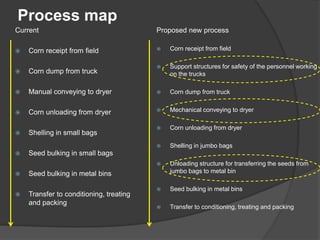
Process map
Current
 Corn receipt from field
 Corn dump from truck
 Manual conveying to dryer
 Corn unloading from dryer
 Shelling in small bags
 Seed bulking in small bags
 Seed bulking in metal bins
 Transfer to conditioning, treating
and packing
Proposed new process
 Corn receipt from field
 Support structures for safety of the personnel working
on the trucks
 Corn dump from truck
 Mechanical conveying to dryer
 Corn unloading from dryer
 Shelling in jumbo bags
 Unloading structure for transferring the seeds from
jumbo bags to metal bin
 Seed bulking in metal bins
 Transfer to conditioning, treating and packing
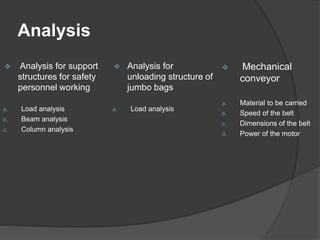
Analysis
 Analysis for
unloading structure of
jumbo bags
a. Load analysis
 Analysis for support
structures for safety
personnel working
a. Load analysis
b. Beam analysis
c. Column analysis
 Mechanical
conveyor
a. Material to be carried
b. Speed of the belt
c. Dimensions of the belt
d. Power of the motor
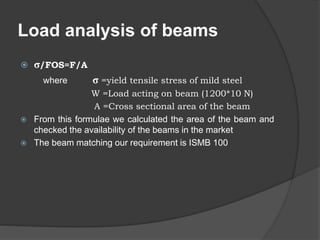
Load analysis of beams
 /FOS=F/A
where =yield tensile stress of mild steel
W =Load acting on beam (1200*10 N)
A =Cross sectional area of the beam
 From this formulae we calculated the area of the beam and
checked the availability of the beams in the market
 The beam matching our requirement is ISMB 100
Analysis of columns
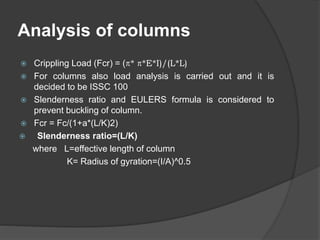
 Crippling Load (Fcr) = ( * *E*I)/(L*L)
 For columns also load analysis is carried out and it is
decided to be ISSC 100
 Slenderness ratio and EULERS formula is considered to
prevent buckling of column.
 Fcr = Fc/(1+a*(L/K)2)
 Slenderness ratio=(L/K)
where L=effective length of column
K= Radius of gyration=(I/A)^0.5
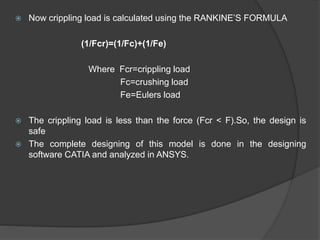
 Now crippling load is calculated using the RANKINE’S FORMULA
(1/Fcr)=(1/Fc)+(1/Fe)
Where Fcr=crippling load
Fc=crushing load
Fe=Eulers load
 The crippling load is less than the force (Fcr < F).So, the design is
safe
 The complete designing of this model is done in the designing
software CATIA and analyzed in ANSYS.
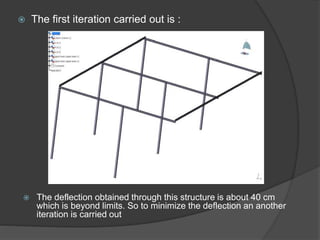
 The first iteration carried out is :
 The deflection obtained through this structure is about 40 cm
which is beyond limits. So to minimize the deflection an another
iteration is carried out
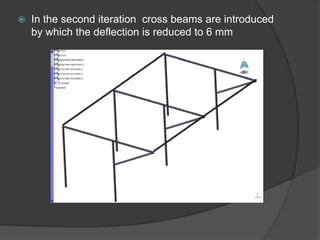
 In the second iteration cross beams are introduced
by which the deflection is reduced to 6 mm
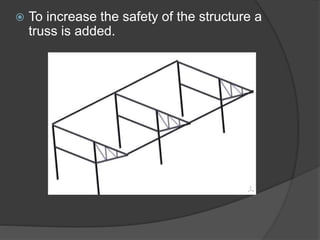
 To increase the safety of the structure a
truss is added.
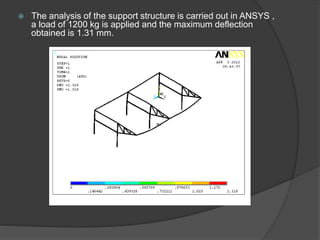
 The analysis of the support structure is carried out in ANSYS ,
a load of 1200 kg is applied and the maximum deflection
obtained is 1.31 mm.
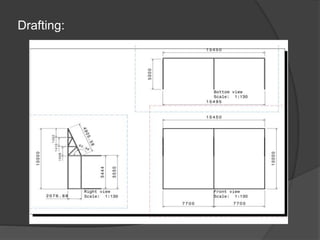
Drafting:
 The main purpose of this support structure is to become a platform
for the unloading of jumbo bags.
 A number of iterations were used for the final design of the support
structure
 The load applied on these rods is about 2000 Kg.
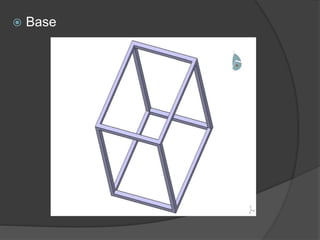
 A solid base was selected for the support structure to be designed
and for the assembly of the hollow rods.
SUPPORT STRUCTURE FOR HANDLING 2
TON WEIGHT:
 Base
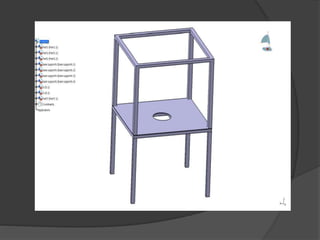
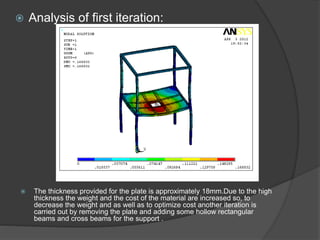
 Analysis of first iteration:
 The thickness provided for the plate is approximately 18mm.Due to the high
thickness the weight and the cost of the material are increased so, to
decrease the weight and as well as to optimize cost another iteration is
carried out by removing the plate and adding some hollow rectangular
beams and cross beams for the support .
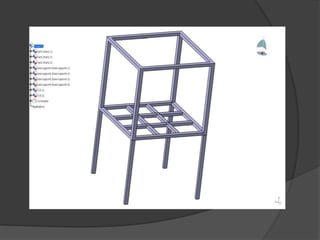
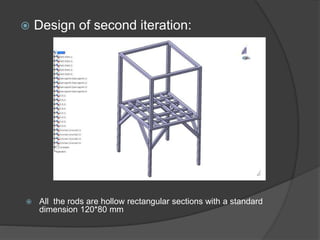
 Design of second iteration:
 All the rods are hollow rectangular sections with a standard
dimension 120*80 mm
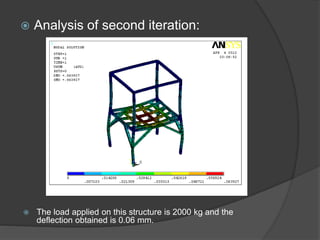
 Analysis of second iteration:
 The load applied on this structure is 2000 kg and the
deflection obtained is 0.06 mm.
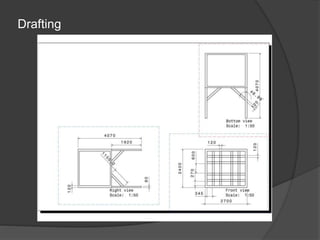
Drafting
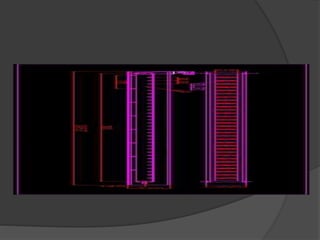
Conveyor
 STEPS INVOLVED IN THE DESIGNING PROCESS
1. Material to be conveyed: Corn
2. Bulk density of material to be conveyed :0.75
3. No of tons to be conveyed :10 tons per hour
4. Length of the conveyer : 10 meters
5. Number of cubic meters conveyed per hour : 13.3 cubic
meters
6. Efficiency
7. Material repose
8. Conveyor speed : 1 meter per second
9. Width of conveyor belt :300 mm
10. Free zone
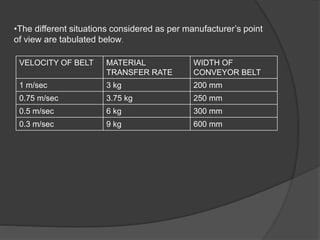
VELOCITY OF BELT MATERIAL
TRANSFER RATE
WIDTH OF
CONVEYOR BELT
1 m/sec 3 kg 200 mm
0.75 m/sec 3.75 kg 250 mm
0.5 m/sec 6 kg 300 mm
0.3 m/sec 9 kg 600 mm
•The different situations considered as per manufacturer’s point
of view are tabulated below.
Conclusion
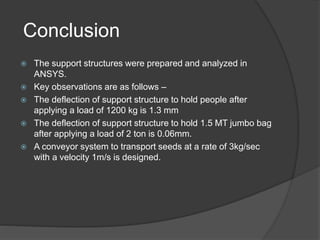
 The support structures were prepared and analyzed in
ANSYS.
 Key observations are as follows –
 The deflection of support structure to hold people after
applying a load of 1200 kg is 1.3 mm
 The deflection of support structure to hold 1.5 MT jumbo bag
after applying a load of 2 ton is 0.06mm.
 A conveyor system to transport seeds at a rate of 3kg/sec
with a velocity 1m/s is designed.
THANK YOU

DESIGN OF SUPPORT STRUCTURES

  • 2.
    Background  Pioneer Hi-Bred,a DuPont business headquartered in Des Moines, Iowa, is the world's leading developer and supplier of advanced plant genetics, agronomic support, and services to farmers.  Basic Facts  Founded in 1926 by Henry A. Wallace  Business operations in more than 90 countries  More than 70 production locations  More than 100 research locations  More than 10,000 employees worldwide  Pioneer Hi-Bred and its employees share a responsibility to create a safe and healthy workplace by performing to the highest standards of safety – every time, everywhere.  PHI Medchal - India  Multi crop seed processing plant – Corn, Rice, Millet, Mustard and Sunflower  High speed and automated machinery for seed drying, conditioning, treating and packaging  Annually over 30000 MT of seed is handled  Over 100 workers are engaged for daily operations
  • 3.
    Problem and challenges Seed handling is a manual process, needing several casual workers and hamalies. There is a challenge to effectively move the large quantities of seed for regular operations.  Safety is utmost priority and one of the core value of the company.  Due to manual handling few accidents occurred in the plant in the past while loading and unloading the seed bags to the trucks.  So, for improving the safety efficiency few support structures are needed  Reducing manual intervention through effective material conveying system is needed.
  • 4.
    Objectives  Support structuresare to be designed for safety of the personnel working on the trucks [like loaders / unloaders – hamalies]. This requires structural designing and calculation of all the loads that are required to design the support structures.  Design an unloading structure for transferring the seeds from jumbo bags of capacity 1.5 MT to a metal bin for effective material handling  Design a conveyor belt for the transportation of corn into the conditioning plant.
  • 5.
    Assessment and study Initially we differentiated the work space from the available space.  Then the clearance is provided to the work space and the total measurements are taken exactly.  Detailed study is done on present unloading system.
  • 6.
    Process map Current  Cornreceipt from field  Corn dump from truck  Manual conveying to dryer  Corn unloading from dryer  Shelling in small bags  Seed bulking in small bags  Seed bulking in metal bins  Transfer to conditioning, treating and packing Proposed new process  Corn receipt from field  Support structures for safety of the personnel working on the trucks  Corn dump from truck  Mechanical conveying to dryer  Corn unloading from dryer  Shelling in jumbo bags  Unloading structure for transferring the seeds from jumbo bags to metal bin  Seed bulking in metal bins  Transfer to conditioning, treating and packing
  • 7.
    Analysis  Analysis for unloadingstructure of jumbo bags a. Load analysis  Analysis for support structures for safety personnel working a. Load analysis b. Beam analysis c. Column analysis  Mechanical conveyor a. Material to be carried b. Speed of the belt c. Dimensions of the belt d. Power of the motor
  • 8.
    Load analysis ofbeams  /FOS=F/A where =yield tensile stress of mild steel W =Load acting on beam (1200*10 N) A =Cross sectional area of the beam  From this formulae we calculated the area of the beam and checked the availability of the beams in the market  The beam matching our requirement is ISMB 100
  • 9.
    Analysis of columns Crippling Load (Fcr) = ( * *E*I)/(L*L)  For columns also load analysis is carried out and it is decided to be ISSC 100  Slenderness ratio and EULERS formula is considered to prevent buckling of column.  Fcr = Fc/(1+a*(L/K)2)  Slenderness ratio=(L/K) where L=effective length of column K= Radius of gyration=(I/A)^0.5
  • 10.
     Now cripplingload is calculated using the RANKINE’S FORMULA (1/Fcr)=(1/Fc)+(1/Fe) Where Fcr=crippling load Fc=crushing load Fe=Eulers load  The crippling load is less than the force (Fcr < F).So, the design is safe  The complete designing of this model is done in the designing software CATIA and analyzed in ANSYS.
  • 11.
     The firstiteration carried out is :  The deflection obtained through this structure is about 40 cm which is beyond limits. So to minimize the deflection an another iteration is carried out
  • 12.
     In thesecond iteration cross beams are introduced by which the deflection is reduced to 6 mm
  • 13.
     To increasethe safety of the structure a truss is added.
  • 14.
     The analysisof the support structure is carried out in ANSYS , a load of 1200 kg is applied and the maximum deflection obtained is 1.31 mm.
  • 15.
  • 16.
     The mainpurpose of this support structure is to become a platform for the unloading of jumbo bags.  A number of iterations were used for the final design of the support structure  The load applied on these rods is about 2000 Kg.  A solid base was selected for the support structure to be designed and for the assembly of the hollow rods. SUPPORT STRUCTURE FOR HANDLING 2 TON WEIGHT:
  • 17.
  • 20.
     Analysis offirst iteration:  The thickness provided for the plate is approximately 18mm.Due to the high thickness the weight and the cost of the material are increased so, to decrease the weight and as well as to optimize cost another iteration is carried out by removing the plate and adding some hollow rectangular beams and cross beams for the support .
  • 21.
     Design ofsecond iteration:  All the rods are hollow rectangular sections with a standard dimension 120*80 mm
  • 22.
     Analysis ofsecond iteration:  The load applied on this structure is 2000 kg and the deflection obtained is 0.06 mm.
  • 23.
  • 24.
    Conveyor  STEPS INVOLVEDIN THE DESIGNING PROCESS 1. Material to be conveyed: Corn 2. Bulk density of material to be conveyed :0.75 3. No of tons to be conveyed :10 tons per hour 4. Length of the conveyer : 10 meters 5. Number of cubic meters conveyed per hour : 13.3 cubic meters 6. Efficiency 7. Material repose 8. Conveyor speed : 1 meter per second 9. Width of conveyor belt :300 mm 10. Free zone
  • 26.
    VELOCITY OF BELTMATERIAL TRANSFER RATE WIDTH OF CONVEYOR BELT 1 m/sec 3 kg 200 mm 0.75 m/sec 3.75 kg 250 mm 0.5 m/sec 6 kg 300 mm 0.3 m/sec 9 kg 600 mm •The different situations considered as per manufacturer’s point of view are tabulated below.
  • 27.
    Conclusion  The supportstructures were prepared and analyzed in ANSYS.  Key observations are as follows –  The deflection of support structure to hold people after applying a load of 1200 kg is 1.3 mm  The deflection of support structure to hold 1.5 MT jumbo bag after applying a load of 2 ton is 0.06mm.  A conveyor system to transport seeds at a rate of 3kg/sec with a velocity 1m/s is designed.
  • 28.