Measurable Outcomes
    and Impact
      Reana Rossouw
Next Generation Consultants
        July 2009
A lesson in history
• How far we have come…
  – Commonwealth Business Council calls NGO’s the
    operational arm of civil society.
  – SustainAbility refers to NGO’s as the shock troops of
    civil society.
  – Part of the mystique of the growing prominence of
    NGO’s is the fact that while they continue to grow in
    number and their role expands, it becomes more and
    more difficult to describe them and put them in
    boxes.
Controversy
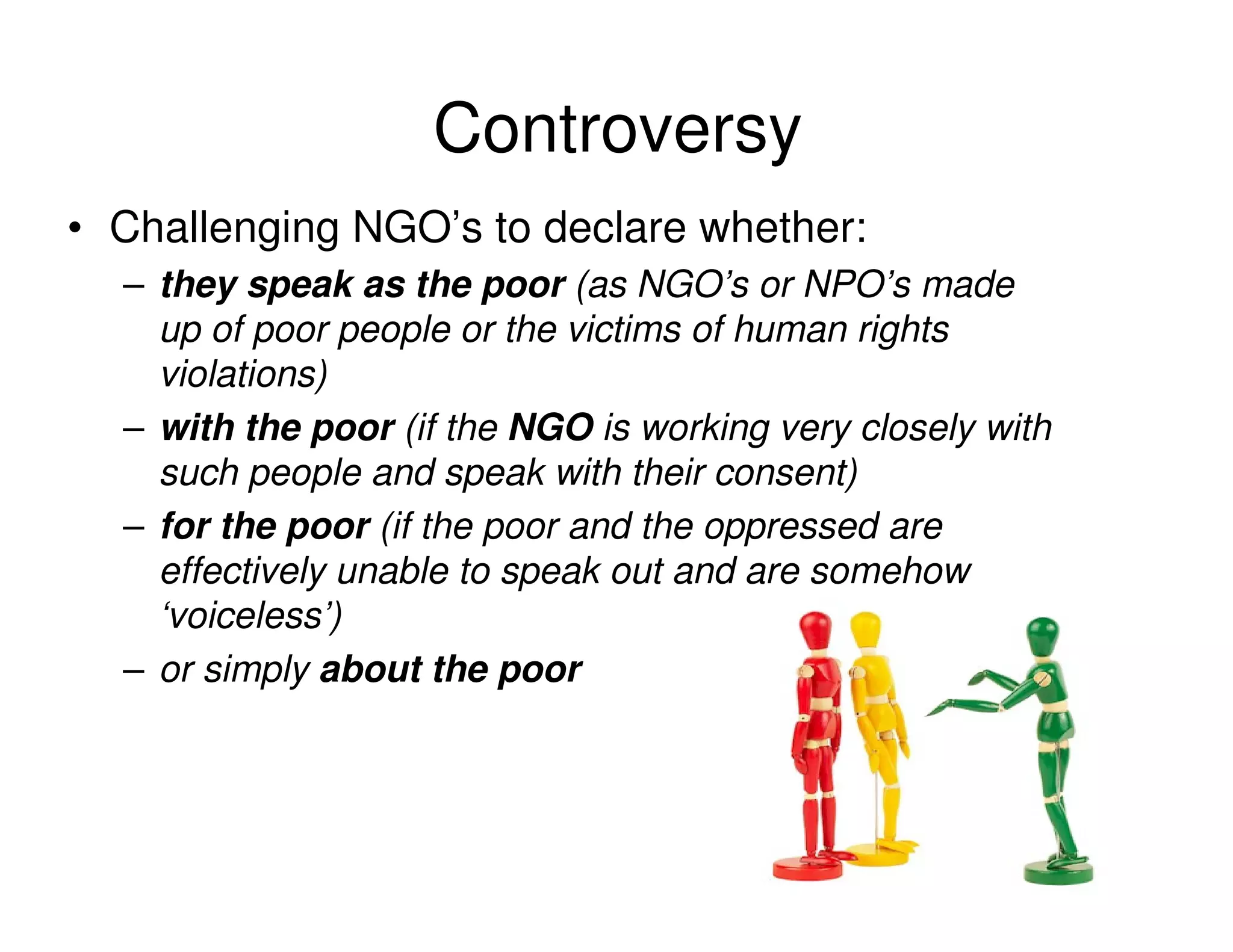
• Challenging NGO’s to declare whether:
  – they speak as the poor (as NGO’s or NPO’s made
    up of poor people or the victims of human rights
    violations)
  – with the poor (if the NGO is working very closely with
    such people and speak with their consent)
  – for the poor (if the poor and the oppressed are
    effectively unable to speak out and are somehow
    ‘voiceless’)
  – or simply about the poor
Controversial or Unlimited Potential
• Service Providers
   – Extending reach, influence and implementation of
     government
• Project Managers
   – Delivering projects and project management services
     to/on behalf of funders
• Developmental Specialists
   – Specialised, in-depth knowledge, experience,
     expertise
• Facilitators
   – Between communities and donors
Global Donor Perspectives
• Tension
   – Business, Government and Development Sector
• Issue
   – Trade or aid or debt relief
• Challenge
   – Climate Change
   – Food and Energy Crises
   – Overall economic downturn and credit crunch
• Demand
   – Greater accountability, transparency and efficiency
   – Superior developmental outcomes and impact
• Solution
   – Business oriented market driven approach to solve global issues
     such as poverty, health, education and the impact of climate
     change
Local Donor Perspectives
• Concept
  – Approach (feasibility & viability)
• Design
  – Proven/effective methods (specific solutions)
• Capability
  – Leadership depth, expertise, specialisation,
    skills
• Control
  – Transparency, governance, financial
    management
• Sustainability
  – Lasting impact (definable, measurable –
    clear)
NGO & NPO Perspectives
• Meeting donor needs for quantification
• Being multi-dimensional and user-friendly
• Measuring intangible changes
• Ensuring enough skills, infrastructure and
  resources
• Constantly proving effectiveness and
  demonstrating ability
• Constantly evolving
from advocacy to delivery
Donor vs NGO Issues
•   Operating Expenses
•   Capacity Building
•   Fundraising
•   Business Model
•   Leverage/partnerships
•   Diversity – reach, influence
Make or Break
• Transformational Change
  – Major back office investment
  – Consolidation / Diversify
  – Redevelop business case/business model
  – New products & services
  – New markets
Sustainability
• How much money donors give the NPO shows
  their respect
  – (Value of income)
• How often donors renew, extend or repeat
  funding shows their loyalty
  – (Renewability of income)
• How freely donors give (untied) shows
  their trust
  – (Trust = freedom)
• Sustainability = Respect x Loyalty x Trust
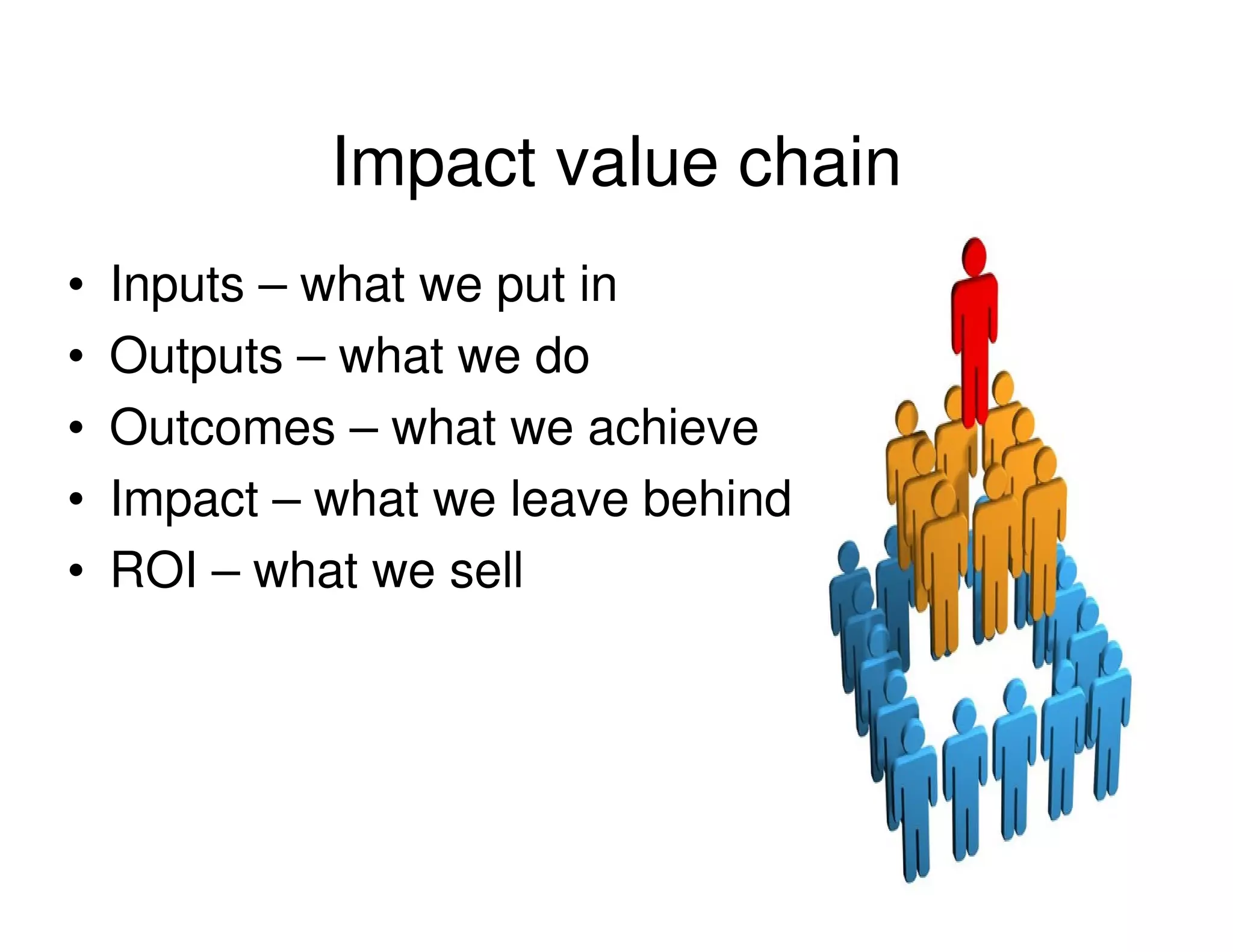
Impact value chain
•   Inputs – what we put in
•   Outputs – what we do
•   Outcomes – what we achieve
•   Impact – what we leave behind
•   ROI – what we sell
Bridging the Gap
•   Reports
•   Disclosure statements
•   Performance assessments
•   Evaluations
•   Participation
•   Self-regulation
•   Social audits
Measurable outcomes and impact
• Why it matters
  – Performance improvement
  – Demonstrating added value
  – Accountability
And the question is?
• As a sector, we judge ourselves not primarily on
  whether we have made a profit or achieved
  planned outputs, but on whether or not we have
  made a difference

  – Voluntary organisations often claim that they add
    value but are not skilled in explaining what value
    they add and how they add it. Voluntary
    organisations will need to develop answers to these
    questions because it is unlikely that the public sector
    and other funders will see things in exactly the same
    way
And the answer is?
• Being held to account – by stakeholders, or on
  their behalf, via sanctions or other methods of
  redress which enforce the right to effect change.
• Giving an account – providing stakeholders
  with an explanation or information to report what
  has taken place and the outcomes of that
  activity.
• Taking account - of stakeholders' needs and
  views and responding to these by examining
  and, if necessary, revising practices or
  enhancing performance
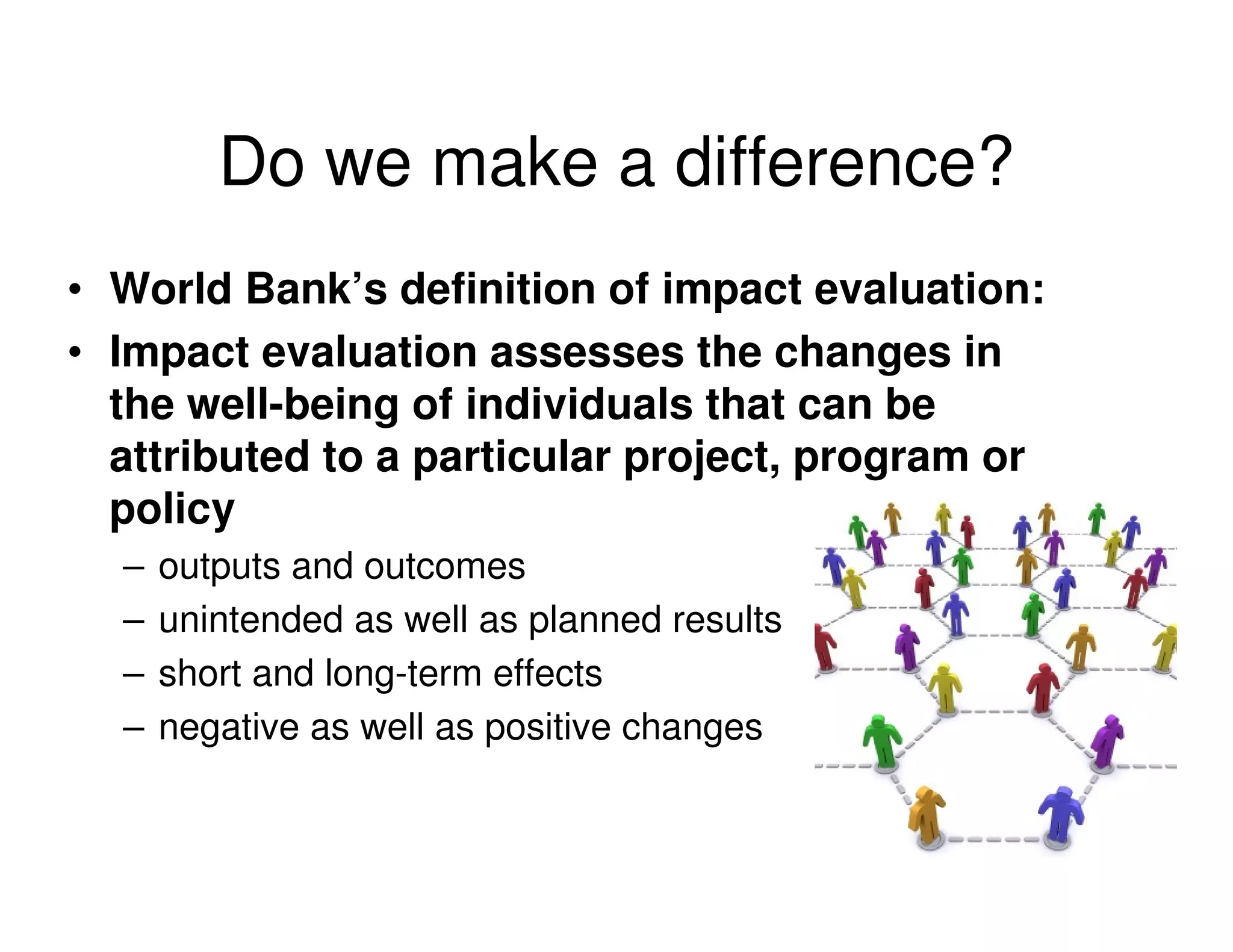
Do we make a difference?
• World Bank’s definition of impact evaluation:
• Impact evaluation assesses the changes in
  the well-being of individuals that can be
  attributed to a particular project, program or
  policy
  –   outputs and outcomes
  –   unintended as well as planned results
  –   short and long-term effects
  –   negative as well as positive changes
Impact assessment our future
• Impact assessment is a relatively new discipline. It is also a very
  broad one, covering all possible outcomes from an activity whether
  intended or unintended, good or bad. In reality we cannot
  “assess” impact in its entirety. This is a huge area and in order to
  address it organisations will need to strategically limit the focus of
  their evaluation to certain priority areas.

• The real challenge is to find a framework that does justice to an
  organisation’s contribution, is simple to use and produces results
  helpful to all stakeholders.

• Assessment methods need to be methodologically sound in order
  to ensure reliable results. However, it is also important that they
  are not overly rigid or constraining. In particular, a flexible
  methodological framework is required to allow for unintended and
  negative outcomes to be taken into account.
A question of definition
• Impact is related to a progression over
  time
• Impact is highly subjective and
  perceptions will vary from individual to
  individual
• Soft outcomes are crucial element in the
  impact of much voluntary activity
Recommendations for the future
• Impacts assessment needs to be approached as a tool
  for enhancing performance improvement and
  organisational development within NGO’s, not simply
  as a reporting requirement
• It is crucial that impact is evaluated in a way that is
  meaningful to users and that any learning is acted
  upon
• There is a clear need for skills development and
  capacity building in relation to the assessment of
  impacts for both NGO’s and those organisations that
  fund them
• Impacts assessment needs to be built into projects
  rather than bolted on after the event.
Towards the future

• Assessment criteria should be negotiated
  during grant or contract discussions and
  should not be altered during the course of the
  programme except by mutual consent
• NGO’s and funders should consider the potential
  value of evaluating global impact rather than
  focusing on component projects in isolation. This
  should allow organisations to produce a single
  impact report that they could ‘passport’
  across different funders.
Towards the future

• A database of indicators of impact should be
  developed to meet the need of NGO’s and
  funders in developing appropriate tools for
  assessing impact
• Both funders and NGO’s should think about the
  impact of impact assessment on activities they
  wish to support. In particular they will need to
  make a balanced assessment about any
  capacity that may be diverted from delivery
  activity towards assessment activity and make a
  judgement about the degree of assessment they
  require on that basis.
Recommendations
                              to NGO’s
• In order to get the most from the assessment
  process NGO’s may need to work on
  developing their relationships with funders
• Processes for evaluating impacts need to be
  tied into internal planning process and related
  both to other monitoring and reporting activity
  and to organisational strategies for performance
  improvement
• Good internal communication processes and a
  wider promotion of the strategic benefits
  associated with evaluation activity are required
  to ensure staff buy-in into the assessment
  process
Recommendations
                                 to NGO’s
• NGO’s will need to assess both the financial costs
  and the capacity demands related to assessing the
  impacts of their projects and programmes and make
  representations to funders about any potential negative
  impacts that requirements may have
• Organisations need to think strategically about
  achieving a balance between being held to account
  by funders and their responsibilities to be
  accountable to other stakeholders
• Organisations should focus on transparency with all
  stakeholders not just funders
• In certain cases NGO’s may need to make a strategic
  decision not to enter into (or not to renew) a funding
  agreement where they feel that the negative effects of
  undertaking impact assessment are too great.
Recommendations for funders
• Funders need to recognise the status of voluntary organisations as
  independent self-governing bodies with a primary responsibility to be
  accountable to their stakeholders, of whom funders are likely to be one
  amongst many
• The reporting requirements placed upon NGO’s should be
  proportionate both to the size and capacity of the funded organisation,
  the size and aims of the grant provided and the levels of risk involved.
• Both funders and NGO’s would benefit from the development of a body
  of good practice examples that could be used to establish a
  consensus about what actually constitutes a proportionate requirement
  in relation to monitoring and evaluation.
• Funders need to recognise that impact assessment forms part of the
  full cost of programme delivery and take steps to ensure that they
  recognise those costs in their funding allocations.
Recommendations for funders
• Funding organisations need to be aware of
  their own levels of capacity in this area and
  take steps to address any skills shortages or
  knowledge gaps.
• Those funders that have a particular interest in
  evaluating the impact of their programmes may
  wish to consider how best to support the
  development of the sector’s skills base in
  this area.
• Funders may wish to review their relationships
  with funded organisations and think about where
  they aim to position themselves on the
  continuum between the two roles of
  “policing” and “support”.
In closing
• As long as NGO’s and NPO’s require funding from
  outside they will be forced to be accountable,
  transparent and compliant
• The current modus operandi, business model and
  funding model is unsustainable
• Measurable outcomes and impact is paramount to our
  industry no matter what service we deliver – we have to
  justify our existence – it is our licence to operate

• I believe it is time to recreate and brand ourselves as
  either
   –   social enterprises
   –   public benefit organisations
   –   voluntary sector organisations
   –   social service organisations
   –   community service organisations
Contact

•   Reana Rossouw
•   Next Generation Consultants
•   Specialists in Corporate Responsibility and Sustainability
    Reporting: Social Investment and Development: Business
    Development and Growth:
•   Tel & Fax: (021) 9766291
•   E-mail: rrossouw@nextgeneration.co.za
•   Web: www.nextgeneration.co.za

Measurable Outcomes

  • 1.
    Measurable Outcomes and Impact Reana Rossouw Next Generation Consultants July 2009
  • 2.
    A lesson inhistory • How far we have come… – Commonwealth Business Council calls NGO’s the operational arm of civil society. – SustainAbility refers to NGO’s as the shock troops of civil society. – Part of the mystique of the growing prominence of NGO’s is the fact that while they continue to grow in number and their role expands, it becomes more and more difficult to describe them and put them in boxes.
  • 3.
    Controversy • Challenging NGO’sto declare whether: – they speak as the poor (as NGO’s or NPO’s made up of poor people or the victims of human rights violations) – with the poor (if the NGO is working very closely with such people and speak with their consent) – for the poor (if the poor and the oppressed are effectively unable to speak out and are somehow ‘voiceless’) – or simply about the poor
  • 4.
    Controversial or UnlimitedPotential • Service Providers – Extending reach, influence and implementation of government • Project Managers – Delivering projects and project management services to/on behalf of funders • Developmental Specialists – Specialised, in-depth knowledge, experience, expertise • Facilitators – Between communities and donors
  • 5.
    Global Donor Perspectives •Tension – Business, Government and Development Sector • Issue – Trade or aid or debt relief • Challenge – Climate Change – Food and Energy Crises – Overall economic downturn and credit crunch • Demand – Greater accountability, transparency and efficiency – Superior developmental outcomes and impact • Solution – Business oriented market driven approach to solve global issues such as poverty, health, education and the impact of climate change
  • 6.
    Local Donor Perspectives •Concept – Approach (feasibility & viability) • Design – Proven/effective methods (specific solutions) • Capability – Leadership depth, expertise, specialisation, skills • Control – Transparency, governance, financial management • Sustainability – Lasting impact (definable, measurable – clear)
  • 7.
    NGO & NPOPerspectives • Meeting donor needs for quantification • Being multi-dimensional and user-friendly • Measuring intangible changes • Ensuring enough skills, infrastructure and resources • Constantly proving effectiveness and demonstrating ability • Constantly evolving from advocacy to delivery
  • 8.
    Donor vs NGOIssues • Operating Expenses • Capacity Building • Fundraising • Business Model • Leverage/partnerships • Diversity – reach, influence
  • 9.
    Make or Break •Transformational Change – Major back office investment – Consolidation / Diversify – Redevelop business case/business model – New products & services – New markets
  • 10.
    Sustainability • How muchmoney donors give the NPO shows their respect – (Value of income) • How often donors renew, extend or repeat funding shows their loyalty – (Renewability of income) • How freely donors give (untied) shows their trust – (Trust = freedom) • Sustainability = Respect x Loyalty x Trust
  • 11.
    Impact value chain • Inputs – what we put in • Outputs – what we do • Outcomes – what we achieve • Impact – what we leave behind • ROI – what we sell
  • 12.
    Bridging the Gap • Reports • Disclosure statements • Performance assessments • Evaluations • Participation • Self-regulation • Social audits
  • 13.
    Measurable outcomes andimpact • Why it matters – Performance improvement – Demonstrating added value – Accountability
  • 14.
    And the questionis? • As a sector, we judge ourselves not primarily on whether we have made a profit or achieved planned outputs, but on whether or not we have made a difference – Voluntary organisations often claim that they add value but are not skilled in explaining what value they add and how they add it. Voluntary organisations will need to develop answers to these questions because it is unlikely that the public sector and other funders will see things in exactly the same way
  • 15.
    And the answeris? • Being held to account – by stakeholders, or on their behalf, via sanctions or other methods of redress which enforce the right to effect change. • Giving an account – providing stakeholders with an explanation or information to report what has taken place and the outcomes of that activity. • Taking account - of stakeholders' needs and views and responding to these by examining and, if necessary, revising practices or enhancing performance
  • 16.
    Do we makea difference? • World Bank’s definition of impact evaluation: • Impact evaluation assesses the changes in the well-being of individuals that can be attributed to a particular project, program or policy – outputs and outcomes – unintended as well as planned results – short and long-term effects – negative as well as positive changes
  • 17.
    Impact assessment ourfuture • Impact assessment is a relatively new discipline. It is also a very broad one, covering all possible outcomes from an activity whether intended or unintended, good or bad. In reality we cannot “assess” impact in its entirety. This is a huge area and in order to address it organisations will need to strategically limit the focus of their evaluation to certain priority areas. • The real challenge is to find a framework that does justice to an organisation’s contribution, is simple to use and produces results helpful to all stakeholders. • Assessment methods need to be methodologically sound in order to ensure reliable results. However, it is also important that they are not overly rigid or constraining. In particular, a flexible methodological framework is required to allow for unintended and negative outcomes to be taken into account.
  • 18.
    A question ofdefinition • Impact is related to a progression over time • Impact is highly subjective and perceptions will vary from individual to individual • Soft outcomes are crucial element in the impact of much voluntary activity
  • 19.
    Recommendations for thefuture • Impacts assessment needs to be approached as a tool for enhancing performance improvement and organisational development within NGO’s, not simply as a reporting requirement • It is crucial that impact is evaluated in a way that is meaningful to users and that any learning is acted upon • There is a clear need for skills development and capacity building in relation to the assessment of impacts for both NGO’s and those organisations that fund them • Impacts assessment needs to be built into projects rather than bolted on after the event.
  • 20.
    Towards the future •Assessment criteria should be negotiated during grant or contract discussions and should not be altered during the course of the programme except by mutual consent • NGO’s and funders should consider the potential value of evaluating global impact rather than focusing on component projects in isolation. This should allow organisations to produce a single impact report that they could ‘passport’ across different funders.
  • 21.
    Towards the future •A database of indicators of impact should be developed to meet the need of NGO’s and funders in developing appropriate tools for assessing impact • Both funders and NGO’s should think about the impact of impact assessment on activities they wish to support. In particular they will need to make a balanced assessment about any capacity that may be diverted from delivery activity towards assessment activity and make a judgement about the degree of assessment they require on that basis.
  • 22.
    Recommendations to NGO’s • In order to get the most from the assessment process NGO’s may need to work on developing their relationships with funders • Processes for evaluating impacts need to be tied into internal planning process and related both to other monitoring and reporting activity and to organisational strategies for performance improvement • Good internal communication processes and a wider promotion of the strategic benefits associated with evaluation activity are required to ensure staff buy-in into the assessment process
  • 23.
    Recommendations to NGO’s • NGO’s will need to assess both the financial costs and the capacity demands related to assessing the impacts of their projects and programmes and make representations to funders about any potential negative impacts that requirements may have • Organisations need to think strategically about achieving a balance between being held to account by funders and their responsibilities to be accountable to other stakeholders • Organisations should focus on transparency with all stakeholders not just funders • In certain cases NGO’s may need to make a strategic decision not to enter into (or not to renew) a funding agreement where they feel that the negative effects of undertaking impact assessment are too great.
  • 24.
    Recommendations for funders •Funders need to recognise the status of voluntary organisations as independent self-governing bodies with a primary responsibility to be accountable to their stakeholders, of whom funders are likely to be one amongst many • The reporting requirements placed upon NGO’s should be proportionate both to the size and capacity of the funded organisation, the size and aims of the grant provided and the levels of risk involved. • Both funders and NGO’s would benefit from the development of a body of good practice examples that could be used to establish a consensus about what actually constitutes a proportionate requirement in relation to monitoring and evaluation. • Funders need to recognise that impact assessment forms part of the full cost of programme delivery and take steps to ensure that they recognise those costs in their funding allocations.
  • 25.
    Recommendations for funders •Funding organisations need to be aware of their own levels of capacity in this area and take steps to address any skills shortages or knowledge gaps. • Those funders that have a particular interest in evaluating the impact of their programmes may wish to consider how best to support the development of the sector’s skills base in this area. • Funders may wish to review their relationships with funded organisations and think about where they aim to position themselves on the continuum between the two roles of “policing” and “support”.
  • 26.
    In closing • Aslong as NGO’s and NPO’s require funding from outside they will be forced to be accountable, transparent and compliant • The current modus operandi, business model and funding model is unsustainable • Measurable outcomes and impact is paramount to our industry no matter what service we deliver – we have to justify our existence – it is our licence to operate • I believe it is time to recreate and brand ourselves as either – social enterprises – public benefit organisations – voluntary sector organisations – social service organisations – community service organisations
  • 27.
    Contact • Reana Rossouw • Next Generation Consultants • Specialists in Corporate Responsibility and Sustainability Reporting: Social Investment and Development: Business Development and Growth: • Tel & Fax: (021) 9766291 • E-mail: rrossouw@nextgeneration.co.za • Web: www.nextgeneration.co.za