PRESENTATION ON
DIE CASTING PROCESS
BY
NAME :- LAXMAN KR. JHA
S. NO :- 417325
G.SEC :- G2E
CONTENTS
1. WHAT IS DIE CASTING
2. DIE CASTING PROCESS
3. TYPES OF DIE CASTING
4. ADVANTAGES
5. DISADVANTAGES
WHAT IS DIE CASTING
• Die casting is
assentialy parmament
mold Casting in
Which pressure force
the molten into the
mould cavity.
DIE CASTING PROCESS
• Die casting is a metal casting process that is characterized by
forcing Molten metal under the high pressure into a mold
cavity.
• The mold cavity is created using two handened tool steel dies
which have been machined into shape and work similarly to an
injectian mold during the process.
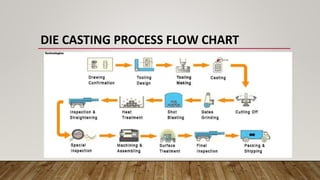
DIE CASTING PROCESS FLOW CHART
TYPES OF DIE CASTING
1. Gravity die casting
2. Pressure die casting
GRAVITY DIE CASTING
• Gravity die casting is also
know as parmanent mold
casting.
• Both ferrous or non-
ferrous metals Can be
casted.
PRESSURE DIE CASTING
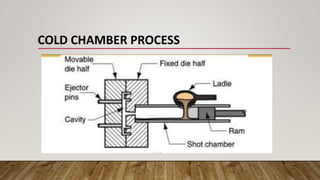
1. COLD CHAMBER PROCESS
• The metal is forced into the die casting at pressures usally ranging
form 20- 70 mpa, althought it may be as high as 150 mpa.
• The machince may be horizental as verticle.
• High melting paint alloys as alluminium, megnesium and copper are
normally cast by this mathod.
COLD CHAMBER PROCESS
PRESSURE DIE CASTING
2. HOT CHEMBER PROCESS
• In which the matal is held under perssure until it solidifies in the die.
• The present ranges upto 35 mpa, with as everage as about 15 mpa.
• Low melting paint alloys such zinc, tin and lead are commonly cast by
this process.
HOT CHAMBER PROCESS
ADVANTAGES
1. High producatin rate.
2. High accuracy in part dimensions.
3. Smooth surface finish for minimum mechanical finishing.
4. Ability to make many intricate part such as hole opening slat
trademark number etc.
5. Ability to cast inserts such as pins studs shafts, fasteners etc.
DISADVANTAGES
1. Hollow shapes are not readily casted because of high metal pressure.
2. Limited sizes of the products can be produced based on the
availability of the equipment.
3. High melting temp alloys are practically not die casted.
4. Flash is present except for very small zinc die casted.
5. Undercut can not be found in simple two piece dies.
THANK YOU

Casting process / Die casting process

  • 1.
    PRESENTATION ON DIE CASTINGPROCESS BY NAME :- LAXMAN KR. JHA S. NO :- 417325 G.SEC :- G2E
  • 2.
    CONTENTS 1. WHAT ISDIE CASTING 2. DIE CASTING PROCESS 3. TYPES OF DIE CASTING 4. ADVANTAGES 5. DISADVANTAGES
  • 3.
    WHAT IS DIECASTING • Die casting is assentialy parmament mold Casting in Which pressure force the molten into the mould cavity.
  • 4.
    DIE CASTING PROCESS •Die casting is a metal casting process that is characterized by forcing Molten metal under the high pressure into a mold cavity. • The mold cavity is created using two handened tool steel dies which have been machined into shape and work similarly to an injectian mold during the process.
  • 5.
  • 6.
    TYPES OF DIECASTING 1. Gravity die casting 2. Pressure die casting
  • 7.
    GRAVITY DIE CASTING •Gravity die casting is also know as parmanent mold casting. • Both ferrous or non- ferrous metals Can be casted.
  • 8.
    PRESSURE DIE CASTING 1.COLD CHAMBER PROCESS • The metal is forced into the die casting at pressures usally ranging form 20- 70 mpa, althought it may be as high as 150 mpa. • The machince may be horizental as verticle. • High melting paint alloys as alluminium, megnesium and copper are normally cast by this mathod.
  • 9.
  • 10.
    PRESSURE DIE CASTING 2.HOT CHEMBER PROCESS • In which the matal is held under perssure until it solidifies in the die. • The present ranges upto 35 mpa, with as everage as about 15 mpa. • Low melting paint alloys such zinc, tin and lead are commonly cast by this process.
  • 11.
  • 12.
    ADVANTAGES 1. High producatinrate. 2. High accuracy in part dimensions. 3. Smooth surface finish for minimum mechanical finishing. 4. Ability to make many intricate part such as hole opening slat trademark number etc. 5. Ability to cast inserts such as pins studs shafts, fasteners etc.
  • 13.
    DISADVANTAGES 1. Hollow shapesare not readily casted because of high metal pressure. 2. Limited sizes of the products can be produced based on the availability of the equipment. 3. High melting temp alloys are practically not die casted. 4. Flash is present except for very small zinc die casted. 5. Undercut can not be found in simple two piece dies.
  • 14.