MARKETING
DEFINITION
According to American Marketing Association (1948) -
"Marketing is the performance of business activities directed
toward, and incident to, the flow of goods and services from
producer to consumer or user.“
AMA (1960) - "Marketing is the performance of business
activities that direct the flow of goods and services from producer to
consumer or user.“
According to Kotler (2000) - "A societal process by which
individuals and groups obtain what they need and want through
creating, offering, and freely exchanging products and services of
value with others.“
According to AMA (2004) - "Marketing is an organisational
function and set of processes for creating, communicating and
delivering value to customers and for managing relationships in a
way that benefits both the organisation and the stakeholder."
What Is Marketing?
• Marketing is about identifying and meeting human and
social needs. One of the shortest good definitions of
marketing is “meeting needs profitably.” Marketing is
the activity, set of institutions, and processes for
creating, communicating, delivering, and exchanging
offerings that have value for customers, clients,
partners, and society at large.
• Marketing management is the art and science of
choosing target markets and getting, keeping, and
growing customers through creating, delivering, and
communicating superior customer value.
What Is Marketed?
1. GOODS Physical goods constitute the bulk of most countries’ production
and marketing efforts.
2. SERVICES As economies advance, a growing proportion of their activities
focuses on the production of services.
3. EVENTS Marketers promote time-based events, such as major trade
shows, artistic performances, and company anniversaries.
4. EXPERIENCES By orchestrating several services and goods, a firm can
create, stage, and market experiences
5. PERSONS Artists, musicians, CEOs, physicians, high-profile lawyers and
financiers, and other professionals all get help from celebrity marketers.
6. PLACES Cities, states, regions, and whole nations compete to attract
tourists, residents, factories, and company headquarters.
7. PROPERTIES Properties are intangible rights of ownership to either real
property (real estate) or financial property (stocks and bonds). They are
bought and sold, and these exchanges require marketing.
8. ORGANIZATIONS Organizations work to build a strong, favorable, and
unique image in the minds of their target publics.
9. INFORMATION The production, packaging, and distribution of
information are major industries.
10. IDEAS Every market offering includes a basic idea.
Who Markets?
MARKETERS AND PROSPECTS
 A marketer is someone who seeks a
response—attention, a purchase, a vote, a
donation—from another party, called the
prospect. If two parties are seeking to sell
something to each other, we call them both
marketers.
DEMAND STATES
1. Negative demand—Consumers dislike the product and
may even pay to avoid it.
2. Nonexistent demand—Consumers may be unaware of or
uninterested in the product.
3. Latent demand—Consumers may share a strong need
that cannot be satisfied by an existing product.
4. Declining demand—Consumers begin to buy the product
less frequently or not at all.
5. Irregular demand—Consumer purchases vary on a
seasonal, monthly, weekly, daily, or even hourly basis.
6. Full demand—Consumers are adequately buying all
products put into the marketplace.
7. Overfull demand—More consumers would like to buy the
product than can be satisfied.
8. Unwholesome demand—Consumers may be attracted to
products that have undesirable social consequences.
Structure of Flows in a Modern
Exchange Economy
A Simple Marketing System
KEY CUSTOMER MARKETS
1. Consumer Markets :- Companies selling mass consumer goods and
services.
2. Business Markets :- Companies selling business goods and services
3. Global Markets:- Companies in the global marketplace must decide
which countries to enter; how to enter each; how to adapt product and
service features to each country; how to price products in different
countries; and how to design communications for different cultures.
4. Non-profit and Governmental Markets:- Companies selling to non-profit
organizations with limited purchasing power such as churches,
universities, charitable organizations, and government agencies need to
price carefully.
Core Marketing Concepts
• Needs, Wants, and Demands Needs are the
basic human requirements such as for air,
food, water, clothing, and shelter. Humans
also have strong needs for recreation,
education, and entertainment. These needs
become wants. Demands are wants for
specific products backed by an ability to pay
TYPES OF NEEDS
1. Stated needs:- The customer wants an inexpensive
car.
2. Real needs:- The customer wants a car whose
operating cost, not initial price, is low
3. Unstated needs:- The customer expects good service
from the dealer.
4. Delight needs:- The customer would like the dealer to
include an onboard GPS navigation system.
5. Secret needs:- The customer wants friends to see him
or her as a savvy consumer.
Customer value triad
1. Quality
2. Service
3. Price
Value perceptions increase with quality and
service but decrease with price
Marketing Channels
1. Communication channels deliver and receive
messages from target buyers.
2. Distribution channels is used to display, sell,
or deliver the physical product or service(s)
to the buyer or user.
3. Service channels that include warehouses,
transportation companies, banks, and
insurance companies
Marketing Environment
• The Task environment includes the actors
engaged in producing, distributing, and
promoting the offering. These are the company,
suppliers, distributors, dealers, and target
customers.
• The broad environment consists of six
components: demographic environment,
economic environment, social-cultural
environment, natural environment, technological
environment, and political-legal environment.
The New Marketing Realities
• Network information technology
• Globalization
• Deregulation
• Privatization
• Heightened competition
• Industry convergence
• Retail transformation
• Disintermediation
• Consumer buying power
• Consumer information
• Consumer participation
• Consumer resistance
New Company Capabilities
• Marketers can use the Internet as a powerful information and sales
channel.
• Marketers can collect fuller and richer information about markets,
customers, prospects, and competitors
• Marketers can tap into social media to amplify their brand message
• Marketers can facilitate and speed external communication among
customers
• Marketers can send ads, coupons, samples, and information to
customers who have requested them or given the company
permission to send them.
• Marketers can reach consumers on the move with mobile marketing.
• Companies can make and sell individually differentiated goods.
• Companies can improve purchasing, recruiting, training, and internal
and external communications.
• Companies can facilitate and speed up internal communication
among their employees by using the Internet as a private intranet.
• Companies can improve their cost efficiency by skilful use of the
Internet
Evolution of earlier marketing ideas
1. The Production Concept:- The production concept is one of the
oldest concepts in business. It holds that consumers prefer
products that are widely available and inexpensive.
2. The Product Concept:- The product concept proposes that
consumers favour products offering the most quality,
performance, or innovative features.
3. The Selling Concept :- The selling concept holds that consumers
and businesses, if left alone, won’t buy enough of the
organization’s products.
4. The Marketing Concept:- The marketing concept holds that the
key to achieving organizational goals is being more effective than
competitors in creating, delivering, and communicating superior
customer value to your target markets.
5. The Holistic Marketing Concept:- The holistic marketing concept is
based on the development, design, and implementation of
marketing programs, processes, and activities that recognize their
breadth and interdependencies.
Holistic Marketing Dimensions
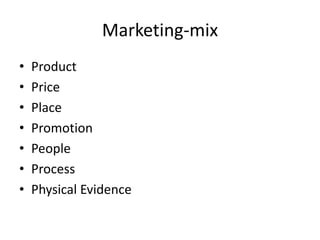
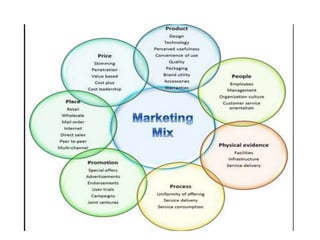
Marketing-mix
• Product
• Price
• Place
• Promotion
• People
• Process
• Physical Evidence
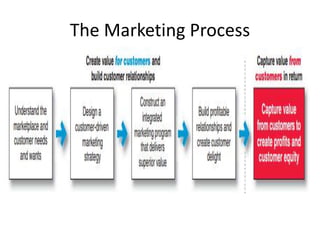
The Marketing Process
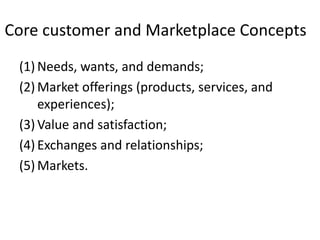
Core customer and Marketplace Concepts
(1) Needs, wants, and demands;
(2) Market offerings (products, services, and
experiences);
(3) Value and satisfaction;
(4) Exchanges and relationships;
(5) Markets.
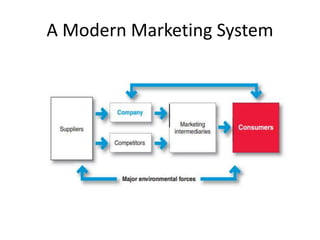
A Modern Marketing System
Selling and Marketing Concepts
Contrasted
Three Considerations Underlying the
Societal Marketing Concept
Customer relationship management
The overall process of building and
maintaining profitable customer relationships by
delivering superior customer value and
satisfaction.
 Customer-perceived value:-The customer’s
evaluation of the difference between all the
benefits and all the costs of a marketing offer
relative to those of competing offers.
 Customer satisfaction:- The extent to which a
product’s perceived performance matches a
buyer’s expectations
An Expanded Model of the Marketing Process
Classification of Marketing
1. Macro marketing Versus Micromarketing
2. Service Marketing Versus Goods Marketing
3. For-profit Marketing Versus Nonprofit Marketing
4. Mass Marketing, Direct Marketing, and Internet
Marketing
5. Local, Regional, National, International, and
Global Marketers
6. Consumer Goods Marketing and Business-to-
Business (Industrial) Marketing
KEYS TO MARKETING SUCCESS
1. To realize that establishing customer satisfaction
should be the company's number-one priority.
2. to establish a company image that clearly reflects the
values and aspirations of the company to employees,
customers, intermediaries, and the general public.
3. Marketing is the aspect of the business that
customers see.
4. The business should develop a unique strategy that is
consistent with the circumstances that it faces.
5. Technological progress dictates how marketing will be
performed in the future.
THE MARKET
A group of potential buyers with needs
and wants and the purchasing power to satisfy
them.
The Market Is People
The Market Is a Place
The Market Is an Economic Entity
TYPES OF MARKETS
(1) Consumer markets.
(2) Industrial markets.
(3) Institutional markets.
(4) Reseller markets.
For a product provider, the person(s) or
organization(s) selected as potential customers are
referred to as the target market.

Marketing part i

  • 1.
  • 2.
    DEFINITION According to AmericanMarketing Association (1948) - "Marketing is the performance of business activities directed toward, and incident to, the flow of goods and services from producer to consumer or user.“ AMA (1960) - "Marketing is the performance of business activities that direct the flow of goods and services from producer to consumer or user.“ According to Kotler (2000) - "A societal process by which individuals and groups obtain what they need and want through creating, offering, and freely exchanging products and services of value with others.“ According to AMA (2004) - "Marketing is an organisational function and set of processes for creating, communicating and delivering value to customers and for managing relationships in a way that benefits both the organisation and the stakeholder."
  • 3.
    What Is Marketing? •Marketing is about identifying and meeting human and social needs. One of the shortest good definitions of marketing is “meeting needs profitably.” Marketing is the activity, set of institutions, and processes for creating, communicating, delivering, and exchanging offerings that have value for customers, clients, partners, and society at large. • Marketing management is the art and science of choosing target markets and getting, keeping, and growing customers through creating, delivering, and communicating superior customer value.
  • 4.
    What Is Marketed? 1.GOODS Physical goods constitute the bulk of most countries’ production and marketing efforts. 2. SERVICES As economies advance, a growing proportion of their activities focuses on the production of services. 3. EVENTS Marketers promote time-based events, such as major trade shows, artistic performances, and company anniversaries. 4. EXPERIENCES By orchestrating several services and goods, a firm can create, stage, and market experiences 5. PERSONS Artists, musicians, CEOs, physicians, high-profile lawyers and financiers, and other professionals all get help from celebrity marketers. 6. PLACES Cities, states, regions, and whole nations compete to attract tourists, residents, factories, and company headquarters. 7. PROPERTIES Properties are intangible rights of ownership to either real property (real estate) or financial property (stocks and bonds). They are bought and sold, and these exchanges require marketing. 8. ORGANIZATIONS Organizations work to build a strong, favorable, and unique image in the minds of their target publics. 9. INFORMATION The production, packaging, and distribution of information are major industries. 10. IDEAS Every market offering includes a basic idea.
  • 5.
    Who Markets? MARKETERS ANDPROSPECTS  A marketer is someone who seeks a response—attention, a purchase, a vote, a donation—from another party, called the prospect. If two parties are seeking to sell something to each other, we call them both marketers.
  • 6.
    DEMAND STATES 1. Negativedemand—Consumers dislike the product and may even pay to avoid it. 2. Nonexistent demand—Consumers may be unaware of or uninterested in the product. 3. Latent demand—Consumers may share a strong need that cannot be satisfied by an existing product. 4. Declining demand—Consumers begin to buy the product less frequently or not at all. 5. Irregular demand—Consumer purchases vary on a seasonal, monthly, weekly, daily, or even hourly basis. 6. Full demand—Consumers are adequately buying all products put into the marketplace. 7. Overfull demand—More consumers would like to buy the product than can be satisfied. 8. Unwholesome demand—Consumers may be attracted to products that have undesirable social consequences.
  • 7.
    Structure of Flowsin a Modern Exchange Economy
  • 8.
  • 9.
    KEY CUSTOMER MARKETS 1.Consumer Markets :- Companies selling mass consumer goods and services. 2. Business Markets :- Companies selling business goods and services 3. Global Markets:- Companies in the global marketplace must decide which countries to enter; how to enter each; how to adapt product and service features to each country; how to price products in different countries; and how to design communications for different cultures. 4. Non-profit and Governmental Markets:- Companies selling to non-profit organizations with limited purchasing power such as churches, universities, charitable organizations, and government agencies need to price carefully.
  • 10.
    Core Marketing Concepts •Needs, Wants, and Demands Needs are the basic human requirements such as for air, food, water, clothing, and shelter. Humans also have strong needs for recreation, education, and entertainment. These needs become wants. Demands are wants for specific products backed by an ability to pay
  • 11.
    TYPES OF NEEDS 1.Stated needs:- The customer wants an inexpensive car. 2. Real needs:- The customer wants a car whose operating cost, not initial price, is low 3. Unstated needs:- The customer expects good service from the dealer. 4. Delight needs:- The customer would like the dealer to include an onboard GPS navigation system. 5. Secret needs:- The customer wants friends to see him or her as a savvy consumer.
  • 12.
    Customer value triad 1.Quality 2. Service 3. Price Value perceptions increase with quality and service but decrease with price
  • 13.
    Marketing Channels 1. Communicationchannels deliver and receive messages from target buyers. 2. Distribution channels is used to display, sell, or deliver the physical product or service(s) to the buyer or user. 3. Service channels that include warehouses, transportation companies, banks, and insurance companies
  • 14.
    Marketing Environment • TheTask environment includes the actors engaged in producing, distributing, and promoting the offering. These are the company, suppliers, distributors, dealers, and target customers. • The broad environment consists of six components: demographic environment, economic environment, social-cultural environment, natural environment, technological environment, and political-legal environment.
  • 15.
    The New MarketingRealities • Network information technology • Globalization • Deregulation • Privatization • Heightened competition • Industry convergence • Retail transformation • Disintermediation • Consumer buying power • Consumer information • Consumer participation • Consumer resistance
  • 16.
    New Company Capabilities •Marketers can use the Internet as a powerful information and sales channel. • Marketers can collect fuller and richer information about markets, customers, prospects, and competitors • Marketers can tap into social media to amplify their brand message • Marketers can facilitate and speed external communication among customers • Marketers can send ads, coupons, samples, and information to customers who have requested them or given the company permission to send them. • Marketers can reach consumers on the move with mobile marketing. • Companies can make and sell individually differentiated goods. • Companies can improve purchasing, recruiting, training, and internal and external communications. • Companies can facilitate and speed up internal communication among their employees by using the Internet as a private intranet. • Companies can improve their cost efficiency by skilful use of the Internet
  • 17.
    Evolution of earliermarketing ideas 1. The Production Concept:- The production concept is one of the oldest concepts in business. It holds that consumers prefer products that are widely available and inexpensive. 2. The Product Concept:- The product concept proposes that consumers favour products offering the most quality, performance, or innovative features. 3. The Selling Concept :- The selling concept holds that consumers and businesses, if left alone, won’t buy enough of the organization’s products. 4. The Marketing Concept:- The marketing concept holds that the key to achieving organizational goals is being more effective than competitors in creating, delivering, and communicating superior customer value to your target markets. 5. The Holistic Marketing Concept:- The holistic marketing concept is based on the development, design, and implementation of marketing programs, processes, and activities that recognize their breadth and interdependencies.
  • 18.
  • 19.
    Marketing-mix • Product • Price •Place • Promotion • People • Process • Physical Evidence
  • 21.
  • 22.
    Core customer andMarketplace Concepts (1) Needs, wants, and demands; (2) Market offerings (products, services, and experiences); (3) Value and satisfaction; (4) Exchanges and relationships; (5) Markets.
  • 23.
  • 24.
    Selling and MarketingConcepts Contrasted
  • 25.
    Three Considerations Underlyingthe Societal Marketing Concept
  • 26.
    Customer relationship management Theoverall process of building and maintaining profitable customer relationships by delivering superior customer value and satisfaction.  Customer-perceived value:-The customer’s evaluation of the difference between all the benefits and all the costs of a marketing offer relative to those of competing offers.  Customer satisfaction:- The extent to which a product’s perceived performance matches a buyer’s expectations
  • 27.
    An Expanded Modelof the Marketing Process
  • 28.
    Classification of Marketing 1.Macro marketing Versus Micromarketing 2. Service Marketing Versus Goods Marketing 3. For-profit Marketing Versus Nonprofit Marketing 4. Mass Marketing, Direct Marketing, and Internet Marketing 5. Local, Regional, National, International, and Global Marketers 6. Consumer Goods Marketing and Business-to- Business (Industrial) Marketing
  • 29.
    KEYS TO MARKETINGSUCCESS 1. To realize that establishing customer satisfaction should be the company's number-one priority. 2. to establish a company image that clearly reflects the values and aspirations of the company to employees, customers, intermediaries, and the general public. 3. Marketing is the aspect of the business that customers see. 4. The business should develop a unique strategy that is consistent with the circumstances that it faces. 5. Technological progress dictates how marketing will be performed in the future.
  • 30.
    THE MARKET A groupof potential buyers with needs and wants and the purchasing power to satisfy them. The Market Is People The Market Is a Place The Market Is an Economic Entity
  • 31.
    TYPES OF MARKETS (1)Consumer markets. (2) Industrial markets. (3) Institutional markets. (4) Reseller markets. For a product provider, the person(s) or organization(s) selected as potential customers are referred to as the target market.