DevOps and Groupthink
October 23,
An Oxymoron?
by
Gerie Owen
Gerie
Owen
• Test Manager, Test Lead, Tester
• Subject expert on testing for
TechTarget’s
SearchSoftwareQuality.com
• International and Domestic
Conference Presenter
• Marathon Runner & Running
Coach
• Cat Mom
www.qualitestgroup.com
gowen@qualitestgroup.com
2
Once Upon A Time...
What is Groupthink?
|Groupthink - A mode of thinking that people engage
in when they are deeply involved in a cohesive in-
group, when the members' strivings for unanimity
override their motivation to realistically appraise
alternative courses of action.
- Irving Janis. Victims of Groupthink. 1972, p. 9
What is Groupthink?
Characteristics of Groupthink
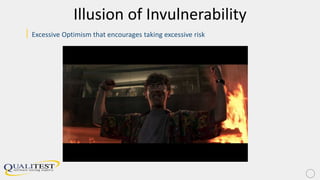
Illusion of Invulnerability
| Excessive Optimism that encourages taking excessive risk
Collective Rationalization
| Groups fail to reconsider assumptions and minimize warnings
Belief in Inherent Morality
| Groups believe in the rightness of their cause to the exclusion of ethical consequences
Stereotyped Outgroups
| Groups fail to consider the views of those members who are different from the norm.
Direct Pressure on Dissenters
| Dissenting team members are expected to conform or face consequences including
status degradation, expulsion from group or isolation
Self-Censorship
| Group members fail to express their own doubts and dissenting opinions, sabotaging
critical analysis
Illusion of Unanimity
| Teams assume the majority view is unanimous
An Oxymoron?
| DevOps is based on a culture of collaboration
| DevOps team members come from different and opposite disciplines
| However:
| Team members may have biases and fixed mindsets based on their respective areas of
expertise
| Team members from opposite disciplines may become polarized
| Informal leaders emerge
Groupthink in DevOps Teams
|The illusion of invulnerability
|The team is consistently in agreement with little discussion.
|Collective rationalization and self-censorship during meetings and
team discussions
How does Groupthink Happen?
| Informational Signals
| Group members withhold differing information
out of respect for information that has already
been provided
| Social Pressures
| Group members withhold contradictory
information because they fear disapproval or
sanctions
| Influence of Strong Leaders
Why does Groupthink Happen?
| Group members’ mindsets impede critical thinking
| Group interaction amplifies individual biases
| Group Discussions dissolve into Deliberation Failures
What is a mindset?
|Developed by psychologist Carol Dweck
|How we mentally approach life and its challenges
|Why brains and talent don’t bring success
|How they can stand in the way of it
|Why praising brains and talent doesn’t foster self-esteem and
accomplishment, but jeopardizes them
What is a mindset
|Broadly categorized in one of two ways
|Fixed
|Growth
Characteristics of a fixed mindset
| We are either smart or dumb
| We have to continually prove ourselves
| Failure is a personal reflection on our intelligence
Implications of a fixed mindset
|“I did my job right; someone else screwed up”
|“These builds negatively impact network resources”
|“The network needs to be able to handle these builds”
Characteristics of a growth mindset
| We can work to improve our intelligence and abilities
| What we have now is only a starting point
| We accept failure as a learning process
Implications of a growth mindset
|“I always have more to learn”
|“We can work together to make code changes without
impacting stability and reliability”
Fixed mindsets can lead to
groupthink
Group Interactions Amplify Biases
| Representativeness
| People make judgements about situations based
upon on similar the situation under consideration
is to others that they have experienced.
| Confirmation Bias
| People weigh more heavily information which
supports what they already believe to be true.
Failures in Deliberation
|Cascade Effect
|Polarization
Cascade Effect
| Because of the human desire to conform, group members will agree with the views of
the initial speakers without critically assessing their own and later speakers ideas.
Polarization
| Group members may start out with moderate views on an issue but as opposite points
of view emerge, moderate views tend to move to extremes as members focus on
only the information supporting their initial view.
Managing Groupthink
| Individually
| Manage our own biases and mindsets
| Internally
| From within the team
| Externally
| From outside the team
Managing Groupthink Individually
| Listen to team members
| Listen 80% of the time, talk 20%
| Listen to yourself
| Be the Anxious Leader
| What bothers you about this decision?
| Voice it!
| Manage Your Own Mindset
Manage Groupthink Internally
| Build a Diverse Team
| Establish a Group “Growth” Mindset
| Withhold discussion until each team member has given their opinion
| Appoint a “devil’s advocate” to help the group critically examine all decisions.
Managing Groupthink Externally
|Container
|Difference
|Exchange
Container Difference Exchange Theory
|Managers can influence the team’s self organization
|Glenda Eoyang based CDE theory on organizational behavior
|Container Difference and Exchange are factors that influence teams
| How a team self-organizes
| Thinks, and
| Acts as a group
The Container
|The container creates the bounds within which the
system forms
|DevOps Team Containers:
| Physical space
| Scope of Responsibility of the team
| Size of the team
The Difference
|Difference refers to the individual characteristics of the team
members and this affects the team’s interactions.
|DevOps Team Differences:
| Technical backgrounds and specializations of the developers and operations staff
| Domain knowledge, length of service
• gender, education
| Individuals mindsets and biases
The Exchange
|The exchange is how the group members interact among
themselves and with their stakeholders
|DevOps Team Exchanges:
• Who provides and receives information
• How information is provided and received
Using CDE…Evaluate the Factors
| What containers, differences and exchanges affect the team?
| Are these containers, differences and exchanges appropriate in terms of size, scope,
level of influence?
| What impact does each container, difference and exchanges have on the team?
| Is the impact positive, negative, neutral?
| What container, difference or exchange is causing the biggest negative impact?
| What change or changes can be made to that container/difference/exchange?
Examples of CDE
| Changing the Container
| Professional Community: Groupthink may be occurring because the team is not exposed to cutting edge
ideas on testing
| Send team members to conferences, user groups etc. to instill the importance of quality
| Changing the Difference
| Groupthink may be happening because one team members has a strong personality and is not committed
to quality and others won’t express opposing opinions.
| Add an equally strong-willed team member or remove the team member from the team.
| Changing the Exchange:
| Groupthink may be happening because the team is not getting enough feedback on quality in the sprint
reviews.
| Make sure the stakeholders to whom quality is most important are invited to the sprint review meetings
Why Mitigate Groupthink in DevOps?
| Inhibits the DevOps Principles of
Communication and Transparency
| Impedes DevOps Transformations
| Limits innovative solutions that can come
from the cross-functional nature of DevOps
Teams
41
Summary
| Groupthink is a danger for any specialized and close-knit group
| When DevOps teams engage in groupthink, continuous integration may be
compromised.
| Managers and leaders can counteract groupthink by using CDE to influence the team’s
self-organization
| Collaborate as a group, but think as an individual
References:
Mindset: The New Psychology of Success, Dweck, 2006.
Facilitating Organizational Change, Olson and Eoyang, 2001.
Thinking Fast and Slow, Kahneman, 2011
Victims of Groupthink, Janis, 1972
Wiser: Getting Beyond Groupthink to Make Groups Smarter, Sunstein and Hastie, 2015

DevOps and Groupthink An Oxymoron?

  • 1.
    DevOps and Groupthink October23, An Oxymoron? by Gerie Owen
  • 2.
    Gerie Owen • Test Manager,Test Lead, Tester • Subject expert on testing for TechTarget’s SearchSoftwareQuality.com • International and Domestic Conference Presenter • Marathon Runner & Running Coach • Cat Mom www.qualitestgroup.com gowen@qualitestgroup.com 2
  • 3.
    Once Upon ATime...
  • 6.
    What is Groupthink? |Groupthink- A mode of thinking that people engage in when they are deeply involved in a cohesive in- group, when the members' strivings for unanimity override their motivation to realistically appraise alternative courses of action. - Irving Janis. Victims of Groupthink. 1972, p. 9
  • 7.
  • 8.
  • 9.
    Illusion of Invulnerability |Excessive Optimism that encourages taking excessive risk
  • 10.
    Collective Rationalization | Groupsfail to reconsider assumptions and minimize warnings
  • 11.
    Belief in InherentMorality | Groups believe in the rightness of their cause to the exclusion of ethical consequences
  • 12.
    Stereotyped Outgroups | Groupsfail to consider the views of those members who are different from the norm.
  • 13.
    Direct Pressure onDissenters | Dissenting team members are expected to conform or face consequences including status degradation, expulsion from group or isolation
  • 14.
    Self-Censorship | Group membersfail to express their own doubts and dissenting opinions, sabotaging critical analysis
  • 15.
    Illusion of Unanimity |Teams assume the majority view is unanimous
  • 16.
    An Oxymoron? | DevOpsis based on a culture of collaboration | DevOps team members come from different and opposite disciplines | However: | Team members may have biases and fixed mindsets based on their respective areas of expertise | Team members from opposite disciplines may become polarized | Informal leaders emerge
  • 17.
    Groupthink in DevOpsTeams |The illusion of invulnerability |The team is consistently in agreement with little discussion. |Collective rationalization and self-censorship during meetings and team discussions
  • 18.
    How does GroupthinkHappen? | Informational Signals | Group members withhold differing information out of respect for information that has already been provided | Social Pressures | Group members withhold contradictory information because they fear disapproval or sanctions | Influence of Strong Leaders
  • 19.
    Why does GroupthinkHappen? | Group members’ mindsets impede critical thinking | Group interaction amplifies individual biases | Group Discussions dissolve into Deliberation Failures
  • 20.
    What is amindset? |Developed by psychologist Carol Dweck |How we mentally approach life and its challenges |Why brains and talent don’t bring success |How they can stand in the way of it |Why praising brains and talent doesn’t foster self-esteem and accomplishment, but jeopardizes them
  • 21.
    What is amindset |Broadly categorized in one of two ways |Fixed |Growth
  • 22.
    Characteristics of afixed mindset | We are either smart or dumb | We have to continually prove ourselves | Failure is a personal reflection on our intelligence
  • 23.
    Implications of afixed mindset |“I did my job right; someone else screwed up” |“These builds negatively impact network resources” |“The network needs to be able to handle these builds”
  • 24.
    Characteristics of agrowth mindset | We can work to improve our intelligence and abilities | What we have now is only a starting point | We accept failure as a learning process
  • 25.
    Implications of agrowth mindset |“I always have more to learn” |“We can work together to make code changes without impacting stability and reliability”
  • 26.
    Fixed mindsets canlead to groupthink
  • 27.
    Group Interactions AmplifyBiases | Representativeness | People make judgements about situations based upon on similar the situation under consideration is to others that they have experienced. | Confirmation Bias | People weigh more heavily information which supports what they already believe to be true.
  • 28.
  • 29.
    Cascade Effect | Becauseof the human desire to conform, group members will agree with the views of the initial speakers without critically assessing their own and later speakers ideas.
  • 30.
    Polarization | Group membersmay start out with moderate views on an issue but as opposite points of view emerge, moderate views tend to move to extremes as members focus on only the information supporting their initial view.
  • 31.
    Managing Groupthink | Individually |Manage our own biases and mindsets | Internally | From within the team | Externally | From outside the team
  • 32.
    Managing Groupthink Individually |Listen to team members | Listen 80% of the time, talk 20% | Listen to yourself | Be the Anxious Leader | What bothers you about this decision? | Voice it! | Manage Your Own Mindset
  • 33.
    Manage Groupthink Internally |Build a Diverse Team | Establish a Group “Growth” Mindset | Withhold discussion until each team member has given their opinion | Appoint a “devil’s advocate” to help the group critically examine all decisions.
  • 34.
  • 35.
    Container Difference ExchangeTheory |Managers can influence the team’s self organization |Glenda Eoyang based CDE theory on organizational behavior |Container Difference and Exchange are factors that influence teams | How a team self-organizes | Thinks, and | Acts as a group
  • 36.
    The Container |The containercreates the bounds within which the system forms |DevOps Team Containers: | Physical space | Scope of Responsibility of the team | Size of the team
  • 37.
    The Difference |Difference refersto the individual characteristics of the team members and this affects the team’s interactions. |DevOps Team Differences: | Technical backgrounds and specializations of the developers and operations staff | Domain knowledge, length of service • gender, education | Individuals mindsets and biases
  • 38.
    The Exchange |The exchangeis how the group members interact among themselves and with their stakeholders |DevOps Team Exchanges: • Who provides and receives information • How information is provided and received
  • 39.
    Using CDE…Evaluate theFactors | What containers, differences and exchanges affect the team? | Are these containers, differences and exchanges appropriate in terms of size, scope, level of influence? | What impact does each container, difference and exchanges have on the team? | Is the impact positive, negative, neutral? | What container, difference or exchange is causing the biggest negative impact? | What change or changes can be made to that container/difference/exchange?
  • 40.
    Examples of CDE |Changing the Container | Professional Community: Groupthink may be occurring because the team is not exposed to cutting edge ideas on testing | Send team members to conferences, user groups etc. to instill the importance of quality | Changing the Difference | Groupthink may be happening because one team members has a strong personality and is not committed to quality and others won’t express opposing opinions. | Add an equally strong-willed team member or remove the team member from the team. | Changing the Exchange: | Groupthink may be happening because the team is not getting enough feedback on quality in the sprint reviews. | Make sure the stakeholders to whom quality is most important are invited to the sprint review meetings
  • 41.
    Why Mitigate Groupthinkin DevOps? | Inhibits the DevOps Principles of Communication and Transparency | Impedes DevOps Transformations | Limits innovative solutions that can come from the cross-functional nature of DevOps Teams 41
  • 42.
    Summary | Groupthink isa danger for any specialized and close-knit group | When DevOps teams engage in groupthink, continuous integration may be compromised. | Managers and leaders can counteract groupthink by using CDE to influence the team’s self-organization | Collaborate as a group, but think as an individual
  • 43.
    References: Mindset: The NewPsychology of Success, Dweck, 2006. Facilitating Organizational Change, Olson and Eoyang, 2001. Thinking Fast and Slow, Kahneman, 2011 Victims of Groupthink, Janis, 1972 Wiser: Getting Beyond Groupthink to Make Groups Smarter, Sunstein and Hastie, 2015

Editor's Notes

  • #7 The development of a group’s norms tends to place limits around the independent and creative thinking Group analysis may be biased Which could lead to poor decisions An agile team made the decision to user the F word on a mobile app. This decision probably wouldn’t have been made if there were more open discussion among the team members.
  • #9 Groupthink has some very specific characteristics; let’s look at each.
  • #20 Let’s talk a bit about each of these
  • #23 Can you think on someone who has a fixed mindset?
  • #24 In a DevOps team, a team member with a fixed mindset will try to protect themselves by saying the issue is caused by others. So if a developer has a fixed mindset, he may say the problem is with infrastructure or network or that the testers didn’t find the bug.
  • #25 Can you think of someone who has a growth mindset?
  • #27 And of course, if the team has more members with growth mindsets, they are more likely to respect and challenge each other’s opinions.
  • #28 Biases are our predispositions to think in certain ways.
  • #30 Story pointing
  • #31 Group polarization can be a result of cascades
  • #39 For example: Active and respectful or Passive and dismissing
  • #40 Groupthink may be happening because one developer has a strong personality and is not committed to quality and others won’t express opposing opinions. Add an equally strong-willed team member or remove the developer from the team.