MILLING OF WHEAT
BY - P R AV E E N S A I N I
WHEAT GRAIN AND ITS COMPOSITION
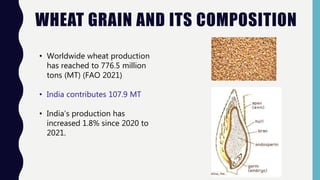
• Worldwide wheat production
has reached to 776.5 million
tons (MT) (FAO 2021)
• India contributes 107.9 MT
• India’s production has
increased 1.8% since 2020 to
2021.
WHEAT MILLING METHODS
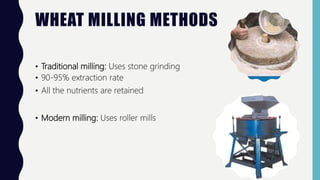
• Traditional milling: Uses stone grinding
• 90-95% extraction rate
• All the nutrients are retained
• Modern milling: Uses roller mills
A ROLLER MILL
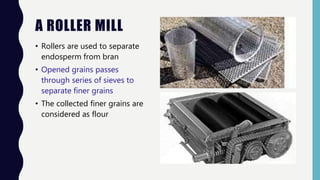
• Rollers are used to separate
endosperm from bran
• Opened grains passes
through series of sieves to
separate finer grains
• The collected finer grains are
considered as flour
MODERN INDUSTRIAL MILLING STEPS
 Raw material receiving & sampling
• Quality
• Quantity
• Samples to determine overall state of material
 Storage & handling
• According to state material is stored
• Fumigation (if needed)
 Mixing
STEPS OF MILLING
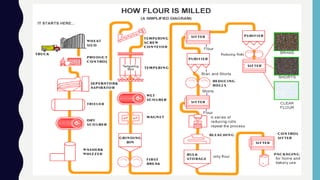
 Cleaning
Magnetic separator: Separates metallic impurities
Separator: Uses vibrating screens
Aspirator: Uses vacuum
De-stoner: Uses gravity to separate heavy from light
Disc separator: On the basis of shape
Scourer: Scouring action to remove dust from crease
STEPS OF MILLING
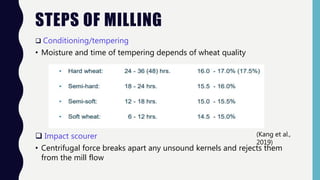
 Conditioning/tempering
• Moisture and time of tempering depends of wheat quality
 Impact scourer
• Centrifugal force breaks apart any unsound kernels and rejects them
from the mill flow
(Kang et al.,
2019)
STEPS OF MILLING
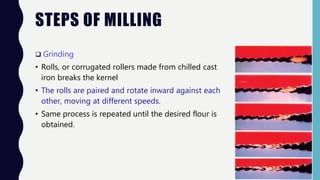
 Grinding
• Rolls, or corrugated rollers made from chilled cast
iron breaks the kernel
• The rolls are paired and rotate inward against each
other, moving at different speeds.
• Same process is repeated until the desired flour is
obtained.
STEPS OF MILLING
 Sifters
• Huge, rotating, box-like sifters shakes the ground through a series of
screens to separate the larger from the smaller particles.
Purifiers
• A controlled flow of air lifts off bran particles while at the same time a
bolting cloth separates and grades coarser fractions by size and
STEPS OF MILLING
 Repetition
• The process is repeated over and over again, sifters to purifiers to
reducing rolls, until the maximum amount of flour is separated
• The remaining percentage of the wheat kernel is classified as mill feed-
shorts, bran and germ.
 Filling &Packaging
• Finally packed into bags or bulk stored
WHEAT MILLING COMPONENTS
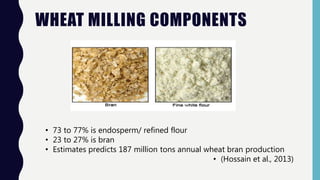
• 73 to 77% is endosperm/ refined flour
• 23 to 27% is bran
• Estimates predicts 187 million tons annual wheat bran production
• (Hossain et al., 2013)
WHEAT MILLING INDUSTRY
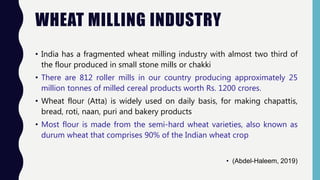
• India has a fragmented wheat milling industry with almost two third of
the flour produced in small stone mills or chakki
• There are 812 roller mills in our country producing approximately 25
million tonnes of milled cereal products worth Rs. 1200 crores.
• Wheat flour (Atta) is widely used on daily basis, for making chapattis,
bread, roti, naan, puri and bakery products
• Most flour is made from the semi-hard wheat varieties, also known as
durum wheat that comprises 90% of the Indian wheat crop
• (Abdel-Haleem, 2019)
WHEAT MILLING INDUSTRY
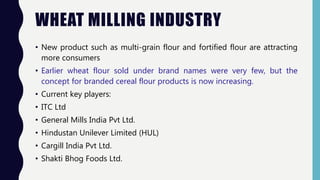
• New product such as multi-grain flour and fortified flour are attracting
more consumers
• Earlier wheat flour sold under brand names were very few, but the
concept for branded cereal flour products is now increasing.
• Current key players:
• ITC Ltd
• General Mills India Pvt Ltd.
• Hindustan Unilever Limited (HUL)
• Cargill India Pvt Ltd.
• Shakti Bhog Foods Ltd.
OPPORTUNITIES
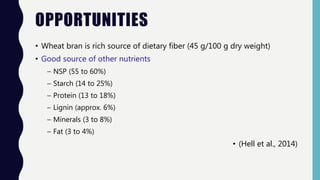
• Wheat bran is rich source of dietary fiber (45 g/100 g dry weight)
• Good source of other nutrients
– NSP (55 to 60%)
– Starch (14 to 25%)
– Protein (13 to 18%)
– Lignin (approx. 6%)
– Minerals (3 to 8%)
– Fat (3 to 4%)
• (Hell et al., 2014)
MARKET GROWTH DRIVERS
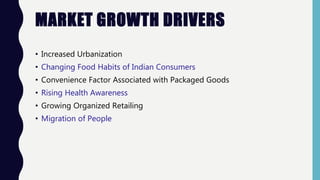
• Increased Urbanization
• Changing Food Habits of Indian Consumers
• Convenience Factor Associated with Packaged Goods
• Rising Health Awareness
• Growing Organized Retailing
• Migration of People
MARKET CHALLENGES
• Consumer Perception
• Product Packaging & Supply Chain Management
• Establishing Strong Distribution Network
• Regulatory Environment
REFERENCES
• Food and Agriculture Organization of the United Nations (FAO). 2021. Crop prospects and food
situation—No. 4 December 2021. Accessed January 2022.
• Hossain, K., Ulven, C., Glover, K., Ghavami, F., Simsek, S., Alamri, M. S., ... & Mergoum, M. (2013).
Interdependence of cultivar and environment on fiber composition in wheat bran. Australian Journal of
Crop Science, 7(4), 525.
• Hell, J., Kneifel, W., Rosenau, T., & Boehmdorfer, S. (2014). Analytical techniques for the elucidation of
wheat bran constituents and their structural features with emphasis on dietary fiber–A review. Trends in
food science & technology, 35(2), 102-113.
• Kang, M. J., Kim, M. J., Kwak, H. S., & Kim, S. S. (2019). Effects of milling methods and cultivars on
physicochemical properties of whole-wheat flour. Journal of Food Quality, 2019.
• Abdel-Haleem, A. M. (2019). Influence of heat treatment for some wheat milling fractions on fino bread
quality. Journal of food science and technology, 56(5), 2639-2650
THANKS

Wheat milling and bran.pptx

  • 1.
    MILLING OF WHEAT BY- P R AV E E N S A I N I
  • 2.
    WHEAT GRAIN ANDITS COMPOSITION • Worldwide wheat production has reached to 776.5 million tons (MT) (FAO 2021) • India contributes 107.9 MT • India’s production has increased 1.8% since 2020 to 2021.
  • 3.
    WHEAT MILLING METHODS •Traditional milling: Uses stone grinding • 90-95% extraction rate • All the nutrients are retained • Modern milling: Uses roller mills
  • 4.
    A ROLLER MILL •Rollers are used to separate endosperm from bran • Opened grains passes through series of sieves to separate finer grains • The collected finer grains are considered as flour
  • 5.
    MODERN INDUSTRIAL MILLINGSTEPS  Raw material receiving & sampling • Quality • Quantity • Samples to determine overall state of material  Storage & handling • According to state material is stored • Fumigation (if needed)  Mixing
  • 6.
    STEPS OF MILLING Cleaning Magnetic separator: Separates metallic impurities Separator: Uses vibrating screens Aspirator: Uses vacuum De-stoner: Uses gravity to separate heavy from light Disc separator: On the basis of shape Scourer: Scouring action to remove dust from crease
  • 7.
    STEPS OF MILLING Conditioning/tempering • Moisture and time of tempering depends of wheat quality  Impact scourer • Centrifugal force breaks apart any unsound kernels and rejects them from the mill flow (Kang et al., 2019)
  • 8.
    STEPS OF MILLING Grinding • Rolls, or corrugated rollers made from chilled cast iron breaks the kernel • The rolls are paired and rotate inward against each other, moving at different speeds. • Same process is repeated until the desired flour is obtained.
  • 9.
    STEPS OF MILLING Sifters • Huge, rotating, box-like sifters shakes the ground through a series of screens to separate the larger from the smaller particles. Purifiers • A controlled flow of air lifts off bran particles while at the same time a bolting cloth separates and grades coarser fractions by size and
  • 10.
    STEPS OF MILLING Repetition • The process is repeated over and over again, sifters to purifiers to reducing rolls, until the maximum amount of flour is separated • The remaining percentage of the wheat kernel is classified as mill feed- shorts, bran and germ.  Filling &Packaging • Finally packed into bags or bulk stored
  • 12.
    WHEAT MILLING COMPONENTS •73 to 77% is endosperm/ refined flour • 23 to 27% is bran • Estimates predicts 187 million tons annual wheat bran production • (Hossain et al., 2013)
  • 13.
    WHEAT MILLING INDUSTRY •India has a fragmented wheat milling industry with almost two third of the flour produced in small stone mills or chakki • There are 812 roller mills in our country producing approximately 25 million tonnes of milled cereal products worth Rs. 1200 crores. • Wheat flour (Atta) is widely used on daily basis, for making chapattis, bread, roti, naan, puri and bakery products • Most flour is made from the semi-hard wheat varieties, also known as durum wheat that comprises 90% of the Indian wheat crop • (Abdel-Haleem, 2019)
  • 14.
    WHEAT MILLING INDUSTRY •New product such as multi-grain flour and fortified flour are attracting more consumers • Earlier wheat flour sold under brand names were very few, but the concept for branded cereal flour products is now increasing. • Current key players: • ITC Ltd • General Mills India Pvt Ltd. • Hindustan Unilever Limited (HUL) • Cargill India Pvt Ltd. • Shakti Bhog Foods Ltd.
  • 15.
    OPPORTUNITIES • Wheat branis rich source of dietary fiber (45 g/100 g dry weight) • Good source of other nutrients – NSP (55 to 60%) – Starch (14 to 25%) – Protein (13 to 18%) – Lignin (approx. 6%) – Minerals (3 to 8%) – Fat (3 to 4%) • (Hell et al., 2014)
  • 16.
    MARKET GROWTH DRIVERS •Increased Urbanization • Changing Food Habits of Indian Consumers • Convenience Factor Associated with Packaged Goods • Rising Health Awareness • Growing Organized Retailing • Migration of People
  • 17.
    MARKET CHALLENGES • ConsumerPerception • Product Packaging & Supply Chain Management • Establishing Strong Distribution Network • Regulatory Environment
  • 18.
    REFERENCES • Food andAgriculture Organization of the United Nations (FAO). 2021. Crop prospects and food situation—No. 4 December 2021. Accessed January 2022. • Hossain, K., Ulven, C., Glover, K., Ghavami, F., Simsek, S., Alamri, M. S., ... & Mergoum, M. (2013). Interdependence of cultivar and environment on fiber composition in wheat bran. Australian Journal of Crop Science, 7(4), 525. • Hell, J., Kneifel, W., Rosenau, T., & Boehmdorfer, S. (2014). Analytical techniques for the elucidation of wheat bran constituents and their structural features with emphasis on dietary fiber–A review. Trends in food science & technology, 35(2), 102-113. • Kang, M. J., Kim, M. J., Kwak, H. S., & Kim, S. S. (2019). Effects of milling methods and cultivars on physicochemical properties of whole-wheat flour. Journal of Food Quality, 2019. • Abdel-Haleem, A. M. (2019). Influence of heat treatment for some wheat milling fractions on fino bread quality. Journal of food science and technology, 56(5), 2639-2650
  • 19.