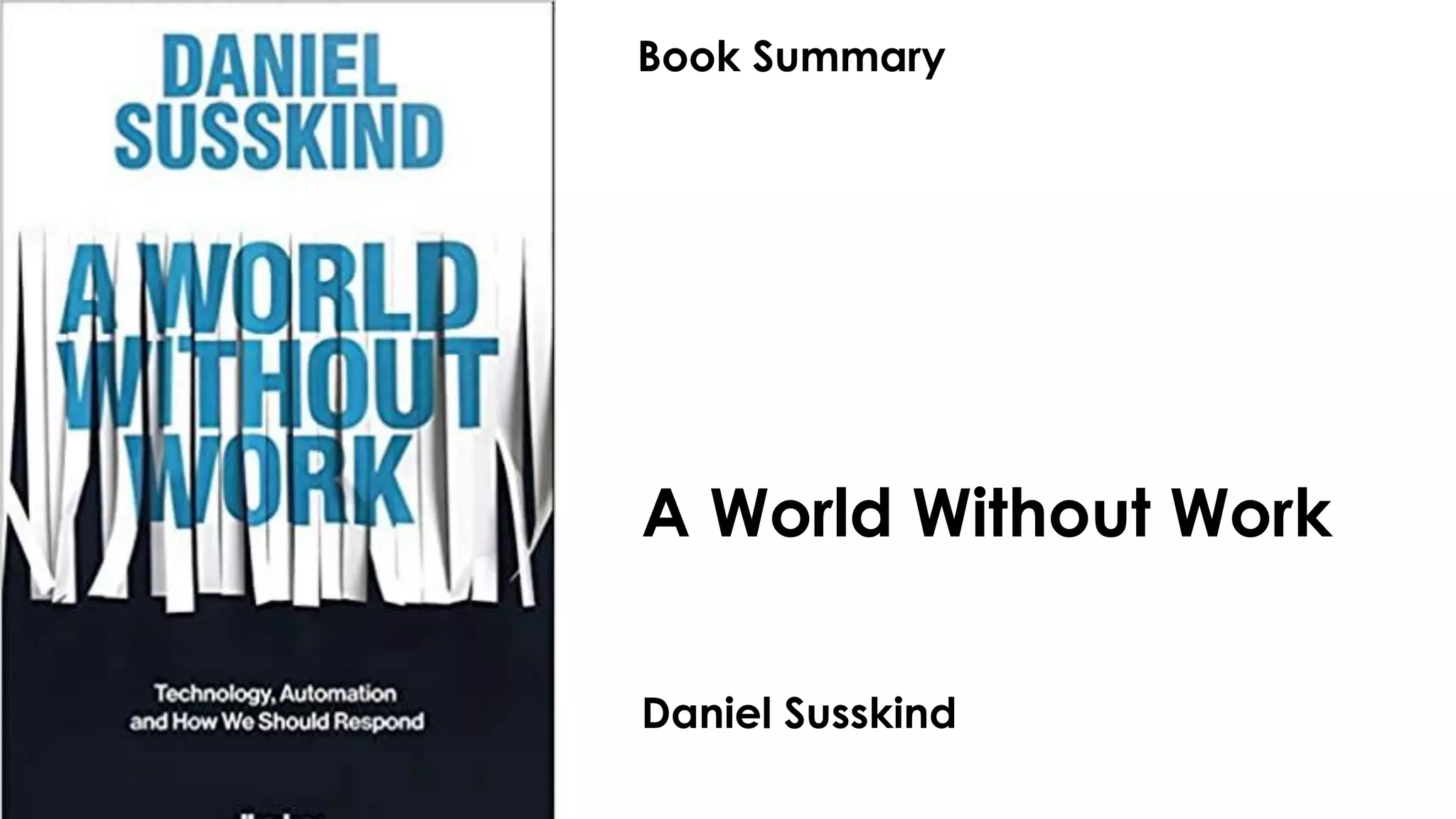
A World Without Work
Daniel Susskind
Book Summary
Economic growth is a very recent phenomenon, for most of the 300,000
years human beings have been around, economic life was relatively
stagnant.
It was spurred on only in the last few hundred years and the Industrial
Revolution is one of the most significant moments in the history of mankind.
People’s anxiety about automation and machines is not a new
phenomenon. The printing press was met with resistance from human
scribes. James Hargreaves, the inventor of the spinning jenny was attacked
and the marauders attacking machines during the Industrial Revolution
gave birth to the term “Luddites”.
It seems, economic growth and automation anxiety were intertwined.
While Keynes popularized the term “technological unemployment” in 1930.
Looking back over the last few hundred years, there is little evidence to
support the primary fear; that technological progress would create large
pools of permanently unemployed workers.
History suggests that this way of thinking, in terms of jobs alone, cannot
capture the whole picture. Technological change may affect not only the
amount of work, but also the nature of that work.
Throughout the history of machines and automation there have been two
distinct forces at play’ the substituting force which harmed workers, but also
the helpful complementing force, which did the opposite.
This helpful force works in three ways; The Productivity Effect, The Bigger-Pie
Effect and The Changing-Pie Effect.
Through Productivity Effect when productivity increases are passed on to
consumers via lower prices or better-quality services, then the demand for
that goods and services is likely to rise, and the demand for human workers
along with it.
In the Bigger-Pie Effect, with technological progress as an economy grows,
when people become more prosperous with healthier incomes to spend,
the opportunities to work are likely to improve.
While some tasks might be automated and lost to machines, in the
improved economy, but as the economy expands, and demand for goods
and services rise along with it, demand will also increase for all the tasks
needed to produce them. These may include activities that have not yet
bene automated and displaced workers can find work there.
If we think of the economy as a pie, new technology have not only made
the pie bigger, but changed the pie too.
At a certain moment, some tasks might be automated and lost to machines.
But as the economy changes over time, demand will rise for other tasks
elsewhere in the economy. These may even be completely new industries.
As an example, think about the American economy’s shift from agricultural
to manufacturing to services.
The conventional wisdom amongst economists was that technological
progress was either skill-biased, at other times unskill-biased. In either case
though, this progress always broadly benefited workers.
In the dominant model used in the field, it was impossible for new
technologies to make either skilled or unskilled workers worse off, progress
always raised wages, thought at a given time some more than the others.
But starting in the 1980s, new technologies appeared to help both low-
skilled and high-skilled workers at the same time – but workers with middling
skills did not appear to benefit at all.
This phenomenon is know as “polarization” or ‘hollowing out’. In many
countries, as a share of overall employment there are more high-paid
professionals as well as more low-paid like care workers and cleaners,
gardeners, hair-dressers etc.
Labor markets are becoming increasingly two-tiered and divided.
The ALM Hypothesis developed by a group of MIT economists (David Autor,
Frank Levy and Richard Murnane) sought to explain this new puzzle.
Its built on two realizations. First; looking at the labor market in terms of ‘jobs’ is
misleading. To think clearly about technology and work we have to start from
bottom-up, focusing on the tasks people do, rather than looking from top-
down.
Second realization was subtler, what matters is whether the task itself is ‘routine
or not. Routine tasks relies on ‘explicit knowledge’ – easy to explain steps –
hence can be automated. But machines would struggle with tasks that rely on
‘tacit’ knowledge.
The ALM hypothesis brought both these ideas together.
High-paid, high-skill work often turned out to be non-routine, required
human facilities like creativity and judgement, which are hard or impossible
to capture in a set of rules.
Low-paid work often required manual skills that were hard to automate.
Many of the basic things we do with our hands are the most difficult tasks for
a machine to do. (known as ‘Moravec’s Paradox)
Hence technological progress does not destroy entire jobs and the ALM
‘job’ versus ‘task’ distinction explains why.
No job is an unchanging blob of activity that can be entirely automated in
the future. Rather, every job is made up of many tasks and some of these
tasks are far easier to automate than others. And as time passes, the tasks
that make up a particular occupation are likely to change.
The ALM hypothesis has encouraged us to believe that there are a wide
range of tasks that can never be automated, a refuge of activity that will
always provide enough work for human being to do.
However, this optimistic assumption might be wrong. But to understand why,
we must look at technological changes and artificial intelligence.
In the beginning, most AI researchers believed that building a machine to
perform a given task meant observing how human beings performed the
same task and copying them.
But in the second wave of AI, machines no longer relied on this top-down
application of human intelligence. Instead they began to use vast amounts
of processing power and increasingly sophisticated algorithms to search
through huge bodies of data, mining human experience and examples to
figure out what to do themselves, from the bottom-up.
Artificial intelligence, for many pioneers of the field, was only a mechanical
means to understand the human mind.
Today though, a shift in priority is taking place. As technological progress
has accelerated, it has become clear that human intelligence is no longer
the only route to machine capability. Many researchers now are less
interested in trying to understand human intelligence than in building well-
functioning machines.
This has found huge interest from large technology companies leading to a
pragmatist revolution.
The most capable systems are not those that are designed in a top-down
way by intelligent beings. In fact, just as Darwin found a century ago,
remarkable capabilities can emerge gradually from blind, unthinking,
bottom-up processes that do not resemble human intelligence at all.
For many AI researchers, the holy grail is to build machines with ‘artificial
general intelligence’ (AGI), with wide-ranging capabilities, rather than an
‘artificial narrow intelligence’ (ANI), which can handle very particular
assignments.
AGI, it is said, will represent a turning point in human history – perhaps the
turning point. It is thought, an ‘intelligence explosion’ will take place:
machines endlessly improving upon those that came before, their
capabilities soaring in an ever-accelerating blast of recursive self-
improvement.
This process, it is said, will lead to machines with super intelligence; some
call it the ‘singularity’
The prospect of such vastly capable AGIs has worried several people like
Stephan Hawking (‘could spell the end of the human race’), Elon Musk
(‘vastly more risk than North Korea’), and Bill Gates (‘don’t understand why
some people are not concerned’).
One fear is that human beings, limited in what they can do by the
comparatively snail-like pace of evolution, would struggle to keep up with
machines. Another is that these machines, might, perhaps unwittingly,
pursue goals at odds with those of human beings, destroying us in the
process.
Machines can now learn how to perform tasks themselves, deriving their
own rules from the bottom up. And that means they are able to take on
many ‘non-routine’ tasks that were once considered to be out of their reach.
Machines are no longer riding on the coat-tails of human intelligence.
The temptation is to say that because machines cannot reason like us, they
will never exercise judgment, because they cannot think like us, they will
never be empathic.
But it fails to recognize that machines might still be able to carry out tasks
that require empathy, judgment or creativity when done by a human being
– by doing them in some entirely other fashion.
There are three main capabilities human beings draw on in their work;
manual, cognitive and affective capabilities.
Today, each of these in under increasing pressure from machines.
Manual capabilities refers to capabilities of human beings that involve
dealing with the physical world, such as performing manual labor and
responding to what we see around us.
McKinsey & Co. estimate that, as of 2015, 64 percent of worker hours in all
areas of manufacturing were spent on tasks that could be automated with
existing technologies.
Machines are also increasingly encroaching on tasks that, until now, have
required a human ability to think and reason. (Cognitive capabilities)
in medicine, many of the most impressive advances have been in
diagnosis.
In finance, computerized trading is now widespread, responsible for about
half the trade on the stock market.
There are now systems that can direct films, cut trailers and even compose
rudimentary speeches.
Machines are now also encroaching on tasks that require our affective
capabilities, our capacity for feelings and emotions.
There are systems, for example, that can look at a person’s face and tell
whether they are happy, confused or delighted.
There is ‘social robotics’. These have the ability to recognize and react to
human emotions. Many are used in healthcare, Paro, a therapeutic baby
seal, comforts people with dementia and Alzheimer's.
Even though machines are becoming increasingly capable, it does now
mean that they will be adopted at the same pace in different places around
the world. There are three key reasons; different tasks, different costs and
different regulations & contrasting cultures.
Different tasks. Different economies are made up of very different types of
jobs. It is hence inevitable, therefore, that certain technologies will be far
more useful in some places and not others.
Machines will be taken up at different paces in different places due to costs.
In thinking about whether or not it is efficient to use a machine to automate
a task, what matters is not only how productive that machine is relative to
the human alternative, but also how expensive it is compared to the human
alternative.
Relative costs may also cause tech abandonment, example mechanical
car washes in the UK declined with the influx of cheap immigrant labor.
Regulations and cultures have an impact on differing pace of adoption of
new technologies. Almost all developed countries have published some
form of ‘AI strategy’. e.g. China plans to be the ‘front-runner’.
Frictional technological unemployment is a situation where there is still work
to be done by human beings; the problem is that not all workers are able to
reach out and take it up.
There are three types of frictions; mismatch of skills, mismatch of identity and
a mismatch of pace.
With advances in AI, we can now think of a scenario, in which there are
actually too few jobs to go around, as ‘structural’ technological
unemployment.
We can now begin to see how the Age of Labor is likely to end. As time goes
on, machines will become more capable, taking on tasks that fell to human
beings. For some time, the complimenting force continues to raise demand
for displaced workers elsewhere. But as task encroachment goes on, more
tasks fall to machines and human-beings find themselves complemented in
ever shrinking set of tasks.
The world of work does not end with a bang, but a withering in demand for
the work of human beings.
While in the short run, our challenge will be avoiding frictional technological
unemployment, but in the longer term we have to seriously consider the
threat of structural technological unemployment.
While the threat of technological unemployment seems extraordinary, it is
best thought of as an extreme version of what affecting us currently, the
problem of rising inequality.
There are two types of capital; one; where people earn money as a return
on the human capital they have build up and second, is a return on any
traditional capital that they hold.
In a world with less work, the flow of income many people receive from their
work may dry up to a trickle, but the flow of income going to those who own
the latest systems and machines – the new forms of traditional capital is
likely to be quite considerable.
Beneath the headline stories of growing inequality around the world lie three
distinct trends.
First human capital is less and less evenly distributed, with people’s different
skills getting rewarded to very different degrees. Second, human capital is
becoming les and less valuable relative to traditional capital; the part of the
pie that goes to workers as wage is shrinking relative to the part that goes to
owners of traditional capital. And third, traditional capital itself is distributed
in an extraordinarily uneven fashion.
As we approach a world with less work, our economic lives will become
increasingly dominated by large technology companies. And with that
growing economic power the companies will acquire great political power
too.
Why Big Tech? because the best machines will require three expensive
things; huge amounts of data, world-leading software and extraordinarily
powerful hardware. Only the largest companies will be able to afford all of
these at the same time.
Another reason is many new technologies benefit from very strong network
effect.
In the twentieth century, our main preoccupation was with the economic
power of large companies. But in the twenty-first, we will increasingly have
to worry about their political powers as well.
‘More education’ seems our best response at the moment to the threat of
technological unemployment. But we need to make three changes to our
current approach; in what we teach, how we teach it and when we teach it.
What We Teach.
We know with confidence that machines will be able to do more in the
future than they can today. So we are left with a very simple rule for the
moment; do not prepare people for tasks that we know machines can
already do better, or activities that we can reasonably predict will be done
better by machines very soon.
How We Teach
Today’s technologies offer alternatives to traditional schools. From MOOCs
to adaptive or personalized learning.
When We Teach
Most people conceive education as something you do at the start of your
life, build human capital and put it to productive use when you start working.
In the coming years, people will have to get comfortable with the idea of
moving in and out of education, repeatedly, throughout their lives. We have
to constantly re-educate ourselves because it is nearly impossible to predict
what the future roles will be.
But there are limits to education.
Humans are born with different bundles of talents and abilities, as machines
become increasingly capable, narrowing the range of things for people to
do. There is no reason to think that everyone will necessarily be able to learn
to do whatever is left to be done.
Also, learning to do new things takes time and effort, we may find it difficult
to slow down and change course.
Properly responding to technological unemployment, then, means finding
new answers to the question of how we share our prosperity without relying
on jobs and the labor market.
To solve this distribution problem in the future, we need a new institution to
take the place of the labor market – Big State.
Big State will have to perform two main tasks. It will have to significantly tax
those who manage to retain valuable capital and income in the future. And
figure out the best way to share the money that is raised with those who do
not.
To deal with technological unemployment we need Conditional Basic
Income (CBI) for all citizens. Each country may have to design its own
version of CBI that best suits them.
Work offers meaning to the worker and also a chance to gain status and
social esteem. Not having a job, today, is worthy of shame.
The threat of technological unemployment will not only deprive people of
their income but also the sense of purpose in many people’s lives.
We may need leisure policies that inform and shape the way people use
their spare time. Big State needs to play a role here as well.

A World Without Work : Book Summary

  • 1.
    A World WithoutWork Daniel Susskind Book Summary
  • 2.
    Economic growth isa very recent phenomenon, for most of the 300,000 years human beings have been around, economic life was relatively stagnant. It was spurred on only in the last few hundred years and the Industrial Revolution is one of the most significant moments in the history of mankind.
  • 3.
    People’s anxiety aboutautomation and machines is not a new phenomenon. The printing press was met with resistance from human scribes. James Hargreaves, the inventor of the spinning jenny was attacked and the marauders attacking machines during the Industrial Revolution gave birth to the term “Luddites”. It seems, economic growth and automation anxiety were intertwined.
  • 4.
    While Keynes popularizedthe term “technological unemployment” in 1930. Looking back over the last few hundred years, there is little evidence to support the primary fear; that technological progress would create large pools of permanently unemployed workers. History suggests that this way of thinking, in terms of jobs alone, cannot capture the whole picture. Technological change may affect not only the amount of work, but also the nature of that work.
  • 5.
    Throughout the historyof machines and automation there have been two distinct forces at play’ the substituting force which harmed workers, but also the helpful complementing force, which did the opposite. This helpful force works in three ways; The Productivity Effect, The Bigger-Pie Effect and The Changing-Pie Effect.
  • 6.
    Through Productivity Effectwhen productivity increases are passed on to consumers via lower prices or better-quality services, then the demand for that goods and services is likely to rise, and the demand for human workers along with it.
  • 7.
    In the Bigger-PieEffect, with technological progress as an economy grows, when people become more prosperous with healthier incomes to spend, the opportunities to work are likely to improve. While some tasks might be automated and lost to machines, in the improved economy, but as the economy expands, and demand for goods and services rise along with it, demand will also increase for all the tasks needed to produce them. These may include activities that have not yet bene automated and displaced workers can find work there.
  • 8.
    If we thinkof the economy as a pie, new technology have not only made the pie bigger, but changed the pie too. At a certain moment, some tasks might be automated and lost to machines. But as the economy changes over time, demand will rise for other tasks elsewhere in the economy. These may even be completely new industries. As an example, think about the American economy’s shift from agricultural to manufacturing to services.
  • 9.
    The conventional wisdomamongst economists was that technological progress was either skill-biased, at other times unskill-biased. In either case though, this progress always broadly benefited workers. In the dominant model used in the field, it was impossible for new technologies to make either skilled or unskilled workers worse off, progress always raised wages, thought at a given time some more than the others.
  • 10.
    But starting inthe 1980s, new technologies appeared to help both low- skilled and high-skilled workers at the same time – but workers with middling skills did not appear to benefit at all. This phenomenon is know as “polarization” or ‘hollowing out’. In many countries, as a share of overall employment there are more high-paid professionals as well as more low-paid like care workers and cleaners, gardeners, hair-dressers etc. Labor markets are becoming increasingly two-tiered and divided.
  • 11.
    The ALM Hypothesisdeveloped by a group of MIT economists (David Autor, Frank Levy and Richard Murnane) sought to explain this new puzzle. Its built on two realizations. First; looking at the labor market in terms of ‘jobs’ is misleading. To think clearly about technology and work we have to start from bottom-up, focusing on the tasks people do, rather than looking from top- down. Second realization was subtler, what matters is whether the task itself is ‘routine or not. Routine tasks relies on ‘explicit knowledge’ – easy to explain steps – hence can be automated. But machines would struggle with tasks that rely on ‘tacit’ knowledge.
  • 12.
    The ALM hypothesisbrought both these ideas together. High-paid, high-skill work often turned out to be non-routine, required human facilities like creativity and judgement, which are hard or impossible to capture in a set of rules. Low-paid work often required manual skills that were hard to automate. Many of the basic things we do with our hands are the most difficult tasks for a machine to do. (known as ‘Moravec’s Paradox)
  • 13.
    Hence technological progressdoes not destroy entire jobs and the ALM ‘job’ versus ‘task’ distinction explains why. No job is an unchanging blob of activity that can be entirely automated in the future. Rather, every job is made up of many tasks and some of these tasks are far easier to automate than others. And as time passes, the tasks that make up a particular occupation are likely to change.
  • 14.
    The ALM hypothesishas encouraged us to believe that there are a wide range of tasks that can never be automated, a refuge of activity that will always provide enough work for human being to do. However, this optimistic assumption might be wrong. But to understand why, we must look at technological changes and artificial intelligence.
  • 15.
    In the beginning,most AI researchers believed that building a machine to perform a given task meant observing how human beings performed the same task and copying them. But in the second wave of AI, machines no longer relied on this top-down application of human intelligence. Instead they began to use vast amounts of processing power and increasingly sophisticated algorithms to search through huge bodies of data, mining human experience and examples to figure out what to do themselves, from the bottom-up.
  • 16.
    Artificial intelligence, formany pioneers of the field, was only a mechanical means to understand the human mind. Today though, a shift in priority is taking place. As technological progress has accelerated, it has become clear that human intelligence is no longer the only route to machine capability. Many researchers now are less interested in trying to understand human intelligence than in building well- functioning machines. This has found huge interest from large technology companies leading to a pragmatist revolution.
  • 17.
    The most capablesystems are not those that are designed in a top-down way by intelligent beings. In fact, just as Darwin found a century ago, remarkable capabilities can emerge gradually from blind, unthinking, bottom-up processes that do not resemble human intelligence at all.
  • 18.
    For many AIresearchers, the holy grail is to build machines with ‘artificial general intelligence’ (AGI), with wide-ranging capabilities, rather than an ‘artificial narrow intelligence’ (ANI), which can handle very particular assignments.
  • 19.
    AGI, it issaid, will represent a turning point in human history – perhaps the turning point. It is thought, an ‘intelligence explosion’ will take place: machines endlessly improving upon those that came before, their capabilities soaring in an ever-accelerating blast of recursive self- improvement. This process, it is said, will lead to machines with super intelligence; some call it the ‘singularity’
  • 20.
    The prospect ofsuch vastly capable AGIs has worried several people like Stephan Hawking (‘could spell the end of the human race’), Elon Musk (‘vastly more risk than North Korea’), and Bill Gates (‘don’t understand why some people are not concerned’). One fear is that human beings, limited in what they can do by the comparatively snail-like pace of evolution, would struggle to keep up with machines. Another is that these machines, might, perhaps unwittingly, pursue goals at odds with those of human beings, destroying us in the process.
  • 21.
    Machines can nowlearn how to perform tasks themselves, deriving their own rules from the bottom up. And that means they are able to take on many ‘non-routine’ tasks that were once considered to be out of their reach. Machines are no longer riding on the coat-tails of human intelligence.
  • 22.
    The temptation isto say that because machines cannot reason like us, they will never exercise judgment, because they cannot think like us, they will never be empathic. But it fails to recognize that machines might still be able to carry out tasks that require empathy, judgment or creativity when done by a human being – by doing them in some entirely other fashion.
  • 23.
    There are threemain capabilities human beings draw on in their work; manual, cognitive and affective capabilities. Today, each of these in under increasing pressure from machines.
  • 24.
    Manual capabilities refersto capabilities of human beings that involve dealing with the physical world, such as performing manual labor and responding to what we see around us. McKinsey & Co. estimate that, as of 2015, 64 percent of worker hours in all areas of manufacturing were spent on tasks that could be automated with existing technologies.
  • 25.
    Machines are alsoincreasingly encroaching on tasks that, until now, have required a human ability to think and reason. (Cognitive capabilities) in medicine, many of the most impressive advances have been in diagnosis. In finance, computerized trading is now widespread, responsible for about half the trade on the stock market. There are now systems that can direct films, cut trailers and even compose rudimentary speeches.
  • 26.
    Machines are nowalso encroaching on tasks that require our affective capabilities, our capacity for feelings and emotions. There are systems, for example, that can look at a person’s face and tell whether they are happy, confused or delighted. There is ‘social robotics’. These have the ability to recognize and react to human emotions. Many are used in healthcare, Paro, a therapeutic baby seal, comforts people with dementia and Alzheimer's.
  • 27.
    Even though machinesare becoming increasingly capable, it does now mean that they will be adopted at the same pace in different places around the world. There are three key reasons; different tasks, different costs and different regulations & contrasting cultures.
  • 28.
    Different tasks. Differenteconomies are made up of very different types of jobs. It is hence inevitable, therefore, that certain technologies will be far more useful in some places and not others.
  • 29.
    Machines will betaken up at different paces in different places due to costs. In thinking about whether or not it is efficient to use a machine to automate a task, what matters is not only how productive that machine is relative to the human alternative, but also how expensive it is compared to the human alternative. Relative costs may also cause tech abandonment, example mechanical car washes in the UK declined with the influx of cheap immigrant labor.
  • 30.
    Regulations and cultureshave an impact on differing pace of adoption of new technologies. Almost all developed countries have published some form of ‘AI strategy’. e.g. China plans to be the ‘front-runner’.
  • 31.
    Frictional technological unemploymentis a situation where there is still work to be done by human beings; the problem is that not all workers are able to reach out and take it up. There are three types of frictions; mismatch of skills, mismatch of identity and a mismatch of pace.
  • 32.
    With advances inAI, we can now think of a scenario, in which there are actually too few jobs to go around, as ‘structural’ technological unemployment.
  • 33.
    We can nowbegin to see how the Age of Labor is likely to end. As time goes on, machines will become more capable, taking on tasks that fell to human beings. For some time, the complimenting force continues to raise demand for displaced workers elsewhere. But as task encroachment goes on, more tasks fall to machines and human-beings find themselves complemented in ever shrinking set of tasks. The world of work does not end with a bang, but a withering in demand for the work of human beings.
  • 34.
    While in theshort run, our challenge will be avoiding frictional technological unemployment, but in the longer term we have to seriously consider the threat of structural technological unemployment.
  • 35.
    While the threatof technological unemployment seems extraordinary, it is best thought of as an extreme version of what affecting us currently, the problem of rising inequality.
  • 36.
    There are twotypes of capital; one; where people earn money as a return on the human capital they have build up and second, is a return on any traditional capital that they hold. In a world with less work, the flow of income many people receive from their work may dry up to a trickle, but the flow of income going to those who own the latest systems and machines – the new forms of traditional capital is likely to be quite considerable.
  • 37.
    Beneath the headlinestories of growing inequality around the world lie three distinct trends. First human capital is less and less evenly distributed, with people’s different skills getting rewarded to very different degrees. Second, human capital is becoming les and less valuable relative to traditional capital; the part of the pie that goes to workers as wage is shrinking relative to the part that goes to owners of traditional capital. And third, traditional capital itself is distributed in an extraordinarily uneven fashion.
  • 38.
    As we approacha world with less work, our economic lives will become increasingly dominated by large technology companies. And with that growing economic power the companies will acquire great political power too.
  • 39.
    Why Big Tech?because the best machines will require three expensive things; huge amounts of data, world-leading software and extraordinarily powerful hardware. Only the largest companies will be able to afford all of these at the same time. Another reason is many new technologies benefit from very strong network effect.
  • 40.
    In the twentiethcentury, our main preoccupation was with the economic power of large companies. But in the twenty-first, we will increasingly have to worry about their political powers as well.
  • 41.
    ‘More education’ seemsour best response at the moment to the threat of technological unemployment. But we need to make three changes to our current approach; in what we teach, how we teach it and when we teach it.
  • 42.
    What We Teach. Weknow with confidence that machines will be able to do more in the future than they can today. So we are left with a very simple rule for the moment; do not prepare people for tasks that we know machines can already do better, or activities that we can reasonably predict will be done better by machines very soon.
  • 43.
    How We Teach Today’stechnologies offer alternatives to traditional schools. From MOOCs to adaptive or personalized learning.
  • 44.
    When We Teach Mostpeople conceive education as something you do at the start of your life, build human capital and put it to productive use when you start working. In the coming years, people will have to get comfortable with the idea of moving in and out of education, repeatedly, throughout their lives. We have to constantly re-educate ourselves because it is nearly impossible to predict what the future roles will be.
  • 45.
    But there arelimits to education. Humans are born with different bundles of talents and abilities, as machines become increasingly capable, narrowing the range of things for people to do. There is no reason to think that everyone will necessarily be able to learn to do whatever is left to be done. Also, learning to do new things takes time and effort, we may find it difficult to slow down and change course.
  • 46.
    Properly responding totechnological unemployment, then, means finding new answers to the question of how we share our prosperity without relying on jobs and the labor market. To solve this distribution problem in the future, we need a new institution to take the place of the labor market – Big State.
  • 47.
    Big State willhave to perform two main tasks. It will have to significantly tax those who manage to retain valuable capital and income in the future. And figure out the best way to share the money that is raised with those who do not. To deal with technological unemployment we need Conditional Basic Income (CBI) for all citizens. Each country may have to design its own version of CBI that best suits them.
  • 48.
    Work offers meaningto the worker and also a chance to gain status and social esteem. Not having a job, today, is worthy of shame. The threat of technological unemployment will not only deprive people of their income but also the sense of purpose in many people’s lives. We may need leisure policies that inform and shape the way people use their spare time. Big State needs to play a role here as well.