Wolfgang Polifke
2nd Colloquium on
Combustion Dynamics and
Combustion Noise
Menaggio, Sept. 20-22, 2016
Technische Universität München • Professur für Thermofluiddynamik
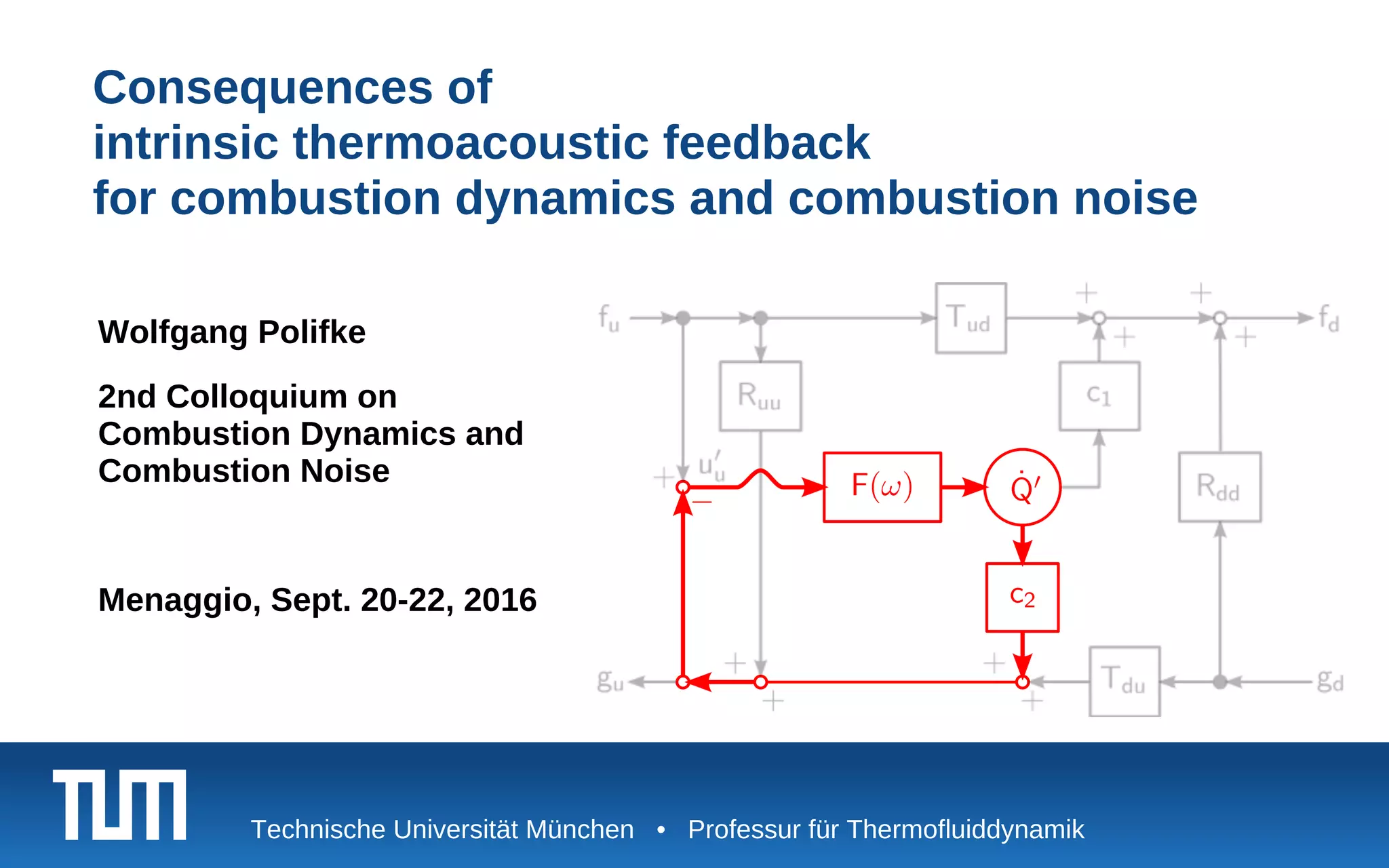
Consequences of
intrinsic thermoacoustic feedback
for combustion dynamics and combustion noise
W. Polifke | Role of intrinsic thermoacoustic feedback in combustion dynamics and combustion noise | CDCN2 | Menaggio | September 2016
Thanks
Sebastian Bomberg, Thomas Emmert, Stefan Jaensch, Camilo Silva
DFG, FVV, TUM/IAS
2
W. Polifke | Role of intrinsic thermoacoustic feedback in combustion dynamics and combustion noise | CDCN2 | Menaggio | September 2016
The control of thermoacoustic instabilities is challenging
2000 (!) full-scale tests of the F1 rocket engine
3
W. Polifke | Role of intrinsic thermoacoustic feedback in combustion dynamics and combustion noise | CDCN2 | Menaggio | September 2016
Nowadays, thermoacoustic instabilities are a major challenge
for low emission gas turbine combustion technology
4
W. Polifke | Role of intrinsic thermoacoustic feedback in combustion dynamics and combustion noise | CDCN2 | Menaggio | September 2016
Thermoacoustic instability results from interactions between
unsteady heat release and acoustics
A heat source in a gas stream is a “source of volume”
A fluctuating flame is a source of sound
‣ combustion noise
‣ self-excited combustion instability if acoustic feedback is favorable, i.e.
5
p′ ˙Q′
dt > 0 (Rayleigh’s Criterion)
˙Q0 R
Plenum Flame Combustion Chamber
R
Premix flames:
Heat release responds to fluctuations of velocity with delay:
System acoustics controls phase p’ - u’:
W. Polifke | Role of intrinsic thermoacoustic feedback in combustion dynamics and combustion noise | CDCN2 | Menaggio | September 2016 6
Time / phase delays between fluctuations of velocity, pressure and
heat release govern the stability of the feedback loop
˙Q0 R
Plenum Flame Combustion Chamber
R
˙Q0 R
Plenum Flame Combustion Chamber
R
W. Polifke | Role of intrinsic thermoacoustic feedback in combustion dynamics and combustion noise | CDCN2 | Menaggio | September 2016
Unsteady heat release Q’ contributes to the outgoing acoustic waves
8Bomberg et al, PROCI, 2015
˙Q0 R
Plenum Flame Combustion Chamber
R
W. Polifke | Role of intrinsic thermoacoustic feedback in combustion dynamics and combustion noise | CDCN2 | Menaggio | September 2016
The flame heat release Q’ is perturbed by upstream velocity uu’
9Bomberg et al, PROCI, 2015
˙Q0 R
Plenum Flame Combustion Chamber
R
W. Polifke | Role of intrinsic thermoacoustic feedback in combustion dynamics and combustion noise | CDCN2 | Menaggio | September 2016
The upstream velocity uu’ is controlled by the upstream acoustics fu, gu
10Bomberg et al, PROCI, 2015
˙Q0 R
Plenum Flame Combustion Chamber
R
W. Polifke | Role of intrinsic thermoacoustic feedback in combustion dynamics and combustion noise | CDCN2 | Menaggio | September 2016
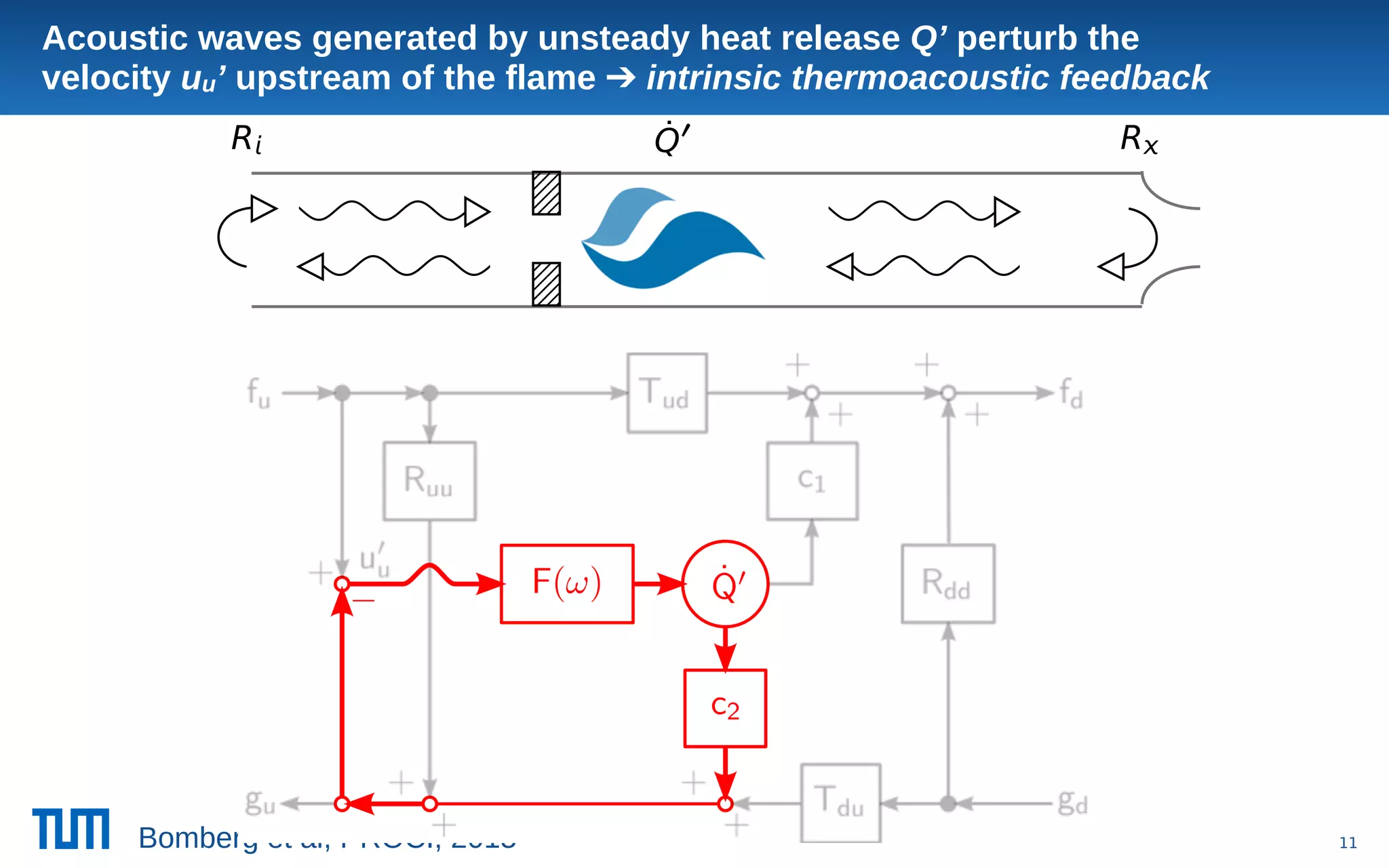
Acoustic waves generated by unsteady heat release Q’ perturb the
velocity uu’ upstream of the flame ➔ intrinsic thermoacoustic feedback
11Bomberg et al, PROCI, 2015
W. Polifke | Role of intrinsic thermoacoustic feedback in combustion dynamics and combustion noise | CDCN2 | Menaggio | September 2016
Analogy: electro-acoustic feedback
12
˙Q0 R
Plenum Flame Combustion Chamber
R
W. Polifke | Role of intrinsic thermoacoustic feedback in combustion dynamics and combustion noise | CDCN2 | Menaggio | September 2016
Acoustic waves generated by unsteady heat release Q’ perturb the
velocity uu’ upstream of the flame ➔ intrinsic thermoacoustic feedback
13
Bomberg et al, 2015
Bomberg et al, PROCI, 2015
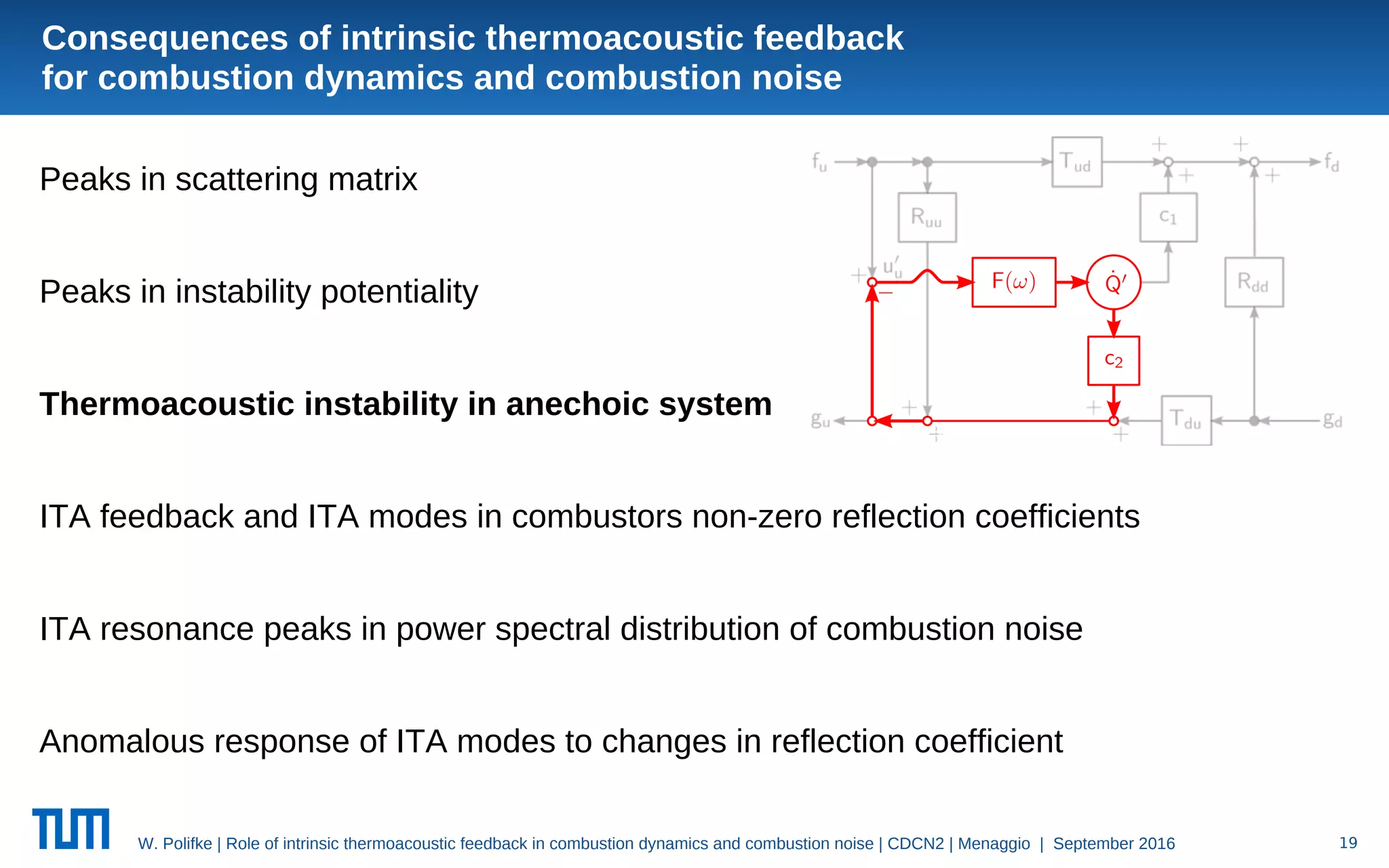
Peaks in scattering matrix
Peaks in instability potentiality
Thermoacoustic instability in anechoic system
ITA feedback and ITA modes in combustors with non-zero reflection coefficients
ITA resonance peaks in power spectral distribution of combustion noise
Anomalous response of ITA modes to changes in reflection coefficient
W. Polifke | Role of intrinsic thermoacoustic feedback in combustion dynamics and combustion noise | CDCN2 | Menaggio | September 2016
Consequences of intrinsic thermoacoustic feedback
for combustion dynamics and combustion noise
14
W. Polifke | Role of intrinsic thermoacoustic feedback in combustion dynamics and combustion noise | CDCN2 | Menaggio | September 2016
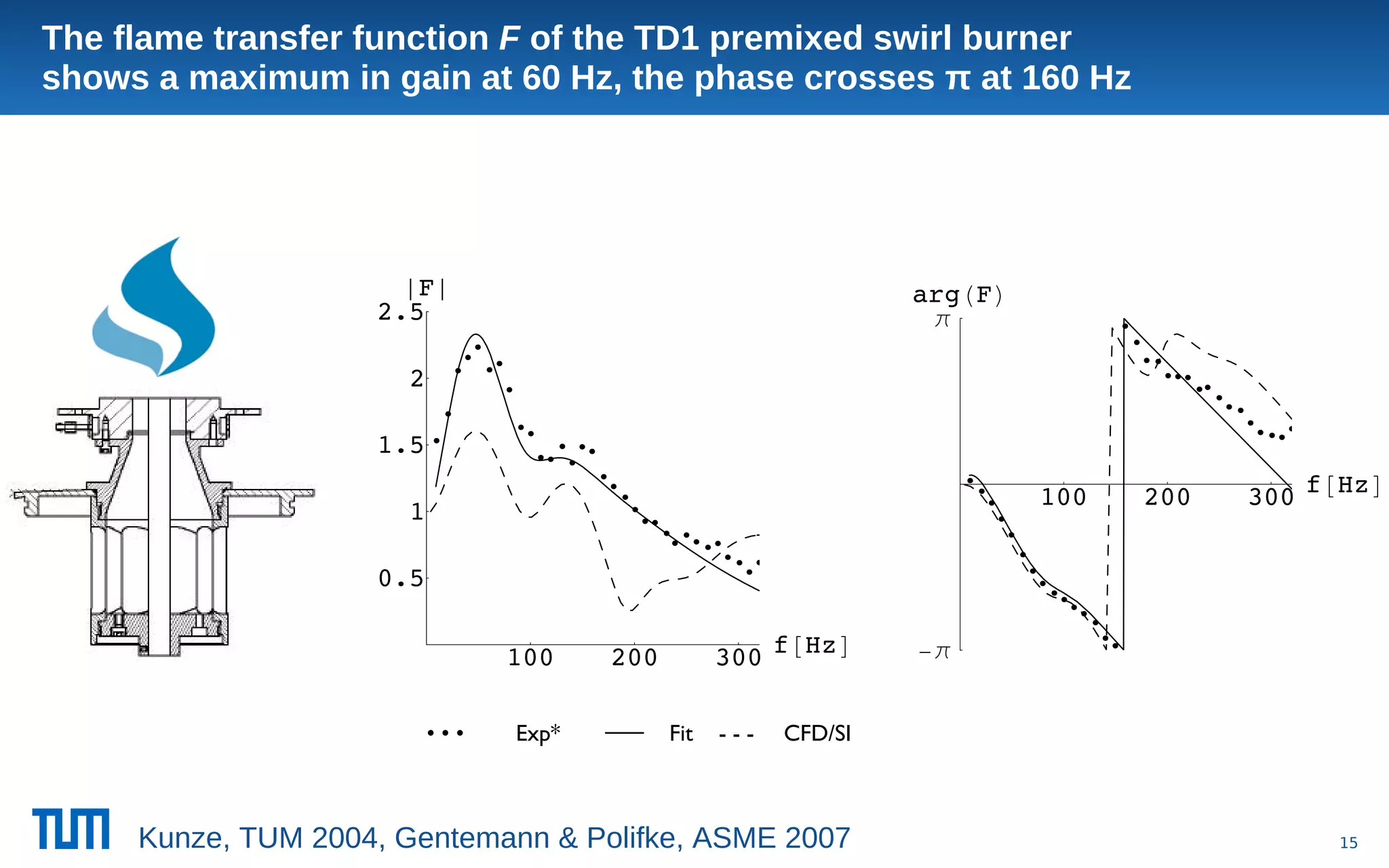
The flame transfer function F of the TD1 premixed swirl burner
shows a maximum in gain at 60 Hz, the phase crosses π at 160 Hz
15
100 200 300 f Hz
0.5
1
1.5
2
2.5
F
100 200 300 f Hz
Π
Π
arg F
Figure 3. GAIN (LEFT) AND PHASE (RIGHT) OF FLAME
FREQUENCY FUNCTION. EXPERIMENT (·), MODEL (—),
t, den Vergleich zwischen einer Einzel-
ordnung, erfüllen zu können, wurde am
brenner für vollständig vorgemischten
einrichtungen eingesetzt werden konnte.
gelegt. Seine Hauptbestandteile sind ein
hließenden konvergenten Düse und einer
mter Drallbrenner
n Drallerzeuger können die tangentialen
rden, wodurch eine Beeinflussung der
ittsdurchmesser des Brenners ist durch
• • • 	 Exp*
___
Fit - - -	 CFD/SI
Kunze, TUM 2004, Gentemann & Polifke, ASME 2007
W. Polifke | Role of intrinsic thermoacoustic feedback in combustion dynamics and combustion noise | CDCN2 | Menaggio | September 2016
Acoustically, burner and flame flame may be described by
the respective transfer matrix T or scattering matrix S
16
⇤
p
c
u
⌅
d
=
T11 T12
T21 T22
⇥ ⇤
p
c
u
⌅
u
T
p
c
u
p
c
u
fu
gu
fd
gd
S
W. Polifke | Role of intrinsic thermoacoustic feedback in combustion dynamics and combustion noise | CDCN2 | Menaggio | September 2016
Scattering matrix coefficients | Sij | of the TD1 burner show strong maxima,
which result from ITA resonance
17Gentemann & Polifke, ASME 2007; Emmert et al, CNF 2015
t, den Vergleich zwischen einer Einzel-
ordnung, erfüllen zu können, wurde am
brenner für vollständig vorgemischten
einrichtungen eingesetzt werden konnte.
gelegt. Seine Hauptbestandteile sind ein
hließenden konvergenten Düse und einer
mter Drallbrenner
n Drallerzeuger können die tangentialen
rden, wodurch eine Beeinflussung der
ittsdurchmesser des Brenners ist durch
0 100 200 300 400
0
5
10
15
20
f [Hz]
|S
11
|
0 100 200 300 400
0
2
4
6
8
10
12
f [Hz]
|S
12
|
0 100 200 300 400
0
0.5
1
1.5
2
2.5
3
f [Hz]
|S
21
|
0 100 200 300 400
0
0.5
1
1.5
f [Hz]
|S
22
|
• • • Exp*
___
Fit
- - -	 CFD/SI
W. Polifke | Role of intrinsic thermoacoustic feedback in combustion dynamics and combustion noise | CDCN2 | Menaggio | September 2016
Strong maxima in the instability potentiality
also result from resonance with the ITA feedback loop
18
an ideal gas with ⌅ = ⇧ 1, the condition ⇥ ⇤ 0 redu
compact flame – see Eq. (17) – to
F(f) ⇤
1+⇧
⌅
=
1
1 ⇧
This condition is illustrated in Fig. 7, showing a pola
frequency responses F(f). The r.h.s. of the above
1/(1 ⇧) ⇤ 0.8 for the present conditions; it is mar
an ”X” in the plot. Indeed, closest proximity to that po
served for frequencies f ⇤ 160 Hz. The frequency respo
puted with CFD/SI has a comparatively smaller gain in
quency range and therefore comes closest to the point ”
respondingly, the maximum amplification predicted by
is larger than the one obtained with the analytical model
6.
For the combined element ”burner & flame” the c
⇥ ⇤ 0 results in the relationAuregan & Starobinsky, AAuA, 1999, Polifke ECM 2011, Emmert et al, CNF 2015
0 100 200 300 400
f[Hz]
0.01
0.1
1
10
100
1000
max , min
Peaks in scattering matrix
Peaks in instability potentiality
Thermoacoustic instability in anechoic system
ITA feedback and ITA modes in combustors non-zero reflection coefficients
ITA resonance peaks in power spectral distribution of combustion noise
Anomalous response of ITA modes to changes in reflection coefficient
W. Polifke | Role of intrinsic thermoacoustic feedback in combustion dynamics and combustion noise | CDCN2 | Menaggio | September 2016
Consequences of intrinsic thermoacoustic feedback
for combustion dynamics and combustion noise
19
SGT5-8000H
˙Q0 R
Plenum Flame Combustion Chamber
R
W. Polifke | Role of intrinsic thermoacoustic feedback in combustion dynamics and combustion noise | CDCN2 | Menaggio | September 2016
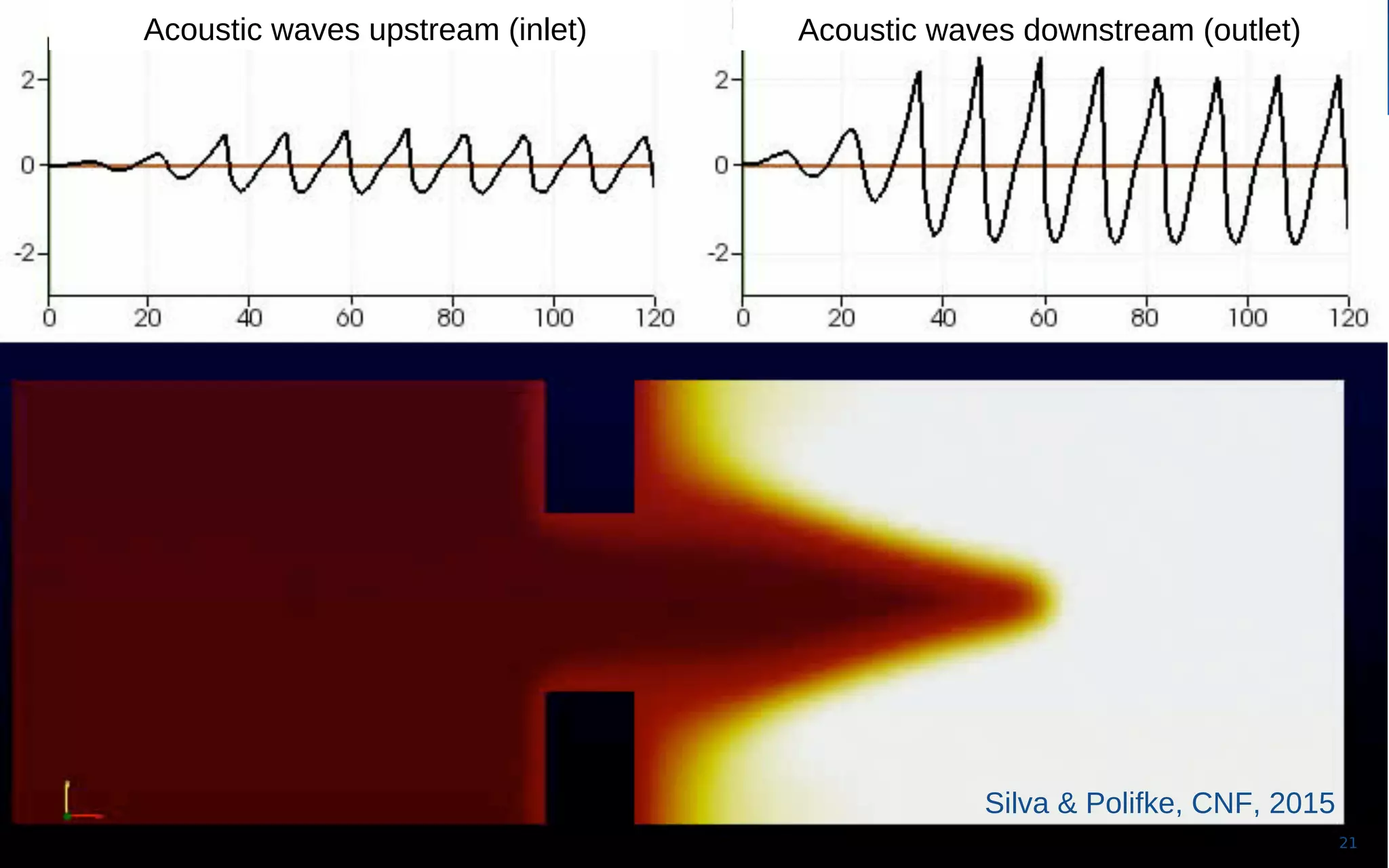
A completely anechoic n-τ system can exhibit thermoacoustic instability !?!?
20Hoeijmakers et al., CNF 2014, 2016
coustic system mode at 284 (Hz). As can be
e to the first standing wave mode of the pas-
ocated at 254 (Hz). Starting from this point, a
eam reflection, corresponding to the up-most
y leads to an increase in both frequency and
al, since the importance of the upstream duct
and hence only L2 becomes the dominating
which determines the system eigenfrequen-
increasing acoustic losses lead to the stabiliz-
in the downstream reflection R2e however,
ame trend. In fact, only the frequency of the
htly, while the stability remains roughly the
y reason for this is the fact that the acoustic
ownstream duct is much smaller than the
to the temperature difference. As a conse-
th of the upstream duct which mainly deter-
behavior. In case one follows the array of
ing up- and downstream reflections, it is clear
des converge to the flame mode located at
. Naturally, this location is in full correspon-
Since the intrinsic flame mode is stable, this
the system poles are depicted in Fig. 7. Except the change of the
gain, no other adjustments to the parameters are made. Clearly,
the same qualitative trends are visible. Due to the increase in gain,
the frequency of the ðR1e; R2eÞ ¼ ð1; À1Þ point is further increased to
302 (Hz). However, the major difference is that since now the
flame intrinsic mode is unstable, located at x ¼ ð250 À 21:1Þ Á 2p,
the system is still unstable even when there are no acoustic
reflections.
In order to further clarify the results, Fig. 8 depicts the time evo-
lution of the mode, calculated from the corresponding eigenvector,
−100 −80 −60 −40 −20 0
200
250
300
350
400
ωi
/(2π)
ω
r
/(2π)
R1e
→ 0
R2e
→0
0.2
0.4
0.6
0.8
1
1.2
1.4
unstable
stable
Rx
Ri
o (Ri, Rx) = (1, -1)
☒ (Ri, Rx) = (0, 0)
Intrinsic mode is unstable if the
interaction index n is supercritical,
and the phase of the FTF = π
W. Polifke | Role of intrinsic thermoacoustic feedback in combustion dynamics and combustion noise | CDCN2 | Menaggio | September 2016
Silva & Polifke, CNF, 2015
21
Acoustic waves upstream (inlet) Acoustic waves downstream (outlet)
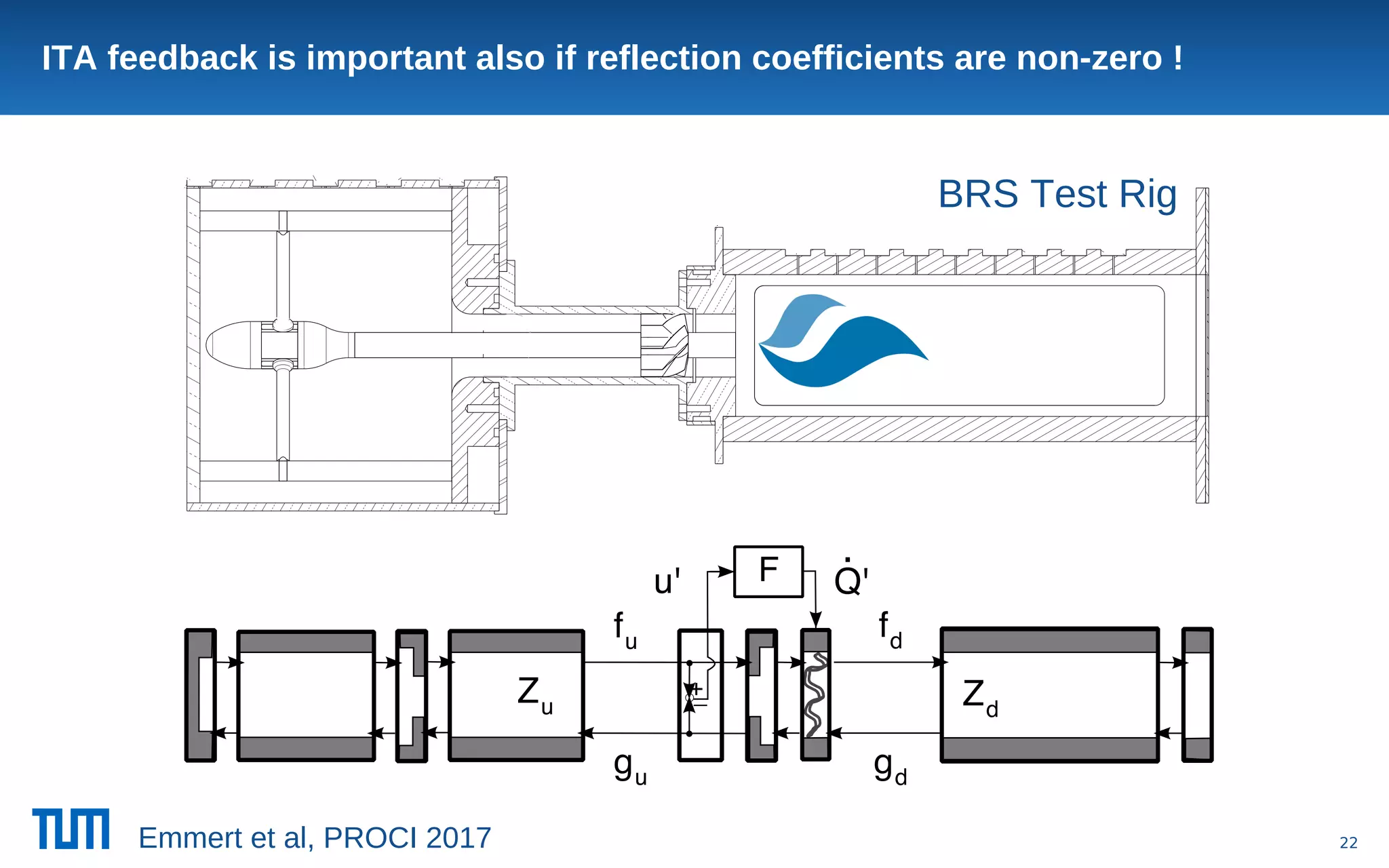
+_
u' F
gu
fu
gd
fd
Q'
.
Zu Zd
W. Polifke | Role of intrinsic thermoacoustic feedback in combustion dynamics and combustion noise | CDCN2 | Menaggio | September 2016
ITA feedback is important also if reflection coefficients are non-zero !
22Emmert et al, PROCI 2017
BRS Test Rig
uation and the CWA uu = fu gu is used. Eqs. (11), (12), (13) and
combined:
0 =
2
6
6
6
6
6
6
6
6
6
6
6
6
4
1 Zu+1
Zu 1
0 0 0 0
↵ ⇠
↵+⇠
1 0 2
↵+⇠
0 ✓
↵+⇠
2↵⇠
↵+⇠
0 1 ⇠ ↵
↵+⇠
0 ⇠✓
↵+⇠
0 0 Zd 1
Zd+1
1 0 0
1 1 0 0 1 0
0 0 0 0 F 1
3
7
7
7
7
7
7
7
7
7
7
7
7
5
| {z }
A(s)
2
6
6
6
6
6
6
6
6
6
6
6
6
4
fu
gu
fd
gd
uu
˙q0
3
7
7
7
7
7
7
7
7
7
7
7
7
5
. (
W. Polifke | Role of intrinsic thermoacoustic feedback in combustion dynamics and combustion noise | CDCN2 | Menaggio | September 2016
Re-arrange system matrix to segregate the network model into
acoustic and ITA sub-systems, which may then be de-coupled
23
(a) Acoustic system.
_
u' F
gu
fd
+
+
back: heat release, upstream traveling wave and velocity fluctuation.
Emmert et al, PROCI 2017
+_
u'gu fd
+
+
+
+
(a) Acoustic system.
(b) ITA system feedback: heat release, upstream traveling wave and velocit
In contrast to the transfer matrix formulation in primitive acoustic vari-
ables p0
, u0
we can now separate out the gu waves caused by the flame. In
Eq. (14) the heat release ˙q0
is driving gu by ✓/(↵ + ⇠) (column 6, row 2) and
gu in turn is acting on fu by (Zu + 1)/(Zu 1) and uu by 1 (column 2 and
rows 1, 5). We rearrange the equations such that in Eq. (17) ˙q0
directly a↵ects
fu by (Zu + 1)/(Zu 1) · ✓/(↵ + ⇠) (column 6, row 1) and uu by ✓/(↵ + ⇠)
(column 6, row 5).
0 =
2
6
6
6
6
6
6
6
6
6
6
6
6
4
1 Zu+1
Zu 1
0 0 0 Zu+1
Zu 1
✓
↵+⇠
↵ ⇠
↵+⇠
1 0 2
↵+⇠
0 0
2↵⇠
↵+⇠
0 1 ⇠ ↵
↵+⇠
0 ⇠✓
↵+⇠
0 0 Zd 1
1+Zd
1 0 0
1 1 0 0 1 ✓
↵+⇠
0 0 0 0 F 1
3
7
7
7
7
7
7
7
7
7
7
7
7
5
| {z }
˜A(s)
2
6
6
6
6
6
6
6
6
6
6
6
6
4
fu
gu
fd
gd
uu
˙q0
3
7
7
7
7
7
7
7
7
7
7
7
7
5
(17)
W. Polifke | Role of intrinsic thermoacoustic feedback in combustion dynamics and combustion noise | CDCN2 | Menaggio | September 2016
Decreasing the coefficient de-couples acoustic and ITA sub-systems
24
back: heat release, upstream traveling wave and
+_
fd
+
+
+
+
_
u'
F
gu
+
+
μ
μ
μ
(c) Coupled, modulated system.
Emmert et al, PROCI 2017
W. Polifke | Role of intrinsic thermoacoustic feedback in combustion dynamics and combustion noise | CDCN2 | Menaggio | September 2016
... which allows to identify acoustic and ITA modes also for the coupled system
25
20 10 0 10 20
0
100
200
300
400
500
Growth Rate (Hz)
Frequency(Hz)
ITA mode
Helmholtz mode
quarter wave mode
Sub-systems:
◦ acoustic
◻ ITA
︎✖︎ full system
Emmert et al, PROCI 2017
W. Polifke | Role of intrinsic thermoacoustic feedback in combustion dynamics and combustion noise | CDCN2 | Menaggio | September 2016
With decreasing strength of acoustic reflection at the exit, Rx = -1 ➜ 0,
the growth rate of the ITA mode of the full system increases !? !
26
40 20 0 20
0
100
200
300
400
500
Growth Rate (Hz)
Frequency(Hz)
Rx = -1:
◦ acoustic
◻ ITA
•
•
•
•
︎✖︎ Rx = 0
ITA mode
Helmholtz mode
1/4 wave mode
ITA mode
ITA mode
Peaks in scattering matrix
Peaks in instability potentiality
Thermoacoustic instability in anechoic system
ITA feedback and ITA modes in combustors non-zero reflection coefficients
ITA resonance peaks in power spectral distribution of combustion noise
Anomalous response of ITA modes to changes in reflection coefficient
W. Polifke | Role of intrinsic thermoacoustic feedback in combustion dynamics and combustion noise | CDCN2 | Menaggio | September 2016
Consequences of intrinsic thermoacoustic feedback
for combustion dynamics and combustion noise
27
SGT5-8000H
W. Polifke | Role of intrinsic thermoacoustic feedback in combustion dynamics and combustion noise | CDCN2 | Menaggio | September 2016
For combustion noise from enclosed flames,
cavity acoustics, flame dynamics (FTF) and ITA feedback are important
28CTR summer programme 2014
•
0 200 400 600
10
5
10
6
|p′
|2
f [Hz]
anechoic
0 200 400 600
10
5
10
6
|p′
|2
f [Hz]
echoic
0 200 400 600
10
5
10
6
|p′
|2
f [Hz]
echoic w/ coupling
W. Polifke | Role of intrinsic thermoacoustic feedback in combustion dynamics and combustion noise | CDCN2 | Menaggio | September 2016
From LES times series of u’ and Q’, extract FTF and PSD of noise source term,
give to network model to predict SPL in combustion chamber
29
0 200 400 600 800 1000
Frequency [Hz]
0
0.05
0.1
0.15
0.2
0
1
2
Gain
0 100 200 300 400 500
Frequency [Hz]
-5π
-3π
-1π
Phase[rad]
+
+
+
+
+
+
++
+
- +
+
0 200 400 600 800 1000
Frequency [Hz]
0
100
200
300
SPL[Pa]
Tay et al, JGTP, 2012, Silva et al, TIGRE, 2016; CNF 2017
FTF
Noise source term
PSD of p’
W. Polifke | Role of intrinsic thermoacoustic feedback in combustion dynamics and combustion noise | CDCN2 | Menaggio | September 2016
We know how to get the FTF from LES with System Identification
30Tay et al, JGTP, 2012
W. Polifke | Role of intrinsic thermoacoustic feedback in combustion dynamics and combustion noise | CDCN2 | Menaggio | September 2016
When determining the FTF from LES time series data,
we assume that turbulent noise is not correlated with upstream excitation ...
31
+FTF
time (s)
0 0.05 0.1 0.15 0.2 0.25 0.3 0.35
Amplitide
-0.4
-0.2
0
0.2
0.4
time (s)
0 0.05 0.1 0.15 0.2 0.25 0.3 0.35
Amplitide
-0.4
-0.2
0
0.2
0.4
Input Output
Silva et al, TIGRE, 2016; CNF 2017
W. Polifke | Role of intrinsic thermoacoustic feedback in combustion dynamics and combustion noise | CDCN2 | Menaggio | September 2016
... so that correlation analysis finds a good estimate of the relation between
input perturbations u’ and response Q’resp
32
+FTF
Z-Transform
0
1
2
Gain
0 100 200 300 400 500
Frequency [Hz]
-5π
-3π
-1π
Phase[rad]
0 0.005 0.01 0.015
Time [s]
-200
0
200
400
600
Amplitude
UIR
FTF
✓
✓
Silva et al, TIGRE, 2016, CNF 2017
✗
W. Polifke | Role of intrinsic thermoacoustic feedback in combustion dynamics and combustion noise | CDCN2 | Menaggio | September 2016
Finally, compute the noise source Q’noise from the residual of SysID
33
+FTF
✓
✓
✓
0.05 0.1 0.15 0.2 0.25 0.3 0.35
time (s)
-0.2
0
0.2
Amplitide
0 200 400 600 800 1000
Frequency [Hz]
0
0.05
0.1
0.15
0.2
PSD
˙Q0
noise
¯˙QLES
ˆ˙Qnoise
¯˙QLES
Silva et al, TIGRE, 2016, CNF 2017
0 200 400 600 800 1000
Frequency [Hz]
0
100
200
300
SPL[Pa]
One-Way Coupling
experiment
network model
fu
gu
gd
fd
+
+
+
+
+
Ac.Boundary
Ac.Boundary
˙Q0
noise
+
+p0
mic
W. Polifke | Role of intrinsic thermoacoustic feedback in combustion dynamics and combustion noise | CDCN2 | Menaggio | September 2016
One-way coupling between noise source and combustor acoustics
yields a resonance peak at 400 Hz - the quarter wave mode of the combustor
34
?
Silva et al, TIGRE, 2016, CNF 2017
W. Polifke | Role of intrinsic thermoacoustic feedback in combustion dynamics and combustion noise | CDCN2 | Menaggio | September 2016
With two-way coupling, we recover also the low-frequency peak, and identify it
as resonance of the noise source term with the ITA feedback loop
35
0 200 400 600 800 1000
Frequency [Hz]
0
100
200
300
SPL[Pa]
0 200 400 600 800 1000
Frequency [Hz]
0
100
200
300
SPL[Pa]
One-Way Coupling Two-Way Coupling
experiment
network model
experiment
network model
fu
gu
gd
fd
+
+
+
+
+
+
-
Ac.Boundary
Ac.Boundary
Flame
Response
u0
˙Q0
resp
˙Q0
noise
˙Q0
+
+p0
mic
Silva et al, TIGRE, 2016, CNF 2017
W. Polifke | Role of intrinsic thermoacoustic feedback in combustion dynamics and combustion noise | CDCN2 | Menaggio | September 2016
Again, the ITA resonance peak shows non-intuitive response to variation in the
exit reflection coefficient
36
≈370 Hz
98 Hz
|Rx| increases
Silva et al, TIGRE, 2016, CNF 2017
W. Polifke | Role of intrinsic thermoacoustic feedback in combustion dynamics and combustion noise | CDCN2 | Menaggio | September 2016
ITA feedback may also be important for instability / noise of open flames:
Plate 4 has high viscous losses; unstable only at ITA frequency ~ 500 Hzbviously, lock-on is not the only possibility
N. Noiray (2007)
37
Peaks in scattering matrix
Peaks in instability potentiality
Thermoacoustic instability in anechoic system
ITA feedback and ITA modes in combustors non-zero reflection coefficients
ITA resonance peaks in power spectral distribution of combustion noise
Anomalous response of ITA modes to changes in reflection coefficient
W. Polifke | Role of intrinsic thermoacoustic feedback in combustion dynamics and combustion noise | CDCN2 | Menaggio | September 2016
Consequences of intrinsic thermoacoustic feedback
for combustion dynamics and combustion noise
38
SGT5-8000H
W. Polifke | Role of intrinsic thermoacoustic feedback in combustion dynamics and combustion noise | CDCN2 | Menaggio | September 2016
Publications
1
Bomberg, S., Emmert, T., and Polifke, W., “Thermal Versus Acoustic Response of Velocity Sensitive Premixed Flames,” Proceedings of the Combustion Institute, vol. 35
(3), 2015, pp. 3185–3192.
Courtine, E., Selle, L., and Poinsot, T., “DNS of Intrinsic Thermoacoustic Modes in Laminar Premixed Flames,” Combustion and Flame, vol. 162, 2015, pp. 4331–4341.
Courtine, E., Selle, L., Nicoud, F., Polifke, W., Silva, C., Bauerheim, M., and Poinsot, T., “Causality and intrinsic thermoacoustic instability modes,” Proceedings of the
2014 Summer Program, Stanford, USA: Center for Turbulence Research, Stanford University, 2014, pp. 169–178.
Gentemann, A., and Polifke, W., “Scattering and generation of acoustic energy by a premix swirl burner,” Int’l Gas Turbine and Aeroengine Congress & Exposition,
Montreal, Quebec, Canada: 2007.
Hoeijmakers, M., Kornilov, V., Lopez Arteaga, I., de Goey, P., and Nijmeijer, H., “Intrinsic Instability of Flame-Acoustic Coupling,” Combustion and Flame, vol. 161, Nov.
2014, pp. 2860–2867.
Hoeijmakers, M., Kornilov, V., Lopez Arteaga, I., Goey, P. de, and Nijmeijer, H., “Flame dominated thermoacoustic instabilities in a system with high acoustic losses,”
Combustion and Flame, vol. 169, 2016, pp. 209–215.
Emmert, T., Bomberg, S., Jaensch, S., and Polifke, W., “Acoustic and intrinsic thermoacoustic modes of a premixed combustor,” Proceedings of the Combustion Institute,
vol. 36, 2017, pp. 3835–3842.
Emmert, T., Bomberg, S., and Polifke, W., “Intrinsic Thermoacoustic Instability of Premixed Flames,” Combustion and Flame, vol. 162, 2015, pp. 75–85.
Noiray, N., “Analyse linéaire et non-linéaire des instabilités de combustion, application aux systèmes à injection multipoints et stratégies de contr^ole,” PhD Thesis, Έcole
Centrale Paris, 2007.
Silva, C. F., Emmert, T., Jaensch, S., and Polifke, W., “Numerical Study on Intrinsic Thermoacoustic Instability of a Laminar Premixed Flame,” Combustion and Flame,
vol. 162, 2015, pp. 3370–3378.
Silva, C. F., Merk, M., Komarek, T., and Polifke, W., “The Contribution of Intrinsic Thermoacoustic Feedback to Combustion Noise and Resonances of a Confined
Turbulent Premixed Flame,” Combustion and Flame, 2017.
Tay-Wo-Chong, L., Bomberg, S., Ulhaq, A., Komarek, T., and Polifke, W., “Comparative Validation Study on Identification of Premixed Flame Transfer Function,” Journal
of Engineering for Gas Turbines and Power, vol. 134, 2012, pp. 21502-1–8.
39

Consequences of intrinsic thermoacoustic feedback for combustion dynamics and combustion noise

  • 1.
    Wolfgang Polifke 2nd Colloquiumon Combustion Dynamics and Combustion Noise Menaggio, Sept. 20-22, 2016 Technische Universität München • Professur für Thermofluiddynamik Consequences of intrinsic thermoacoustic feedback for combustion dynamics and combustion noise
  • 2.
    W. Polifke |Role of intrinsic thermoacoustic feedback in combustion dynamics and combustion noise | CDCN2 | Menaggio | September 2016 Thanks Sebastian Bomberg, Thomas Emmert, Stefan Jaensch, Camilo Silva DFG, FVV, TUM/IAS 2
  • 3.
    W. Polifke |Role of intrinsic thermoacoustic feedback in combustion dynamics and combustion noise | CDCN2 | Menaggio | September 2016 The control of thermoacoustic instabilities is challenging 2000 (!) full-scale tests of the F1 rocket engine 3
  • 4.
    W. Polifke |Role of intrinsic thermoacoustic feedback in combustion dynamics and combustion noise | CDCN2 | Menaggio | September 2016 Nowadays, thermoacoustic instabilities are a major challenge for low emission gas turbine combustion technology 4
  • 5.
    W. Polifke |Role of intrinsic thermoacoustic feedback in combustion dynamics and combustion noise | CDCN2 | Menaggio | September 2016 Thermoacoustic instability results from interactions between unsteady heat release and acoustics A heat source in a gas stream is a “source of volume” A fluctuating flame is a source of sound ‣ combustion noise ‣ self-excited combustion instability if acoustic feedback is favorable, i.e. 5 p′ ˙Q′ dt > 0 (Rayleigh’s Criterion) ˙Q0 R Plenum Flame Combustion Chamber R
  • 6.
    Premix flames: Heat releaseresponds to fluctuations of velocity with delay: System acoustics controls phase p’ - u’: W. Polifke | Role of intrinsic thermoacoustic feedback in combustion dynamics and combustion noise | CDCN2 | Menaggio | September 2016 6 Time / phase delays between fluctuations of velocity, pressure and heat release govern the stability of the feedback loop ˙Q0 R Plenum Flame Combustion Chamber R
  • 7.
    ˙Q0 R Plenum FlameCombustion Chamber R W. Polifke | Role of intrinsic thermoacoustic feedback in combustion dynamics and combustion noise | CDCN2 | Menaggio | September 2016 Unsteady heat release Q’ contributes to the outgoing acoustic waves 8Bomberg et al, PROCI, 2015
  • 8.
    ˙Q0 R Plenum FlameCombustion Chamber R W. Polifke | Role of intrinsic thermoacoustic feedback in combustion dynamics and combustion noise | CDCN2 | Menaggio | September 2016 The flame heat release Q’ is perturbed by upstream velocity uu’ 9Bomberg et al, PROCI, 2015
  • 9.
    ˙Q0 R Plenum FlameCombustion Chamber R W. Polifke | Role of intrinsic thermoacoustic feedback in combustion dynamics and combustion noise | CDCN2 | Menaggio | September 2016 The upstream velocity uu’ is controlled by the upstream acoustics fu, gu 10Bomberg et al, PROCI, 2015
  • 10.
    ˙Q0 R Plenum FlameCombustion Chamber R W. Polifke | Role of intrinsic thermoacoustic feedback in combustion dynamics and combustion noise | CDCN2 | Menaggio | September 2016 Acoustic waves generated by unsteady heat release Q’ perturb the velocity uu’ upstream of the flame ➔ intrinsic thermoacoustic feedback 11Bomberg et al, PROCI, 2015
  • 11.
    W. Polifke |Role of intrinsic thermoacoustic feedback in combustion dynamics and combustion noise | CDCN2 | Menaggio | September 2016 Analogy: electro-acoustic feedback 12
  • 12.
    ˙Q0 R Plenum FlameCombustion Chamber R W. Polifke | Role of intrinsic thermoacoustic feedback in combustion dynamics and combustion noise | CDCN2 | Menaggio | September 2016 Acoustic waves generated by unsteady heat release Q’ perturb the velocity uu’ upstream of the flame ➔ intrinsic thermoacoustic feedback 13 Bomberg et al, 2015 Bomberg et al, PROCI, 2015
  • 13.
    Peaks in scatteringmatrix Peaks in instability potentiality Thermoacoustic instability in anechoic system ITA feedback and ITA modes in combustors with non-zero reflection coefficients ITA resonance peaks in power spectral distribution of combustion noise Anomalous response of ITA modes to changes in reflection coefficient W. Polifke | Role of intrinsic thermoacoustic feedback in combustion dynamics and combustion noise | CDCN2 | Menaggio | September 2016 Consequences of intrinsic thermoacoustic feedback for combustion dynamics and combustion noise 14
  • 14.
    W. Polifke |Role of intrinsic thermoacoustic feedback in combustion dynamics and combustion noise | CDCN2 | Menaggio | September 2016 The flame transfer function F of the TD1 premixed swirl burner shows a maximum in gain at 60 Hz, the phase crosses π at 160 Hz 15 100 200 300 f Hz 0.5 1 1.5 2 2.5 F 100 200 300 f Hz Π Π arg F Figure 3. GAIN (LEFT) AND PHASE (RIGHT) OF FLAME FREQUENCY FUNCTION. EXPERIMENT (·), MODEL (—), t, den Vergleich zwischen einer Einzel- ordnung, erfüllen zu können, wurde am brenner für vollständig vorgemischten einrichtungen eingesetzt werden konnte. gelegt. Seine Hauptbestandteile sind ein hließenden konvergenten Düse und einer mter Drallbrenner n Drallerzeuger können die tangentialen rden, wodurch eine Beeinflussung der ittsdurchmesser des Brenners ist durch • • • Exp* ___ Fit - - - CFD/SI Kunze, TUM 2004, Gentemann & Polifke, ASME 2007
  • 15.
    W. Polifke |Role of intrinsic thermoacoustic feedback in combustion dynamics and combustion noise | CDCN2 | Menaggio | September 2016 Acoustically, burner and flame flame may be described by the respective transfer matrix T or scattering matrix S 16 ⇤ p c u ⌅ d = T11 T12 T21 T22 ⇥ ⇤ p c u ⌅ u T p c u p c u fu gu fd gd S
  • 16.
    W. Polifke |Role of intrinsic thermoacoustic feedback in combustion dynamics and combustion noise | CDCN2 | Menaggio | September 2016 Scattering matrix coefficients | Sij | of the TD1 burner show strong maxima, which result from ITA resonance 17Gentemann & Polifke, ASME 2007; Emmert et al, CNF 2015 t, den Vergleich zwischen einer Einzel- ordnung, erfüllen zu können, wurde am brenner für vollständig vorgemischten einrichtungen eingesetzt werden konnte. gelegt. Seine Hauptbestandteile sind ein hließenden konvergenten Düse und einer mter Drallbrenner n Drallerzeuger können die tangentialen rden, wodurch eine Beeinflussung der ittsdurchmesser des Brenners ist durch 0 100 200 300 400 0 5 10 15 20 f [Hz] |S 11 | 0 100 200 300 400 0 2 4 6 8 10 12 f [Hz] |S 12 | 0 100 200 300 400 0 0.5 1 1.5 2 2.5 3 f [Hz] |S 21 | 0 100 200 300 400 0 0.5 1 1.5 f [Hz] |S 22 | • • • Exp* ___ Fit - - - CFD/SI
  • 17.
    W. Polifke |Role of intrinsic thermoacoustic feedback in combustion dynamics and combustion noise | CDCN2 | Menaggio | September 2016 Strong maxima in the instability potentiality also result from resonance with the ITA feedback loop 18 an ideal gas with ⌅ = ⇧ 1, the condition ⇥ ⇤ 0 redu compact flame – see Eq. (17) – to F(f) ⇤ 1+⇧ ⌅ = 1 1 ⇧ This condition is illustrated in Fig. 7, showing a pola frequency responses F(f). The r.h.s. of the above 1/(1 ⇧) ⇤ 0.8 for the present conditions; it is mar an ”X” in the plot. Indeed, closest proximity to that po served for frequencies f ⇤ 160 Hz. The frequency respo puted with CFD/SI has a comparatively smaller gain in quency range and therefore comes closest to the point ” respondingly, the maximum amplification predicted by is larger than the one obtained with the analytical model 6. For the combined element ”burner & flame” the c ⇥ ⇤ 0 results in the relationAuregan & Starobinsky, AAuA, 1999, Polifke ECM 2011, Emmert et al, CNF 2015 0 100 200 300 400 f[Hz] 0.01 0.1 1 10 100 1000 max , min
  • 18.
    Peaks in scatteringmatrix Peaks in instability potentiality Thermoacoustic instability in anechoic system ITA feedback and ITA modes in combustors non-zero reflection coefficients ITA resonance peaks in power spectral distribution of combustion noise Anomalous response of ITA modes to changes in reflection coefficient W. Polifke | Role of intrinsic thermoacoustic feedback in combustion dynamics and combustion noise | CDCN2 | Menaggio | September 2016 Consequences of intrinsic thermoacoustic feedback for combustion dynamics and combustion noise 19 SGT5-8000H
  • 19.
    ˙Q0 R Plenum FlameCombustion Chamber R W. Polifke | Role of intrinsic thermoacoustic feedback in combustion dynamics and combustion noise | CDCN2 | Menaggio | September 2016 A completely anechoic n-τ system can exhibit thermoacoustic instability !?!? 20Hoeijmakers et al., CNF 2014, 2016 coustic system mode at 284 (Hz). As can be e to the first standing wave mode of the pas- ocated at 254 (Hz). Starting from this point, a eam reflection, corresponding to the up-most y leads to an increase in both frequency and al, since the importance of the upstream duct and hence only L2 becomes the dominating which determines the system eigenfrequen- increasing acoustic losses lead to the stabiliz- in the downstream reflection R2e however, ame trend. In fact, only the frequency of the htly, while the stability remains roughly the y reason for this is the fact that the acoustic ownstream duct is much smaller than the to the temperature difference. As a conse- th of the upstream duct which mainly deter- behavior. In case one follows the array of ing up- and downstream reflections, it is clear des converge to the flame mode located at . Naturally, this location is in full correspon- Since the intrinsic flame mode is stable, this the system poles are depicted in Fig. 7. Except the change of the gain, no other adjustments to the parameters are made. Clearly, the same qualitative trends are visible. Due to the increase in gain, the frequency of the ðR1e; R2eÞ ¼ ð1; À1Þ point is further increased to 302 (Hz). However, the major difference is that since now the flame intrinsic mode is unstable, located at x ¼ ð250 À 21:1Þ Á 2p, the system is still unstable even when there are no acoustic reflections. In order to further clarify the results, Fig. 8 depicts the time evo- lution of the mode, calculated from the corresponding eigenvector, −100 −80 −60 −40 −20 0 200 250 300 350 400 ωi /(2π) ω r /(2π) R1e → 0 R2e →0 0.2 0.4 0.6 0.8 1 1.2 1.4 unstable stable Rx Ri o (Ri, Rx) = (1, -1) ☒ (Ri, Rx) = (0, 0) Intrinsic mode is unstable if the interaction index n is supercritical, and the phase of the FTF = π
  • 20.
    W. Polifke |Role of intrinsic thermoacoustic feedback in combustion dynamics and combustion noise | CDCN2 | Menaggio | September 2016 Silva & Polifke, CNF, 2015 21 Acoustic waves upstream (inlet) Acoustic waves downstream (outlet)
  • 21.
    +_ u' F gu fu gd fd Q' . Zu Zd W.Polifke | Role of intrinsic thermoacoustic feedback in combustion dynamics and combustion noise | CDCN2 | Menaggio | September 2016 ITA feedback is important also if reflection coefficients are non-zero ! 22Emmert et al, PROCI 2017 BRS Test Rig
  • 22.
    uation and theCWA uu = fu gu is used. Eqs. (11), (12), (13) and combined: 0 = 2 6 6 6 6 6 6 6 6 6 6 6 6 4 1 Zu+1 Zu 1 0 0 0 0 ↵ ⇠ ↵+⇠ 1 0 2 ↵+⇠ 0 ✓ ↵+⇠ 2↵⇠ ↵+⇠ 0 1 ⇠ ↵ ↵+⇠ 0 ⇠✓ ↵+⇠ 0 0 Zd 1 Zd+1 1 0 0 1 1 0 0 1 0 0 0 0 0 F 1 3 7 7 7 7 7 7 7 7 7 7 7 7 5 | {z } A(s) 2 6 6 6 6 6 6 6 6 6 6 6 6 4 fu gu fd gd uu ˙q0 3 7 7 7 7 7 7 7 7 7 7 7 7 5 . ( W. Polifke | Role of intrinsic thermoacoustic feedback in combustion dynamics and combustion noise | CDCN2 | Menaggio | September 2016 Re-arrange system matrix to segregate the network model into acoustic and ITA sub-systems, which may then be de-coupled 23 (a) Acoustic system. _ u' F gu fd + + back: heat release, upstream traveling wave and velocity fluctuation. Emmert et al, PROCI 2017 +_ u'gu fd + + + + (a) Acoustic system. (b) ITA system feedback: heat release, upstream traveling wave and velocit In contrast to the transfer matrix formulation in primitive acoustic vari- ables p0 , u0 we can now separate out the gu waves caused by the flame. In Eq. (14) the heat release ˙q0 is driving gu by ✓/(↵ + ⇠) (column 6, row 2) and gu in turn is acting on fu by (Zu + 1)/(Zu 1) and uu by 1 (column 2 and rows 1, 5). We rearrange the equations such that in Eq. (17) ˙q0 directly a↵ects fu by (Zu + 1)/(Zu 1) · ✓/(↵ + ⇠) (column 6, row 1) and uu by ✓/(↵ + ⇠) (column 6, row 5). 0 = 2 6 6 6 6 6 6 6 6 6 6 6 6 4 1 Zu+1 Zu 1 0 0 0 Zu+1 Zu 1 ✓ ↵+⇠ ↵ ⇠ ↵+⇠ 1 0 2 ↵+⇠ 0 0 2↵⇠ ↵+⇠ 0 1 ⇠ ↵ ↵+⇠ 0 ⇠✓ ↵+⇠ 0 0 Zd 1 1+Zd 1 0 0 1 1 0 0 1 ✓ ↵+⇠ 0 0 0 0 F 1 3 7 7 7 7 7 7 7 7 7 7 7 7 5 | {z } ˜A(s) 2 6 6 6 6 6 6 6 6 6 6 6 6 4 fu gu fd gd uu ˙q0 3 7 7 7 7 7 7 7 7 7 7 7 7 5 (17)
  • 23.
    W. Polifke |Role of intrinsic thermoacoustic feedback in combustion dynamics and combustion noise | CDCN2 | Menaggio | September 2016 Decreasing the coefficient de-couples acoustic and ITA sub-systems 24 back: heat release, upstream traveling wave and +_ fd + + + + _ u' F gu + + μ μ μ (c) Coupled, modulated system. Emmert et al, PROCI 2017
  • 24.
    W. Polifke |Role of intrinsic thermoacoustic feedback in combustion dynamics and combustion noise | CDCN2 | Menaggio | September 2016 ... which allows to identify acoustic and ITA modes also for the coupled system 25 20 10 0 10 20 0 100 200 300 400 500 Growth Rate (Hz) Frequency(Hz) ITA mode Helmholtz mode quarter wave mode Sub-systems: ◦ acoustic ◻ ITA ︎✖︎ full system Emmert et al, PROCI 2017
  • 25.
    W. Polifke |Role of intrinsic thermoacoustic feedback in combustion dynamics and combustion noise | CDCN2 | Menaggio | September 2016 With decreasing strength of acoustic reflection at the exit, Rx = -1 ➜ 0, the growth rate of the ITA mode of the full system increases !? ! 26 40 20 0 20 0 100 200 300 400 500 Growth Rate (Hz) Frequency(Hz) Rx = -1: ◦ acoustic ◻ ITA • • • • ︎✖︎ Rx = 0 ITA mode Helmholtz mode 1/4 wave mode ITA mode ITA mode
  • 26.
    Peaks in scatteringmatrix Peaks in instability potentiality Thermoacoustic instability in anechoic system ITA feedback and ITA modes in combustors non-zero reflection coefficients ITA resonance peaks in power spectral distribution of combustion noise Anomalous response of ITA modes to changes in reflection coefficient W. Polifke | Role of intrinsic thermoacoustic feedback in combustion dynamics and combustion noise | CDCN2 | Menaggio | September 2016 Consequences of intrinsic thermoacoustic feedback for combustion dynamics and combustion noise 27 SGT5-8000H
  • 27.
    W. Polifke |Role of intrinsic thermoacoustic feedback in combustion dynamics and combustion noise | CDCN2 | Menaggio | September 2016 For combustion noise from enclosed flames, cavity acoustics, flame dynamics (FTF) and ITA feedback are important 28CTR summer programme 2014 • 0 200 400 600 10 5 10 6 |p′ |2 f [Hz] anechoic 0 200 400 600 10 5 10 6 |p′ |2 f [Hz] echoic 0 200 400 600 10 5 10 6 |p′ |2 f [Hz] echoic w/ coupling
  • 28.
    W. Polifke |Role of intrinsic thermoacoustic feedback in combustion dynamics and combustion noise | CDCN2 | Menaggio | September 2016 From LES times series of u’ and Q’, extract FTF and PSD of noise source term, give to network model to predict SPL in combustion chamber 29 0 200 400 600 800 1000 Frequency [Hz] 0 0.05 0.1 0.15 0.2 0 1 2 Gain 0 100 200 300 400 500 Frequency [Hz] -5π -3π -1π Phase[rad] + + + + + + ++ + - + + 0 200 400 600 800 1000 Frequency [Hz] 0 100 200 300 SPL[Pa] Tay et al, JGTP, 2012, Silva et al, TIGRE, 2016; CNF 2017 FTF Noise source term PSD of p’
  • 29.
    W. Polifke |Role of intrinsic thermoacoustic feedback in combustion dynamics and combustion noise | CDCN2 | Menaggio | September 2016 We know how to get the FTF from LES with System Identification 30Tay et al, JGTP, 2012
  • 30.
    W. Polifke |Role of intrinsic thermoacoustic feedback in combustion dynamics and combustion noise | CDCN2 | Menaggio | September 2016 When determining the FTF from LES time series data, we assume that turbulent noise is not correlated with upstream excitation ... 31 +FTF time (s) 0 0.05 0.1 0.15 0.2 0.25 0.3 0.35 Amplitide -0.4 -0.2 0 0.2 0.4 time (s) 0 0.05 0.1 0.15 0.2 0.25 0.3 0.35 Amplitide -0.4 -0.2 0 0.2 0.4 Input Output Silva et al, TIGRE, 2016; CNF 2017
  • 31.
    W. Polifke |Role of intrinsic thermoacoustic feedback in combustion dynamics and combustion noise | CDCN2 | Menaggio | September 2016 ... so that correlation analysis finds a good estimate of the relation between input perturbations u’ and response Q’resp 32 +FTF Z-Transform 0 1 2 Gain 0 100 200 300 400 500 Frequency [Hz] -5π -3π -1π Phase[rad] 0 0.005 0.01 0.015 Time [s] -200 0 200 400 600 Amplitude UIR FTF ✓ ✓ Silva et al, TIGRE, 2016, CNF 2017 ✗
  • 32.
    W. Polifke |Role of intrinsic thermoacoustic feedback in combustion dynamics and combustion noise | CDCN2 | Menaggio | September 2016 Finally, compute the noise source Q’noise from the residual of SysID 33 +FTF ✓ ✓ ✓ 0.05 0.1 0.15 0.2 0.25 0.3 0.35 time (s) -0.2 0 0.2 Amplitide 0 200 400 600 800 1000 Frequency [Hz] 0 0.05 0.1 0.15 0.2 PSD ˙Q0 noise ¯˙QLES ˆ˙Qnoise ¯˙QLES Silva et al, TIGRE, 2016, CNF 2017
  • 33.
    0 200 400600 800 1000 Frequency [Hz] 0 100 200 300 SPL[Pa] One-Way Coupling experiment network model fu gu gd fd + + + + + Ac.Boundary Ac.Boundary ˙Q0 noise + +p0 mic W. Polifke | Role of intrinsic thermoacoustic feedback in combustion dynamics and combustion noise | CDCN2 | Menaggio | September 2016 One-way coupling between noise source and combustor acoustics yields a resonance peak at 400 Hz - the quarter wave mode of the combustor 34 ? Silva et al, TIGRE, 2016, CNF 2017
  • 34.
    W. Polifke |Role of intrinsic thermoacoustic feedback in combustion dynamics and combustion noise | CDCN2 | Menaggio | September 2016 With two-way coupling, we recover also the low-frequency peak, and identify it as resonance of the noise source term with the ITA feedback loop 35 0 200 400 600 800 1000 Frequency [Hz] 0 100 200 300 SPL[Pa] 0 200 400 600 800 1000 Frequency [Hz] 0 100 200 300 SPL[Pa] One-Way Coupling Two-Way Coupling experiment network model experiment network model fu gu gd fd + + + + + + - Ac.Boundary Ac.Boundary Flame Response u0 ˙Q0 resp ˙Q0 noise ˙Q0 + +p0 mic Silva et al, TIGRE, 2016, CNF 2017
  • 35.
    W. Polifke |Role of intrinsic thermoacoustic feedback in combustion dynamics and combustion noise | CDCN2 | Menaggio | September 2016 Again, the ITA resonance peak shows non-intuitive response to variation in the exit reflection coefficient 36 ≈370 Hz 98 Hz |Rx| increases Silva et al, TIGRE, 2016, CNF 2017
  • 36.
    W. Polifke |Role of intrinsic thermoacoustic feedback in combustion dynamics and combustion noise | CDCN2 | Menaggio | September 2016 ITA feedback may also be important for instability / noise of open flames: Plate 4 has high viscous losses; unstable only at ITA frequency ~ 500 Hzbviously, lock-on is not the only possibility N. Noiray (2007) 37
  • 37.
    Peaks in scatteringmatrix Peaks in instability potentiality Thermoacoustic instability in anechoic system ITA feedback and ITA modes in combustors non-zero reflection coefficients ITA resonance peaks in power spectral distribution of combustion noise Anomalous response of ITA modes to changes in reflection coefficient W. Polifke | Role of intrinsic thermoacoustic feedback in combustion dynamics and combustion noise | CDCN2 | Menaggio | September 2016 Consequences of intrinsic thermoacoustic feedback for combustion dynamics and combustion noise 38 SGT5-8000H
  • 38.
    W. Polifke |Role of intrinsic thermoacoustic feedback in combustion dynamics and combustion noise | CDCN2 | Menaggio | September 2016 Publications 1 Bomberg, S., Emmert, T., and Polifke, W., “Thermal Versus Acoustic Response of Velocity Sensitive Premixed Flames,” Proceedings of the Combustion Institute, vol. 35 (3), 2015, pp. 3185–3192. Courtine, E., Selle, L., and Poinsot, T., “DNS of Intrinsic Thermoacoustic Modes in Laminar Premixed Flames,” Combustion and Flame, vol. 162, 2015, pp. 4331–4341. Courtine, E., Selle, L., Nicoud, F., Polifke, W., Silva, C., Bauerheim, M., and Poinsot, T., “Causality and intrinsic thermoacoustic instability modes,” Proceedings of the 2014 Summer Program, Stanford, USA: Center for Turbulence Research, Stanford University, 2014, pp. 169–178. Gentemann, A., and Polifke, W., “Scattering and generation of acoustic energy by a premix swirl burner,” Int’l Gas Turbine and Aeroengine Congress & Exposition, Montreal, Quebec, Canada: 2007. Hoeijmakers, M., Kornilov, V., Lopez Arteaga, I., de Goey, P., and Nijmeijer, H., “Intrinsic Instability of Flame-Acoustic Coupling,” Combustion and Flame, vol. 161, Nov. 2014, pp. 2860–2867. Hoeijmakers, M., Kornilov, V., Lopez Arteaga, I., Goey, P. de, and Nijmeijer, H., “Flame dominated thermoacoustic instabilities in a system with high acoustic losses,” Combustion and Flame, vol. 169, 2016, pp. 209–215. Emmert, T., Bomberg, S., Jaensch, S., and Polifke, W., “Acoustic and intrinsic thermoacoustic modes of a premixed combustor,” Proceedings of the Combustion Institute, vol. 36, 2017, pp. 3835–3842. Emmert, T., Bomberg, S., and Polifke, W., “Intrinsic Thermoacoustic Instability of Premixed Flames,” Combustion and Flame, vol. 162, 2015, pp. 75–85. Noiray, N., “Analyse linéaire et non-linéaire des instabilités de combustion, application aux systèmes à injection multipoints et stratégies de contr^ole,” PhD Thesis, Έcole Centrale Paris, 2007. Silva, C. F., Emmert, T., Jaensch, S., and Polifke, W., “Numerical Study on Intrinsic Thermoacoustic Instability of a Laminar Premixed Flame,” Combustion and Flame, vol. 162, 2015, pp. 3370–3378. Silva, C. F., Merk, M., Komarek, T., and Polifke, W., “The Contribution of Intrinsic Thermoacoustic Feedback to Combustion Noise and Resonances of a Confined Turbulent Premixed Flame,” Combustion and Flame, 2017. Tay-Wo-Chong, L., Bomberg, S., Ulhaq, A., Komarek, T., and Polifke, W., “Comparative Validation Study on Identification of Premixed Flame Transfer Function,” Journal of Engineering for Gas Turbines and Power, vol. 134, 2012, pp. 21502-1–8. 39