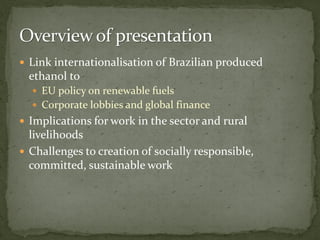
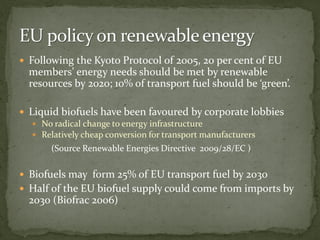
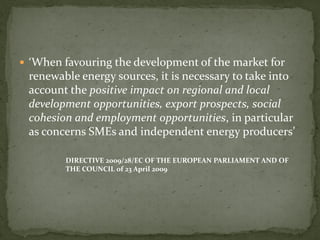
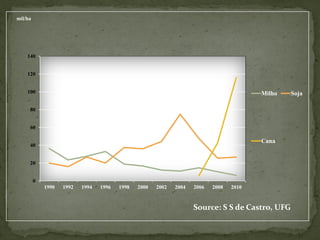
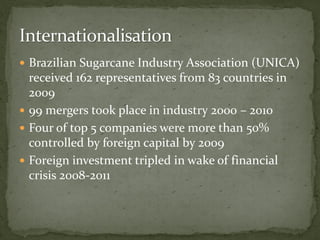
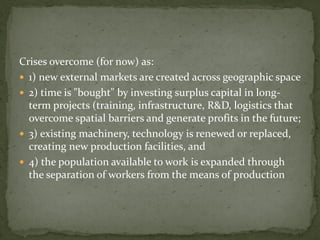
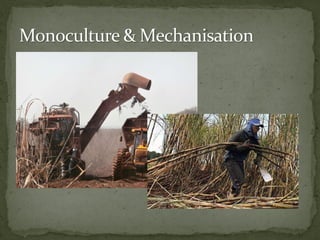
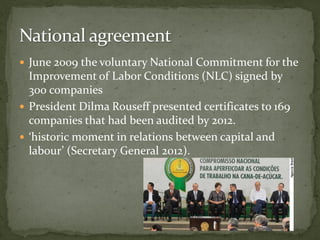
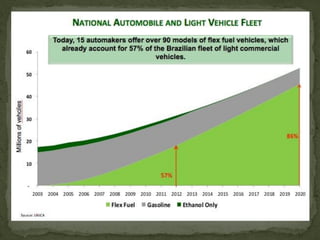
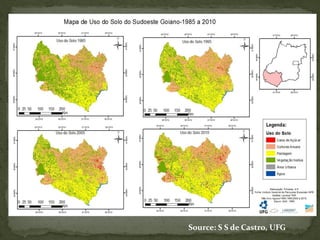
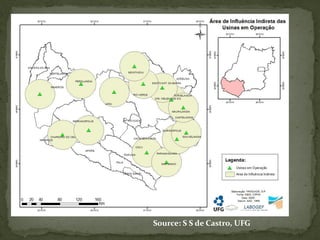
This document summarizes the internationalization of the Brazilian ethanol industry and its implications for rural livelihoods and labor conditions. It discusses how EU renewable fuel policies and corporate lobbying have promoted the growth of the Brazilian sugarcane industry and biofuel exports to meet EU targets. However, this has led to job losses, debt, mill closures, and deteriorating working conditions for cane cutters and other laborers. Mechanization has reduced labor needs but intensified the workload. Many workers face conditions analogous to slavery, and voluntary agreements to improve conditions have not been effectively enforced.

![‘[...] incessantly revolutionizes the economic
structure from within, incessantly destroying the
old one, incessantly creating a new one’.
J Schumpeter (1942: 82-83): Innovation averts /
postpones crises over time
D Harvey (2001; 2003): capital shifts its internal
contradictions around in space, redistributing risk
geographically while compressing time](https://image.slidesharecdn.com/briangarveyesrc-150226132226-conversion-gate01/85/Brian-Garvey-11-320.jpg)
![“The challenge for society is to create the conditions in which
these basic entitlements [relationships, meaningful
employment, the ability to participate in the life of society ]
are possible. This is likely to require a closer attention to the
social, psychological and material conditions of living – for
example, to people’s psychological wellbeing and to the
resilience of communities – than is familiar in free market
societies” (Jackson 2009:9)
“We can not transform our relation with nature without
transforming the social relation between ourselves”
(Harvey, 2012)](https://image.slidesharecdn.com/briangarveyesrc-150226132226-conversion-gate01/85/Brian-Garvey-34-320.jpg)

![ BIOFRAC. Biofuels in the European Union: a vision for 2030 and beyond. Final report of the
Biofuels Research Advisory Council, 2006.
EBFTP. European Biofuels Technology Platform: Strategic research agenda & strategy
deployment. CPL Press. Available from:
http://www.biofuelstp.eu/srasdd/080111_sra_sdd_web_res.pdf , 2008 (Accessed 12 July 2013).
EC. Directive 2009/28/EC of the European Parliament and of the Council of 23 April 2009 on
the promotion of the use of energy from renewable sources and amending and subsequently
repealing Directives 2001/77/EC and 2003/30/EC Renewable Energy Directive, O.J. L 140: 16–62,
5 June, 2009.
ESTADO DO S.PAULO. ‘Crise leva quase 20% das usinas de cana do Centro-Sul a fechar ou
mudar de dono’18 De Março 2014, available at
http://www.estadao.com.br/noticias/impresso,crise-leva-quase-20-das-usinas-de-cana-do-
centro-sul-a-fechar-ou-mudar-de-dono,998219,0.htm( accessed 24 March 2014).
de Castro, S S. A expansão recente da cana-de-açúcar em Goiás: padrões espaciais e
consequências1º Workshop Sobre “A Expansão Da Agroindústria Canavieira Em Goiás –
Brasil: Efeitos Socioambientais E Precarização Do Trabalho No Campo”, Dec 2013
HARVEY, D. Globalization and the spatial fi x. Geographische Revue 2: 23–30, 2001
HARVEY, D The New Imperialism, Oxford: Oxford University Press, 2003, pp. 253.
JACKSON, T. Prosperity without growth? A transition to a sustainable economy. Report for
the Sustainable Development Commission, 2009, pp. 136.
SCHUMPETER, J. Capitalism, Socialism and Democracy. London: Routledge, 1994 [1942],
pp. 460.](https://image.slidesharecdn.com/briangarveyesrc-150226132226-conversion-gate01/85/Brian-Garvey-36-320.jpg)


