Employment regulation
and the firm: stimulant or
irritant?
Mark Beatson
Chief Economist, CIPD
@MarkBeatson1
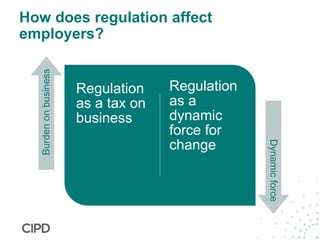
How does regulation affect
employers?
Regulation
as a tax on
business
Regulation
as a
dynamic
force for
change
Burdenonbusiness
Dynamicforce
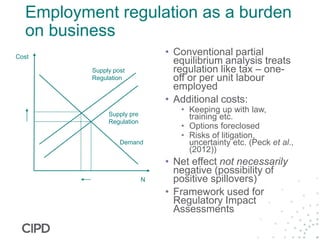
Employment regulation as a burden
on business
• Conventional partial
equilibrium analysis treats
regulation like tax – one-
off or per unit labour
employed
• Additional costs:
• Keeping up with law,
training etc.
• Options foreclosed
• Risks of litigation,
uncertainty etc. (Peck et al.,
(2012))
• Net effect not necessarily
negative (possibility of
positive spillovers)
• Framework used for
Regulatory Impact
Assessments
Demand
Supply pre
Regulation
Supply post
Regulation
Cost
N
Employment regulation as a
dynamic force
• Regulations a ‘dynamic force for change’ in SMEs
(Kitching, Hart and Wilson (2015))
• Regulations ‘constraining, enabling and motivating’
(Blackburn (2012))
• Regulations a vehicle for knowledge dissemination –
both content and as trigger for external advice
(Blackburn (2012))
• Regulations as ‘shock to the system’ and source of
innovation – common hypothesis for environmental
regulation
How does this lead us towards an
enriched understanding of impact?
• The ‘state of nature’ - Regulation integral to doing
business, not an ‘unnatural’ imposition
• Time – Path dependency
• Information – Including content of regulations, production
possibilities
• Decision-making – Human agency, rationality,
perceptions, myths, habitus (Allinson et al. (2013))
• Relationships – Trust and reputation (internal and
external), embeddedness in networks, political
representation
• Interaction with product and labour market strategies
• Heterogeneity of firms – size, age, industry, market
conditions etc.
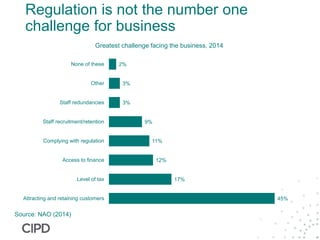
Regulation is not the number one
challenge for business
45%
17%
12%
11%
9%
3%
3%
2%
Attracting and retaining customers
Level of tax
Access to finance
Complying with regulation
Staff recruitment/retention
Staff redundancies
Other
None of these
Greatest challenge facing the business, 2014
Source: NAO (2014)
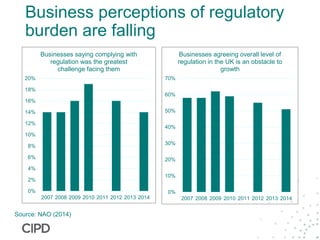
Business perceptions of regulatory
burden are falling
0%
2%
4%
6%
8%
10%
12%
14%
16%
18%
20%
2007 2008 2009 2010 2011 2012 2013 2014
Businesses saying complying with
regulation was the greatest
challenge facing them
0%
10%
20%
30%
40%
50%
60%
70%
2007 2008 2009 2010 2011 2012 2013 2014
Businesses agreeing overall level of
regulation in the UK is an obstacle to
growth
Source: NAO (2014)
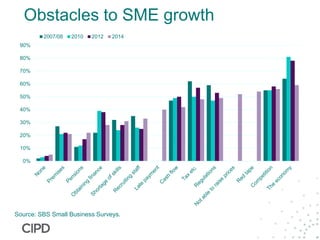
Obstacles to SME growth
0%
10%
20%
30%
40%
50%
60%
70%
80%
90%
2007/08 2010 2012 2014
Source: SBS Small Business Surveys.
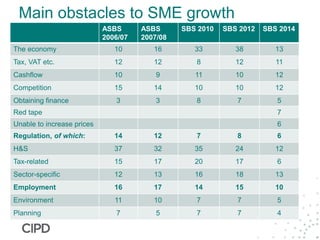
Main obstacles to SME growth
ASBS
2006/07
ASBS
2007/08
SBS 2010 SBS 2012 SBS 2014
The economy 10 16 33 38 13
Tax, VAT etc. 12 12 8 12 11
Cashflow 10 9 11 10 12
Competition 15 14 10 10 12
Obtaining finance 3 3 8 7 5
Red tape 7
Unable to increase prices 6
Regulation, of which: 14 12 7 8 6
H&S 37 32 35 24 12
Tax-related 15 17 20 17 6
Sector-specific 12 13 16 18 13
Employment 16 17 14 15 10
Environment 11 10 7 7 5
Planning 7 5 7 7 4
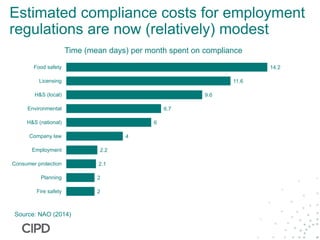
Estimated compliance costs for employment
regulations are now (relatively) modest
2
2
2.1
2.2
4
6
6.7
9.6
11.6
14.2
Fire safety
Planning
Consumer protection
Employment
Company law
H&S (national)
Environmental
H&S (local)
Licensing
Food safety
Time (mean days) per month spent on compliance
Source: NAO (2014)
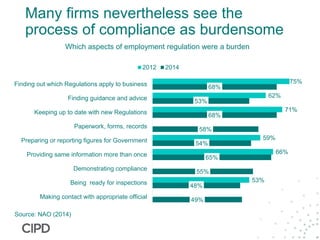
Many firms nevertheless see the
process of compliance as burdensome
49%
48%
55%
65%
54%
58%
68%
53%
68%
53%
66%
59%
71%
62%
75%
Making contact with appropriate official
Being ready for inspections
Demonstrating compliance
Providing same information more than once
Preparing or reporting figures for Government
Paperwork, forms, records
Keeping up to date with new Regulations
Finding guidance and advice
Finding out which Regulations apply to business
Which aspects of employment regulation were a burden
2012 2014
Source: NAO (2014)
Though there is evidence of stronger
(negative) perceptions in the past
• CIPD (2005) - survey found new legislation cited by 36%
of employers as most important factor driving practice in
their organisation – top reason, exceeding need to
improve business performance (25%) and changes to top
management team (9%)
• Firms sometimes choose to go beyond statutory
requirements – 2005 CIPD survey found that 57% of HR
respondents said their organisations met the minimum
standard and 41% said they went beyond it.
• To achieve minimum standard:
• NMW (initially in some industries)
• Working Time (annual leave)
• Equal pay when equal pay for equal value claims successful
(principally engineered by trade unions (Conley (2014))
• Auto-enrolment (if not already providing an occupational pension
scheme)
What lies behind these employer
perceptions?
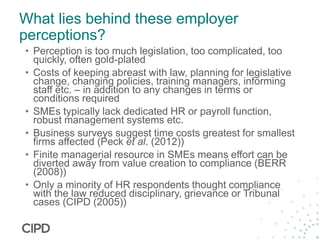
• Perception is too much legislation, too complicated, too
quickly, often gold-plated
• Costs of keeping abreast with law, planning for legislative
change, changing policies, training managers, informing
staff etc. – in addition to any changes in terms or
conditions required
• SMEs typically lack dedicated HR or payroll function,
robust management systems etc.
• Business surveys suggest time costs greatest for smallest
firms affected (Peck et al. (2012))
• Finite managerial resource in SMEs means effort can be
diverted away from value creation to compliance (BERR
(2008))
• Only a minority of HR respondents thought compliance
with the law reduced disciplinary, grievance or Tribunal
cases (CIPD (2005))
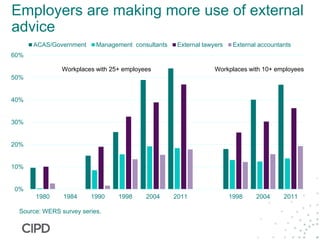
Employers are making more use of external
advice
0%
10%
20%
30%
40%
50%
60%
1980 1984 1990 1998 2004 2011 1998 2004 2011
ACAS/Government Management consultants External lawyers External accountants
Workplaces with 25+ employees Workplaces with 10+ employees
Source: WERS survey series.
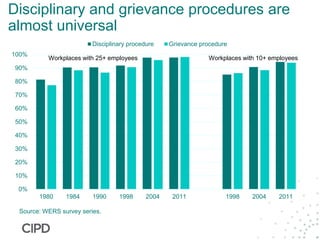
Disciplinary and grievance procedures are
almost universal
0%
10%
20%
30%
40%
50%
60%
70%
80%
90%
100%
1980 1984 1990 1998 2004 2011 1998 2004 2011
Disciplinary procedure Grievance procedure
Workplaces with 25+ employees Workplaces with 10+ employees
Source: WERS survey series.
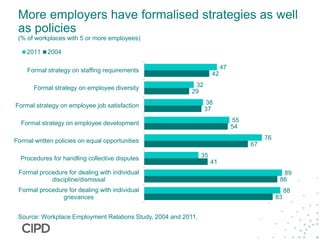
More employers have formalised strategies as well
as policies
(% of workplaces with 5 or more employees)
83
86
41
67
54
37
29
42
88
89
35
76
55
38
32
47
Formal procedure for dealing with individual
grievances
Formal procedure for dealing with individual
discipline/dismissal
Procedures for handling collective disputes
Formal written policies on equal opportunities
Formal strategy on employee development
Formal strategy on employee job satisfaction
Formal strategy on employee diversity
Formal strategy on staffing requirements
2011 2004
Source: Workplace Employment Relations Study, 2004 and 2011.
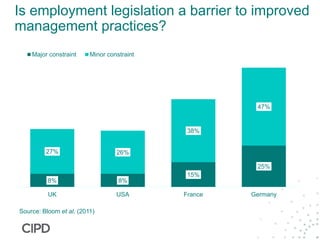
Is employment legislation a barrier to improved
management practices?
8% 8%
15%
25%
27% 26%
38%
47%
UK USA France Germany
Major constraint Minor constraint
Source: Bloom et al. (2011)
Has legislation changed the way
people are managed?
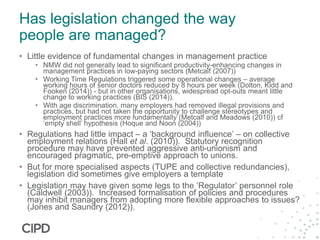
• Little evidence of fundamental changes in management practice
• NMW did not generally lead to significant productivity-enhancing changes in
management practices in low-paying sectors (Metcalf (2007))
• Working Time Regulations triggered some operational changes – average
working hours of senior doctors reduced by 8 hours per week (Dolton, Kidd and
Fooken (2014)) - but in other organisations, widespread opt-outs meant little
change to working practices (BIS (2014)).
• With age discrimination, many employers had removed illegal provisions and
practices, but had not taken the opportunity to challenge stereotypes and
employment practices more fundamentally (Metcalf and Meadows (2010)) cf
‘empty shell’ hypothesis (Hoque and Noon (2004))
• Regulations had little impact – a ‘background influence’ – on collective
employment relations (Hall et al. (2010)). Statutory recognition
procedure may have prevented aggressive anti-unionism and
encouraged pragmatic, pre-emptive approach to unions.
• But for more specialised aspects (TUPE and collective redundancies),
legislation did sometimes give employers a template
• Legislation may have given some legs to the ‘Regulator’ personnel role
(Caldwell (2003)). Increased formalisation of policies and procedures
may inhibit managers from adopting more flexible approaches to issues?
(Jones and Saundry (2012)).
Impact on SMEs?
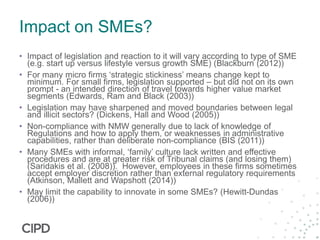
• Impact of legislation and reaction to it will vary according to type of SME
(e.g. start up versus lifestyle versus growth SME) (Blackburn (2012))
• For many micro firms ‘strategic stickiness’ means change kept to
minimum. For small firms, legislation supported – but did not on its own
prompt - an intended direction of travel towards higher value market
segments (Edwards, Ram and Black (2003))
• Legislation may have sharpened and moved boundaries between legal
and illicit sectors? (Dickens, Hall and Wood (2005))
• Non-compliance with NMW generally due to lack of knowledge of
Regulations and how to apply them, or weaknesses in administrative
capabilities, rather than deliberate non-compliance (BIS (2011))
• Many SMEs with informal, ‘family’ culture lack written and effective
procedures and are at greater risk of Tribunal claims (and losing them)
(Saridakis et al. (2008)). However, employees in these firms sometimes
accept employer discretion rather than external regulatory requirements
(Atkinson, Mallett and Wapshott (2014))
• May limit the capability to innovate in some SMEs? (Hewitt-Dundas
(2006))
What if things were different?
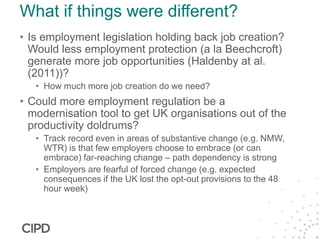
• Is employment legislation holding back job creation?
Would less employment protection (a la Beechcroft)
generate more job opportunities (Haldenby at al.
(2011))?
• How much more job creation do we need?
• Could more employment regulation be a
modernisation tool to get UK organisations out of the
productivity doldrums?
• Track record even in areas of substantive change (e.g. NMW,
WTR) is that few employers choose to embrace (or can
embrace) far-reaching change – path dependency is strong
• Employers are fearful of forced change (e.g. expected
consequences if the UK lost the opt-out provisions to the 48
hour week)
Conclusions
• Business perceptions of costs and burdens were strong in
the post-1997 period but have moderated since 2009/2010
– either the irritant itches less, the government has applied
a soothing balm or the recession imposed a new sense of
proportion!
• Little aggregate evidence of transformational change but
legislation has generally been a carefully crafted
compromise between opposing positions – designed not to
be too disruptive or costly – and it has tended to go with
the grain of prevailing people management practices.
• Too much too quickly early in the post-1997 period may
have diverted management attention away from other
priorities.
• Businesses remain nervous about the future and possibility
of imposed change.
• Little evidence of the impact on business of recent
changes in awareness and enforcement.
References
Allinson, G, Braidford, P, Houston, M and Stone, I (2013) Understanding growth in microbusinesses. BIS Research Paper No. 114.
Atkinson, C, Wapshott, R and Mallett, O (2014) ‘”You try to be a fair employer”: Regulation and employment relationships in medium-sized firms’, International Small Business Journal,
BERR (2008) Impact of regulation on productivity. BERR Occasional Paper No. 3.
Blackburn, R (2012) Segmenting the SME market and implications for service provision: a literature review. ACAS Research Paper 09/12.
Bloom, N, Lemos, R, Qi, M, Sadun, R and Van Reenen, J (2011) Constraints on developing UK management practices. BIS Research Paper No. 58.
BIS (2011) Research into employers’ attitudes and behaviour towards compliance with UK National Minimum Wage (NMW) legislation. BIS Employment Relations Research Series No. 121.
BIS Small Business Survey 2014.
BIS (2014) The impact of the Working Time Regulations on the UK labour market: a review of the evidence. BIS Analysis Paper No. 5.
Caldwell, R (2003) ‘The changing roles of personnel managers: old ambiguities, new uncertainties’. Journal of Management Studies 40 (4), pp. 983-1004.
CIPD (2005) Employment and the law: burden or benefit? London:CIPD.
Conley, H (2014) ‘Trade unions, equal pay and the law in the UK’, Economic and industrial democracy, Vol. 35, No. 2, pp. 309-323.
Dickens, L, Hall, M and Wood, S (2005) Review of research into the impact of employment legislation. DTI Employment Relations Research Series No. 45.
Dolton, P, Kidd, P and Fooken, J (2014) ‘Get a life? The impact of the European Working Time Directive: The case of UK senior doctors’, Health Economics, Vol. 24, No. 3.
Edwards, P, Ram, M and Black, J (2003) The impact of employment legislation on small firms: a case study analysis. DTI Employment Relations Research Series No. 20.
Haldenby, A, Nolan, P, Parson, L and Tanner, W (2011) The long game: increasing UK economic growth. London: Reform.
Hall, M, Hutchinson, S, Purcell, J, Terry, M and Parker, J (2010) Information and Consultation under the ICE Regulations: evidence from longitudinal case studies. BIS Employment Relations
Research Series No. 117.
Hewitt-Dundas, N (2006) ‘Resource and Capability Constraints to Innovation in small and large Plants’, Small Business Economics, Vol. 26(3) pp 257-277.
Hoque, K and Noon, M (2004) ‘Equal Opportunities Policy and Practice in Britain: Evaluating the 'Empty Shell’ Hypothesis’, Work, Employment and Society, Volume 18(3): pp481–506.
Jones, C and Saundry, R (2012) ‘The practice of discipline: evaluating the roles and relationship between managers and HR professionals’, Human Resource Management Journal, Vol. 22:3, pp
252-266.
Kitching, J, Hart, M and Wilson, N (2015), 'Burden or benefit? Regulation as a dynamic influence on small business performance' International small business journal, vol 33, no. 2, pp. 130-147.
Metcalf, D (2007) Why has the British National Minimum Wage had little or no impact on employment? CEP Discussion Paper No. 781.
Metcalf, H and Meadows, P (2010) Second Survey of Employers’ Policies, Practices and Preferences relating to Age, BIS URN 1008, DWP Research Report No 682.
NAO (2014) Business perceptions survey 2014.
Peck, R, Mulvey, G, Jackson, K and Jackson, J (2012), Business perceptions of regulatory burden. Centre for Regional Economic Development, University of Cumbria. Report submitted to BIS.

Newcastle seminar presentation beatson with references

  • 1.
    Employment regulation and thefirm: stimulant or irritant? Mark Beatson Chief Economist, CIPD @MarkBeatson1
  • 2.
    How does regulationaffect employers? Regulation as a tax on business Regulation as a dynamic force for change Burdenonbusiness Dynamicforce
  • 3.
    Employment regulation asa burden on business • Conventional partial equilibrium analysis treats regulation like tax – one- off or per unit labour employed • Additional costs: • Keeping up with law, training etc. • Options foreclosed • Risks of litigation, uncertainty etc. (Peck et al., (2012)) • Net effect not necessarily negative (possibility of positive spillovers) • Framework used for Regulatory Impact Assessments Demand Supply pre Regulation Supply post Regulation Cost N
  • 4.
    Employment regulation asa dynamic force • Regulations a ‘dynamic force for change’ in SMEs (Kitching, Hart and Wilson (2015)) • Regulations ‘constraining, enabling and motivating’ (Blackburn (2012)) • Regulations a vehicle for knowledge dissemination – both content and as trigger for external advice (Blackburn (2012)) • Regulations as ‘shock to the system’ and source of innovation – common hypothesis for environmental regulation
  • 5.
    How does thislead us towards an enriched understanding of impact? • The ‘state of nature’ - Regulation integral to doing business, not an ‘unnatural’ imposition • Time – Path dependency • Information – Including content of regulations, production possibilities • Decision-making – Human agency, rationality, perceptions, myths, habitus (Allinson et al. (2013)) • Relationships – Trust and reputation (internal and external), embeddedness in networks, political representation • Interaction with product and labour market strategies • Heterogeneity of firms – size, age, industry, market conditions etc.
  • 6.
    Regulation is notthe number one challenge for business 45% 17% 12% 11% 9% 3% 3% 2% Attracting and retaining customers Level of tax Access to finance Complying with regulation Staff recruitment/retention Staff redundancies Other None of these Greatest challenge facing the business, 2014 Source: NAO (2014)
  • 7.
    Business perceptions ofregulatory burden are falling 0% 2% 4% 6% 8% 10% 12% 14% 16% 18% 20% 2007 2008 2009 2010 2011 2012 2013 2014 Businesses saying complying with regulation was the greatest challenge facing them 0% 10% 20% 30% 40% 50% 60% 70% 2007 2008 2009 2010 2011 2012 2013 2014 Businesses agreeing overall level of regulation in the UK is an obstacle to growth Source: NAO (2014)
  • 8.
    Obstacles to SMEgrowth 0% 10% 20% 30% 40% 50% 60% 70% 80% 90% 2007/08 2010 2012 2014 Source: SBS Small Business Surveys.
  • 9.
    Main obstacles toSME growth ASBS 2006/07 ASBS 2007/08 SBS 2010 SBS 2012 SBS 2014 The economy 10 16 33 38 13 Tax, VAT etc. 12 12 8 12 11 Cashflow 10 9 11 10 12 Competition 15 14 10 10 12 Obtaining finance 3 3 8 7 5 Red tape 7 Unable to increase prices 6 Regulation, of which: 14 12 7 8 6 H&S 37 32 35 24 12 Tax-related 15 17 20 17 6 Sector-specific 12 13 16 18 13 Employment 16 17 14 15 10 Environment 11 10 7 7 5 Planning 7 5 7 7 4
  • 10.
    Estimated compliance costsfor employment regulations are now (relatively) modest 2 2 2.1 2.2 4 6 6.7 9.6 11.6 14.2 Fire safety Planning Consumer protection Employment Company law H&S (national) Environmental H&S (local) Licensing Food safety Time (mean days) per month spent on compliance Source: NAO (2014)
  • 11.
    Many firms neverthelesssee the process of compliance as burdensome 49% 48% 55% 65% 54% 58% 68% 53% 68% 53% 66% 59% 71% 62% 75% Making contact with appropriate official Being ready for inspections Demonstrating compliance Providing same information more than once Preparing or reporting figures for Government Paperwork, forms, records Keeping up to date with new Regulations Finding guidance and advice Finding out which Regulations apply to business Which aspects of employment regulation were a burden 2012 2014 Source: NAO (2014)
  • 12.
    Though there isevidence of stronger (negative) perceptions in the past • CIPD (2005) - survey found new legislation cited by 36% of employers as most important factor driving practice in their organisation – top reason, exceeding need to improve business performance (25%) and changes to top management team (9%) • Firms sometimes choose to go beyond statutory requirements – 2005 CIPD survey found that 57% of HR respondents said their organisations met the minimum standard and 41% said they went beyond it. • To achieve minimum standard: • NMW (initially in some industries) • Working Time (annual leave) • Equal pay when equal pay for equal value claims successful (principally engineered by trade unions (Conley (2014)) • Auto-enrolment (if not already providing an occupational pension scheme)
  • 13.
    What lies behindthese employer perceptions? • Perception is too much legislation, too complicated, too quickly, often gold-plated • Costs of keeping abreast with law, planning for legislative change, changing policies, training managers, informing staff etc. – in addition to any changes in terms or conditions required • SMEs typically lack dedicated HR or payroll function, robust management systems etc. • Business surveys suggest time costs greatest for smallest firms affected (Peck et al. (2012)) • Finite managerial resource in SMEs means effort can be diverted away from value creation to compliance (BERR (2008)) • Only a minority of HR respondents thought compliance with the law reduced disciplinary, grievance or Tribunal cases (CIPD (2005))
  • 14.
    Employers are makingmore use of external advice 0% 10% 20% 30% 40% 50% 60% 1980 1984 1990 1998 2004 2011 1998 2004 2011 ACAS/Government Management consultants External lawyers External accountants Workplaces with 25+ employees Workplaces with 10+ employees Source: WERS survey series.
  • 15.
    Disciplinary and grievanceprocedures are almost universal 0% 10% 20% 30% 40% 50% 60% 70% 80% 90% 100% 1980 1984 1990 1998 2004 2011 1998 2004 2011 Disciplinary procedure Grievance procedure Workplaces with 25+ employees Workplaces with 10+ employees Source: WERS survey series.
  • 16.
    More employers haveformalised strategies as well as policies (% of workplaces with 5 or more employees) 83 86 41 67 54 37 29 42 88 89 35 76 55 38 32 47 Formal procedure for dealing with individual grievances Formal procedure for dealing with individual discipline/dismissal Procedures for handling collective disputes Formal written policies on equal opportunities Formal strategy on employee development Formal strategy on employee job satisfaction Formal strategy on employee diversity Formal strategy on staffing requirements 2011 2004 Source: Workplace Employment Relations Study, 2004 and 2011.
  • 17.
    Is employment legislationa barrier to improved management practices? 8% 8% 15% 25% 27% 26% 38% 47% UK USA France Germany Major constraint Minor constraint Source: Bloom et al. (2011)
  • 18.
    Has legislation changedthe way people are managed? • Little evidence of fundamental changes in management practice • NMW did not generally lead to significant productivity-enhancing changes in management practices in low-paying sectors (Metcalf (2007)) • Working Time Regulations triggered some operational changes – average working hours of senior doctors reduced by 8 hours per week (Dolton, Kidd and Fooken (2014)) - but in other organisations, widespread opt-outs meant little change to working practices (BIS (2014)). • With age discrimination, many employers had removed illegal provisions and practices, but had not taken the opportunity to challenge stereotypes and employment practices more fundamentally (Metcalf and Meadows (2010)) cf ‘empty shell’ hypothesis (Hoque and Noon (2004)) • Regulations had little impact – a ‘background influence’ – on collective employment relations (Hall et al. (2010)). Statutory recognition procedure may have prevented aggressive anti-unionism and encouraged pragmatic, pre-emptive approach to unions. • But for more specialised aspects (TUPE and collective redundancies), legislation did sometimes give employers a template • Legislation may have given some legs to the ‘Regulator’ personnel role (Caldwell (2003)). Increased formalisation of policies and procedures may inhibit managers from adopting more flexible approaches to issues? (Jones and Saundry (2012)).
  • 19.
    Impact on SMEs? •Impact of legislation and reaction to it will vary according to type of SME (e.g. start up versus lifestyle versus growth SME) (Blackburn (2012)) • For many micro firms ‘strategic stickiness’ means change kept to minimum. For small firms, legislation supported – but did not on its own prompt - an intended direction of travel towards higher value market segments (Edwards, Ram and Black (2003)) • Legislation may have sharpened and moved boundaries between legal and illicit sectors? (Dickens, Hall and Wood (2005)) • Non-compliance with NMW generally due to lack of knowledge of Regulations and how to apply them, or weaknesses in administrative capabilities, rather than deliberate non-compliance (BIS (2011)) • Many SMEs with informal, ‘family’ culture lack written and effective procedures and are at greater risk of Tribunal claims (and losing them) (Saridakis et al. (2008)). However, employees in these firms sometimes accept employer discretion rather than external regulatory requirements (Atkinson, Mallett and Wapshott (2014)) • May limit the capability to innovate in some SMEs? (Hewitt-Dundas (2006))
  • 20.
    What if thingswere different? • Is employment legislation holding back job creation? Would less employment protection (a la Beechcroft) generate more job opportunities (Haldenby at al. (2011))? • How much more job creation do we need? • Could more employment regulation be a modernisation tool to get UK organisations out of the productivity doldrums? • Track record even in areas of substantive change (e.g. NMW, WTR) is that few employers choose to embrace (or can embrace) far-reaching change – path dependency is strong • Employers are fearful of forced change (e.g. expected consequences if the UK lost the opt-out provisions to the 48 hour week)
  • 21.
    Conclusions • Business perceptionsof costs and burdens were strong in the post-1997 period but have moderated since 2009/2010 – either the irritant itches less, the government has applied a soothing balm or the recession imposed a new sense of proportion! • Little aggregate evidence of transformational change but legislation has generally been a carefully crafted compromise between opposing positions – designed not to be too disruptive or costly – and it has tended to go with the grain of prevailing people management practices. • Too much too quickly early in the post-1997 period may have diverted management attention away from other priorities. • Businesses remain nervous about the future and possibility of imposed change. • Little evidence of the impact on business of recent changes in awareness and enforcement.
  • 22.
    References Allinson, G, Braidford,P, Houston, M and Stone, I (2013) Understanding growth in microbusinesses. BIS Research Paper No. 114. Atkinson, C, Wapshott, R and Mallett, O (2014) ‘”You try to be a fair employer”: Regulation and employment relationships in medium-sized firms’, International Small Business Journal, BERR (2008) Impact of regulation on productivity. BERR Occasional Paper No. 3. Blackburn, R (2012) Segmenting the SME market and implications for service provision: a literature review. ACAS Research Paper 09/12. Bloom, N, Lemos, R, Qi, M, Sadun, R and Van Reenen, J (2011) Constraints on developing UK management practices. BIS Research Paper No. 58. BIS (2011) Research into employers’ attitudes and behaviour towards compliance with UK National Minimum Wage (NMW) legislation. BIS Employment Relations Research Series No. 121. BIS Small Business Survey 2014. BIS (2014) The impact of the Working Time Regulations on the UK labour market: a review of the evidence. BIS Analysis Paper No. 5. Caldwell, R (2003) ‘The changing roles of personnel managers: old ambiguities, new uncertainties’. Journal of Management Studies 40 (4), pp. 983-1004. CIPD (2005) Employment and the law: burden or benefit? London:CIPD. Conley, H (2014) ‘Trade unions, equal pay and the law in the UK’, Economic and industrial democracy, Vol. 35, No. 2, pp. 309-323. Dickens, L, Hall, M and Wood, S (2005) Review of research into the impact of employment legislation. DTI Employment Relations Research Series No. 45. Dolton, P, Kidd, P and Fooken, J (2014) ‘Get a life? The impact of the European Working Time Directive: The case of UK senior doctors’, Health Economics, Vol. 24, No. 3. Edwards, P, Ram, M and Black, J (2003) The impact of employment legislation on small firms: a case study analysis. DTI Employment Relations Research Series No. 20. Haldenby, A, Nolan, P, Parson, L and Tanner, W (2011) The long game: increasing UK economic growth. London: Reform. Hall, M, Hutchinson, S, Purcell, J, Terry, M and Parker, J (2010) Information and Consultation under the ICE Regulations: evidence from longitudinal case studies. BIS Employment Relations Research Series No. 117. Hewitt-Dundas, N (2006) ‘Resource and Capability Constraints to Innovation in small and large Plants’, Small Business Economics, Vol. 26(3) pp 257-277. Hoque, K and Noon, M (2004) ‘Equal Opportunities Policy and Practice in Britain: Evaluating the 'Empty Shell’ Hypothesis’, Work, Employment and Society, Volume 18(3): pp481–506. Jones, C and Saundry, R (2012) ‘The practice of discipline: evaluating the roles and relationship between managers and HR professionals’, Human Resource Management Journal, Vol. 22:3, pp 252-266. Kitching, J, Hart, M and Wilson, N (2015), 'Burden or benefit? Regulation as a dynamic influence on small business performance' International small business journal, vol 33, no. 2, pp. 130-147. Metcalf, D (2007) Why has the British National Minimum Wage had little or no impact on employment? CEP Discussion Paper No. 781. Metcalf, H and Meadows, P (2010) Second Survey of Employers’ Policies, Practices and Preferences relating to Age, BIS URN 1008, DWP Research Report No 682. NAO (2014) Business perceptions survey 2014. Peck, R, Mulvey, G, Jackson, K and Jackson, J (2012), Business perceptions of regulatory burden. Centre for Regional Economic Development, University of Cumbria. Report submitted to BIS.