Electrical Equipment in
Medical Practice
Steve Hayes
General Manager
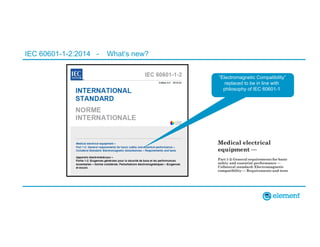
IEC 60601-1-2:2014 - What‘s new?
“Electromagnetic Compatibility”
replaced to be in line with
philosophy of IEC 60601-1
IEC 60601-Series of Standards: Structure
Products need to apply:
IEC 60601-1-X
Collateral Standards
(for classes of
products)
IEC 60601-2-X
Particular Standards
(for specific products)
IEC 60601-1 Medical Electrical Equipment
Part 1: General requirements for basic safety and essential performance
Part 2: Particular requirements for basic safety and essential
performance … of about 70 product families
e.g. CT, MR, endoscopic-, ultrasonic equipment
-1-2: Electromagnetic Compatibility
-1-3: Radiation Protection
-1-6: Usability
-1-8: Alarms
-1-9: Environment
-1-10: Physiological Closed-Loop Controllers
-1-11: Home Healthcare Environment
-1-12: Emergency Medical Services Environment
a) the -1
b) all applicable Collateral’s
c) all applicable Particular’s
which all have to belong to
the same edition of the -1
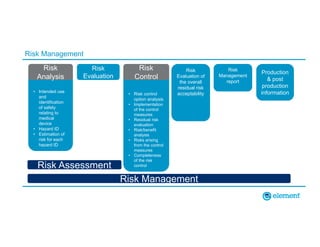
Risk Management
Risk
Evaluation
Risk
Evaluation of
the overall
residual risk
acceptability
Risk
Management
report
Production
& post
production
information• Intended use
and
identification
of safety
relating to
medical
device
• Hazard ID
• Estimation of
risk for each
hazard ID
Risk
Analysis
• Risk control
option analysis
• Implementation
of the control
measures
• Residual risk
evaluation
• Risk/benefit
analysis
• Risks arising
from the control
measures
• Completeness
of the risk
control
Risk
Control
Risk Assessment
Risk Management
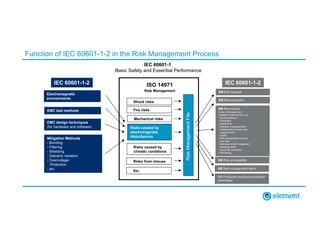
Function of IEC 60601-1-2 in the Risk Management Process
IEC 60601-1:
Basic Safety and Essential Performance
ISO 14971
Risk Management
Shock risks
Fire risks
Mechanical risks
Risks caused by
electromagnetic
disturbances
Risks caused by
climatic conditions
Risks from misuse
Etc.
RiskManagementFile
Mitigation Methods
- Bonding
- Filtering
- Shielding
- Galvanic isolation
- Overvoltage
Protection
- etc.
EMC design techniques
(for hardware and software)
EMC test methods
Electromagnetic
environments
IEC 60601-1-2 IEC 60601-1-2
EM Risk analysis
EM Risk evaluation
EM Risk control
Using verification and
validation methods such as:
- Demonstrations
- Checklists
- Inspections
- Reviews & assessments
- Independent reviews and
assessments
- Audits
- Non-standardized checks
and tests
- individual and/or integrated
hardware tests
- Computer simulation
- EM testing
EM Risk management report
EM Risk acceptability
EM Production and post-production
information
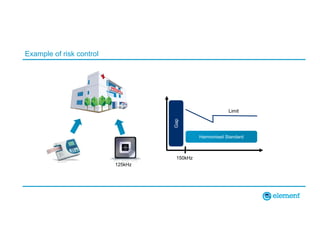
Example of risk control
125kHz
Gap
Harmonised Standard
Limit
150kHz
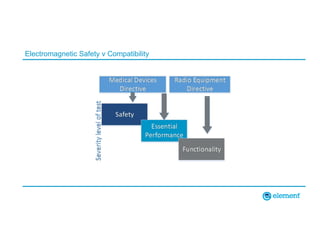
Electromagnetic Safety v Compatibility
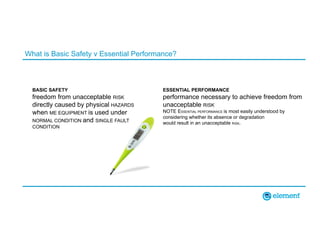
What is Basic Safety v Essential Performance?
BASIC SAFETY
freedom from unacceptable RISK
directly caused by physical HAZARDS
when ME EQUIPMENT is used under
NORMAL CONDITION and SINGLE FAULT
CONDITION
ESSENTIAL PERFORMANCE
performance necessary to achieve freedom from
unacceptable RISK
NOTE ESSENTIAL PERFORMANCE is most easily understood by
considering whether its absence or degradation
would result in an unacceptable RISK.
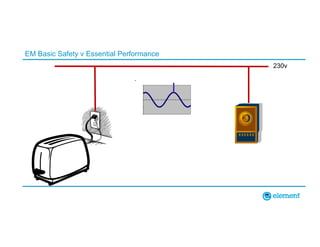
EM Basic Safety v Essential Performance
230v
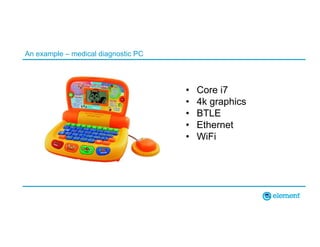
An example – medical diagnostic PC
• Core i7
• 4k graphics
• BTLE
• Ethernet
• WiFi
What environment has it designed for?
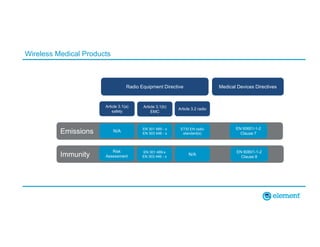
Wireless Medical Products
Radio Equipment Directive Medical Devices Directives
Article 3.1(a)
safety
Article 3.1(b)
EMC
Article 3.2 radio
Emissions N/A EN 301 489 - x
EN 303 446 - x
ETSI EN radio
standard(s)
EN 60601-1-2
Clause 7
Immunity
Risk
Assessment
EN 301 489-x
EN 303 446 - x
N/A
EN 60601-1-2
Clause 8
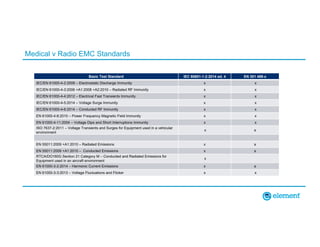
Medical v Radio EMC Standards
Basic Test Standard IEC 60601-1-2:2014 ed. 4 EN 301 489-x
IEC/EN 61000-4-2:2009 – Electrostatic Discharge Immunity x x
IEC/EN 61000-4-3:2006 +A1:2008 +A2:2010 – Radiated RF Immunity x x
IEC/EN 61000-4-4:2012 – Electrical Fast Transients Immunity x x
IEC/EN 61000-4-5:2014 – Voltage Surge Immunity x x
IEC/EN 61000-4-6:2014 – Conducted RF Immunity x x
EN 61000-4-8:2010 – Power Frequency Magnetic Field Immunity x x
EN 61000-4-11:2004 – Voltage Dips and Short Interruptions Immunity x x
ISO 7637-2:2011 – Voltage Transients and Surges for Equipment used in a vehicular
environment
x x
EN 55011:2009 +A1:2010 – Radiated Emissions x x
EN 55011:2009 +A1:2010 – Conducted Emissions x x
RTCA/DO160G Section 21 Category M – Conducted and Radiated Emissions for
Equipment used in an aircraft environment
x
EN 61000-3-2:2014 – Harmonic Current Emissions x x
EN 61000-3-3:2013 – Voltage Fluctuations and Flicker x x
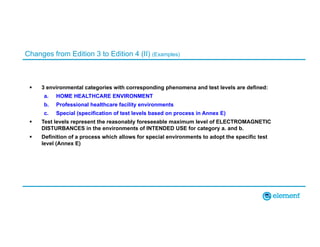
Changes from Edition 3 to Edition 4 (II) (Examples)
 3 environmental categories with corresponding phenomena and test levels are defined:
a. HOME HEALTHCARE ENVIRONMENT
b. Professional healthcare facility environments
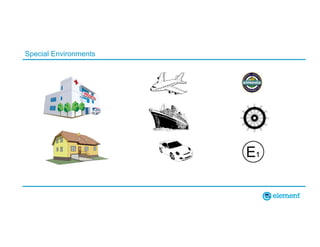
c. Special (specification of test levels based on process in Annex E)
 Test levels represent the reasonably foreseeable maximum level of ELECTROMAGNETIC
DISTURBANCES in the environments of INTENDED USE for category a. and b.
 Definition of a process which allows for special environments to adopt the specific test
level (Annex E)
Special Environments
Industrial Commercial
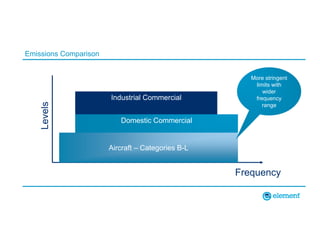
Emissions Comparison
Domestic Commercial
Aircraft – Categories B-L
Levels
Frequency
More stringent
limits with
wider
frequency
range
Aircraft – Categories B-L
(radiated)
Aircraft – Categories B-L
(conducted)
Industrial Commercial
(radiated)
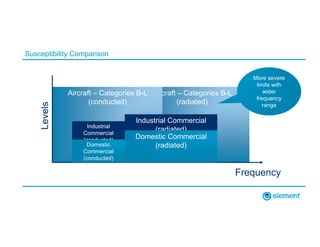
Susceptibility Comparison
Domestic Commercial
(radiated)
Industrial
Commercial
(conducted)
Domestic
Commercial
(conducted)
Levels
Frequency
More severe
limits with
wider
frequency
range
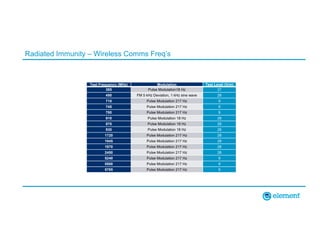
Radiated Immunity – Wireless Comms Freq’s
Test Frequency (MHz) Modulation Test Level (V/m)
385 Pulse Modulation18 Hz 27
450 FM 5 kHz Deviation, 1 kHz sine wave 28
710 Pulse Modulation 217 Hz 9
745 Pulse Modulation 217 Hz 9
780 Pulse Modulation 217 Hz 9
810 Pulse Modulation 18 Hz 28
870 Pulse Modulation 18 Hz 28
930 Pulse Modulation 18 Hz 28
1720 Pulse Modulation 217 Hz 28
1845 Pulse Modulation 217 Hz 28
1970 Pulse Modulation 217 Hz 28
2450 Pulse Modulation 217 Hz 28
5240 Pulse Modulation 217 Hz 9
5500 Pulse Modulation 217 Hz 9
5785 Pulse Modulation 217 Hz 9
Changes from Edition 3 to Edition 4 (III) (Examples)
 Test levels are higher for some phenomena:
 ESD
 Conducted disturbances induced by RF fields (HAM radio -, ISM - bands)
 RATED power frequency magnetic fields
(It is not so easy to compare it to edition 3 because other compliance criteria (basic safety and
essential performance) are valid!)
 Considers new phenomena
 Immunity against RF transmitters in close proximity (mobile phones, WiFi,
RFID, etc.)
 Considers modulation characteristics
 Test procedure according IEC 61000-4-3 as interim solution till specific
procedure is developed by SC77B
(planned IEC 61000-4-39).
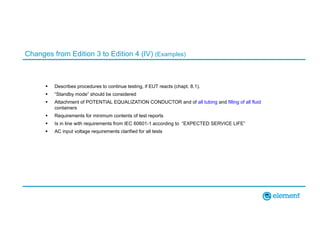
Changes from Edition 3 to Edition 4 (IV) (Examples)
 Describes procedures to continue testing, if EUT reacts (chapt. 8.1).
 “Standby mode” should be considered
 Attachment of POTENTIAL EQUALIZATION CONDUCTOR and of all tubing and filling of all fluid
containers
 Requirements for minimum contents of test reports
 Is in line with requirements from IEC 60601-1 according to “EXPECTED SERVICE LIFE”
 AC input voltage requirements clarified for all tests
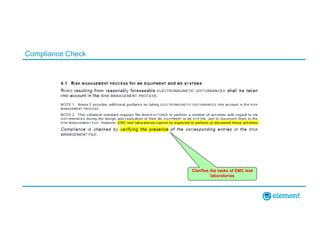
Compliance Check
Clarifies the tasks of EMC test
laboratories
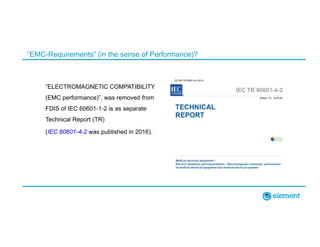
“EMC-Requirements” (in the sense of Performance)?
“ELECTROMAGNETIC COMPATIBILITY
(EMC performance)”, was removed from
FDIS of IEC 60601-1-2 is as separate
Technical Report (TR)
(IEC 60601-4-2 was published in 2016).
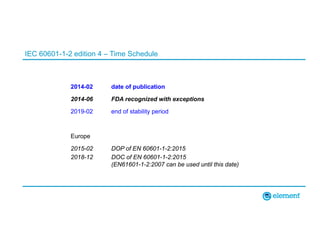
IEC 60601-1-2 edition 4 – Time Schedule
2014-02 date of publication
2014-06 FDA recognized with exceptions
2019-02 end of stability period
Europe
2015-02 DOP of EN 60601-1-2:2015
2018-12 DOC of EN 60601-1-2:2015
(EN61601-1-2:2007 can be used until this date)
Thank you for your
attention!

Electrical Equipment in Medical Practice

  • 1.
    Electrical Equipment in MedicalPractice Steve Hayes General Manager
  • 2.
    IEC 60601-1-2:2014 -What‘s new? “Electromagnetic Compatibility” replaced to be in line with philosophy of IEC 60601-1
  • 3.
    IEC 60601-Series ofStandards: Structure Products need to apply: IEC 60601-1-X Collateral Standards (for classes of products) IEC 60601-2-X Particular Standards (for specific products) IEC 60601-1 Medical Electrical Equipment Part 1: General requirements for basic safety and essential performance Part 2: Particular requirements for basic safety and essential performance … of about 70 product families e.g. CT, MR, endoscopic-, ultrasonic equipment -1-2: Electromagnetic Compatibility -1-3: Radiation Protection -1-6: Usability -1-8: Alarms -1-9: Environment -1-10: Physiological Closed-Loop Controllers -1-11: Home Healthcare Environment -1-12: Emergency Medical Services Environment a) the -1 b) all applicable Collateral’s c) all applicable Particular’s which all have to belong to the same edition of the -1
  • 4.
    Risk Management Risk Evaluation Risk Evaluation of theoverall residual risk acceptability Risk Management report Production & post production information• Intended use and identification of safety relating to medical device • Hazard ID • Estimation of risk for each hazard ID Risk Analysis • Risk control option analysis • Implementation of the control measures • Residual risk evaluation • Risk/benefit analysis • Risks arising from the control measures • Completeness of the risk control Risk Control Risk Assessment Risk Management
  • 5.
    Function of IEC60601-1-2 in the Risk Management Process IEC 60601-1: Basic Safety and Essential Performance ISO 14971 Risk Management Shock risks Fire risks Mechanical risks Risks caused by electromagnetic disturbances Risks caused by climatic conditions Risks from misuse Etc. RiskManagementFile Mitigation Methods - Bonding - Filtering - Shielding - Galvanic isolation - Overvoltage Protection - etc. EMC design techniques (for hardware and software) EMC test methods Electromagnetic environments IEC 60601-1-2 IEC 60601-1-2 EM Risk analysis EM Risk evaluation EM Risk control Using verification and validation methods such as: - Demonstrations - Checklists - Inspections - Reviews & assessments - Independent reviews and assessments - Audits - Non-standardized checks and tests - individual and/or integrated hardware tests - Computer simulation - EM testing EM Risk management report EM Risk acceptability EM Production and post-production information
  • 6.
    Example of riskcontrol 125kHz Gap Harmonised Standard Limit 150kHz
  • 7.
  • 8.
    What is BasicSafety v Essential Performance? BASIC SAFETY freedom from unacceptable RISK directly caused by physical HAZARDS when ME EQUIPMENT is used under NORMAL CONDITION and SINGLE FAULT CONDITION ESSENTIAL PERFORMANCE performance necessary to achieve freedom from unacceptable RISK NOTE ESSENTIAL PERFORMANCE is most easily understood by considering whether its absence or degradation would result in an unacceptable RISK.
  • 9.
    EM Basic Safetyv Essential Performance 230v
  • 10.
    An example –medical diagnostic PC • Core i7 • 4k graphics • BTLE • Ethernet • WiFi
  • 11.
    What environment hasit designed for?
  • 12.
    Wireless Medical Products RadioEquipment Directive Medical Devices Directives Article 3.1(a) safety Article 3.1(b) EMC Article 3.2 radio Emissions N/A EN 301 489 - x EN 303 446 - x ETSI EN radio standard(s) EN 60601-1-2 Clause 7 Immunity Risk Assessment EN 301 489-x EN 303 446 - x N/A EN 60601-1-2 Clause 8
  • 13.
    Medical v RadioEMC Standards Basic Test Standard IEC 60601-1-2:2014 ed. 4 EN 301 489-x IEC/EN 61000-4-2:2009 – Electrostatic Discharge Immunity x x IEC/EN 61000-4-3:2006 +A1:2008 +A2:2010 – Radiated RF Immunity x x IEC/EN 61000-4-4:2012 – Electrical Fast Transients Immunity x x IEC/EN 61000-4-5:2014 – Voltage Surge Immunity x x IEC/EN 61000-4-6:2014 – Conducted RF Immunity x x EN 61000-4-8:2010 – Power Frequency Magnetic Field Immunity x x EN 61000-4-11:2004 – Voltage Dips and Short Interruptions Immunity x x ISO 7637-2:2011 – Voltage Transients and Surges for Equipment used in a vehicular environment x x EN 55011:2009 +A1:2010 – Radiated Emissions x x EN 55011:2009 +A1:2010 – Conducted Emissions x x RTCA/DO160G Section 21 Category M – Conducted and Radiated Emissions for Equipment used in an aircraft environment x EN 61000-3-2:2014 – Harmonic Current Emissions x x EN 61000-3-3:2013 – Voltage Fluctuations and Flicker x x
  • 14.
    Changes from Edition3 to Edition 4 (II) (Examples)  3 environmental categories with corresponding phenomena and test levels are defined: a. HOME HEALTHCARE ENVIRONMENT b. Professional healthcare facility environments c. Special (specification of test levels based on process in Annex E)  Test levels represent the reasonably foreseeable maximum level of ELECTROMAGNETIC DISTURBANCES in the environments of INTENDED USE for category a. and b.  Definition of a process which allows for special environments to adopt the specific test level (Annex E)
  • 15.
  • 16.
    Industrial Commercial Emissions Comparison DomesticCommercial Aircraft – Categories B-L Levels Frequency More stringent limits with wider frequency range
  • 17.
    Aircraft – CategoriesB-L (radiated) Aircraft – Categories B-L (conducted) Industrial Commercial (radiated) Susceptibility Comparison Domestic Commercial (radiated) Industrial Commercial (conducted) Domestic Commercial (conducted) Levels Frequency More severe limits with wider frequency range
  • 18.
    Radiated Immunity –Wireless Comms Freq’s Test Frequency (MHz) Modulation Test Level (V/m) 385 Pulse Modulation18 Hz 27 450 FM 5 kHz Deviation, 1 kHz sine wave 28 710 Pulse Modulation 217 Hz 9 745 Pulse Modulation 217 Hz 9 780 Pulse Modulation 217 Hz 9 810 Pulse Modulation 18 Hz 28 870 Pulse Modulation 18 Hz 28 930 Pulse Modulation 18 Hz 28 1720 Pulse Modulation 217 Hz 28 1845 Pulse Modulation 217 Hz 28 1970 Pulse Modulation 217 Hz 28 2450 Pulse Modulation 217 Hz 28 5240 Pulse Modulation 217 Hz 9 5500 Pulse Modulation 217 Hz 9 5785 Pulse Modulation 217 Hz 9
  • 19.
    Changes from Edition3 to Edition 4 (III) (Examples)  Test levels are higher for some phenomena:  ESD  Conducted disturbances induced by RF fields (HAM radio -, ISM - bands)  RATED power frequency magnetic fields (It is not so easy to compare it to edition 3 because other compliance criteria (basic safety and essential performance) are valid!)  Considers new phenomena  Immunity against RF transmitters in close proximity (mobile phones, WiFi, RFID, etc.)  Considers modulation characteristics  Test procedure according IEC 61000-4-3 as interim solution till specific procedure is developed by SC77B (planned IEC 61000-4-39).
  • 20.
    Changes from Edition3 to Edition 4 (IV) (Examples)  Describes procedures to continue testing, if EUT reacts (chapt. 8.1).  “Standby mode” should be considered  Attachment of POTENTIAL EQUALIZATION CONDUCTOR and of all tubing and filling of all fluid containers  Requirements for minimum contents of test reports  Is in line with requirements from IEC 60601-1 according to “EXPECTED SERVICE LIFE”  AC input voltage requirements clarified for all tests
  • 21.
    Compliance Check Clarifies thetasks of EMC test laboratories
  • 22.
    “EMC-Requirements” (in thesense of Performance)? “ELECTROMAGNETIC COMPATIBILITY (EMC performance)”, was removed from FDIS of IEC 60601-1-2 is as separate Technical Report (TR) (IEC 60601-4-2 was published in 2016).
  • 23.
    IEC 60601-1-2 edition4 – Time Schedule 2014-02 date of publication 2014-06 FDA recognized with exceptions 2019-02 end of stability period Europe 2015-02 DOP of EN 60601-1-2:2015 2018-12 DOC of EN 60601-1-2:2015 (EN61601-1-2:2007 can be used until this date)
  • 24.
    Thank you foryour attention!