Open Infrastructure for Edge:
A Distributed Ledger Outlook
A. Zavodovski, N. Mohan, W. Wong and J. Kangasharju
How Will Edge Get Deployed?
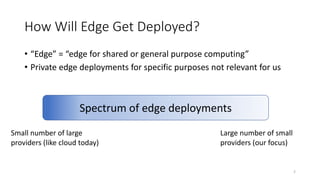
• “Edge” = “edge for shared or general purpose computing”
• Private edge deployments for specific purposes not relevant for us
2
Spectrum of edge deployments
Small number of large
providers (like cloud today)
Large number of small
providers (our focus)
Motivation: An Open Infrastructure for Edge
• Where will the edge servers come from?
• Anyone should be able to become an edge provider
• Set of common standards and practices for edge providers is required
• Solution for handling agreement and financial transactions
• Large number of independent providers
• Large number of clients/users
• Is a distributed ledger a possible choice? (our focus in this paper)
3
Why Distributed Ledgers for Edge?
• Widely used and popular, despite known issues
• In principle, they provide decentralized trust and transactions
• Very interesting and useful for open edge
• Two key building blocks:
• Smart contracts: Executable code
• Ricardian contracts: Legal agreement in machine-readable tamper-proof form
• Ricardian triple: <prose, parameters, code>
• Prose = Ricardian contract
• Code = Smart contract
• Parameters: This particular instance of the agreement
4
Requirements for Agreements in Open Edge
• Fast and cheap transactions
• Appropriate level of privacy and accountability
• Protection from volatility of crypto assets
• Conflict resolution and escrow service
• Legislation for digital agreement
• Environmentally sustainable operation
• True decentralization, no central authority
5
Sustainability, Transaction Cost, Volatility
6
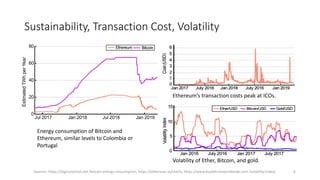
Energy consumption of Bitcoin and
Ethereum, similar levels to Colombia or
Portugal
Sources: https://digiconomist.net /bitcoin-energy-consumption, https://etherscan.io/charts, https://www.buybitcoinworldwide.com /volatility-index/
Ethereum’s transaction costs peak at ICOs.
Volatility of Ether, Bitcoin, and gold.
Smart Contract Platforms
• Ethereum has been the leader so far
• Cons: high energy consumption (proof-of-work), low performance, high costs
• Pros: truly distributed, backing community is largest (7000-20000 nodes)
• Transition to greener proof-of-stake Casper protocol is expected
• Second generation of platforms
• EOS, Stellar, Cardano, etc
• Many use delegated proof-of-stake (DPoS), greener and faster
• Some charge zero fee
• Decentralization vs. efficiency
• DPoS is efficient, but its decentralization is often questioned (e.g., EOS)
7
Other Considerations
• Volatility protection
• Stable coins, e.g., Tether, USD Coin, TrueUSD, backed by some institution
• Buyer of the coin must trust the institution, no decentralization
• Allegations, e.g., no real money backing Tether, no way to check
• Privacy
• Blockchain is open by design
• For business considerations, edge providers might want to conceal their prices
• Systems like Zcash use zero knowledge proofs to store private data while
keeping blockchain public
• No smart contract system supporting privacy in convenient way so far
8
Takeaways
• No distributed ledger exists that would support everything that open
infrastructure for edge ideally requires
• Common tradeoffs
• Accountability vs. privacy
• Efficiency and low costs vs. true decentralization
• Volatility vs. Trusting a non-regulated institution
• Legal status of digital agreement will always be out of technical scope
• Energy wasteful PoW and low transaction throughput are likely to be
tackled as proof-of-stake family of protocols take hold
• Interledgers unite diverse systems enabling interactions between
participants using different ledgers
• Current developments are leading into a positive direction
9
Open Questions? Issues? Problems?
• Will there ever be a general-purpose edge?
• What form will it take?
• Based on current cloud operators?
• Based on independent edge providers?
• This paper: Thought experiment + requirement analysis for open edge
• Main conclusion: Feasible, although needs more work
• Shared edge looks very likely
• Shared = One application, many providers
• Need: Standardized APIs, discovery, agreements
10
Thank you!
jussi.kangasharju@helsinki.fi

Open Infrastructure for Edge: A Distributed Ledger Outlook

  • 1.
    Open Infrastructure forEdge: A Distributed Ledger Outlook A. Zavodovski, N. Mohan, W. Wong and J. Kangasharju
  • 2.
    How Will EdgeGet Deployed? • “Edge” = “edge for shared or general purpose computing” • Private edge deployments for specific purposes not relevant for us 2 Spectrum of edge deployments Small number of large providers (like cloud today) Large number of small providers (our focus)
  • 3.
    Motivation: An OpenInfrastructure for Edge • Where will the edge servers come from? • Anyone should be able to become an edge provider • Set of common standards and practices for edge providers is required • Solution for handling agreement and financial transactions • Large number of independent providers • Large number of clients/users • Is a distributed ledger a possible choice? (our focus in this paper) 3
  • 4.
    Why Distributed Ledgersfor Edge? • Widely used and popular, despite known issues • In principle, they provide decentralized trust and transactions • Very interesting and useful for open edge • Two key building blocks: • Smart contracts: Executable code • Ricardian contracts: Legal agreement in machine-readable tamper-proof form • Ricardian triple: <prose, parameters, code> • Prose = Ricardian contract • Code = Smart contract • Parameters: This particular instance of the agreement 4
  • 5.
    Requirements for Agreementsin Open Edge • Fast and cheap transactions • Appropriate level of privacy and accountability • Protection from volatility of crypto assets • Conflict resolution and escrow service • Legislation for digital agreement • Environmentally sustainable operation • True decentralization, no central authority 5
  • 6.
    Sustainability, Transaction Cost,Volatility 6 Energy consumption of Bitcoin and Ethereum, similar levels to Colombia or Portugal Sources: https://digiconomist.net /bitcoin-energy-consumption, https://etherscan.io/charts, https://www.buybitcoinworldwide.com /volatility-index/ Ethereum’s transaction costs peak at ICOs. Volatility of Ether, Bitcoin, and gold.
  • 7.
    Smart Contract Platforms •Ethereum has been the leader so far • Cons: high energy consumption (proof-of-work), low performance, high costs • Pros: truly distributed, backing community is largest (7000-20000 nodes) • Transition to greener proof-of-stake Casper protocol is expected • Second generation of platforms • EOS, Stellar, Cardano, etc • Many use delegated proof-of-stake (DPoS), greener and faster • Some charge zero fee • Decentralization vs. efficiency • DPoS is efficient, but its decentralization is often questioned (e.g., EOS) 7
  • 8.
    Other Considerations • Volatilityprotection • Stable coins, e.g., Tether, USD Coin, TrueUSD, backed by some institution • Buyer of the coin must trust the institution, no decentralization • Allegations, e.g., no real money backing Tether, no way to check • Privacy • Blockchain is open by design • For business considerations, edge providers might want to conceal their prices • Systems like Zcash use zero knowledge proofs to store private data while keeping blockchain public • No smart contract system supporting privacy in convenient way so far 8
  • 9.
    Takeaways • No distributedledger exists that would support everything that open infrastructure for edge ideally requires • Common tradeoffs • Accountability vs. privacy • Efficiency and low costs vs. true decentralization • Volatility vs. Trusting a non-regulated institution • Legal status of digital agreement will always be out of technical scope • Energy wasteful PoW and low transaction throughput are likely to be tackled as proof-of-stake family of protocols take hold • Interledgers unite diverse systems enabling interactions between participants using different ledgers • Current developments are leading into a positive direction 9
  • 10.
    Open Questions? Issues?Problems? • Will there ever be a general-purpose edge? • What form will it take? • Based on current cloud operators? • Based on independent edge providers? • This paper: Thought experiment + requirement analysis for open edge • Main conclusion: Feasible, although needs more work • Shared edge looks very likely • Shared = One application, many providers • Need: Standardized APIs, discovery, agreements 10
  • 11.