SEMINAR By: SANAT PANDOH
1656/15
1. INTRODUCTION.
2. HISTORY.
3. BLOCKCHAIN AND ITS WORING
4. SMART CONTRACT
5.EVM
6.SOLIDITY
7.ETHER ,MINING ,GAS AND TRANSACTION.
8.PROJECTS DETAILS.
9.REFERENCES.
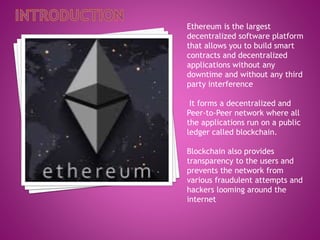
Ethereum is the largest
decentralized software platform
that allows you to build smart
contracts and decentralized
applications without any
downtime and without any third
party interference
It forms a decentralized and
Peer-to-Peer network where all
the applications run on a public
ledger called blockchain.
Blockchain also provides
transparency to the users and
prevents the network from
various fraudulent attempts and
hackers looming around the
internet
Ethereum
The Ethereum Project's logo, first used in 2014
Original author(s) Vitalik Buterin, Gavin Wood, Joseph
Lubin
Initial release 30 July 2015
Repository  https://github.com/ethereum
Written in Go, C++, Rust
Operating system Clients available
for Linux, Windows, macOS, POSIX, Ras
pbian
Platform x86, AMD64, ARM
Type Decentralized
computing, Blockchain, Cryptocurrency
License GPLv3, LGPLv3, MIT[1][2]
Website www.ethereum.org
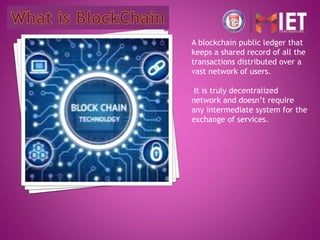
A blockchain public ledger that
keeps a shared record of all the
transactions distributed over a
vast network of users.
It is truly decentralized
network and doesn’t require
any intermediate system for the
exchange of services.
A blockchain is comprised of a series of data blocks wherein each block
stores a small patch of transactions made by the users. All these data blocks
are chained together electronically using a top-tier form of cryptography.
 Thus, all the blocks together form a permanent and tamper-proof public
record of each and every transaction happened in the network. In a
blockchain, every user is connected in such a way that his/her data is made
visible to every other user in that blockchain without revealing their
identity. To make it more simple, blockchain provides a total transparency
to the users.
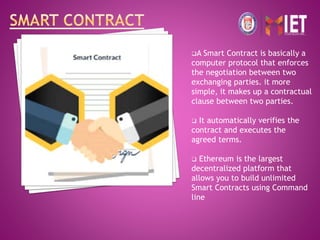
A Smart Contract is basically a
computer protocol that enforces
the negotiation between two
exchanging parties. it more
simple, it makes up a contractual
clause between two parties.
 It automatically verifies the
contract and executes the
agreed terms.
 Ethereum is the largest
decentralized platform that
allows you to build unlimited
Smart Contracts using Command
line
 Ethereum Virtual Machine is a computer software which runs at an
abstraction layer straight above the underlying hardware. Ethereum
uses a Turing Complete Virtual Machine for running and compiling the
codes.
 For this reason, Ethereum Virtual Machine is also called Turing
Complete Virtual Machine. The term “Turing Complete” flaunts that
this software is adroit enough to run any code defined by the
developer or user.
 Solidity is one of the two main programming
languages that are specifically designed to target
the Ethereum Virtual Machine or EVM. The other
one is Serpent.
 All the Ethereum based applications and Smart
Contracts are written in Solidity.
 Solidity was initially proposed in August 2014 by
Dr. Gavin Wood and it was later developed by
the Ethereum project's Solidity team, lead by Dr.
Christian Reitweissner.
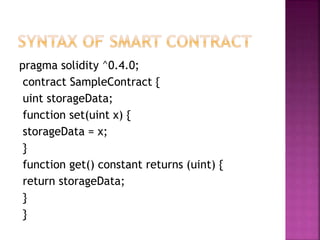
pragma solidity ^0.4.0;
contract SampleContract {
uint storageData;
function set(uint x) {
storageData = x;
}
function get() constant returns (uint) {
return storageData;
}
}
The first step is compilation of contracts. The compilation is done
using solidity compiler.
The compiler generates two major artifacts
 ABI definition and.
Think of ABI (application binary interface) as an interface consisting
of all external and public function declarations along with their
parameters and return types. The ABI defines the contract and any
caller wanting to invoke any contract function can use the ABI to do
so.
A new instance of contract is created using the ABI definition.
Contracts byte code
 The bytecode is what represents the contract and is deployed in
Ethereum ecosystem. The bytecode is needed during deployment
and ABI is needed for invoking functions in contract.
 A new transaction is created that utilizes the newly instance of
contract passing in the contract bytecode and appropriate
quantity of gas for execution of transaction. After the transaction
is mined, the contract is available at an address determined by
Ethereum.
Now, that contract is deployed within the Ethereum virtual
machine, its time to invoke the contract.
Using the newly generated address, an instance of contracts can be
created and its functions can be invoked.
 Ether is the digital token used by Ethereum. It is
also used to pay transaction fees and other
computational services on the Ethereum
Network.
 Ether is also used as a cryptocurrency and is
traded on various exchanges just like bitcoin.
 It is the second most popular cryptocurrency in
the world and has a market capitalisation of 950
million USD.
 The price of Ether token is also volatile just like
other cryptocurrencies and it keeps fluctuating
every minute.
 The process of discovering and producing new ether tokens
is called Mining. Ether mining is very similar to the bitcoin
mining except for the block halving and rewarding scheme
offered to the miners.
 The person who mines or produces an ether, bitcoin or any
other cryptocurrency is called Miner. The miners solve
complex mathematical problems on their computers using
advanced software tools and dedicated hardware chips
called ASICs.
 The main idea is to create a new block which gets added
to the existing blockchain. Each block contains a list of all
the recent transactions happened within the bitcoin
network.
It was mentioned that Ether is paid
as fees for any execution that
changes state in Ethereum. Ether is
traded on public exchanges and its
price fluctuate daily. If Ether is
used for paying fees, then the cost
of using the same service could be
very high on certain days and low
on other days. People will wait for
price of Ether to fall to execute
their transactions. This is not ideal
for a platform like Ethereum. Gas
helps in alleviating this problem.
Gas is the internal currency of
Ethereum. The execution and
resource utilization cost is
predetermined in Ethereum in
terms of Gas units. This is also
known as Gas Cost. There is also
Gas price that can be adjusted to
lower price when price of Ether
increases and higher price when
price of Ether decreases. For
example, to invoke a function in a
contract that modifies a string will
cost Gas which is pre-determined,
and Users should pay in terms of
Gas to ensure smooth execution of
this transaction.
 A transaction is an agreement between a buyer and seller, a
supplier and a consumer or a provider and a consumer that there
would be exchange of assets, products or services in lieu of
currency, crypto-currency or some other asset either in present
or in future. Ethereum helps in executing transaction. There are
Three types of transaction that can be executed in Ethereum.
A. Transfer of Ether from one account to another. The accounts
can be externally owned accounts or contract account
B. Deployment of Smart contract—An externally owned
account can deploy a contract using a transaction in
Ethereum virtual machine.
C. Using or invoking a function within a contract—Executing a
function in a contract that changes state are considered as
transactions in Ethereum. If executing a function does not
change state, it does not require a transaction
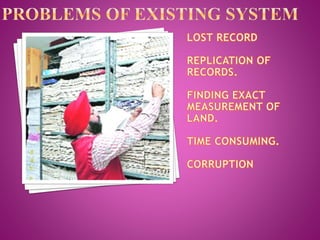
 At present, Revenue Department store there records manually. The records
store in a room in the form of papers. There are many revenue office in a
state, records are store in a particular office with respect to lands at different
places. There are many chances of replication of records as well as many
chances for record missing. The Land is divided to owner by giving owner
land a various numbers(Khata no, Khawat no, khasari no, had-bast no, etc.).
 This Project helps government Revenue department to store record in
a systematic way, And maintain new records in a real time. This
Platform helps to government revenue department to overcome the
missing of records and also helps to find and correct Replicated
record. With the help of this platform the user can apply online for the
NOC as well as apply online for the Registration of transfer of
property. Also Citizen as well as Government Revenue department
find the land location and land details by giving a proper coordinate’s
or point on a map. The user can also get the tax detail of the land at
the time of transferring land papers .
 All Records are store in a
block chain in the form of
blocks.
 The new record or new block
which is added to block chain
is verified by all the node in a
block chain
 User can easily get the land
location by entering the
certain details or identifiers
of land.(Khata no,khawat
no,had-bast no,khasri no etc.)
 By creating online platform
time consummation reduces
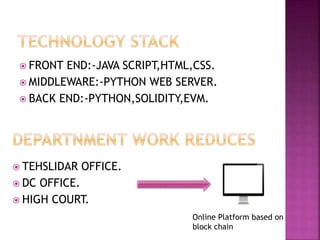
 FRONT END:-JAVA SCRIPT,HTML,CSS.
 MIDDLEWARE:-PYTHON WEB SERVER.
 BACK END:-PYTHON,SOLIDITY,EVM.
 TEHSLIDAR OFFICE.
 DC OFFICE.
 HIGH COURT.
Online Platform based on
block chain
Ethereum Block Chain

Ethereum Block Chain

  • 1.
    SEMINAR By: SANATPANDOH 1656/15
  • 2.
    1. INTRODUCTION. 2. HISTORY. 3.BLOCKCHAIN AND ITS WORING 4. SMART CONTRACT 5.EVM 6.SOLIDITY 7.ETHER ,MINING ,GAS AND TRANSACTION. 8.PROJECTS DETAILS. 9.REFERENCES.
  • 3.
    Ethereum is thelargest decentralized software platform that allows you to build smart contracts and decentralized applications without any downtime and without any third party interference It forms a decentralized and Peer-to-Peer network where all the applications run on a public ledger called blockchain. Blockchain also provides transparency to the users and prevents the network from various fraudulent attempts and hackers looming around the internet
  • 4.
    Ethereum The Ethereum Project'slogo, first used in 2014 Original author(s) Vitalik Buterin, Gavin Wood, Joseph Lubin Initial release 30 July 2015 Repository  https://github.com/ethereum Written in Go, C++, Rust Operating system Clients available for Linux, Windows, macOS, POSIX, Ras pbian Platform x86, AMD64, ARM Type Decentralized computing, Blockchain, Cryptocurrency License GPLv3, LGPLv3, MIT[1][2] Website www.ethereum.org
  • 5.
    A blockchain publicledger that keeps a shared record of all the transactions distributed over a vast network of users. It is truly decentralized network and doesn’t require any intermediate system for the exchange of services.
  • 6.
    A blockchain iscomprised of a series of data blocks wherein each block stores a small patch of transactions made by the users. All these data blocks are chained together electronically using a top-tier form of cryptography.  Thus, all the blocks together form a permanent and tamper-proof public record of each and every transaction happened in the network. In a blockchain, every user is connected in such a way that his/her data is made visible to every other user in that blockchain without revealing their identity. To make it more simple, blockchain provides a total transparency to the users.
  • 7.
    A Smart Contractis basically a computer protocol that enforces the negotiation between two exchanging parties. it more simple, it makes up a contractual clause between two parties.  It automatically verifies the contract and executes the agreed terms.  Ethereum is the largest decentralized platform that allows you to build unlimited Smart Contracts using Command line
  • 8.
     Ethereum VirtualMachine is a computer software which runs at an abstraction layer straight above the underlying hardware. Ethereum uses a Turing Complete Virtual Machine for running and compiling the codes.  For this reason, Ethereum Virtual Machine is also called Turing Complete Virtual Machine. The term “Turing Complete” flaunts that this software is adroit enough to run any code defined by the developer or user.
  • 9.
     Solidity isone of the two main programming languages that are specifically designed to target the Ethereum Virtual Machine or EVM. The other one is Serpent.  All the Ethereum based applications and Smart Contracts are written in Solidity.  Solidity was initially proposed in August 2014 by Dr. Gavin Wood and it was later developed by the Ethereum project's Solidity team, lead by Dr. Christian Reitweissner.
  • 10.
    pragma solidity ^0.4.0; contractSampleContract { uint storageData; function set(uint x) { storageData = x; } function get() constant returns (uint) { return storageData; } }
  • 11.
    The first stepis compilation of contracts. The compilation is done using solidity compiler. The compiler generates two major artifacts  ABI definition and. Think of ABI (application binary interface) as an interface consisting of all external and public function declarations along with their parameters and return types. The ABI defines the contract and any caller wanting to invoke any contract function can use the ABI to do so. A new instance of contract is created using the ABI definition.
  • 12.
    Contracts byte code The bytecode is what represents the contract and is deployed in Ethereum ecosystem. The bytecode is needed during deployment and ABI is needed for invoking functions in contract.  A new transaction is created that utilizes the newly instance of contract passing in the contract bytecode and appropriate quantity of gas for execution of transaction. After the transaction is mined, the contract is available at an address determined by Ethereum. Now, that contract is deployed within the Ethereum virtual machine, its time to invoke the contract. Using the newly generated address, an instance of contracts can be created and its functions can be invoked.
  • 13.
     Ether isthe digital token used by Ethereum. It is also used to pay transaction fees and other computational services on the Ethereum Network.  Ether is also used as a cryptocurrency and is traded on various exchanges just like bitcoin.  It is the second most popular cryptocurrency in the world and has a market capitalisation of 950 million USD.  The price of Ether token is also volatile just like other cryptocurrencies and it keeps fluctuating every minute.
  • 14.
     The processof discovering and producing new ether tokens is called Mining. Ether mining is very similar to the bitcoin mining except for the block halving and rewarding scheme offered to the miners.  The person who mines or produces an ether, bitcoin or any other cryptocurrency is called Miner. The miners solve complex mathematical problems on their computers using advanced software tools and dedicated hardware chips called ASICs.  The main idea is to create a new block which gets added to the existing blockchain. Each block contains a list of all the recent transactions happened within the bitcoin network.
  • 15.
    It was mentionedthat Ether is paid as fees for any execution that changes state in Ethereum. Ether is traded on public exchanges and its price fluctuate daily. If Ether is used for paying fees, then the cost of using the same service could be very high on certain days and low on other days. People will wait for price of Ether to fall to execute their transactions. This is not ideal for a platform like Ethereum. Gas helps in alleviating this problem. Gas is the internal currency of Ethereum. The execution and resource utilization cost is predetermined in Ethereum in terms of Gas units. This is also known as Gas Cost. There is also Gas price that can be adjusted to lower price when price of Ether increases and higher price when price of Ether decreases. For example, to invoke a function in a contract that modifies a string will cost Gas which is pre-determined, and Users should pay in terms of Gas to ensure smooth execution of this transaction.
  • 16.
     A transactionis an agreement between a buyer and seller, a supplier and a consumer or a provider and a consumer that there would be exchange of assets, products or services in lieu of currency, crypto-currency or some other asset either in present or in future. Ethereum helps in executing transaction. There are Three types of transaction that can be executed in Ethereum. A. Transfer of Ether from one account to another. The accounts can be externally owned accounts or contract account B. Deployment of Smart contract—An externally owned account can deploy a contract using a transaction in Ethereum virtual machine. C. Using or invoking a function within a contract—Executing a function in a contract that changes state are considered as transactions in Ethereum. If executing a function does not change state, it does not require a transaction
  • 17.
     At present,Revenue Department store there records manually. The records store in a room in the form of papers. There are many revenue office in a state, records are store in a particular office with respect to lands at different places. There are many chances of replication of records as well as many chances for record missing. The Land is divided to owner by giving owner land a various numbers(Khata no, Khawat no, khasari no, had-bast no, etc.).  This Project helps government Revenue department to store record in a systematic way, And maintain new records in a real time. This Platform helps to government revenue department to overcome the missing of records and also helps to find and correct Replicated record. With the help of this platform the user can apply online for the NOC as well as apply online for the Registration of transfer of property. Also Citizen as well as Government Revenue department find the land location and land details by giving a proper coordinate’s or point on a map. The user can also get the tax detail of the land at the time of transferring land papers .
  • 19.
     All Recordsare store in a block chain in the form of blocks.  The new record or new block which is added to block chain is verified by all the node in a block chain  User can easily get the land location by entering the certain details or identifiers of land.(Khata no,khawat no,had-bast no,khasri no etc.)  By creating online platform time consummation reduces
  • 20.
     FRONT END:-JAVASCRIPT,HTML,CSS.  MIDDLEWARE:-PYTHON WEB SERVER.  BACK END:-PYTHON,SOLIDITY,EVM.  TEHSLIDAR OFFICE.  DC OFFICE.  HIGH COURT. Online Platform based on block chain