www.vestforsk.no
Blockchain Technology as a Support
Infrastructure in e-Government
Svein Ølnes, Vestlandsforsking
Arild Jansen, University of Oslo
eGov 2017, 05.09.2017, ITMO University, St. Petersburg
www.vestforsk.no
Content
 Motivation and research questions
 Bitcoin and blockchain technology
 Open and closed blockchains
 Bitcoins' layered architecture
 Bitcoin/blockchain as an infrastructure
 Conclusions and further research
www.vestforsk.no
Motivation
 Bitcoin and blockchain technology is a hot topic!
 Significant acceptance in the last years – can be a
platform for various application in different areas
 Can provide secure identification and authentication
in various types of distributed computing
environment
 Blockchain development resembles early Internet
development
 We argue that the Bitcoin/blockchain technology,
can be used for many types of applications
www.vestforsk.no
Research objectives
 To understand the Bitcoin/blockchain technology
as
1. an emerging platform
2. potentially as a support infrastructure
for improving the digitalization in public sector
www.vestforsk.no
Research method:
 Our research approach is exploratory, analysing the
diffusion of blockchain technology in an information
infrastructure perspective.
 Using the snow-ball method:
 Our use of literature builds on important research papers about the
subject as a starting point and going through references of papers already
included
 We have also searched the extensive e-Government
Research Library (EGRL) v. 12.0
 Still very few publications on the combination of blockchain technology
and eGovernment
www.vestforsk.no
Cross-disciplinary!
www.vestforsk.no
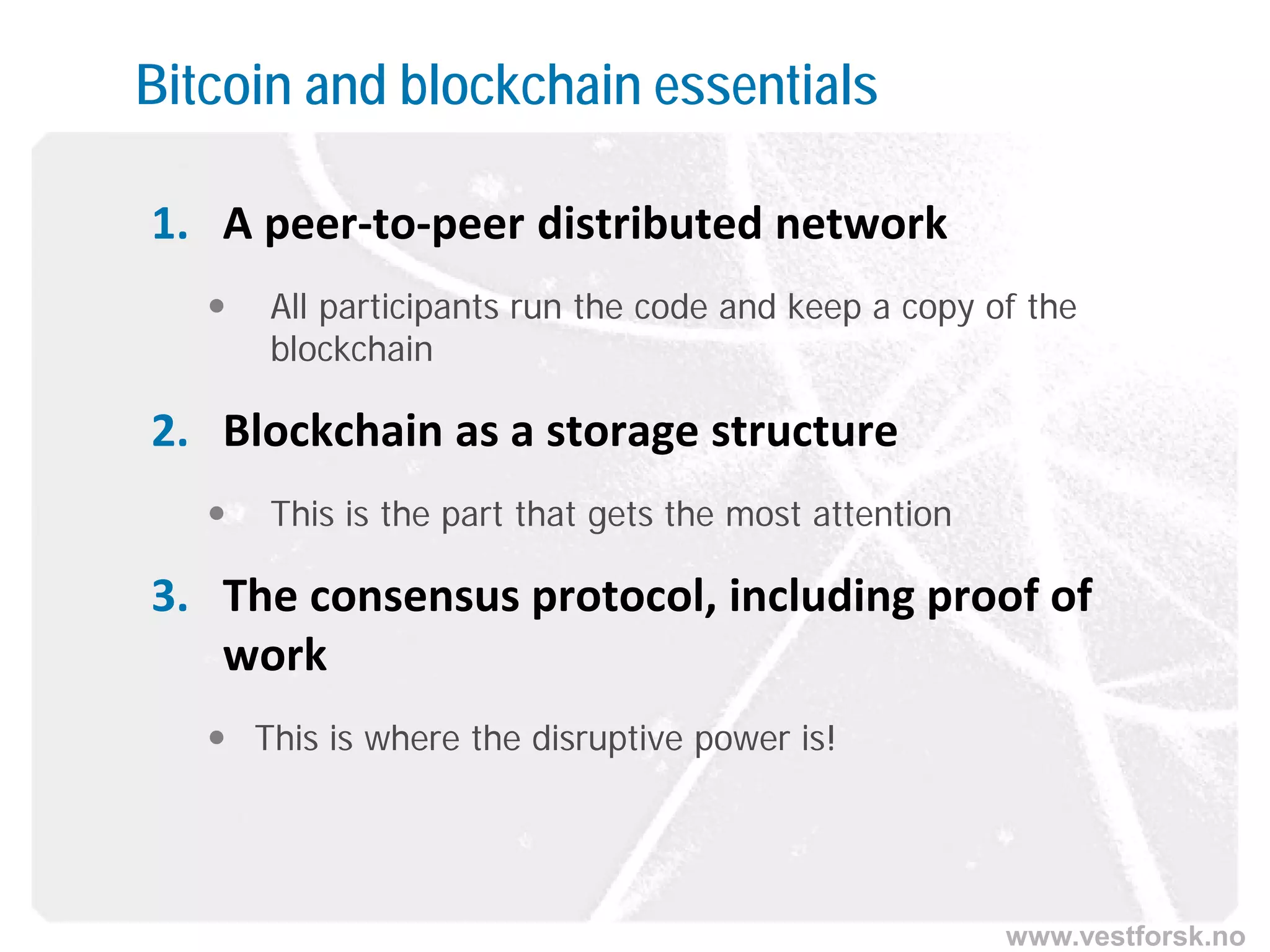
Bitcoin and blockchain essentials
1. A peer-to-peer distributed network
 All participants run the code and keep a copy of the
blockchain
2. Blockchain as a storage structure
 This is the part that gets the most attention
3. The consensus protocol, including proof of
work
 This is where the disruptive power is!
www.vestforsk.no
Nakamoto Consensus
 Protocol for maintaining the Bitcoin blockchain
 rules for validating transactions
 rules for verifying blocks
 proof of work to avoid double-spending and third-party
reliance
 Enables the participants to have a shared and
agreed-upon view of the current state of the
blockchain
www.vestforsk.no
Open and closed blockchain networks
Open
(«permissionless)
Closed
(«permissioned»)
Who updates Everybody Appointed pers./org.
Who produces data All users Customers
Incentive to follow rules Direct economic (both
carrot & whip)
Reputation
Storage Distributed Centralized
Trust central actors No Yes
Transaction costs - +
Capacity/Thoughput - +
Immutabililty + -
Currency/token Yes No
Examples Bitcoin, Ethereum HyperLedger, Corda
www.vestforsk.no
Information infrastructure Perspectives
 Information Infrastructure (II) as “a shared, open and
unbounded, heterogeneous and evolving socio-
technical system consisting of a set of IT capabilities
and their user, operations, and design communities.”
 Dispersed and distributed ownership [the lack of
centralized control] :
 Different actors shape, maintain, and extend information
infrastructure in modular increments
 Installed base – the “living” legacy of existing technical
solution along with organizational, economic and legal
elements
www.vestforsk.no
Infrastructures must be built incremental
using building blocks that follow some basic rules
www.vestforsk.no
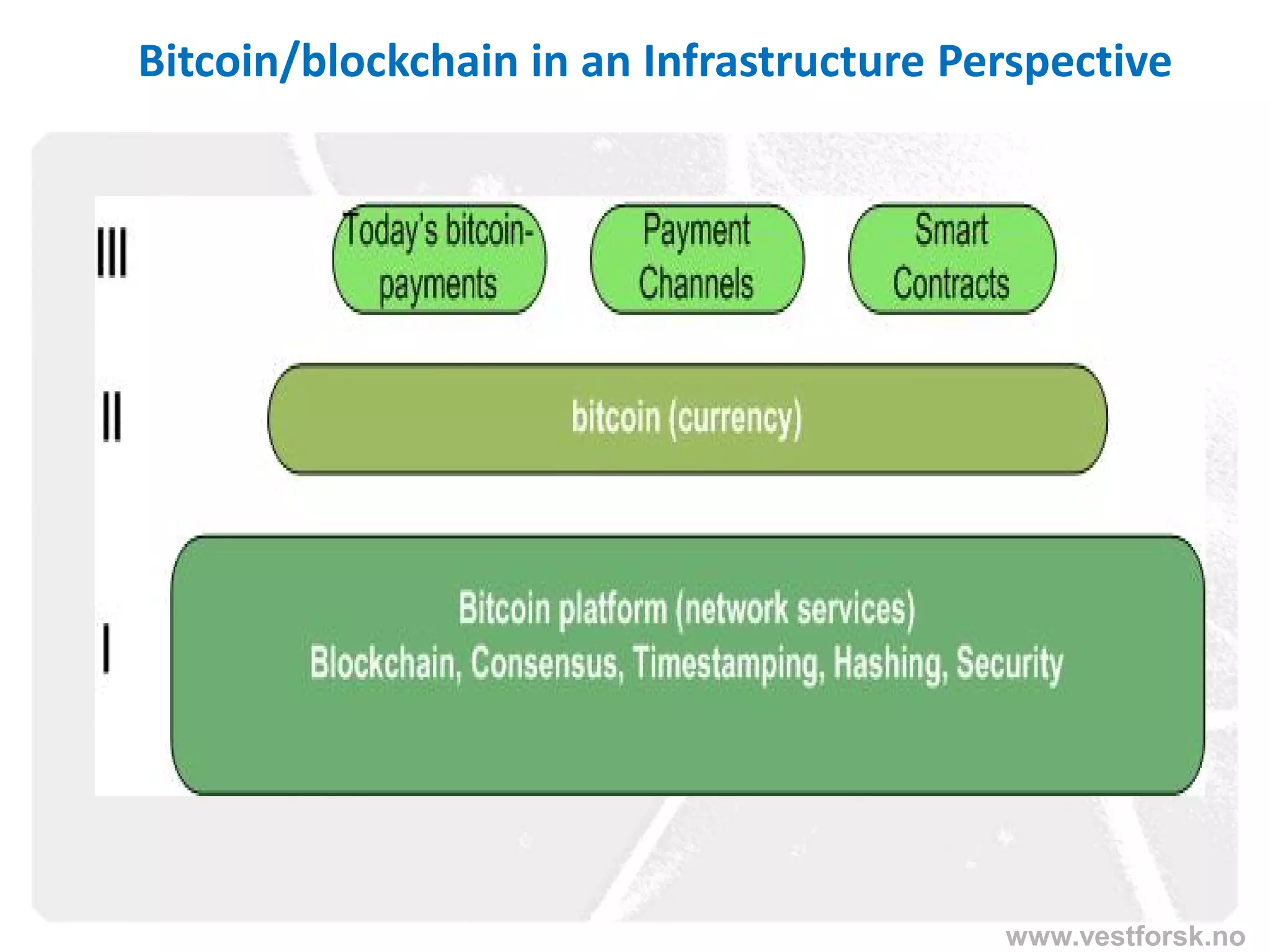
Bitcoin's layered architecture
Bitcoin/blockchain in an Infrastructure Perspective
www.vestforsk.no
Characteristics of different architectures
Property
Universal information infra-
structure, e. g. Internet
Bitcoin/blockchain
Shared
Universally and across multiple
IT capabilities
Potentially shared among those who
are involved in building and
maintaining this platform
Open
Yes, allowing unlimited
connections to communities
and new capabilities
Bitcoin is open to any user and offers
a platform for payment system and
secure document/asset handling
Installed
base
The current Internet applica-
tions are integrated with its
users, growing exponentially
The present installed base is limited,
which may stimulate innovations but
lack the networks effects
Evolving
Yes, unlimited by time or user
community. Both linear and
nonlinear growth
Although it is a new technology,
Bitcoin has demonstrated innovative
potential.
Control
Distributed and dynamically
negotiated
Distributed control based on open
source sw. Changes are dynamically
negotiated in user community
www.vestforsk.no
Comparing Internet and open blockchains
as layered structures:
Internet Open Blockchain
technology
Applications Applications
HTTP/HTML/… Bitcoin/other currency
TCP/IP Consensus rules, peer-to-
peer, security
Physical and logical
link
Distributed blockchain
database
Support
infrastructures
www.vestforsk.no
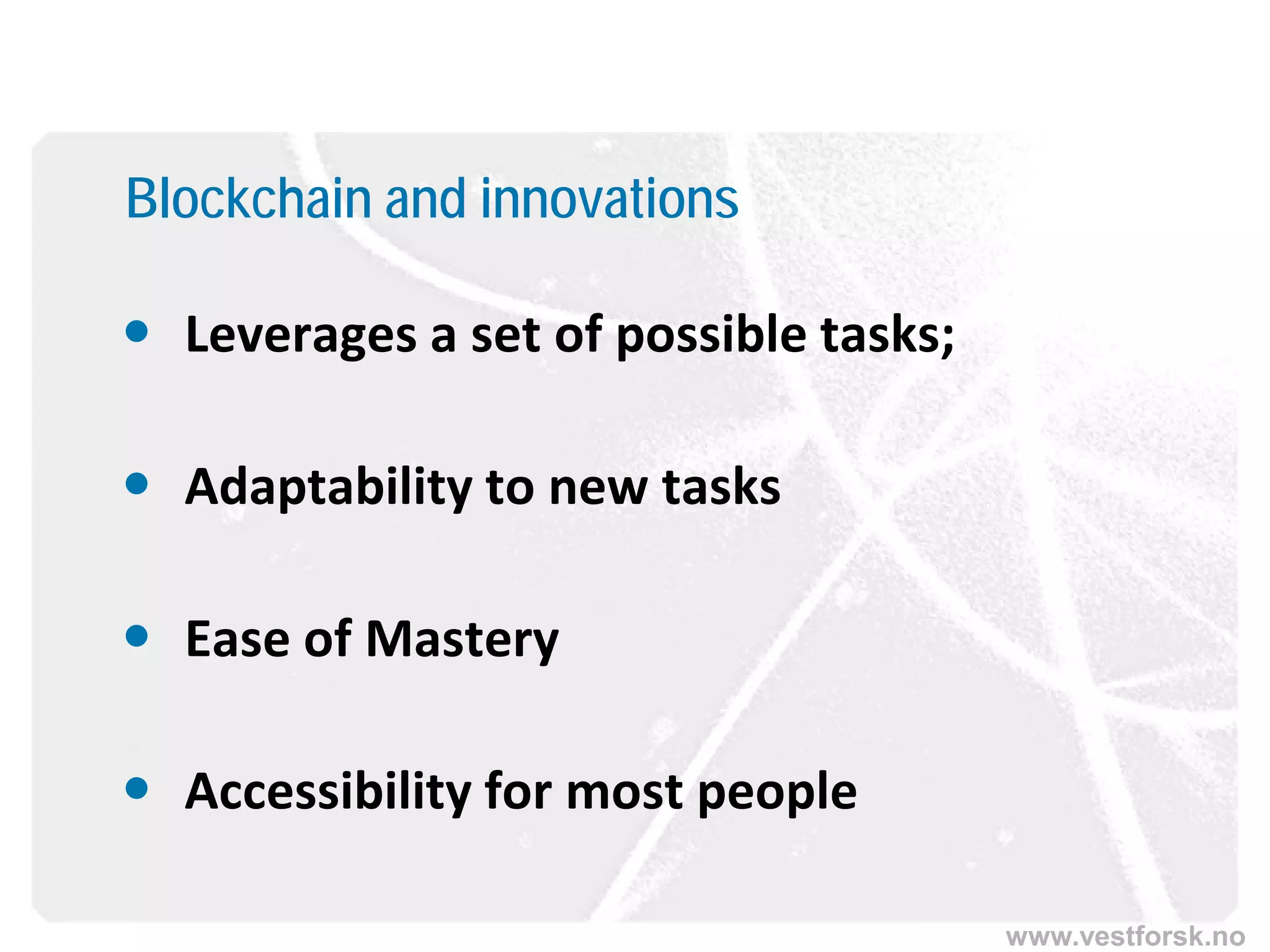
Blockchain and innovations
 Leverages a set of possible tasks;
 Adaptability to new tasks
 Ease of Mastery
 Accessibility for most people
www.vestforsk.no
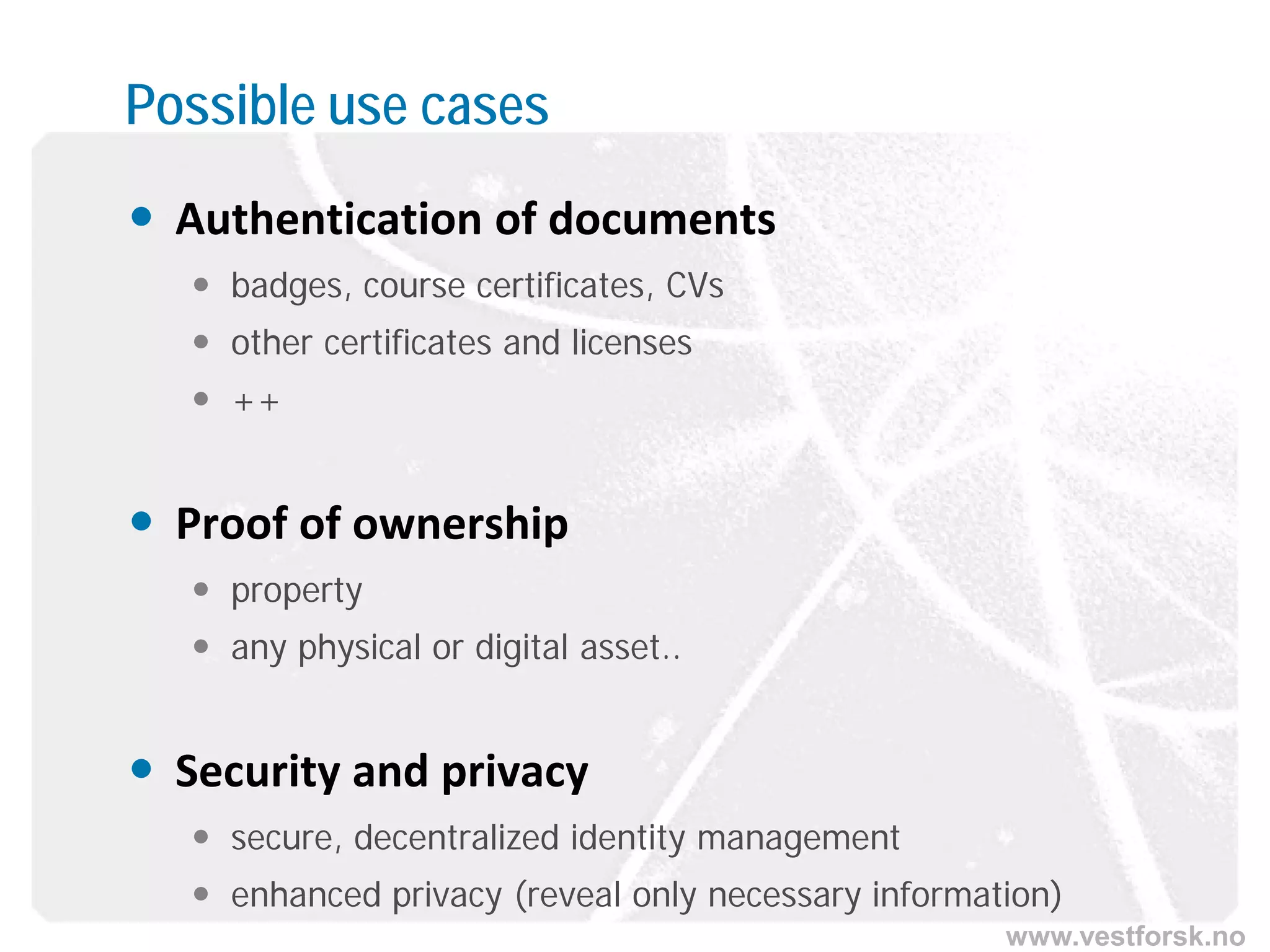
Possible use cases
 Authentication of documents
 badges, course certificates, CVs
 other certificates and licenses
 ++
 Proof of ownership
 property
 any physical or digital asset..
 Security and privacy
 secure, decentralized identity management
 enhanced privacy (reveal only necessary information)
www.vestforsk.no
Conclusions and further research
Bitcoin/blockchain can potentially evolve into a support
infrastructure, which however require:
 An open technology which is flexible and enable to support
different types of innovations
 To resemble a layered and modular architecture
 To keep it simple and easy to use
 To cultivate the installed base without creating path-
dependencies and lock-in mechanisms
 To establish a governance structure that allow for diversity,
and «conflicting handling« in creative ways
Further research should aim at developing this technology
according to these principles !
www.vestforsk.no
Thank you for your attention!
 Questions?
 Contact information:
svein.olnes@vestforsk.no
arildj@jus.uio.no

eGov2017 Blockchain Technology

  • 1.
    www.vestforsk.no Blockchain Technology asa Support Infrastructure in e-Government Svein Ølnes, Vestlandsforsking Arild Jansen, University of Oslo eGov 2017, 05.09.2017, ITMO University, St. Petersburg
  • 2.
    www.vestforsk.no Content  Motivation andresearch questions  Bitcoin and blockchain technology  Open and closed blockchains  Bitcoins' layered architecture  Bitcoin/blockchain as an infrastructure  Conclusions and further research
  • 3.
    www.vestforsk.no Motivation  Bitcoin andblockchain technology is a hot topic!  Significant acceptance in the last years – can be a platform for various application in different areas  Can provide secure identification and authentication in various types of distributed computing environment  Blockchain development resembles early Internet development  We argue that the Bitcoin/blockchain technology, can be used for many types of applications
  • 4.
    www.vestforsk.no Research objectives  Tounderstand the Bitcoin/blockchain technology as 1. an emerging platform 2. potentially as a support infrastructure for improving the digitalization in public sector
  • 5.
    www.vestforsk.no Research method:  Ourresearch approach is exploratory, analysing the diffusion of blockchain technology in an information infrastructure perspective.  Using the snow-ball method:  Our use of literature builds on important research papers about the subject as a starting point and going through references of papers already included  We have also searched the extensive e-Government Research Library (EGRL) v. 12.0  Still very few publications on the combination of blockchain technology and eGovernment
  • 6.
  • 7.
    www.vestforsk.no Bitcoin and blockchainessentials 1. A peer-to-peer distributed network  All participants run the code and keep a copy of the blockchain 2. Blockchain as a storage structure  This is the part that gets the most attention 3. The consensus protocol, including proof of work  This is where the disruptive power is!
  • 8.
    www.vestforsk.no Nakamoto Consensus  Protocolfor maintaining the Bitcoin blockchain  rules for validating transactions  rules for verifying blocks  proof of work to avoid double-spending and third-party reliance  Enables the participants to have a shared and agreed-upon view of the current state of the blockchain
  • 9.
    www.vestforsk.no Open and closedblockchain networks Open («permissionless) Closed («permissioned») Who updates Everybody Appointed pers./org. Who produces data All users Customers Incentive to follow rules Direct economic (both carrot & whip) Reputation Storage Distributed Centralized Trust central actors No Yes Transaction costs - + Capacity/Thoughput - + Immutabililty + - Currency/token Yes No Examples Bitcoin, Ethereum HyperLedger, Corda
  • 10.
    www.vestforsk.no Information infrastructure Perspectives Information Infrastructure (II) as “a shared, open and unbounded, heterogeneous and evolving socio- technical system consisting of a set of IT capabilities and their user, operations, and design communities.”  Dispersed and distributed ownership [the lack of centralized control] :  Different actors shape, maintain, and extend information infrastructure in modular increments  Installed base – the “living” legacy of existing technical solution along with organizational, economic and legal elements
  • 11.
    www.vestforsk.no Infrastructures must bebuilt incremental using building blocks that follow some basic rules
  • 12.
  • 13.
    www.vestforsk.no Characteristics of differentarchitectures Property Universal information infra- structure, e. g. Internet Bitcoin/blockchain Shared Universally and across multiple IT capabilities Potentially shared among those who are involved in building and maintaining this platform Open Yes, allowing unlimited connections to communities and new capabilities Bitcoin is open to any user and offers a platform for payment system and secure document/asset handling Installed base The current Internet applica- tions are integrated with its users, growing exponentially The present installed base is limited, which may stimulate innovations but lack the networks effects Evolving Yes, unlimited by time or user community. Both linear and nonlinear growth Although it is a new technology, Bitcoin has demonstrated innovative potential. Control Distributed and dynamically negotiated Distributed control based on open source sw. Changes are dynamically negotiated in user community
  • 14.
    www.vestforsk.no Comparing Internet andopen blockchains as layered structures: Internet Open Blockchain technology Applications Applications HTTP/HTML/… Bitcoin/other currency TCP/IP Consensus rules, peer-to- peer, security Physical and logical link Distributed blockchain database Support infrastructures
  • 15.
    www.vestforsk.no Blockchain and innovations Leverages a set of possible tasks;  Adaptability to new tasks  Ease of Mastery  Accessibility for most people
  • 16.
    www.vestforsk.no Possible use cases Authentication of documents  badges, course certificates, CVs  other certificates and licenses  ++  Proof of ownership  property  any physical or digital asset..  Security and privacy  secure, decentralized identity management  enhanced privacy (reveal only necessary information)
  • 17.
    www.vestforsk.no Conclusions and furtherresearch Bitcoin/blockchain can potentially evolve into a support infrastructure, which however require:  An open technology which is flexible and enable to support different types of innovations  To resemble a layered and modular architecture  To keep it simple and easy to use  To cultivate the installed base without creating path- dependencies and lock-in mechanisms  To establish a governance structure that allow for diversity, and «conflicting handling« in creative ways Further research should aim at developing this technology according to these principles !
  • 18.
    www.vestforsk.no Thank you foryour attention!  Questions?  Contact information: svein.olnes@vestforsk.no arildj@jus.uio.no