PRESENTATION ON 
DELHI MUMBAI INDUSTRIAL CORRIDOR 
BUSINESS OPPORTUNITY 
ON 
OPPORTUNITY FOR INDUSTRIES
ABOUT DMIC Project Plan $ 90 Billion 
 The Delhi Mumbai Industrial Corridor, or DMIC, plans to develop seven Greenfield 
future cities in six states and integrate them with the Indian Railways’ dedicated 
freight corridor. 
 DMICDC acts as a pass through entity for specific projects and raise various 
financing instruments such as ‘Project Development Fund (PDF)’ that could be used 
as a Revolving Fund and would specifically be used for undertaking project 
development activities on Public Private Partnership basis. 
 This project incorporates Nine Mega Industrial zones of about 200-250 sq. km., high 
speed freight line, three ports, and six air ports; a six-lane intersection-free 
expressway connecting the country’s political and financial capitals and a 4000 MW 
power plant. 
 DMIC would also include development of requisite feeder rail/road connectivity to 
hinterland/markets and select ports along the western coast.
VISION AND GOALS OF DMIC 
 Delhi-Mumbai Industrial Corridor is to be conceived as a Model industrial 
Corridor of international standards with emphasis on expanding the 
manufacturing and services base and develop DMIC as the 'Global 
Manufacturing and Trading Hub'. 
 Infusing worldwide technological advancements to the grass route level of 
local production sources and upgrade human skills of influencing region 
and the country. 
 Create physical and social infrastructure facilities of international standards. 
 DMIC Project Goals Accordingly the project goals for DMIC are: 
 . Double employment potential in five years (14.87% CAGR) 
 . Triple industrial output in five years (24.57% CAGR) 
 . Quadruple exports from the region in five years (31.95% CAGR)
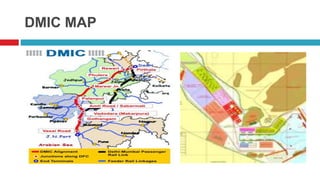
DMIC MAP
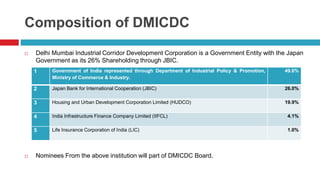
Composition of DMICDC 
 Delhi Mumbai Industrial Corridor Development Corporation is a Government Entity with the Japan 
Government as its 26% Shareholding through JBIC. 
1 Government of India represented through Department of Industrial Policy & Promotion, 
Ministry of Commerce & Industry. 
 Nominees From the above institution will part of DMICDC Board. 
49.0% 
2 Japan Bank for International Cooperation (JBIC) 26.0% 
3 Housing and Urban Development Corporation Limited (HUDCO) 19.9% 
4 India Infrastructure Finance Company Limited (IIFCL) 4.1% 
5 Life Insurance Corporation of India (LIC) 1.0%
Amitabh Kant – CEO & MD : DMIC 
 Famously known for the Brand India Companying “ Incredible India”. He has extensive 
experience in infrastructure creation, International Marketing, Travel & Tourism and Hospitality 
industry. He has conceptualized and executed the positioning and branding of Kerala as “God’s 
Own Country” and later the “Incredible !ndia” campaign. Both these campaigns has won several 
International awards and embraced a host of activities – Infrastructure development, product 
enhancement, changes in organizational culture and promotional partnerships based on intensive 
market research. He has structured large infrastructure projects for diversification of India’s 
tourism product and sourced international funding through the Asian Development Bank (ADB), 
Japanese Bank for International Cooperation (JBIC) and UNDP. 
 Member of Indian Administrative Service (Kerala Cadre : 1980 Batch). 
Previous Postings 
 Principal Secretary & Special Commissioner (Industries) Government of Kerala. 
 Joint Secretary - July 2001 – June 2007 Ministry of Tourism, Government of India 
 http://www.amitabhkant.in
Project Influence Area 
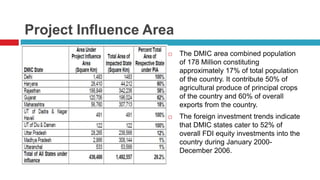
 The DMIC area combined population 
of 178 Million constituting 
approximately 17% of total population 
of the country. It contribute 50% of 
agricultural produce of principal crops 
of the country and 60% of overall 
exports from the country. 
 The foreign investment trends indicate 
that DMIC states cater to 52% of 
overall FDI equity investments into the 
country during January 2000- 
December 2006.
Project Influence Areas Under Development 
 An Investment Region (IRs) would be a specifically delineated industrial region with a minimum area of over 200 
square kilometers (20,000 hectares), while an Industrial Area (IAs) would be developed with a minimum area of 
over 100 square kilometers (10,000 hectares). 24 such nodes - 9 IRs and 15 IAs spanning across six states have 
been identified after wide consultations with the stakeholders i.e the State Governments and the concerned 
Central Ministries. It is proposed that 6 IR and 6 IAs would be taken up for implementation in the First Phase 
during 2008-2012 and rest of the development would be phased out in the next 4 years 
 Distribution of length of dedicated freight corridor indicates that Rajasthan (39%) and Gujarat (38%) together 
constitute 77% of total length of the alignment of freight corridor, followed by Haryana and Maharashtra (10% 
each) and Uttar Pradesh and the National Capital Region of Delhi (1.5% of total length each) between Delhi and 
Mumbai. 
 Project Influence Area (PIA) for DMIC comprises of 436,486Sqkm area, which constitutes 13.8% of geographical 
area of overall India. Based on the area distribution, PIA of DMIC comprises of seven states and two union 
territories: 
 It is envisaged that the alignment of the proposed corridor will have Nine Junctions stations, at following 
locations, for exchange of traffic between the existing railway system and the DFC, in addition to the end 
terminals at Tughlakabad and Dadri in NCR of Delhi and J.N.Port in Navi Mumbai.
Details Of Nine Junctions 
 Vasai Road: To cater to traffic to/from Mumbai, other than J.Nehru Port 
 Gothangam: For traffic to/from Hazira Complex, Jalgaon-Udhna 
 Makarpura (Vadodara): For traffic to/from Ahmedabad, Vadodara and Vadodara- 
Godhra Routes 
 Amli Road (Sabarmati): For traffic to/from ICD-Sabarmati, Viramgam- Sabarmati 
Route, Ahmedabad, Rajkot and Bhavnagar Divisions of Western Railway 
 Palanpur: For traffic to/from Kandla/ Mundra Ports and Gandhidham Area 
 Marwar Junction: For Traffic from/to Jodhpur area (and ICD-Jodhpur) 
 Phulera: For traffic to/from Jaipur-Tundla and Jaipur-Sawai Madhopur Routes 
 Rewari: For traffic to/from Rewari-Hissar-Ludhiana/Bathinda Routes 
 Pirthala (Tughlakabad): For traffic to/from Tughlakabad (and ICD- Tughalakabad)
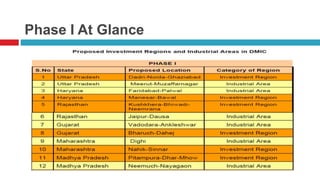
Phase I At Glance
Parallel Story 
 The Tokaido Corridor which represents accumulation of 
infrastructure and productive forces in the Tokyo-Nagoya- 
Osaka belt of Japan that accounts for 90 million people, 
almost 70% of the Japanese population. In 1930, an express 
train took 8½ hours between Tokyo and Osaka. Now it takes 
only 2 hours and 20 minutes. 
 The other parallel is the Asian Highway Network 1 (Gyeongbu 
Expressway) connecting Seoul to Busan. It is 416km long 
and has been the key driver of growth in the South Korean 
economy.
Economic Effectiveness 
 90% Decrease in Transport Time – Huge Cost 
Saving and Increase in Goods Volume. 
 Presently all goods produced in northern India take 
12-13 days to reach the ports on the western coast. 
The cost of transportation in India is, therefore, very 
high. 
 By 2017, the 1,483km-long dedicated freight corridor 
will transport goods within 12-13 hours.
Industry Opportunity Under PPP. 
Identified Projects that can be implemented through Public 
Private Partnership (PPP Viable Projects) viz. 
 Logistics Infrastructure; 
 Power Plants, Ports and Airports; 
 Special Economic Zones, Industrial Parks, IT/ITES/Biotech 
Hubs and Agro-Processing Hubs; 
 Knowledge Cities, Integrated Townships; and 
 Augmentation of selected National and State Highways.
Other Avenues(Non- PPP Projects) 
 Augmentation of rail linkages and development of 
connectivity to the Identified investment regions/ 
industrial areas; 
 Provision of requisite urban infrastructure; 
 Augmentation of industrial areas; 
 Provision of missing links and augmentation of state 
highways.
Financial Analysis 
 Implementation of DMIC Project requires an investment of US$90Billion for developing projects implemented 
through Public Private Partnership (PPP) and for projects developed through budgetary resources. Broad 
assessment indicates that there is a potential to implement projects, worth 75% of the estimated overall 
investment, through PPP. 
 A special purpose company, Delhi Mumbai Industrial Corridor Development Corporation Limited (DMICDC) is 
founded for implementing DMIC Project, incorporated on 7th January, 2008 with 49% equity stake by Government 
of India and 51% from the financial institutions. 
 Apex Authority was also constituted with Union Finance Minister as Chairman, other cabinet ministers and six 
chief ministers of DMIC states as Members to monitor the implementation of DMIC. 
 Project development/preparatory activities for DMIC projects would lead to identification of several projects in wide 
range of sectors (viz. industrial areas/clusters/parks/SEZ/EOU, agro/food processing hubs, multimodal logistics 
hubs, expressways/highway linkages, rail network, ports and airports, knowledge cities, IT/Biotechnology Hubs, 
ubran infrastructure facilities etc). 
 These projects may include a combination of viable and non-viable projects, which would thus be bundled/ 
unbundled as attractive groups of projects by sector/regions/states/agencies and amenable for participation of 
private sector entrepreneurs in infrastructure development (as part of special purpose companies that would be 
formed) through Public Private Partnership/ private sector format for development/ implementation, operation and 
management of facilities for a suitable concession period. Accordingly, the projects will be structured to achieve 
Financial Internal Rate of Return of at least 14% so as to make the projects viable for development through 
private sector funds.
India Infrastructure Finance Company Limited 
(IIFCL): 
IIFCL as a wholly government-owned company, with an authorized capital of INR 1,000 Crore 
and paid-up capital of INR 100 Crore to provide long-term finance to infrastructure projects 
 IIFCL caters to the financing gap in long-term financing of infrastructure projects in the 
public, private, or PPP sector. Any government project awarded to a private sector 
company for development, financing, and construction through PPP will have overriding 
priority under the scheme. 
 IIFCL is an apex financial intermediary for the purpose of providing financial support to 
infrastructure projects and facilities in the country. IIFCL renders financial assistance to 
commercially viable infrastructure projects through: 
 Direct lending to eligible projects; 
 Refinance to banks and FIs for loans with tenor of five years or more; 
 Any other method approved by GOI;
India Infrastructure Finance Company Limited 
(IIFCL): 
 Financial assistance from IIFCL would be available for eligible projects in 
the following sectors: 
 Roads & bridges, railways, seaports, airports, inland waterways, other 
transportation projects; 
 Power; 
 Urban transport, water supply, sewerage, solid waste management and 
 other physical infrastructure in urban areas; 
 Gas pipelines; 
 Infrastructure projects in special economic zones; 
 International convention centres, other tourism related infrastructure; 
 Special Economic Zones; 
 Other infrastructure projects, as may be determined from time to time.
Funding from Japan Bank for International 
Cooperation (JBIC) 
 JBIC is a statutory mandate to conduct Japanese Government’s external economic policy 
and economic cooperation. At present India accounts for the largest portion of JBIC 
funding (with 6.5% share constituting US$13.2 Billion) among the 27 countries, with an 
overall loan size of US $ 184.4 Billion. 
 Japanese government indicated that JETRO would be the supporting consultant and 
would act as a bridge between Japanese investors, Indian government and consultant for 
Promoting Japanese investment to the DMIC region. 
 JBIC has two distinct operations as 
 International Finance Operations (IFO) : Lends directly to borrowers or via financial intermediaries primarily 
to finance to promote Japanese exports, imports and economic activities overseas and the stability of 
international financial order and 
 Overseas Economic Cooperation Operations (OECO) :YEN Loans make development funds available to 
developing countries at low interest rates and with long repayment periods. These loans provide funds to 
develop and improve the economic and social infrastructure necessary to support self-help efforts and 
sustainable economic development for developing countries.
Special Purpose Vehicles For Project 
Implementation 
 Specific Special Purpose Vehicles (SPV) can be formed, based on entirely private sector entities, 
be PPP entities, or even purely public sector (central/ state government) entities depending upon 
the type of projects. These SPVs could be promoted either by DMICDC or by respective central/ 
state government agencies. However, there will be considerable savings in time in case SPVs are 
created through DMICDC as a number of approvals that are required for setting up of SPVs or 
during disinvestments in later stages can be avoided. 
 Roles and Responsibilities of the Project Specific Special Purpose Vehicles will include design, 
finance, construct, operate, maintain and collect user charges/ toll, sharing revenue with the 
respective government agencies and transferring the project assets to the concerned agency at 
the end of concession period. 
 Financial Structure of SPVs: 
 Own equity specific to each project, 
 Initial small equities could be of DMICDC, which would then be sold to operators selected for implementation. 
 Debts raised domestically and externally. Debts could also be raised by DMICDC and passed on to SPVs.
Sea Port Opportunity: 
 The states of Gujarat and Maharashtra, being located along the Western Coast, have a coast line of 1600km and 
720km length respectively, which together constitute about 31% of total coast length of the country. 
 Gujarat has one major port at Kandla and 40 minor and intermediate ports. Of which, 21 minor and intermediate 
ports are operating at present. These minor and intermediate ports are divided into ten groups viz. Mandvi Group 
(3 ports), Navlakhi group, Bedi group (4 ports), Okha group/ Rupen Beyt, Porbandar group, Veraval group (5 
ports), Pipavav Group (3 ports), Bhavnagar Group (2 ports), Bharuch group (3 ports), Magdalla group (8 ports). 
 Maharashtra has two major ports of the country, Mumbai Port and Jawaharlal Nehru Port, and 48 minor ports. 
The minor ports of Maharashtra fall into 5 groups viz. Bandra Group (9 ports), Mora group (11 ports), Rajpuri 
group (9 ports), Ratnagiri group (11 ports) and Vengurla group (8 ports). At present only 8 minor ports are 
operating 
 FUTURE PLANS 
 Maharashtra has identified other sites for the development of all weather Greenfield ports under five different 
locational groups - Bandra, Mora, Rajpuri, Ratnagiri and Vengurla.
Sea Port Opportunity: 
 Gujarat Maritime Board (GMB) in Gujarat has been actively perusing the development of its minor 
/ intermediate ports through the PPP and BOOT routes. Ultimately, GMB plans to handle 1000 
million tonnes of traffic at its ports. 
 Maharashtra -Jawaharlal Nehru Port Major Schemes envisaged at JN Port include 
Extension of Container Berth by 330M (7.2 MTPA) 
3rd Container Terminal, recently commissioned (15.60 MTPA) 
Development of 4th Container Terminal (26.40 MTPA) 
Development of Marine Chemical Terminal (5.5 MTPA) 
 Mumbai Port proposes to build a dedicated offshore container terminal within the next 5 years which will 
enable it to handle upto 1.50 million TEUs per annum along with a dedicated freight line between 
Wadala and Kurla so its incoming and outgoing traffic can be handled by rail. 
 Kandla Port-handled a mere 131,000 TEUs in 2004-05 and 148,000 TEUs in 2005-06, it has 
planned the development of a new container terminal, which will enable it to generate a capacity 
of 800,000 TEUs per annum by 2013-14.
Future Prospects : Port Infrastructure 
in DMIC 
 Greenfield Port at Alewadi, Thane District, Maharashtra 
 Greenfield Port at Dighi, Raigad District, Maharashtra 
 Greenfield Port at Maroli, Valsad District, Gujarat 
 Greenfield Port at Dholera with Investment Region
Airport – DMIC Area 
 DMIC States have 37 airports of various categories, as per the categorization defined by the 
Ministry of Civil Aviation (MoCA), which includes four international airports, four customs airports, 
three model airports and twenty-six other domestic airports and civil enclaves. 
 MoCA has allocated about INR 50 Crore for upgradation of Jaipur Airport to international 
standards. 
 In Madhya Pradesh, the Indore Airport has tremendous potential to develop as International 
Airport. MoCA has also prioritized up gradation of Udaipur Airport and has allocated INR 113 
Crore. 
 Gujarat has prioritizes development of Ahmedabad Airport to international standards as well as 
upgradation of Vadodara, Surat, Ankleshwar and Bhuj Airports. 
 Uttar Pradesh is looking forward to develop the Greater Noida Airport through its funding sources. 
andhas finalized detailed feasibility study for developing Multi-Modal Aviation Hub near Greater 
NOIDA along the proposed Taj Expressway to cater to international passenger and cargo traffic.
Railway Network –DMIC Area 
 DMIC states constitute 43% of total length of rail network in the country (63,332km). Apart from Union Territories 
of Diu & Daman and Dadra & Nagar Haveli, Delhi constitutes least length of rail network length (204km). In 
Rajasthan, the length of rail network (5838km) is slightly higher than the respective lengths in Maharashtra and 
Gujarat states. 
 The state of freight operations on the Indian Railways as a whole can be judged from the fact that goods trains 
achieve an average speed of only 25 kmph and a goods wagon is on run for merely 25% of the day. The existing 
Delhi - Mumbai routes are no different. 
 Dedicated Freight Corridor-The Most important impending development is the MoR's proposal to build two 
dedicated freight corridors along the Delhi-Mumbai and Delhi-Kolkata legs of IR's Golden Quadrilateral, termed as 
the Western and Eastern Dedicated Freight Corridors (DFCs), respectively. By providing higher speed (100 kmph) 
and higher per train throughput capacity, the high axle load (25Tonne per axle) western DFC will be particularly 
relevant to the DMIC. 
 Wagons deployed on the DFC will carry a gross load of 100 Tonnes as against the present limitation of 81.28 
Tonnes, and a unit train will be able to carry a gross load of upto 6200 Tonnes as against 4715 Tonnes at present. 
 DFC will generate additional capacity of carrying upto 120 freight trains per direction per day. Further, as trains 
running on the DFC will not be overtaken by other passenger trains, these will have uninterrupted runs and 
achieve an average commercial speed of 60kmph or more.
Railway Network –DMIC Area 
 DMIC plans to build the DFC along the J N Port-Vadodara Ahmedabad-Palanpur-Ajmer-Phulera-Rewari- 
Dadri alignment. The advantage of this alignment is that, besides connecting the terminals of J.N.Port/ 
Mumbai Port at the Mumbai end and Tughlakabad and Dadri ICDs in the NCR of Delhi, it has the 
potential to connect all the existing and anticipated ports in Gujarat (Dahej, Hazira, Kandla, Mundra, 
Pipavav, Bhavnagar, Navlakhi, Bedi, Dholera, Maroli etc.) through the different feeder routes which 
would also be upgraded and developed simultaneously with the construction of the DFC. 
 Indian Railways plans to develop high speed passenger rail connectivity between Ahmedabad-Mumbai 
and Jaipur-Delhi-Amritsar for implementation through public private partnership. 
The funding for the DFC is structured so that the entire equity will be funded by Indian Railways from the 
budgetary support of the government to Indian Railways. The debt funds, to the tune of 73%, will be 
financed by JICA (Japanese International Corporation Agency) for the western corridor and World Bank 
for a large portion of the eastern corridor. 
 As per Economic Survey, 7768 hectares (73%) of the 10,703 hectares of total landrequired for the 
corridors has been acquired, and the entire land acquisition process is expected to be completed by the 
end of 2013. Recent press statements have suggested 86% of the total land has been acquired, and for 
contracts that will be awarded this year, 98% of the land has been acquired
Power Sector DMIC Area 
 Overview of Power Sector in India -India is currently ranked fifth in the world in terms of total energy consumption and 
has invested over INR 1,000Billion since independence on development of the Power sector. The installed power 
generation capacity as on February 01, 2007 is around 128,581 MW. The annual per capita consumption of the country, at 
about 606 kWh is among the lowest in the world. Moreover the country is facing a continuous deficit of 8-10 % in energy 
terms. 
 The electrical energy demand for 2021-22 has been estimated as 1915 Tera Watt Hours and peak electric demand of 298 
Giga Watts. GoI had set an ambitious target to achieve capacity addition of 41,110 MW in 10th Plan period (2002-07) and 
60,000 MW in 11th Plan period (2007-2012). However, actual capacity addition during the 10th Plan period has fallen 
substantially short of the target. 
 DMIC states have identified suitable locations for setting up power generation plants under XI Five Year Plan and 
envisage to commission by 2011-12. Major initiatives in the DMIC influence area include power plants at Hissar (1200MW 
Coal based plant in Haryana), Kota (195MW Coal based plant in Rajasthan) and Surat (Lignite based plant in Gujarat). 
 DMIC Region also offers opportunities for setting up natural gas based combined cycle power in the vicinity of existing / 
proposed Gas Authority of India (GAIL) pipeline especially in Gujarat, Rajasthan & Uttar Pradesh depending on the 
availability of gas. However, exact locations for power plants would be identified during the detailed feasibility stage based 
on availability of land, domestic / imported fuel and other enabling raw materials and infrastructure. 

Power Sector DMIC Area 
 Fuel Supply for DMIC Power Projects 
 Lignite-The state of Rajasthan is endowed with large lignite deposits in the country after Tamilnadu & Gujarat. In the three 
districts of the state viz. Bikaner, Nagaur and Barmer, geological reserves of more than 1 billion tonnes have been 
confirmed so far by exploratory drilling. Presently, RRSMML is operating the Matasukh-Kasnau Lignite mine in Nagaur. The 
commercial production of Lignite from these mines, was commenced from November 2003 with envisaged capacity of 
12,00,000 MT per year. This area can be further explored for the feasibility of setting up Lignite based pithead power plants. 
 Domestic Coal- A study conducted by GSI, CMPDI & MECL in January 2006, has estimated a cumulative total of 253.30 
Billion Tonnes of Geological Reserves of Coal in India. Pench - Kanhan Coalfield in Madhya Pradesh and few blocks in 
Wardha Coal Field in Maharashtra have sufficient coal reserves and can be further evaluated for the fuel linkage. 
 Imported Coal-Power Projects identified in Gujarat and Maharashtra lie along the west coast. Imported coal would be the 
most apt choice, depending on the feasibility the DFC can be used for transporting imported coal from Jawaharlal Nehru 
Port or any other port (as feasible) to the projects identified in Haryana and Rajasthan. 
 Gas Based Power Projects-through Gujarat State Petronet Limited (GSPL), has well laid-out plans for developing 2200km 
long 'Gas Grid Network' across the state. About 360km pipeline between Hazira- Vadodara-Ahmedabad-Kalol is already in 
operation, transporting 9MMSCMD of gas at present including 3MMSCMD of LNG. DMIC Region offers opportunities for 
developing Gas based power plants to cater to respective investment nodes (i.e investment regions/industrial areas) in DMIC Region.
Mega-Power Project Status 
 GOI launched Mega Power Policy in 1998 to provide fiscal incentives for development of large 
power generation projects in the country. As per the revised policy guidelines, power projects 
meeting the following criteria are eligible for grant of Mega Power Project (MPP) status for DMIC 
States: 
- An interstate thermal power plant of a capacity of 1000MW or more, and 
- An interstate hydel power plant of a capacity of 500MW or more 
 According to the Mega Power Policy, selection of project contractors should take place through 
International Competitive Bidding (ICB) route. It is important to note that the status of 'Mega 
Power Projects' helps in availing following fiscal concessions/ benefits: 
 
Zero Customs Duty: Import of capital equipment would be free of customs duty 
Deemed Export Benefits: Under Chapter 8(f) of Foreign Trade Policy, Deemed Export benefits are available 
to domestic bidders for projects both under public and private sector subjected to prescribed stipulations. 
Price Preference to domestic PSUs bidders: In order to ensure that domestic bidders are not adversely 
affected, price preference of 15% would be given for the projects under pubic sector. 
Income Tax Benefits: Income Tax Holiday regime as per Section 80-IA of the Income Tax Act 1961 can also 
be availed.
Logistic Hubs/ ICD/CFS/ Free Trade 
Warehousing Zones 
 Logistic Parks/ Transhipments Zones As part of the development 
of Western Dedicated Freight Corridor (DFC) between Delhi and 
Mumbai, Indian Railways have proposed development of Freight 
Logistic Parks at six locations along the DFC to enhance rail based 
traffic along the DFC. These locations include: 
 
(i) Navi Mumbai 
(ii) Vapi (Gujarat) 
(iii) Ahmedabad (Gujarat) 
(iv) Gandhidham (Gujarat) 
(v) Jaipur (Rajasthan) 
(vi) National Capital Region of Delhi
Logistic Initiative in Brief - 
 Logistic Parks/ Hubs in Gujarat 
 Modern Rail Terminal at Boraki, Greater Noida 
 Logistic Parks/ Hubs in DMIC Region of Madhya Pradesh 
 Inland Container Depot/ Container Freight Station 
 Services at ICD/ CFS- For Export-Import 
 Initiatives of Haryana State Government 
 Initiatives of Rajasthan State Government 
 Custom Bonded Warehouses 
 Free Trade Warehousing Zones 
 Rail side Warehousing Complexes
Knowledge Based Infrastructure in DMIC 
 Governments of Gujarat, Maharashtra, Haryana, U.P, Madhya Pradesh and Delhi are increasingly 
investing in Knowledge based infrastructure for various industrial sectors such as engineering/ industrial 
technology, IT-enabled services, agriculture, marine training, aviation, management, medical, and 
Biotechnology and they are making constant endeavors in the direction. 
 Proposed Delivery Models for Vocational Training for Capacity Expansion: 
 Public Private Partnership (PPP) Model 
 Decentralized Model 
 Distance Learning 
 Computerized Vocational Training 
 Telecommunication Network 
 Intellectual Property Rights (IPR) -Intellectual Property Rights (IPR) has been considered as an 
emerging indispensable strategic tool in today's knowledge economies and societies. The development 
of a vibrant IPR culture in the processes of knowledge creation, application and dissemination, all of 
which are connected with market demand and rewards.
Foreign Direct Investment Policy 
 Special Economic Zones-100% FDI is permitted under 
automatic route for setting up of Special Economic Zone. 
 Export Oriented Units (EOUs)-100% FDI is permitted under 
automatic route for setting up 100% EOU, subject to sectorial 
norms. 
 Industrial Park-100% FDI is permitted under automatic route 
for setting up of Industrial Park. 
 Software Technology Park Units-All proposals for FDI/NRI 
investment in STP Units are eligible for approval under 
automatic route subject to parameters listed.
SEZ Policy 
 Development of Social Infrastructure in the SEZ For a sector- specific SEZ, full tax benefits would be given for 
constructing specified social infrastructure. The upper ceiling for these benefits is 50,000 sq metre of office space, 
7,500 houses, 100 hotel rooms, 25-bed hospitals and educational Institutes on a 25,000 sq metre area. 
 For a multi-product SEZs, full tax benefits will be given for 25,000 houses, 250 hotel rooms, 100-bed hospitals 
and educational institutes on 0.25 Mn Sq metre. 
 Developers have the right to build more such facilities without violating the master plan and earmarking 40% land 
as green-zone. Facilities created by SEZ developers over and above the specified ceilings will not qualify for full 
tax benefits. There could, however, be exceptions to this rule, subject to the BoA nod. 
 There is no restriction on outsiders availing of these social infrastructure facilities, although SEZ employees would 
get priority. The employees can sub-lease their houses or other property, but not sell them. 
 The authorized operations eligible for approval in IT/ITES, biotech, and gems & jewellery SEZs include Wi Fi / Wi 
Max services, roads and rain harvesting plants. In multi-product SEZs these include, rail heads, ports, airports, 
banks and golf courses.
Current Investments 
 Financial structuring of Asia’s largest desalination project with a capacity of 336 million litres per day. This is being 
established by Hitachi Ltd of Japan and Hyflux Ltd of Singapore. Dahej SEZ Ltd had signed a water purchase 
agreement (WPA) to buy water. 
 DMICDC has also structured a gas-generated power supply project with advanced Japanese technology based 
on imported LNG (liquefied natural gas). The project in Manesar is being established by Toshiba Corp. and the 
one in Neemrana by the Kansai Electric Power Co. 
 Dholera, the government of Gujarat has adopted a town planning process with community participation. This has 
been extremely successful and we have been able to pool almost 540 sq. km of land through six different town 
planning schemes. 
 In the case of Maharashtra, the MIDC (Maharashtra Industrial Development Corporation) has undertaken 
negotiated purchase with land owners under the MIDC Act. 
 In addition to the revolving fund of Rs.18,500 crore from the government of India, the government of Japan has 
provided $4.5 billion through JICA (Japan International Cooperation Agency) and JBIC (Japan Bank for 
International Cooperation). 
 Japanese engineering companies such as Mitsubishi Heavy Industries, HitachiBSE -0.16 %, Mitsui Engineering & 
Shipbuilding Co, Toshiba, Sojitz etc. have shown interests in executing 19 projects that would be funded out of 
$4.5 billion Japanese support promised for India-Japan friendship project, Delhi Mumbai Industrial Corridor 
(DMIC)
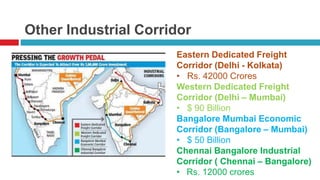
Other Industrial Corridor 
Eastern Dedicated Freight 
Corridor (Delhi - Kolkata) 
• Rs. 42000 Crores 
Western Dedicated Freight 
Corridor (Delhi – Mumbai) 
• $ 90 Billion 
Bangalore Mumbai Economic 
Corridor (Bangalore – Mumbai) 
• $ 50 Billion 
Chennai Bangalore Industrial 
Corridor ( Chennai – Bangalore) 
• Rs. 12000 crores
Total Opportunity in India - Industrial 
Corridors 
INR – 8.94 + Lakh Crores 
USD $– 150 + Billion
Advantages- Industrial Corridor 
 Can attract more FDI 
 Can bring word-class technology 
 Economies of scale 
 Better Connectivity 
 Low logistics cost and low inventory 
 Supply chain integration 
 Skilled manpower 
 Enhance Export Competitiveness
Services we can provide ? 
 Identifying Opportunity 
 Provide Framework & Guidelines, Statutory Compliances 
 Help with Initial Detail Business Plan & Understanding 
 Set-up Virtual Office 
 Co-ordinate For Statutory Clearance 
 Identifying Joint Venture Partners and Tie-ups 
 “Let’s strategically source our services , let’s Netsource 
!”
Contact us : 
 Umesh Gosar, FCA. 
 umesh@netsourcing.in 
 Linked In: in.linkedin.com/pub/umesh-gosar/16/460/370 
 Rupal Panchal CA,MBA. (Author) 
 rupal@netsourcing.in 
 Linked In: in.linkedin.com/in/rp109 
 www.netsourcing.in 
Linked In: http://in.linkedin.com/in/netsourcing/ 
“LETS Strategically Outsource , Lets Netsource !” 
Mumbai Office : 
NETSOURCING 
902, “Empressa”, 2nd Road, 
Near Station, Khar (West), 
Mumbai- 400052.
Thank You 
Looking Forward To Being Your Trusted Corporate Advisor.

INDUSTRIAL CORRIDOR - MAKE IN INDIA

  • 1.
    PRESENTATION ON DELHIMUMBAI INDUSTRIAL CORRIDOR BUSINESS OPPORTUNITY ON OPPORTUNITY FOR INDUSTRIES
  • 2.
    ABOUT DMIC ProjectPlan $ 90 Billion  The Delhi Mumbai Industrial Corridor, or DMIC, plans to develop seven Greenfield future cities in six states and integrate them with the Indian Railways’ dedicated freight corridor.  DMICDC acts as a pass through entity for specific projects and raise various financing instruments such as ‘Project Development Fund (PDF)’ that could be used as a Revolving Fund and would specifically be used for undertaking project development activities on Public Private Partnership basis.  This project incorporates Nine Mega Industrial zones of about 200-250 sq. km., high speed freight line, three ports, and six air ports; a six-lane intersection-free expressway connecting the country’s political and financial capitals and a 4000 MW power plant.  DMIC would also include development of requisite feeder rail/road connectivity to hinterland/markets and select ports along the western coast.
  • 3.
    VISION AND GOALSOF DMIC  Delhi-Mumbai Industrial Corridor is to be conceived as a Model industrial Corridor of international standards with emphasis on expanding the manufacturing and services base and develop DMIC as the 'Global Manufacturing and Trading Hub'.  Infusing worldwide technological advancements to the grass route level of local production sources and upgrade human skills of influencing region and the country.  Create physical and social infrastructure facilities of international standards.  DMIC Project Goals Accordingly the project goals for DMIC are:  . Double employment potential in five years (14.87% CAGR)  . Triple industrial output in five years (24.57% CAGR)  . Quadruple exports from the region in five years (31.95% CAGR)
  • 4.
  • 5.
    Composition of DMICDC  Delhi Mumbai Industrial Corridor Development Corporation is a Government Entity with the Japan Government as its 26% Shareholding through JBIC. 1 Government of India represented through Department of Industrial Policy & Promotion, Ministry of Commerce & Industry.  Nominees From the above institution will part of DMICDC Board. 49.0% 2 Japan Bank for International Cooperation (JBIC) 26.0% 3 Housing and Urban Development Corporation Limited (HUDCO) 19.9% 4 India Infrastructure Finance Company Limited (IIFCL) 4.1% 5 Life Insurance Corporation of India (LIC) 1.0%
  • 6.
    Amitabh Kant –CEO & MD : DMIC  Famously known for the Brand India Companying “ Incredible India”. He has extensive experience in infrastructure creation, International Marketing, Travel & Tourism and Hospitality industry. He has conceptualized and executed the positioning and branding of Kerala as “God’s Own Country” and later the “Incredible !ndia” campaign. Both these campaigns has won several International awards and embraced a host of activities – Infrastructure development, product enhancement, changes in organizational culture and promotional partnerships based on intensive market research. He has structured large infrastructure projects for diversification of India’s tourism product and sourced international funding through the Asian Development Bank (ADB), Japanese Bank for International Cooperation (JBIC) and UNDP.  Member of Indian Administrative Service (Kerala Cadre : 1980 Batch). Previous Postings  Principal Secretary & Special Commissioner (Industries) Government of Kerala.  Joint Secretary - July 2001 – June 2007 Ministry of Tourism, Government of India  http://www.amitabhkant.in
  • 7.
    Project Influence Area  The DMIC area combined population of 178 Million constituting approximately 17% of total population of the country. It contribute 50% of agricultural produce of principal crops of the country and 60% of overall exports from the country.  The foreign investment trends indicate that DMIC states cater to 52% of overall FDI equity investments into the country during January 2000- December 2006.
  • 8.
    Project Influence AreasUnder Development  An Investment Region (IRs) would be a specifically delineated industrial region with a minimum area of over 200 square kilometers (20,000 hectares), while an Industrial Area (IAs) would be developed with a minimum area of over 100 square kilometers (10,000 hectares). 24 such nodes - 9 IRs and 15 IAs spanning across six states have been identified after wide consultations with the stakeholders i.e the State Governments and the concerned Central Ministries. It is proposed that 6 IR and 6 IAs would be taken up for implementation in the First Phase during 2008-2012 and rest of the development would be phased out in the next 4 years  Distribution of length of dedicated freight corridor indicates that Rajasthan (39%) and Gujarat (38%) together constitute 77% of total length of the alignment of freight corridor, followed by Haryana and Maharashtra (10% each) and Uttar Pradesh and the National Capital Region of Delhi (1.5% of total length each) between Delhi and Mumbai.  Project Influence Area (PIA) for DMIC comprises of 436,486Sqkm area, which constitutes 13.8% of geographical area of overall India. Based on the area distribution, PIA of DMIC comprises of seven states and two union territories:  It is envisaged that the alignment of the proposed corridor will have Nine Junctions stations, at following locations, for exchange of traffic between the existing railway system and the DFC, in addition to the end terminals at Tughlakabad and Dadri in NCR of Delhi and J.N.Port in Navi Mumbai.
  • 9.
    Details Of NineJunctions  Vasai Road: To cater to traffic to/from Mumbai, other than J.Nehru Port  Gothangam: For traffic to/from Hazira Complex, Jalgaon-Udhna  Makarpura (Vadodara): For traffic to/from Ahmedabad, Vadodara and Vadodara- Godhra Routes  Amli Road (Sabarmati): For traffic to/from ICD-Sabarmati, Viramgam- Sabarmati Route, Ahmedabad, Rajkot and Bhavnagar Divisions of Western Railway  Palanpur: For traffic to/from Kandla/ Mundra Ports and Gandhidham Area  Marwar Junction: For Traffic from/to Jodhpur area (and ICD-Jodhpur)  Phulera: For traffic to/from Jaipur-Tundla and Jaipur-Sawai Madhopur Routes  Rewari: For traffic to/from Rewari-Hissar-Ludhiana/Bathinda Routes  Pirthala (Tughlakabad): For traffic to/from Tughlakabad (and ICD- Tughalakabad)
  • 10.
    Phase I AtGlance
  • 11.
    Parallel Story The Tokaido Corridor which represents accumulation of infrastructure and productive forces in the Tokyo-Nagoya- Osaka belt of Japan that accounts for 90 million people, almost 70% of the Japanese population. In 1930, an express train took 8½ hours between Tokyo and Osaka. Now it takes only 2 hours and 20 minutes.  The other parallel is the Asian Highway Network 1 (Gyeongbu Expressway) connecting Seoul to Busan. It is 416km long and has been the key driver of growth in the South Korean economy.
  • 12.
    Economic Effectiveness 90% Decrease in Transport Time – Huge Cost Saving and Increase in Goods Volume.  Presently all goods produced in northern India take 12-13 days to reach the ports on the western coast. The cost of transportation in India is, therefore, very high.  By 2017, the 1,483km-long dedicated freight corridor will transport goods within 12-13 hours.
  • 13.
    Industry Opportunity UnderPPP. Identified Projects that can be implemented through Public Private Partnership (PPP Viable Projects) viz.  Logistics Infrastructure;  Power Plants, Ports and Airports;  Special Economic Zones, Industrial Parks, IT/ITES/Biotech Hubs and Agro-Processing Hubs;  Knowledge Cities, Integrated Townships; and  Augmentation of selected National and State Highways.
  • 14.
    Other Avenues(Non- PPPProjects)  Augmentation of rail linkages and development of connectivity to the Identified investment regions/ industrial areas;  Provision of requisite urban infrastructure;  Augmentation of industrial areas;  Provision of missing links and augmentation of state highways.
  • 15.
    Financial Analysis Implementation of DMIC Project requires an investment of US$90Billion for developing projects implemented through Public Private Partnership (PPP) and for projects developed through budgetary resources. Broad assessment indicates that there is a potential to implement projects, worth 75% of the estimated overall investment, through PPP.  A special purpose company, Delhi Mumbai Industrial Corridor Development Corporation Limited (DMICDC) is founded for implementing DMIC Project, incorporated on 7th January, 2008 with 49% equity stake by Government of India and 51% from the financial institutions.  Apex Authority was also constituted with Union Finance Minister as Chairman, other cabinet ministers and six chief ministers of DMIC states as Members to monitor the implementation of DMIC.  Project development/preparatory activities for DMIC projects would lead to identification of several projects in wide range of sectors (viz. industrial areas/clusters/parks/SEZ/EOU, agro/food processing hubs, multimodal logistics hubs, expressways/highway linkages, rail network, ports and airports, knowledge cities, IT/Biotechnology Hubs, ubran infrastructure facilities etc).  These projects may include a combination of viable and non-viable projects, which would thus be bundled/ unbundled as attractive groups of projects by sector/regions/states/agencies and amenable for participation of private sector entrepreneurs in infrastructure development (as part of special purpose companies that would be formed) through Public Private Partnership/ private sector format for development/ implementation, operation and management of facilities for a suitable concession period. Accordingly, the projects will be structured to achieve Financial Internal Rate of Return of at least 14% so as to make the projects viable for development through private sector funds.
  • 16.
    India Infrastructure FinanceCompany Limited (IIFCL): IIFCL as a wholly government-owned company, with an authorized capital of INR 1,000 Crore and paid-up capital of INR 100 Crore to provide long-term finance to infrastructure projects  IIFCL caters to the financing gap in long-term financing of infrastructure projects in the public, private, or PPP sector. Any government project awarded to a private sector company for development, financing, and construction through PPP will have overriding priority under the scheme.  IIFCL is an apex financial intermediary for the purpose of providing financial support to infrastructure projects and facilities in the country. IIFCL renders financial assistance to commercially viable infrastructure projects through:  Direct lending to eligible projects;  Refinance to banks and FIs for loans with tenor of five years or more;  Any other method approved by GOI;
  • 17.
    India Infrastructure FinanceCompany Limited (IIFCL):  Financial assistance from IIFCL would be available for eligible projects in the following sectors:  Roads & bridges, railways, seaports, airports, inland waterways, other transportation projects;  Power;  Urban transport, water supply, sewerage, solid waste management and  other physical infrastructure in urban areas;  Gas pipelines;  Infrastructure projects in special economic zones;  International convention centres, other tourism related infrastructure;  Special Economic Zones;  Other infrastructure projects, as may be determined from time to time.
  • 18.
    Funding from JapanBank for International Cooperation (JBIC)  JBIC is a statutory mandate to conduct Japanese Government’s external economic policy and economic cooperation. At present India accounts for the largest portion of JBIC funding (with 6.5% share constituting US$13.2 Billion) among the 27 countries, with an overall loan size of US $ 184.4 Billion.  Japanese government indicated that JETRO would be the supporting consultant and would act as a bridge between Japanese investors, Indian government and consultant for Promoting Japanese investment to the DMIC region.  JBIC has two distinct operations as  International Finance Operations (IFO) : Lends directly to borrowers or via financial intermediaries primarily to finance to promote Japanese exports, imports and economic activities overseas and the stability of international financial order and  Overseas Economic Cooperation Operations (OECO) :YEN Loans make development funds available to developing countries at low interest rates and with long repayment periods. These loans provide funds to develop and improve the economic and social infrastructure necessary to support self-help efforts and sustainable economic development for developing countries.
  • 19.
    Special Purpose VehiclesFor Project Implementation  Specific Special Purpose Vehicles (SPV) can be formed, based on entirely private sector entities, be PPP entities, or even purely public sector (central/ state government) entities depending upon the type of projects. These SPVs could be promoted either by DMICDC or by respective central/ state government agencies. However, there will be considerable savings in time in case SPVs are created through DMICDC as a number of approvals that are required for setting up of SPVs or during disinvestments in later stages can be avoided.  Roles and Responsibilities of the Project Specific Special Purpose Vehicles will include design, finance, construct, operate, maintain and collect user charges/ toll, sharing revenue with the respective government agencies and transferring the project assets to the concerned agency at the end of concession period.  Financial Structure of SPVs:  Own equity specific to each project,  Initial small equities could be of DMICDC, which would then be sold to operators selected for implementation.  Debts raised domestically and externally. Debts could also be raised by DMICDC and passed on to SPVs.
  • 20.
    Sea Port Opportunity:  The states of Gujarat and Maharashtra, being located along the Western Coast, have a coast line of 1600km and 720km length respectively, which together constitute about 31% of total coast length of the country.  Gujarat has one major port at Kandla and 40 minor and intermediate ports. Of which, 21 minor and intermediate ports are operating at present. These minor and intermediate ports are divided into ten groups viz. Mandvi Group (3 ports), Navlakhi group, Bedi group (4 ports), Okha group/ Rupen Beyt, Porbandar group, Veraval group (5 ports), Pipavav Group (3 ports), Bhavnagar Group (2 ports), Bharuch group (3 ports), Magdalla group (8 ports).  Maharashtra has two major ports of the country, Mumbai Port and Jawaharlal Nehru Port, and 48 minor ports. The minor ports of Maharashtra fall into 5 groups viz. Bandra Group (9 ports), Mora group (11 ports), Rajpuri group (9 ports), Ratnagiri group (11 ports) and Vengurla group (8 ports). At present only 8 minor ports are operating  FUTURE PLANS  Maharashtra has identified other sites for the development of all weather Greenfield ports under five different locational groups - Bandra, Mora, Rajpuri, Ratnagiri and Vengurla.
  • 21.
    Sea Port Opportunity:  Gujarat Maritime Board (GMB) in Gujarat has been actively perusing the development of its minor / intermediate ports through the PPP and BOOT routes. Ultimately, GMB plans to handle 1000 million tonnes of traffic at its ports.  Maharashtra -Jawaharlal Nehru Port Major Schemes envisaged at JN Port include Extension of Container Berth by 330M (7.2 MTPA) 3rd Container Terminal, recently commissioned (15.60 MTPA) Development of 4th Container Terminal (26.40 MTPA) Development of Marine Chemical Terminal (5.5 MTPA)  Mumbai Port proposes to build a dedicated offshore container terminal within the next 5 years which will enable it to handle upto 1.50 million TEUs per annum along with a dedicated freight line between Wadala and Kurla so its incoming and outgoing traffic can be handled by rail.  Kandla Port-handled a mere 131,000 TEUs in 2004-05 and 148,000 TEUs in 2005-06, it has planned the development of a new container terminal, which will enable it to generate a capacity of 800,000 TEUs per annum by 2013-14.
  • 22.
    Future Prospects :Port Infrastructure in DMIC  Greenfield Port at Alewadi, Thane District, Maharashtra  Greenfield Port at Dighi, Raigad District, Maharashtra  Greenfield Port at Maroli, Valsad District, Gujarat  Greenfield Port at Dholera with Investment Region
  • 23.
    Airport – DMICArea  DMIC States have 37 airports of various categories, as per the categorization defined by the Ministry of Civil Aviation (MoCA), which includes four international airports, four customs airports, three model airports and twenty-six other domestic airports and civil enclaves.  MoCA has allocated about INR 50 Crore for upgradation of Jaipur Airport to international standards.  In Madhya Pradesh, the Indore Airport has tremendous potential to develop as International Airport. MoCA has also prioritized up gradation of Udaipur Airport and has allocated INR 113 Crore.  Gujarat has prioritizes development of Ahmedabad Airport to international standards as well as upgradation of Vadodara, Surat, Ankleshwar and Bhuj Airports.  Uttar Pradesh is looking forward to develop the Greater Noida Airport through its funding sources. andhas finalized detailed feasibility study for developing Multi-Modal Aviation Hub near Greater NOIDA along the proposed Taj Expressway to cater to international passenger and cargo traffic.
  • 24.
    Railway Network –DMICArea  DMIC states constitute 43% of total length of rail network in the country (63,332km). Apart from Union Territories of Diu & Daman and Dadra & Nagar Haveli, Delhi constitutes least length of rail network length (204km). In Rajasthan, the length of rail network (5838km) is slightly higher than the respective lengths in Maharashtra and Gujarat states.  The state of freight operations on the Indian Railways as a whole can be judged from the fact that goods trains achieve an average speed of only 25 kmph and a goods wagon is on run for merely 25% of the day. The existing Delhi - Mumbai routes are no different.  Dedicated Freight Corridor-The Most important impending development is the MoR's proposal to build two dedicated freight corridors along the Delhi-Mumbai and Delhi-Kolkata legs of IR's Golden Quadrilateral, termed as the Western and Eastern Dedicated Freight Corridors (DFCs), respectively. By providing higher speed (100 kmph) and higher per train throughput capacity, the high axle load (25Tonne per axle) western DFC will be particularly relevant to the DMIC.  Wagons deployed on the DFC will carry a gross load of 100 Tonnes as against the present limitation of 81.28 Tonnes, and a unit train will be able to carry a gross load of upto 6200 Tonnes as against 4715 Tonnes at present.  DFC will generate additional capacity of carrying upto 120 freight trains per direction per day. Further, as trains running on the DFC will not be overtaken by other passenger trains, these will have uninterrupted runs and achieve an average commercial speed of 60kmph or more.
  • 25.
    Railway Network –DMICArea  DMIC plans to build the DFC along the J N Port-Vadodara Ahmedabad-Palanpur-Ajmer-Phulera-Rewari- Dadri alignment. The advantage of this alignment is that, besides connecting the terminals of J.N.Port/ Mumbai Port at the Mumbai end and Tughlakabad and Dadri ICDs in the NCR of Delhi, it has the potential to connect all the existing and anticipated ports in Gujarat (Dahej, Hazira, Kandla, Mundra, Pipavav, Bhavnagar, Navlakhi, Bedi, Dholera, Maroli etc.) through the different feeder routes which would also be upgraded and developed simultaneously with the construction of the DFC.  Indian Railways plans to develop high speed passenger rail connectivity between Ahmedabad-Mumbai and Jaipur-Delhi-Amritsar for implementation through public private partnership. The funding for the DFC is structured so that the entire equity will be funded by Indian Railways from the budgetary support of the government to Indian Railways. The debt funds, to the tune of 73%, will be financed by JICA (Japanese International Corporation Agency) for the western corridor and World Bank for a large portion of the eastern corridor.  As per Economic Survey, 7768 hectares (73%) of the 10,703 hectares of total landrequired for the corridors has been acquired, and the entire land acquisition process is expected to be completed by the end of 2013. Recent press statements have suggested 86% of the total land has been acquired, and for contracts that will be awarded this year, 98% of the land has been acquired
  • 26.
    Power Sector DMICArea  Overview of Power Sector in India -India is currently ranked fifth in the world in terms of total energy consumption and has invested over INR 1,000Billion since independence on development of the Power sector. The installed power generation capacity as on February 01, 2007 is around 128,581 MW. The annual per capita consumption of the country, at about 606 kWh is among the lowest in the world. Moreover the country is facing a continuous deficit of 8-10 % in energy terms.  The electrical energy demand for 2021-22 has been estimated as 1915 Tera Watt Hours and peak electric demand of 298 Giga Watts. GoI had set an ambitious target to achieve capacity addition of 41,110 MW in 10th Plan period (2002-07) and 60,000 MW in 11th Plan period (2007-2012). However, actual capacity addition during the 10th Plan period has fallen substantially short of the target.  DMIC states have identified suitable locations for setting up power generation plants under XI Five Year Plan and envisage to commission by 2011-12. Major initiatives in the DMIC influence area include power plants at Hissar (1200MW Coal based plant in Haryana), Kota (195MW Coal based plant in Rajasthan) and Surat (Lignite based plant in Gujarat).  DMIC Region also offers opportunities for setting up natural gas based combined cycle power in the vicinity of existing / proposed Gas Authority of India (GAIL) pipeline especially in Gujarat, Rajasthan & Uttar Pradesh depending on the availability of gas. However, exact locations for power plants would be identified during the detailed feasibility stage based on availability of land, domestic / imported fuel and other enabling raw materials and infrastructure. 
  • 27.
    Power Sector DMICArea  Fuel Supply for DMIC Power Projects  Lignite-The state of Rajasthan is endowed with large lignite deposits in the country after Tamilnadu & Gujarat. In the three districts of the state viz. Bikaner, Nagaur and Barmer, geological reserves of more than 1 billion tonnes have been confirmed so far by exploratory drilling. Presently, RRSMML is operating the Matasukh-Kasnau Lignite mine in Nagaur. The commercial production of Lignite from these mines, was commenced from November 2003 with envisaged capacity of 12,00,000 MT per year. This area can be further explored for the feasibility of setting up Lignite based pithead power plants.  Domestic Coal- A study conducted by GSI, CMPDI & MECL in January 2006, has estimated a cumulative total of 253.30 Billion Tonnes of Geological Reserves of Coal in India. Pench - Kanhan Coalfield in Madhya Pradesh and few blocks in Wardha Coal Field in Maharashtra have sufficient coal reserves and can be further evaluated for the fuel linkage.  Imported Coal-Power Projects identified in Gujarat and Maharashtra lie along the west coast. Imported coal would be the most apt choice, depending on the feasibility the DFC can be used for transporting imported coal from Jawaharlal Nehru Port or any other port (as feasible) to the projects identified in Haryana and Rajasthan.  Gas Based Power Projects-through Gujarat State Petronet Limited (GSPL), has well laid-out plans for developing 2200km long 'Gas Grid Network' across the state. About 360km pipeline between Hazira- Vadodara-Ahmedabad-Kalol is already in operation, transporting 9MMSCMD of gas at present including 3MMSCMD of LNG. DMIC Region offers opportunities for developing Gas based power plants to cater to respective investment nodes (i.e investment regions/industrial areas) in DMIC Region.
  • 28.
    Mega-Power Project Status  GOI launched Mega Power Policy in 1998 to provide fiscal incentives for development of large power generation projects in the country. As per the revised policy guidelines, power projects meeting the following criteria are eligible for grant of Mega Power Project (MPP) status for DMIC States: - An interstate thermal power plant of a capacity of 1000MW or more, and - An interstate hydel power plant of a capacity of 500MW or more  According to the Mega Power Policy, selection of project contractors should take place through International Competitive Bidding (ICB) route. It is important to note that the status of 'Mega Power Projects' helps in availing following fiscal concessions/ benefits:  Zero Customs Duty: Import of capital equipment would be free of customs duty Deemed Export Benefits: Under Chapter 8(f) of Foreign Trade Policy, Deemed Export benefits are available to domestic bidders for projects both under public and private sector subjected to prescribed stipulations. Price Preference to domestic PSUs bidders: In order to ensure that domestic bidders are not adversely affected, price preference of 15% would be given for the projects under pubic sector. Income Tax Benefits: Income Tax Holiday regime as per Section 80-IA of the Income Tax Act 1961 can also be availed.
  • 29.
    Logistic Hubs/ ICD/CFS/Free Trade Warehousing Zones  Logistic Parks/ Transhipments Zones As part of the development of Western Dedicated Freight Corridor (DFC) between Delhi and Mumbai, Indian Railways have proposed development of Freight Logistic Parks at six locations along the DFC to enhance rail based traffic along the DFC. These locations include:  (i) Navi Mumbai (ii) Vapi (Gujarat) (iii) Ahmedabad (Gujarat) (iv) Gandhidham (Gujarat) (v) Jaipur (Rajasthan) (vi) National Capital Region of Delhi
  • 30.
    Logistic Initiative inBrief -  Logistic Parks/ Hubs in Gujarat  Modern Rail Terminal at Boraki, Greater Noida  Logistic Parks/ Hubs in DMIC Region of Madhya Pradesh  Inland Container Depot/ Container Freight Station  Services at ICD/ CFS- For Export-Import  Initiatives of Haryana State Government  Initiatives of Rajasthan State Government  Custom Bonded Warehouses  Free Trade Warehousing Zones  Rail side Warehousing Complexes
  • 31.
    Knowledge Based Infrastructurein DMIC  Governments of Gujarat, Maharashtra, Haryana, U.P, Madhya Pradesh and Delhi are increasingly investing in Knowledge based infrastructure for various industrial sectors such as engineering/ industrial technology, IT-enabled services, agriculture, marine training, aviation, management, medical, and Biotechnology and they are making constant endeavors in the direction.  Proposed Delivery Models for Vocational Training for Capacity Expansion:  Public Private Partnership (PPP) Model  Decentralized Model  Distance Learning  Computerized Vocational Training  Telecommunication Network  Intellectual Property Rights (IPR) -Intellectual Property Rights (IPR) has been considered as an emerging indispensable strategic tool in today's knowledge economies and societies. The development of a vibrant IPR culture in the processes of knowledge creation, application and dissemination, all of which are connected with market demand and rewards.
  • 32.
    Foreign Direct InvestmentPolicy  Special Economic Zones-100% FDI is permitted under automatic route for setting up of Special Economic Zone.  Export Oriented Units (EOUs)-100% FDI is permitted under automatic route for setting up 100% EOU, subject to sectorial norms.  Industrial Park-100% FDI is permitted under automatic route for setting up of Industrial Park.  Software Technology Park Units-All proposals for FDI/NRI investment in STP Units are eligible for approval under automatic route subject to parameters listed.
  • 33.
    SEZ Policy Development of Social Infrastructure in the SEZ For a sector- specific SEZ, full tax benefits would be given for constructing specified social infrastructure. The upper ceiling for these benefits is 50,000 sq metre of office space, 7,500 houses, 100 hotel rooms, 25-bed hospitals and educational Institutes on a 25,000 sq metre area.  For a multi-product SEZs, full tax benefits will be given for 25,000 houses, 250 hotel rooms, 100-bed hospitals and educational institutes on 0.25 Mn Sq metre.  Developers have the right to build more such facilities without violating the master plan and earmarking 40% land as green-zone. Facilities created by SEZ developers over and above the specified ceilings will not qualify for full tax benefits. There could, however, be exceptions to this rule, subject to the BoA nod.  There is no restriction on outsiders availing of these social infrastructure facilities, although SEZ employees would get priority. The employees can sub-lease their houses or other property, but not sell them.  The authorized operations eligible for approval in IT/ITES, biotech, and gems & jewellery SEZs include Wi Fi / Wi Max services, roads and rain harvesting plants. In multi-product SEZs these include, rail heads, ports, airports, banks and golf courses.
  • 34.
    Current Investments Financial structuring of Asia’s largest desalination project with a capacity of 336 million litres per day. This is being established by Hitachi Ltd of Japan and Hyflux Ltd of Singapore. Dahej SEZ Ltd had signed a water purchase agreement (WPA) to buy water.  DMICDC has also structured a gas-generated power supply project with advanced Japanese technology based on imported LNG (liquefied natural gas). The project in Manesar is being established by Toshiba Corp. and the one in Neemrana by the Kansai Electric Power Co.  Dholera, the government of Gujarat has adopted a town planning process with community participation. This has been extremely successful and we have been able to pool almost 540 sq. km of land through six different town planning schemes.  In the case of Maharashtra, the MIDC (Maharashtra Industrial Development Corporation) has undertaken negotiated purchase with land owners under the MIDC Act.  In addition to the revolving fund of Rs.18,500 crore from the government of India, the government of Japan has provided $4.5 billion through JICA (Japan International Cooperation Agency) and JBIC (Japan Bank for International Cooperation).  Japanese engineering companies such as Mitsubishi Heavy Industries, HitachiBSE -0.16 %, Mitsui Engineering & Shipbuilding Co, Toshiba, Sojitz etc. have shown interests in executing 19 projects that would be funded out of $4.5 billion Japanese support promised for India-Japan friendship project, Delhi Mumbai Industrial Corridor (DMIC)
  • 35.
    Other Industrial Corridor Eastern Dedicated Freight Corridor (Delhi - Kolkata) • Rs. 42000 Crores Western Dedicated Freight Corridor (Delhi – Mumbai) • $ 90 Billion Bangalore Mumbai Economic Corridor (Bangalore – Mumbai) • $ 50 Billion Chennai Bangalore Industrial Corridor ( Chennai – Bangalore) • Rs. 12000 crores
  • 36.
    Total Opportunity inIndia - Industrial Corridors INR – 8.94 + Lakh Crores USD $– 150 + Billion
  • 37.
    Advantages- Industrial Corridor  Can attract more FDI  Can bring word-class technology  Economies of scale  Better Connectivity  Low logistics cost and low inventory  Supply chain integration  Skilled manpower  Enhance Export Competitiveness
  • 38.
    Services we canprovide ?  Identifying Opportunity  Provide Framework & Guidelines, Statutory Compliances  Help with Initial Detail Business Plan & Understanding  Set-up Virtual Office  Co-ordinate For Statutory Clearance  Identifying Joint Venture Partners and Tie-ups  “Let’s strategically source our services , let’s Netsource !”
  • 39.
    Contact us :  Umesh Gosar, FCA.  umesh@netsourcing.in  Linked In: in.linkedin.com/pub/umesh-gosar/16/460/370  Rupal Panchal CA,MBA. (Author)  rupal@netsourcing.in  Linked In: in.linkedin.com/in/rp109  www.netsourcing.in Linked In: http://in.linkedin.com/in/netsourcing/ “LETS Strategically Outsource , Lets Netsource !” Mumbai Office : NETSOURCING 902, “Empressa”, 2nd Road, Near Station, Khar (West), Mumbai- 400052.
  • 40.
    Thank You LookingForward To Being Your Trusted Corporate Advisor.