MINI-MAX ALGORITHM
Mini-Max Algorithm in Artificial Intelligence
• Mini-max algorithm is a recursive or backtracking algorithm which is used
in decision-making and game theory. It provides an optimal move for the
player assuming that opponent is also playing optimally.
• Mini-Max algorithm uses recursion to search through the game-tree.
• Min-Max algorithm is mostly used for game playing in AI. Such as Chess,
Checkers, tic-tac-toe, go, and various tow-players game. This Algorithm
computes the minimax decision for the current state.
• In this algorithm two players play the game, one is called MAX and other is
called MIN.
• Both the players fight it as the opponent player gets the minimum benefit
while they get the maximum benefit.
Continued….
• Both Players of the game are opponent of each other, where MAX will
select the maximized value and MIN will select the minimized value.
• The minimax algorithm performs a depth-first search algorithm for
the exploration of the complete game tree.
• The minimax algorithm proceeds all the way down to the terminal
node of the tree, then backtrack the tree as the recursion.
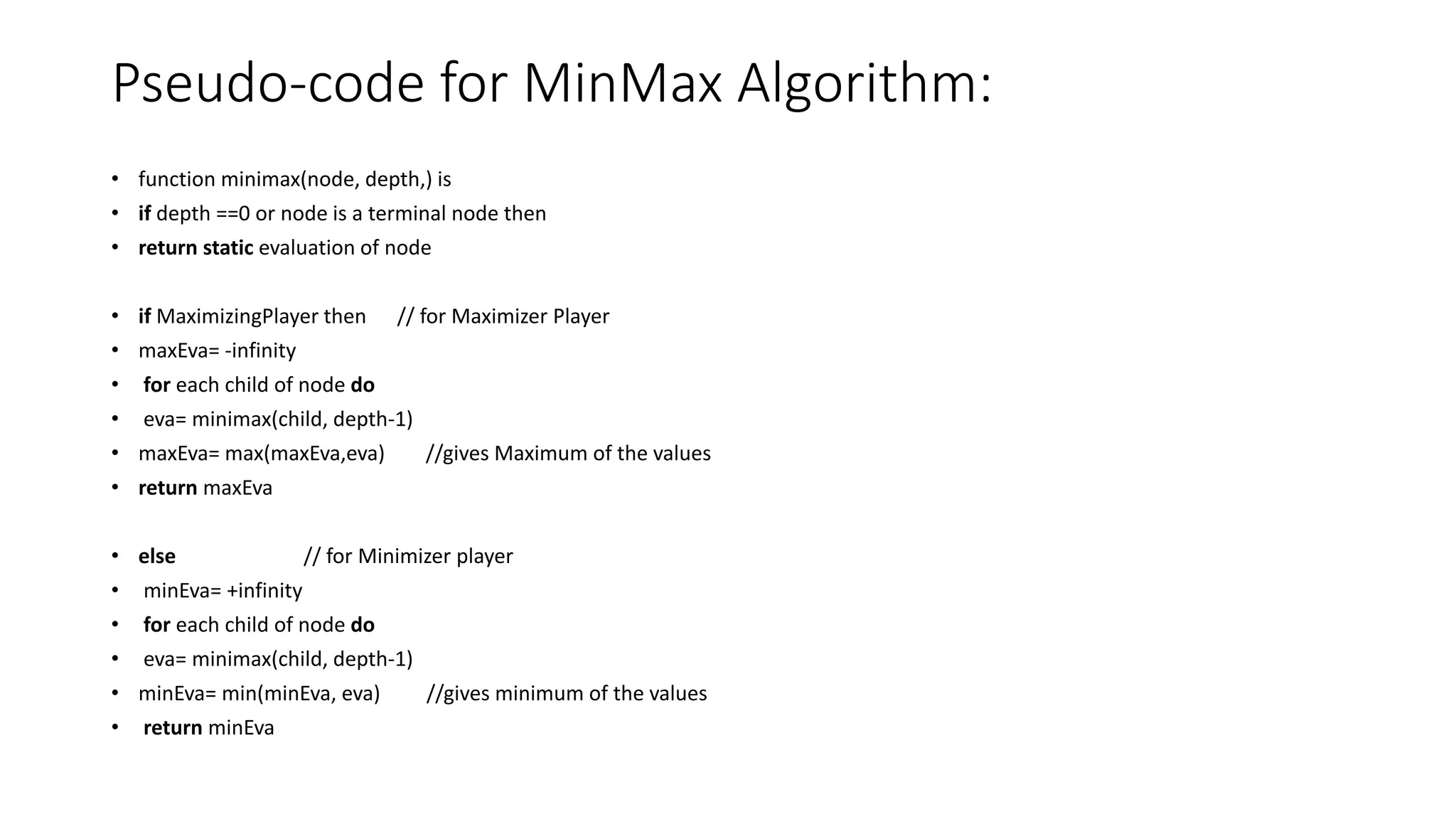
Pseudo-code for MinMax Algorithm:
• function minimax(node, depth,) is
• if depth ==0 or node is a terminal node then
• return static evaluation of node
• if MaximizingPlayer then // for Maximizer Player
• maxEva= -infinity
• for each child of node do
• eva= minimax(child, depth-1)
• maxEva= max(maxEva,eva) //gives Maximum of the values
• return maxEva
• else // for Minimizer player
• minEva= +infinity
• for each child of node do
• eva= minimax(child, depth-1)
• minEva= min(minEva, eva) //gives minimum of the values
• return minEva
Working of Min-Max Algorithm:
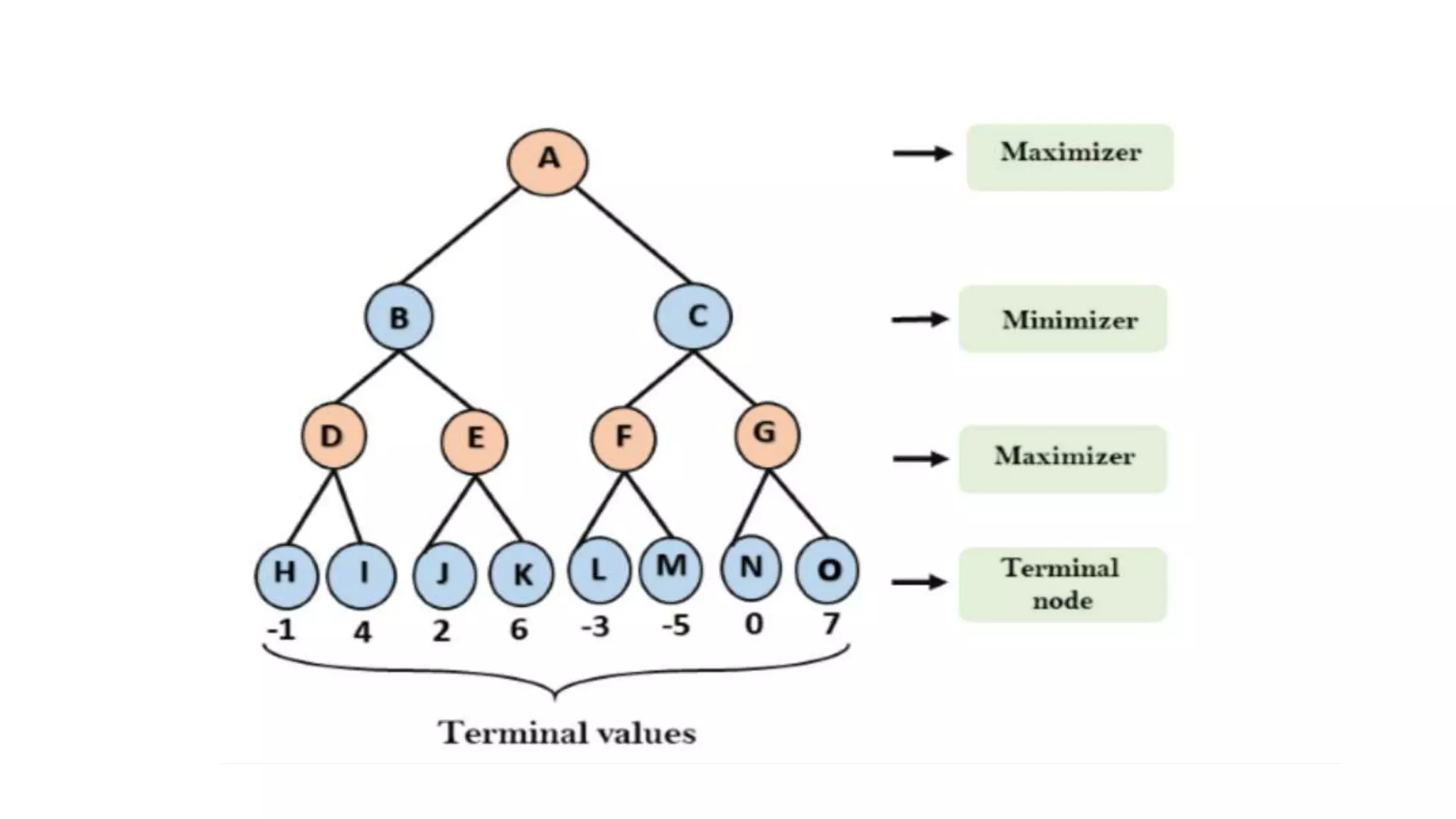
• Consider an example of game-tree which is representing the two-
player game.
• In this example, there are two players one is called Maximizer and
other is called Minimizer.
• Maximizer will try to get the Maximum possible score, and Minimizer
will try to get the minimum possible score.
• This algorithm applies DFS, so in this game-tree, we have to go all the
way through the leaves to reach the terminal nodes.
• At the terminal node, the terminal values are given so we will
compare those value and backtrack the tree until the initial state
occurs.
Following are the main steps involved in
solving the two-player game tree:
• Step-1: In the first step, the algorithm generates the entire game-tree
and apply the utility function to get the utility values for the terminal
states.
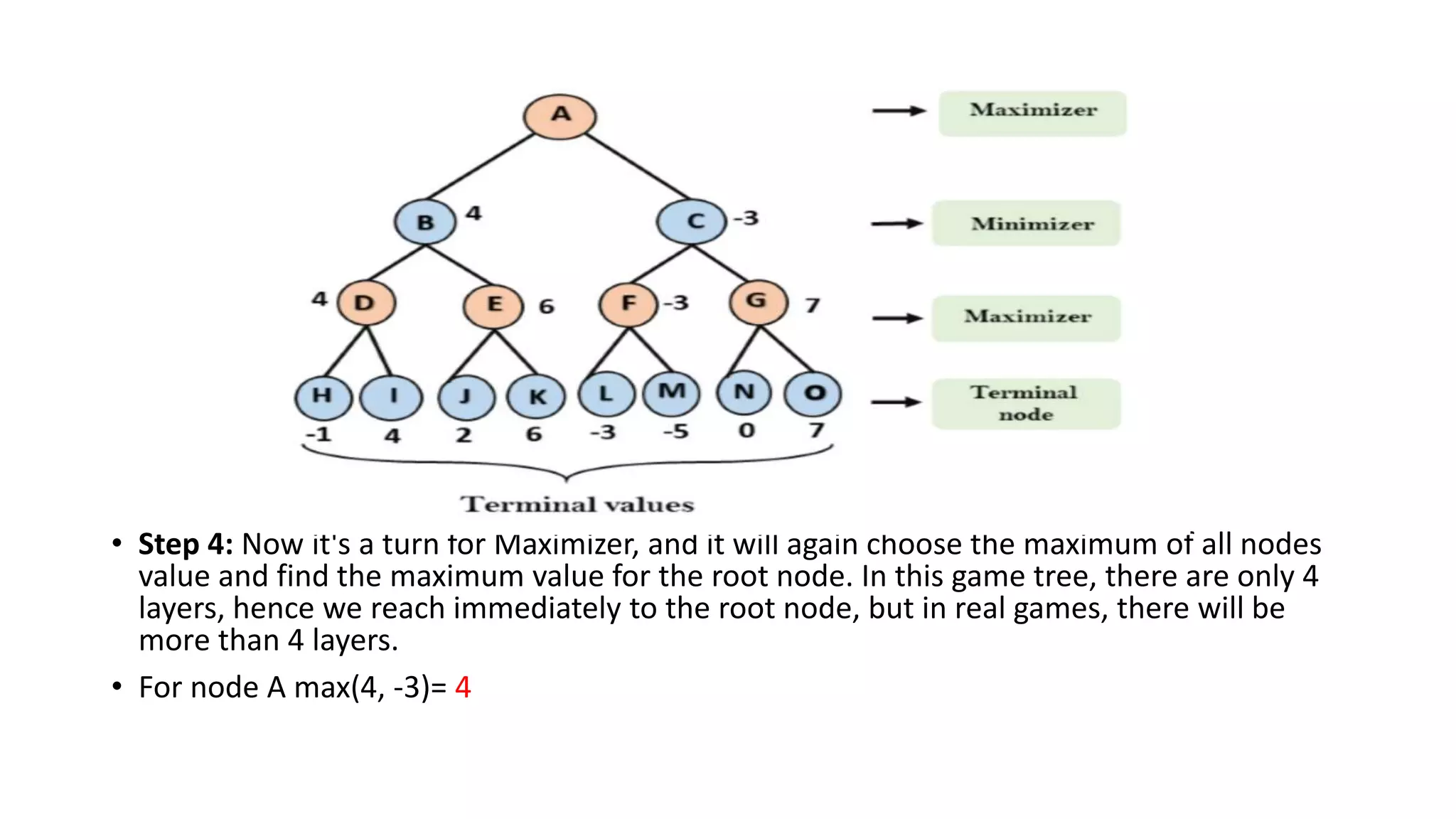
• In the below tree diagram, let's take A is the initial state of the tree.
• Suppose maximizer takes first turn which has worst-case initial value
=- infinity, and minimizer will take next turn which has worst-case
initial value = +infinity.
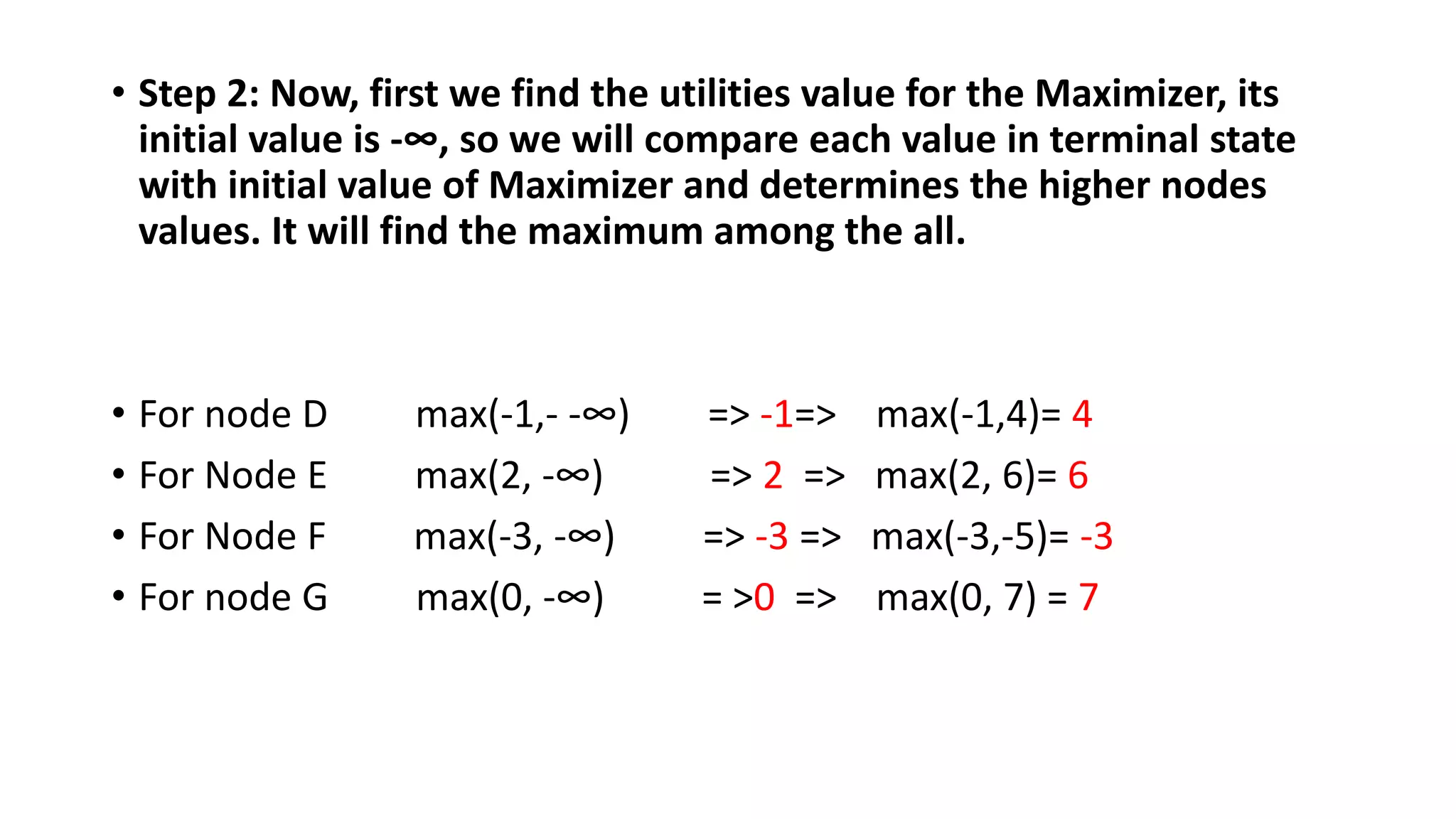
• Step 2: Now, first we find the utilities value for the Maximizer, its
initial value is -∞, so we will compare each value in terminal state
with initial value of Maximizer and determines the higher nodes
values. It will find the maximum among the all.
• For node D max(-1,- -∞) => -1=> max(-1,4)= 4
• For Node E max(2, -∞) => 2 => max(2, 6)= 6
• For Node F max(-3, -∞) => -3 => max(-3,-5)= -3
• For node G max(0, -∞) = >0 => max(0, 7) = 7
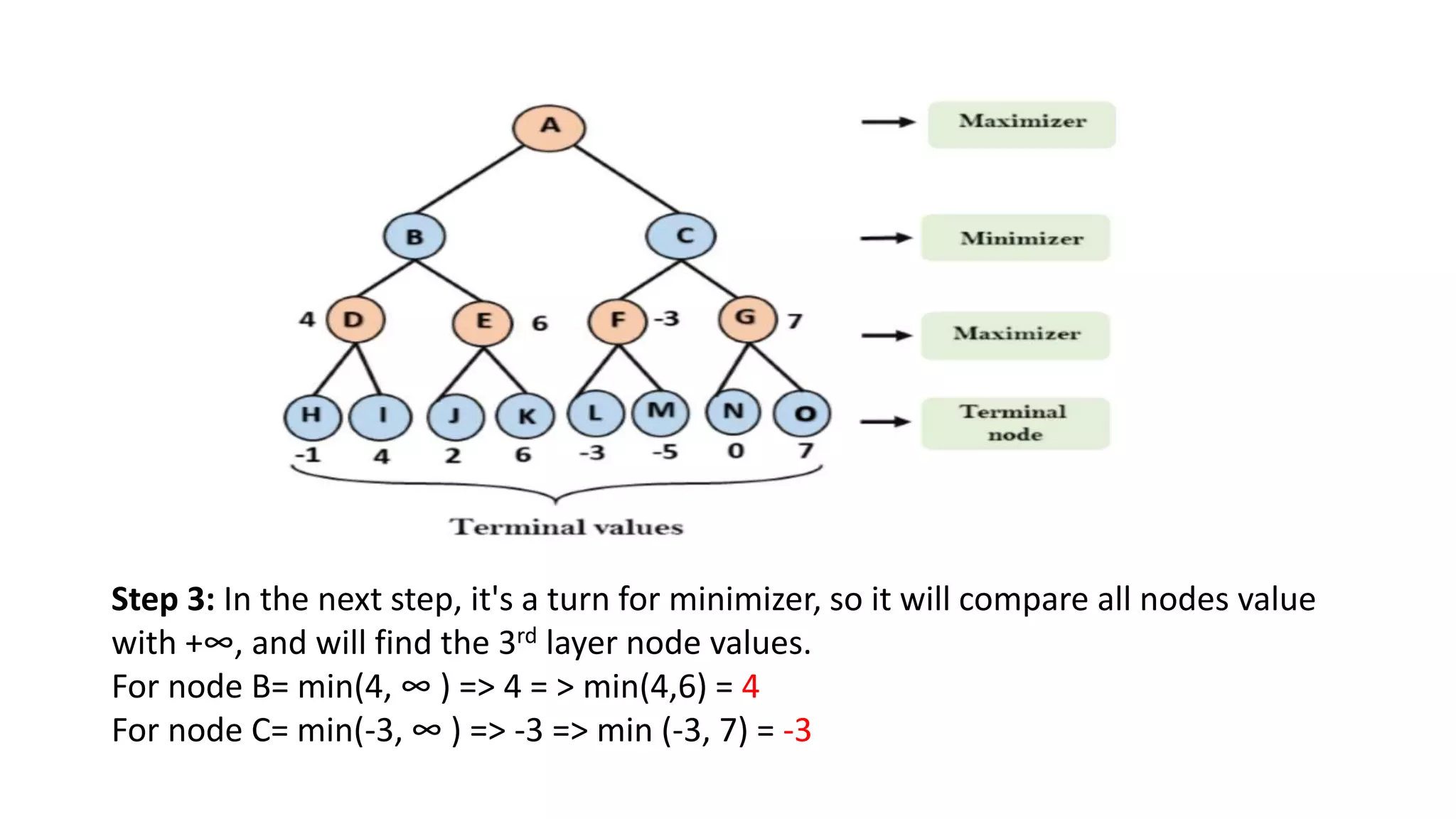
Step 3: In the next step, it's a turn for minimizer, so it will compare all nodes value
with +∞, and will find the 3rd layer node values.
For node B= min(4, ∞ ) => 4 = > min(4,6) = 4
For node C= min(-3, ∞ ) => -3 => min (-3, 7) = -3
• Step 4: Now it's a turn for Maximizer, and it will again choose the maximum of all nodes
value and find the maximum value for the root node. In this game tree, there are only 4
layers, hence we reach immediately to the root node, but in real games, there will be
more than 4 layers.
• For node A max(4, -3)= 4
Describing a Perfect Game of Tic Tac Toe
• To begin, let's start by defining what it means to play a perfect game
of tic tac toe:
• If I play perfectly, every time I play I will either win the game, or I will
draw the game. Furthermore if I play against another perfect player, I
will always draw the game.
• How might we describe these situations quantitatively? Let's assign a
score to the "end game conditions:"
• I win, hurray! I get 10 points!
• I lose, shit. I lose 10 points (because the other player gets 10 points)
• I draw, whatever. I get zero points, nobody gets any points.
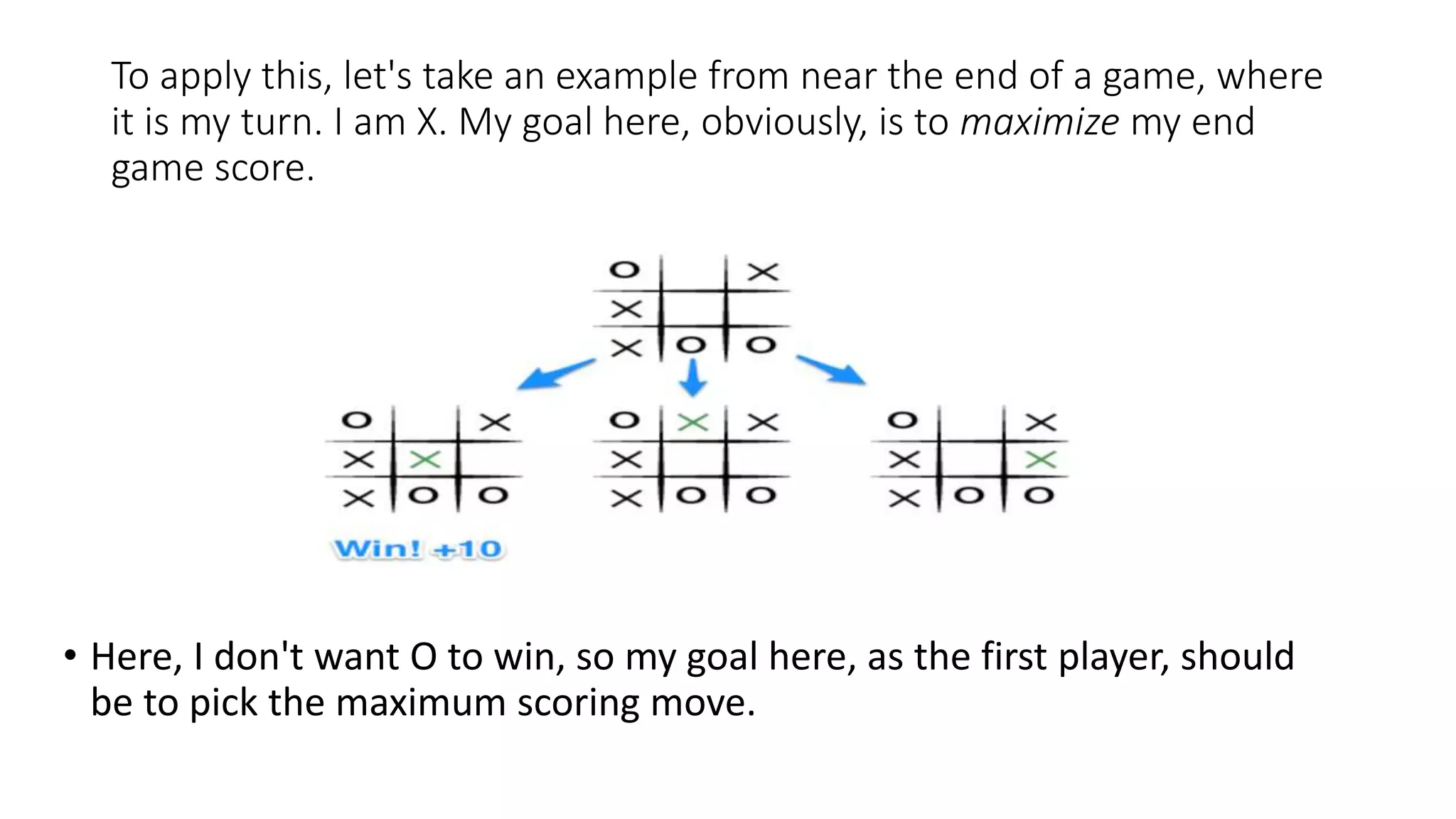
To apply this, let's take an example from near the end of a game, where
it is my turn. I am X. My goal here, obviously, is to maximize my end
game score.
• Here, I don't want O to win, so my goal here, as the first player, should
be to pick the maximum scoring move.
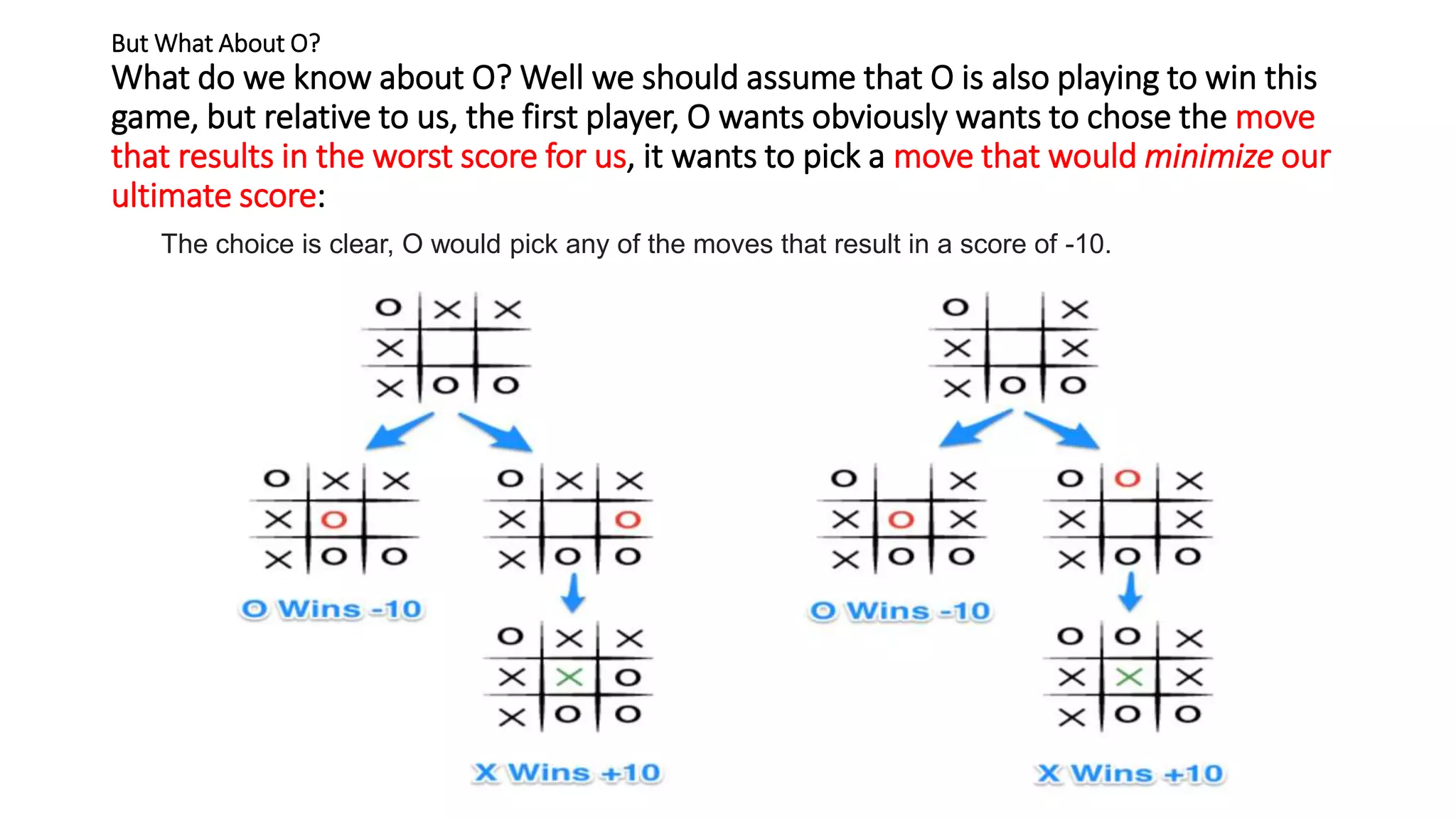
But What About O?
What do we know about O? Well we should assume that O is also playing to win this
game, but relative to us, the first player, O wants obviously wants to chose the move
that results in the worst score for us, it wants to pick a move that would minimize our
ultimate score:
The choice is clear, O would pick any of the moves that result in a score of -10.
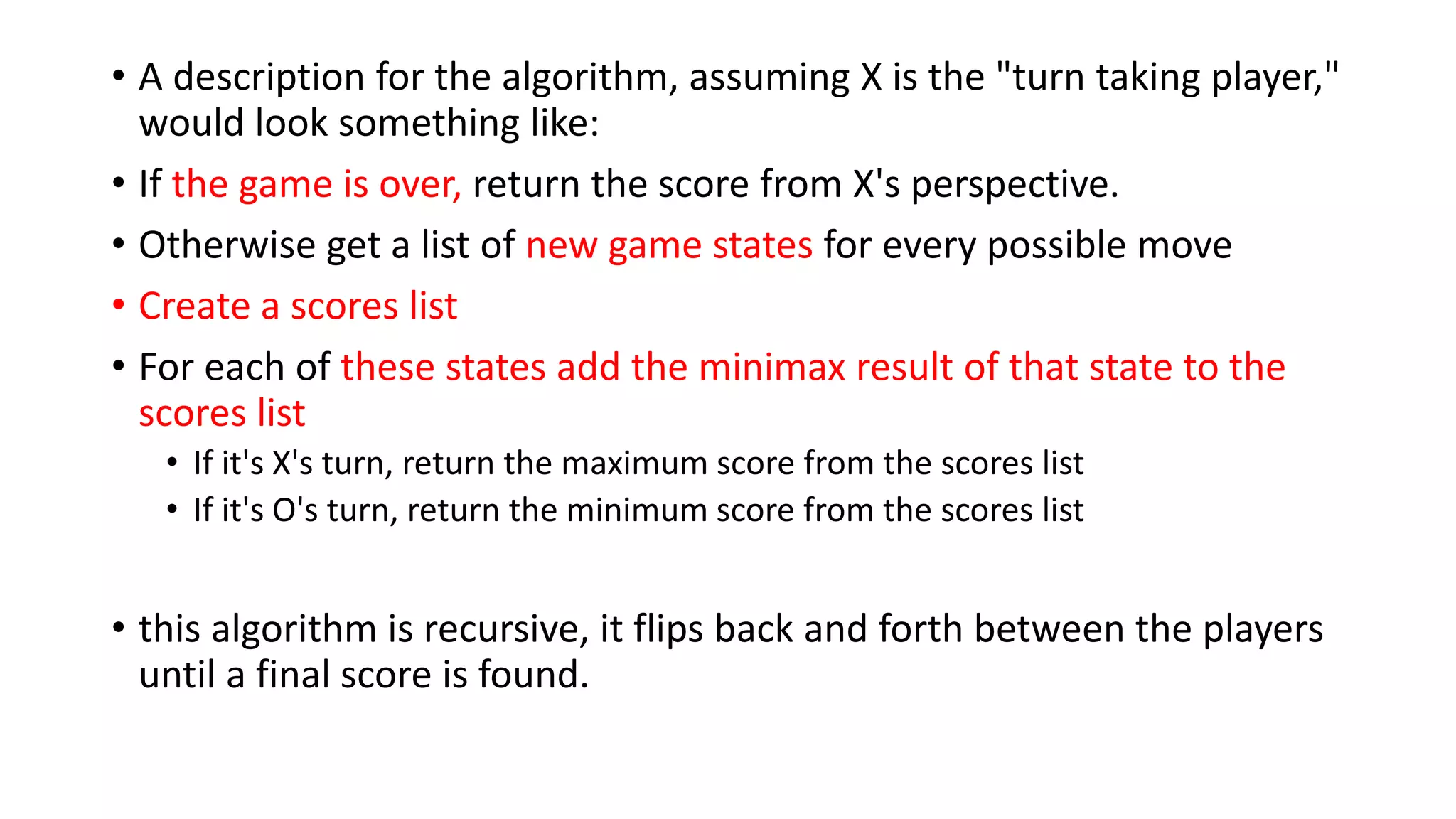
Describing Minimax
• The key to the Minimax algorithm is a back and forth between the
two players, where the player whose "turn it is" desires to pick the
move with the maximum score.
• In turn, the scores for each of the available moves are determined by
the opposing player deciding which of its available moves has the
minimum score.
• And the scores for the opposing players moves are again determined
by the turn-taking player trying to maximize its score and so on all the
way down the move tree to an end state.
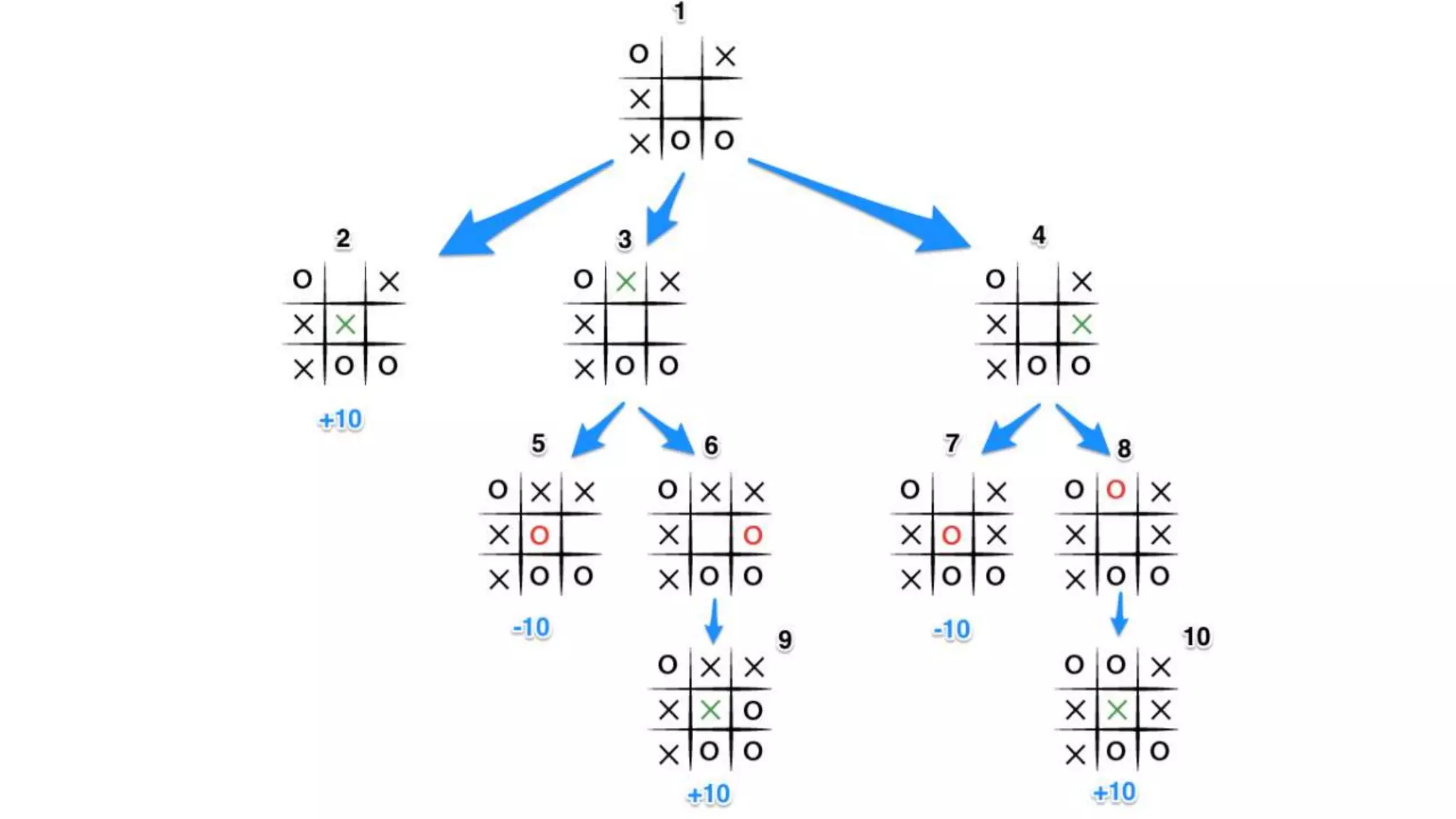
• A description for the algorithm, assuming X is the "turn taking player,"
would look something like:
• If the game is over, return the score from X's perspective.
• Otherwise get a list of new game states for every possible move
• Create a scores list
• For each of these states add the minimax result of that state to the
scores list
• If it's X's turn, return the maximum score from the scores list
• If it's O's turn, return the minimum score from the scores list
• this algorithm is recursive, it flips back and forth between the players
until a final score is found.
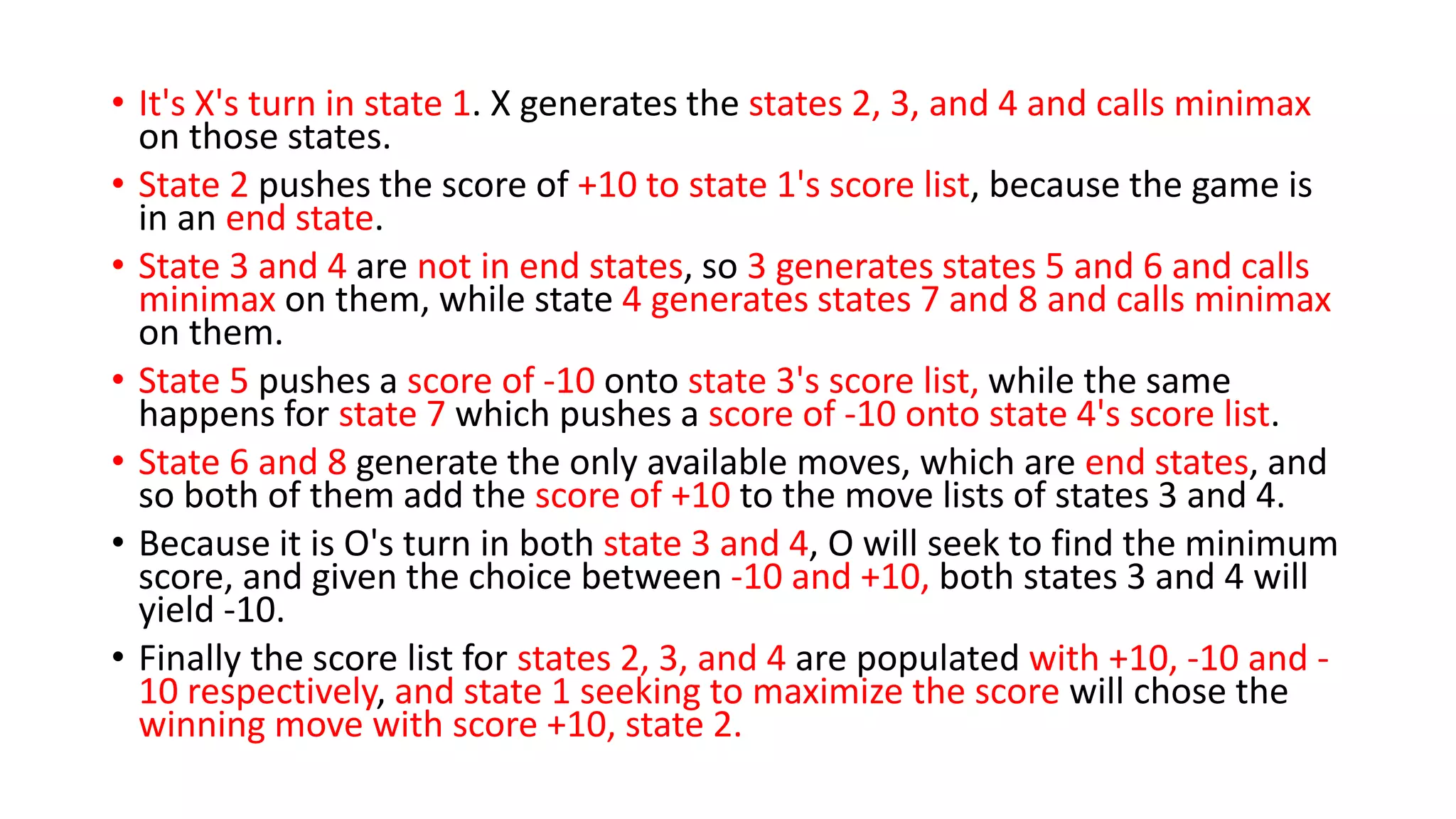
• It's X's turn in state 1. X generates the states 2, 3, and 4 and calls minimax
on those states.
• State 2 pushes the score of +10 to state 1's score list, because the game is
in an end state.
• State 3 and 4 are not in end states, so 3 generates states 5 and 6 and calls
minimax on them, while state 4 generates states 7 and 8 and calls minimax
on them.
• State 5 pushes a score of -10 onto state 3's score list, while the same
happens for state 7 which pushes a score of -10 onto state 4's score list.
• State 6 and 8 generate the only available moves, which are end states, and
so both of them add the score of +10 to the move lists of states 3 and 4.
• Because it is O's turn in both state 3 and 4, O will seek to find the minimum
score, and given the choice between -10 and +10, both states 3 and 4 will
yield -10.
• Finally the score list for states 2, 3, and 4 are populated with +10, -10 and -
10 respectively, and state 1 seeking to maximize the score will chose the
winning move with score +10, state 2.
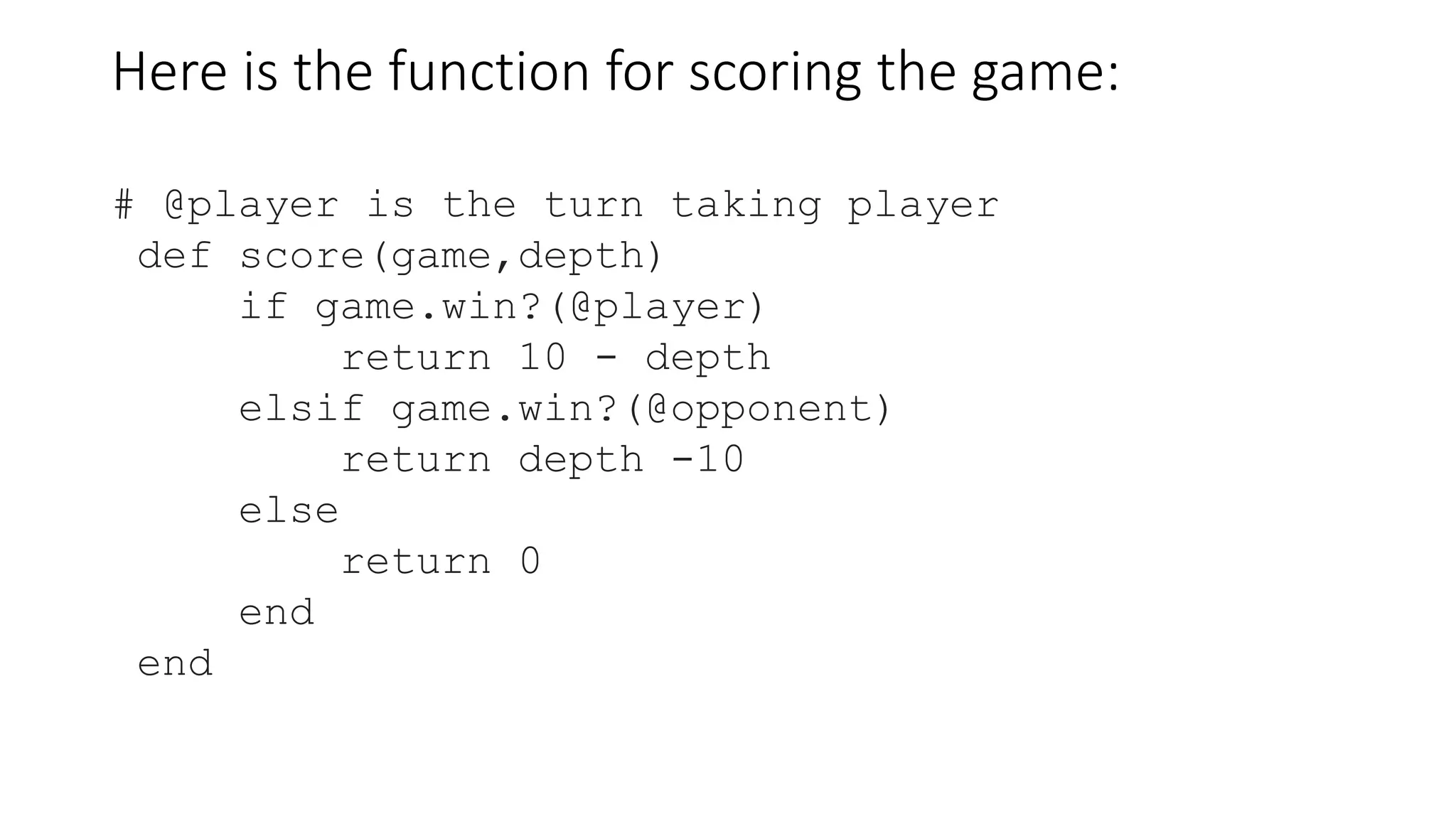
Here is the function for scoring the game:
# @player is the turn taking player
def score(game,depth)
if game.win?(@player)
return 10 - depth
elsif game.win?(@opponent)
return depth -10
else
return 0
end
end
def minimax(game, depth)
return score(game) if game.over?
depth +=1
scores = [] # an array of scores
moves = [] # an array of moves
# Populate the scores array, recursing as needed
game.get_available_moves.each do |move|
possible_game = game.get_new_state(move)
scores.push minimax(possible_game, depth)
moves.push move
end
# Do the min or the max calculation
if game.active_turn == @player
# This is the max calculation
max_score_index = scores.each_with_index.max[1]
@choice = moves[max_score_index]
return scores[max_score_index]
else
# This is the min calculation
min_score_index = scores.each_with_index.min[1]
@choice = moves[min_score_index]
return scores[min_score_index]
end
end
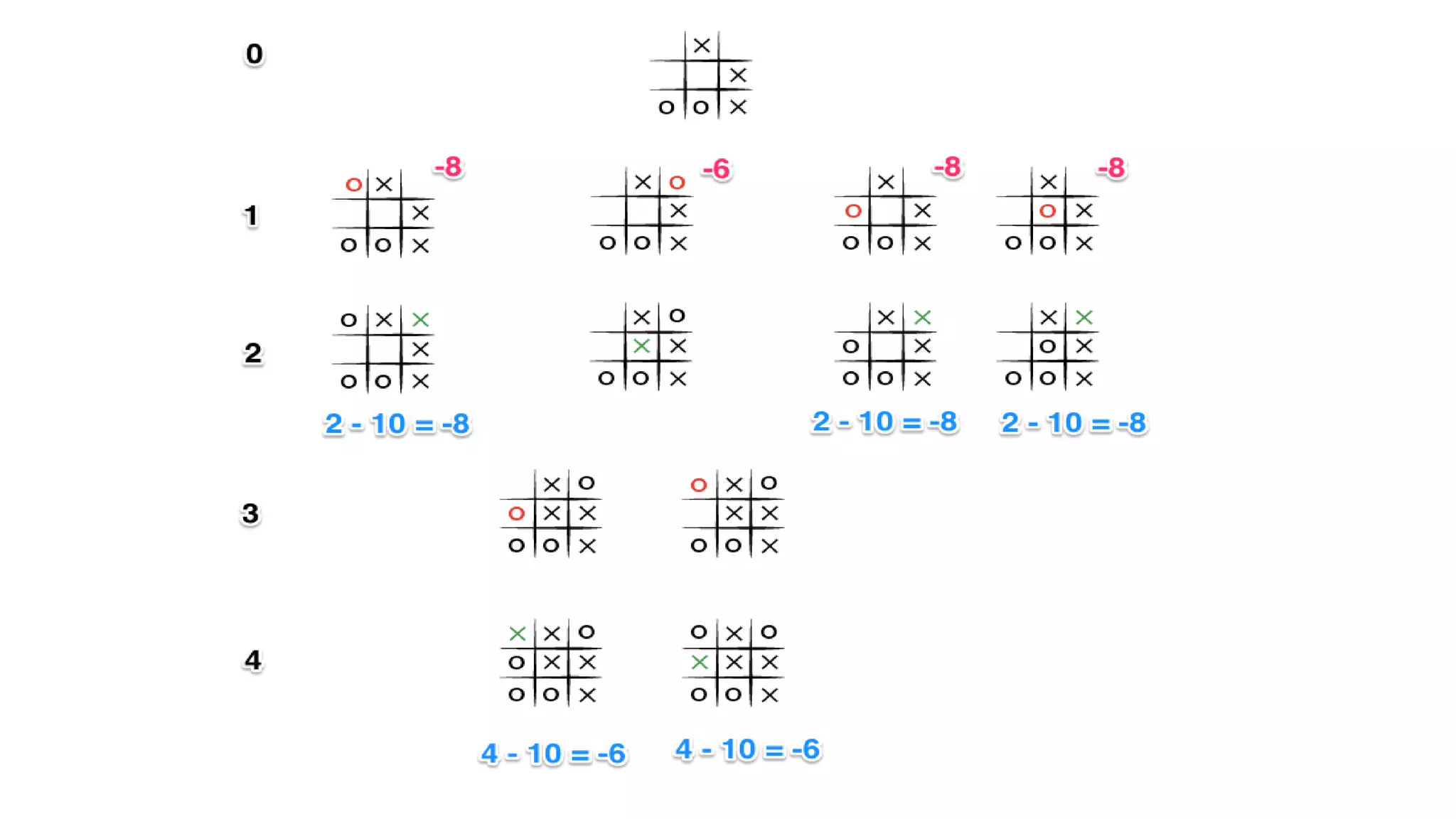
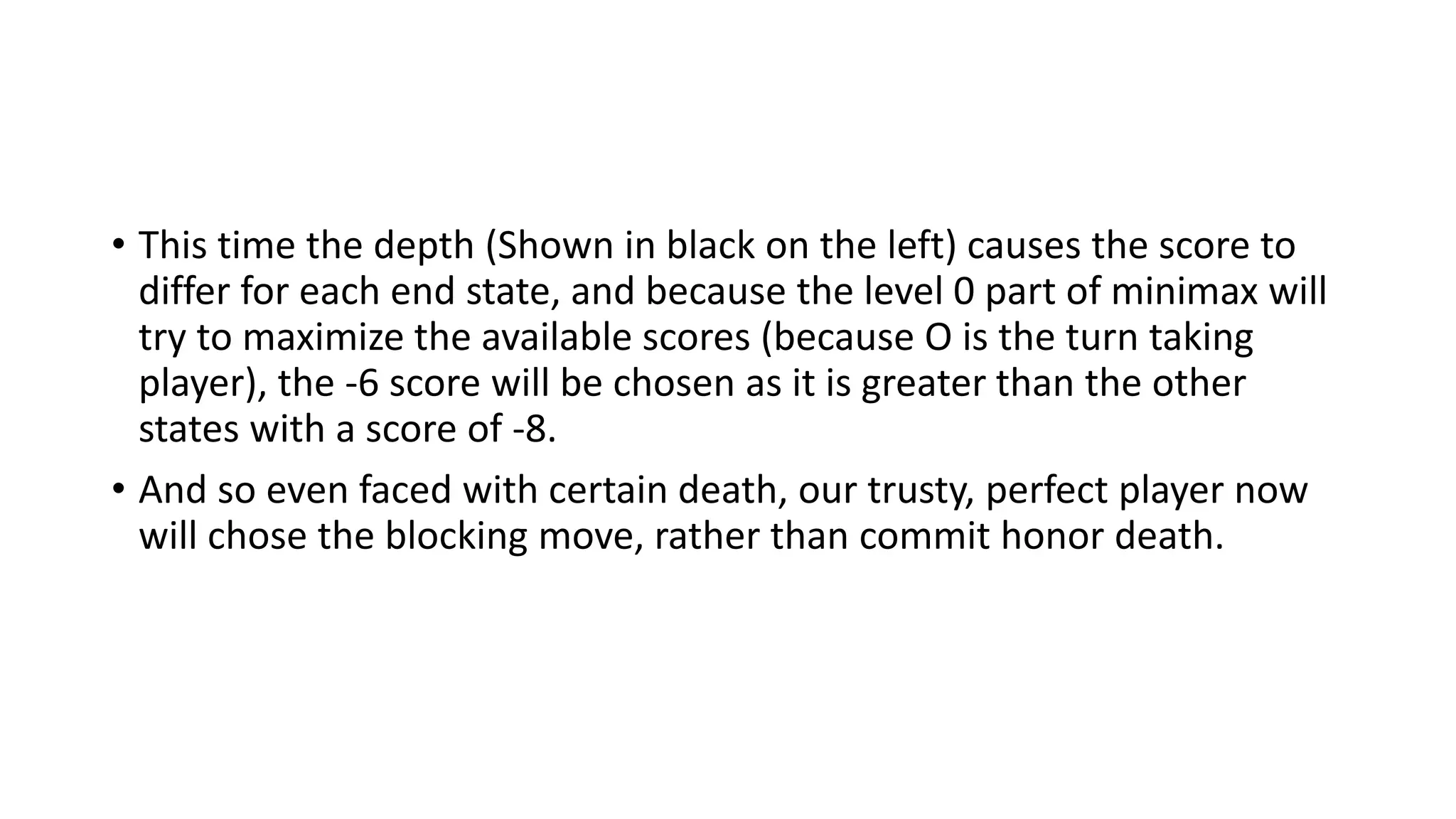
• This time the depth (Shown in black on the left) causes the score to
differ for each end state, and because the level 0 part of minimax will
try to maximize the available scores (because O is the turn taking
player), the -6 score will be chosen as it is greater than the other
states with a score of -8.
• And so even faced with certain death, our trusty, perfect player now
will chose the blocking move, rather than commit honor death.

MINI-MAX ALGORITHM.pptx

  • 1.
  • 2.
    Mini-Max Algorithm inArtificial Intelligence • Mini-max algorithm is a recursive or backtracking algorithm which is used in decision-making and game theory. It provides an optimal move for the player assuming that opponent is also playing optimally. • Mini-Max algorithm uses recursion to search through the game-tree. • Min-Max algorithm is mostly used for game playing in AI. Such as Chess, Checkers, tic-tac-toe, go, and various tow-players game. This Algorithm computes the minimax decision for the current state. • In this algorithm two players play the game, one is called MAX and other is called MIN. • Both the players fight it as the opponent player gets the minimum benefit while they get the maximum benefit.
  • 3.
    Continued…. • Both Playersof the game are opponent of each other, where MAX will select the maximized value and MIN will select the minimized value. • The minimax algorithm performs a depth-first search algorithm for the exploration of the complete game tree. • The minimax algorithm proceeds all the way down to the terminal node of the tree, then backtrack the tree as the recursion.
  • 4.
    Pseudo-code for MinMaxAlgorithm: • function minimax(node, depth,) is • if depth ==0 or node is a terminal node then • return static evaluation of node • if MaximizingPlayer then // for Maximizer Player • maxEva= -infinity • for each child of node do • eva= minimax(child, depth-1) • maxEva= max(maxEva,eva) //gives Maximum of the values • return maxEva • else // for Minimizer player • minEva= +infinity • for each child of node do • eva= minimax(child, depth-1) • minEva= min(minEva, eva) //gives minimum of the values • return minEva
  • 5.
    Working of Min-MaxAlgorithm: • Consider an example of game-tree which is representing the two- player game. • In this example, there are two players one is called Maximizer and other is called Minimizer. • Maximizer will try to get the Maximum possible score, and Minimizer will try to get the minimum possible score. • This algorithm applies DFS, so in this game-tree, we have to go all the way through the leaves to reach the terminal nodes. • At the terminal node, the terminal values are given so we will compare those value and backtrack the tree until the initial state occurs.
  • 6.
    Following are themain steps involved in solving the two-player game tree: • Step-1: In the first step, the algorithm generates the entire game-tree and apply the utility function to get the utility values for the terminal states. • In the below tree diagram, let's take A is the initial state of the tree. • Suppose maximizer takes first turn which has worst-case initial value =- infinity, and minimizer will take next turn which has worst-case initial value = +infinity.
  • 8.
    • Step 2:Now, first we find the utilities value for the Maximizer, its initial value is -∞, so we will compare each value in terminal state with initial value of Maximizer and determines the higher nodes values. It will find the maximum among the all. • For node D max(-1,- -∞) => -1=> max(-1,4)= 4 • For Node E max(2, -∞) => 2 => max(2, 6)= 6 • For Node F max(-3, -∞) => -3 => max(-3,-5)= -3 • For node G max(0, -∞) = >0 => max(0, 7) = 7
  • 9.
    Step 3: Inthe next step, it's a turn for minimizer, so it will compare all nodes value with +∞, and will find the 3rd layer node values. For node B= min(4, ∞ ) => 4 = > min(4,6) = 4 For node C= min(-3, ∞ ) => -3 => min (-3, 7) = -3
  • 10.
    • Step 4:Now it's a turn for Maximizer, and it will again choose the maximum of all nodes value and find the maximum value for the root node. In this game tree, there are only 4 layers, hence we reach immediately to the root node, but in real games, there will be more than 4 layers. • For node A max(4, -3)= 4
  • 11.
    Describing a PerfectGame of Tic Tac Toe • To begin, let's start by defining what it means to play a perfect game of tic tac toe: • If I play perfectly, every time I play I will either win the game, or I will draw the game. Furthermore if I play against another perfect player, I will always draw the game. • How might we describe these situations quantitatively? Let's assign a score to the "end game conditions:" • I win, hurray! I get 10 points! • I lose, shit. I lose 10 points (because the other player gets 10 points) • I draw, whatever. I get zero points, nobody gets any points.
  • 12.
    To apply this,let's take an example from near the end of a game, where it is my turn. I am X. My goal here, obviously, is to maximize my end game score. • Here, I don't want O to win, so my goal here, as the first player, should be to pick the maximum scoring move.
  • 13.
    But What AboutO? What do we know about O? Well we should assume that O is also playing to win this game, but relative to us, the first player, O wants obviously wants to chose the move that results in the worst score for us, it wants to pick a move that would minimize our ultimate score: The choice is clear, O would pick any of the moves that result in a score of -10.
  • 14.
    Describing Minimax • Thekey to the Minimax algorithm is a back and forth between the two players, where the player whose "turn it is" desires to pick the move with the maximum score. • In turn, the scores for each of the available moves are determined by the opposing player deciding which of its available moves has the minimum score. • And the scores for the opposing players moves are again determined by the turn-taking player trying to maximize its score and so on all the way down the move tree to an end state.
  • 15.
    • A descriptionfor the algorithm, assuming X is the "turn taking player," would look something like: • If the game is over, return the score from X's perspective. • Otherwise get a list of new game states for every possible move • Create a scores list • For each of these states add the minimax result of that state to the scores list • If it's X's turn, return the maximum score from the scores list • If it's O's turn, return the minimum score from the scores list • this algorithm is recursive, it flips back and forth between the players until a final score is found.
  • 17.
    • It's X'sturn in state 1. X generates the states 2, 3, and 4 and calls minimax on those states. • State 2 pushes the score of +10 to state 1's score list, because the game is in an end state. • State 3 and 4 are not in end states, so 3 generates states 5 and 6 and calls minimax on them, while state 4 generates states 7 and 8 and calls minimax on them. • State 5 pushes a score of -10 onto state 3's score list, while the same happens for state 7 which pushes a score of -10 onto state 4's score list. • State 6 and 8 generate the only available moves, which are end states, and so both of them add the score of +10 to the move lists of states 3 and 4. • Because it is O's turn in both state 3 and 4, O will seek to find the minimum score, and given the choice between -10 and +10, both states 3 and 4 will yield -10. • Finally the score list for states 2, 3, and 4 are populated with +10, -10 and - 10 respectively, and state 1 seeking to maximize the score will chose the winning move with score +10, state 2.
  • 18.
    Here is thefunction for scoring the game: # @player is the turn taking player def score(game,depth) if game.win?(@player) return 10 - depth elsif game.win?(@opponent) return depth -10 else return 0 end end
  • 19.
    def minimax(game, depth) returnscore(game) if game.over? depth +=1 scores = [] # an array of scores moves = [] # an array of moves # Populate the scores array, recursing as needed game.get_available_moves.each do |move| possible_game = game.get_new_state(move) scores.push minimax(possible_game, depth) moves.push move end
  • 20.
    # Do themin or the max calculation if game.active_turn == @player # This is the max calculation max_score_index = scores.each_with_index.max[1] @choice = moves[max_score_index] return scores[max_score_index] else # This is the min calculation min_score_index = scores.each_with_index.min[1] @choice = moves[min_score_index] return scores[min_score_index] end end
  • 22.
    • This timethe depth (Shown in black on the left) causes the score to differ for each end state, and because the level 0 part of minimax will try to maximize the available scores (because O is the turn taking player), the -6 score will be chosen as it is greater than the other states with a score of -8. • And so even faced with certain death, our trusty, perfect player now will chose the blocking move, rather than commit honor death.