MALADAPTIVE
PATTERNS OF
BEHAVIOR
WILMA O. RIVADENERA, RN,MAN
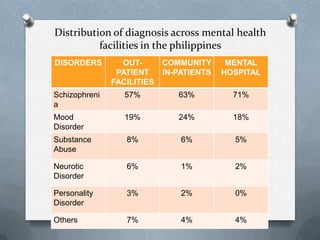
Distribution of diagnosis across mental health
facilities in the philippines
DISORDERS

OUTPATIENT
FACILITIES

COMMUNITY
IN-PATIENTS

MENTAL
HOSPITAL

Schizophreni
a

57%

63%

71%

Mood
Disorder

19%

24%

18%

Substance
Abuse

8%

6%

5%

Neurotic
Disorder

6%

1%

2%

Personality
Disorder

3%

2%

0%

Others

7%

4%

4%
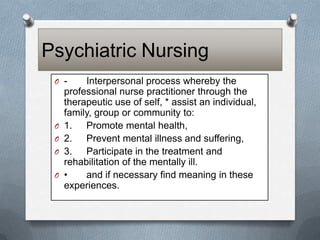
Psychiatric Nursing
O -

O

O
O
O

Interpersonal process whereby the
professional nurse practitioner through the
therapeutic use of self, * assist an individual,
family, group or community to:
1. Promote mental health,
2. Prevent mental illness and suffering,
3. Participate in the treatment and
rehabilitation of the mentally ill.
•
and if necessary find meaning in these
experiences.
Psychiatric Nursing
- Is both a science and
an art
HEALTH
O State of complete physical, mental,

and social wellness, not merely the
absence of disease or
infirmity…..(WHO)
Mental
Health
O A state of complete physical, mental,

and social wellness, not merely the
absence of disease or infirmity (WHO).
Criteria:
a. Satisfying interpersonal relationship;
b. Effective behavior and coping;
c. Positive self – concept; and
d. Emotional stability
Factors Influencing a person’s
Mental Health
O Individual or personal – biologic
make-up, autonomy and independence,
capacity for growth, vitality, ability to find
meaning in life, sense of belonging, reality
orientation and coping or stress
management abilities
Factors influencing a person’s
Mental health
O Interpersonal, or relationship –
effective communication, ability to help
others, intimacy and a balance of
separateness and connectedness.
O Social/cultural, or environmental
– sense of community, success to
adequate resources, intolerance of
violence, support of diversity among
people, mastery of the environment, and a
positive, yet realistic, view of one’s world
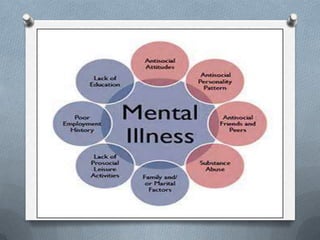
Mental Illness
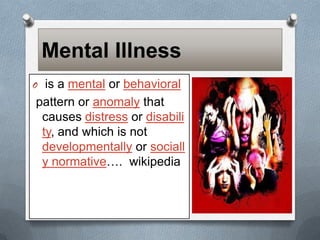
is a mental or behavioral
pattern or anomaly that
causes distress or disabili
ty, and which is not
developmentally or sociall
y normative…. wikipedia

O
Criteria to diagnose Mental
Disorders
O Dissatisfaction with one’s characteristics,

abilities, and accomplishments;
O Ineffective or unsatisfying relationships;
O Dissatisfaction with one’s place in the
world;
O Ineffective coping with life events; and
O Lack of personal growth
Factors
 Individual – biologic make – up,
intolerable or unrealistic worries or fears,
inability to distinguish reality from fantasy,
intolerance of life’s uncertainties, a sense
of disharmony in life, and a loss of
meaning in one’s life.
Factor
s
O Interpersonal - - ineffective
communication, excessive
dependency on or withdrawal from
relationships, no sense of
belonging, inadequate social
support, and loss of emotional
control.
O Social/cultural factors – lack of

resources, violence, homelessness,
poverty, an unwarranted negative
view of the world, and discrimination
such as stigma, racism, classism,
ageism, and sexism
DSM-IV
(DIAGNOSTIC AND STATISITCAL MANUAL OF
MENTAL DISORDERS)

O published by the American

Psychiatric Association (APA),
provides a common language and
standard criteria for
the classification of mental
disorders.
Purposes of DSM-IV-TR
O To provide standardized nomenclature

and language for all mental health
professionals
O To present defining characteristics or
symptoms that differentiate specific
diagnoses.
O To assist in identifying the underlying
causes of disorders
The DSM-IV organizes each psychiatric diagnosis
into five dimensions (axes) relating to different
aspects of disorder or disability:
Axis I: All psychological diagnostic categories
except mental retardation and personality disorder
Axis II: reporting of Personality disorders and
mental retardation
Axis III: General medical condition; acute medical
conditions and physical disorders
Axis IV: Psychosocial and environmental factors
contributing to the disorder
Axis V: Global Assessment of
Functioning or Children's Global Assessment
Scale for children and teens under the age of 18
BENCHMARK IN
PSYCHIATRIC NURSING
ANCIENT TIMES
-

Punishments for sins and wrong doing
Viewed as either divine or demonic, depending on
their behavior
Aristotle (383-322 BC) – relate disorders to
physical disorders and his theory that amounts of
blood, water and yellow and black bile in the body
controlled the emotions (corresponds with
happiness, calmness, anger and sadness).
O Treatment: blood-letting, starving, and purging (till
19th century)
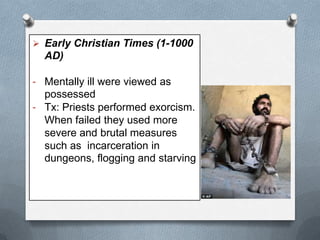
 Early Christian Times (1-1000
AD)
- Mentally ill were viewed as

possessed
- Tx: Priests performed exorcism.
When failed they used more
severe and brutal measures
such as incarceration in
dungeons, flogging and starving
 Rennaisance (1300-1600)
- Distinguished from criminals
 1547 – Hospital of St. Mary of Bethlehem was

officially declared as hospital for the insane.
 1775 – Charged for a fee for a privilege of

viewing and ridiculing the inmates who were
seen as animal rather than human.
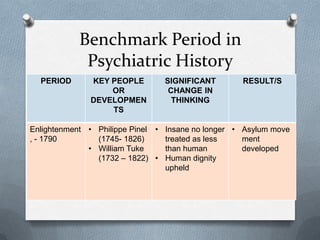
Benchmark Period in
Psychiatric History
PERIOD

KEY PEOPLE
OR
DEVELOPMEN
TS

SIGNIFICANT
CHANGE IN
THINKING

RESULT/S

Enlightenment • Philippe Pinel • Insane no longer • Asylum move
, - 1790
(1745- 1826)
treated as less
ment
• William Tuke
than human
developed
(1732 – 1822) • Human dignity
upheld
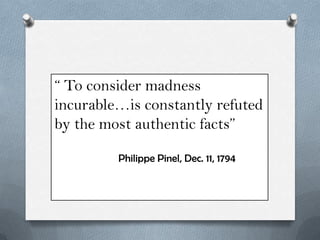
“ To consider madness
incurable…is constantly refuted
by the most authentic facts”
Philippe Pinel, Dec. 11, 1794
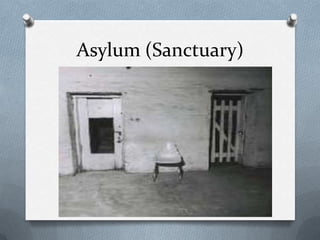
Asylum (Sanctuary)
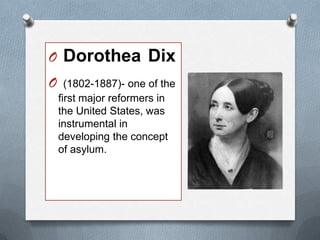
O Dorothea Dix
O

(1802-1887)- one of the
first major reformers in
the United States, was
instrumental in
developing the concept
of asylum.
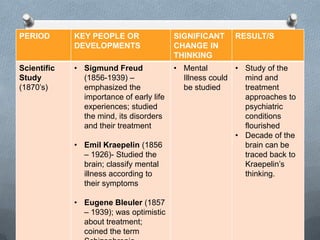
PERIOD

Scientific
Study
(1870’s)

KEY PEOPLE OR
DEVELOPMENTS

s

• Sigmund Freud
(1856-1939) –
emphasized the
importance of early life
experiences; studied
the mind, its disorders
and their treatment
• Emil Kraepelin (1856
– 1926)- Studied the
brain; classify mental
illness according to
their symptoms
• Eugene Bleuler (1857
– 1939); was optimistic
about treatment;
coined the term

SIGNIFICANT
CHANGE IN
THINKING

RESULT/S

• Mental
• Study of the
Illness could
mind and
be studied
treatment
approaches to
psychiatric
conditions
flourished
• Decade of the
brain can be
traced back to
Kraepelin’s
thinking.
PERIOD

KEY PEOPLE OR SIGNIFICANT
DEVELOPMENTS CHANGE IN
THINKING

g

RESULT/S

Psychotropic
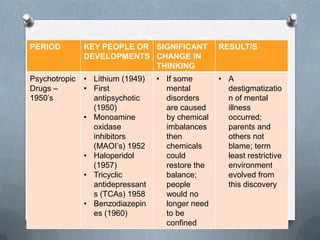
Drugs –
1950’s

• Lithium (1949)
• First
antipsychotic
(1950)
• Monoamine
oxidase
inhibitors
(MAOI’s) 1952
• Haloperidol
(1957)
• Tricyclic
antidepressant
s (TCAs) 1958
• Benzodiazepin
es (1960)

• If some
mental
disorders
are caused
by chemical
imbalances
then
chemicals
could
restore the
balance;
people
would no
longer need
to be
confined

• A
destigmatizatio
n of mental
illness
occurred;
parents and
others not
blame; term
least restrictive
environment
evolved from
this discovery
PERIOD

KEY PEOPLE
OR
DEVELOPMEN
TS

SIGNIFICANT
CHANGE IN
THINKING

RESULT/S

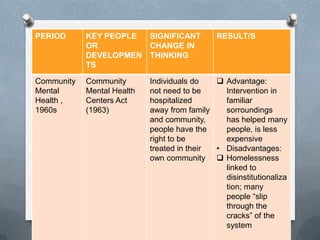
Community
Mental
Health ,
1960s

Community
Mental Health
Centers Act
(1963)

Individuals do
 Advantage:
not need to be
Intervention in
hospitalized
familiar
away from family
sorroundings
and community,
has helped many
people have the
people, is less
right to be
expensive
treated in their
• Disadvantages:
own community  Homelessness
linked to
disinstitutionaliza
tion; many
people “slip
through the
cracks” of the
system
PERIOD

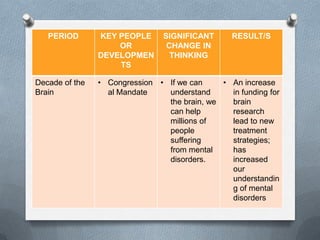
Decade of the
Brain

KEY PEOPLE
OR
DEVELOPMEN
TS

SIGNIFICANT
CHANGE IN
THINKING

RESULT/S

• Congression • If we can
• An increase
al Mandate
understand
in funding for
the brain, we
brain
can help
research
millions of
lead to new
people
treatment
suffering
strategies;
from mental
has
disorders.
increased
our
understandin
g of mental
disorders
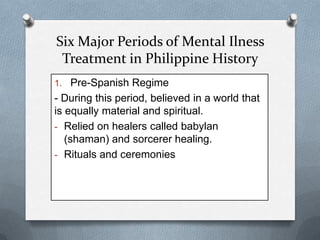
Six Major Periods of Mental Ilness
Treatment in Philippine History
1. Pre-Spanish Regime

- During this period, believed in a world that
is equally material and spiritual.
- Relied on healers called babylan
(shaman) and sorcerer healing.
- Rituals and ceremonies
2. Spanish Rule
- Filipinos accepted that mental illness was
caused by an act of sorcery
(mangkukulam or witches and
manggagaway or the devil men)
Treatment:
- Herbmen (herbolarios)
- Brought to church for exorcism or ritual
cleaning
Early Nineteenth Century
- Organized care and treatment for
individuals with mental illness was
established at the Hospicio de San Jose
- Spanish naval authorities requested for a
place of confinement for their mentally ill
sailors.
The American Era
- Two Americans provided treatment for
mentally ill patients of the Civil Hospitals
located in Calle Iris (now known as Claro
M Recto Avenue)
- In 1904, the insane department was
opened at the San Lazaro Hospital.
- The first physician to attain formal training
in psychiatry in the US is Dr. Elias
Domingo.
Japanese Occupation
- World War II
- National Psychopathic Hospital continued
to operate
- The Japanese Army donated an
electroshock apparatus to the hospital.
The Liberation Period and the Era of the
Republic
- The National Psychopathic Hospital was
renamed National Mental Hospital, with Dr.
Jose A. Fernandez designated as officer in
charge from Oct 1946 to April 1961
Present Day Psychiatry
O The use of SOMATIC

Therapies became most
popular.
Psychiatric Nursing
Education: THREE FIRSTS
 Linda Richard – the first American

Psychiatric Nurse
 Nursing Mental Disease – the first
psychiatric nursing book wrote by Harriet
Bailey
 Hildegard Peplau – first psychiatric
nursing theorist
Development of Psychiatric
Education in the Philippines
 An Outline of Psychiatric Nursing – the

first textbook wrote by Jesusa Bagan Lara
in 1973
 Nenita Yasay-Davadilla – the first
psychiatric nurse to be sent abroad to
obtain MSN under WHO scholarship
program.
 Magda Carolina Go Vera Llamanzares –
first Filipino child psychiatric nurse
 Sotera Capellan – the first chief nurse of a
Mental Hospital
Role of Mental Health
Nurse
 Ward manager- creates a

therapeutic environment
 Socializing agent- assists the
patient to feel comfortable with
others
 Counselor- Listens to the
patient’s verbalization
 Parent surrogate- assists the
patient in the performance of
ADL
Role
 Patient advocate- enables the

patient and his relatives to
know their rights and
responsibilities
 Teacher- assists the patient to
learn more adaptive ways of
coping
 Technician- facilitates the
performance of nursing
procedures
Role
 Therapist- explores the

patient’s needs, problems and
concerns through varied
therapeutic means.
 Reality base- enables the
patient to distinguish objective
reality and subjective reality.
 Healthy role model-acts as a
symbol of health by serving as
an example of healthful living.
 Stranger- Offering the client
the same acceptance and
courtesy that the nurse would
do to any strangers.
Essential Qualities
 Empathy – ability to see beyond outward

behavior and sense accurately another
person’s inner experiencing.
 Genuineness- ability to use therapeutic
tools appropriately.
 Unconditional positive regard - respect
Decision Tree for
Continuum of Care
Continuum of Care
O A complete range of programs and

services that treats the whole person from
wellness to illness to recovery within the
community
Green and Lyndon, 1998
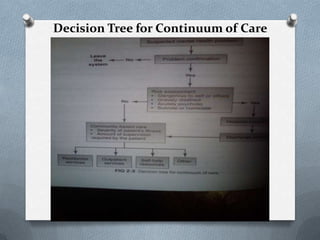
Decision Tree for Continuum of Care
Parameters in Decision Tree
O Safety requirements
O Intensity of supervision needed
O Severity of symptoms
O Level of functioning

O Type of treatment needed
1 maladaptive patterns of behavior

1 maladaptive patterns of behavior

  • 1.
  • 2.
    Distribution of diagnosisacross mental health facilities in the philippines DISORDERS OUTPATIENT FACILITIES COMMUNITY IN-PATIENTS MENTAL HOSPITAL Schizophreni a 57% 63% 71% Mood Disorder 19% 24% 18% Substance Abuse 8% 6% 5% Neurotic Disorder 6% 1% 2% Personality Disorder 3% 2% 0% Others 7% 4% 4%
  • 3.
    Psychiatric Nursing O - O O O O Interpersonalprocess whereby the professional nurse practitioner through the therapeutic use of self, * assist an individual, family, group or community to: 1. Promote mental health, 2. Prevent mental illness and suffering, 3. Participate in the treatment and rehabilitation of the mentally ill. • and if necessary find meaning in these experiences.
  • 4.
    Psychiatric Nursing - Isboth a science and an art
  • 5.
    HEALTH O State ofcomplete physical, mental, and social wellness, not merely the absence of disease or infirmity…..(WHO)
  • 6.
    Mental Health O A stateof complete physical, mental, and social wellness, not merely the absence of disease or infirmity (WHO). Criteria: a. Satisfying interpersonal relationship; b. Effective behavior and coping; c. Positive self – concept; and d. Emotional stability
  • 7.
    Factors Influencing aperson’s Mental Health O Individual or personal – biologic make-up, autonomy and independence, capacity for growth, vitality, ability to find meaning in life, sense of belonging, reality orientation and coping or stress management abilities
  • 8.
    Factors influencing aperson’s Mental health O Interpersonal, or relationship – effective communication, ability to help others, intimacy and a balance of separateness and connectedness. O Social/cultural, or environmental – sense of community, success to adequate resources, intolerance of violence, support of diversity among people, mastery of the environment, and a positive, yet realistic, view of one’s world
  • 9.
    Mental Illness is amental or behavioral pattern or anomaly that causes distress or disabili ty, and which is not developmentally or sociall y normative…. wikipedia O
  • 11.
    Criteria to diagnoseMental Disorders O Dissatisfaction with one’s characteristics, abilities, and accomplishments; O Ineffective or unsatisfying relationships; O Dissatisfaction with one’s place in the world; O Ineffective coping with life events; and O Lack of personal growth
  • 12.
    Factors  Individual –biologic make – up, intolerable or unrealistic worries or fears, inability to distinguish reality from fantasy, intolerance of life’s uncertainties, a sense of disharmony in life, and a loss of meaning in one’s life.
  • 13.
    Factor s O Interpersonal -- ineffective communication, excessive dependency on or withdrawal from relationships, no sense of belonging, inadequate social support, and loss of emotional control.
  • 14.
    O Social/cultural factors– lack of resources, violence, homelessness, poverty, an unwarranted negative view of the world, and discrimination such as stigma, racism, classism, ageism, and sexism
  • 15.
    DSM-IV (DIAGNOSTIC AND STATISITCALMANUAL OF MENTAL DISORDERS) O published by the American Psychiatric Association (APA), provides a common language and standard criteria for the classification of mental disorders.
  • 16.
    Purposes of DSM-IV-TR OTo provide standardized nomenclature and language for all mental health professionals O To present defining characteristics or symptoms that differentiate specific diagnoses. O To assist in identifying the underlying causes of disorders
  • 17.
    The DSM-IV organizeseach psychiatric diagnosis into five dimensions (axes) relating to different aspects of disorder or disability: Axis I: All psychological diagnostic categories except mental retardation and personality disorder Axis II: reporting of Personality disorders and mental retardation Axis III: General medical condition; acute medical conditions and physical disorders Axis IV: Psychosocial and environmental factors contributing to the disorder Axis V: Global Assessment of Functioning or Children's Global Assessment Scale for children and teens under the age of 18
  • 18.
  • 19.
    ANCIENT TIMES - Punishments forsins and wrong doing Viewed as either divine or demonic, depending on their behavior Aristotle (383-322 BC) – relate disorders to physical disorders and his theory that amounts of blood, water and yellow and black bile in the body controlled the emotions (corresponds with happiness, calmness, anger and sadness). O Treatment: blood-letting, starving, and purging (till 19th century)
  • 21.
     Early ChristianTimes (1-1000 AD) - Mentally ill were viewed as possessed - Tx: Priests performed exorcism. When failed they used more severe and brutal measures such as incarceration in dungeons, flogging and starving
  • 22.
     Rennaisance (1300-1600) -Distinguished from criminals  1547 – Hospital of St. Mary of Bethlehem was officially declared as hospital for the insane.  1775 – Charged for a fee for a privilege of viewing and ridiculing the inmates who were seen as animal rather than human.
  • 23.
    Benchmark Period in PsychiatricHistory PERIOD KEY PEOPLE OR DEVELOPMEN TS SIGNIFICANT CHANGE IN THINKING RESULT/S Enlightenment • Philippe Pinel • Insane no longer • Asylum move , - 1790 (1745- 1826) treated as less ment • William Tuke than human developed (1732 – 1822) • Human dignity upheld
  • 24.
    “ To considermadness incurable…is constantly refuted by the most authentic facts” Philippe Pinel, Dec. 11, 1794
  • 25.
  • 26.
    O Dorothea Dix O (1802-1887)-one of the first major reformers in the United States, was instrumental in developing the concept of asylum.
  • 27.
    PERIOD Scientific Study (1870’s) KEY PEOPLE OR DEVELOPMENTS s •Sigmund Freud (1856-1939) – emphasized the importance of early life experiences; studied the mind, its disorders and their treatment • Emil Kraepelin (1856 – 1926)- Studied the brain; classify mental illness according to their symptoms • Eugene Bleuler (1857 – 1939); was optimistic about treatment; coined the term SIGNIFICANT CHANGE IN THINKING RESULT/S • Mental • Study of the Illness could mind and be studied treatment approaches to psychiatric conditions flourished • Decade of the brain can be traced back to Kraepelin’s thinking.
  • 28.
    PERIOD KEY PEOPLE ORSIGNIFICANT DEVELOPMENTS CHANGE IN THINKING g RESULT/S Psychotropic Drugs – 1950’s • Lithium (1949) • First antipsychotic (1950) • Monoamine oxidase inhibitors (MAOI’s) 1952 • Haloperidol (1957) • Tricyclic antidepressant s (TCAs) 1958 • Benzodiazepin es (1960) • If some mental disorders are caused by chemical imbalances then chemicals could restore the balance; people would no longer need to be confined • A destigmatizatio n of mental illness occurred; parents and others not blame; term least restrictive environment evolved from this discovery
  • 29.
    PERIOD KEY PEOPLE OR DEVELOPMEN TS SIGNIFICANT CHANGE IN THINKING RESULT/S Community Mental Health, 1960s Community Mental Health Centers Act (1963) Individuals do  Advantage: not need to be Intervention in hospitalized familiar away from family sorroundings and community, has helped many people have the people, is less right to be expensive treated in their • Disadvantages: own community  Homelessness linked to disinstitutionaliza tion; many people “slip through the cracks” of the system
  • 30.
    PERIOD Decade of the Brain KEYPEOPLE OR DEVELOPMEN TS SIGNIFICANT CHANGE IN THINKING RESULT/S • Congression • If we can • An increase al Mandate understand in funding for the brain, we brain can help research millions of lead to new people treatment suffering strategies; from mental has disorders. increased our understandin g of mental disorders
  • 31.
    Six Major Periodsof Mental Ilness Treatment in Philippine History 1. Pre-Spanish Regime - During this period, believed in a world that is equally material and spiritual. - Relied on healers called babylan (shaman) and sorcerer healing. - Rituals and ceremonies
  • 32.
    2. Spanish Rule -Filipinos accepted that mental illness was caused by an act of sorcery (mangkukulam or witches and manggagaway or the devil men) Treatment: - Herbmen (herbolarios) - Brought to church for exorcism or ritual cleaning
  • 33.
    Early Nineteenth Century -Organized care and treatment for individuals with mental illness was established at the Hospicio de San Jose - Spanish naval authorities requested for a place of confinement for their mentally ill sailors.
  • 34.
    The American Era -Two Americans provided treatment for mentally ill patients of the Civil Hospitals located in Calle Iris (now known as Claro M Recto Avenue) - In 1904, the insane department was opened at the San Lazaro Hospital. - The first physician to attain formal training in psychiatry in the US is Dr. Elias Domingo.
  • 35.
    Japanese Occupation - WorldWar II - National Psychopathic Hospital continued to operate - The Japanese Army donated an electroshock apparatus to the hospital.
  • 36.
    The Liberation Periodand the Era of the Republic - The National Psychopathic Hospital was renamed National Mental Hospital, with Dr. Jose A. Fernandez designated as officer in charge from Oct 1946 to April 1961
  • 37.
    Present Day Psychiatry OThe use of SOMATIC Therapies became most popular.
  • 38.
    Psychiatric Nursing Education: THREEFIRSTS  Linda Richard – the first American Psychiatric Nurse  Nursing Mental Disease – the first psychiatric nursing book wrote by Harriet Bailey  Hildegard Peplau – first psychiatric nursing theorist
  • 39.
    Development of Psychiatric Educationin the Philippines  An Outline of Psychiatric Nursing – the first textbook wrote by Jesusa Bagan Lara in 1973  Nenita Yasay-Davadilla – the first psychiatric nurse to be sent abroad to obtain MSN under WHO scholarship program.  Magda Carolina Go Vera Llamanzares – first Filipino child psychiatric nurse  Sotera Capellan – the first chief nurse of a Mental Hospital
  • 40.
    Role of MentalHealth Nurse  Ward manager- creates a therapeutic environment  Socializing agent- assists the patient to feel comfortable with others  Counselor- Listens to the patient’s verbalization  Parent surrogate- assists the patient in the performance of ADL
  • 41.
    Role  Patient advocate-enables the patient and his relatives to know their rights and responsibilities  Teacher- assists the patient to learn more adaptive ways of coping  Technician- facilitates the performance of nursing procedures
  • 42.
    Role  Therapist- exploresthe patient’s needs, problems and concerns through varied therapeutic means.  Reality base- enables the patient to distinguish objective reality and subjective reality.  Healthy role model-acts as a symbol of health by serving as an example of healthful living.  Stranger- Offering the client the same acceptance and courtesy that the nurse would do to any strangers.
  • 43.
    Essential Qualities  Empathy– ability to see beyond outward behavior and sense accurately another person’s inner experiencing.  Genuineness- ability to use therapeutic tools appropriately.  Unconditional positive regard - respect
  • 44.
  • 45.
    Continuum of Care OA complete range of programs and services that treats the whole person from wellness to illness to recovery within the community Green and Lyndon, 1998
  • 46.
    Decision Tree forContinuum of Care
  • 47.
    Parameters in DecisionTree O Safety requirements O Intensity of supervision needed O Severity of symptoms O Level of functioning O Type of treatment needed

Editor's Notes

  • #6 HEALTH AS A POSITIVE STATE OF WELL BEING…. People in a state of emotional, physical and social well being fullfill life responsibilities, function effectively in daily life and satisfied with their interpersonal relationships and themselves.
  • #18 Axis 1 – depression, schizophrenia, anxiety and subd]stance-related disordersAxis III – reporting current medical conditions that are potentially relevant to understanding and managing the persons mental disorder as well as the medical conditionsAxis IV – problem with primary support group,, social environment, education, occupation, housing, economics, acess to health care and legal syatem
  • #25 Refuted -