Technical Aspects of Data Anonymisation &
Pseudonymisation
Risks, Challenges & Mitigations
Matt Lewis
Principal Consultant
Agenda
NCC Group – who we are and what we do
Anonymisation, Pseudonymisation & Re-identification – overview
of concepts
Examples – when anonymisation goes wrong
Pitfalls of image anonymisation and other information leakage
through meta-data
A risk-based approach to anonymisation
Summary and advice
Questions
7/15/2013 © NCC Group 2
NCC Group
7/15/2013 © NCC Group 3
Global information assurance specialist
15,000 customers worldwide across all sectors
The Group has two complementary divisions - escrow and
assurance
Independence from hardware and software providers ensures we
provide unbiased and impartial advice
Largest penetration testing team in the world, with approximately
250 consultants
Me: Brief Bio
7/15/2013 © NCC Group 4
Over 12 years working in Information Security
Previous Employers:
• CESG – The Information Assurance arm of GCHQ
• Information Risk Management (IRM) plc – penetration testing
• KPMG – Executive Advisor in the Information Protection
division of IT Advisory
• NCC Group – Principal Consultant, providing penetration
testing and consultancy around all aspects of Information
Security
Anonymisation – Overview
7/15/2013 © NCC Group 5
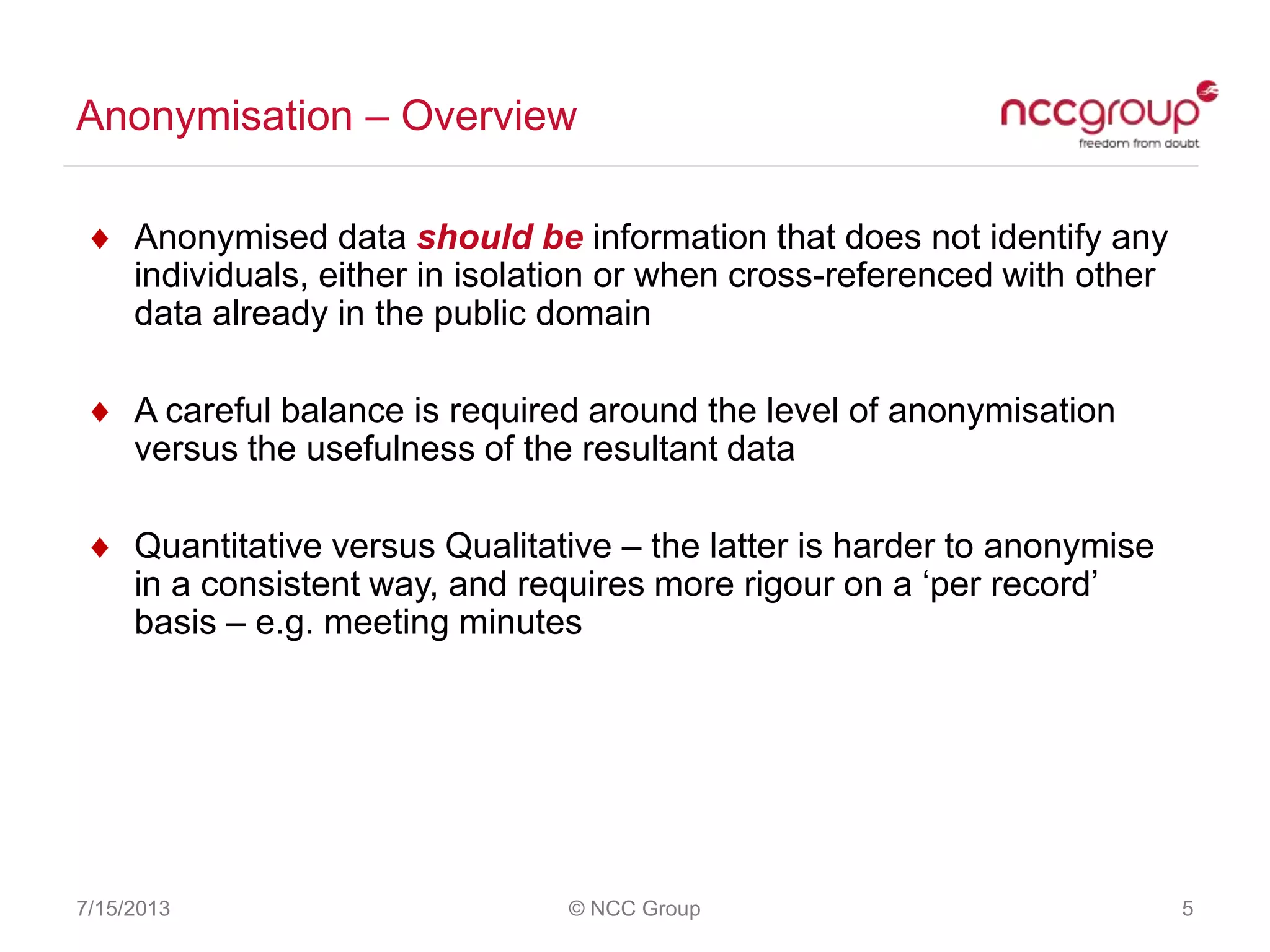
Anonymised data should be information that does not identify any
individuals, either in isolation or when cross-referenced with other
data already in the public domain
A careful balance is required around the level of anonymisation
versus the usefulness of the resultant data
Quantitative versus Qualitative – the latter is harder to anonymise
in a consistent way, and requires more rigour on a „per record‟
basis – e.g. meeting minutes
Pseudonymisation – Overview
7/15/2013 © NCC Group 6
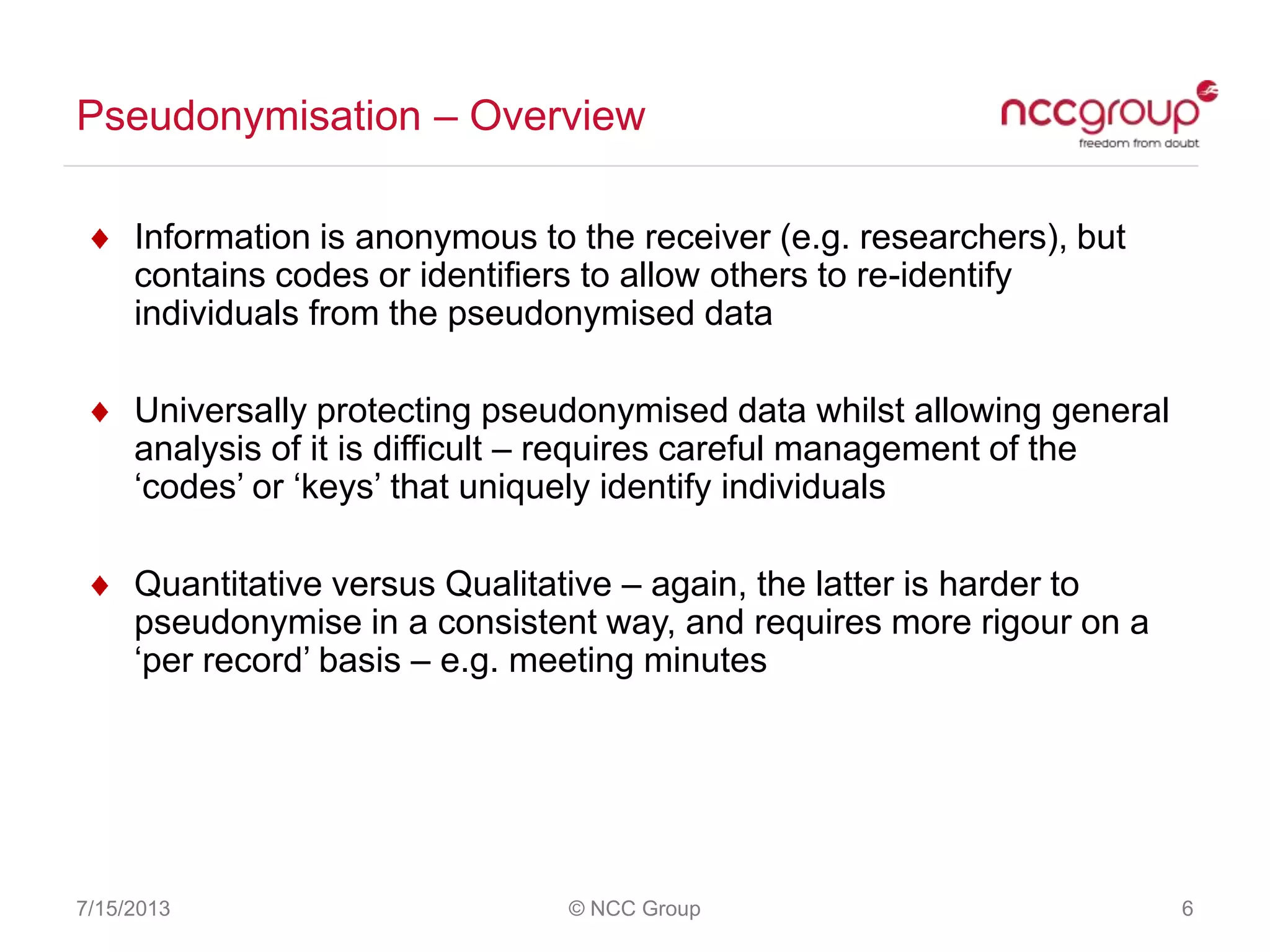
Information is anonymous to the receiver (e.g. researchers), but
contains codes or identifiers to allow others to re-identify
individuals from the pseudonymised data
Universally protecting pseudonymised data whilst allowing general
analysis of it is difficult – requires careful management of the
„codes‟ or „keys‟ that uniquely identify individuals
Quantitative versus Qualitative – again, the latter is harder to
pseudonymise in a consistent way, and requires more rigour on a
„per record‟ basis – e.g. meeting minutes
Anonymisation – Techniques and Methods
7/15/2013 © NCC Group 7
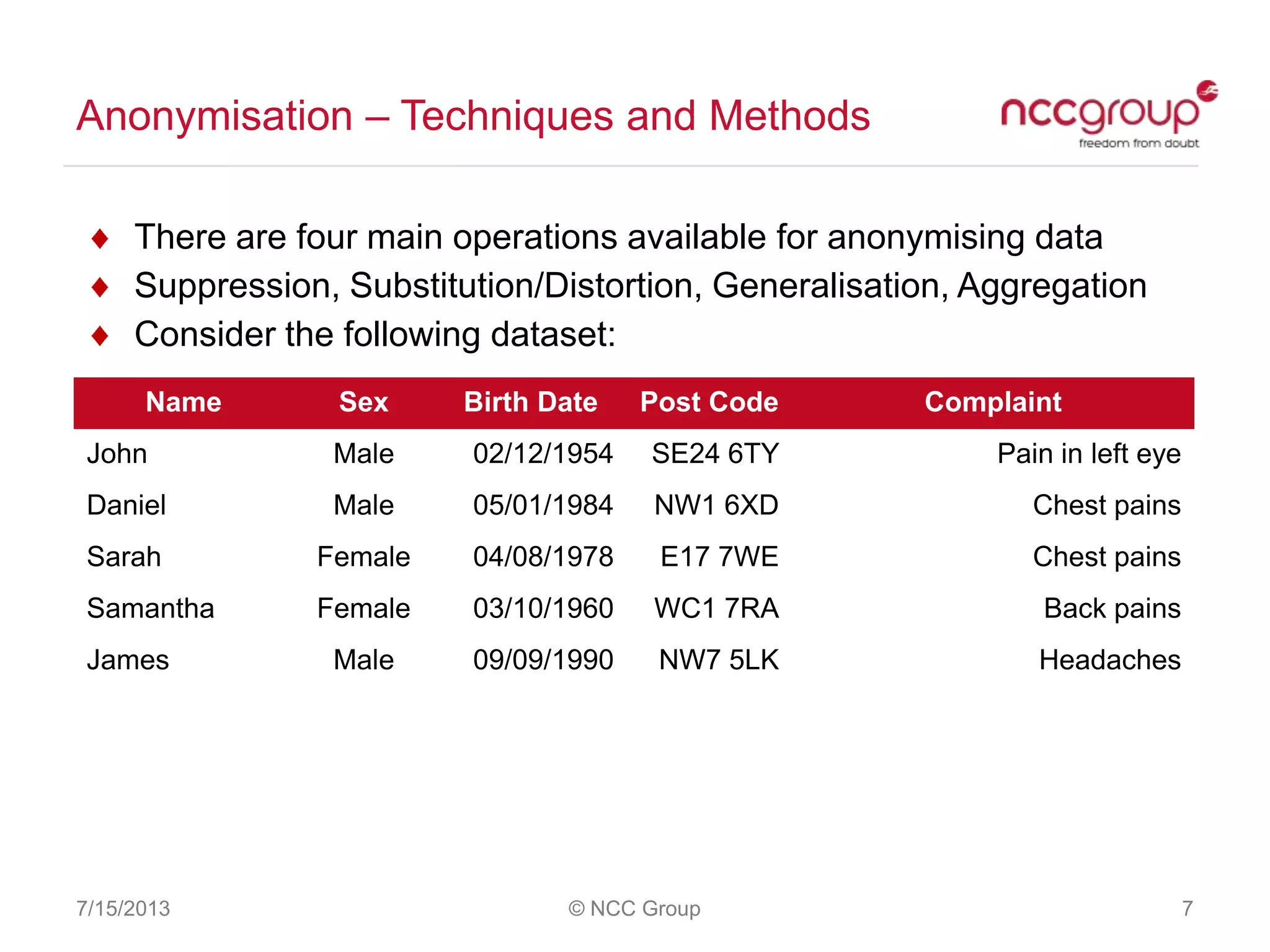
There are four main operations available for anonymising data
Suppression, Substitution/Distortion, Generalisation, Aggregation
Consider the following dataset:
Name Sex Birth Date Post Code Complaint
John Male 02/12/1954 SE24 6TY Pain in left eye
Daniel Male 05/01/1984 NW1 6XD Chest pains
Sarah Female 04/08/1978 E17 7WE Chest pains
Samantha Female 03/10/1960 WC1 7RA Back pains
James Male 09/09/1990 NW7 5LK Headaches
Anonymisation – Techniques and Methods
7/15/2013 © NCC Group 8
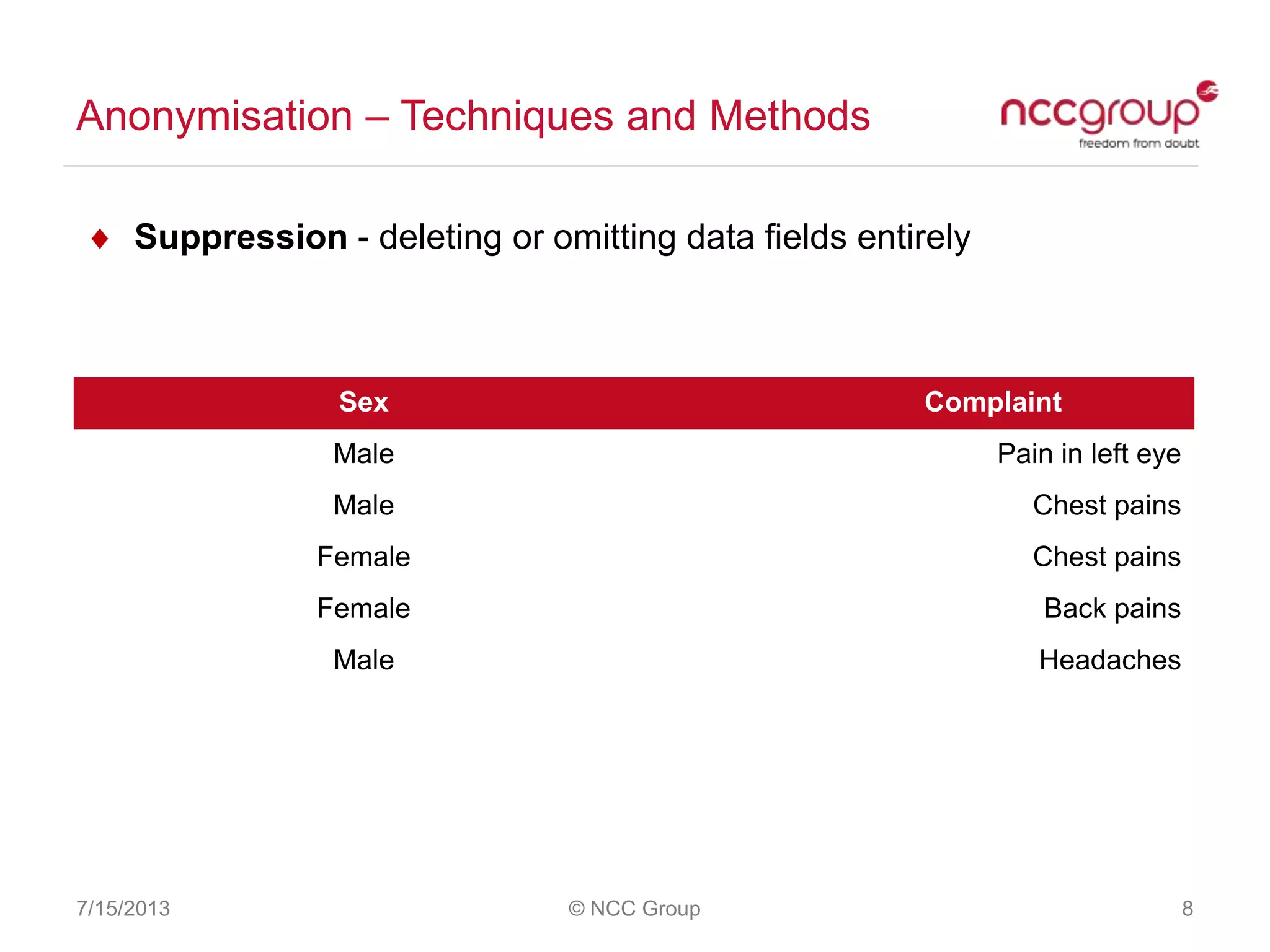
Suppression - deleting or omitting data fields entirely
Sex Complaint
Male Pain in left eye
Male Chest pains
Female Chest pains
Female Back pains
Male Headaches
Anonymisation – Techniques and Methods
7/15/2013 © NCC Group 9
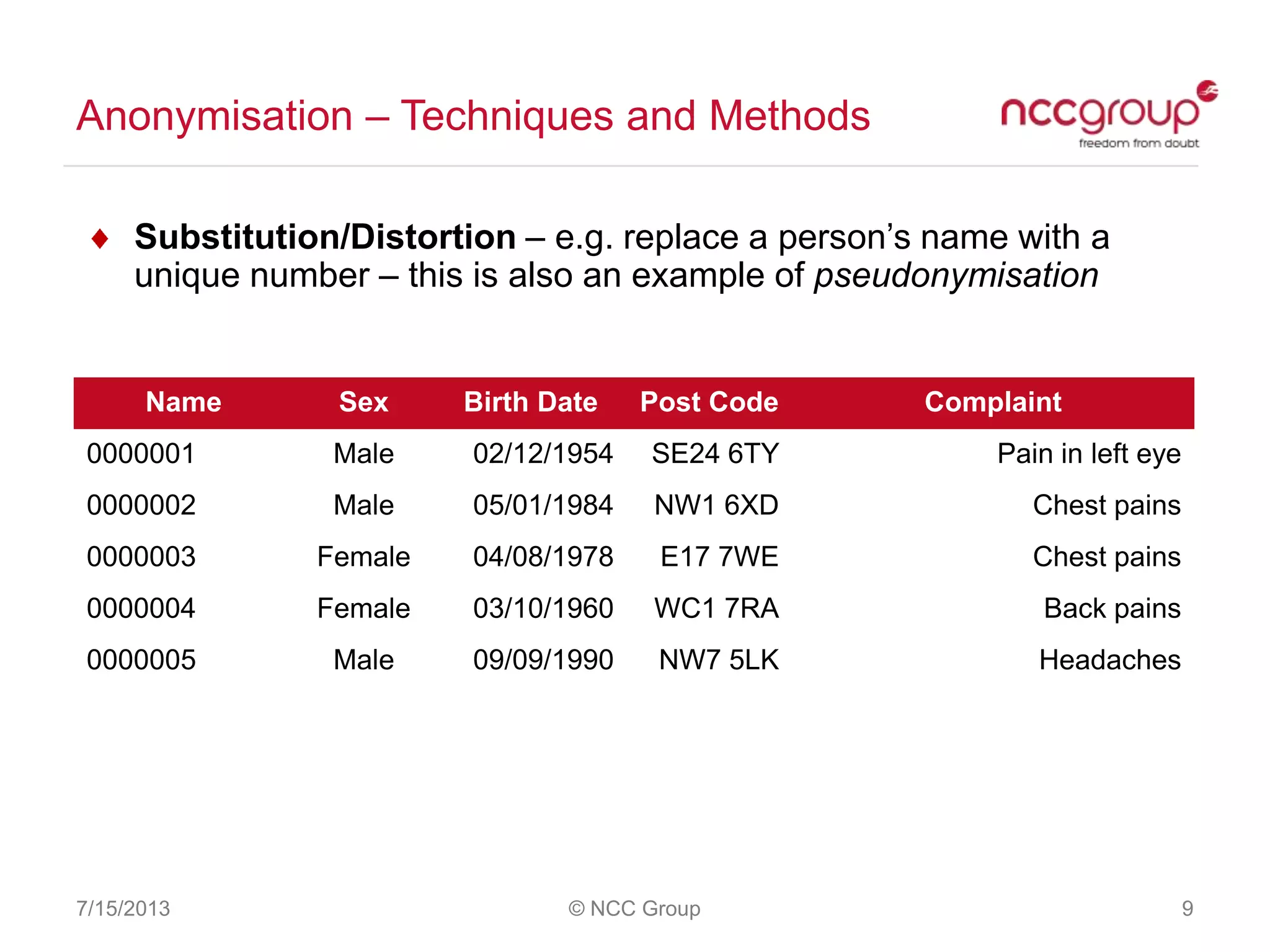
Substitution/Distortion – e.g. replace a person‟s name with a
unique number – this is also an example of pseudonymisation
Name Sex Birth Date Post Code Complaint
0000001 Male 02/12/1954 SE24 6TY Pain in left eye
0000002 Male 05/01/1984 NW1 6XD Chest pains
0000003 Female 04/08/1978 E17 7WE Chest pains
0000004 Female 03/10/1960 WC1 7RA Back pains
0000005 Male 09/09/1990 NW7 5LK Headaches
Anonymisation – Techniques and Methods
7/15/2013 © NCC Group 10
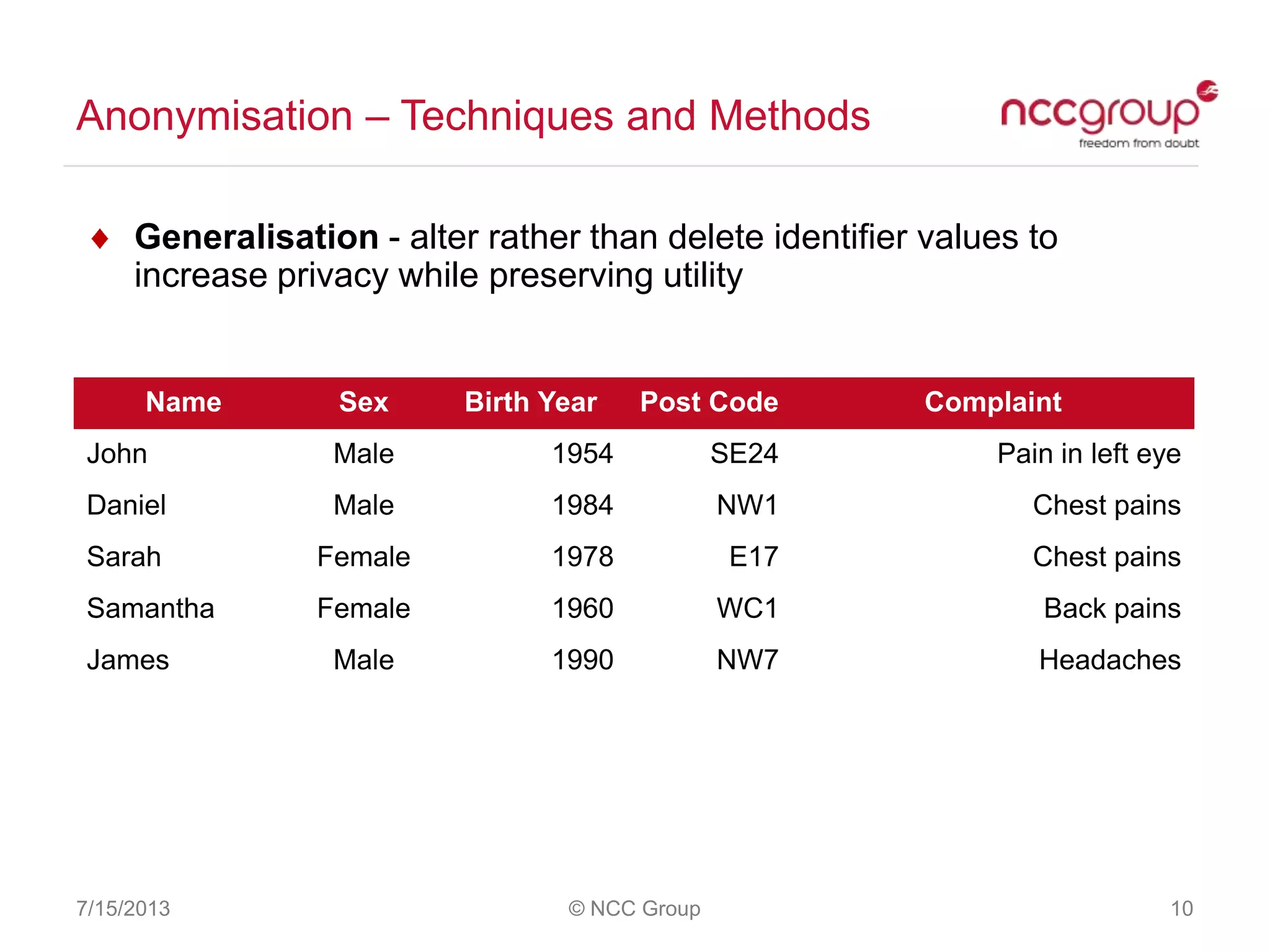
Generalisation - alter rather than delete identifier values to
increase privacy while preserving utility
Name Sex Birth Year Post Code Complaint
John Male 1954 SE24 Pain in left eye
Daniel Male 1984 NW1 Chest pains
Sarah Female 1978 E17 Chest pains
Samantha Female 1960 WC1 Back pains
James Male 1990 NW7 Headaches
Anonymisation – Techniques and Methods
7/15/2013 © NCC Group 11
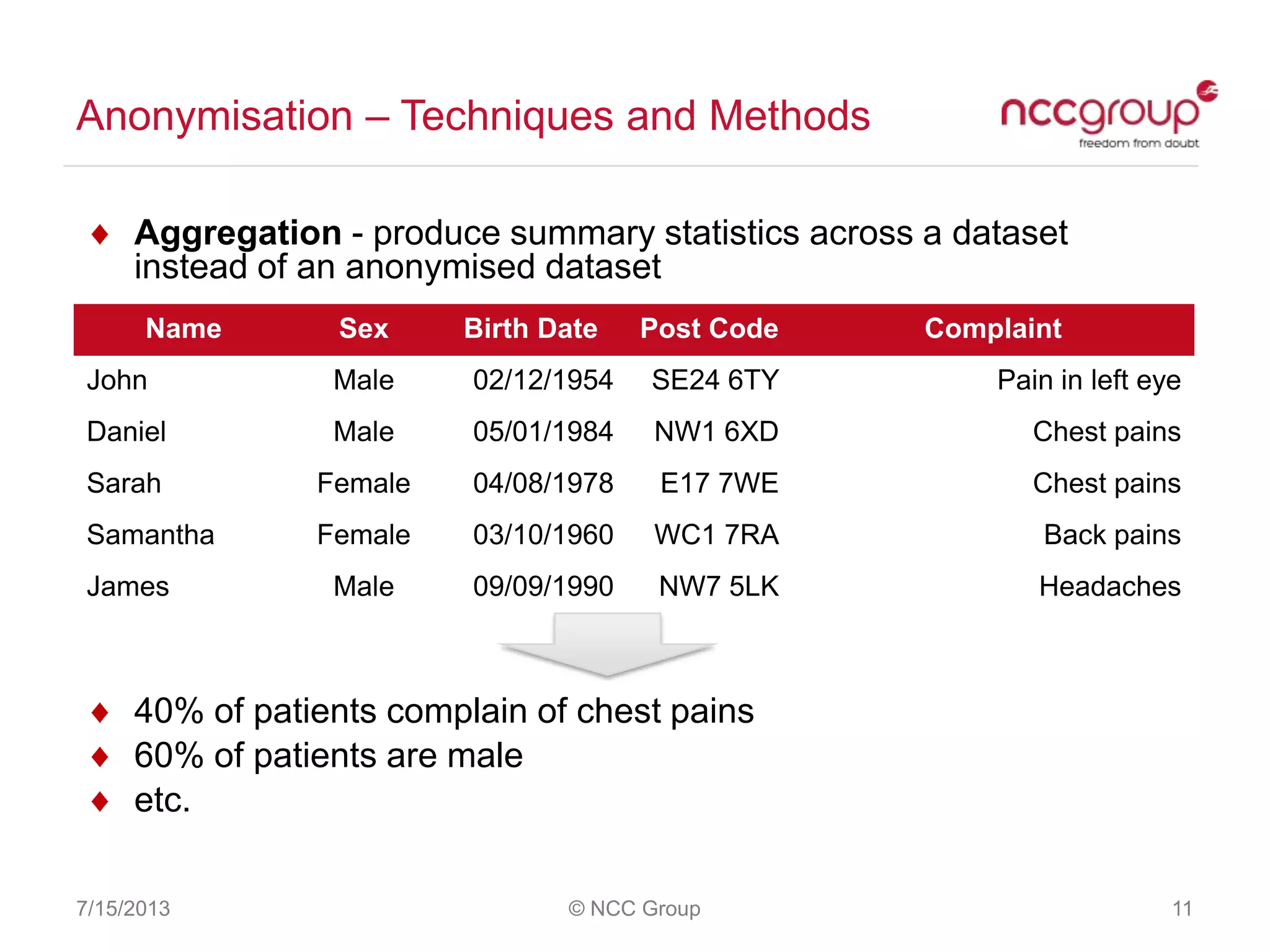
Aggregation - produce summary statistics across a dataset
instead of an anonymised dataset
40% of patients complain of chest pains
60% of patients are male
etc.
Name Sex Birth Date Post Code Complaint
John Male 02/12/1954 SE24 6TY Pain in left eye
Daniel Male 05/01/1984 NW1 6XD Chest pains
Sarah Female 04/08/1978 E17 7WE Chest pains
Samantha Female 03/10/1960 WC1 7RA Back pains
James Male 09/09/1990 NW7 5LK Headaches
Anonymisation of Qualitative Data
7/15/2013 © NCC Group 12
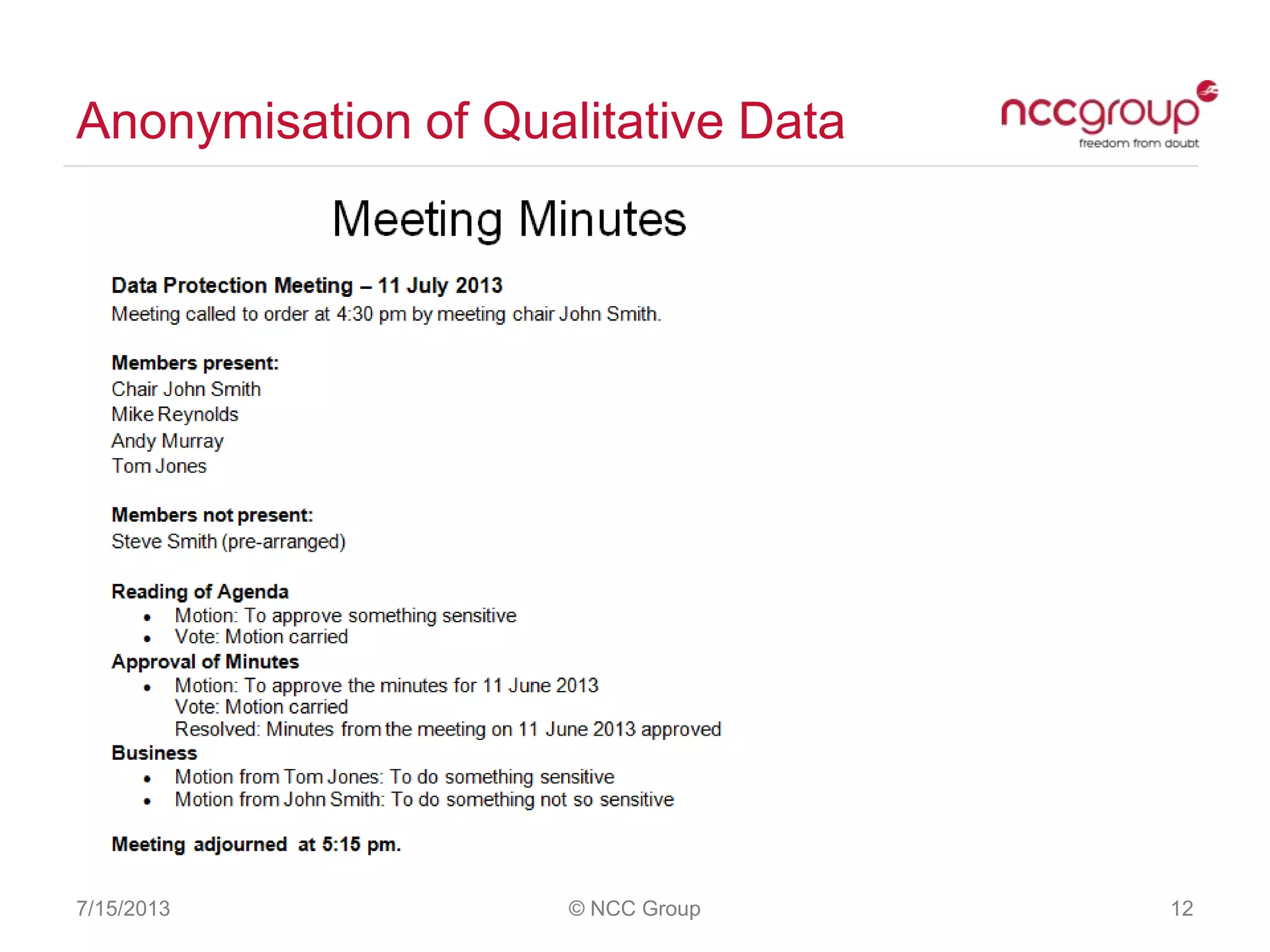
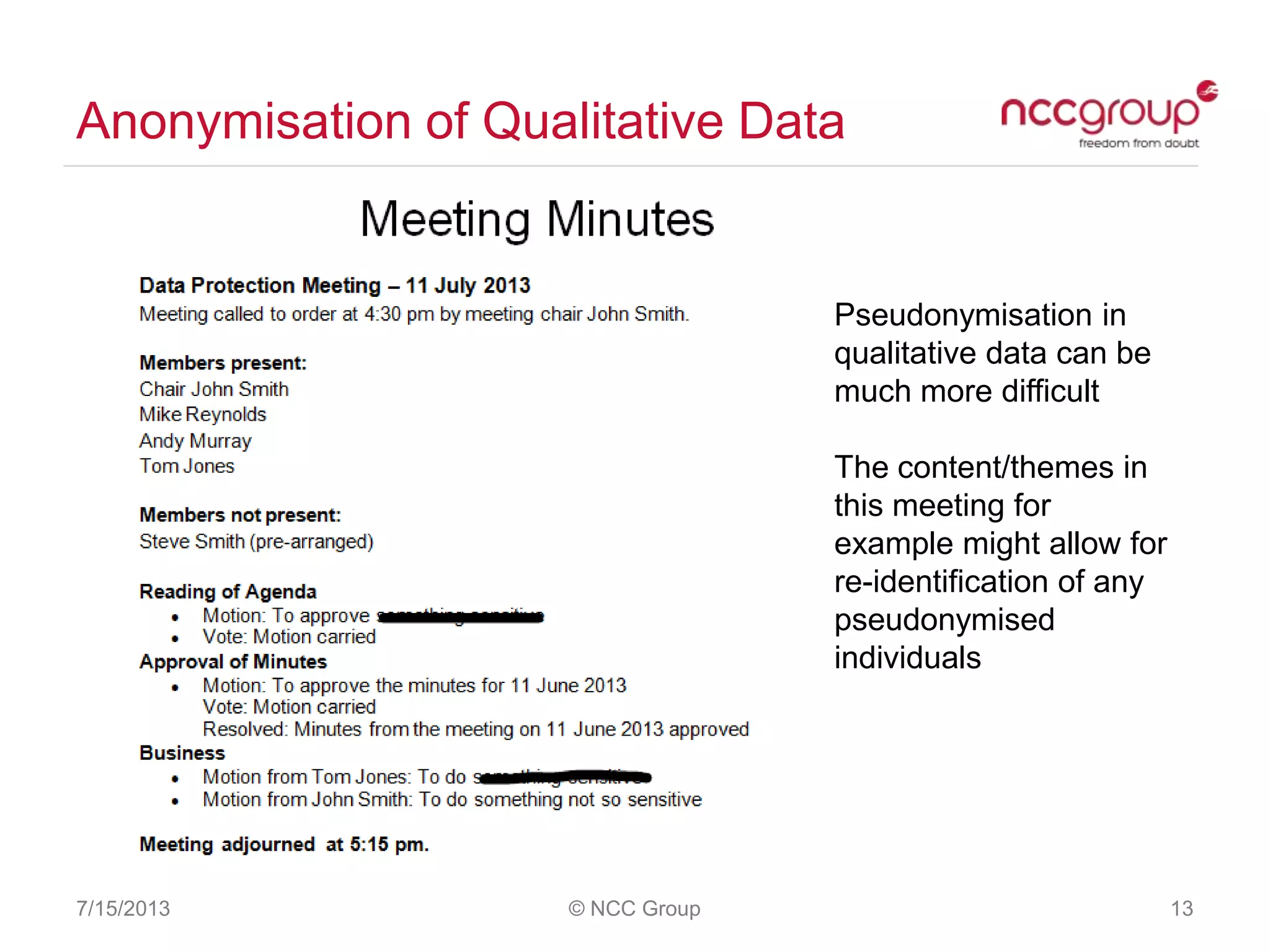
Anonymisation of Qualitative Data
7/15/2013 © NCC Group 13
Pseudonymisation in
qualitative data can be
much more difficult
The content/themes in
this meeting for
example might allow for
re-identification of any
pseudonymised
individuals
Re-identification – What is it?
7/15/2013 © NCC Group 14
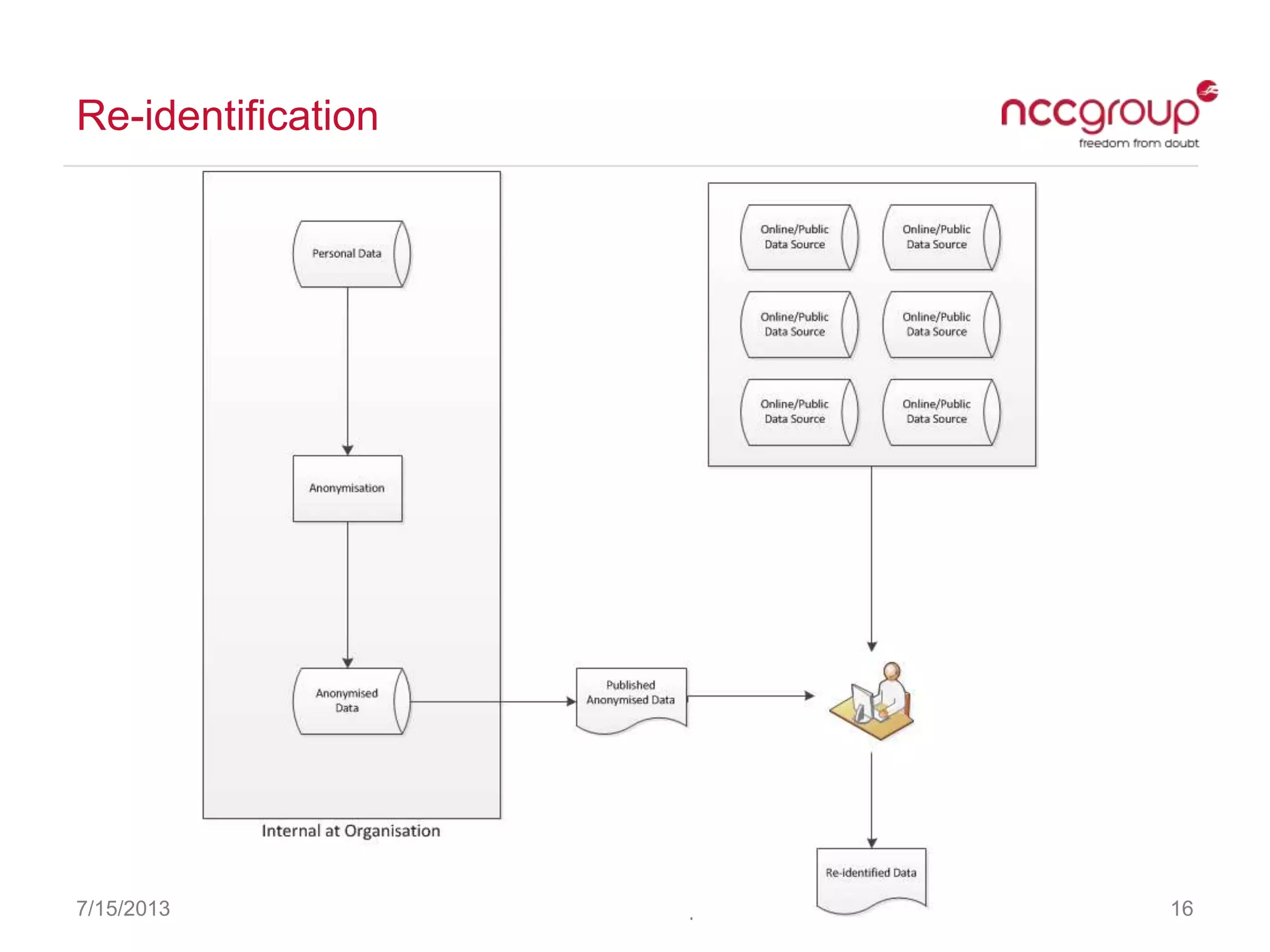
Re-identification is the act of cross-referencing anonymised data with
other data sources, and using inference, deduction and correlation to
identify individuals
Depending on the nature of data re-identified, this might raise data
protection concerns
Re-identification – Who does this and Why?
7/15/2013 © NCC Group 15
Researchers – e.g. computer scientists, genuinely interested in the
challenges of re-identification
Malicious individuals use re-identification information to discriminate,
harass or discredit a victim
Investigative journalists
Organised crime – re-identification can facilitate creation of fake
identities, or be used to extort victims (if data is personal/sensitive in
nature)
Competitors – seeking to re-identify and publish to discredit
State sponsored data mining and correlation
The Internet is essentially a vast, ever-growing cross-correlation
database; access to most of which is open and free to anyone…
Re-identification
7/15/2013 © NCC Group 16
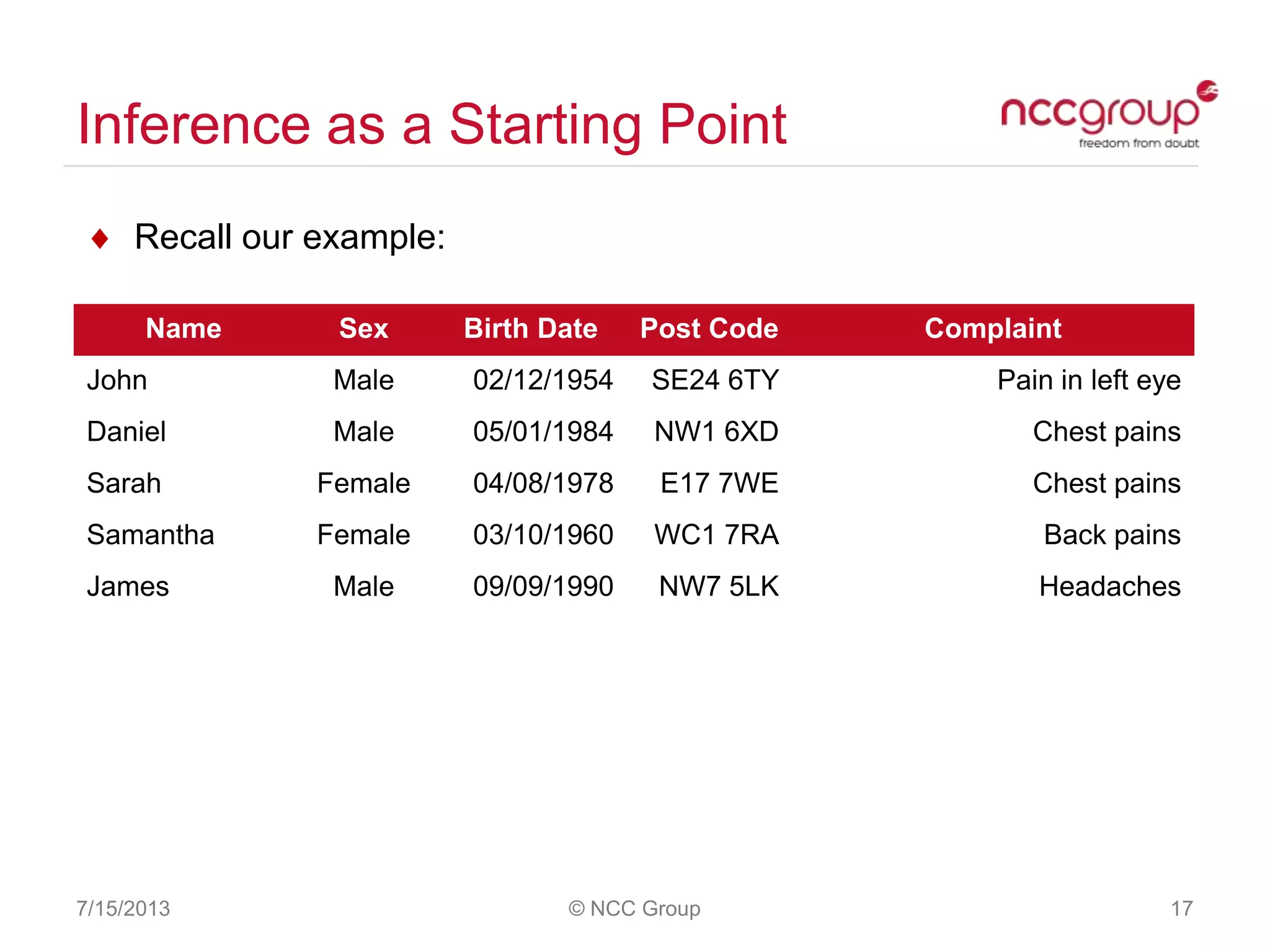
Inference as a Starting Point
Recall our example:
7/15/2013 © NCC Group 17
Name Sex Birth Date Post Code Complaint
John Male 02/12/1954 SE24 6TY Pain in left eye
Daniel Male 05/01/1984 NW1 6XD Chest pains
Sarah Female 04/08/1978 E17 7WE Chest pains
Samantha Female 03/10/1960 WC1 7RA Back pains
James Male 09/09/1990 NW7 5LK Headaches
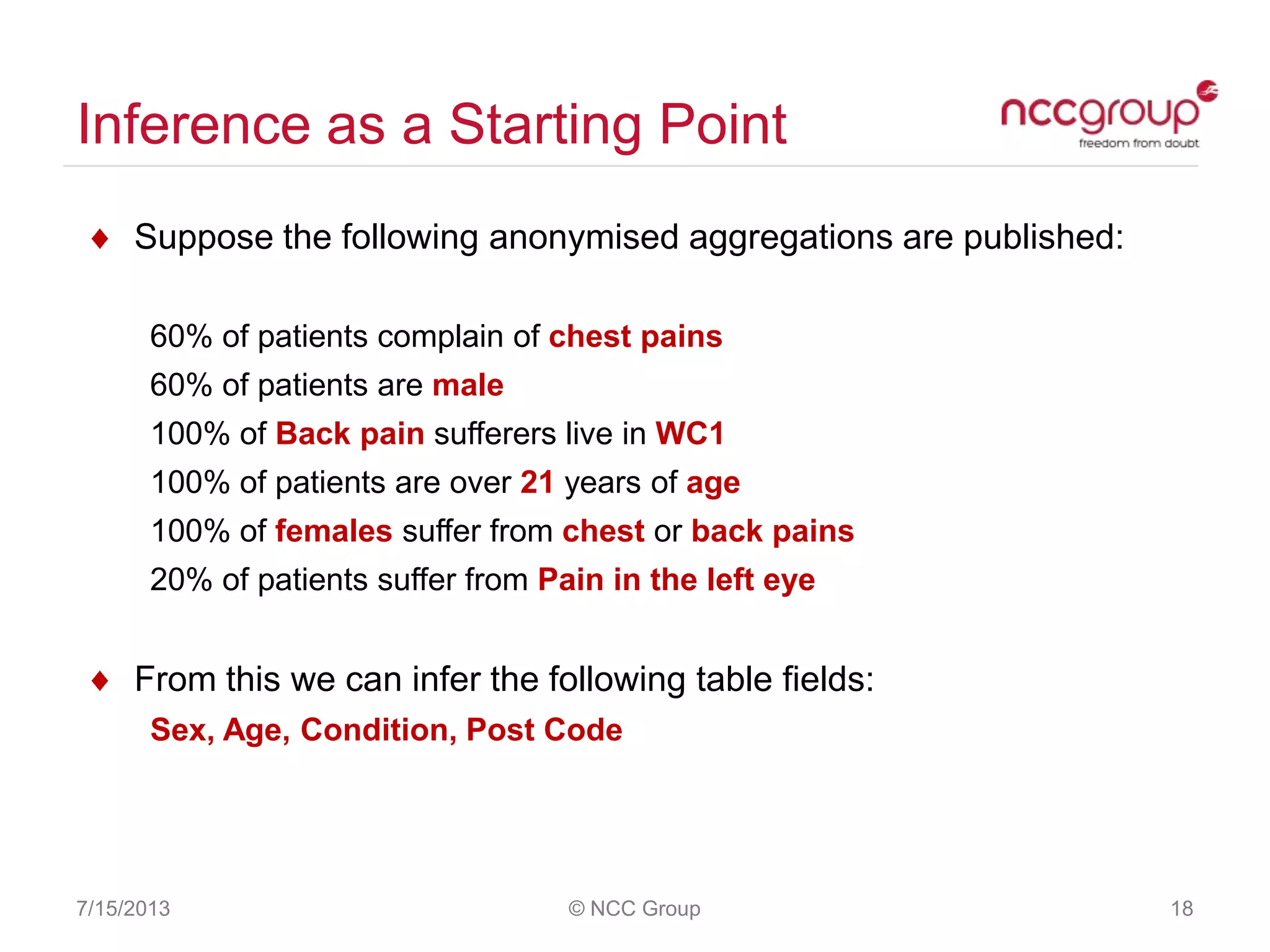
Inference as a Starting Point
Suppose the following anonymised aggregations are published:
60% of patients complain of chest pains
60% of patients are male
100% of Back pain sufferers live in WC1
100% of patients are over 21 years of age
100% of females suffer from chest or back pains
20% of patients suffer from Pain in the left eye
From this we can infer the following table fields:
Sex, Age, Condition, Post Code
7/15/2013 © NCC Group 18
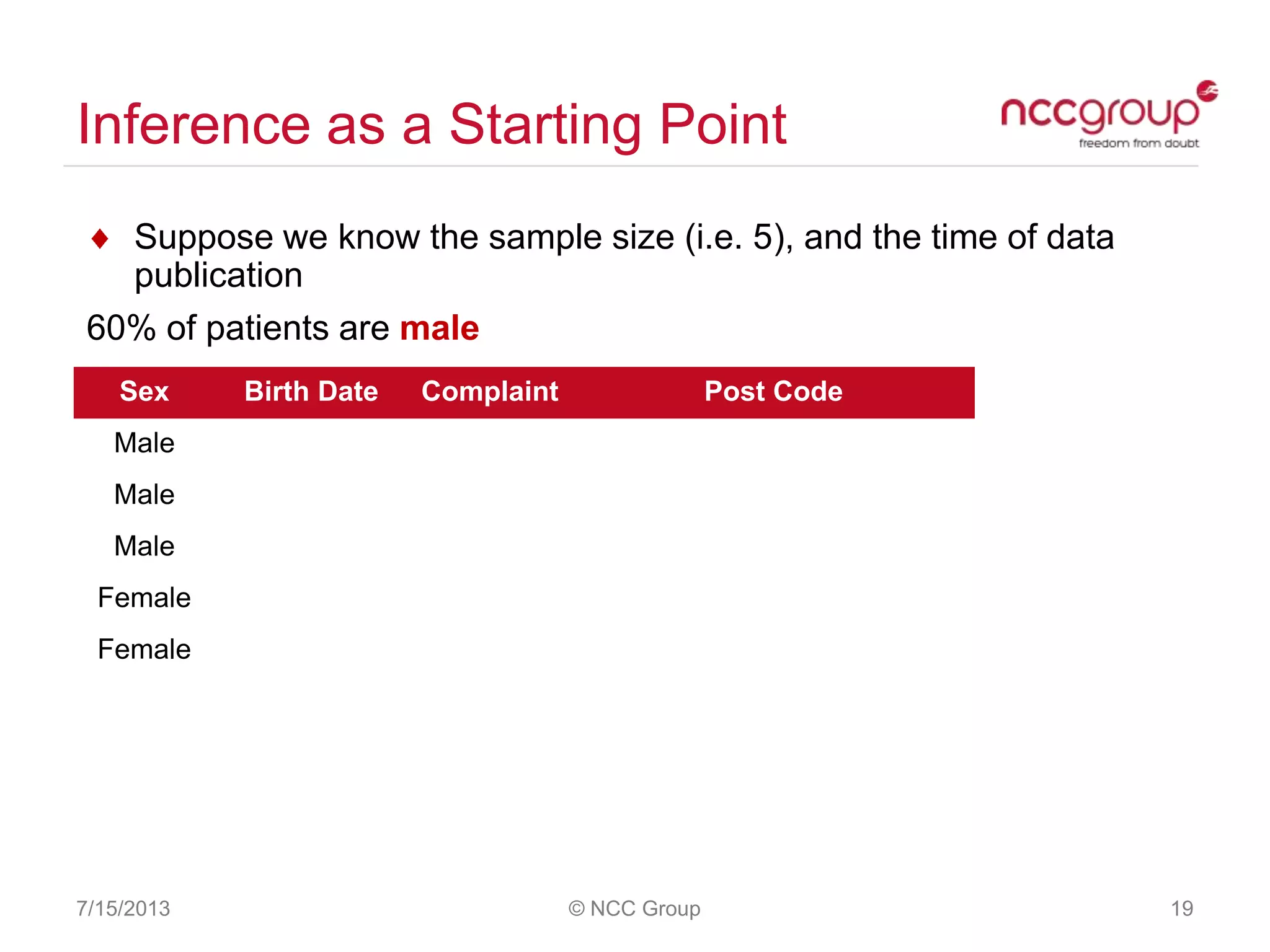
Inference as a Starting Point
Suppose we know the sample size (i.e. 5), and the time of data
publication
60% of patients are male
7/15/2013 © NCC Group 19
Sex Birth Date Complaint Post Code
Male
Male
Male
Female
Female
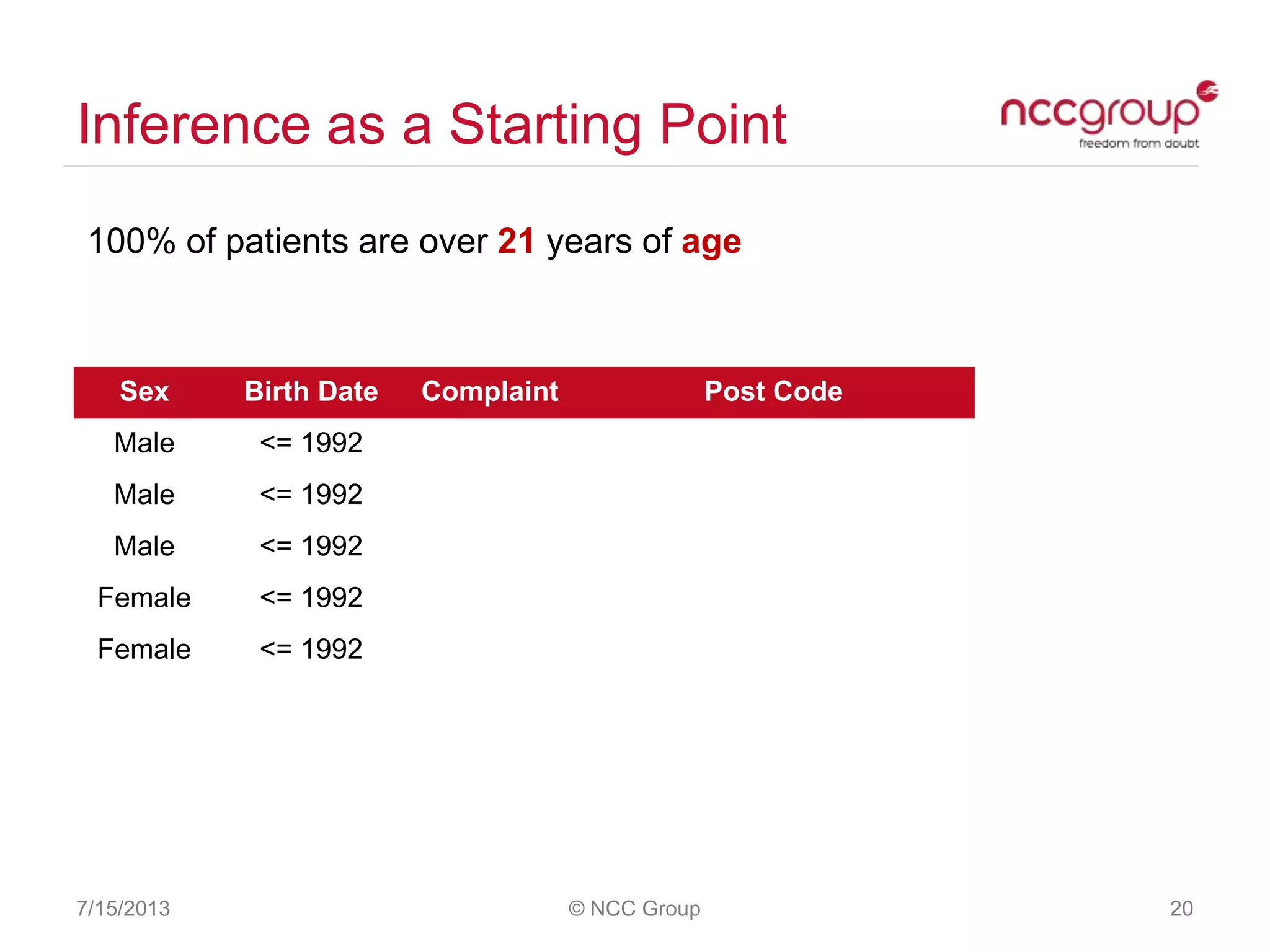
Inference as a Starting Point
100% of patients are over 21 years of age
7/15/2013 © NCC Group 20
Sex Birth Date Complaint Post Code
Male <= 1992
Male <= 1992
Male <= 1992
Female <= 1992
Female <= 1992
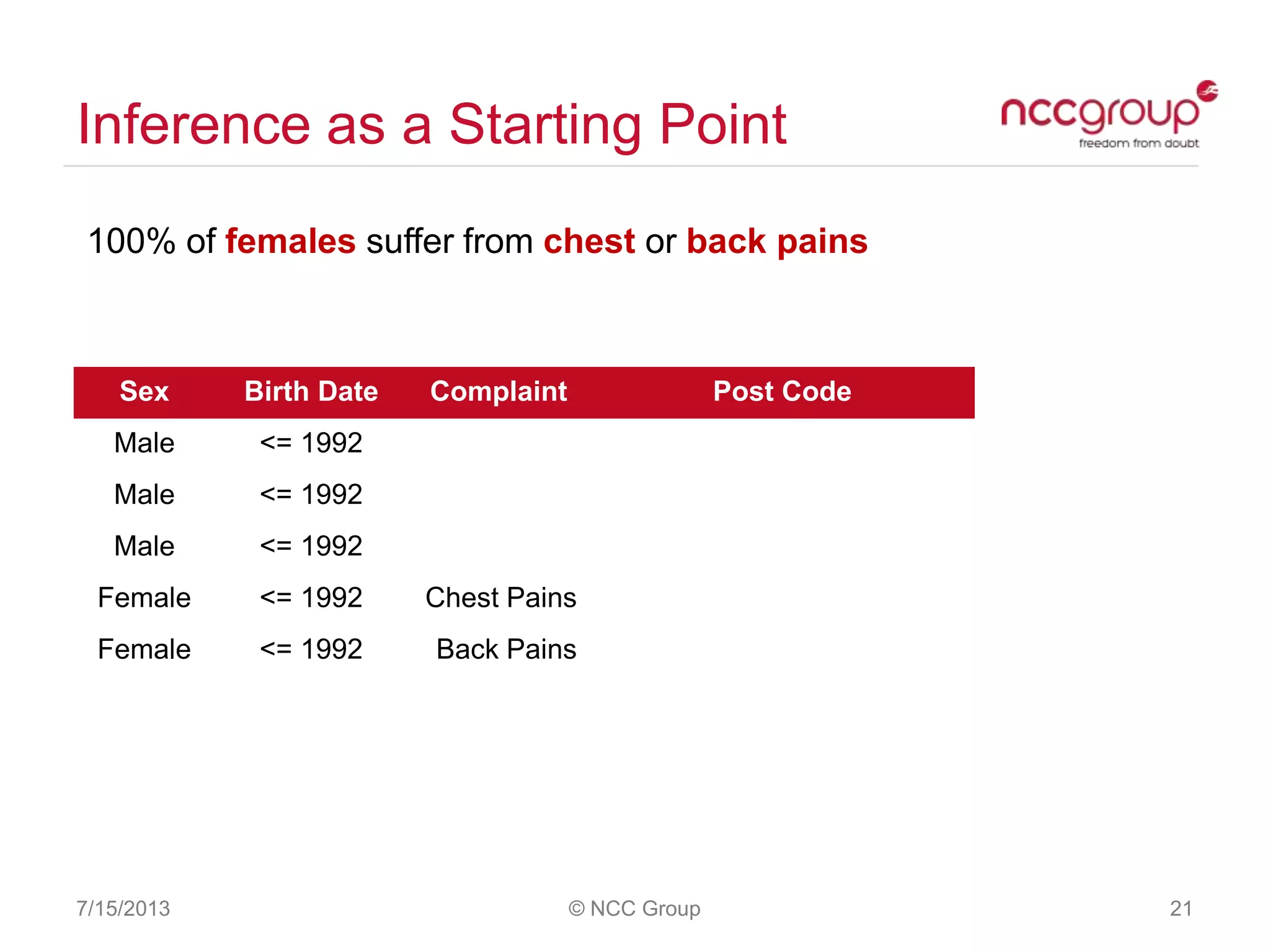
Inference as a Starting Point
100% of females suffer from chest or back pains
7/15/2013 © NCC Group 21
Sex Birth Date Complaint Post Code
Male <= 1992
Male <= 1992
Male <= 1992
Female <= 1992 Chest Pains
Female <= 1992 Back Pains
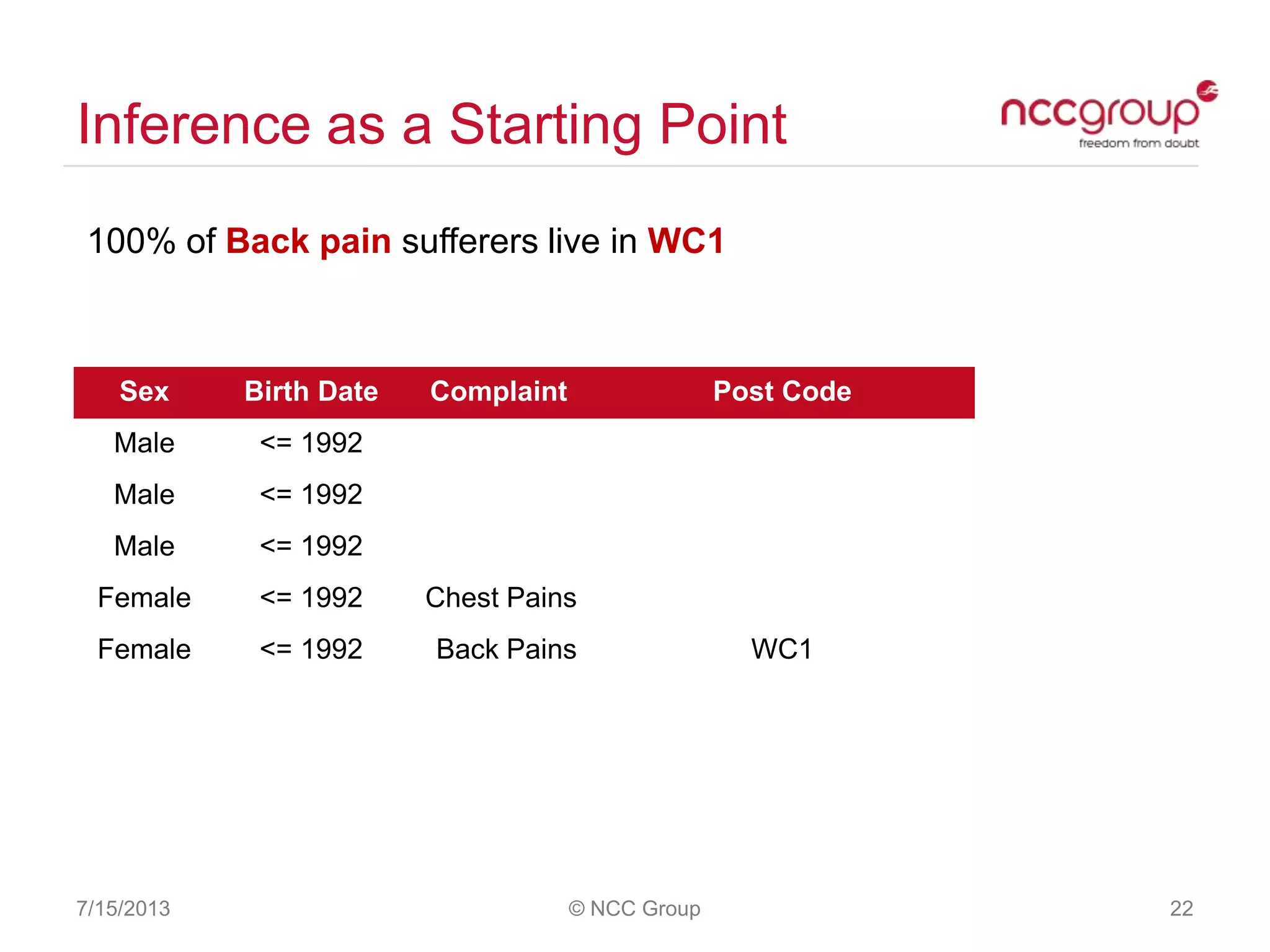
Inference as a Starting Point
100% of Back pain sufferers live in WC1
7/15/2013 © NCC Group 22
Sex Birth Date Complaint Post Code
Male <= 1992
Male <= 1992
Male <= 1992
Female <= 1992 Chest Pains
Female <= 1992 Back Pains WC1
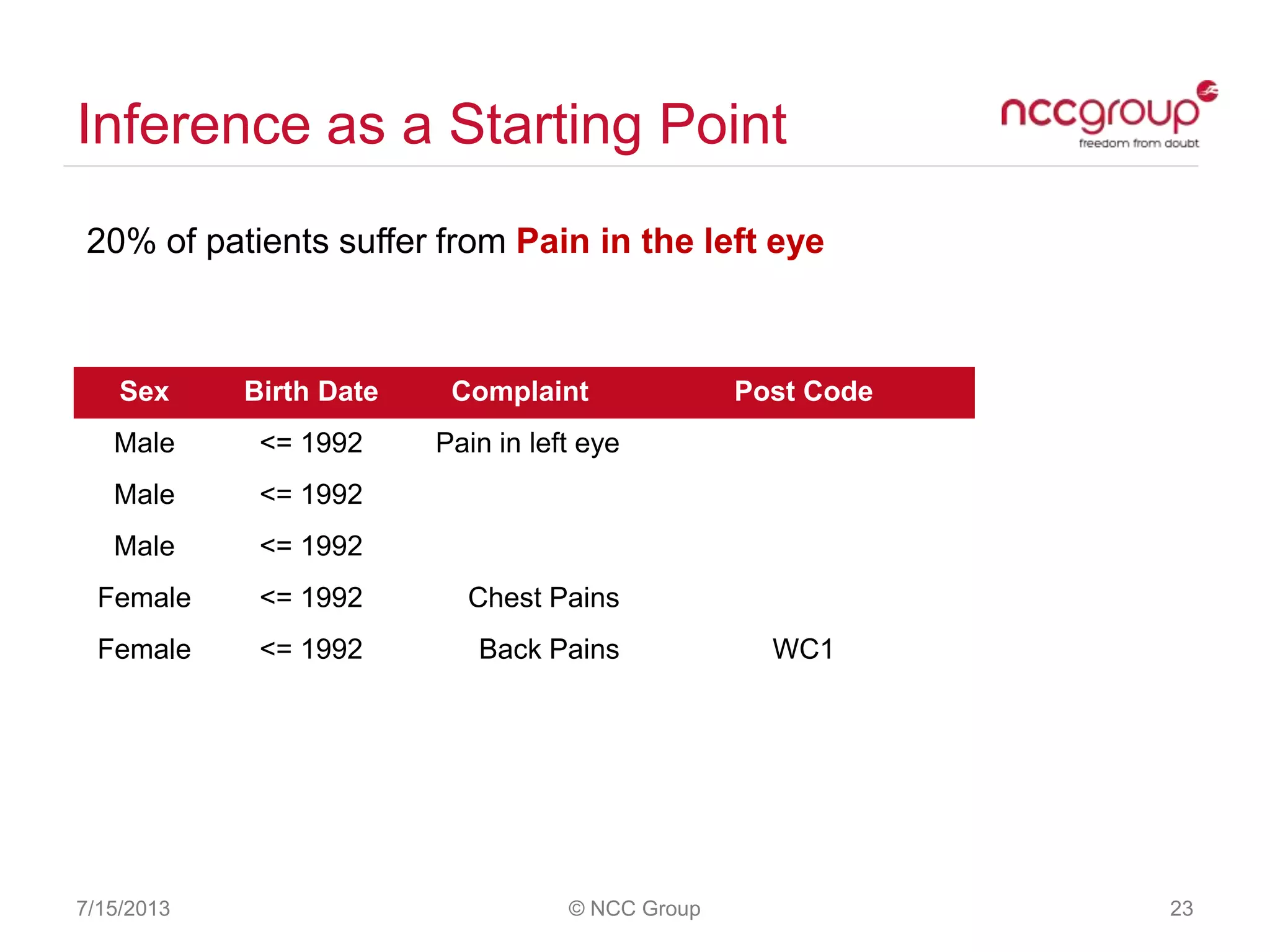
Inference as a Starting Point
20% of patients suffer from Pain in the left eye
7/15/2013 © NCC Group 23
Sex Birth Date Complaint Post Code
Male <= 1992 Pain in left eye
Male <= 1992
Male <= 1992
Female <= 1992 Chest Pains
Female <= 1992 Back Pains WC1
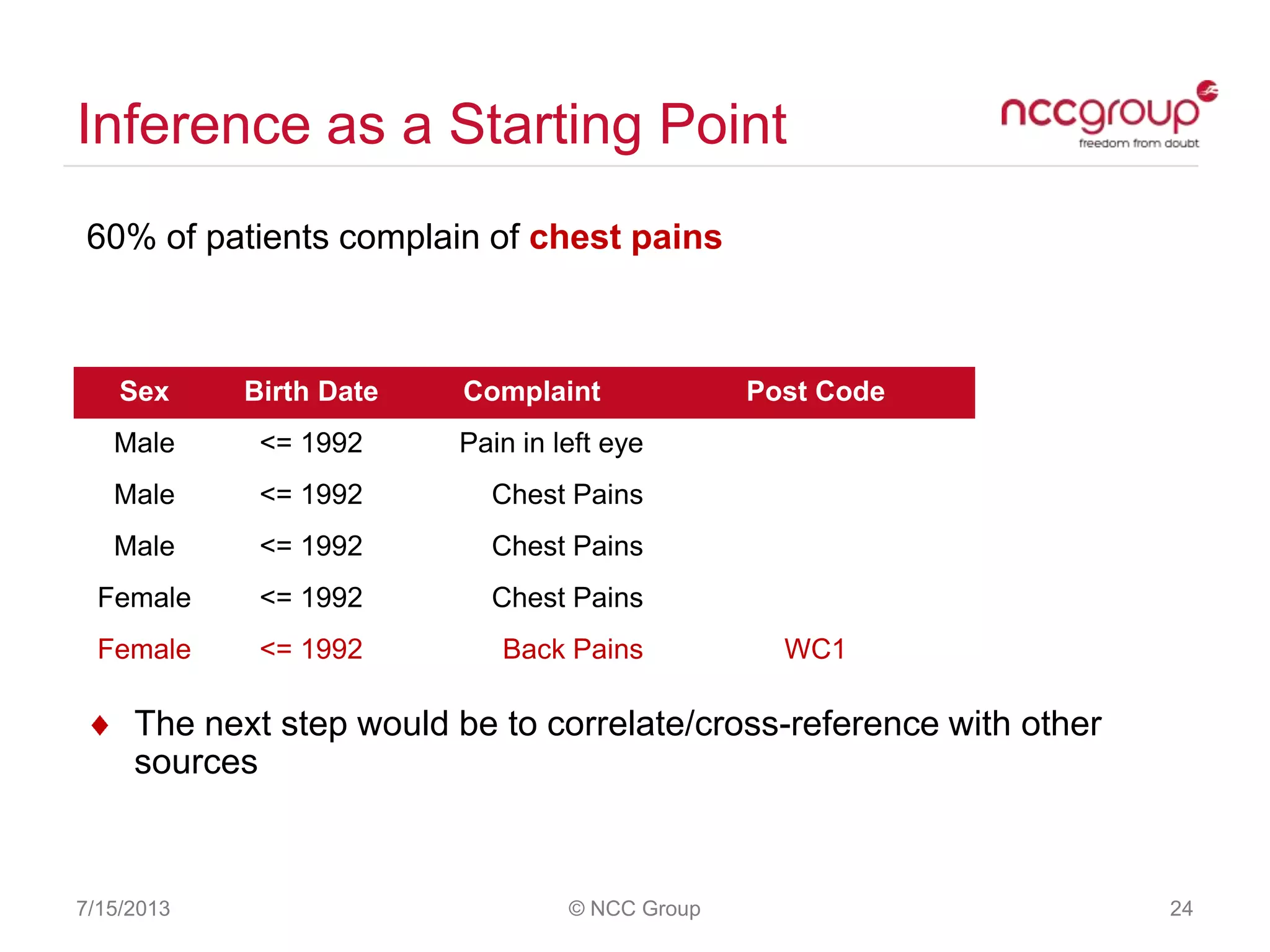
Inference as a Starting Point
60% of patients complain of chest pains
The next step would be to correlate/cross-reference with other
sources
7/15/2013 © NCC Group 24
Sex Birth Date Complaint Post Code
Male <= 1992 Pain in left eye
Male <= 1992 Chest Pains
Female <= 1992 Chest Pains
Female <= 1992 Back Pains WC1
An Example: Massachusetts Group Insurance Company
7/15/2013 © NCC Group 25
In the mid-1990s GIC released anonymised data on state employees that
showed every single hospital visit
The goal was to help researchers; the state spent time removing all
obvious identifiers such as name, address, and Social Security number
William Weld, then Governor of Massachusetts, assured the public that
GIC had protected patient privacy by deleting identifiers
Computer Science graduate Dr. Latanya Sweeney requested a copy of the
data and performed re-identification research on the dataset
Main anonymisation technique used: Suppression
An Example: Massachusetts Group Insurance Company
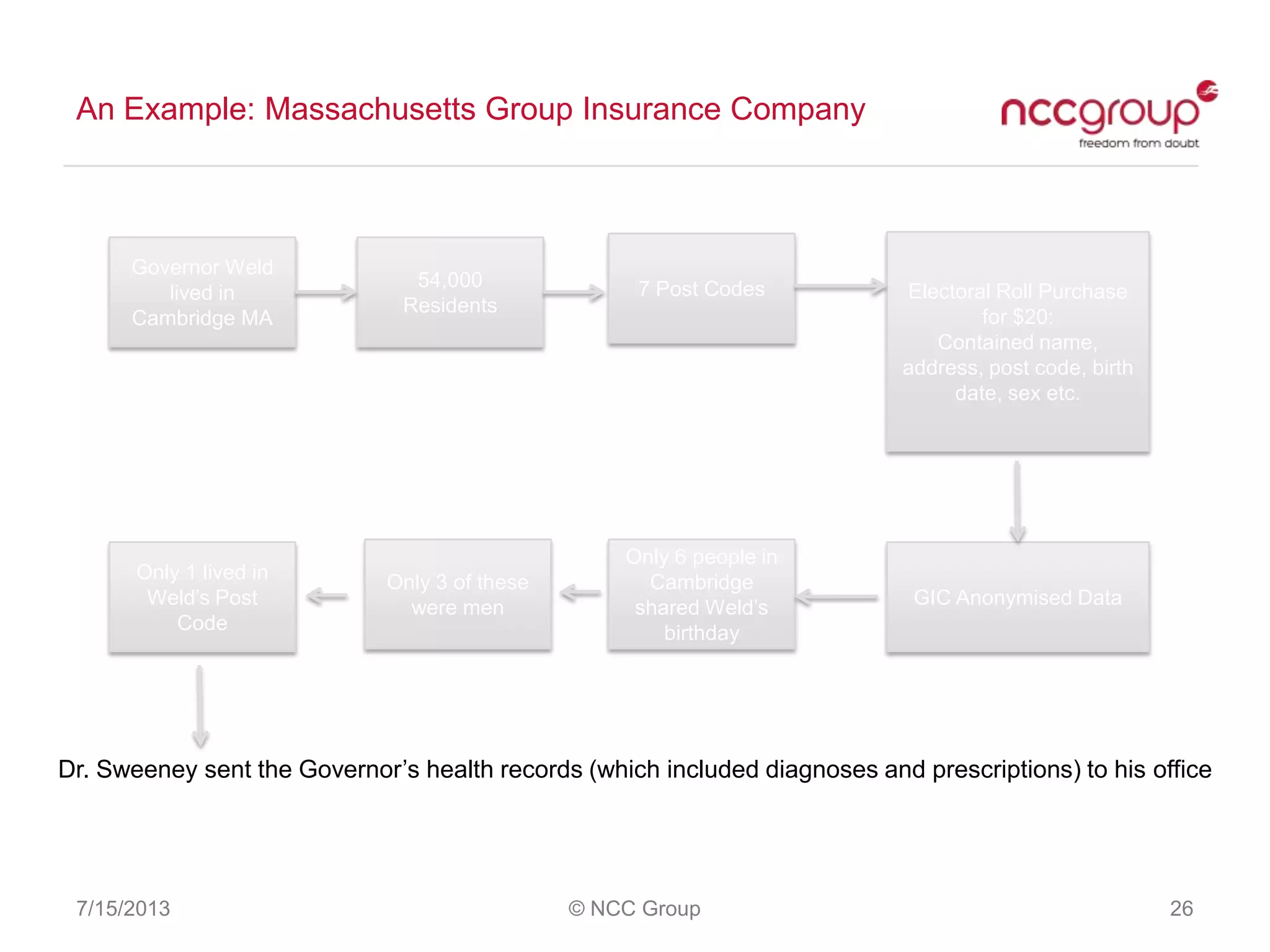
7/15/2013 © NCC Group 26
Governor Weld
lived in
Cambridge MA
54,000
Residents
7 Post Codes Electoral Roll Purchase
for $20:
Contained name,
address, post code, birth
date, sex etc.
GIC Anonymised Data
Only 6 people in
Cambridge
shared Weld‟s
birthday
Only 3 of these
were men
Only 1 lived in
Weld‟s Post
Code
Dr. Sweeney sent the Governor‟s health records (which included diagnoses and prescriptions) to his office
Another Example: America Online (AOL) Data Release
7/15/2013 © NCC Group 27
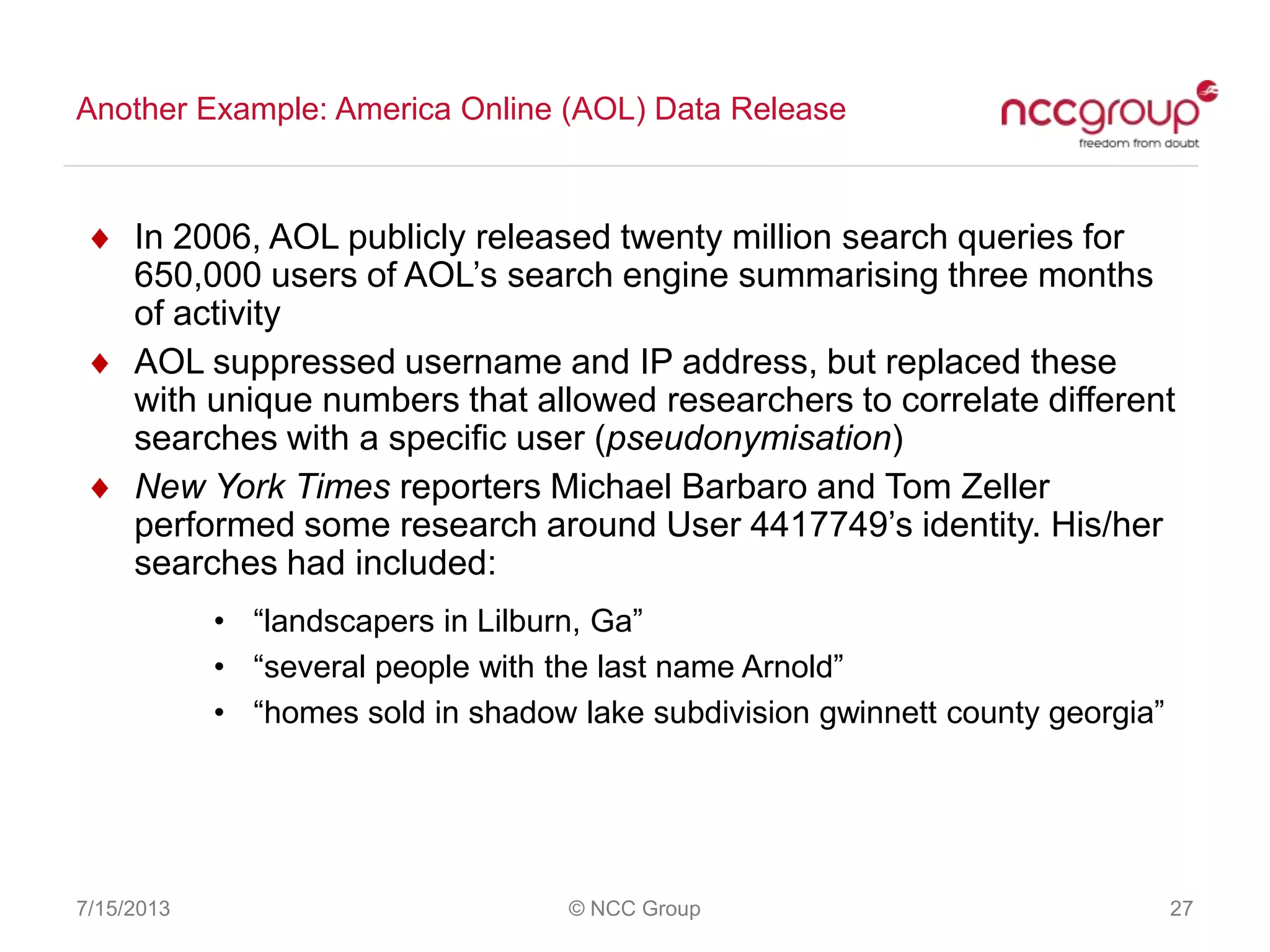
In 2006, AOL publicly released twenty million search queries for
650,000 users of AOL‟s search engine summarising three months
of activity
AOL suppressed username and IP address, but replaced these
with unique numbers that allowed researchers to correlate different
searches with a specific user (pseudonymisation)
New York Times reporters Michael Barbaro and Tom Zeller
performed some research around User 4417749‟s identity. His/her
searches had included:
• “landscapers in Lilburn, Ga”
• “several people with the last name Arnold”
• “homes sold in shadow lake subdivision gwinnett county georgia”
Another Example: America Online (AOL) Data Release
7/15/2013 © NCC Group 28
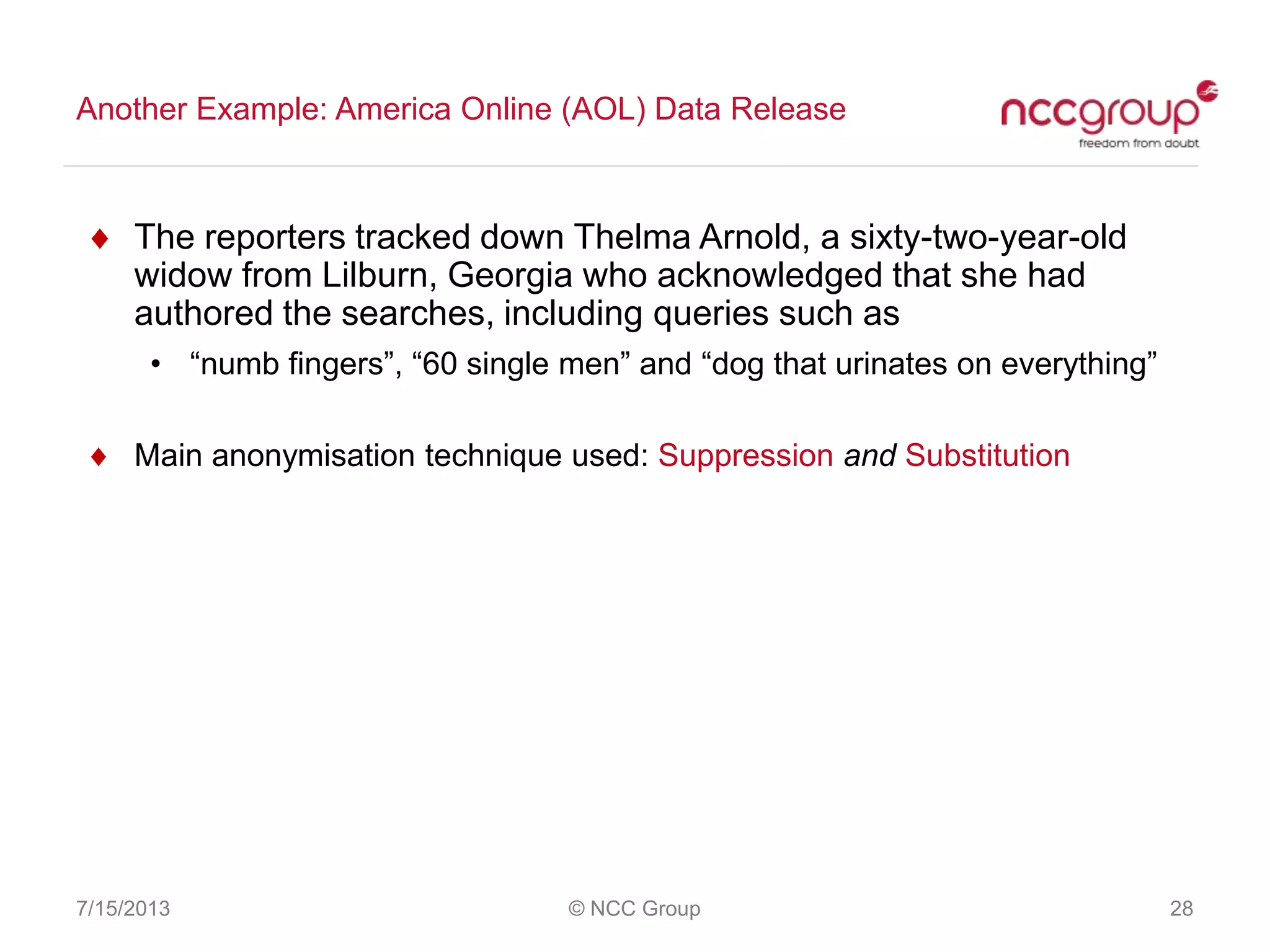
The reporters tracked down Thelma Arnold, a sixty-two-year-old
widow from Lilburn, Georgia who acknowledged that she had
authored the searches, including queries such as
• “numb fingers”, “60 single men” and “dog that urinates on everything”
Main anonymisation technique used: Suppression and Substitution
Anonymisation of non-textual data and Metadata
7/15/2013 © NCC Group 29
Anonymisation might be required of non-textual data. E.g. images
and videos (obfuscating faces)
This might require release of hundreds or thousands of
anonymised files, rather than one large dataset
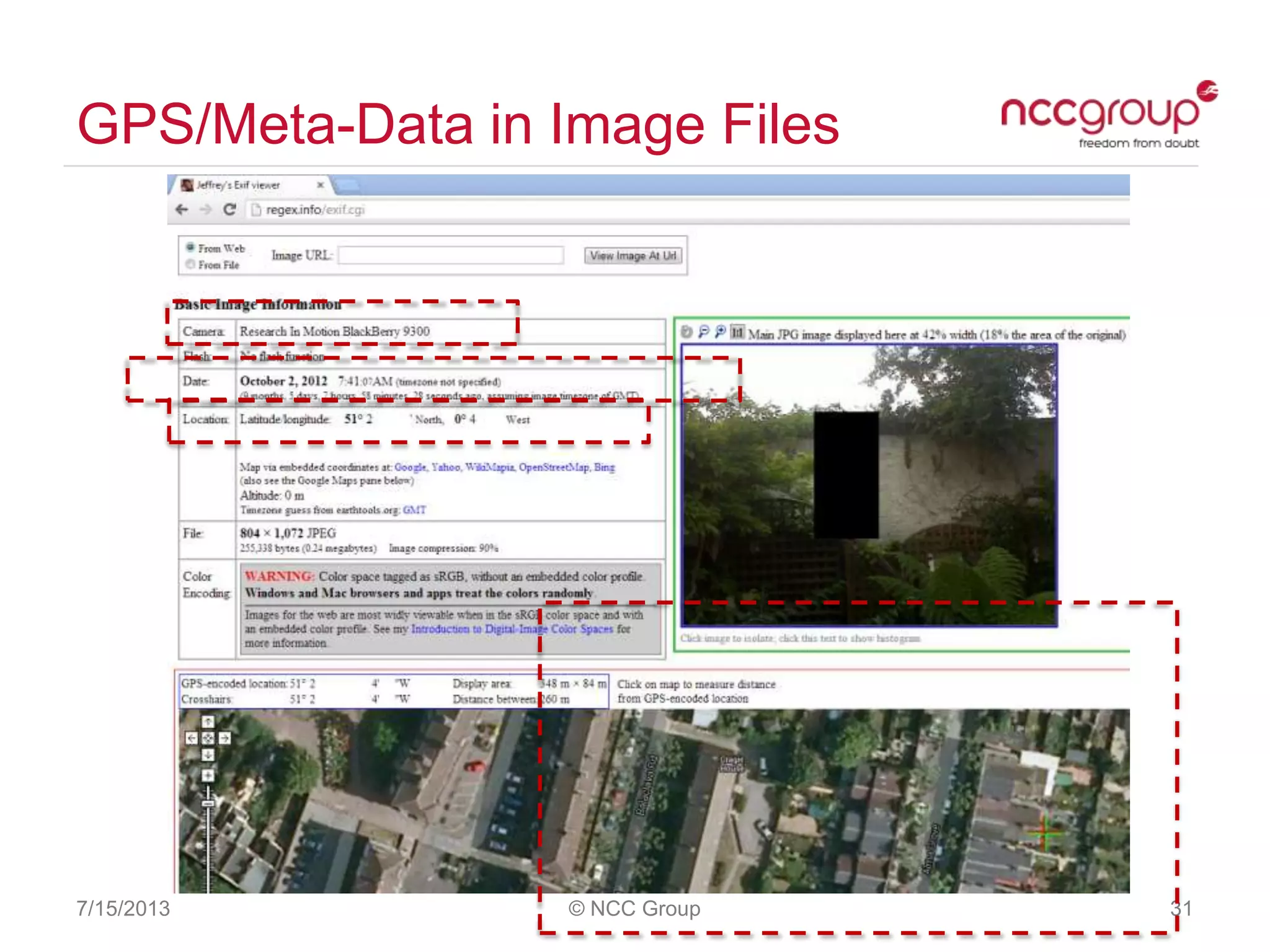
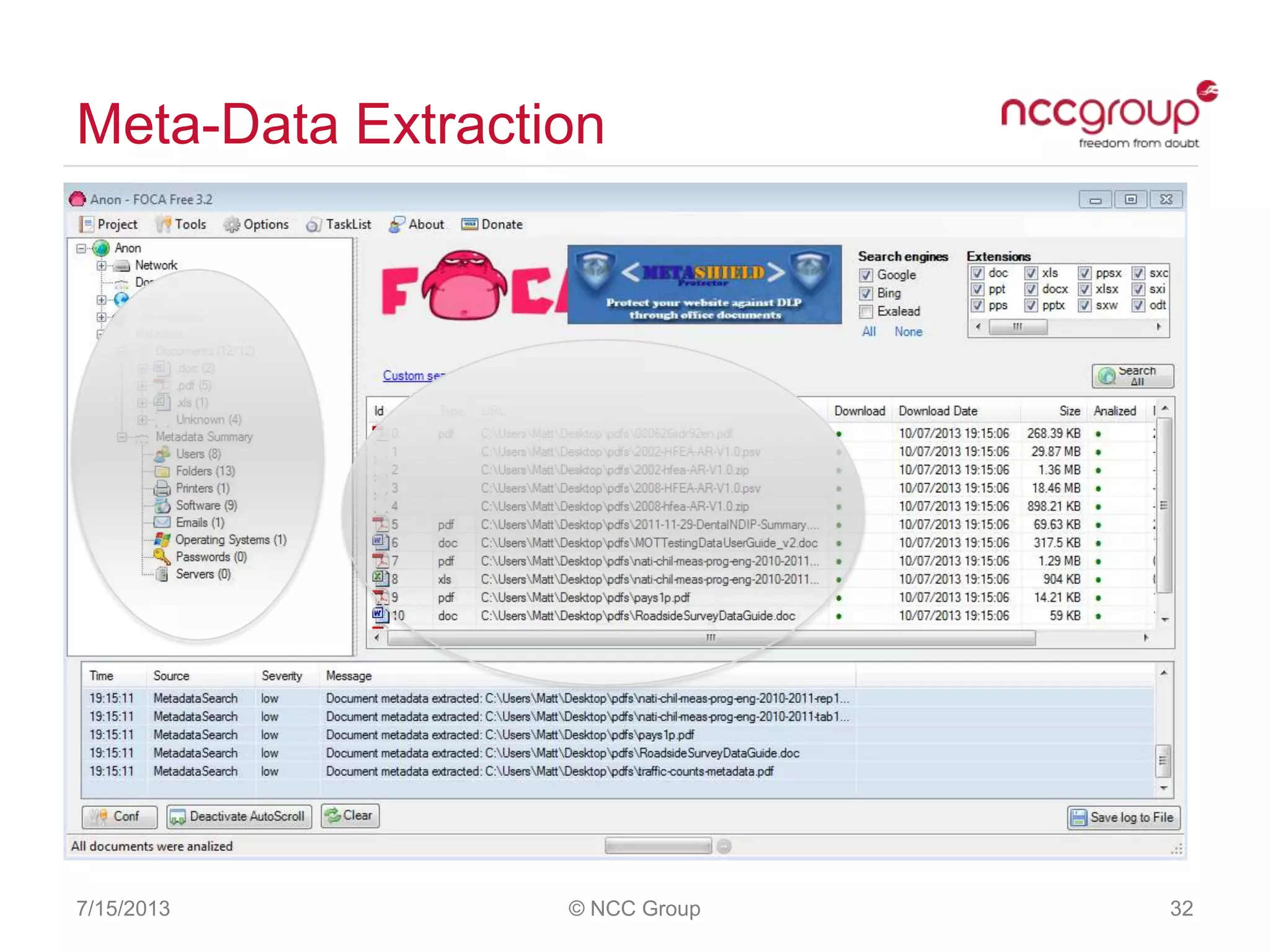
Often, hidden meta-data within those files is forgotten, and can be
a valuable source for individuals attempting re-identification
Anonymisation of non-textual data and Metadata
7/15/2013 © NCC Group 30
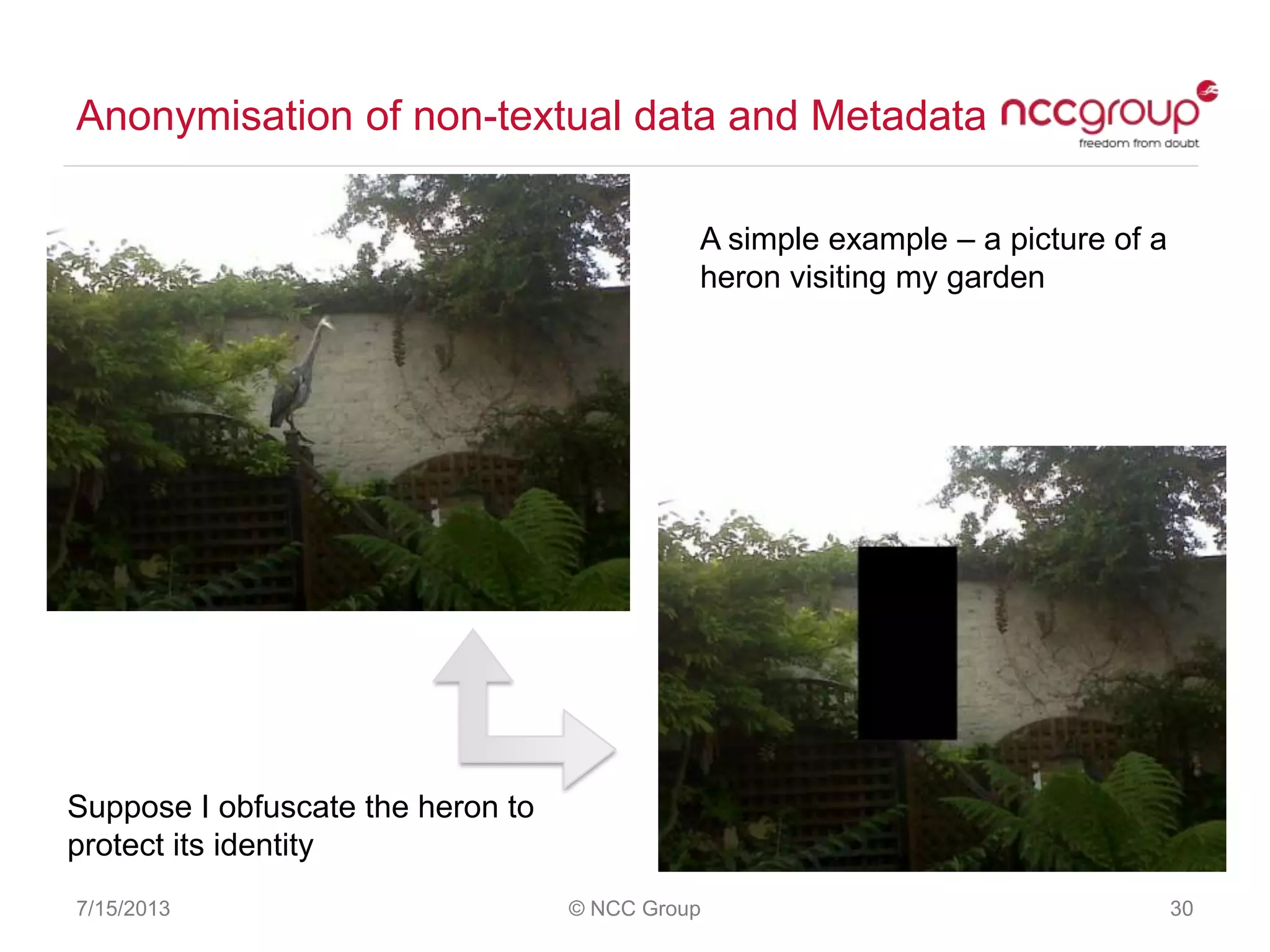
A simple example – a picture of a
heron visiting my garden
Suppose I obfuscate the heron to
protect its identity
GPS/Meta-Data in Image Files
7/15/2013 © NCC Group 31
Meta-Data Extraction
7/15/2013 © NCC Group 32
A Risk-Based Approach
7/15/2013 © NCC Group 33
There is anonymisation guidance, but there is no anonymisation
formula
Anonymisation is not an exact science
Each data set presents a unique instance, and the choice of
anonymisation operation(s) must be carefully considered in order
to maintain anonymity and utility
A risk-based approach is therefore the only option…
Risk Mitigation Advice
7/15/2013 © NCC Group 34
Consult with experts before embarking on anonymisation, on the
proposed approach and potential risks
If there is no business case or perceived benefit in going through
the process, then don‟t
Consider release to limited audiences – only go public if strictly
required
Protect the anonymisation method/formula
Qualitative anonymisation can typically be automated, Quantitative
anonymisation will require more manual efforts
Always vet anonymisations of Quantitative and Qualitative data
before release, don‟t just fire and forget
Risk Mitigation Advice
7/15/2013 © NCC Group 35
Perform your own rudimentary Google searches and correlation
attempts with other public data sources before publishing
If in doubt, engage again with experts on the likelihood of re-
identification given the derived anonymised data set
Consider the quantity of released anonymised data - in practically
all re-identification studies performed, researchers have been more
successful with larger databases
Try and remove one or more of the top 3 culprits: Post Code,
Birthdate and Sex.
• In 2000 Dr. Latanya Sweeney showed that 87% of all Americans could
be uniquely identified using only these three bits of information
Metadata – prior to release, ensure all meta-data in documents is
removed – A number of tools exist for this, depending on the
document type (e.g. Adobe Acrobat, Microsoft Office, JPEGs etc.)
Risk Mitigation Advice - Pseudonymisation
7/15/2013 © NCC Group 36
Don‟t chose reversible identifiers – for example, names replaced
with identifiers that are based on record data
John Smith, 05/01/1978 -> JS05011978
Be aware of potential inferences from sorted data (e.g. alphabetical
ordering might provide clues for re-identification)
Keep the pseudonymisation formula secret – protect it with the same
controls as for encryption keys and passwords
Perform pseudonymisation functions on segregated, secure
environments, only copy/migrate the pseudonymised data (keep
them separate)
Remove all meta-data from pseudonymised data files – make sure
the individual(s) performing the pseudonymisation are not
referenced in the meta-data
Any cryptographic hashing used as identifiers/keys should always
be salted
References
7/15/2013 © NCC Group 37
ICO guidance on anonymisation:
http://www.ico.org.uk/for_organisations/data_protection/topic_guides/anon
ymisation
Paper on the failures of anonymisation, Paul Ohm
http://papers.ssrn.com/sol3/papers.cfm?abstract_id=1450006
Research/Blog on anonymisation http://33bits.org/
Questions?
Matt Lewis
matt.lewis@nccgroup.com
UK Offices
Manchester - Head Office
Cheltenham
Edinburgh
Leatherhead
London
Thame
North American Offices
San Francisco
Atlanta
New York
Seattle
Australian Offices
Sydney
European Offices
Amsterdam - Netherlands
Munich – Germany
Zurich - Switzerland

2013 07-12 ncc-group_data_anonymisation_technical_aspects_v1 0

  • 1.
    Technical Aspects ofData Anonymisation & Pseudonymisation Risks, Challenges & Mitigations Matt Lewis Principal Consultant
  • 2.
    Agenda NCC Group –who we are and what we do Anonymisation, Pseudonymisation & Re-identification – overview of concepts Examples – when anonymisation goes wrong Pitfalls of image anonymisation and other information leakage through meta-data A risk-based approach to anonymisation Summary and advice Questions 7/15/2013 © NCC Group 2
  • 3.
    NCC Group 7/15/2013 ©NCC Group 3 Global information assurance specialist 15,000 customers worldwide across all sectors The Group has two complementary divisions - escrow and assurance Independence from hardware and software providers ensures we provide unbiased and impartial advice Largest penetration testing team in the world, with approximately 250 consultants
  • 4.
    Me: Brief Bio 7/15/2013© NCC Group 4 Over 12 years working in Information Security Previous Employers: • CESG – The Information Assurance arm of GCHQ • Information Risk Management (IRM) plc – penetration testing • KPMG – Executive Advisor in the Information Protection division of IT Advisory • NCC Group – Principal Consultant, providing penetration testing and consultancy around all aspects of Information Security
  • 5.
    Anonymisation – Overview 7/15/2013© NCC Group 5 Anonymised data should be information that does not identify any individuals, either in isolation or when cross-referenced with other data already in the public domain A careful balance is required around the level of anonymisation versus the usefulness of the resultant data Quantitative versus Qualitative – the latter is harder to anonymise in a consistent way, and requires more rigour on a „per record‟ basis – e.g. meeting minutes
  • 6.
    Pseudonymisation – Overview 7/15/2013© NCC Group 6 Information is anonymous to the receiver (e.g. researchers), but contains codes or identifiers to allow others to re-identify individuals from the pseudonymised data Universally protecting pseudonymised data whilst allowing general analysis of it is difficult – requires careful management of the „codes‟ or „keys‟ that uniquely identify individuals Quantitative versus Qualitative – again, the latter is harder to pseudonymise in a consistent way, and requires more rigour on a „per record‟ basis – e.g. meeting minutes
  • 7.
    Anonymisation – Techniquesand Methods 7/15/2013 © NCC Group 7 There are four main operations available for anonymising data Suppression, Substitution/Distortion, Generalisation, Aggregation Consider the following dataset: Name Sex Birth Date Post Code Complaint John Male 02/12/1954 SE24 6TY Pain in left eye Daniel Male 05/01/1984 NW1 6XD Chest pains Sarah Female 04/08/1978 E17 7WE Chest pains Samantha Female 03/10/1960 WC1 7RA Back pains James Male 09/09/1990 NW7 5LK Headaches
  • 8.
    Anonymisation – Techniquesand Methods 7/15/2013 © NCC Group 8 Suppression - deleting or omitting data fields entirely Sex Complaint Male Pain in left eye Male Chest pains Female Chest pains Female Back pains Male Headaches
  • 9.
    Anonymisation – Techniquesand Methods 7/15/2013 © NCC Group 9 Substitution/Distortion – e.g. replace a person‟s name with a unique number – this is also an example of pseudonymisation Name Sex Birth Date Post Code Complaint 0000001 Male 02/12/1954 SE24 6TY Pain in left eye 0000002 Male 05/01/1984 NW1 6XD Chest pains 0000003 Female 04/08/1978 E17 7WE Chest pains 0000004 Female 03/10/1960 WC1 7RA Back pains 0000005 Male 09/09/1990 NW7 5LK Headaches
  • 10.
    Anonymisation – Techniquesand Methods 7/15/2013 © NCC Group 10 Generalisation - alter rather than delete identifier values to increase privacy while preserving utility Name Sex Birth Year Post Code Complaint John Male 1954 SE24 Pain in left eye Daniel Male 1984 NW1 Chest pains Sarah Female 1978 E17 Chest pains Samantha Female 1960 WC1 Back pains James Male 1990 NW7 Headaches
  • 11.
    Anonymisation – Techniquesand Methods 7/15/2013 © NCC Group 11 Aggregation - produce summary statistics across a dataset instead of an anonymised dataset 40% of patients complain of chest pains 60% of patients are male etc. Name Sex Birth Date Post Code Complaint John Male 02/12/1954 SE24 6TY Pain in left eye Daniel Male 05/01/1984 NW1 6XD Chest pains Sarah Female 04/08/1978 E17 7WE Chest pains Samantha Female 03/10/1960 WC1 7RA Back pains James Male 09/09/1990 NW7 5LK Headaches
  • 12.
    Anonymisation of QualitativeData 7/15/2013 © NCC Group 12
  • 13.
    Anonymisation of QualitativeData 7/15/2013 © NCC Group 13 Pseudonymisation in qualitative data can be much more difficult The content/themes in this meeting for example might allow for re-identification of any pseudonymised individuals
  • 14.
    Re-identification – Whatis it? 7/15/2013 © NCC Group 14 Re-identification is the act of cross-referencing anonymised data with other data sources, and using inference, deduction and correlation to identify individuals Depending on the nature of data re-identified, this might raise data protection concerns
  • 15.
    Re-identification – Whodoes this and Why? 7/15/2013 © NCC Group 15 Researchers – e.g. computer scientists, genuinely interested in the challenges of re-identification Malicious individuals use re-identification information to discriminate, harass or discredit a victim Investigative journalists Organised crime – re-identification can facilitate creation of fake identities, or be used to extort victims (if data is personal/sensitive in nature) Competitors – seeking to re-identify and publish to discredit State sponsored data mining and correlation The Internet is essentially a vast, ever-growing cross-correlation database; access to most of which is open and free to anyone…
  • 16.
  • 17.
    Inference as aStarting Point Recall our example: 7/15/2013 © NCC Group 17 Name Sex Birth Date Post Code Complaint John Male 02/12/1954 SE24 6TY Pain in left eye Daniel Male 05/01/1984 NW1 6XD Chest pains Sarah Female 04/08/1978 E17 7WE Chest pains Samantha Female 03/10/1960 WC1 7RA Back pains James Male 09/09/1990 NW7 5LK Headaches
  • 18.
    Inference as aStarting Point Suppose the following anonymised aggregations are published: 60% of patients complain of chest pains 60% of patients are male 100% of Back pain sufferers live in WC1 100% of patients are over 21 years of age 100% of females suffer from chest or back pains 20% of patients suffer from Pain in the left eye From this we can infer the following table fields: Sex, Age, Condition, Post Code 7/15/2013 © NCC Group 18
  • 19.
    Inference as aStarting Point Suppose we know the sample size (i.e. 5), and the time of data publication 60% of patients are male 7/15/2013 © NCC Group 19 Sex Birth Date Complaint Post Code Male Male Male Female Female
  • 20.
    Inference as aStarting Point 100% of patients are over 21 years of age 7/15/2013 © NCC Group 20 Sex Birth Date Complaint Post Code Male <= 1992 Male <= 1992 Male <= 1992 Female <= 1992 Female <= 1992
  • 21.
    Inference as aStarting Point 100% of females suffer from chest or back pains 7/15/2013 © NCC Group 21 Sex Birth Date Complaint Post Code Male <= 1992 Male <= 1992 Male <= 1992 Female <= 1992 Chest Pains Female <= 1992 Back Pains
  • 22.
    Inference as aStarting Point 100% of Back pain sufferers live in WC1 7/15/2013 © NCC Group 22 Sex Birth Date Complaint Post Code Male <= 1992 Male <= 1992 Male <= 1992 Female <= 1992 Chest Pains Female <= 1992 Back Pains WC1
  • 23.
    Inference as aStarting Point 20% of patients suffer from Pain in the left eye 7/15/2013 © NCC Group 23 Sex Birth Date Complaint Post Code Male <= 1992 Pain in left eye Male <= 1992 Male <= 1992 Female <= 1992 Chest Pains Female <= 1992 Back Pains WC1
  • 24.
    Inference as aStarting Point 60% of patients complain of chest pains The next step would be to correlate/cross-reference with other sources 7/15/2013 © NCC Group 24 Sex Birth Date Complaint Post Code Male <= 1992 Pain in left eye Male <= 1992 Chest Pains Male <= 1992 Chest Pains Female <= 1992 Chest Pains Female <= 1992 Back Pains WC1
  • 25.
    An Example: MassachusettsGroup Insurance Company 7/15/2013 © NCC Group 25 In the mid-1990s GIC released anonymised data on state employees that showed every single hospital visit The goal was to help researchers; the state spent time removing all obvious identifiers such as name, address, and Social Security number William Weld, then Governor of Massachusetts, assured the public that GIC had protected patient privacy by deleting identifiers Computer Science graduate Dr. Latanya Sweeney requested a copy of the data and performed re-identification research on the dataset Main anonymisation technique used: Suppression
  • 26.
    An Example: MassachusettsGroup Insurance Company 7/15/2013 © NCC Group 26 Governor Weld lived in Cambridge MA 54,000 Residents 7 Post Codes Electoral Roll Purchase for $20: Contained name, address, post code, birth date, sex etc. GIC Anonymised Data Only 6 people in Cambridge shared Weld‟s birthday Only 3 of these were men Only 1 lived in Weld‟s Post Code Dr. Sweeney sent the Governor‟s health records (which included diagnoses and prescriptions) to his office
  • 27.
    Another Example: AmericaOnline (AOL) Data Release 7/15/2013 © NCC Group 27 In 2006, AOL publicly released twenty million search queries for 650,000 users of AOL‟s search engine summarising three months of activity AOL suppressed username and IP address, but replaced these with unique numbers that allowed researchers to correlate different searches with a specific user (pseudonymisation) New York Times reporters Michael Barbaro and Tom Zeller performed some research around User 4417749‟s identity. His/her searches had included: • “landscapers in Lilburn, Ga” • “several people with the last name Arnold” • “homes sold in shadow lake subdivision gwinnett county georgia”
  • 28.
    Another Example: AmericaOnline (AOL) Data Release 7/15/2013 © NCC Group 28 The reporters tracked down Thelma Arnold, a sixty-two-year-old widow from Lilburn, Georgia who acknowledged that she had authored the searches, including queries such as • “numb fingers”, “60 single men” and “dog that urinates on everything” Main anonymisation technique used: Suppression and Substitution
  • 29.
    Anonymisation of non-textualdata and Metadata 7/15/2013 © NCC Group 29 Anonymisation might be required of non-textual data. E.g. images and videos (obfuscating faces) This might require release of hundreds or thousands of anonymised files, rather than one large dataset Often, hidden meta-data within those files is forgotten, and can be a valuable source for individuals attempting re-identification
  • 30.
    Anonymisation of non-textualdata and Metadata 7/15/2013 © NCC Group 30 A simple example – a picture of a heron visiting my garden Suppose I obfuscate the heron to protect its identity
  • 31.
    GPS/Meta-Data in ImageFiles 7/15/2013 © NCC Group 31
  • 32.
  • 33.
    A Risk-Based Approach 7/15/2013© NCC Group 33 There is anonymisation guidance, but there is no anonymisation formula Anonymisation is not an exact science Each data set presents a unique instance, and the choice of anonymisation operation(s) must be carefully considered in order to maintain anonymity and utility A risk-based approach is therefore the only option…
  • 34.
    Risk Mitigation Advice 7/15/2013© NCC Group 34 Consult with experts before embarking on anonymisation, on the proposed approach and potential risks If there is no business case or perceived benefit in going through the process, then don‟t Consider release to limited audiences – only go public if strictly required Protect the anonymisation method/formula Qualitative anonymisation can typically be automated, Quantitative anonymisation will require more manual efforts Always vet anonymisations of Quantitative and Qualitative data before release, don‟t just fire and forget
  • 35.
    Risk Mitigation Advice 7/15/2013© NCC Group 35 Perform your own rudimentary Google searches and correlation attempts with other public data sources before publishing If in doubt, engage again with experts on the likelihood of re- identification given the derived anonymised data set Consider the quantity of released anonymised data - in practically all re-identification studies performed, researchers have been more successful with larger databases Try and remove one or more of the top 3 culprits: Post Code, Birthdate and Sex. • In 2000 Dr. Latanya Sweeney showed that 87% of all Americans could be uniquely identified using only these three bits of information Metadata – prior to release, ensure all meta-data in documents is removed – A number of tools exist for this, depending on the document type (e.g. Adobe Acrobat, Microsoft Office, JPEGs etc.)
  • 36.
    Risk Mitigation Advice- Pseudonymisation 7/15/2013 © NCC Group 36 Don‟t chose reversible identifiers – for example, names replaced with identifiers that are based on record data John Smith, 05/01/1978 -> JS05011978 Be aware of potential inferences from sorted data (e.g. alphabetical ordering might provide clues for re-identification) Keep the pseudonymisation formula secret – protect it with the same controls as for encryption keys and passwords Perform pseudonymisation functions on segregated, secure environments, only copy/migrate the pseudonymised data (keep them separate) Remove all meta-data from pseudonymised data files – make sure the individual(s) performing the pseudonymisation are not referenced in the meta-data Any cryptographic hashing used as identifiers/keys should always be salted
  • 37.
    References 7/15/2013 © NCCGroup 37 ICO guidance on anonymisation: http://www.ico.org.uk/for_organisations/data_protection/topic_guides/anon ymisation Paper on the failures of anonymisation, Paul Ohm http://papers.ssrn.com/sol3/papers.cfm?abstract_id=1450006 Research/Blog on anonymisation http://33bits.org/
  • 38.
    Questions? Matt Lewis matt.lewis@nccgroup.com UK Offices Manchester- Head Office Cheltenham Edinburgh Leatherhead London Thame North American Offices San Francisco Atlanta New York Seattle Australian Offices Sydney European Offices Amsterdam - Netherlands Munich – Germany Zurich - Switzerland