
©	Margolis	Healy	
Building and Assessing
Your Physical Security
Program
National Center for Campus Public Safety
September 19, 2017
©	Margolis	Healy	
Introductions
Daniel R. Pascale, CPP
Managing Director
Margolis Healy and Associates
dpascale@margolishealy.com
262-527-1332 direct
2
©	Margolis	Healy	
What is a Physical Security Program?
•  Define your physical security program?
- “We have 200 cameras”
- “We have card swipes”
- “We have blue light phones”
While each of these are relevant to physical security, they are only
parts to a more comprehensive program.
•  Your physical security program should highlight
the interrelationships between many elements
including: People, Policies, Standards, Equipment,
Response, Education, etc.
3
©	Margolis	Healy	
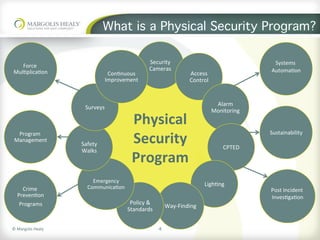
What is a Physical Security Program?
4
Physical	
Security	
Program	
Security	
Cameras	
Access	
Control	
Alarm	
Monitoring	
CPTED	
Ligh<ng	
Way-Finding	
Policy	&	
Standards	
Emergency	
Communica<on	
Safety	
Walks	
Surveys	
Con<nuous	
Improvement	
Force	
Mul<plica<on	
Crime	
Preven<on	
Programs	
	
Systems	
Automa<on	
	
Post	Incident	
Inves<ga<on	
Sustainability	Program	
Management
©	Margolis	Healy	
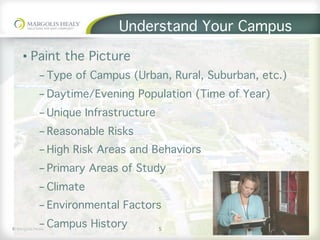
Understand Your Campus
5
•  Paint the Picture
- Type of Campus (Urban, Rural, Suburban, etc.)
- Daytime/Evening Population (Time of Year)
- Unique Infrastructure
- Reasonable Risks
- High Risk Areas and Behaviors
- Primary Areas of Study
- Climate
- Environmental Factors
- Campus History
©	Margolis	Healy	
Challenges (Vision Killers)
•  Culture
-  Resistance to Change (This is how we’ve always done it)
•  Budget
-  “Who’s going to pay for all this”?
•  Disparate/Legacy Systems
-  Multiple Systems, Integration, “Outdated Technology”
•  Technical Knowledge/Resources
-  Reliance on Others
•  Vendor Management
-  Developing RFP’s, Contracts, Project Management
6
©	Margolis	Healy	
Getting Started
“Begin with the end in Mind” – Stephen Covey
- What is the goal of your physical security program? What
problem are you trying to solve?
§ Crime Prevention
§ Force Multiplication/Reduction
§ Process Automation
§ Record Keeping
- When you know your goals, you can begin to assess the
programs effectiveness and identify gaps.
- There is no one size fits all solution.
- Because a peer institution has 1,000 cameras doesn’t
mean your institution should.
7
©	Margolis	Healy	
Conduct An Assessment
Conducting a Campus-Wide Assessment
- Determine if this will be done internally or external
- Think globally and develop a committee w/partners
§  Facilities/Physical Plant
§  Information Technology
§  Student/Residence Life/Housing
§  Athletics
§  Faculty/Staff Representation
§  Student Groups
8
©	Margolis	Healy	
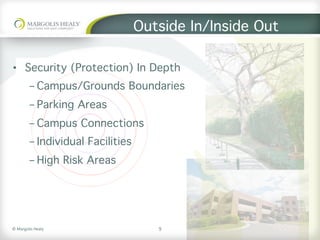
Outside In/Inside Out
9
•  Security (Protection) In Depth
- Campus/Grounds Boundaries
- Parking Areas
- Campus Connections
- Individual Facilities
- High Risk Areas
©	Margolis	Healy	
Understanding Your Facilities
Earlier I mentioned understanding your
campus & this extends to your buildings;
- How are facilities used?
- By whom?
- During what hours?
- What high risk areas exist and what special
countermeasures are reasonable?
10
©	Margolis	Healy	
Quick Quiz
•  Given this information, are you effectively
addressing the following to reach your
goals?
- Perimeter Security
§  Way-Finding Signage
§  Clear lines of sight?
§  Windows (accessibility, type)
11
©	Margolis	Healy	
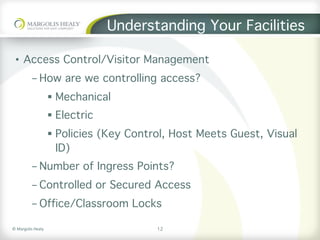
Understanding Your Facilities
•  Access Control/Visitor Management
- How are we controlling access?
§  Mechanical
§  Electric
§  Policies (Key Control, Host Meets Guest, Visual
ID)
- Number of Ingress Points?
- Controlled or Secured Access
- Office/Classroom Locks
12
©	Margolis	Healy	
Understanding Your Facilities
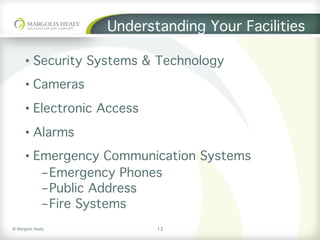
•  Security Systems & Technology
•  Cameras
•  Electronic Access
•  Alarms
•  Emergency Communication Systems
- Emergency Phones
- Public Address
- Fire Systems
13
©	Margolis	Healy	
Understanding Your Facilities
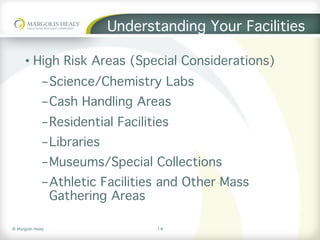
•  High Risk Areas (Special Considerations)
- Science/Chemistry Labs
- Cash Handling Areas
- Residential Facilities
- Libraries
- Museums/Special Collections
- Athletic Facilities and Other Mass
Gathering Areas
14
©	Margolis	Healy	
Policies & Standards
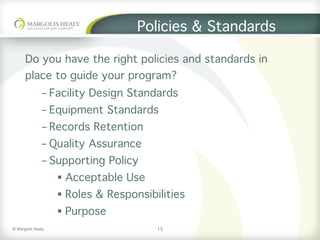
Do you have the right policies and standards in
place to guide your program?
- Facility Design Standards
- Equipment Standards
- Records Retention
- Quality Assurance
- Supporting Policy
§  Acceptable Use
§  Roles & Responsibilities
§  Purpose
15
©	Margolis	Healy	
Management
Who is managing your physical security program?
•  Physical security programs are typically managed
by a single “business owner” or champion
- Developing and maintaining a program is a
collaborative effort across department lines
- Can live in many different functional areas
- Requires subject matter expertise
- Collaboration
- Vendor management
- Project management
16
©	Margolis	Healy	
Sustainability
•  How will you pay tomorrow for what you
have today?
- State of the industry
- Equipment failure
- Emerging threats
•  Options
•  Capital funding (operational increases)
•  Department direct funding
•  Chargebacks (pass through)
•  Chargebacks with fees*
17
©	Margolis	Healy	
Putting it all Together
•  Define what your physical security program is?
•  Understand your campus/institution and its
uniqueness, reasonable threats, and resources
•  Determine your program goals
•  Understand and prepare for challenges
•  Conduct a campus-wide assessment
•  Establish/maintain policies & standards
•  Be collaborative in managing program
•  Consider program sustainability as threats and
technology change & equipment begins to fail
18
©	Margolis	Healy	
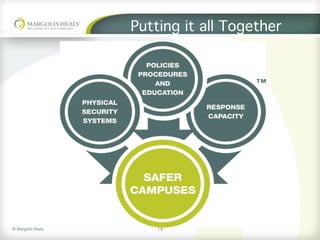
Putting it all Together
19
©	Margolis	Healy	
Stay Connected With Us
@margolishealy!
www.facebook.com/margolishealy!
www.linkedin.com/company/margolis-healy-&-associates!
www.slideshare.net/margolishealy!
www.nccpsafety.org
20
www.margolishealy.com
www.nccpsafety.org
info@nccpsafety.org
1.866.817.5817
www.bja.gov

Building and Assessing Your Physical Security Program

  • 2.
    © Margolis Healy Building and Assessing YourPhysical Security Program National Center for Campus Public Safety September 19, 2017
  • 3.
    © Margolis Healy Introductions Daniel R. Pascale,CPP Managing Director Margolis Healy and Associates dpascale@margolishealy.com 262-527-1332 direct 2
  • 4.
    © Margolis Healy What is aPhysical Security Program? •  Define your physical security program? - “We have 200 cameras” - “We have card swipes” - “We have blue light phones” While each of these are relevant to physical security, they are only parts to a more comprehensive program. •  Your physical security program should highlight the interrelationships between many elements including: People, Policies, Standards, Equipment, Response, Education, etc. 3
  • 5.
    © Margolis Healy What is aPhysical Security Program? 4 Physical Security Program Security Cameras Access Control Alarm Monitoring CPTED Ligh<ng Way-Finding Policy & Standards Emergency Communica<on Safety Walks Surveys Con<nuous Improvement Force Mul<plica<on Crime Preven<on Programs Systems Automa<on Post Incident Inves<ga<on Sustainability Program Management
  • 6.
    © Margolis Healy Understand Your Campus 5 • Paint the Picture - Type of Campus (Urban, Rural, Suburban, etc.) - Daytime/Evening Population (Time of Year) - Unique Infrastructure - Reasonable Risks - High Risk Areas and Behaviors - Primary Areas of Study - Climate - Environmental Factors - Campus History
  • 7.
    © Margolis Healy Challenges (Vision Killers) • Culture -  Resistance to Change (This is how we’ve always done it) •  Budget -  “Who’s going to pay for all this”? •  Disparate/Legacy Systems -  Multiple Systems, Integration, “Outdated Technology” •  Technical Knowledge/Resources -  Reliance on Others •  Vendor Management -  Developing RFP’s, Contracts, Project Management 6
  • 8.
    © Margolis Healy Getting Started “Begin withthe end in Mind” – Stephen Covey - What is the goal of your physical security program? What problem are you trying to solve? § Crime Prevention § Force Multiplication/Reduction § Process Automation § Record Keeping - When you know your goals, you can begin to assess the programs effectiveness and identify gaps. - There is no one size fits all solution. - Because a peer institution has 1,000 cameras doesn’t mean your institution should. 7
  • 9.
    © Margolis Healy Conduct An Assessment Conductinga Campus-Wide Assessment - Determine if this will be done internally or external - Think globally and develop a committee w/partners §  Facilities/Physical Plant §  Information Technology §  Student/Residence Life/Housing §  Athletics §  Faculty/Staff Representation §  Student Groups 8
  • 10.
    © Margolis Healy Outside In/Inside Out 9 • Security (Protection) In Depth - Campus/Grounds Boundaries - Parking Areas - Campus Connections - Individual Facilities - High Risk Areas
  • 11.
    © Margolis Healy Understanding Your Facilities EarlierI mentioned understanding your campus & this extends to your buildings; - How are facilities used? - By whom? - During what hours? - What high risk areas exist and what special countermeasures are reasonable? 10
  • 12.
    © Margolis Healy Quick Quiz •  Giventhis information, are you effectively addressing the following to reach your goals? - Perimeter Security §  Way-Finding Signage §  Clear lines of sight? §  Windows (accessibility, type) 11
  • 13.
    © Margolis Healy Understanding Your Facilities • Access Control/Visitor Management - How are we controlling access? §  Mechanical §  Electric §  Policies (Key Control, Host Meets Guest, Visual ID) - Number of Ingress Points? - Controlled or Secured Access - Office/Classroom Locks 12
  • 14.
    © Margolis Healy Understanding Your Facilities • Security Systems & Technology •  Cameras •  Electronic Access •  Alarms •  Emergency Communication Systems - Emergency Phones - Public Address - Fire Systems 13
  • 15.
    © Margolis Healy Understanding Your Facilities • High Risk Areas (Special Considerations) - Science/Chemistry Labs - Cash Handling Areas - Residential Facilities - Libraries - Museums/Special Collections - Athletic Facilities and Other Mass Gathering Areas 14
  • 16.
    © Margolis Healy Policies & Standards Doyou have the right policies and standards in place to guide your program? - Facility Design Standards - Equipment Standards - Records Retention - Quality Assurance - Supporting Policy §  Acceptable Use §  Roles & Responsibilities §  Purpose 15
  • 17.
    © Margolis Healy Management Who is managingyour physical security program? •  Physical security programs are typically managed by a single “business owner” or champion - Developing and maintaining a program is a collaborative effort across department lines - Can live in many different functional areas - Requires subject matter expertise - Collaboration - Vendor management - Project management 16
  • 18.
    © Margolis Healy Sustainability •  How willyou pay tomorrow for what you have today? - State of the industry - Equipment failure - Emerging threats •  Options •  Capital funding (operational increases) •  Department direct funding •  Chargebacks (pass through) •  Chargebacks with fees* 17
  • 19.
    © Margolis Healy Putting it allTogether •  Define what your physical security program is? •  Understand your campus/institution and its uniqueness, reasonable threats, and resources •  Determine your program goals •  Understand and prepare for challenges •  Conduct a campus-wide assessment •  Establish/maintain policies & standards •  Be collaborative in managing program •  Consider program sustainability as threats and technology change & equipment begins to fail 18
  • 20.
  • 21.
    © Margolis Healy Stay Connected WithUs @margolishealy! www.facebook.com/margolishealy! www.linkedin.com/company/margolis-healy-&-associates! www.slideshare.net/margolishealy! www.nccpsafety.org 20
  • 22.