SCREENING OF INDUSTRIALLY
IMPORTANT MICROORGANISMS
SUPERVISED BY
DR. Neha Batra
Department Of Biotechnology
PRESENTED BY
Muskan Bhardwaj
Bsc. (P.C.) SEM V
Microbiology
THE IIS UNIVERSITY
(2017-2018)
SCREENING
The procedure of isolation, detection , and
separation of microorganisms of our interest
from a mixed population by using highly selective
procedures is called SCREENING
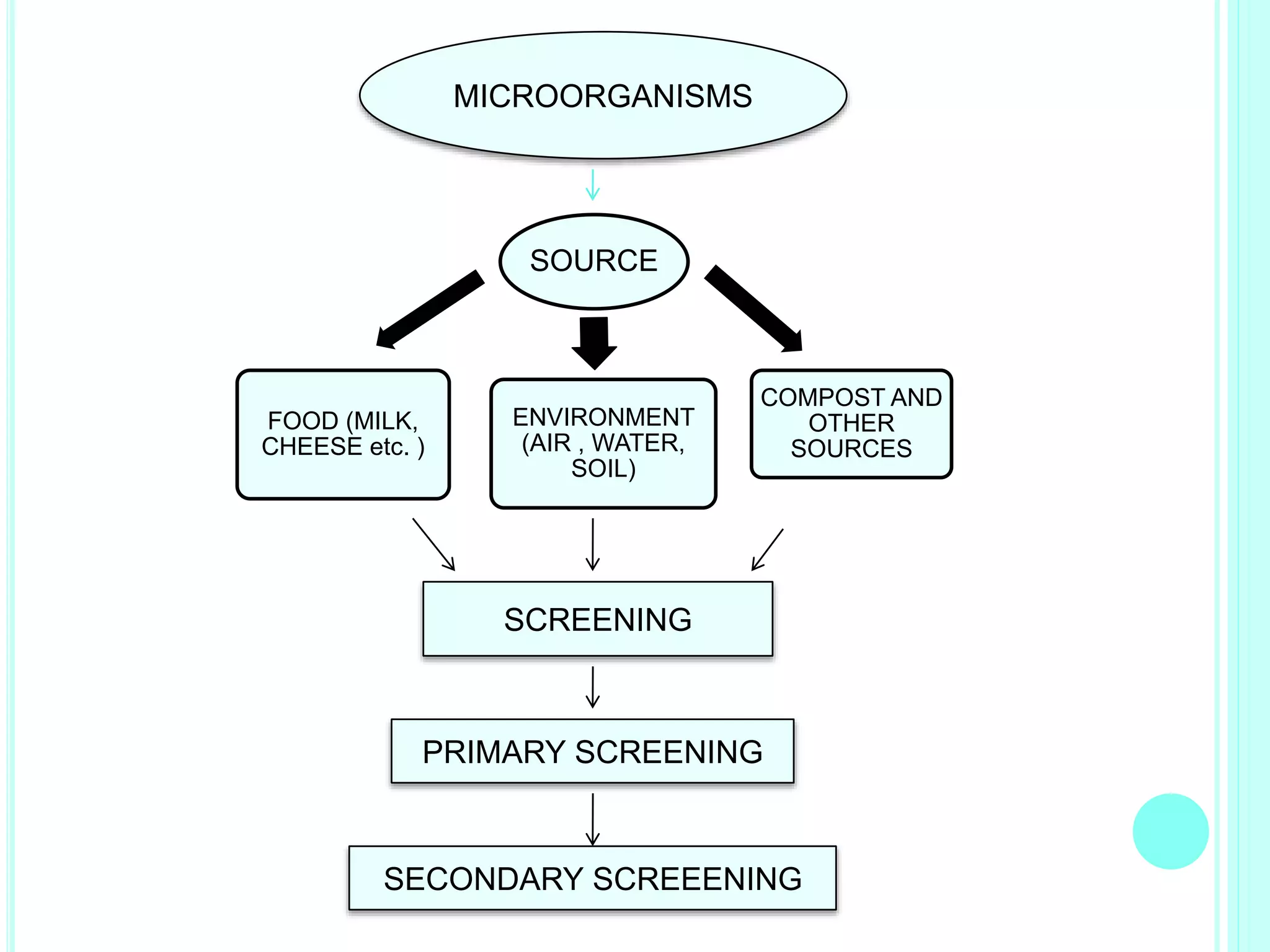
MICROORGANISMS
SOURCE
ENVIRONMENT
(AIR , WATER,
SOIL)
FOOD (MILK,
CHEESE etc. )
COMPOST AND
OTHER
SOURCES
SCREENING
PRIMARY SCREENING
SECONDARY SCREEENING
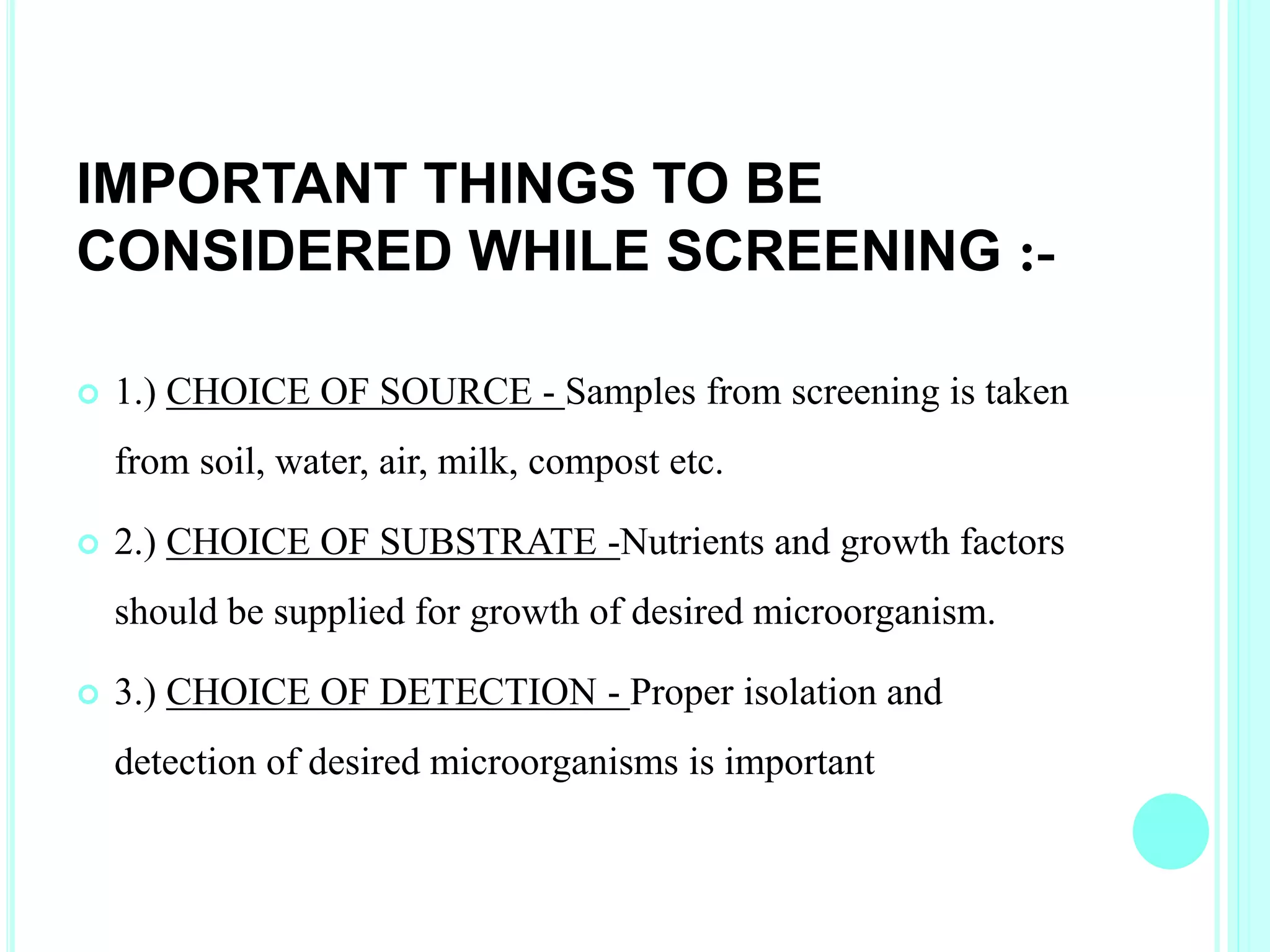
IMPORTANT THINGS TO BE
CONSIDERED WHILE SCREENING :-
 1.) CHOICE OF SOURCE - Samples from screening is taken
from soil, water, air, milk, compost etc.
 2.) CHOICE OF SUBSTRATE -Nutrients and growth factors
should be supplied for growth of desired microorganism.
 3.) CHOICE OF DETECTION - Proper isolation and
detection of desired microorganisms is important
TYPES OF SCREENING
SRCEENING
PRIMARY SCREENING SECONDARY SCREENING
ORGANIC ACID
PRODUCING
MICROORGANISMS
ANTIBIOTIC
PRODUCING
MICROORGANISMS
EXTRACELLULAR
METABOLITES
PRODUCING
MICROORGANISMS
ENRICHMENT
CULTURE
TECHNIQUE
BY USING DYES BY USING
CROWDED
PLATE
TECHNIQUE
BY
AUXANOGRAPHY
TECHNIQUE
BY
DEFINED
MEDIA
PRIMARY SCREENING
 It’s a process for detection and isolation of microorganisms of our
interest.
 Determines which microorganisms are able to produce a
compounds.
 Does not provide much idea about the production or yield potential
of microorganisms.
 It separate out only a few microorganisms, only few have
commercial value while discards the valueless microorganisms .
1) PRIMARY SCREENING OF ORGANIC
ACID PRODUCING MICROORGANISMS
The ph indicating dyes may be used for detecting
microorganism that are capable of producing organic
acids.
These dyes undergo color changes according to its ph.
Dyes such as Neutral red, Bromothymol blue are added to
the poorly buffered nutrient agar media .
Colonies are subcultured to make stock culture.
Further testing is needed since inorganic acids, bases are
also metabolic products of microbial growth.
 Incorporation of CaCO3 in medium is also used to screen
organic acid producing microbes on basis of formation of
clear zone of dissolved CaCO3 around the colony.
2) PRIMARY SCREENING OF ANTIBIOTIC
PRODUCING MICROORGANISMS
 Crowded plate technique is used for screening of antibiotic
producing microorganisms.
 Does not give information about the sensitivity of antibiotics
towards other microorganisms.
 Dilutions are made and then pouring and spreading of soil
samples that give 300 to 400 or more colonies per plate.
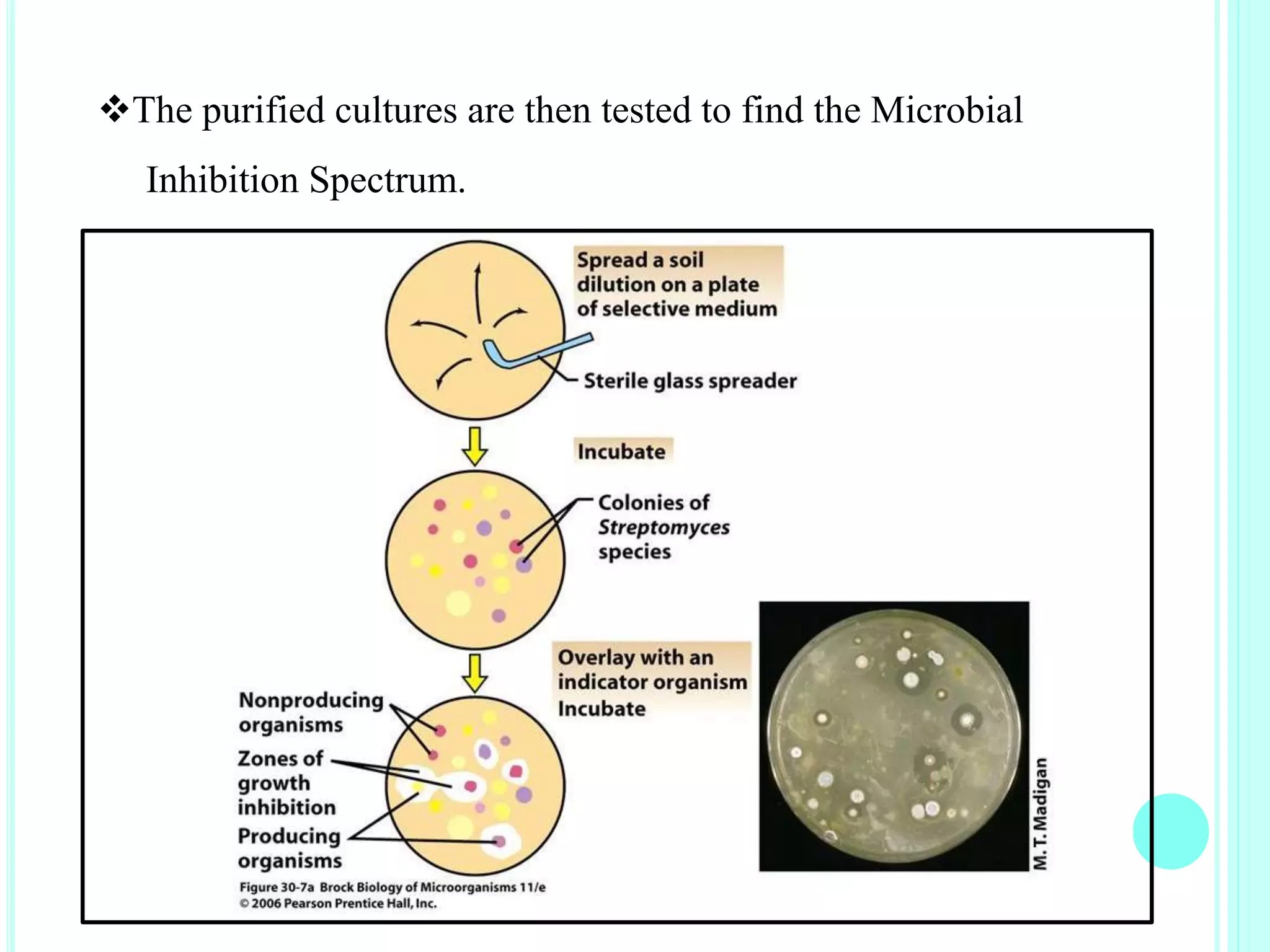
 Colonies showing antibiotic activity are indicated by zone of
inhibition around the colony .
 Such colonies are sub cultured and purified by streak before
making stock cultures.
The purified cultures are then tested to find the Microbial
Inhibition Spectrum.
3) PRIMARY SCREENING EXTRACELLULAR
METABOLITE PRODUCING MICROORGANISM
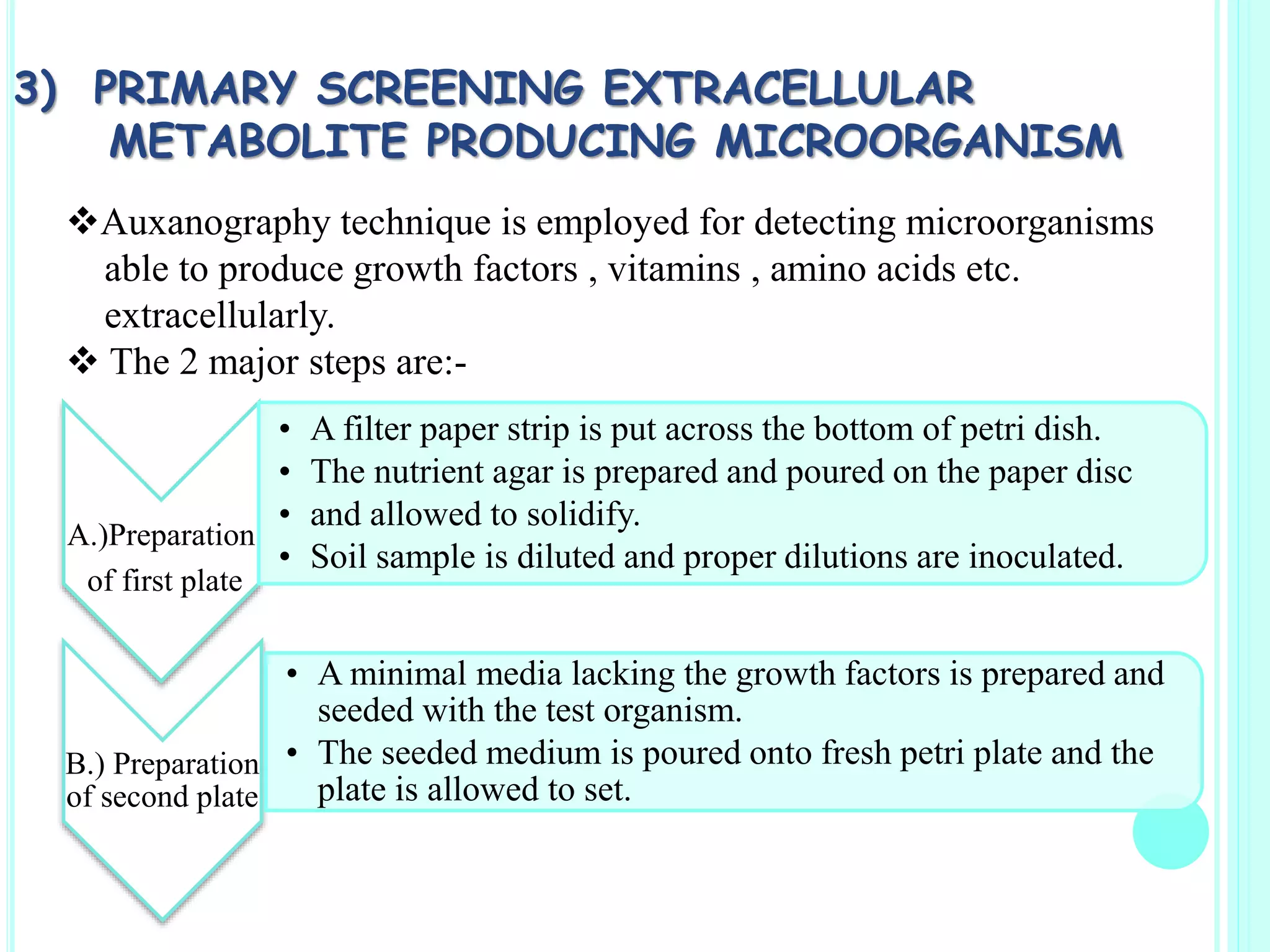
Auxanography technique is employed for detecting microorganisms
able to produce growth factors , vitamins , amino acids etc.
extracellularly.
 The 2 major steps are:-
A.)Preparation
of first plate
• A filter paper strip is put across the bottom of petri dish.
• The nutrient agar is prepared and poured on the paper disc
• and allowed to solidify.
• Soil sample is diluted and proper dilutions are inoculated.
B.) Preparation
of second plate
• A minimal media lacking the growth factors is prepared and
seeded with the test organism.
• The seeded medium is poured onto fresh petri plate and the
plate is allowed to set.
The agar in first plate is then lifted and placed on the second plate
without inverting.
The growth factors produced on agar can diffuse into the lower layer
containing test organism.
The zones of stimulated growth of test organism around colonies is an
indication that organism produce growth factor extracellularly.
4) ENRICHMENT CULTURE TECHNIQUE
This was designed by Beijerinck to isolate the desired
microorganism from heterogeneous microbial population.
 It consists of following steps :
a.) Nutrient broth is inoculated with microbial source material
and incubated.
b.) A small portion of all inoculums is plated onto the solid
medium and well isolated colonies are obtained.
c.) Suspected colonies from the plate are sub cultured on fresh
media and subjected for further testing.
SECONDARY SCREENING
It’s a systematic screening programme intended to isolate
industrially important or useful microorganisms .
SOME IMPORTANT POINTS ASSOCIATED WITH
SECONDARY SCREENING ARE:-
• It is useful in sorting of microorganisms that have real commercial
value. The microorganisms having poor applicability in fermentation
process are discarded.
• Provides the information whether the product formed by
microorganisms is new or not. This may be accomplished by paper ,
thin layer, chromatographic technique.
• It should show whether the product possess physical properties such as
UV light absorption or fluorescence or chemical properties that can be
employed to detect the compound during use of paper chromatography.
• It is conducted on agar plates, in flasks or in small fermentor containing
liquid media.
• It gives an idea about the economic position of the fermentation
process involving the use of a newly discovered culture.
• It helps in providing information regarding the product yield potentials
of different isolates.
• It determines the optimum conditions for growth or accumulation of a
product associated with a particular culture.
•Chemical, physical and biological properties of a product are also
determined during secondary screening. Moreover, it reveals whether
a product produced in the culture broth occurs in more than one
chemical form.
• It detects gross genetic instability in microbial cultures. This type
of information is very important, since microorganisms tending to
undergo mutation or alteration is some way may lose their capability
for maximum accumulation of the fermentation products.
•It tells about the chemical stability of the fermentation product.
•It can be qualitative or quantitative in its approach.
EXAMPLE OF SECONDARY SCREENING –
ANTIBIOTIC PRODUCNING STREPTOMYCES
SPECIES
1. Streptomyces isolates are streaked as a narrow band on nutrient
agar plates are incubated .
2. Test organisms are then streaked from the edge of plates without
touching streptomyceal isolate and then the plates are then
incubated .
3. At the end of incubation, growth inhibitory zones for each organism
are measured in millimeters .
4. Such organisms are again subjected for further testing by growing
the culture in sterilized liquid media and incubated at constant
temperature in a mechanical shaker.
Screening

Screening

  • 1.
    SCREENING OF INDUSTRIALLY IMPORTANTMICROORGANISMS SUPERVISED BY DR. Neha Batra Department Of Biotechnology PRESENTED BY Muskan Bhardwaj Bsc. (P.C.) SEM V Microbiology THE IIS UNIVERSITY (2017-2018)
  • 2.
    SCREENING The procedure ofisolation, detection , and separation of microorganisms of our interest from a mixed population by using highly selective procedures is called SCREENING
  • 3.
    MICROORGANISMS SOURCE ENVIRONMENT (AIR , WATER, SOIL) FOOD(MILK, CHEESE etc. ) COMPOST AND OTHER SOURCES SCREENING PRIMARY SCREENING SECONDARY SCREEENING
  • 4.
    IMPORTANT THINGS TOBE CONSIDERED WHILE SCREENING :-  1.) CHOICE OF SOURCE - Samples from screening is taken from soil, water, air, milk, compost etc.  2.) CHOICE OF SUBSTRATE -Nutrients and growth factors should be supplied for growth of desired microorganism.  3.) CHOICE OF DETECTION - Proper isolation and detection of desired microorganisms is important
  • 5.
    TYPES OF SCREENING SRCEENING PRIMARYSCREENING SECONDARY SCREENING ORGANIC ACID PRODUCING MICROORGANISMS ANTIBIOTIC PRODUCING MICROORGANISMS EXTRACELLULAR METABOLITES PRODUCING MICROORGANISMS ENRICHMENT CULTURE TECHNIQUE BY USING DYES BY USING CROWDED PLATE TECHNIQUE BY AUXANOGRAPHY TECHNIQUE BY DEFINED MEDIA
  • 6.
    PRIMARY SCREENING  It’sa process for detection and isolation of microorganisms of our interest.  Determines which microorganisms are able to produce a compounds.  Does not provide much idea about the production or yield potential of microorganisms.  It separate out only a few microorganisms, only few have commercial value while discards the valueless microorganisms .
  • 7.
    1) PRIMARY SCREENINGOF ORGANIC ACID PRODUCING MICROORGANISMS The ph indicating dyes may be used for detecting microorganism that are capable of producing organic acids. These dyes undergo color changes according to its ph. Dyes such as Neutral red, Bromothymol blue are added to the poorly buffered nutrient agar media . Colonies are subcultured to make stock culture. Further testing is needed since inorganic acids, bases are also metabolic products of microbial growth.
  • 8.
     Incorporation ofCaCO3 in medium is also used to screen organic acid producing microbes on basis of formation of clear zone of dissolved CaCO3 around the colony.
  • 9.
    2) PRIMARY SCREENINGOF ANTIBIOTIC PRODUCING MICROORGANISMS  Crowded plate technique is used for screening of antibiotic producing microorganisms.  Does not give information about the sensitivity of antibiotics towards other microorganisms.  Dilutions are made and then pouring and spreading of soil samples that give 300 to 400 or more colonies per plate.  Colonies showing antibiotic activity are indicated by zone of inhibition around the colony .  Such colonies are sub cultured and purified by streak before making stock cultures.
  • 10.
    The purified culturesare then tested to find the Microbial Inhibition Spectrum.
  • 11.
    3) PRIMARY SCREENINGEXTRACELLULAR METABOLITE PRODUCING MICROORGANISM Auxanography technique is employed for detecting microorganisms able to produce growth factors , vitamins , amino acids etc. extracellularly.  The 2 major steps are:- A.)Preparation of first plate • A filter paper strip is put across the bottom of petri dish. • The nutrient agar is prepared and poured on the paper disc • and allowed to solidify. • Soil sample is diluted and proper dilutions are inoculated. B.) Preparation of second plate • A minimal media lacking the growth factors is prepared and seeded with the test organism. • The seeded medium is poured onto fresh petri plate and the plate is allowed to set.
  • 12.
    The agar infirst plate is then lifted and placed on the second plate without inverting. The growth factors produced on agar can diffuse into the lower layer containing test organism. The zones of stimulated growth of test organism around colonies is an indication that organism produce growth factor extracellularly.
  • 13.
    4) ENRICHMENT CULTURETECHNIQUE This was designed by Beijerinck to isolate the desired microorganism from heterogeneous microbial population.  It consists of following steps : a.) Nutrient broth is inoculated with microbial source material and incubated. b.) A small portion of all inoculums is plated onto the solid medium and well isolated colonies are obtained. c.) Suspected colonies from the plate are sub cultured on fresh media and subjected for further testing.
  • 15.
    SECONDARY SCREENING It’s asystematic screening programme intended to isolate industrially important or useful microorganisms . SOME IMPORTANT POINTS ASSOCIATED WITH SECONDARY SCREENING ARE:- • It is useful in sorting of microorganisms that have real commercial value. The microorganisms having poor applicability in fermentation process are discarded. • Provides the information whether the product formed by microorganisms is new or not. This may be accomplished by paper , thin layer, chromatographic technique.
  • 16.
    • It shouldshow whether the product possess physical properties such as UV light absorption or fluorescence or chemical properties that can be employed to detect the compound during use of paper chromatography. • It is conducted on agar plates, in flasks or in small fermentor containing liquid media. • It gives an idea about the economic position of the fermentation process involving the use of a newly discovered culture. • It helps in providing information regarding the product yield potentials of different isolates. • It determines the optimum conditions for growth or accumulation of a product associated with a particular culture.
  • 17.
    •Chemical, physical andbiological properties of a product are also determined during secondary screening. Moreover, it reveals whether a product produced in the culture broth occurs in more than one chemical form. • It detects gross genetic instability in microbial cultures. This type of information is very important, since microorganisms tending to undergo mutation or alteration is some way may lose their capability for maximum accumulation of the fermentation products. •It tells about the chemical stability of the fermentation product. •It can be qualitative or quantitative in its approach.
  • 18.
    EXAMPLE OF SECONDARYSCREENING – ANTIBIOTIC PRODUCNING STREPTOMYCES SPECIES 1. Streptomyces isolates are streaked as a narrow band on nutrient agar plates are incubated . 2. Test organisms are then streaked from the edge of plates without touching streptomyceal isolate and then the plates are then incubated . 3. At the end of incubation, growth inhibitory zones for each organism are measured in millimeters . 4. Such organisms are again subjected for further testing by growing the culture in sterilized liquid media and incubated at constant temperature in a mechanical shaker.