How does your media product represent particular social
groups?
My media product represents particularly young girls, who idolise fashion, music and friends. I feel this
successfully captures my mode of address as these are what they are believed to adore. Girls idolise women pop
stars as they want to be like them. This also appeals to male, as males are attracted to beautiful females which is
what I have visually shown. This appeals to all teenage social groups.
My media product represents youth in a positive light, it rejects the negative stereotypes teenagers are given
visually and mentally. I have used body language, facial expressions and costume to emphasis this. In all my
image, my models facial expressions are either sophisticated positively, showing they can and will achieve all their
ambitions or happy where they have reached their ambitions. This change in facial expression also shows how
teenagers change fast but stereotypes do not recognise this. It also reinforces the way in which stereotypes are
not representative of social groups as a whole, they are small scale and therefore, should not be generalised.
However, in ways it adheres these stereotypes. In my third photograph, the body language almost expresses
youth in a negative light yet the sly smiles shining through the eyes, gives a contrasting feel, questioning ‘why do
you think this of us, we are a successful, positive, shining generation?’. Costume is also used to enhance this, as
girls are wearing hooded t-shirts, almost represent youth tribes (gangsters), yet fashionable scarf's. I feel this is a
key aspect of my media product as it challenges stereotypes by adhering and rejecting together.
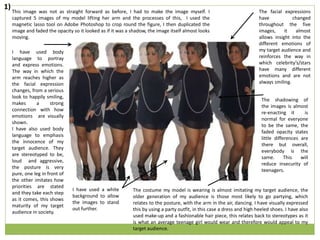
This image was not as straight forward as before, I had to make the image myself. I
captured 5 images of my model lifting her arm and the processes of this, I used the
magnetic lasso tool on Adobe Photoshop to crop round the figure, I then duplicated the
image and faded the opacity so it looked as if it was a shadow, the image itself almost looks
moving.
The facial expressions
have changed
throughout the five
images, it almost
allows insight into the
different emotions of
my target audience and
reinforces the way in
which celebrity’s/stars
have many different
emotions and are not
always smiling.
I have used a white
background to allow
the images to stand
out further.
I have used body
language to portray
and express emotions.
The way in which the
arm reaches higher as
the facial expression
changes, from a serious
look to happily smiling,
makes a strong
connection with how
emotions are visually
shown.
I have also used body
language to emphasis
the innocence of my
target audience. They
are stereotyped to be,
loud and aggressive,
the posture is very
pure, one leg in front of
the other imitates how
priorities are stated
and they take each step
as it comes, this shows
maturity of my target
audience in society.
The costume my model is wearing is almost imitating my target audience, the
older generation of my audience is those most likely to go partying, which
relates to the posture, with the arm in the air, dancing. I have visually expressed
this by using a party outfit, in this case a dress and high heeled shoes. I have also
used make-up and a fashionable hair piece, this relates back to stereotypes as it
is what an average teenage girl would wear and therefore would appeal to my
target audience.
The shadowing of
the images is almost
re-enacting it is
normal for everyone
to be the same, the
faded opacity states
little differences are
there but overall,
everybody is the
same. This will
reduce insecurity of
teenagers.
1)
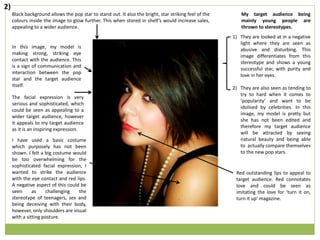
In this image, my model is
making strong, striking eye
contact with the audience. This
is a sign of communication and
interaction between the pop
star and the target audience
itself.
Red outstanding lips to appeal to
target audience. Red connotates
love and could be seen as
imitating the love for ‘turn it on,
turn it up’ magazine.
My target audience being
mainly young people are
thrown to stereotypes.
1) They are looked at in a negative
light where they are seen as
abusive and disturbing. This
image differentiates from this
stereotype and shows a young
successful star, with purity and
love in her eyes.
2) They are also seen as tending to
try to hard when it comes to
‘popularity’ and want to be
idolised by celebrities. In this
image, my model is pretty but
she has not been edited and
therefore my target audience
will be attracted by seeing
natural beauty and being able
to actually compare themselves
to the new pop stars.
Black background allows the pop star to stand out. It also the bright, star striking feel of the
colours inside the image to glow further. This when stored in shelf’s would increase sales,
appealing to a wider audience.
The facial expression is very
serious and sophisticated, which
could be seen as appealing to a
wider target audience, however
it appeals to my target audience
as it is an inspiring expression.
I have used a basic costume
which purposely has not been
shown. I felt a big costume would
be too overwhelming for the
sophisticated facial expression, I
wanted to strike the audience
with the eye contact and red lips.
A negative aspect of this could be
seen as challenging the
stereotype of teenagers, sex and
being deceiving with their body,
however, only shoulders are visual
with a sitting posture.
2)
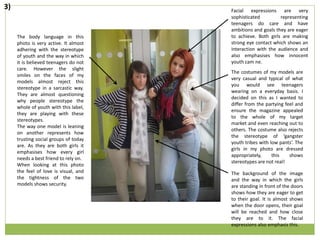
The body language in this
photo is very active. It almost
adhering with the stereotype
of youth and the way in which
it is believed teenagers do not
care. However the slight
smiles on the faces of my
models almost reject this
stereotype in a sarcastic way.
They are almost questioning
why people stereotype the
whole of youth with this label,
they are playing with these
stereotypes.
The way one model is leaning
on another represents how
trusting social groups of today
are. As they are both girls it
emphasises how every girl
needs a best friend to rely on.
When looking at this photo
the feel of love is visual, and
the tightness of the two
models shows security.
The costumes of my models are
very casual and typical of what
you would see teenagers
wearing on a everyday basis. I
decided on this as I wanted to
differ from the partying feel and
ensure the magazine appealed
to the whole of my target
market and even reaching out to
others. The costume also rejects
the stereotype of ‘gangster
youth tribes with low pants’. The
girls in my photo are dressed
appropriately, this shows
stereotypes are not real!
Facial expressions are very
sophisticated representing
teenagers do care and have
ambitions and goals they are eager
to achieve. Both girls are making
strong eye contact which shows an
interaction with the audience and
also emphasises how innocent
youth cam ne.
The background of the image
and the way in which the girls
are standing in front of the doors
shows how they are eager to get
to their goal. It is almost shows
when the door opens, their goal
will be reached and how close
they are to it. The facial
expressions also emphasis this.
3)
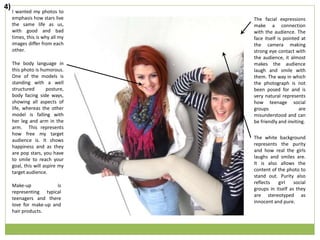
I wanted my photos to
emphasis how stars live
the same life as us,
with good and bad
times, this is why all my
images differ from each
other.
The body language in
this photo is humorous.
One of the models is
standing with a well
structured posture,
body facing side ways,
showing all aspects of
life, whereas the other
model is falling with
her leg and arm in the
arm. This represents
how free my target
audience is. It shows
happiness and as they
are pop stars, you have
to smile to reach your
goal, this will aspire my
target audience.
The facial expressions
make a connection
with the audience. The
face itself is pointed at
the camera making
strong eye contact with
the audience, it almost
makes the audience
laugh and smile with
them. The way in which
the photograph is not
been posed for and is
very natural represents
how teenage social
groups are
misunderstood and can
be friendly and inviting.
Make-up is
representing typical
teenagers and there
love for make-up and
hair products.
The white background
represents the purity
and how real the girls
laughs and smiles are.
It is also allows the
content of the photo to
stand out. Purity also
reflects girl social
groups in itself as they
are stereotyped as
innocent and pure.
4)

Annotation for photography

  • 1.
    How does yourmedia product represent particular social groups? My media product represents particularly young girls, who idolise fashion, music and friends. I feel this successfully captures my mode of address as these are what they are believed to adore. Girls idolise women pop stars as they want to be like them. This also appeals to male, as males are attracted to beautiful females which is what I have visually shown. This appeals to all teenage social groups. My media product represents youth in a positive light, it rejects the negative stereotypes teenagers are given visually and mentally. I have used body language, facial expressions and costume to emphasis this. In all my image, my models facial expressions are either sophisticated positively, showing they can and will achieve all their ambitions or happy where they have reached their ambitions. This change in facial expression also shows how teenagers change fast but stereotypes do not recognise this. It also reinforces the way in which stereotypes are not representative of social groups as a whole, they are small scale and therefore, should not be generalised. However, in ways it adheres these stereotypes. In my third photograph, the body language almost expresses youth in a negative light yet the sly smiles shining through the eyes, gives a contrasting feel, questioning ‘why do you think this of us, we are a successful, positive, shining generation?’. Costume is also used to enhance this, as girls are wearing hooded t-shirts, almost represent youth tribes (gangsters), yet fashionable scarf's. I feel this is a key aspect of my media product as it challenges stereotypes by adhering and rejecting together.
  • 2.
    This image wasnot as straight forward as before, I had to make the image myself. I captured 5 images of my model lifting her arm and the processes of this, I used the magnetic lasso tool on Adobe Photoshop to crop round the figure, I then duplicated the image and faded the opacity so it looked as if it was a shadow, the image itself almost looks moving. The facial expressions have changed throughout the five images, it almost allows insight into the different emotions of my target audience and reinforces the way in which celebrity’s/stars have many different emotions and are not always smiling. I have used a white background to allow the images to stand out further. I have used body language to portray and express emotions. The way in which the arm reaches higher as the facial expression changes, from a serious look to happily smiling, makes a strong connection with how emotions are visually shown. I have also used body language to emphasis the innocence of my target audience. They are stereotyped to be, loud and aggressive, the posture is very pure, one leg in front of the other imitates how priorities are stated and they take each step as it comes, this shows maturity of my target audience in society. The costume my model is wearing is almost imitating my target audience, the older generation of my audience is those most likely to go partying, which relates to the posture, with the arm in the air, dancing. I have visually expressed this by using a party outfit, in this case a dress and high heeled shoes. I have also used make-up and a fashionable hair piece, this relates back to stereotypes as it is what an average teenage girl would wear and therefore would appeal to my target audience. The shadowing of the images is almost re-enacting it is normal for everyone to be the same, the faded opacity states little differences are there but overall, everybody is the same. This will reduce insecurity of teenagers. 1)
  • 3.
    In this image,my model is making strong, striking eye contact with the audience. This is a sign of communication and interaction between the pop star and the target audience itself. Red outstanding lips to appeal to target audience. Red connotates love and could be seen as imitating the love for ‘turn it on, turn it up’ magazine. My target audience being mainly young people are thrown to stereotypes. 1) They are looked at in a negative light where they are seen as abusive and disturbing. This image differentiates from this stereotype and shows a young successful star, with purity and love in her eyes. 2) They are also seen as tending to try to hard when it comes to ‘popularity’ and want to be idolised by celebrities. In this image, my model is pretty but she has not been edited and therefore my target audience will be attracted by seeing natural beauty and being able to actually compare themselves to the new pop stars. Black background allows the pop star to stand out. It also the bright, star striking feel of the colours inside the image to glow further. This when stored in shelf’s would increase sales, appealing to a wider audience. The facial expression is very serious and sophisticated, which could be seen as appealing to a wider target audience, however it appeals to my target audience as it is an inspiring expression. I have used a basic costume which purposely has not been shown. I felt a big costume would be too overwhelming for the sophisticated facial expression, I wanted to strike the audience with the eye contact and red lips. A negative aspect of this could be seen as challenging the stereotype of teenagers, sex and being deceiving with their body, however, only shoulders are visual with a sitting posture. 2)
  • 4.
    The body languagein this photo is very active. It almost adhering with the stereotype of youth and the way in which it is believed teenagers do not care. However the slight smiles on the faces of my models almost reject this stereotype in a sarcastic way. They are almost questioning why people stereotype the whole of youth with this label, they are playing with these stereotypes. The way one model is leaning on another represents how trusting social groups of today are. As they are both girls it emphasises how every girl needs a best friend to rely on. When looking at this photo the feel of love is visual, and the tightness of the two models shows security. The costumes of my models are very casual and typical of what you would see teenagers wearing on a everyday basis. I decided on this as I wanted to differ from the partying feel and ensure the magazine appealed to the whole of my target market and even reaching out to others. The costume also rejects the stereotype of ‘gangster youth tribes with low pants’. The girls in my photo are dressed appropriately, this shows stereotypes are not real! Facial expressions are very sophisticated representing teenagers do care and have ambitions and goals they are eager to achieve. Both girls are making strong eye contact which shows an interaction with the audience and also emphasises how innocent youth cam ne. The background of the image and the way in which the girls are standing in front of the doors shows how they are eager to get to their goal. It is almost shows when the door opens, their goal will be reached and how close they are to it. The facial expressions also emphasis this. 3)
  • 5.
    I wanted myphotos to emphasis how stars live the same life as us, with good and bad times, this is why all my images differ from each other. The body language in this photo is humorous. One of the models is standing with a well structured posture, body facing side ways, showing all aspects of life, whereas the other model is falling with her leg and arm in the arm. This represents how free my target audience is. It shows happiness and as they are pop stars, you have to smile to reach your goal, this will aspire my target audience. The facial expressions make a connection with the audience. The face itself is pointed at the camera making strong eye contact with the audience, it almost makes the audience laugh and smile with them. The way in which the photograph is not been posed for and is very natural represents how teenage social groups are misunderstood and can be friendly and inviting. Make-up is representing typical teenagers and there love for make-up and hair products. The white background represents the purity and how real the girls laughs and smiles are. It is also allows the content of the photo to stand out. Purity also reflects girl social groups in itself as they are stereotyped as innocent and pure. 4)