HUMAN COMPUTER INTERACTION FACTORS
IN
TECHNOLOGY ENHANCED LEARNING
Linda Crearie
University of the West of Scotland
United Kingdom
Presenter: Mohsen Farahanchi
Course: HCI / Sprint 1398
Instructor: Dr. Kangavari
Iran University of Science and Technology
1
Abstract
Today there is an increasing emphasis on technology in the learning
process.
HCI provides many relevant theories that are significant in the
context of learning and retrieval of knowledge as well as influences
that are significant in relation to pedagogies.
Research, including work on making training and technology
interactive, suggests that when users are properly cognitively
involved, engaged, and challenged the outcomes are better.
Challenges include creating memorable learning experiences to
encourage long lasting mental representations that enhance learning.
2
3
HCI Definition
From my perspective, Human Computer Interaction
(HCI) can be defined as:
A discipline concerned with the study, design,
construction and implementation of human-centred
interactive computer systems. HCI goes beyond
designing screens and menus that are easier to use
and studies the reasoning behind building specific
functionality into computers and the long-term
effects that systems will have on humans.
4
Student experience with mobile devices means that they
are often familiar with instant access to online resources
and expect to be able to use them as part of their own
individual learning.
many of the important problems of learning / education
are not primarily addressed through innovations in
learning theory but by addressing important problems
through useful, usable, perhaps innovative designs
HCI provides a number of relevant theories of memory,
attention, perception, and knowledge that are particularly
significant when it comes to the acquisition, storage and
retrieval of knowledge – particularly heuristic knowledge
gained through experience – learning by doing.
5
The learning society is often referred to a society that
is “founded on the acquisition, renewal and use of
knowledge” (emphasis by author) moving the focus
from teaching/teacher to learning/learner and from
formal to a much more self-directed form of
“learning throughout life experiences”
Knowledge-based society providing easy access to
data, facts, and information as well as helping the
learner transform information into knowledge.
Knowledge about facts is becoming less important
than learning how to access, analyse and exploit
information and transform it into new knowledge.
6
HCI has long been concerned with accessibility and
principles for designing interactive technologies for
diverse users. Aspirations of overcoming the Digital
Divide, through providing universality and
accessibility for all, have become major concerns in
HCI.
Many tools we are familiar with today may be
enhanced to provide advanced data services. A good
example of this is the newspaper, which in the future
may have flexible content which can present data,
information and knowledge in many innovative forms,
for example, virtual reality, 3D, 4D and multiple
dimensions of visualization.
7
Active learning
The active learning approach is based to a
large extent on a social constructionist view of
learning and in particular much of the work
of Biggs (1996) on constructive alignment.
“The teacher’s task is not to transmit correct
understandings but to help students construct
understandings that are more or less acceptable”
—said Biggs.
8
“Research shows that active learning is much better
recalled, enjoyed and understood. Active methods
require us to 'make our own meaning’, that is, develop
our own conceptualizations of what we are learning”
During this process we
physically make neural
connections in our brain.
despite passive one.
Active methods also develop
thinking skills such as
analysis, problem solving,
and evaluation and are more
fun.
9
HCI influences on Pedagogies
Relevant to Online Learning
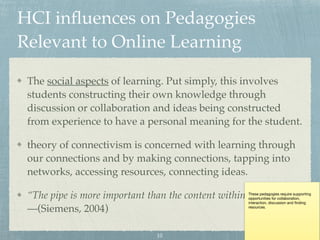
The social aspects of learning. Put simply, this involves
students constructing their own knowledge through
discussion or collaboration and ideas being constructed
from experience to have a personal meaning for the student.
theory of connectivism is concerned with learning through
our connections and by making connections, tapping into
networks, accessing resources, connecting ideas.
“The pipe is more important than the content within the pipe” 

—(Siemens, 2004)
These pedagogies require supporting
opportunities for collaboration,
interaction, discussion and finding
resources.
10
Learning and Technological Changes
A Report by Cisco called The Learning Society
(Halkett, 2010) the author suggested:
The future of education is networked. Using the
full power of video and mobility, people can
collaborate to create and share knowledge as well
as develop new ways of teaching and learning that
captures the attention and imagination of learners
anywhere, anytime on any device.
11
Learning Society
significant developments in learning research:
Learning is an active, social process. Learners learn
new knowledge, principles, and concepts for themselves
through dialogue and interaction with others.
Learners start from different places and take
different routes to the learning outcome.
To be effective, knowledge should be discovered
as an authentic, integrated whole.
12
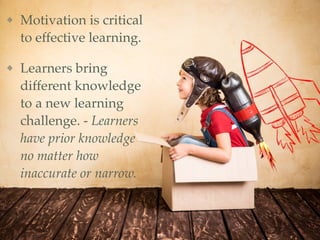
Motivation is critical
to effective learning.
Learners bring
different knowledge
to a new learning
challenge. - Learners
have prior knowledge
no matter how
inaccurate or narrow.
13
Technology Enhanced Learning
JISC (2010) defined a technology enhanced learning culture
where a wide range of learners (e.g., full-time, part-time,
professionals, overseas) is provided with a robust technology
environment that provides the learning opportunities wherever
the learner chooses.
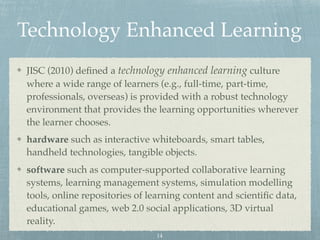
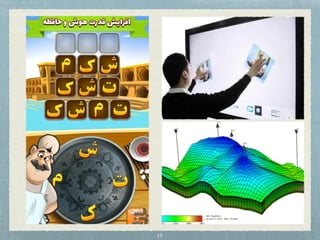
hardware such as interactive whiteboards, smart tables,
handheld technologies, tangible objects.
software such as computer-supported collaborative learning
systems, learning management systems, simulation modelling
tools, online repositories of learning content and scientific data,
educational games, web 2.0 social applications, 3D virtual
reality.
14
15
This can be summarised as encouraging
student-faculty contact, cooperation among
students, active learning, giving prompt
feedback, emphasizing timings,
communicating high expectations and
respecting diverse talents and ways of
learning.
16
Effective interactive learning
Maria Montessori — Her educational approach
encourages experimentation and independent thinking
rather than the more mainstream pre-determined textbook
curriculum.
HCI can contribute greatly in this area since there is a
recognition and acceptance of human differences and
diversity that education needs to take account of.
The challenge is to create mental representations that are
long lasting and effect behaviour, something best done by
creating memorable learning experiences targeting
specific brain structures
17
Technologies: An example Clickers
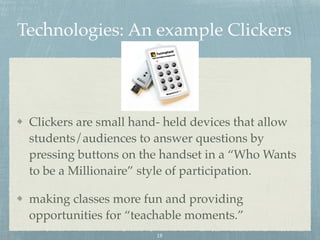
Clickers are small hand- held devices that allow
students/audiences to answer questions by
pressing buttons on the handset in a “Who Wants
to be a Millionaire” style of participation.
making classes more fun and providing
opportunities for “teachable moments.”
18
HCI experiment: Memory
enhancement using visualisation
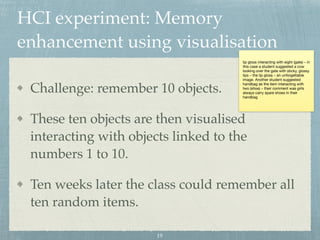
Challenge: remember 10 objects.
These ten objects are then visualised
interacting with objects linked to the
numbers 1 to 10.
Ten weeks later the class could remember all
ten random items.
lip gloss interacting with eight (gate) – in
this case a student suggested a cow
looking over the gate with sticky, glossy
lips – the lip gloss – an unforgettable
image. Another student suggested
handbag as the item interacting with
two (shoe) – their comment was girls
always carry spare shoes in their
handbag
19
”A picture is worth a thousand stories“
a fact about human memory
20
The goal of visualisation
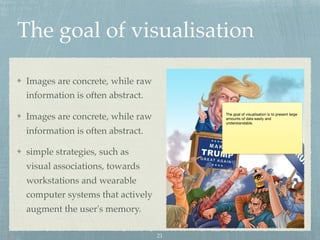
Images are concrete, while raw
information is often abstract.
Images are concrete, while raw
information is often abstract.
simple strategies, such as
visual associations, towards
workstations and wearable
computer systems that actively
augment the user's memory.
The goal of visualisation is to present large
amounts of data easily and
understandable.
21
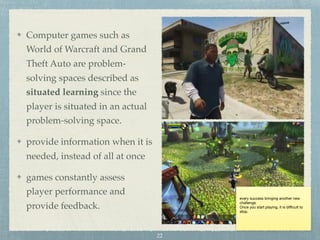
every success bringing another new
challenge.

Once you start playing, it is difficult to
stop.
Computer games such as
World of Warcraft and Grand
Theft Auto are problem-
solving spaces described as
situated learning since the
player is situated in an actual
problem-solving space.
provide information when it is
needed, instead of all at once
games constantly assess
player performance and
provide feedback.
22
Engagement concept
Engagement is an important concept in HCI, enabling
more sophisticated interfaces capable of adapting to
users.
Engagement has often been described as occurring
when the brain is rewarded
This could be through providing explicit praise or
through more implicit elements that engage or
entertain the user. Novelty, social interaction, feedback
and surprise are all potentially rewarding to the user.
23
Affective learning
affective learning as a way to design systems to
elicit positive responses from users (feeling at
ease, being comfortable, enjoying the
experience) and topics such as user
frustration caused by an interface and how
interface agents (anthropomorphism) and
synthetic characters affect us.
‫عنوان‬ ‫به‬ ‫عاطفی‬ ‫یادگیری‬ ‫مورد‬ ‫در‬ ‫کامپیوتری‬ ‫تعامل‬
‫از‬ ‫مثبت‬ ‫پاسخ‬ ‫برای‬ ‫ها‬ ‫سیستم‬ ‫طراحی‬ ‫برای‬ ‫راهی‬
‫از‬ ‫بردن‬ ‫لذت‬ ،‫بودن‬ ‫راحت‬ ،‫راحتی‬ ‫)احساس‬ ‫کاربران‬
‫از‬ ‫ناشی‬ ‫کاربر‬ ‫ناامیدی‬ ‫مانند‬ ‫موضوعاتی‬ ‫و‬ ،(‫تجربه‬

‫رابط‬ ‫یک‬
‫های‬ ‫شخصیت‬ ‫و‬ (‫شناسی‬ ‫)انسان‬ ‫رابط‬ ‫عوامل‬ ‫چگونه‬
‫گذارد‬ ‫می‬ ‫تاثیر‬ ‫ما‬ ‫بر‬ ‫مصنوعی‬
24
Usability
HCI is often focused on software interfaces
Intuitive design relies on understanding human
psychology.
Usability is a measure of the effectiveness, efficiency and
satisfaction with which specified users can achieve
specified goals in a particular environment.
The relationships between the user’s goals, the required
actions, and the results are sensible, meaningful and not
arbitrary.
25
Three principles of interactive design 

The Design of Everyday Things (Norman, 2002, pp. 4-10)
1. Visibility: It should be obvious what a control is used for.
Good visibility allows the user to easily translate goals into
actions.
2. Affordance: It should be obvious how a control is used. A
button affords (suggests) pushing, a lever affords pulling, etc.
The user should know how to operate a control just by looking
at it.
3. Feedback: It should be obvious when a control has been used.
This relates to the information sent back to the user about what
has been achieved, e.g., sound, highlighting, animation etc.
26
modification or customisation
Users create things like new
maps or scenarios.
HCI it is recognised that
users are different, hence a
diverse, inclusive,
individualised environment
will have many benefits.
27
Interface ideas from games
Ideas that could be applied more widely including the suggestion that
games allow:
Effortless community – easy to form, join, and participate in
communities of users;
Learning by watching – ‘over the shoulder’ of more experienced
users as they work;
Deep customizability – allow users to modify interfaces and share
these with others; and
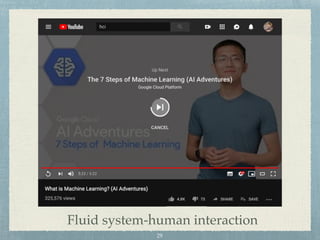
Fluid system-human interaction – communicate information to users
in ways that do not demand the user’s attention and do not interrupt
the flow of work.
28
Fluid system-human interaction
29
Conclusion
Studies have shown that attention spans of the
average student have decreased as we become
more used to expecting instantaneous access to
information online.
In a well-designed technology-enhanced learning
environment learners should be able to engage in
the process of manipulating information and
critical thinking as well as expressing and sharing
their knowledge to peer-learners.
30
By working together, many disciplines such
as HCI, Learning, and Games can hopefully
make this a much more enjoyable and
engaging experience. These are exciting times
for education and there is little doubt that
educational practice will evolve as
technological innovations continue to evolve.
HCI has much to contribute.
31

Human Computer Interface factors in virtual learning environment

  • 1.
    HUMAN COMPUTER INTERACTIONFACTORS IN TECHNOLOGY ENHANCED LEARNING Linda Crearie University of the West of Scotland United Kingdom Presenter: Mohsen Farahanchi Course: HCI / Sprint 1398 Instructor: Dr. Kangavari Iran University of Science and Technology 1
  • 2.
    Abstract Today there isan increasing emphasis on technology in the learning process. HCI provides many relevant theories that are significant in the context of learning and retrieval of knowledge as well as influences that are significant in relation to pedagogies. Research, including work on making training and technology interactive, suggests that when users are properly cognitively involved, engaged, and challenged the outcomes are better. Challenges include creating memorable learning experiences to encourage long lasting mental representations that enhance learning. 2
  • 3.
  • 4.
    HCI Definition From myperspective, Human Computer Interaction (HCI) can be defined as: A discipline concerned with the study, design, construction and implementation of human-centred interactive computer systems. HCI goes beyond designing screens and menus that are easier to use and studies the reasoning behind building specific functionality into computers and the long-term effects that systems will have on humans. 4
  • 5.
    Student experience withmobile devices means that they are often familiar with instant access to online resources and expect to be able to use them as part of their own individual learning. many of the important problems of learning / education are not primarily addressed through innovations in learning theory but by addressing important problems through useful, usable, perhaps innovative designs HCI provides a number of relevant theories of memory, attention, perception, and knowledge that are particularly significant when it comes to the acquisition, storage and retrieval of knowledge – particularly heuristic knowledge gained through experience – learning by doing. 5
  • 6.
    The learning societyis often referred to a society that is “founded on the acquisition, renewal and use of knowledge” (emphasis by author) moving the focus from teaching/teacher to learning/learner and from formal to a much more self-directed form of “learning throughout life experiences” Knowledge-based society providing easy access to data, facts, and information as well as helping the learner transform information into knowledge. Knowledge about facts is becoming less important than learning how to access, analyse and exploit information and transform it into new knowledge. 6
  • 7.
    HCI has longbeen concerned with accessibility and principles for designing interactive technologies for diverse users. Aspirations of overcoming the Digital Divide, through providing universality and accessibility for all, have become major concerns in HCI. Many tools we are familiar with today may be enhanced to provide advanced data services. A good example of this is the newspaper, which in the future may have flexible content which can present data, information and knowledge in many innovative forms, for example, virtual reality, 3D, 4D and multiple dimensions of visualization. 7
  • 8.
    Active learning The activelearning approach is based to a large extent on a social constructionist view of learning and in particular much of the work of Biggs (1996) on constructive alignment. “The teacher’s task is not to transmit correct understandings but to help students construct understandings that are more or less acceptable” —said Biggs. 8
  • 9.
    “Research shows thatactive learning is much better recalled, enjoyed and understood. Active methods require us to 'make our own meaning’, that is, develop our own conceptualizations of what we are learning” During this process we physically make neural connections in our brain. despite passive one. Active methods also develop thinking skills such as analysis, problem solving, and evaluation and are more fun. 9
  • 10.
    HCI influences onPedagogies Relevant to Online Learning The social aspects of learning. Put simply, this involves students constructing their own knowledge through discussion or collaboration and ideas being constructed from experience to have a personal meaning for the student. theory of connectivism is concerned with learning through our connections and by making connections, tapping into networks, accessing resources, connecting ideas. “The pipe is more important than the content within the pipe” 
 —(Siemens, 2004) These pedagogies require supporting opportunities for collaboration, interaction, discussion and finding resources. 10
  • 11.
    Learning and TechnologicalChanges A Report by Cisco called The Learning Society (Halkett, 2010) the author suggested: The future of education is networked. Using the full power of video and mobility, people can collaborate to create and share knowledge as well as develop new ways of teaching and learning that captures the attention and imagination of learners anywhere, anytime on any device. 11
  • 12.
    Learning Society significant developmentsin learning research: Learning is an active, social process. Learners learn new knowledge, principles, and concepts for themselves through dialogue and interaction with others. Learners start from different places and take different routes to the learning outcome. To be effective, knowledge should be discovered as an authentic, integrated whole. 12
  • 13.
    Motivation is critical toeffective learning. Learners bring different knowledge to a new learning challenge. - Learners have prior knowledge no matter how inaccurate or narrow. 13
  • 14.
    Technology Enhanced Learning JISC(2010) defined a technology enhanced learning culture where a wide range of learners (e.g., full-time, part-time, professionals, overseas) is provided with a robust technology environment that provides the learning opportunities wherever the learner chooses. hardware such as interactive whiteboards, smart tables, handheld technologies, tangible objects. software such as computer-supported collaborative learning systems, learning management systems, simulation modelling tools, online repositories of learning content and scientific data, educational games, web 2.0 social applications, 3D virtual reality. 14
  • 15.
  • 16.
    This can besummarised as encouraging student-faculty contact, cooperation among students, active learning, giving prompt feedback, emphasizing timings, communicating high expectations and respecting diverse talents and ways of learning. 16
  • 17.
    Effective interactive learning MariaMontessori — Her educational approach encourages experimentation and independent thinking rather than the more mainstream pre-determined textbook curriculum. HCI can contribute greatly in this area since there is a recognition and acceptance of human differences and diversity that education needs to take account of. The challenge is to create mental representations that are long lasting and effect behaviour, something best done by creating memorable learning experiences targeting specific brain structures 17
  • 18.
    Technologies: An exampleClickers Clickers are small hand- held devices that allow students/audiences to answer questions by pressing buttons on the handset in a “Who Wants to be a Millionaire” style of participation. making classes more fun and providing opportunities for “teachable moments.” 18
  • 19.
    HCI experiment: Memory enhancementusing visualisation Challenge: remember 10 objects. These ten objects are then visualised interacting with objects linked to the numbers 1 to 10. Ten weeks later the class could remember all ten random items. lip gloss interacting with eight (gate) – in this case a student suggested a cow looking over the gate with sticky, glossy lips – the lip gloss – an unforgettable image. Another student suggested handbag as the item interacting with two (shoe) – their comment was girls always carry spare shoes in their handbag 19
  • 20.
    ”A picture isworth a thousand stories“ a fact about human memory 20
  • 21.
    The goal ofvisualisation Images are concrete, while raw information is often abstract. Images are concrete, while raw information is often abstract. simple strategies, such as visual associations, towards workstations and wearable computer systems that actively augment the user's memory. The goal of visualisation is to present large amounts of data easily and understandable. 21
  • 22.
    every success bringinganother new challenge. Once you start playing, it is difficult to stop. Computer games such as World of Warcraft and Grand Theft Auto are problem- solving spaces described as situated learning since the player is situated in an actual problem-solving space. provide information when it is needed, instead of all at once games constantly assess player performance and provide feedback. 22
  • 23.
    Engagement concept Engagement isan important concept in HCI, enabling more sophisticated interfaces capable of adapting to users. Engagement has often been described as occurring when the brain is rewarded This could be through providing explicit praise or through more implicit elements that engage or entertain the user. Novelty, social interaction, feedback and surprise are all potentially rewarding to the user. 23
  • 24.
    Affective learning affective learningas a way to design systems to elicit positive responses from users (feeling at ease, being comfortable, enjoying the experience) and topics such as user frustration caused by an interface and how interface agents (anthropomorphism) and synthetic characters affect us. ‫عنوان‬ ‫به‬ ‫عاطفی‬ ‫یادگیری‬ ‫مورد‬ ‫در‬ ‫کامپیوتری‬ ‫تعامل‬ ‫از‬ ‫مثبت‬ ‫پاسخ‬ ‫برای‬ ‫ها‬ ‫سیستم‬ ‫طراحی‬ ‫برای‬ ‫راهی‬ ‫از‬ ‫بردن‬ ‫لذت‬ ،‫بودن‬ ‫راحت‬ ،‫راحتی‬ ‫)احساس‬ ‫کاربران‬ ‫از‬ ‫ناشی‬ ‫کاربر‬ ‫ناامیدی‬ ‫مانند‬ ‫موضوعاتی‬ ‫و‬ ،(‫تجربه‬ ‫رابط‬ ‫یک‬ ‫های‬ ‫شخصیت‬ ‫و‬ (‫شناسی‬ ‫)انسان‬ ‫رابط‬ ‫عوامل‬ ‫چگونه‬ ‫گذارد‬ ‫می‬ ‫تاثیر‬ ‫ما‬ ‫بر‬ ‫مصنوعی‬ 24
  • 25.
    Usability HCI is oftenfocused on software interfaces Intuitive design relies on understanding human psychology. Usability is a measure of the effectiveness, efficiency and satisfaction with which specified users can achieve specified goals in a particular environment. The relationships between the user’s goals, the required actions, and the results are sensible, meaningful and not arbitrary. 25
  • 26.
    Three principles ofinteractive design 
 The Design of Everyday Things (Norman, 2002, pp. 4-10) 1. Visibility: It should be obvious what a control is used for. Good visibility allows the user to easily translate goals into actions. 2. Affordance: It should be obvious how a control is used. A button affords (suggests) pushing, a lever affords pulling, etc. The user should know how to operate a control just by looking at it. 3. Feedback: It should be obvious when a control has been used. This relates to the information sent back to the user about what has been achieved, e.g., sound, highlighting, animation etc. 26
  • 27.
    modification or customisation Userscreate things like new maps or scenarios. HCI it is recognised that users are different, hence a diverse, inclusive, individualised environment will have many benefits. 27
  • 28.
    Interface ideas fromgames Ideas that could be applied more widely including the suggestion that games allow: Effortless community – easy to form, join, and participate in communities of users; Learning by watching – ‘over the shoulder’ of more experienced users as they work; Deep customizability – allow users to modify interfaces and share these with others; and Fluid system-human interaction – communicate information to users in ways that do not demand the user’s attention and do not interrupt the flow of work. 28
  • 29.
  • 30.
    Conclusion Studies have shownthat attention spans of the average student have decreased as we become more used to expecting instantaneous access to information online. In a well-designed technology-enhanced learning environment learners should be able to engage in the process of manipulating information and critical thinking as well as expressing and sharing their knowledge to peer-learners. 30
  • 31.
    By working together,many disciplines such as HCI, Learning, and Games can hopefully make this a much more enjoyable and engaging experience. These are exciting times for education and there is little doubt that educational practice will evolve as technological innovations continue to evolve. HCI has much to contribute. 31