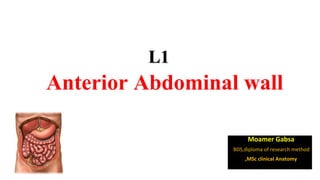
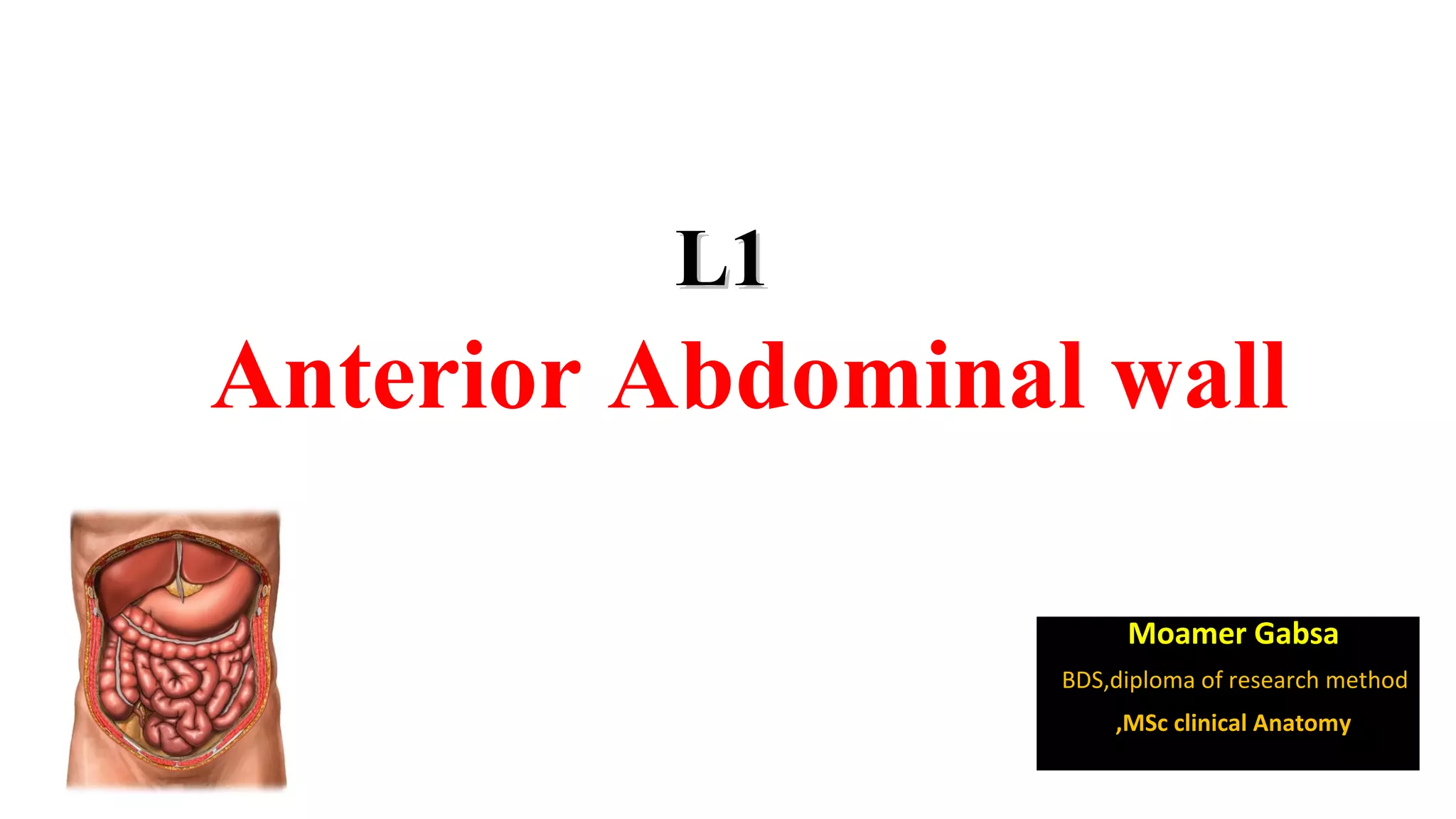
Anterior Abdominal wall
Moamer Gabsa
BDS,diploma of research method
,MSc clinical Anatomy
L1L1
• Introduction
• Regions of abdomen
• Quadrants of the abdominal cavity
• Muscles of the Anterolateral Abdominal Wall
Lecture MapLecture Map
Introduction
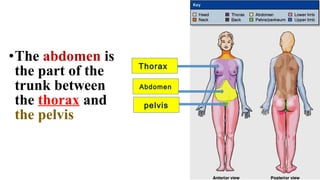
•The abdomen is
the part of the
trunk between
the thorax and
the pelvis
Thorax
Abdomen
pelvis
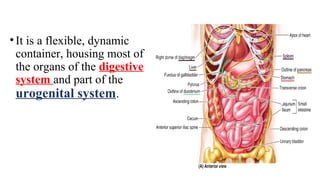
•It is a flexible, dynamic
container, housing most of
the organs of the digestive
system and part of the
urogenital system.
• Introduction
• Regions of abdomen
• Quadrants of the abdominal cavity
• Muscles of the Anterolateral Abdominal Wall
Lecture MapLecture Map
Regions of abdomen
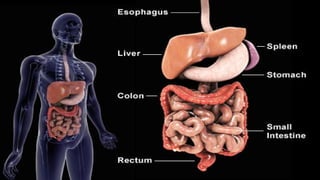
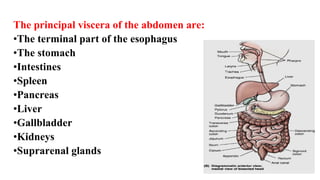
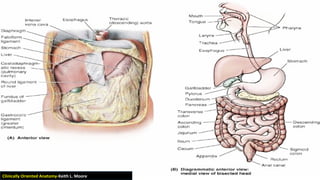
The principal viscera of the abdomen are:
•The terminal part of the esophagus
•The stomach
•Intestines
•Spleen
•Pancreas
•Liver
•Gallbladder
•Kidneys
•Suprarenal glands
Clinically Oriented Anatomy-Keith L. Moore
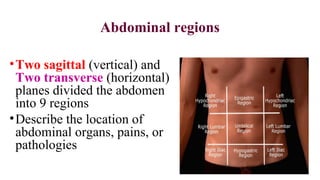
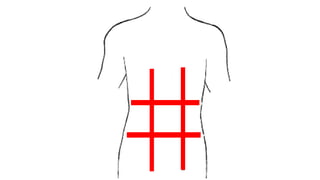
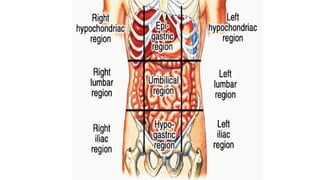
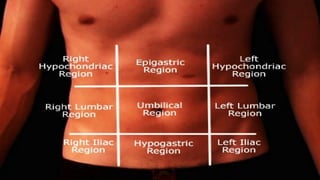
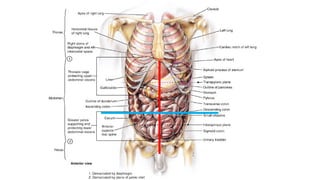
Abdominal regions
•Two sagittal (vertical) and
Two transverse (horizontal)
planes divided the abdomen
into 9 regions
•Describe the location of
abdominal organs, pains, or
pathologies
Vertical planes
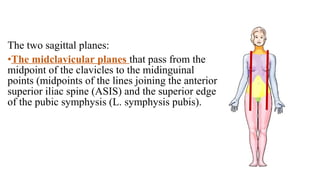
The two sagittal planes:
•The midclavicular planes that pass from the
midpoint of the clavicles to the midinguinal
points (midpoints of the lines joining the anterior
superior iliac spine (ASIS) and the superior edge
of the pubic symphysis (L. symphysis pubis).
Transverse planes
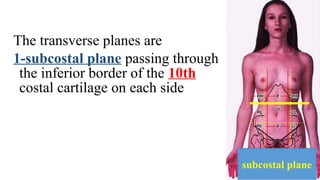
The transverse planes are
1-subcostal plane passing through
the inferior border of the 10th
costal cartilage on each side
subcostal plane
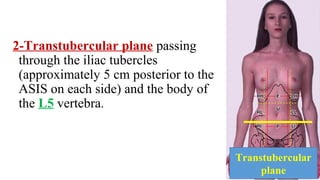
2-Transtubercular plane passing
through the iliac tubercles
(approximately 5 cm posterior to the
ASIS on each side) and the body of
the L5 vertebra.
Transtubercular
plane
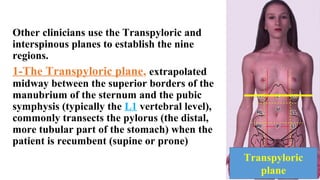
Other clinicians use the Transpyloric and
interspinous planes to establish the nine
regions.
1-The Transpyloric plane, extrapolated
midway between the superior borders of the
manubrium of the sternum and the pubic
symphysis (typically the L1 vertebral level),
commonly transects the pylorus (the distal,
more tubular part of the stomach) when the
patient is recumbent (supine or prone)
Transpyloric
plane
The transpyloric plane is a useful landmark because it also
transects many other important structures:
•The fundus of the gallbladder,
•Neck of the pancreas
•Origins of the superior mesenteric artery (SMA)
•Portal vein
•Root of the transverse mesocolon
•Duodenojejunal junction
•Hila of the kidneys.
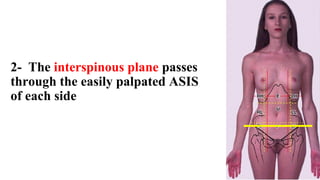
2- The interspinous plane passes
through the easily palpated ASIS
of each side
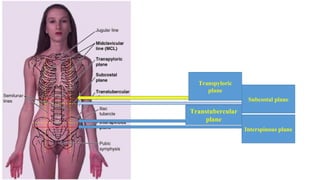
Subcostal plane
Transpyloric
plane
Transtubercular
plane
Interspinous plane
• Introduction
• Regions of abdomen
• Quadrants of the abdominal cavity
• Muscles of the Anterolateral Abdominal Wall
Lecture MapLecture Map
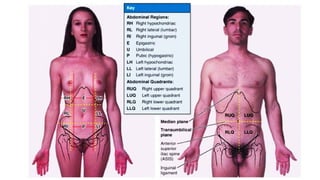
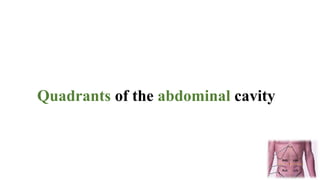
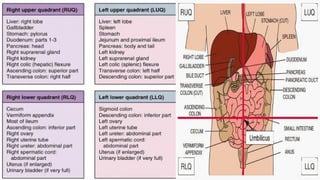
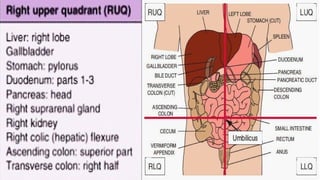
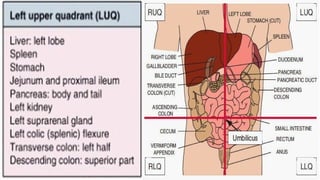
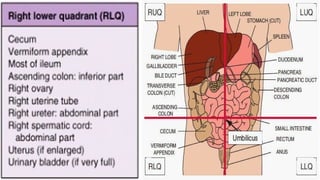
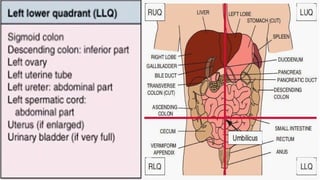
Quadrants of the abdominal cavity
Four quadrants of the abdominal cavity (right and left
upper and lower quadrants) are defined by two readily
defined planes:
• (1) The transverse transumbilical plane passing
through the umbilicus (and the intervertebral [IV] disc
between the L3 and L4 vertebrae), dividing it into upper
and lower halves,
• (2) The vertical median plane passing longitudinally
through the body, dividing it into right and left halves
• Introduction
• Regions of abdomen
• Quadrants of the abdominal cavity
• Muscles of the Anterolateral Abdominal Wall
Lecture MapLecture Map
Anterolateral Abdominal Wall
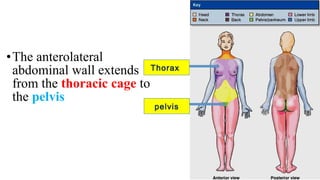
•The anterolateral
abdominal wall extends
from the thoracic cage to
the pelvis
Thorax
pelvis
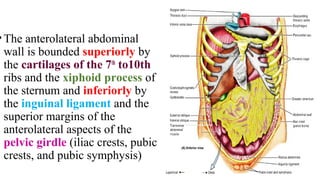
•The anterolateral abdominal
wall is bounded superiorly by
the cartilages of the 7th
to10th
ribs and the xiphoid process of
the sternum and inferiorly by
the inguinal ligament and the
superior margins of the
anterolateral aspects of the
pelvic girdle (iliac crests, pubic
crests, and pubic symphysis)
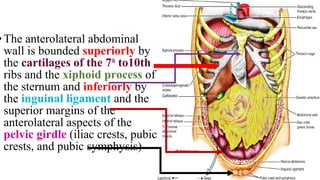
•The anterolateral abdominal
wall is bounded superiorly by
the cartilages of the 7th
to10th
ribs and the xiphoid process of
the sternum and inferiorly by
the inguinal ligament and the
superior margins of the
anterolateral aspects of the
pelvic girdle (iliac crests, pubic
crests, and pubic symphysis)
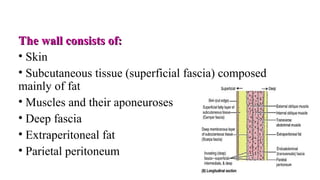
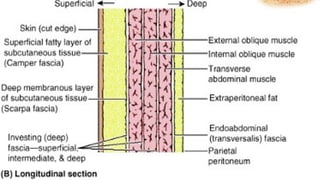
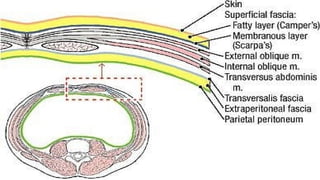
The wall consists of:The wall consists of:
• Skin
• Subcutaneous tissue (superficial fascia) composed
mainly of fat
• Muscles and their aponeuroses
• Deep fascia
• Extraperitoneal fat
• Parietal peritoneum
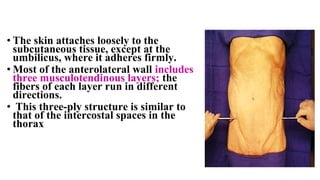
• The skin attaches loosely to the
subcutaneous tissue, except at the
umbilicus, where it adheres firmly.
• Most of the anterolateral wall includes
three musculotendinous layers; the
fibers of each layer run in different
directions.
• This three-ply structure is similar to
that of the intercostal spaces in the
thorax
Muscles of the Anterolateral Abdominal
Wall
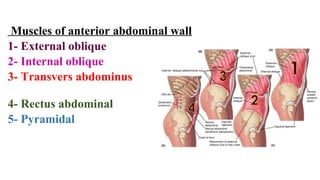
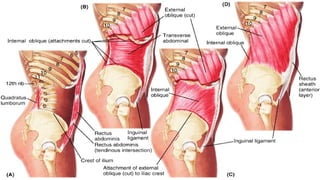
Muscles of anterior abdominal wall
1- External oblique
2- Internal oblique
3- Transvers abdominus
4- Rectus abdominal
5- Pyramidal
External oblique muscle
• Origin : external surfaces of 5th
to 12th
ribs.
• Insertion: linea and alba, pubic tubercle, and
anterior half of iliac crest.
• Nerve supply: thoracoabdominal nerves
(inferior 5 [T7 to T11] thoracic nerves) and
subcostal nerve.
• Action: compress and support abdominal
viscera, flex and rotate trunk.
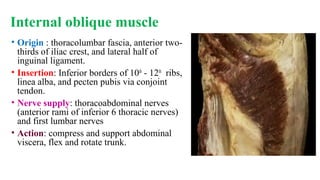
Internal oblique muscle
• Origin : thoracolumbar fascia, anterior two-
thirds of iliac crest, and lateral half of
inguinal ligament.
• Insertion: Inferior borders of 10th
- 12th
ribs,
linea alba, and pecten pubis via conjoint
tendon.
• Nerve supply: thoracoabdominal nerves
(anterior rami of inferior 6 thoracic nerves)
and first lumbar nerves
• Action: compress and support abdominal
viscera, flex and rotate trunk.
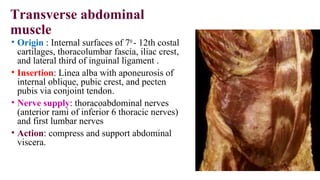
Transverse abdominal
muscle
• Origin : Internal surfaces of 7th
- 12th costal
cartilages, thoracolumbar fascia, iliac crest,
and lateral third of inguinal ligament .
• Insertion: Linea alba with aponeurosis of
internal oblique, pubic crest, and pecten
pubis via conjoint tendon.
• Nerve supply: thoracoabdominal nerves
(anterior rami of inferior 6 thoracic nerves)
and first lumbar nerves
• Action: compress and support abdominal
viscera.
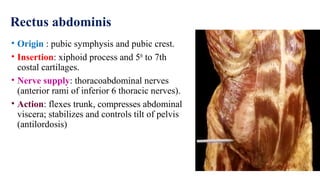
Rectus abdominis
• Origin : pubic symphysis and pubic crest.
• Insertion: xiphoid process and 5th
to 7th
costal cartilages.
• Nerve supply: thoracoabdominal nerves
(anterior rami of inferior 6 thoracic nerves).
• Action: flexes trunk, compresses abdominal
viscera; stabilizes and controls tilt of pelvis
(antilordosis)
Muscle origin insertion Nerve supply action
Rectus abdominis Pubic symphysis and
pubic crest
Xiphoid process and 5th
to
7th costal cartilages
Thoracoabdominal
nerves (anterior rami of
inferior 6 thoracic
nerves)
Flexes tru
Compresses ab
viscera; stabili
controls tilt of
(antilordo
Transverse
abdominal
Internal surfaces of 7th
12th costal cartilages,
thoracolumbar fascia,
iliac crest, and lateral
third of inguinal
ligament
Linea alba with
aponeurosis of internal
oblique, pubic crest, and
pecten pubis via conjoint
tendon
Thoracoabdominal
nerves (anterior rami of
inferior 6 thoracic
nerves) and first lumbar
nerves
Compresses and
abdominal v
Internal oblique Thoracolumbar fascia,
anterior two-thirds of
iliac crest, and lateral
half of inguinal
ligament
Inferior borders of
10th–12th ribs, linea
alba, and pecten pubis via
conjoint tendon
Compress and
abdominal viscer
rotate tru
External oblique External surfaces of
5th–12th ribs
Linea and alba, pubic
tubercle, and anterior
half of iliac crest
Thoracoabdominal
nerves (inferior 5
[T7–T11] thoracic
nerves) and subcostal
• Approximately 80% of people have an
insignificant muscle, the pyramidalis
which is located in the rectus sheath anterior
to the most inferior part of the rectus
abdominis.
• It extends from the pubic crest of the hip
bone to the linea alba.
• This small muscle draws down on the linea
alba.
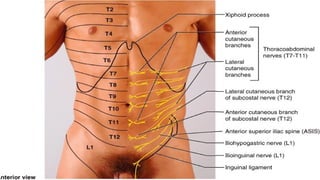
Nerve supply
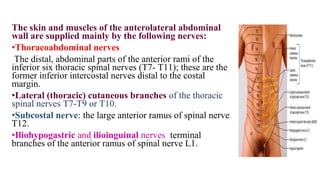
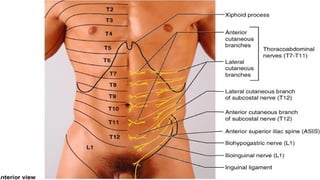
The skin and muscles of the anterolateral abdominal
wall are supplied mainly by the following nerves:
•Thoracoabdominal nerves
The distal, abdominal parts of the anterior rami of the
inferior six thoracic spinal nerves (T7- T11); these are the
former inferior intercostal nerves distal to the costal
margin.
•Lateral (thoracic) cutaneous branches of the thoracic
spinal nerves T7-T9 or T10.
•Subcostal nerve: the large anterior ramus of spinal nerve
T12.
•Iliohypogastric and ilioinguinal nerves: terminal
branches of the anterior ramus of spinal nerve L1.
• The thoracoabdominal nerves pass inferoanteriorly from the
intercostal spaces and run in the neurovascular plane between
the internal oblique and the transverse abdominal muscles to
supply the abdominal skin and muscles.
The anterior abdominal cutaneous branches of
thoracoabdominal nerve(s):
•T7-T9 supply the skin superior to the umbilicus.
•T10 innervates the skin around the umbilicus.
•T11, plus the cutaneous branches of the subcostal
(T12), iliohypogastric , and ilioinguinal (L1), supply
the skin inferior to the umbilicus.
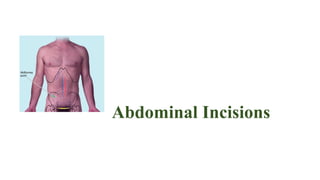
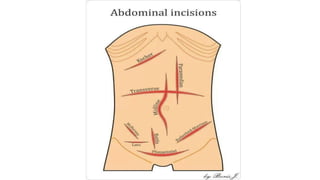
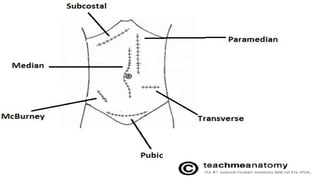
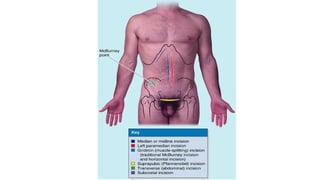
Abdominal Incisions
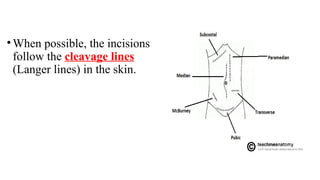
• When possible, the incisions
follow the cleavage lines
(Langer lines) in the skin.
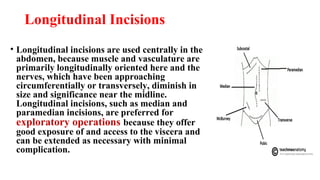
Longitudinal Incisions
• Longitudinal incisions are used centrally in the
abdomen, because muscle and vasculature are
primarily longitudinally oriented here and the
nerves, which have been approaching
circumferentially or transversely, diminish in
size and significance near the midline.
Longitudinal incisions, such as median and
paramedian incisions, are preferred for
exploratory operations because they offer
good exposure of and access to the viscera and
can be extended as necessary with minimal
complication.
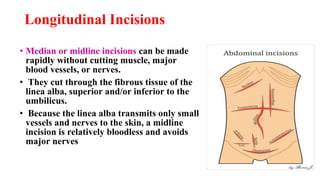
• Median or midline incisions can be made
rapidly without cutting muscle, major
blood vessels, or nerves.
• They cut through the fibrous tissue of the
linea alba, superior and/or inferior to the
umbilicus.
• Because the linea alba transmits only small
vessels and nerves to the skin, a midline
incision is relatively bloodless and avoids
major nerves
Longitudinal Incisions
Oblique and Transverse Incisions
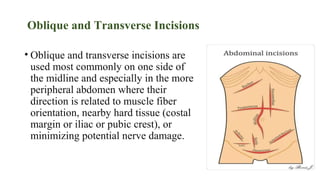
• Oblique and transverse incisions are
used most commonly on one side of
the midline and especially in the more
peripheral abdomen where their
direction is related to muscle fiber
orientation, nearby hard tissue (costal
margin or iliac or pubic crest), or
minimizing potential nerve damage.
Blood Supply
Arterial & Venous Supply
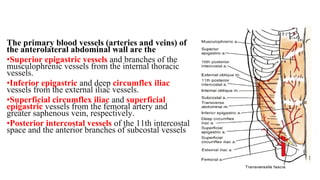
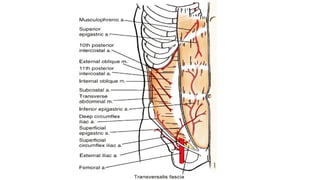
The primary blood vessels (arteries and veins) of
the anterolateral abdominal wall are the
•Superior epigastric vessels and branches of the
musculophrenic vessels from the internal thoracic
vessels.
•Inferior epigastric and deep circumflex iliac
vessels from the external iliac vessels.
•Superficial circumflex iliac and superficial
epigastric vessels from the femoral artery and
greater saphenous vein, respectively.
•Posterior intercostal vessels of the 11th intercostal
space and the anterior branches of subcostal vessels
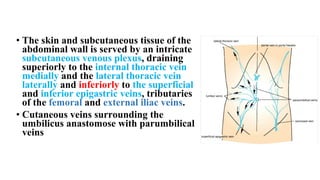
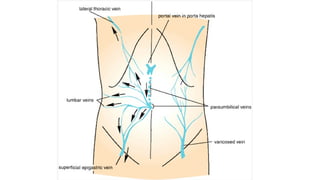
• The skin and subcutaneous tissue of the
abdominal wall is served by an intricate
subcutaneous venous plexus, draining
superiorly to the internal thoracic vein
medially and the lateral thoracic vein
laterally and inferiorly to the superficial
and inferior epigastric veins, tributaries
of the femoral and external iliac veins.
• Cutaneous veins surrounding the
umbilicus anastomose with parumbilical
veins
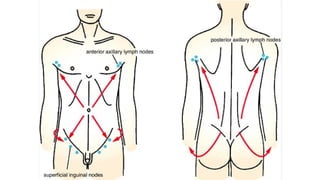
Lymphatic drainage
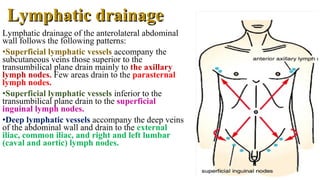
Lymphatic drainage of the anterolateral abdominal
wall follows the following patterns:
•Superficial lymphatic vessels accompany the
subcutaneous veins those superior to the
transumbilical plane drain mainly to the axillary
lymph nodes. Few areas drain to the parasternal
lymph nodes.
•Superficial lymphatic vessels inferior to the
transumbilical plane drain to the superficial
inguinal lymph nodes.
•Deep lymphatic vessels accompany the deep veins
of the abdominal wall and drain to the external
iliac, common iliac, and right and left lumbar
(caval and aortic) lymph nodes.
Lymphatic drainageLymphatic drainage
Any question ?
Reference
• Moore, Keith L.; Dalley, Arthur F, Clinically Oriented Anatomy, 5th
Ed. Lippincott Williams & Wilkins; 2006.
• Harold Ellis, Clinical Anatomy, Applied anatomy for students and
junior doctors, 11th Ed, Blackwell Publishing Ltd, 2006
• Richard S.Snell, Clinical Anatomy by Regions, 8th Ed. Lippincott
Williams & Wilkins.
THANK YOUTHANK YOU

Anterior abdominal wall

  • 1.
    Anterior Abdominal wall MoamerGabsa BDS,diploma of research method ,MSc clinical Anatomy L1L1
  • 2.
    • Introduction • Regionsof abdomen • Quadrants of the abdominal cavity • Muscles of the Anterolateral Abdominal Wall Lecture MapLecture Map
  • 3.
  • 4.
    •The abdomen is thepart of the trunk between the thorax and the pelvis Thorax Abdomen pelvis
  • 5.
    •It is aflexible, dynamic container, housing most of the organs of the digestive system and part of the urogenital system.
  • 8.
    • Introduction • Regionsof abdomen • Quadrants of the abdominal cavity • Muscles of the Anterolateral Abdominal Wall Lecture MapLecture Map
  • 9.
  • 10.
    The principal visceraof the abdomen are: •The terminal part of the esophagus •The stomach •Intestines •Spleen •Pancreas •Liver •Gallbladder •Kidneys •Suprarenal glands
  • 11.
  • 12.
    Abdominal regions •Two sagittal(vertical) and Two transverse (horizontal) planes divided the abdomen into 9 regions •Describe the location of abdominal organs, pains, or pathologies
  • 14.
  • 15.
    The two sagittalplanes: •The midclavicular planes that pass from the midpoint of the clavicles to the midinguinal points (midpoints of the lines joining the anterior superior iliac spine (ASIS) and the superior edge of the pubic symphysis (L. symphysis pubis).
  • 16.
  • 17.
    The transverse planesare 1-subcostal plane passing through the inferior border of the 10th costal cartilage on each side subcostal plane
  • 18.
    2-Transtubercular plane passing throughthe iliac tubercles (approximately 5 cm posterior to the ASIS on each side) and the body of the L5 vertebra. Transtubercular plane
  • 19.
    Other clinicians usethe Transpyloric and interspinous planes to establish the nine regions. 1-The Transpyloric plane, extrapolated midway between the superior borders of the manubrium of the sternum and the pubic symphysis (typically the L1 vertebral level), commonly transects the pylorus (the distal, more tubular part of the stomach) when the patient is recumbent (supine or prone) Transpyloric plane
  • 20.
    The transpyloric planeis a useful landmark because it also transects many other important structures: •The fundus of the gallbladder, •Neck of the pancreas •Origins of the superior mesenteric artery (SMA) •Portal vein •Root of the transverse mesocolon •Duodenojejunal junction •Hila of the kidneys.
  • 21.
    2- The interspinousplane passes through the easily palpated ASIS of each side
  • 22.
  • 27.
    • Introduction • Regionsof abdomen • Quadrants of the abdominal cavity • Muscles of the Anterolateral Abdominal Wall Lecture MapLecture Map
  • 28.
    Quadrants of theabdominal cavity
  • 29.
    Four quadrants ofthe abdominal cavity (right and left upper and lower quadrants) are defined by two readily defined planes: • (1) The transverse transumbilical plane passing through the umbilicus (and the intervertebral [IV] disc between the L3 and L4 vertebrae), dividing it into upper and lower halves, • (2) The vertical median plane passing longitudinally through the body, dividing it into right and left halves
  • 38.
    • Introduction • Regionsof abdomen • Quadrants of the abdominal cavity • Muscles of the Anterolateral Abdominal Wall Lecture MapLecture Map
  • 39.
  • 40.
    •The anterolateral abdominal wallextends from the thoracic cage to the pelvis Thorax pelvis
  • 41.
    •The anterolateral abdominal wallis bounded superiorly by the cartilages of the 7th to10th ribs and the xiphoid process of the sternum and inferiorly by the inguinal ligament and the superior margins of the anterolateral aspects of the pelvic girdle (iliac crests, pubic crests, and pubic symphysis)
  • 42.
    •The anterolateral abdominal wallis bounded superiorly by the cartilages of the 7th to10th ribs and the xiphoid process of the sternum and inferiorly by the inguinal ligament and the superior margins of the anterolateral aspects of the pelvic girdle (iliac crests, pubic crests, and pubic symphysis)
  • 43.
    The wall consistsof:The wall consists of: • Skin • Subcutaneous tissue (superficial fascia) composed mainly of fat • Muscles and their aponeuroses • Deep fascia • Extraperitoneal fat • Parietal peritoneum
  • 46.
    • The skinattaches loosely to the subcutaneous tissue, except at the umbilicus, where it adheres firmly. • Most of the anterolateral wall includes three musculotendinous layers; the fibers of each layer run in different directions. • This three-ply structure is similar to that of the intercostal spaces in the thorax
  • 47.
    Muscles of theAnterolateral Abdominal Wall
  • 48.
    Muscles of anteriorabdominal wall 1- External oblique 2- Internal oblique 3- Transvers abdominus 4- Rectus abdominal 5- Pyramidal
  • 50.
    External oblique muscle •Origin : external surfaces of 5th to 12th ribs. • Insertion: linea and alba, pubic tubercle, and anterior half of iliac crest. • Nerve supply: thoracoabdominal nerves (inferior 5 [T7 to T11] thoracic nerves) and subcostal nerve. • Action: compress and support abdominal viscera, flex and rotate trunk.
  • 51.
    Internal oblique muscle •Origin : thoracolumbar fascia, anterior two- thirds of iliac crest, and lateral half of inguinal ligament. • Insertion: Inferior borders of 10th - 12th ribs, linea alba, and pecten pubis via conjoint tendon. • Nerve supply: thoracoabdominal nerves (anterior rami of inferior 6 thoracic nerves) and first lumbar nerves • Action: compress and support abdominal viscera, flex and rotate trunk.
  • 52.
    Transverse abdominal muscle • Origin: Internal surfaces of 7th - 12th costal cartilages, thoracolumbar fascia, iliac crest, and lateral third of inguinal ligament . • Insertion: Linea alba with aponeurosis of internal oblique, pubic crest, and pecten pubis via conjoint tendon. • Nerve supply: thoracoabdominal nerves (anterior rami of inferior 6 thoracic nerves) and first lumbar nerves • Action: compress and support abdominal viscera.
  • 53.
    Rectus abdominis • Origin: pubic symphysis and pubic crest. • Insertion: xiphoid process and 5th to 7th costal cartilages. • Nerve supply: thoracoabdominal nerves (anterior rami of inferior 6 thoracic nerves). • Action: flexes trunk, compresses abdominal viscera; stabilizes and controls tilt of pelvis (antilordosis)
  • 54.
    Muscle origin insertionNerve supply action Rectus abdominis Pubic symphysis and pubic crest Xiphoid process and 5th to 7th costal cartilages Thoracoabdominal nerves (anterior rami of inferior 6 thoracic nerves) Flexes tru Compresses ab viscera; stabili controls tilt of (antilordo Transverse abdominal Internal surfaces of 7th 12th costal cartilages, thoracolumbar fascia, iliac crest, and lateral third of inguinal ligament Linea alba with aponeurosis of internal oblique, pubic crest, and pecten pubis via conjoint tendon Thoracoabdominal nerves (anterior rami of inferior 6 thoracic nerves) and first lumbar nerves Compresses and abdominal v Internal oblique Thoracolumbar fascia, anterior two-thirds of iliac crest, and lateral half of inguinal ligament Inferior borders of 10th–12th ribs, linea alba, and pecten pubis via conjoint tendon Compress and abdominal viscer rotate tru External oblique External surfaces of 5th–12th ribs Linea and alba, pubic tubercle, and anterior half of iliac crest Thoracoabdominal nerves (inferior 5 [T7–T11] thoracic nerves) and subcostal
  • 55.
    • Approximately 80%of people have an insignificant muscle, the pyramidalis which is located in the rectus sheath anterior to the most inferior part of the rectus abdominis. • It extends from the pubic crest of the hip bone to the linea alba. • This small muscle draws down on the linea alba.
  • 57.
  • 58.
    The skin andmuscles of the anterolateral abdominal wall are supplied mainly by the following nerves: •Thoracoabdominal nerves The distal, abdominal parts of the anterior rami of the inferior six thoracic spinal nerves (T7- T11); these are the former inferior intercostal nerves distal to the costal margin. •Lateral (thoracic) cutaneous branches of the thoracic spinal nerves T7-T9 or T10. •Subcostal nerve: the large anterior ramus of spinal nerve T12. •Iliohypogastric and ilioinguinal nerves: terminal branches of the anterior ramus of spinal nerve L1.
  • 60.
    • The thoracoabdominalnerves pass inferoanteriorly from the intercostal spaces and run in the neurovascular plane between the internal oblique and the transverse abdominal muscles to supply the abdominal skin and muscles.
  • 61.
    The anterior abdominalcutaneous branches of thoracoabdominal nerve(s): •T7-T9 supply the skin superior to the umbilicus. •T10 innervates the skin around the umbilicus. •T11, plus the cutaneous branches of the subcostal (T12), iliohypogastric , and ilioinguinal (L1), supply the skin inferior to the umbilicus.
  • 63.
  • 64.
    • When possible,the incisions follow the cleavage lines (Langer lines) in the skin.
  • 65.
    Longitudinal Incisions • Longitudinalincisions are used centrally in the abdomen, because muscle and vasculature are primarily longitudinally oriented here and the nerves, which have been approaching circumferentially or transversely, diminish in size and significance near the midline. Longitudinal incisions, such as median and paramedian incisions, are preferred for exploratory operations because they offer good exposure of and access to the viscera and can be extended as necessary with minimal complication.
  • 66.
    • Median ormidline incisions can be made rapidly without cutting muscle, major blood vessels, or nerves. • They cut through the fibrous tissue of the linea alba, superior and/or inferior to the umbilicus. • Because the linea alba transmits only small vessels and nerves to the skin, a midline incision is relatively bloodless and avoids major nerves Longitudinal Incisions
  • 67.
    Oblique and TransverseIncisions • Oblique and transverse incisions are used most commonly on one side of the midline and especially in the more peripheral abdomen where their direction is related to muscle fiber orientation, nearby hard tissue (costal margin or iliac or pubic crest), or minimizing potential nerve damage.
  • 72.
  • 73.
  • 74.
    The primary bloodvessels (arteries and veins) of the anterolateral abdominal wall are the •Superior epigastric vessels and branches of the musculophrenic vessels from the internal thoracic vessels. •Inferior epigastric and deep circumflex iliac vessels from the external iliac vessels. •Superficial circumflex iliac and superficial epigastric vessels from the femoral artery and greater saphenous vein, respectively. •Posterior intercostal vessels of the 11th intercostal space and the anterior branches of subcostal vessels
  • 76.
    • The skinand subcutaneous tissue of the abdominal wall is served by an intricate subcutaneous venous plexus, draining superiorly to the internal thoracic vein medially and the lateral thoracic vein laterally and inferiorly to the superficial and inferior epigastric veins, tributaries of the femoral and external iliac veins. • Cutaneous veins surrounding the umbilicus anastomose with parumbilical veins
  • 78.
  • 79.
    Lymphatic drainage ofthe anterolateral abdominal wall follows the following patterns: •Superficial lymphatic vessels accompany the subcutaneous veins those superior to the transumbilical plane drain mainly to the axillary lymph nodes. Few areas drain to the parasternal lymph nodes. •Superficial lymphatic vessels inferior to the transumbilical plane drain to the superficial inguinal lymph nodes. •Deep lymphatic vessels accompany the deep veins of the abdominal wall and drain to the external iliac, common iliac, and right and left lumbar (caval and aortic) lymph nodes. Lymphatic drainageLymphatic drainage
  • 81.
  • 82.
    Reference • Moore, KeithL.; Dalley, Arthur F, Clinically Oriented Anatomy, 5th Ed. Lippincott Williams & Wilkins; 2006. • Harold Ellis, Clinical Anatomy, Applied anatomy for students and junior doctors, 11th Ed, Blackwell Publishing Ltd, 2006 • Richard S.Snell, Clinical Anatomy by Regions, 8th Ed. Lippincott Williams & Wilkins.
  • 83.