GENES FROM SPACE
© RSL UZH
Meredith C. Schuman &
ISSI International Team “Genes from Space”
Using advances in Earth observation to
monitor genetic diversity of ecosystems
GENES FROM SPACE
© RSL UZH
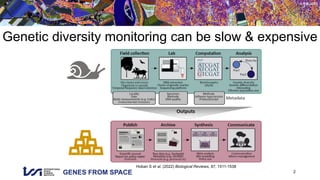
Genetic diversity monitoring can be slow & expensive
2
Hoban S et al. (2022) Biological Reviews, 97, 1511-1538
GENES FROM SPACE
© RSL UZH
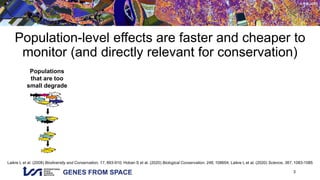
Population-level effects are faster and cheaper to
monitor (and directly relevant for conservation)
3
Populations
that are too
small degrade
Laikre L et al. (2008) Biodiversity and Conservation, 17, 893-910; Hoban S et al. (2020) Biological Conservation, 248, 108654; Laikre L et al. (2020) Science, 367, 1083-1085
GENES FROM SPACE
© RSL UZH
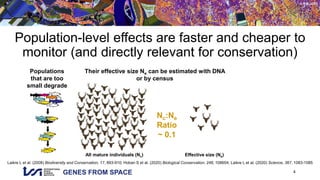
Population-level effects are faster and cheaper to
monitor (and directly relevant for conservation)
4
Populations
that are too
small degrade
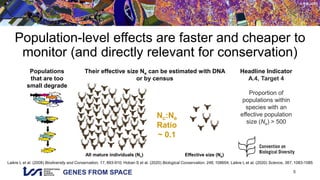
All mature individuals (Nc)
Nc:Ne
Ratio
~ 0.1
Effective size (Ne)
Their effective size Ne can be estimated with DNA
or by census
Laikre L et al. (2008) Biodiversity and Conservation, 17, 893-910; Hoban S et al. (2020) Biological Conservation, 248, 108654; Laikre L et al. (2020) Science, 367, 1083-1085
GENES FROM SPACE
© RSL UZH
Population-level effects are faster and cheaper to
monitor (and directly relevant for conservation)
5
Populations
that are too
small degrade
Headline Indicator
A.4, Target 4
Proportion of
populations within
species with an
effective population
size (Ne) > 500
All mature individuals (Nc)
Nc:Ne
Ratio
~ 0.1
Effective size (Ne)
Their effective size Ne can be estimated with DNA
or by census
Laikre L et al. (2008) Biodiversity and Conservation, 17, 893-910; Hoban S et al. (2020) Biological Conservation, 248, 108654; Laikre L et al. (2020) Science, 367, 1083-1085
GENES FROM SPACE
© RSL UZH
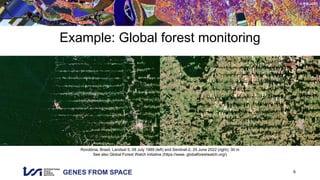
Example: Global forest monitoring
6
Rondônia, Brasil, Landsat 5, 08 July 1989 (left) and Sentinel-2, 29 June 2022 (right), 30 m
See also Global Forest Watch initiative (https://www. globalforestwatch.org/)
GENES FROM SPACE
© RSL UZH
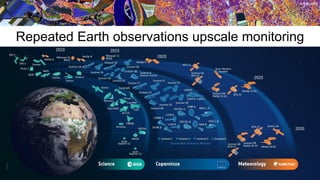
Repeated Earth observations upscale monitoring
7
GENES FROM SPACE
© RSL UZH
Genetic diversity is not a target for Earth observation
8
Skidmore AK et al. (2021) Nature Ecology & Evolution, 5, 896–906 Timmermans J, Kissling WD (2023) Ecological Indicators, 154, 110773
“… [T]he EBV class genetic composition (3,4)
cannot yet be remotely sensed from space
and is not considered further.”
Focus on potential of current and upcoming
technologies, genetic diversity still out-of-scope
GENES FROM SPACE
© RSL UZH
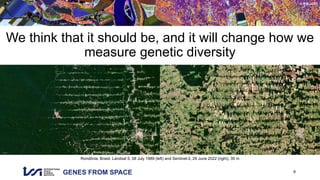
We think that it should be, and it will change how we
measure genetic diversity
9
Rondônia, Brasil, Landsat 5, 08 July 1989 (left) and Sentinel-2, 29 June 2022 (right), 30 m
GENES FROM SPACE
© RSL UZH
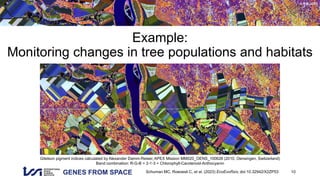
Example:
Monitoring changes in tree populations and habitats
10
Gitelson pigment indices calculated by Alexander Damm-Reiser, APEX Mission MM020_OENS_100626 (2010, Oensingen, Switzerland)
Band combination: R-G-B = 2-1-3 = Chlorophyll-Carotenoid-Anthocyanin
Schuman MC, Roeoesli C, et al. (2023) EcoEvoRxiv, doi:10.32942/X2ZP53
GENES FROM SPACE
© RSL UZH
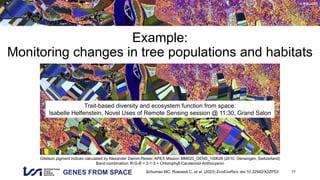
Example:
Monitoring changes in tree populations and habitats
11
Gitelson pigment indices calculated by Alexander Damm-Reiser, APEX Mission MM020_OENS_100626 (2010, Oensingen, Switzerland)
Band combination: R-G-B = 2-1-3 = Chlorophyll-Carotenoid-Anthocyanin
Trait-based diversity and ecosystem function from space:
Isabelle Helfenstein, Novel Uses of Remote Sensing session @ 11:30, Grand Salon
Schuman MC, Roeoesli C, et al. (2023) EcoEvoRxiv, doi:10.32942/X2ZP53
GENES FROM SPACE
© RSL UZH
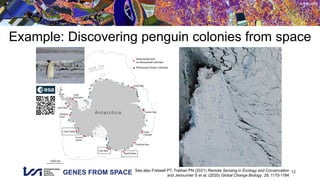
Example: Discovering penguin colonies from space
12
See also Fretwell PT, Trathan PN (2021) Remote Sensing in Ecology and Conservation
and Jenouvrier S et al. (2020) Global Change Biology, 26, 1170-1184
GENES FROM SPACE
© RSL UZH
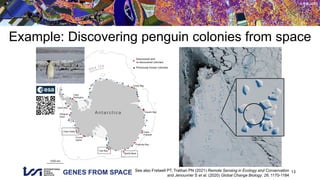
Example: Discovering penguin colonies from space
13
See also Fretwell PT, Trathan PN (2021) Remote Sensing in Ecology and Conservation
and Jenouvrier S et al. (2020) Global Change Biology, 26, 1170-1184
GENES FROM SPACE
© RSL UZH
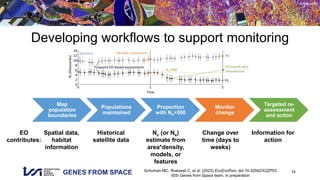
Map
population
boundaries
Populations
maintained
Proportion
with Ne>500
Monitor
change
Targeted re-
assessment
and action
14
Developing workflows to support monitoring
Spatial data,
habitat
information
Historical
satellite data
Nc (or Ne)
estimate from
area*density,
models, or
features
Change over
time (days to
weeks)
EO
contributes:
Information for
action
Schuman MC, Roeoesli C, et al. (2023) EcoEvoRxiv, doi:10.32942/X2ZP53
ISSI Genes from Space team, in preparation
GENES FROM SPACE
© RSL UZH
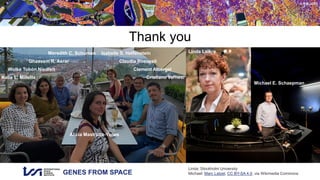
Thank you
Linda: Stockholm University
Michael: Marc Latzel, CC BY-SA 4.0, via Wikimedia Commons
Meredith C. Schuman Isabelle S. Helfenstein
Ghassem R. Asrar Claudia Roeoesli
Wolke Tobón Niedfelt Clement Albergel
Katie L. Millette Cristiano Vernesi
Alicia Mastretta-Yanes
Michael E. Schaepman
Linda Laikre

GenesFromSpace_GEO_BON_2023.pdf

  • 1.
    GENES FROM SPACE ©RSL UZH Meredith C. Schuman & ISSI International Team “Genes from Space” Using advances in Earth observation to monitor genetic diversity of ecosystems
  • 2.
    GENES FROM SPACE ©RSL UZH Genetic diversity monitoring can be slow & expensive 2 Hoban S et al. (2022) Biological Reviews, 97, 1511-1538
  • 3.
    GENES FROM SPACE ©RSL UZH Population-level effects are faster and cheaper to monitor (and directly relevant for conservation) 3 Populations that are too small degrade Laikre L et al. (2008) Biodiversity and Conservation, 17, 893-910; Hoban S et al. (2020) Biological Conservation, 248, 108654; Laikre L et al. (2020) Science, 367, 1083-1085
  • 4.
    GENES FROM SPACE ©RSL UZH Population-level effects are faster and cheaper to monitor (and directly relevant for conservation) 4 Populations that are too small degrade All mature individuals (Nc) Nc:Ne Ratio ~ 0.1 Effective size (Ne) Their effective size Ne can be estimated with DNA or by census Laikre L et al. (2008) Biodiversity and Conservation, 17, 893-910; Hoban S et al. (2020) Biological Conservation, 248, 108654; Laikre L et al. (2020) Science, 367, 1083-1085
  • 5.
    GENES FROM SPACE ©RSL UZH Population-level effects are faster and cheaper to monitor (and directly relevant for conservation) 5 Populations that are too small degrade Headline Indicator A.4, Target 4 Proportion of populations within species with an effective population size (Ne) > 500 All mature individuals (Nc) Nc:Ne Ratio ~ 0.1 Effective size (Ne) Their effective size Ne can be estimated with DNA or by census Laikre L et al. (2008) Biodiversity and Conservation, 17, 893-910; Hoban S et al. (2020) Biological Conservation, 248, 108654; Laikre L et al. (2020) Science, 367, 1083-1085
  • 6.
    GENES FROM SPACE ©RSL UZH Example: Global forest monitoring 6 Rondônia, Brasil, Landsat 5, 08 July 1989 (left) and Sentinel-2, 29 June 2022 (right), 30 m See also Global Forest Watch initiative (https://www. globalforestwatch.org/)
  • 7.
    GENES FROM SPACE ©RSL UZH Repeated Earth observations upscale monitoring 7
  • 8.
    GENES FROM SPACE ©RSL UZH Genetic diversity is not a target for Earth observation 8 Skidmore AK et al. (2021) Nature Ecology & Evolution, 5, 896–906 Timmermans J, Kissling WD (2023) Ecological Indicators, 154, 110773 “… [T]he EBV class genetic composition (3,4) cannot yet be remotely sensed from space and is not considered further.” Focus on potential of current and upcoming technologies, genetic diversity still out-of-scope
  • 9.
    GENES FROM SPACE ©RSL UZH We think that it should be, and it will change how we measure genetic diversity 9 Rondônia, Brasil, Landsat 5, 08 July 1989 (left) and Sentinel-2, 29 June 2022 (right), 30 m
  • 10.
    GENES FROM SPACE ©RSL UZH Example: Monitoring changes in tree populations and habitats 10 Gitelson pigment indices calculated by Alexander Damm-Reiser, APEX Mission MM020_OENS_100626 (2010, Oensingen, Switzerland) Band combination: R-G-B = 2-1-3 = Chlorophyll-Carotenoid-Anthocyanin Schuman MC, Roeoesli C, et al. (2023) EcoEvoRxiv, doi:10.32942/X2ZP53
  • 11.
    GENES FROM SPACE ©RSL UZH Example: Monitoring changes in tree populations and habitats 11 Gitelson pigment indices calculated by Alexander Damm-Reiser, APEX Mission MM020_OENS_100626 (2010, Oensingen, Switzerland) Band combination: R-G-B = 2-1-3 = Chlorophyll-Carotenoid-Anthocyanin Trait-based diversity and ecosystem function from space: Isabelle Helfenstein, Novel Uses of Remote Sensing session @ 11:30, Grand Salon Schuman MC, Roeoesli C, et al. (2023) EcoEvoRxiv, doi:10.32942/X2ZP53
  • 12.
    GENES FROM SPACE ©RSL UZH Example: Discovering penguin colonies from space 12 See also Fretwell PT, Trathan PN (2021) Remote Sensing in Ecology and Conservation and Jenouvrier S et al. (2020) Global Change Biology, 26, 1170-1184
  • 13.
    GENES FROM SPACE ©RSL UZH Example: Discovering penguin colonies from space 13 See also Fretwell PT, Trathan PN (2021) Remote Sensing in Ecology and Conservation and Jenouvrier S et al. (2020) Global Change Biology, 26, 1170-1184
  • 14.
    GENES FROM SPACE ©RSL UZH Map population boundaries Populations maintained Proportion with Ne>500 Monitor change Targeted re- assessment and action 14 Developing workflows to support monitoring Spatial data, habitat information Historical satellite data Nc (or Ne) estimate from area*density, models, or features Change over time (days to weeks) EO contributes: Information for action Schuman MC, Roeoesli C, et al. (2023) EcoEvoRxiv, doi:10.32942/X2ZP53 ISSI Genes from Space team, in preparation
  • 15.
    GENES FROM SPACE ©RSL UZH Thank you Linda: Stockholm University Michael: Marc Latzel, CC BY-SA 4.0, via Wikimedia Commons Meredith C. Schuman Isabelle S. Helfenstein Ghassem R. Asrar Claudia Roeoesli Wolke Tobón Niedfelt Clement Albergel Katie L. Millette Cristiano Vernesi Alicia Mastretta-Yanes Michael E. Schaepman Linda Laikre