NAME : PANDYA MEHAL JITENDRABHAI
ROLL NO :13
SEM: 3
ENROLLMENT NO : 2069108420200029
SUBJECT : Post colonial Literature
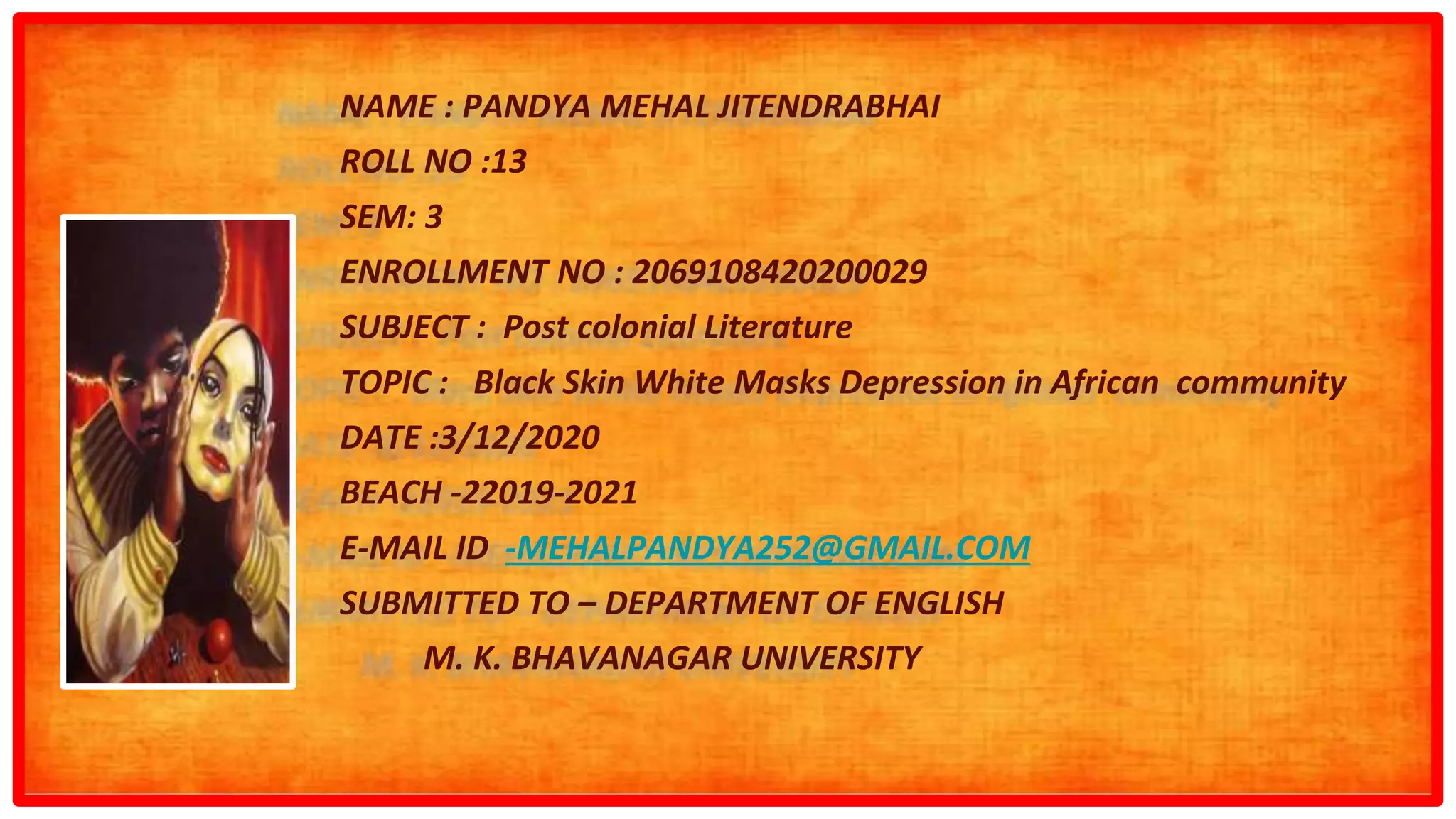
TOPIC : Black Skin White Masks Depression in African community
DATE :3/12/2020
BEACH -22019-2021
E-MAIL ID -MEHALPANDYA252@GMAIL.COM
SUBMITTED TO – DEPARTMENT OF ENGLISH
M. K. BHAVANAGAR UNIVERSITY
“There is but
one destiny for
the black man.
And it is white.”
Franz Fanon
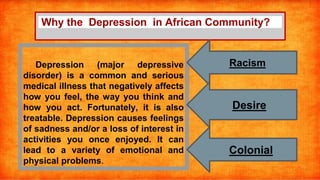
Why the Depression in African Community?
Depression (major depressive
disorder) is a common and serious
medical illness that negatively affects
how you feel, the way you think and
how you act. Fortunately, it is also
treatable. Depression causes feelings
of sadness and/or a loss of interest in
activities you once enjoyed. It can
lead to a variety of emotional and
physical problems.
Racism
Desire
Colonial
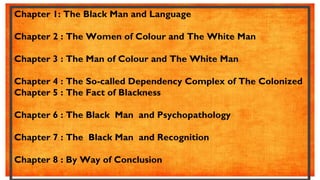
Chapter 1: The Black Man and Language
Chapter 2 : The Women of Colour and The White Man
Chapter 3 : The Man of Colour and The White Man
Chapter 4 : The So-called Dependency Complex of The Colonized
Chapter 5 : The Fact of Blackness
Chapter 6 : The Black Man and Psychopathology
Chapter 7 : The Black Man and Recognition
Chapter 8 : By Way of Conclusion
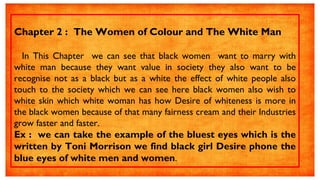
Chapter 2 : The Women of Colour and The White Man
In This Chapter we can see that black women want to marry with
white man because they want value in society they also want to be
recognise not as a black but as a white the effect of white people also
touch to the society which we can see here black women also wish to
white skin which white woman has how Desire of whiteness is more in
the black women because of that many fairness cream and their Industries
grow faster and faster.
Ex : we can take the example of the bluest eyes which is the
written by Toni Morrison we find black girl Desire phone the
blue eyes of white men and women.
In the second chapter of Black Skin, White Masks “The Women
of color and the white man” The Women of color and the white
man” Frantz Fanon makes some assertions about black
Martiniquais women that garnered him the criticism of some
feminist theorists as a misogynist, and as promoting a perverse
(anti-miscegenational) form of black nationalism. Fanon’s rapport
with his subject is that of a psychiatrist attempting to understand
the effects of colonialism and racism on the colonized subject’s
psyche: that is, the internalization of racism and the development
of a “dependency complex.” Among black Martiniquais women,
Fanon argues, this dependency complex is evidenced, among
other places, in their expressed xenocentrism or, as the
phenomenon is most commonly referred to in Hispanic America,
malinchismo: that is, a preference for white sexual partners, and a
distaste for black men.
Chapter 3 : The Man of Colour and the White women
Here in this chapter we can see the paradox of chapter 2
there are women who want to be ameri with white men but in this
chapter the man of colour black I want white women because they
also influence under the white culture and their rule.
white represent weld beauty Intelligence and virtue but the
black people how kind of thinking that they are inferior than white
people.
Chapter 4 : The So-called Dependency Complex of
The Colonized
In this chapter phonons view that people of colour have a deep
desire for right white rules that those who opposite to do not have a
secure sense of self that they have a cheap on their shoulder.
In this chapter we come to understand that the stereotypes of
happy Darkies, Uppity Negroes and white Savior all come from the need
of white people to feel that their power in society is good and not resist
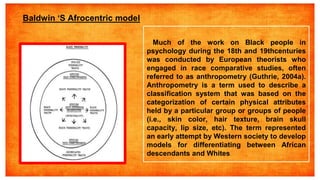
Much of the work on Black people in
psychology during the 18th and 19thcenturies
was conducted by European theorists who
engaged in race comparative studies, often
referred to as anthropometry (Guthrie, 2004a).
Anthropometry is a term used to describe a
classification system that was based on the
categorization of certain physical attributes
held by a particular group or groups of people
(i.e., skin color, hair texture, brain skull
capacity, lip size, etc). The term represented
an early attempt by Western society to develop
models for differentiating between African
descendants and Whites
Baldwin ‘S Afrocentric model
Fairness cream
Fairness cream
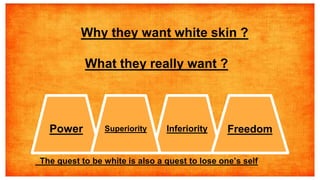
Why they want white skin ?
What they really want ?
Power InferioritySuperiority Freedom
The quest to be white is also a quest to lose one’s self
Conclusion
We come to know that which kind of little to big things can give depression,
anxiety, stress to person.Human always in quest of something and never live in happy
way . Human will never satisfied with things and it will harm them.
Mannoni and Adler say, according to Fanon, is that a Black person’s feeling of
inferiority or any related neurosis is an individual problem that can be corrected by
adjusting an individual’s expectations or desires. Fanon disagrees and says that we
must adjust the social situation that creates these desires and the impossibility of
realizing them.
“ we must change the world rather than the individual.”
- Fanon
Work citation
Baldwin, Joseph A. “African Self-Consciousness and the Mental Health of African-
Americans.” Journal of Black Studies, vol. 15, no. 2, 1984, pp. 177–194. JSTOR,
www.jstor.org/stable/2784007. Accessed 2 Dec. 2020.
Bergner, Gwen. “Who Is That Masked Woman? Or, the Role of Gender in Fanon's
Black Skin, White Masks.” PMLA, vol. 110, no. 1, 1995, pp. 75–88. JSTOR,
www.jstor.org/stable/463196. Accessed 2 Dec. 2020.
Fanon, Frantz, and Charles L. Markmann. Black Skin, White Masks. , 1967. Print.
Phoenix, Aisha. “Colourism and the Politics of Beauty.” Feminist Review, no. 108,
2014, pp. 97–105. JSTOR, www.jstor.org/stable/24571924. Accessed 2 Dec. 2020.
Black skin white masks presentation 1

Black skin white masks presentation 1

  • 1.
    NAME : PANDYAMEHAL JITENDRABHAI ROLL NO :13 SEM: 3 ENROLLMENT NO : 2069108420200029 SUBJECT : Post colonial Literature TOPIC : Black Skin White Masks Depression in African community DATE :3/12/2020 BEACH -22019-2021 E-MAIL ID -MEHALPANDYA252@GMAIL.COM SUBMITTED TO – DEPARTMENT OF ENGLISH M. K. BHAVANAGAR UNIVERSITY
  • 2.
    “There is but onedestiny for the black man. And it is white.” Franz Fanon
  • 3.
    Why the Depressionin African Community? Depression (major depressive disorder) is a common and serious medical illness that negatively affects how you feel, the way you think and how you act. Fortunately, it is also treatable. Depression causes feelings of sadness and/or a loss of interest in activities you once enjoyed. It can lead to a variety of emotional and physical problems. Racism Desire Colonial
  • 4.
    Chapter 1: TheBlack Man and Language Chapter 2 : The Women of Colour and The White Man Chapter 3 : The Man of Colour and The White Man Chapter 4 : The So-called Dependency Complex of The Colonized Chapter 5 : The Fact of Blackness Chapter 6 : The Black Man and Psychopathology Chapter 7 : The Black Man and Recognition Chapter 8 : By Way of Conclusion
  • 5.
    Chapter 2 :The Women of Colour and The White Man In This Chapter we can see that black women want to marry with white man because they want value in society they also want to be recognise not as a black but as a white the effect of white people also touch to the society which we can see here black women also wish to white skin which white woman has how Desire of whiteness is more in the black women because of that many fairness cream and their Industries grow faster and faster. Ex : we can take the example of the bluest eyes which is the written by Toni Morrison we find black girl Desire phone the blue eyes of white men and women.
  • 6.
    In the secondchapter of Black Skin, White Masks “The Women of color and the white man” The Women of color and the white man” Frantz Fanon makes some assertions about black Martiniquais women that garnered him the criticism of some feminist theorists as a misogynist, and as promoting a perverse (anti-miscegenational) form of black nationalism. Fanon’s rapport with his subject is that of a psychiatrist attempting to understand the effects of colonialism and racism on the colonized subject’s psyche: that is, the internalization of racism and the development of a “dependency complex.” Among black Martiniquais women, Fanon argues, this dependency complex is evidenced, among other places, in their expressed xenocentrism or, as the phenomenon is most commonly referred to in Hispanic America, malinchismo: that is, a preference for white sexual partners, and a distaste for black men.
  • 7.
    Chapter 3 :The Man of Colour and the White women Here in this chapter we can see the paradox of chapter 2 there are women who want to be ameri with white men but in this chapter the man of colour black I want white women because they also influence under the white culture and their rule. white represent weld beauty Intelligence and virtue but the black people how kind of thinking that they are inferior than white people.
  • 8.
    Chapter 4 :The So-called Dependency Complex of The Colonized In this chapter phonons view that people of colour have a deep desire for right white rules that those who opposite to do not have a secure sense of self that they have a cheap on their shoulder. In this chapter we come to understand that the stereotypes of happy Darkies, Uppity Negroes and white Savior all come from the need of white people to feel that their power in society is good and not resist
  • 9.
    Much of thework on Black people in psychology during the 18th and 19thcenturies was conducted by European theorists who engaged in race comparative studies, often referred to as anthropometry (Guthrie, 2004a). Anthropometry is a term used to describe a classification system that was based on the categorization of certain physical attributes held by a particular group or groups of people (i.e., skin color, hair texture, brain skull capacity, lip size, etc). The term represented an early attempt by Western society to develop models for differentiating between African descendants and Whites Baldwin ‘S Afrocentric model
  • 10.
  • 11.
  • 12.
    Why they wantwhite skin ? What they really want ? Power InferioritySuperiority Freedom The quest to be white is also a quest to lose one’s self
  • 13.
    Conclusion We come toknow that which kind of little to big things can give depression, anxiety, stress to person.Human always in quest of something and never live in happy way . Human will never satisfied with things and it will harm them. Mannoni and Adler say, according to Fanon, is that a Black person’s feeling of inferiority or any related neurosis is an individual problem that can be corrected by adjusting an individual’s expectations or desires. Fanon disagrees and says that we must adjust the social situation that creates these desires and the impossibility of realizing them. “ we must change the world rather than the individual.” - Fanon
  • 14.
    Work citation Baldwin, JosephA. “African Self-Consciousness and the Mental Health of African- Americans.” Journal of Black Studies, vol. 15, no. 2, 1984, pp. 177–194. JSTOR, www.jstor.org/stable/2784007. Accessed 2 Dec. 2020. Bergner, Gwen. “Who Is That Masked Woman? Or, the Role of Gender in Fanon's Black Skin, White Masks.” PMLA, vol. 110, no. 1, 1995, pp. 75–88. JSTOR, www.jstor.org/stable/463196. Accessed 2 Dec. 2020. Fanon, Frantz, and Charles L. Markmann. Black Skin, White Masks. , 1967. Print. Phoenix, Aisha. “Colourism and the Politics of Beauty.” Feminist Review, no. 108, 2014, pp. 97–105. JSTOR, www.jstor.org/stable/24571924. Accessed 2 Dec. 2020.