Dystopian fiction
Dystopian novels 
• Often set in an imaginary future. 
• Aim is to criticise real aspects of current 
society 
• Satire or warning 
• Can be disturbing
Wider reading: Dystopian Novels 
1. The Chrysalids – John Wyndham 
2. A Clockwork Orange- Anthony Burgess 
3. The Hunger Games- Suzanne Collins 
4. Brave New World – Aldous Huxley 
5. The Time Machine – H.G. Wells 
6. The Running Man – Richard Bachman (Stephen 
King) 
7. The Children of Men – P.D. James 
8. Fahrenheit 451 – Ray Bradbury 
9. A Scanner Darkly; Do Androids Dream of Electric 
Sheep- Philip K Dick 
10. Never Let Me Go – Kazuo Ishigura
Margaret Atwood 
on ‘The Handmaid’s Tale’ 
“One of the tasks I set myself when writing the 
novel was to avoid including any practices 
which had not already happened somewhere, 
at some time. One of the functions of the 
Historical Notes is to indicate the origins of 
some of the practices described in the novel. 
But it is vital to understand that every single 
one of the practices described in the novel is 
drawn from the historical record.”
George Orwell 
1984 was written 
‘to alter other people’s idea of the kind of society 
they should strive after’
Social critique 
• What aspects of society do Orwell and 
Atwood criticise in 1984 and The Handmaid’s 
Tale?
Fiction and reality 
What historical/ contemporary parallels can you think of for the 
following elements of The Handmaid’s Tale / 1984? 
1) Uniforms denoting your social position? 
2) Public execution? 
3) Torture? 
4) Religious wars? 
5) Propaganda and censorship? 
6) Resistance movements? 
7) An underground railroad? 
8) ‘Re-education’? 
9) Testifying? 
10) Enforced religious conversion? 
11) Surveillance and spying? 
12) Enforced attendance at certain rituals and ceremonies? 
13) Rewriting the past
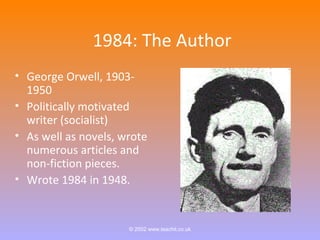
1984: The Author 
• George Orwell, 1903- 
1950 
• Politically motivated 
writer (socialist) 
• As well as novels, wrote 
numerous articles and 
non-fiction pieces. 
• Wrote 1984 in 1948. 
© 2002 www.teachit.co.uk
Context of 1984 
• Written in ’48, 3 years after the end of WW2. 
• World still in state of uncertainty after the 
traumas of war. 
• Huge divide emerging between Communist 
USSR and capitalist West. Beginning of the 
‘Cold War’. 
© 2002 www.teachit.co.uk
Setting 
• The novel is set in a future British society, years after 
a nuclear war has occurred. 
• Society is split into two groups- Party members and 
Proles. 
• Every aspect of a Party member’s life is controlled by 
the Party- individual freedom does not exist. 
• Party members are constantly watched for signs of 
disagreement with the party. 
© 2002 www.teachit.co.uk
Characters 
• Winston Smith: the protagonist in the story, a 
party member who resents the control the 
party exerts. 
• Big Brother: the semi-mythical leader of the 
Party. Images of his face are omnipresent in 
society. 
© 2002 www.teachit.co.uk
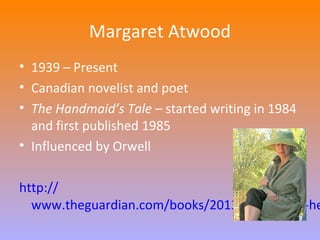
Margaret Atwood 
• 1939 – Present 
• Canadian novelist and poet 
• The Handmaid’s Tale – started writing in 1984 
and first published 1985 
• Influenced by Orwell 
http:// 
www.theguardian.com/books/2013/jan/18/my-hero-
Context of The Handmaid’s Tale 
• Strongly feminist vision of dystopia. 
• Written shortly after the elections of Ronald 
Reagan in the United States and Margaret 
Thatcher in Great Britain 
• A reaction to religious conservatives who 
criticized the excesses of the “sexual 
revolution” of the 1960s and 1970s. 
• Feminists feared that the gains women had 
made in previous decades would be reversed.
Setting 
• Future society in which birth rates are falling 
• Characters are segregated by categories and 
dressed according to their social functions. 
• Women are categorised hierarchically 
according to class status and reproductive 
capacity
Characters 
• Narrator: Offred, a ‘handmaid’ who is illegally 
telling her story 
• The Eyes : a shadowy figure/organisation of 
control
Writing Dystopia in 2014 
What current issues might be addressed in a 
modern dystopian text? Write down as many as 
you can think of 
•Freedom of information 
•Designer babies 
•Cloning 
•Genetic modification

Dystopia 1984 and tht context

  • 1.
  • 2.
    Dystopian novels •Often set in an imaginary future. • Aim is to criticise real aspects of current society • Satire or warning • Can be disturbing
  • 3.
    Wider reading: DystopianNovels 1. The Chrysalids – John Wyndham 2. A Clockwork Orange- Anthony Burgess 3. The Hunger Games- Suzanne Collins 4. Brave New World – Aldous Huxley 5. The Time Machine – H.G. Wells 6. The Running Man – Richard Bachman (Stephen King) 7. The Children of Men – P.D. James 8. Fahrenheit 451 – Ray Bradbury 9. A Scanner Darkly; Do Androids Dream of Electric Sheep- Philip K Dick 10. Never Let Me Go – Kazuo Ishigura
  • 4.
    Margaret Atwood on‘The Handmaid’s Tale’ “One of the tasks I set myself when writing the novel was to avoid including any practices which had not already happened somewhere, at some time. One of the functions of the Historical Notes is to indicate the origins of some of the practices described in the novel. But it is vital to understand that every single one of the practices described in the novel is drawn from the historical record.”
  • 5.
    George Orwell 1984was written ‘to alter other people’s idea of the kind of society they should strive after’
  • 6.
    Social critique •What aspects of society do Orwell and Atwood criticise in 1984 and The Handmaid’s Tale?
  • 7.
    Fiction and reality What historical/ contemporary parallels can you think of for the following elements of The Handmaid’s Tale / 1984? 1) Uniforms denoting your social position? 2) Public execution? 3) Torture? 4) Religious wars? 5) Propaganda and censorship? 6) Resistance movements? 7) An underground railroad? 8) ‘Re-education’? 9) Testifying? 10) Enforced religious conversion? 11) Surveillance and spying? 12) Enforced attendance at certain rituals and ceremonies? 13) Rewriting the past
  • 8.
    1984: The Author • George Orwell, 1903- 1950 • Politically motivated writer (socialist) • As well as novels, wrote numerous articles and non-fiction pieces. • Wrote 1984 in 1948. © 2002 www.teachit.co.uk
  • 9.
    Context of 1984 • Written in ’48, 3 years after the end of WW2. • World still in state of uncertainty after the traumas of war. • Huge divide emerging between Communist USSR and capitalist West. Beginning of the ‘Cold War’. © 2002 www.teachit.co.uk
  • 10.
    Setting • Thenovel is set in a future British society, years after a nuclear war has occurred. • Society is split into two groups- Party members and Proles. • Every aspect of a Party member’s life is controlled by the Party- individual freedom does not exist. • Party members are constantly watched for signs of disagreement with the party. © 2002 www.teachit.co.uk
  • 11.
    Characters • WinstonSmith: the protagonist in the story, a party member who resents the control the party exerts. • Big Brother: the semi-mythical leader of the Party. Images of his face are omnipresent in society. © 2002 www.teachit.co.uk
  • 12.
    Margaret Atwood •1939 – Present • Canadian novelist and poet • The Handmaid’s Tale – started writing in 1984 and first published 1985 • Influenced by Orwell http:// www.theguardian.com/books/2013/jan/18/my-hero-
  • 13.
    Context of TheHandmaid’s Tale • Strongly feminist vision of dystopia. • Written shortly after the elections of Ronald Reagan in the United States and Margaret Thatcher in Great Britain • A reaction to religious conservatives who criticized the excesses of the “sexual revolution” of the 1960s and 1970s. • Feminists feared that the gains women had made in previous decades would be reversed.
  • 14.
    Setting • Futuresociety in which birth rates are falling • Characters are segregated by categories and dressed according to their social functions. • Women are categorised hierarchically according to class status and reproductive capacity
  • 15.
    Characters • Narrator:Offred, a ‘handmaid’ who is illegally telling her story • The Eyes : a shadowy figure/organisation of control
  • 16.
    Writing Dystopia in2014 What current issues might be addressed in a modern dystopian text? Write down as many as you can think of •Freedom of information •Designer babies •Cloning •Genetic modification