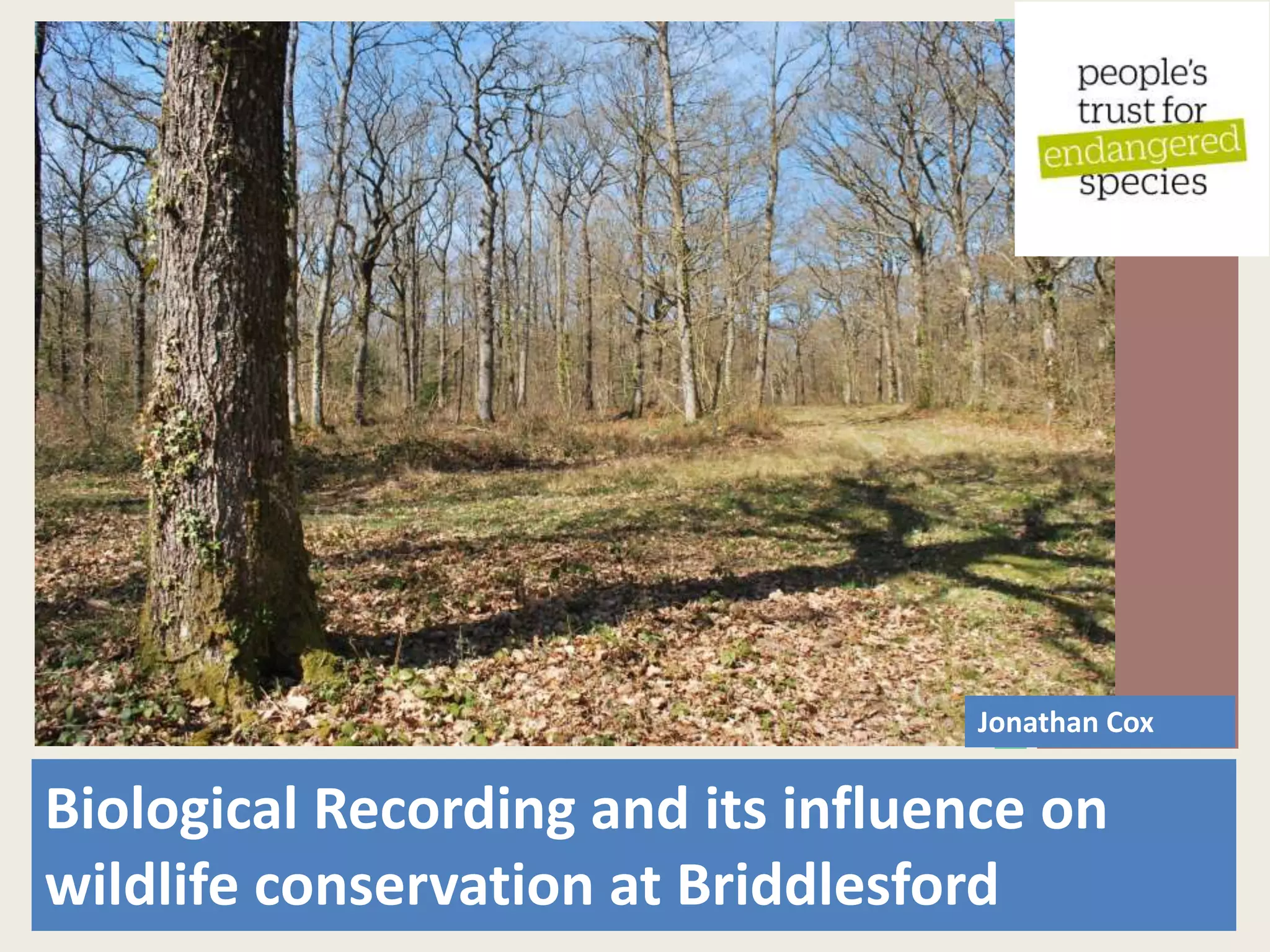
Biological Recording and its influence on
wildlife conservation at Briddlesford
Jonathan Cox
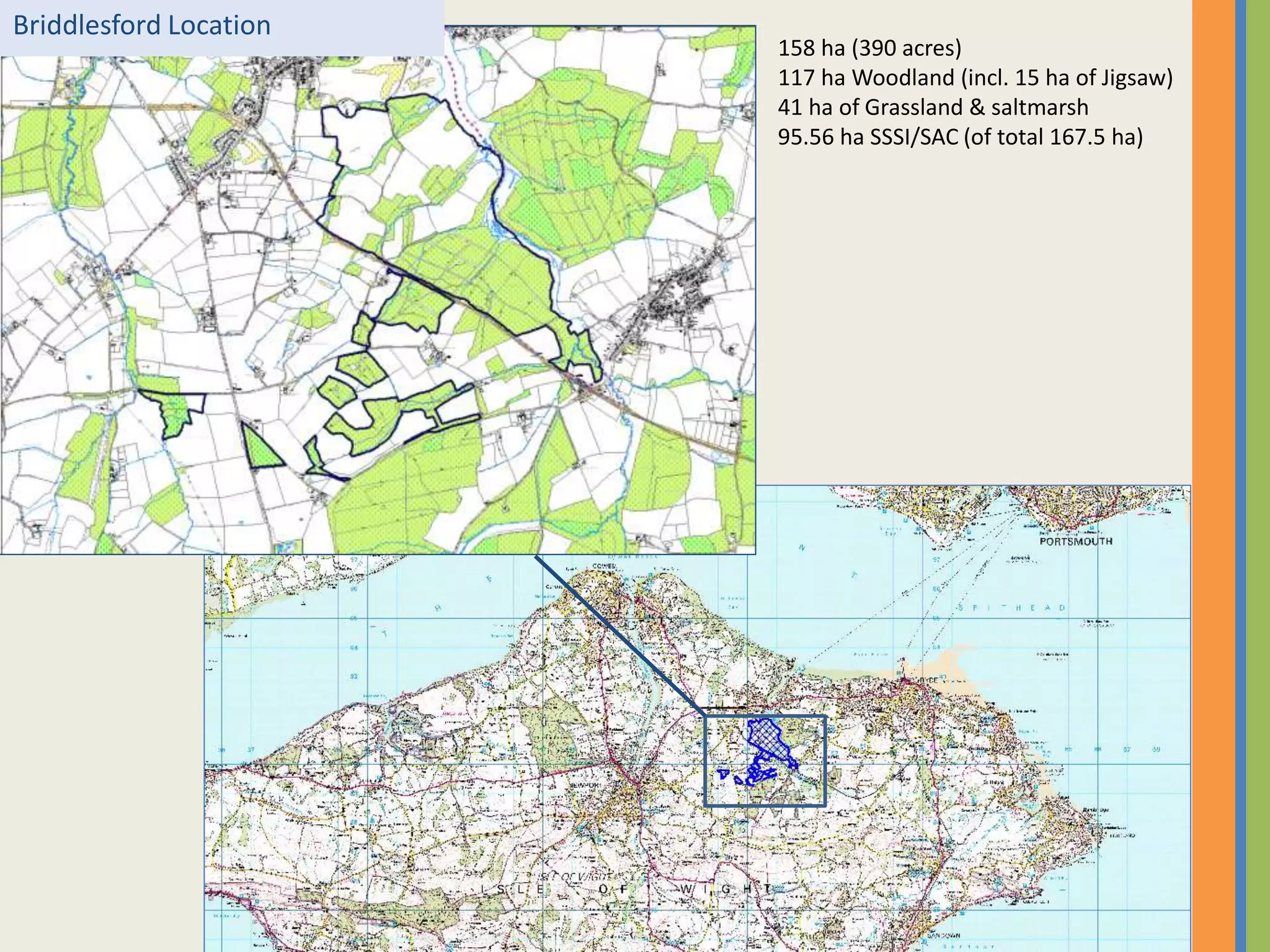
Briddlesford Location
158 ha (390 acres)
117 ha Woodland (incl. 15 ha of Jigsaw)
41 ha of Grassland & saltmarsh
95.56 ha SSSI/SAC (of total 167.5 ha)
A History of Biological Recording and Conservation
Management
 Vegetation & habitat survey and SSSI notification (the 1980s)
 PTES purchase (the 1990s)
 Woodland Management
 Red squirrel and early dormouse research
 Jigsaw woodlands (the 2000s)
 Discovering bats – 2002 survey and effects on management
 Botanical surveys and management
 Bird surveys and management
 Dormouse survey and the national network
 How are the squirrels doing?
 Invertebrate surveys and management
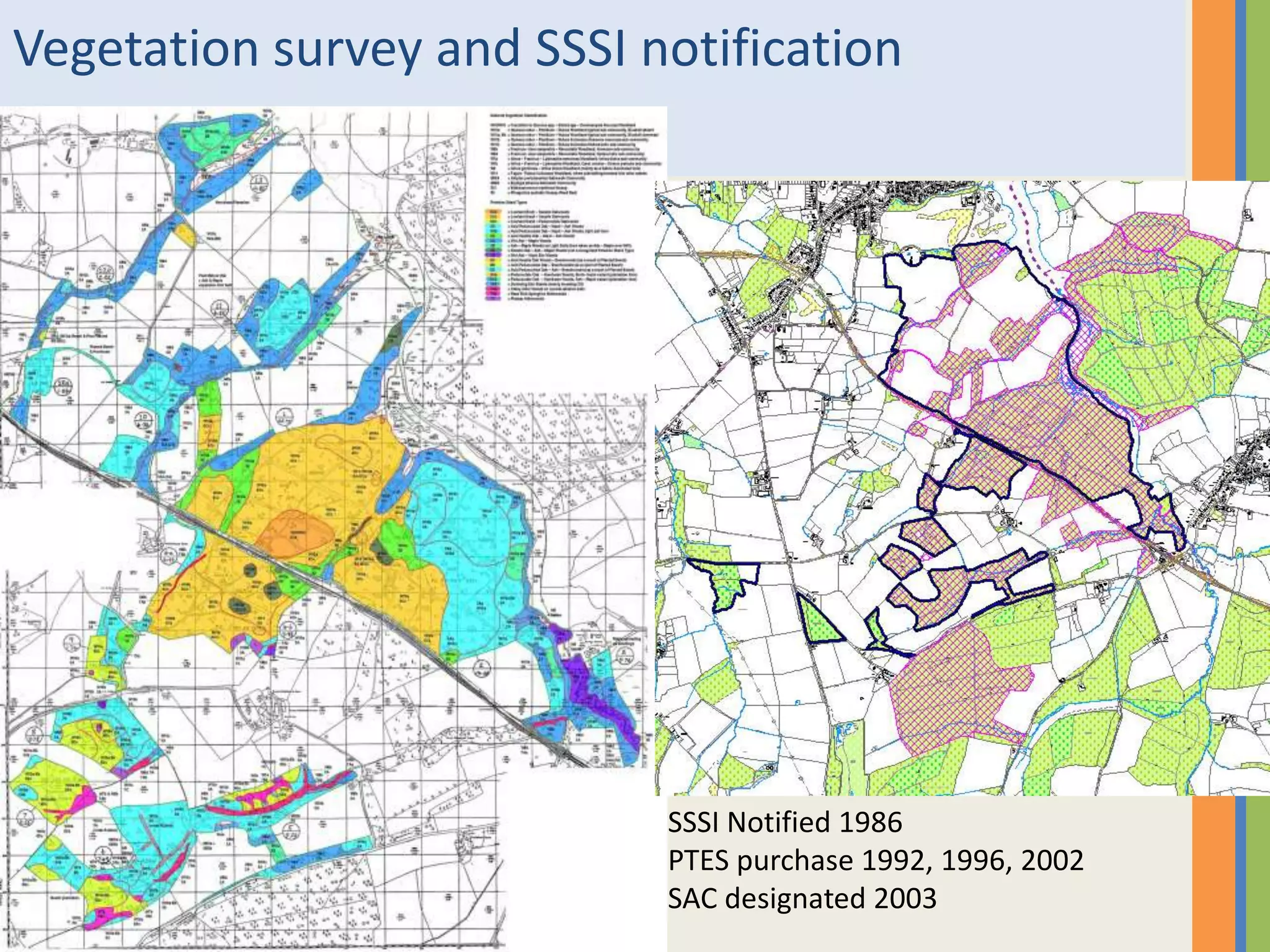
Vegetation survey and SSSI notification
SSSI Notified 1986
PTES purchase 1992, 1996, 2002
SAC designated 2003
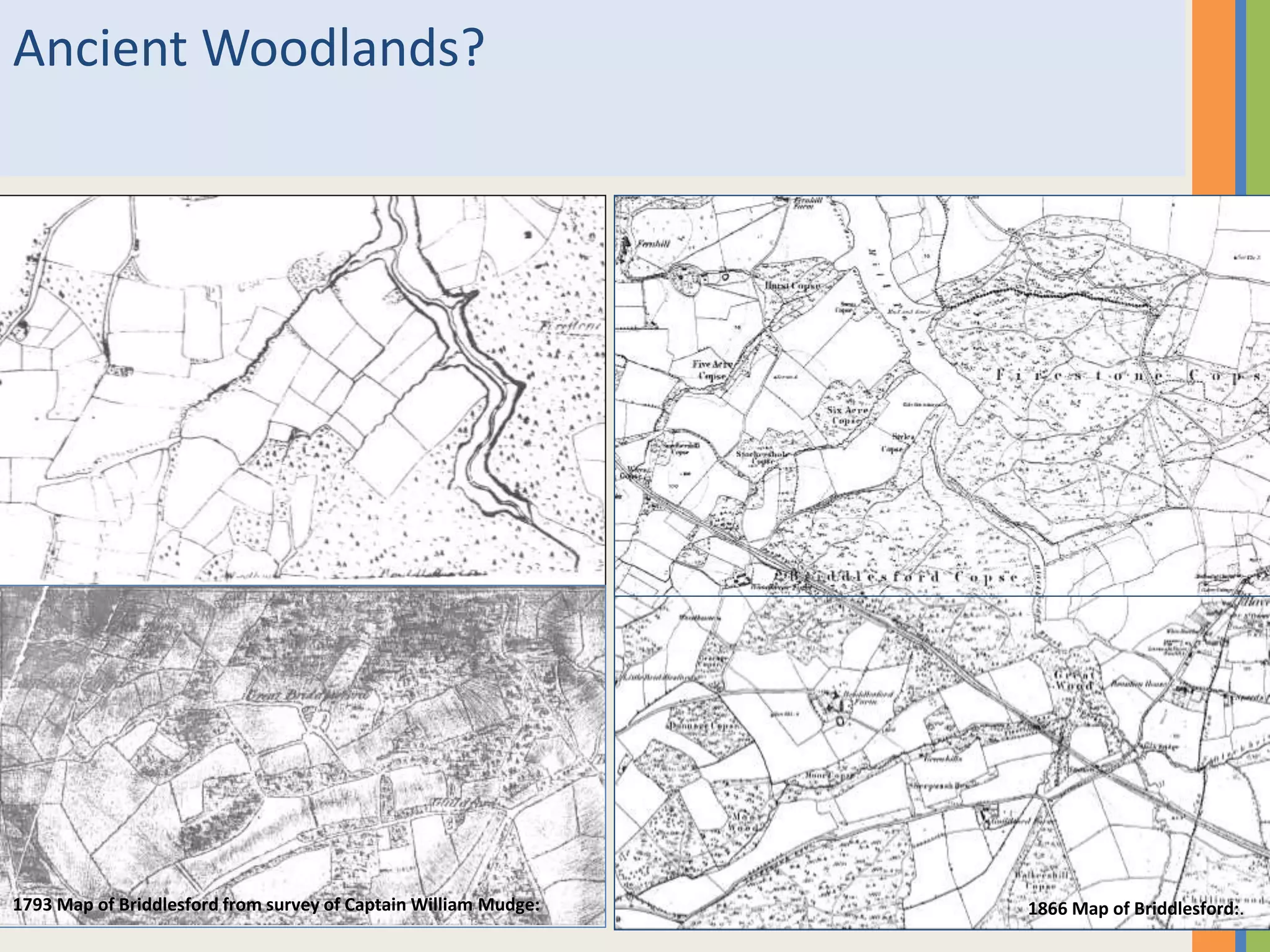
Ancient Woodlands?
1866 Map of Briddlesford:.1793 Map of Briddlesford from survey of Captain William Mudge:
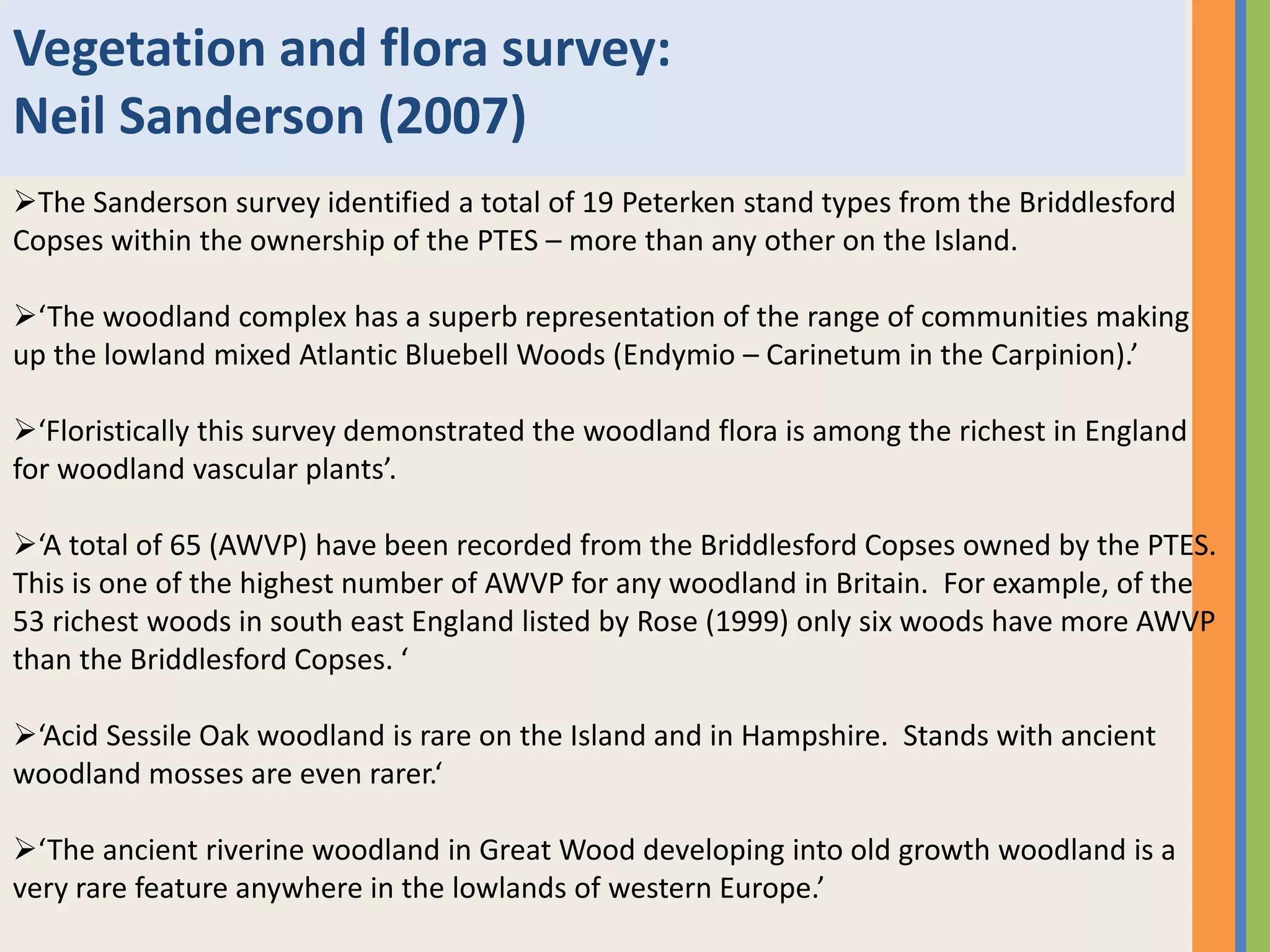
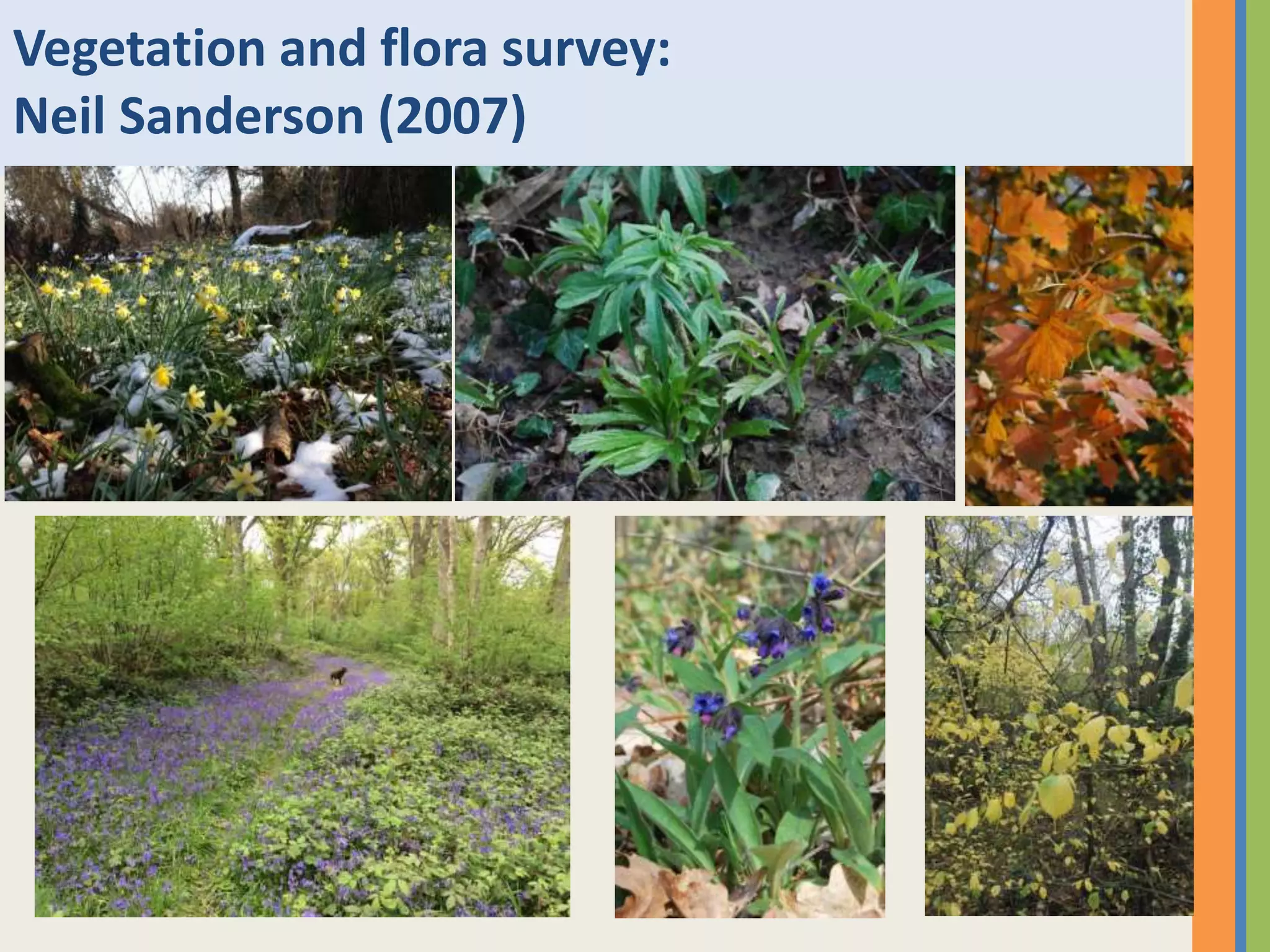
Vegetation and flora survey:
Neil Sanderson (2007)
The Sanderson survey identified a total of 19 Peterken stand types from the Briddlesford
Copses within the ownership of the PTES – more than any other on the Island.
‘The woodland complex has a superb representation of the range of communities making
up the lowland mixed Atlantic Bluebell Woods (Endymio – Carinetum in the Carpinion).’
‘Floristically this survey demonstrated the woodland flora is among the richest in England
for woodland vascular plants’.
‘A total of 65 (AWVP) have been recorded from the Briddlesford Copses owned by the PTES.
This is one of the highest number of AWVP for any woodland in Britain. For example, of the
53 richest woods in south east England listed by Rose (1999) only six woods have more AWVP
than the Briddlesford Copses. ‘
‘Acid Sessile Oak woodland is rare on the Island and in Hampshire. Stands with ancient
woodland mosses are even rarer.‘
‘The ancient riverine woodland in Great Wood developing into old growth woodland is a
very rare feature anywhere in the lowlands of western Europe.’
Vegetation and flora survey:
Neil Sanderson (2007)
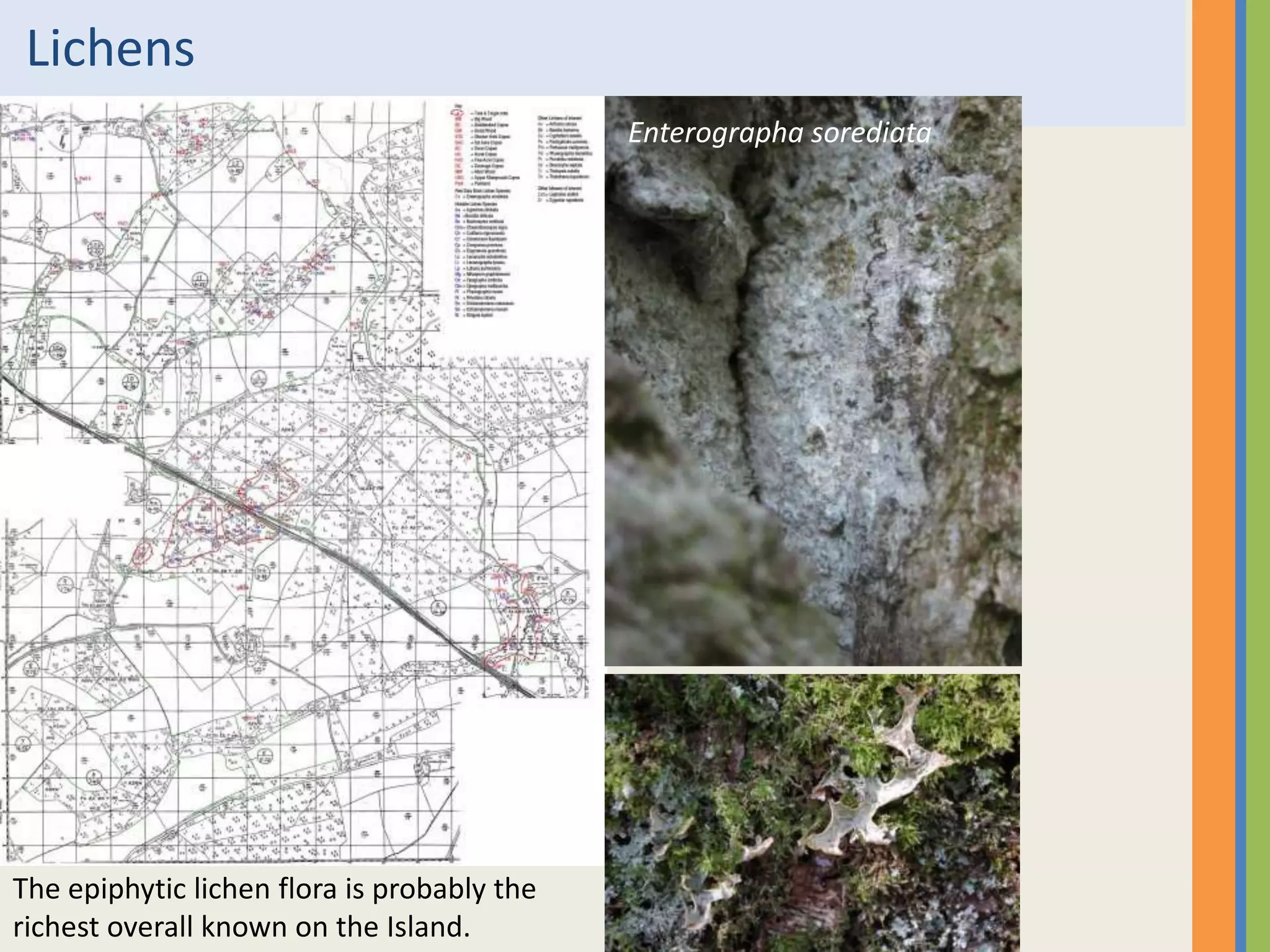
Lichens
The epiphytic lichen flora is probably the
richest overall known on the Island.
Enterographa sorediata
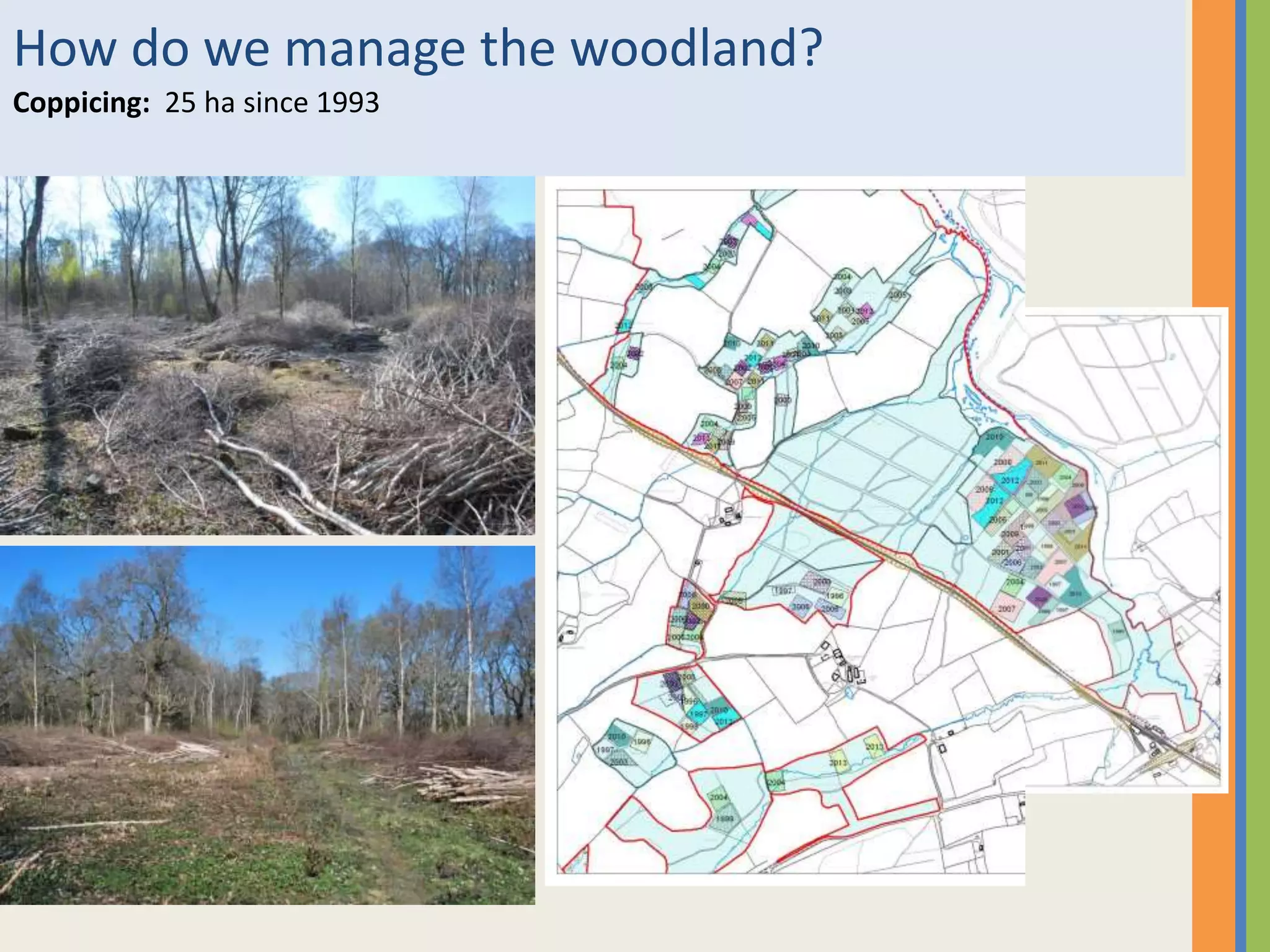
How do we manage the woodland?
Coppicing: 25 ha since 1993
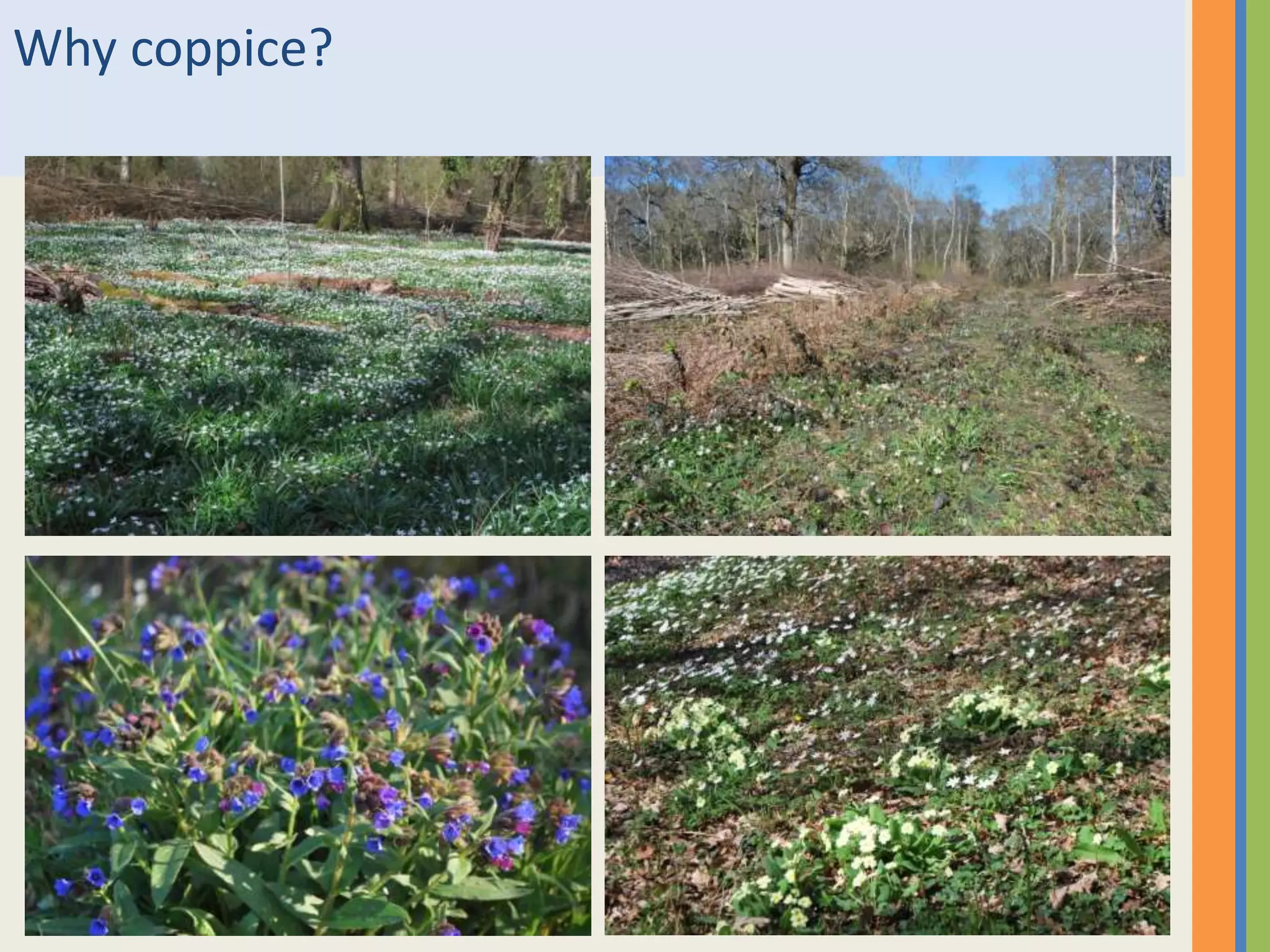
Why coppice?
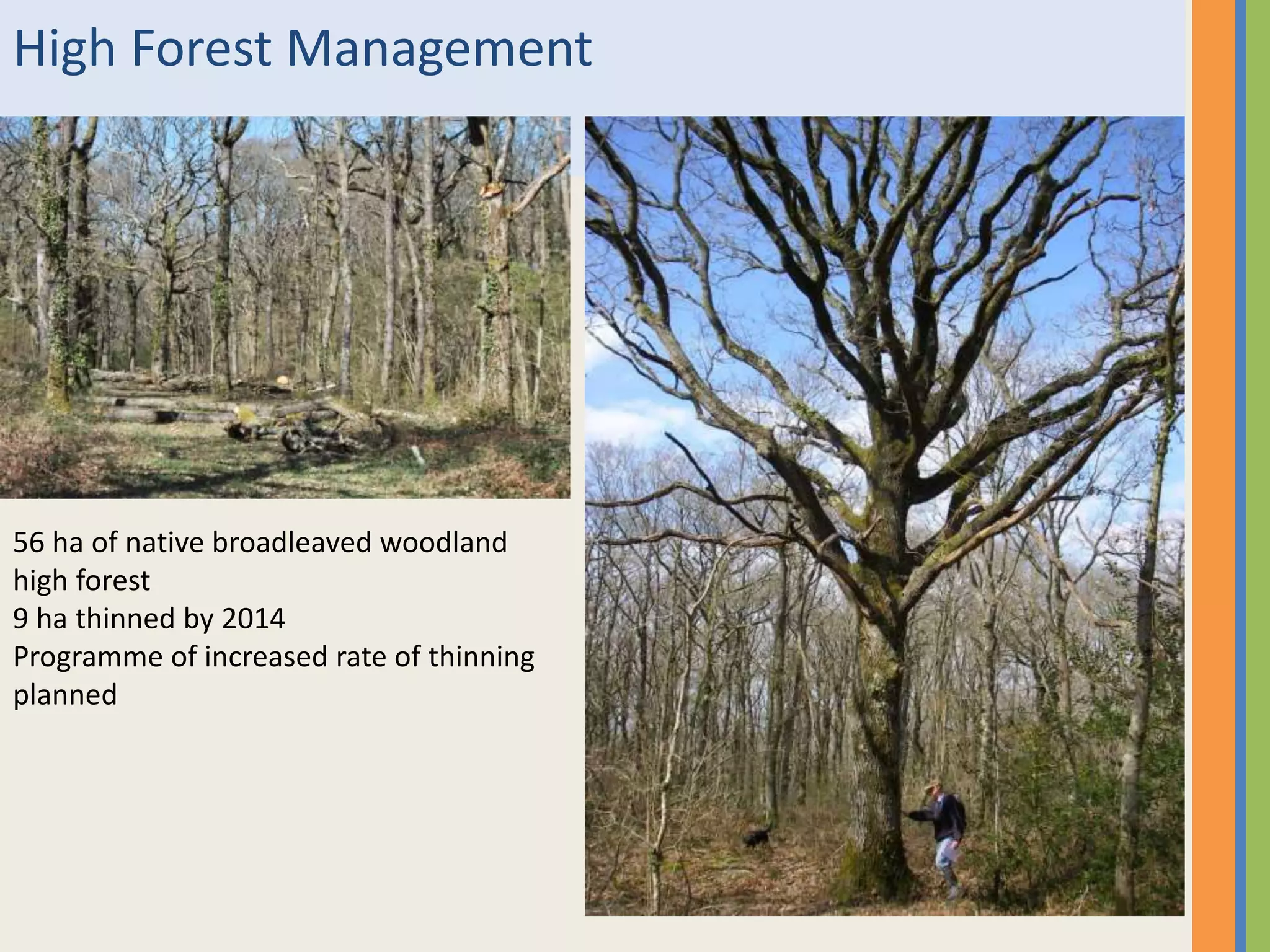
High Forest Management
56 ha of native broadleaved woodland
high forest
9 ha thinned by 2014
Programme of increased rate of thinning
planned
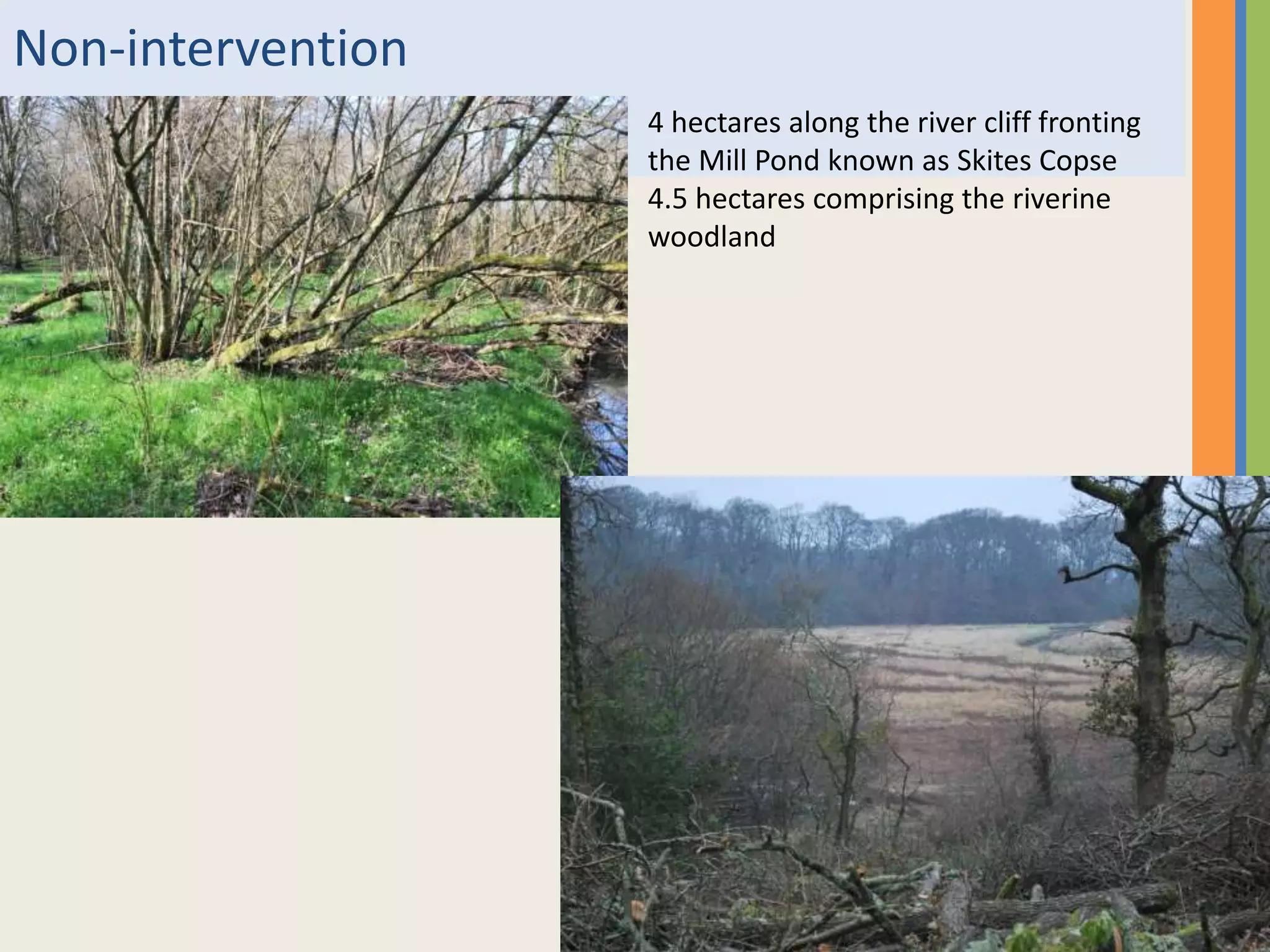
Non-intervention
4 hectares along the river cliff fronting
the Mill Pond known as Skites Copse
4.5 hectares comprising the riverine
woodland
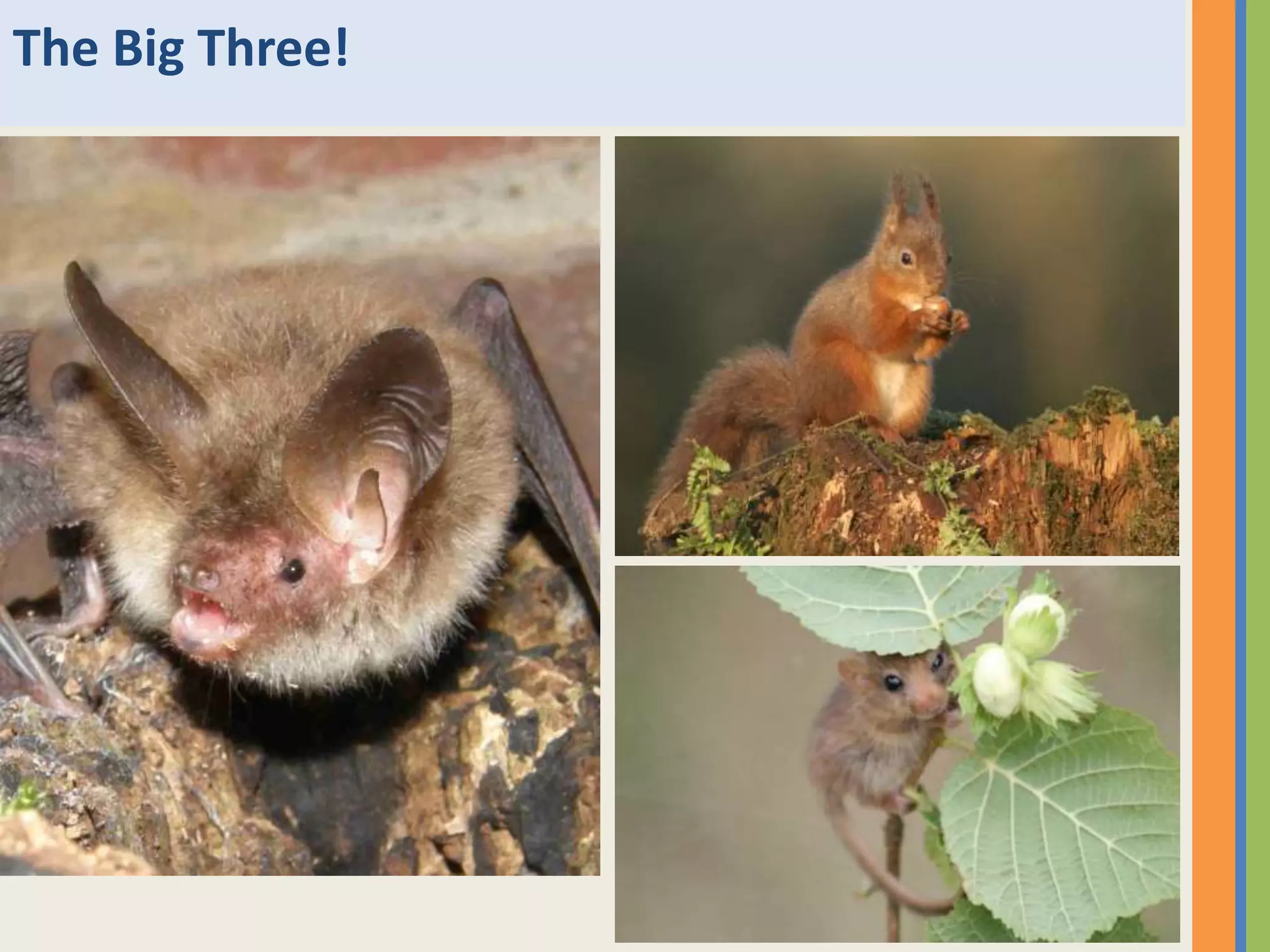
The Big Three!
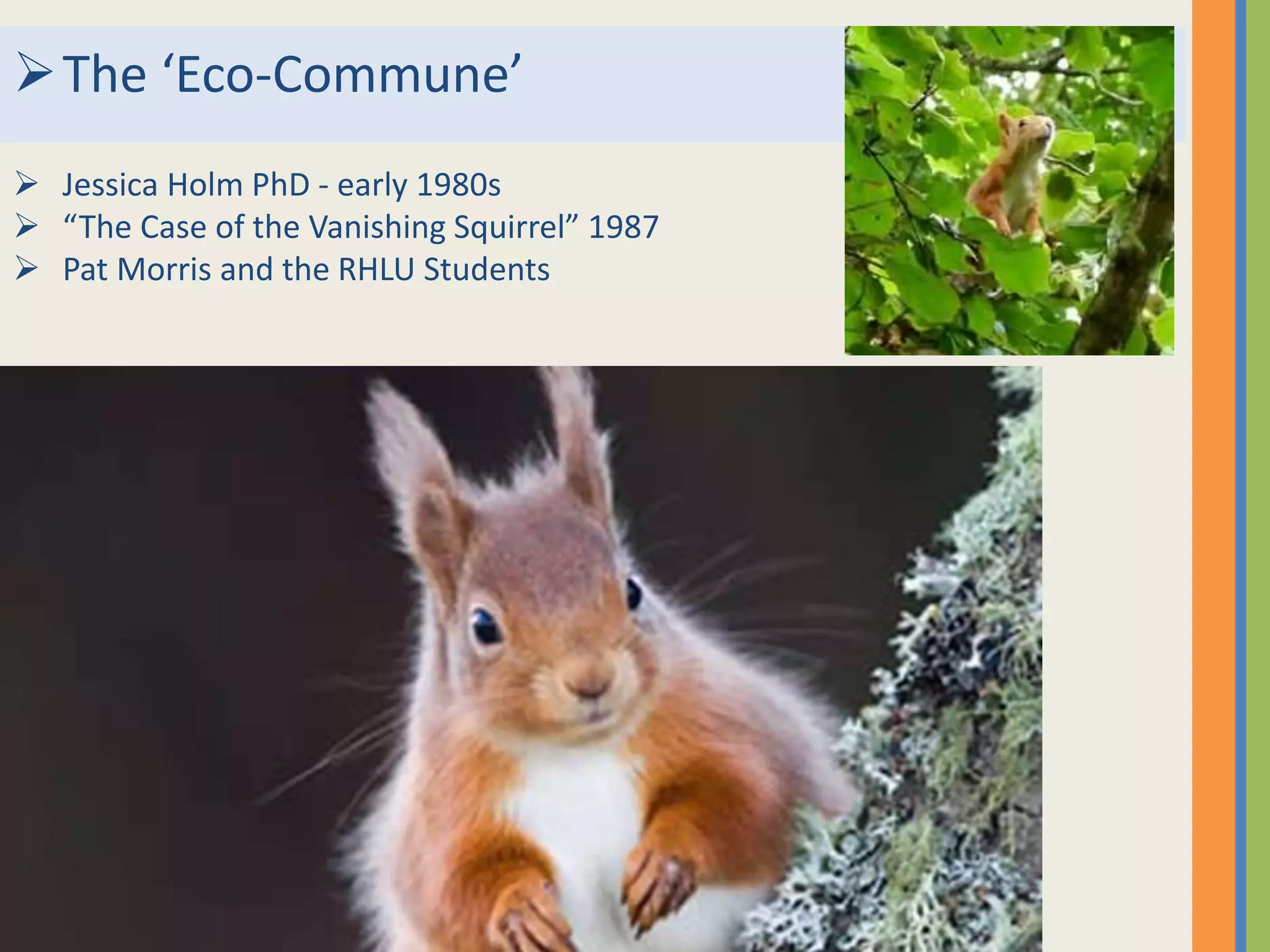
The ‘Eco-Commune’
 Jessica Holm PhD - early 1980s
 “The Case of the Vanishing Squirrel” 1987
 Pat Morris and the RHLU Students
Red Squirrel Ecology – Key Points
Squirrel density
Walters Copes (WC) 0.3-0.7/ha
Briddlesford Copse (BC) 1 – 1.6/ha.
(mean = 0.85/ha or about 100 red squirrels in PTES woodland at Briddlesford)
Fattingpark Copse (FC) 0.6-1.1/ha
Food
Hazel is by far the most important food source for squirrels in deciduous woodland.
Determines the pattern of behaviour throughout the year. Squirrels were able to
survive (at lower densities) in deciduous woodland where hazel was patchy. Oak
provides a critical food source in mid winter when the fungi (Vuillemenia sp) is
stripped from beneath the bark on the underside of dead and dying branches.
Periods of activity
In winter activity is limited to a relatively short period of the morning with peak just
before noon. In summer bi-modal activity was recorded with peaks in morning and
afternoon and a rest period in middle of the day.
Range size
Mean total adult male range = 5.7 ha (3.5 ha FC, 5.3 ha BC, 6.4 ha WC)
Mean total adult female range = 3.6 ha (2.8 ha FC, 3.0 ha BC, 4.1 ha WC)
Mean core adult male range = 1.1 ha (1.0 ha FC & BC, 1.5 ha WC)
Mean core adult female range = 1.0 ha (0.8 ha FC, 1.0 ha BC, 1.1 ha WC)
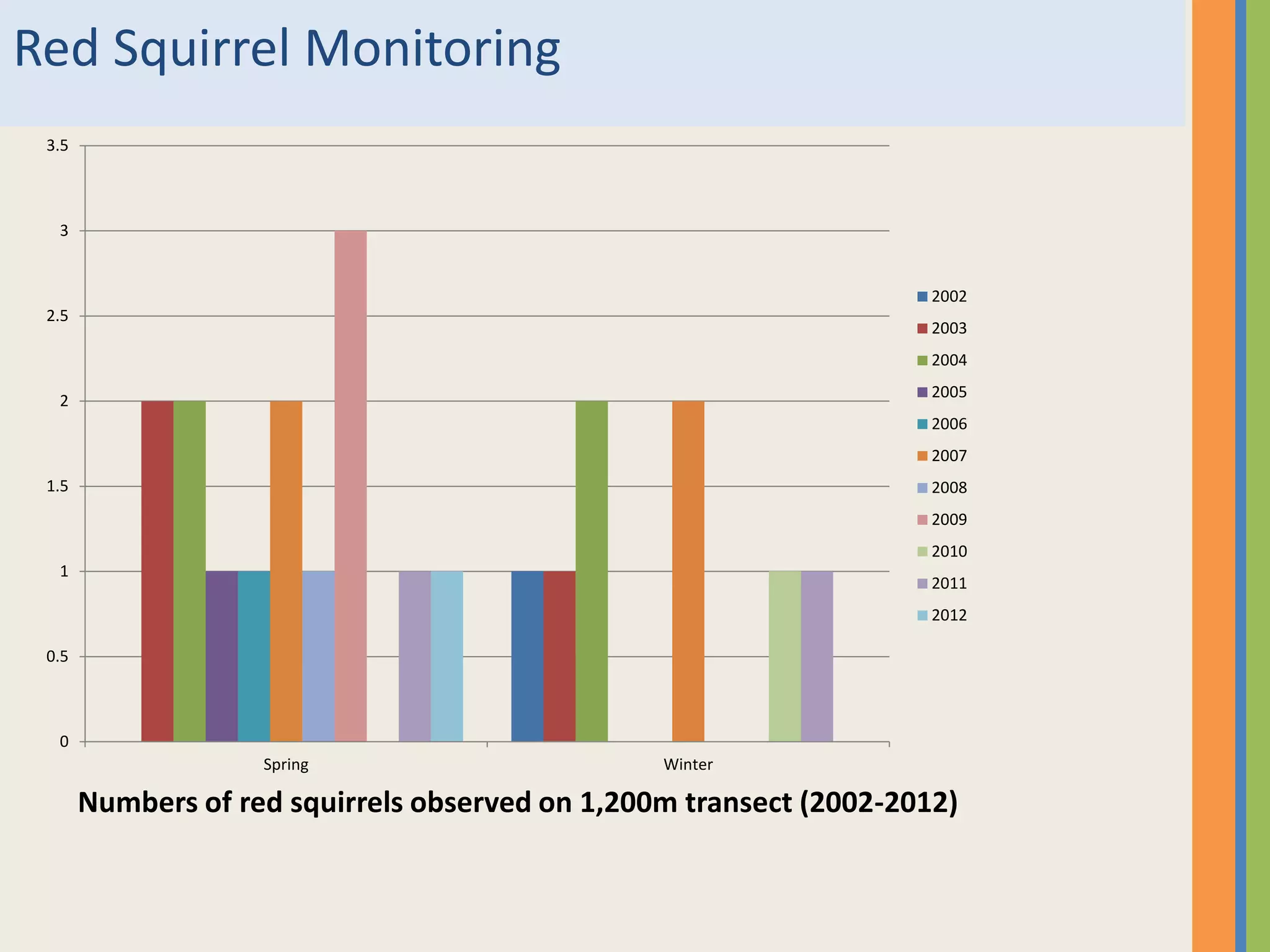
Red Squirrel Monitoring
0
0.5
1
1.5
2
2.5
3
3.5
Spring Winter
2002
2003
2004
2005
2006
2007
2008
2009
2010
2011
2012
Numbers of red squirrels observed on 1,200m transect (2002-2012)
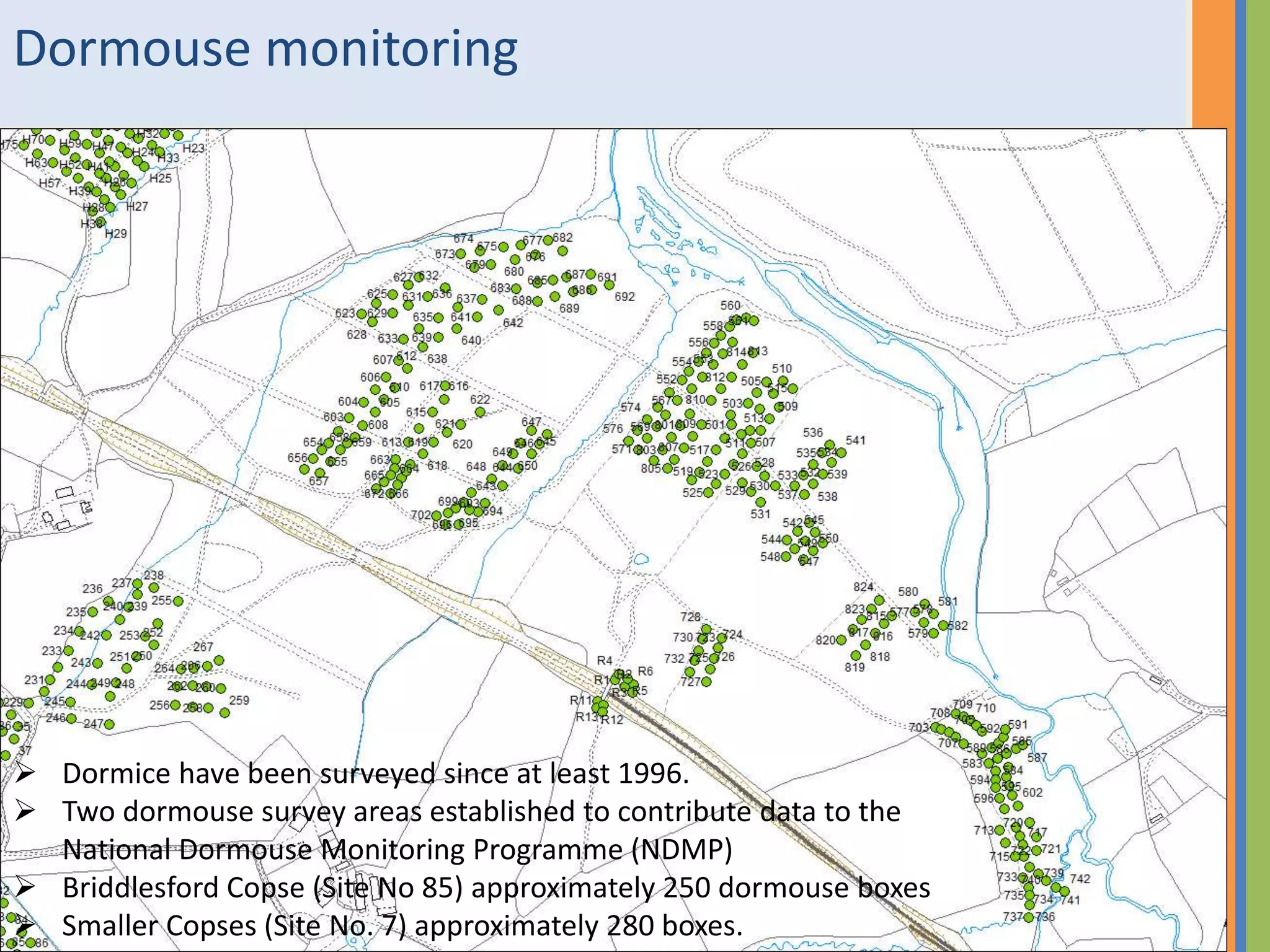
Dormouse monitoring
 Dormice have been surveyed since at least 1996.
 Two dormouse survey areas established to contribute data to the
National Dormouse Monitoring Programme (NDMP)
 Briddlesford Copse (Site No 85) approximately 250 dormouse boxes
 Smaller Copses (Site No. 7) approximately 280 boxes.
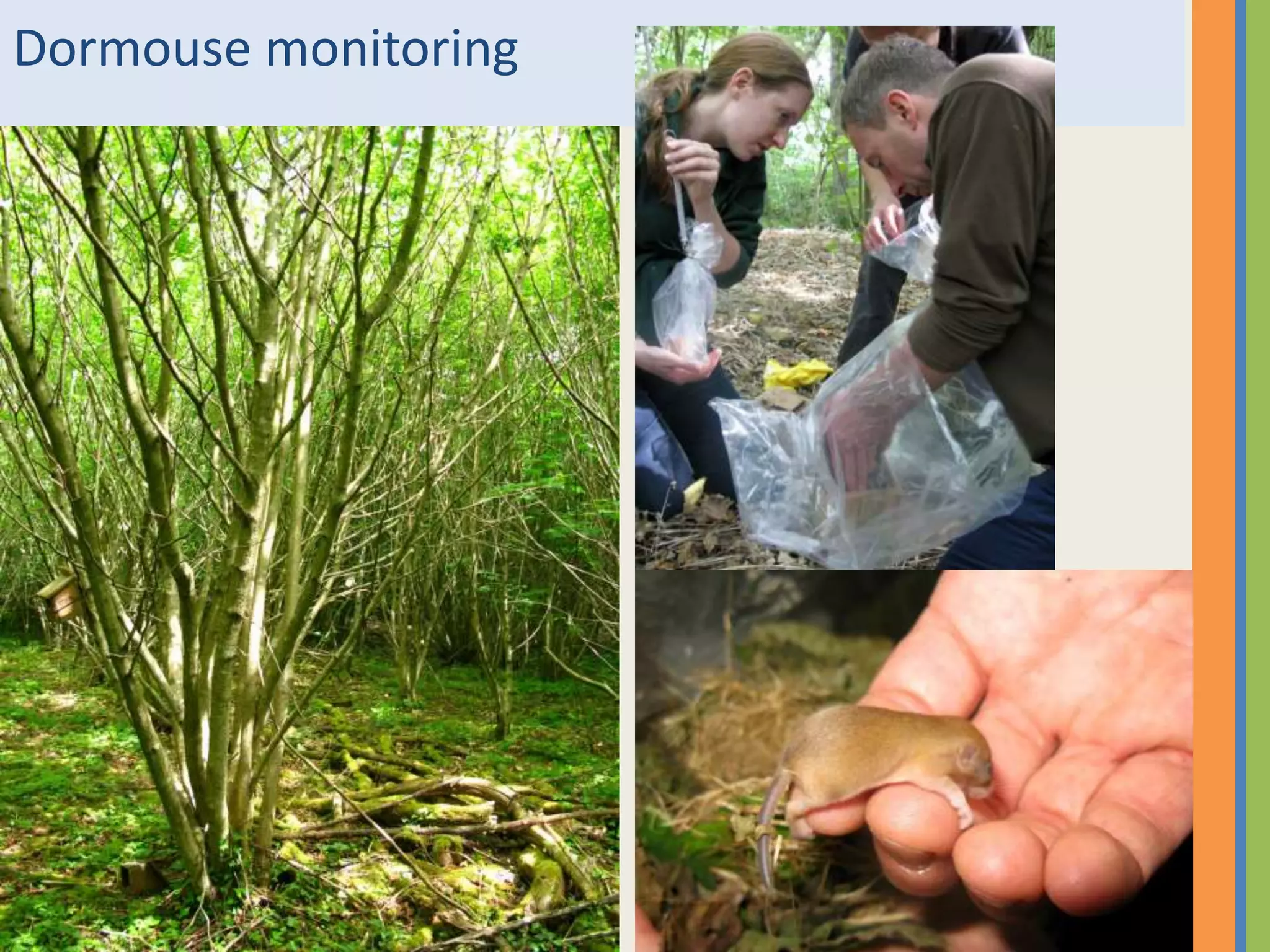
Dormouse monitoring
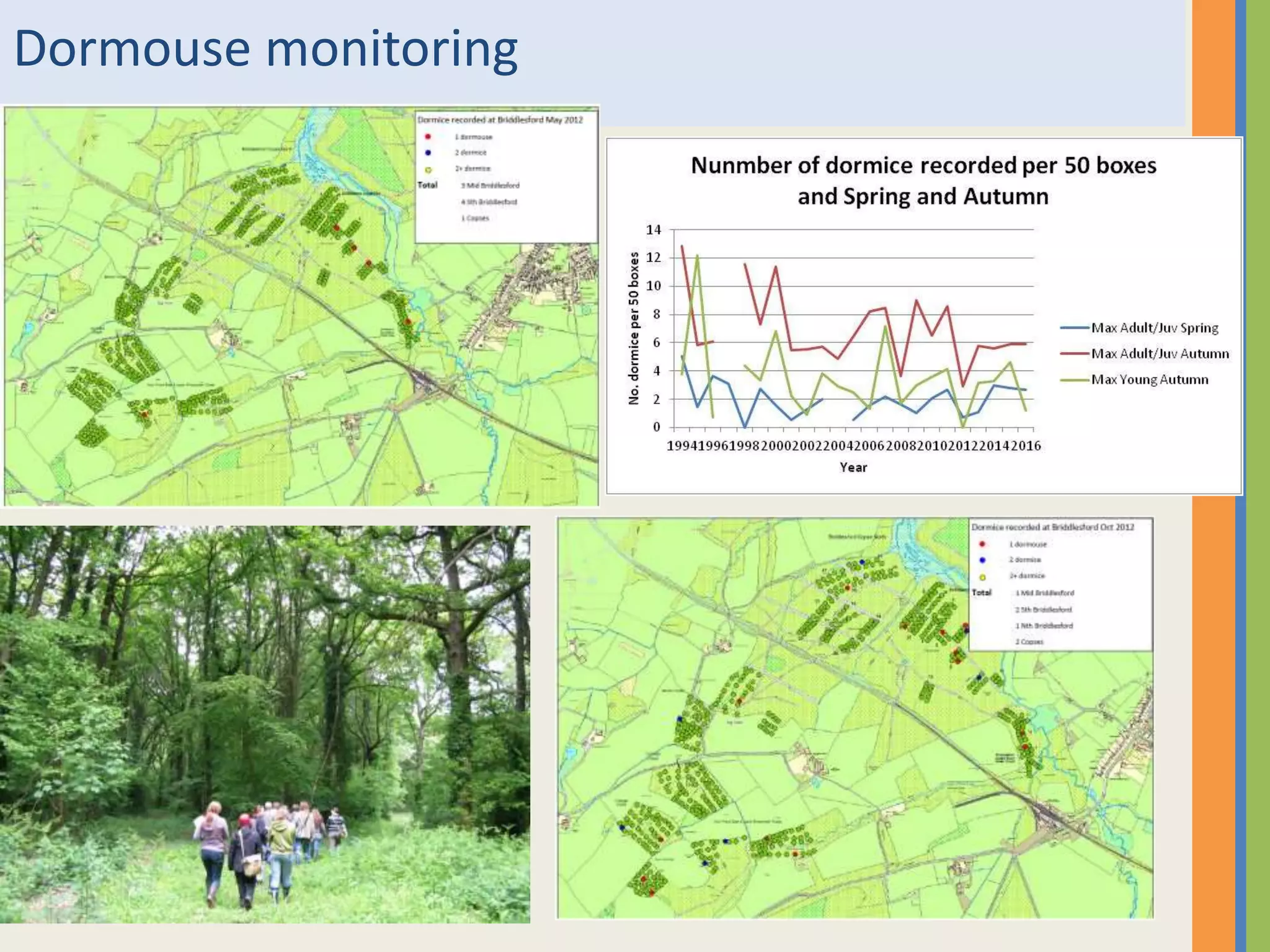
Dormouse monitoring
The Bat Story
The Bat Story
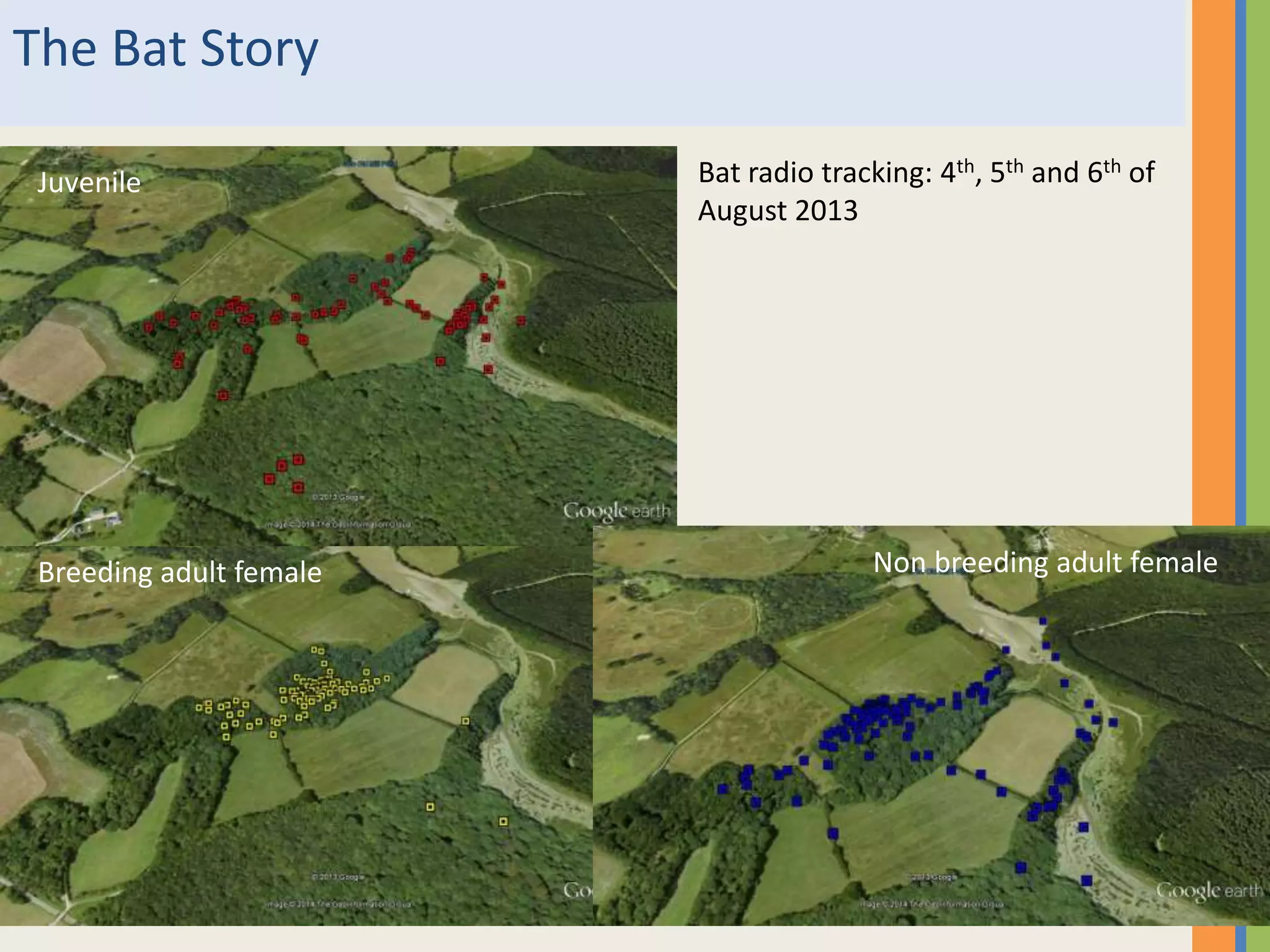
Juvenile
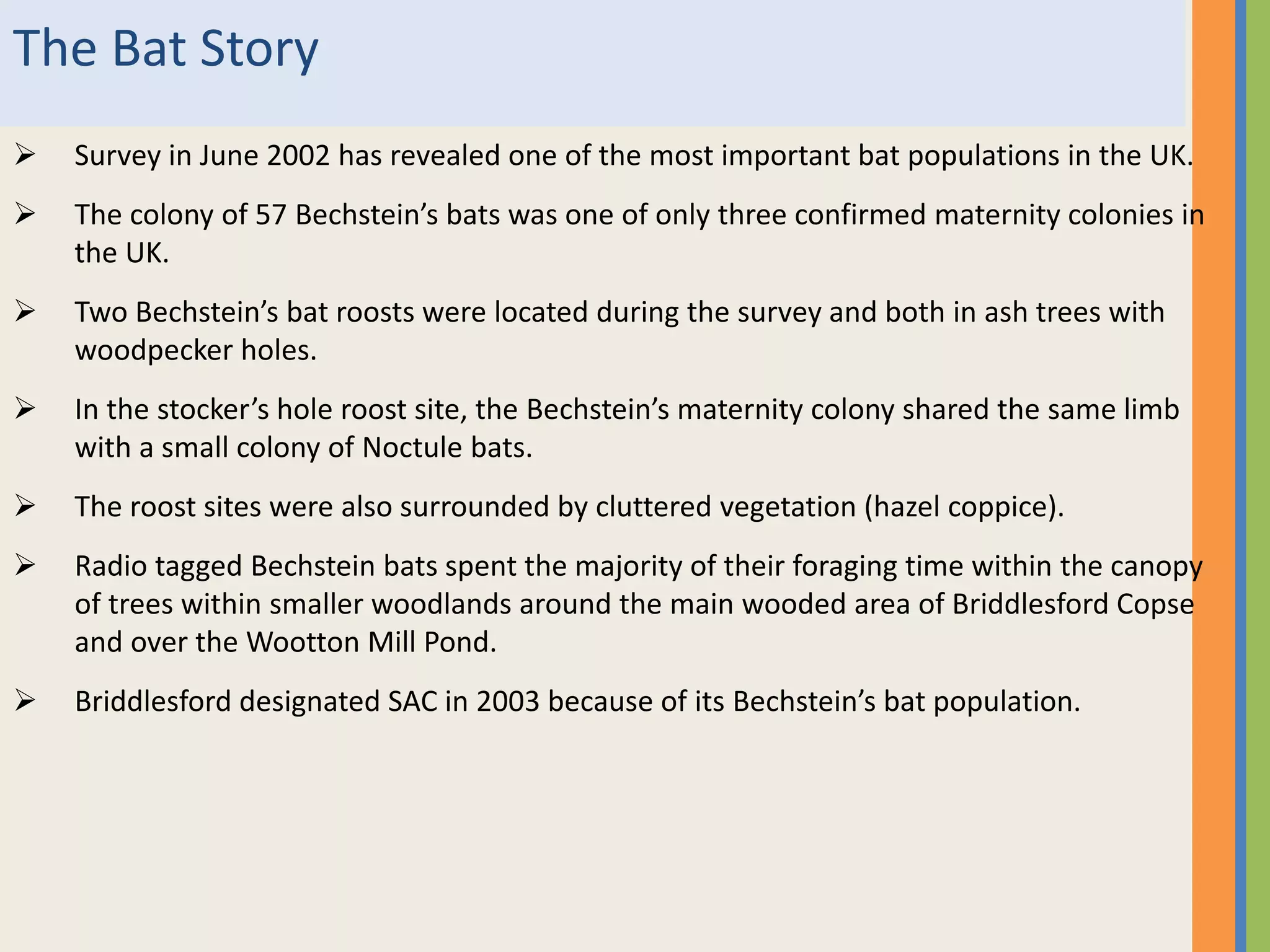
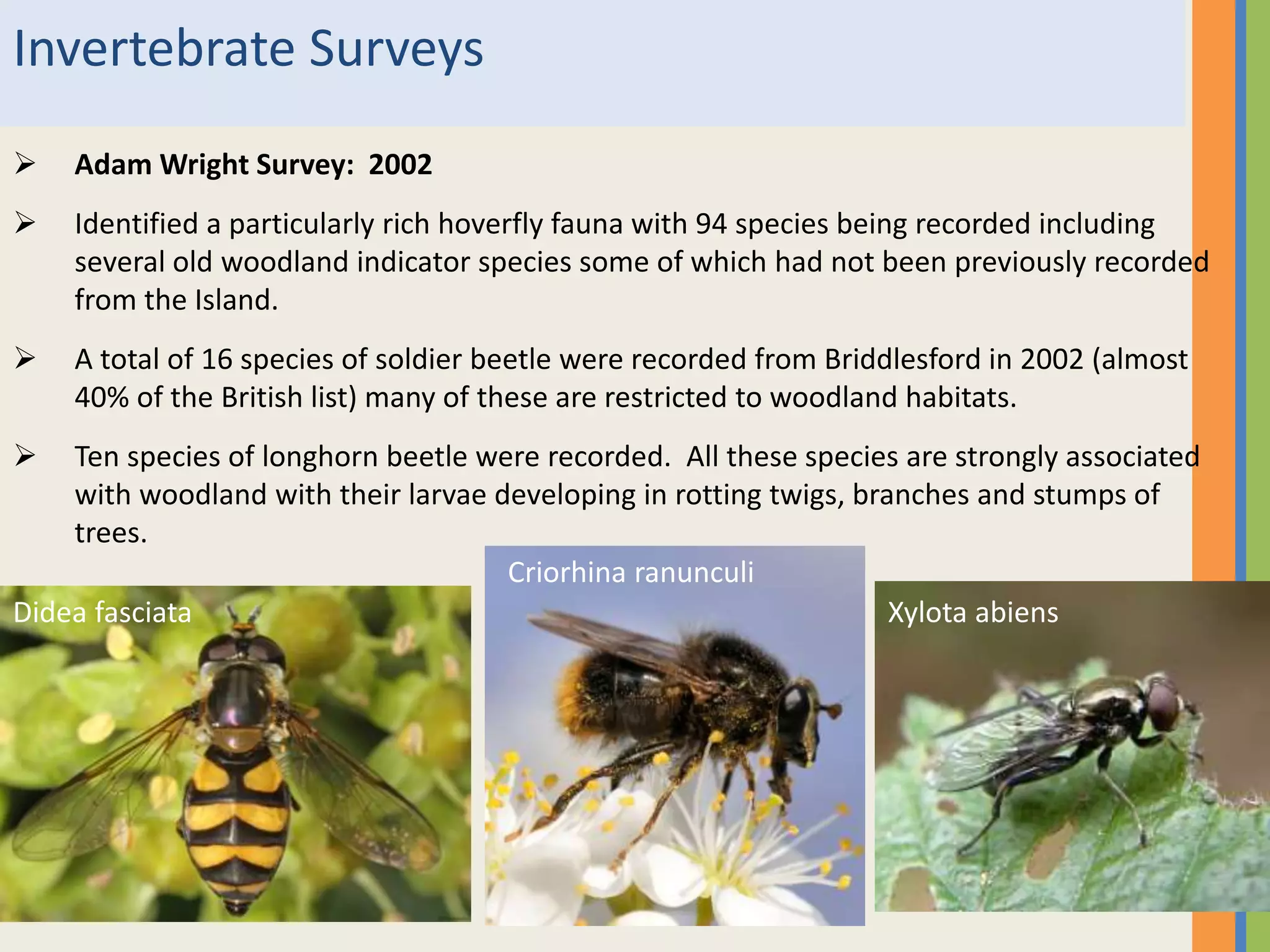
Non breeding adult femaleBreeding adult female
Bat radio tracking: 4th, 5th and 6th of
August 2013
The Bat Story
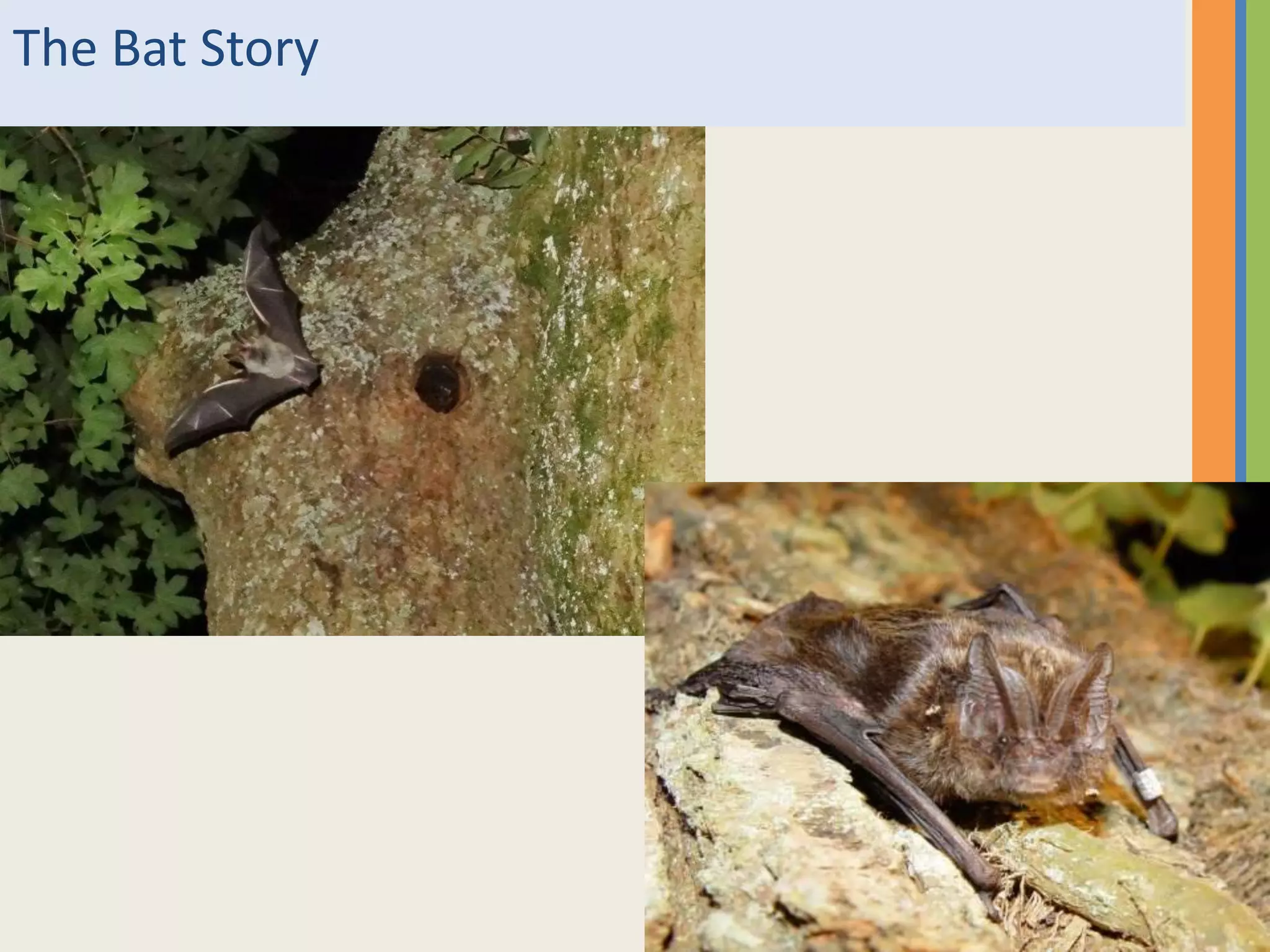
 Survey in June 2002 has revealed one of the most important bat populations in the UK.
 The colony of 57 Bechstein’s bats was one of only three confirmed maternity colonies in
the UK.
 Two Bechstein’s bat roosts were located during the survey and both in ash trees with
woodpecker holes.
 In the stocker’s hole roost site, the Bechstein’s maternity colony shared the same limb
with a small colony of Noctule bats.
 The roost sites were also surrounded by cluttered vegetation (hazel coppice).
 Radio tagged Bechstein bats spent the majority of their foraging time within the canopy
of trees within smaller woodlands around the main wooded area of Briddlesford Copse
and over the Wootton Mill Pond.
 Briddlesford designated SAC in 2003 because of its Bechstein’s bat population.
Invertebrate Surveys
 Adam Wright Survey: 2002
 Identified a particularly rich hoverfly fauna with 94 species being recorded including
several old woodland indicator species some of which had not been previously recorded
from the Island.
 A total of 16 species of soldier beetle were recorded from Briddlesford in 2002 (almost
40% of the British list) many of these are restricted to woodland habitats.
 Ten species of longhorn beetle were recorded. All these species are strongly associated
with woodland with their larvae developing in rotting twigs, branches and stumps of
trees.
Didea fasciata
Criorhina ranunculi
Xylota abiens
Invertebrate Surveys
Keith Alexander: 2012
Briddlesford was proven to be of special nature conservation interest for the following
assemblage types:
 Wood-decay (saproxylic) invertebrates – 150 species identified so far, and of SSSI
quality in its own right; site condition appears favourable at present;
And also of significance are:
 Epiphyte invertebrates;
 Ancient woodland molluscs;
 Fungus associates, especially fungus gnats.
And to a lesser extent:
 Wetland vegetation along Wootton Creek and the stream valleys;
 Bare ground and open grassland species associated mainly with the farmland track
network;
 Tree and shrub canopy fauna;
 Woodland interior species of dappled-shade conditions;
 Woodland seepages.
Overall, a total of 395 invertebrate species were identified in Briddlesford Copses during
2012, bringing the grand total for known invertebrate species to 650.
Invertebrate Surveys
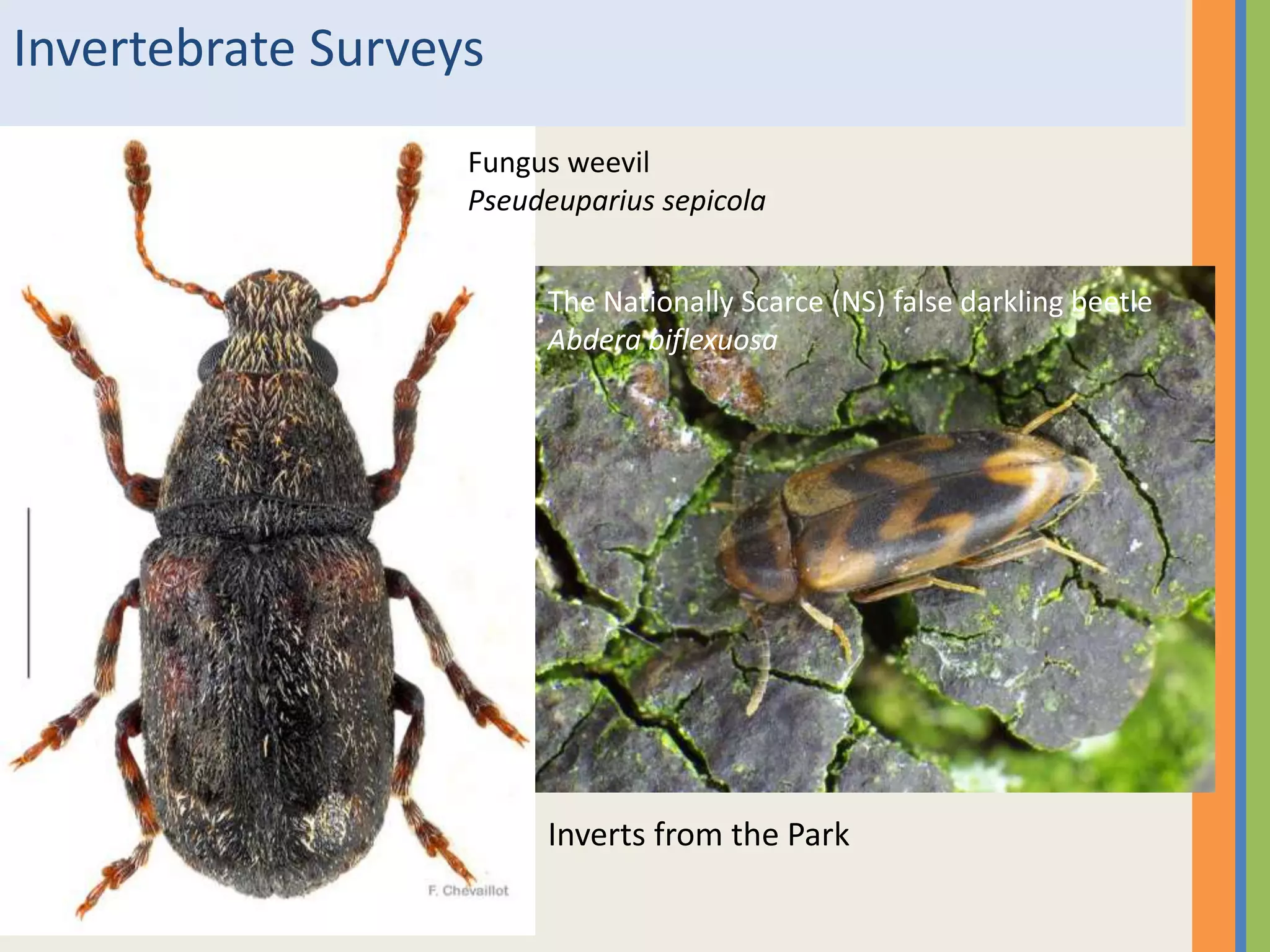
Fungus weevil
Pseudeuparius sepicola
The Nationally Scarce (NS) false darkling beetle
Abdera biflexuosa
Inverts from the Park
Invertebrate Surveys
Other surveys and research
 Niels Brouwers PhD Thesis on Wood Cricket Nemobius sylvestris at
Briddlesford (2008)
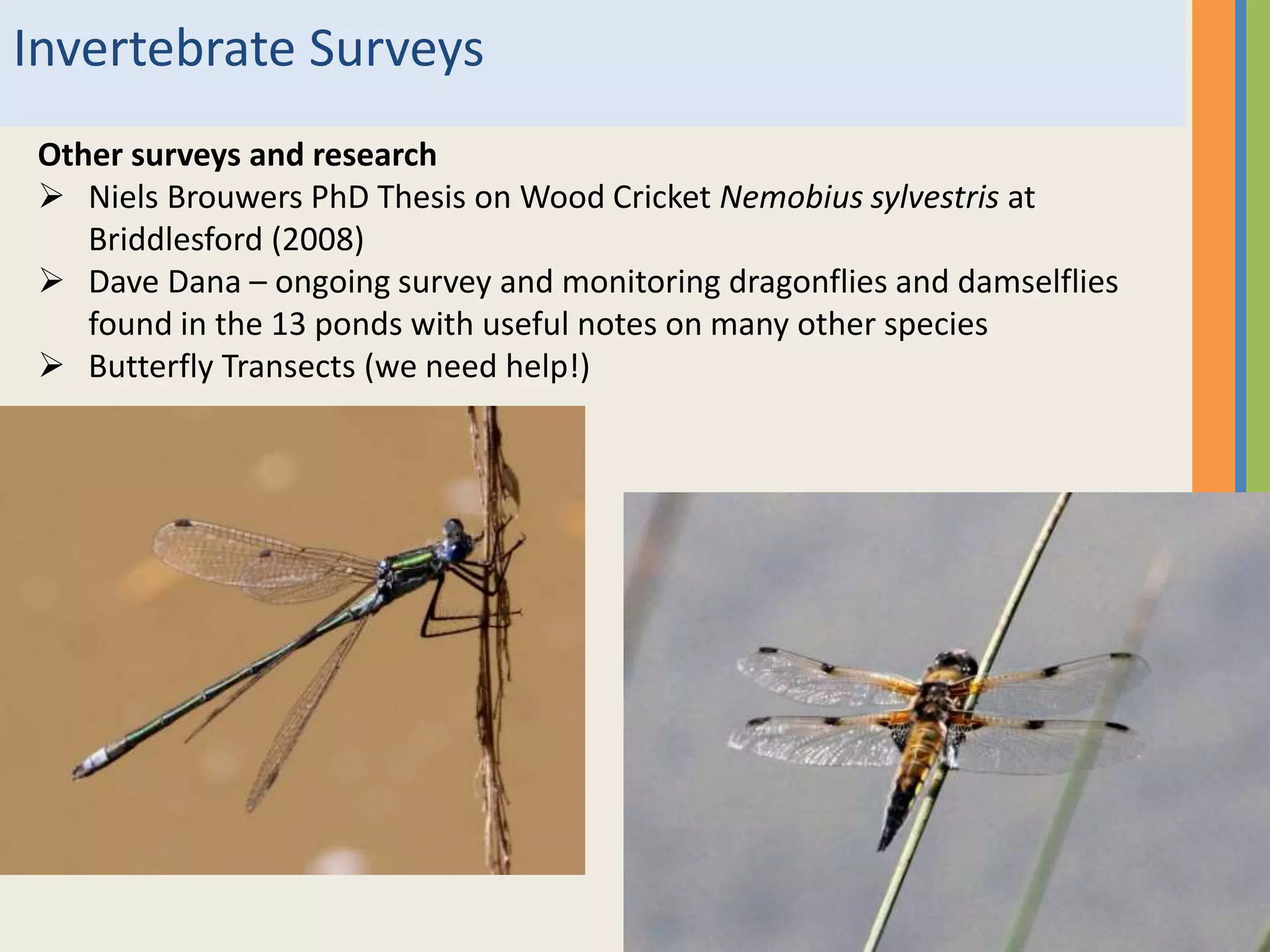
 Dave Dana – ongoing survey and monitoring dragonflies and damselflies
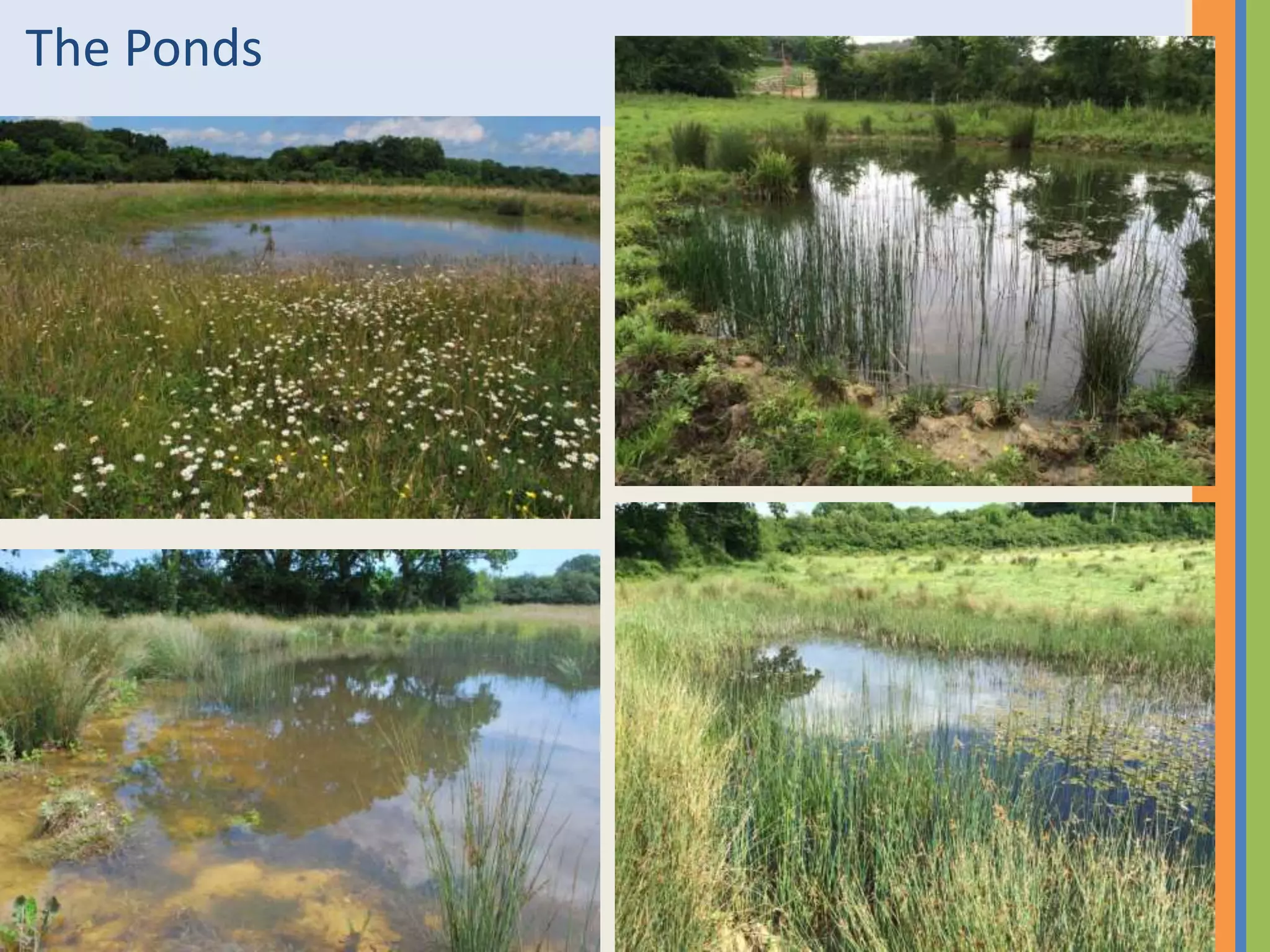
found in the 13 ponds with useful notes on many other species
 Butterfly Transects (we need help!)
Invertebrate Surveys
Moths at Briddlesford
 In his 2012 survey report Keith Alexander stated; ‘It would seem likely that the
reserve will be found to be of significant interest for lichen-feeding moths (macros
and micros) in due course.’
 Isle of Wight moth group survey in August and September 2013.
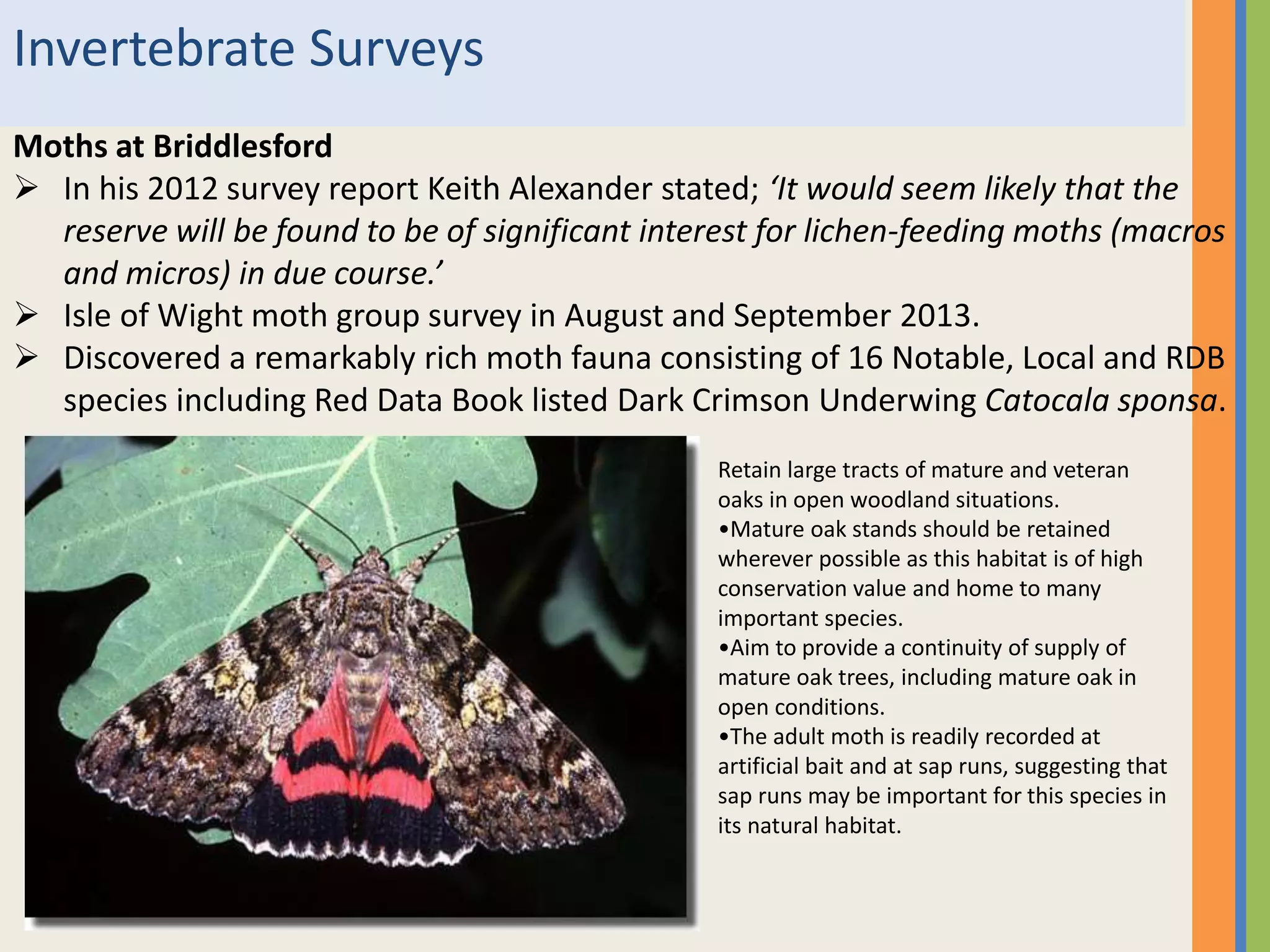
 Discovered a remarkably rich moth fauna consisting of 16 Notable, Local and RDB
species including Red Data Book listed Dark Crimson Underwing Catocala sponsa.
Retain large tracts of mature and veteran
oaks in open woodland situations.
•Mature oak stands should be retained
wherever possible as this habitat is of high
conservation value and home to many
important species.
•Aim to provide a continuity of supply of
mature oak trees, including mature oak in
open conditions.
•The adult moth is readily recorded at
artificial bait and at sap runs, suggesting that
sap runs may be important for this species in
its natural habitat.
Birds
Birds at Briddlesford
 Point count surveys of farmland and woodland edge – 2002, 2007 & 2016
 Barn owl box checks and ringing
 Woodland transect survey 2013 & 2017 (Woodcock?)
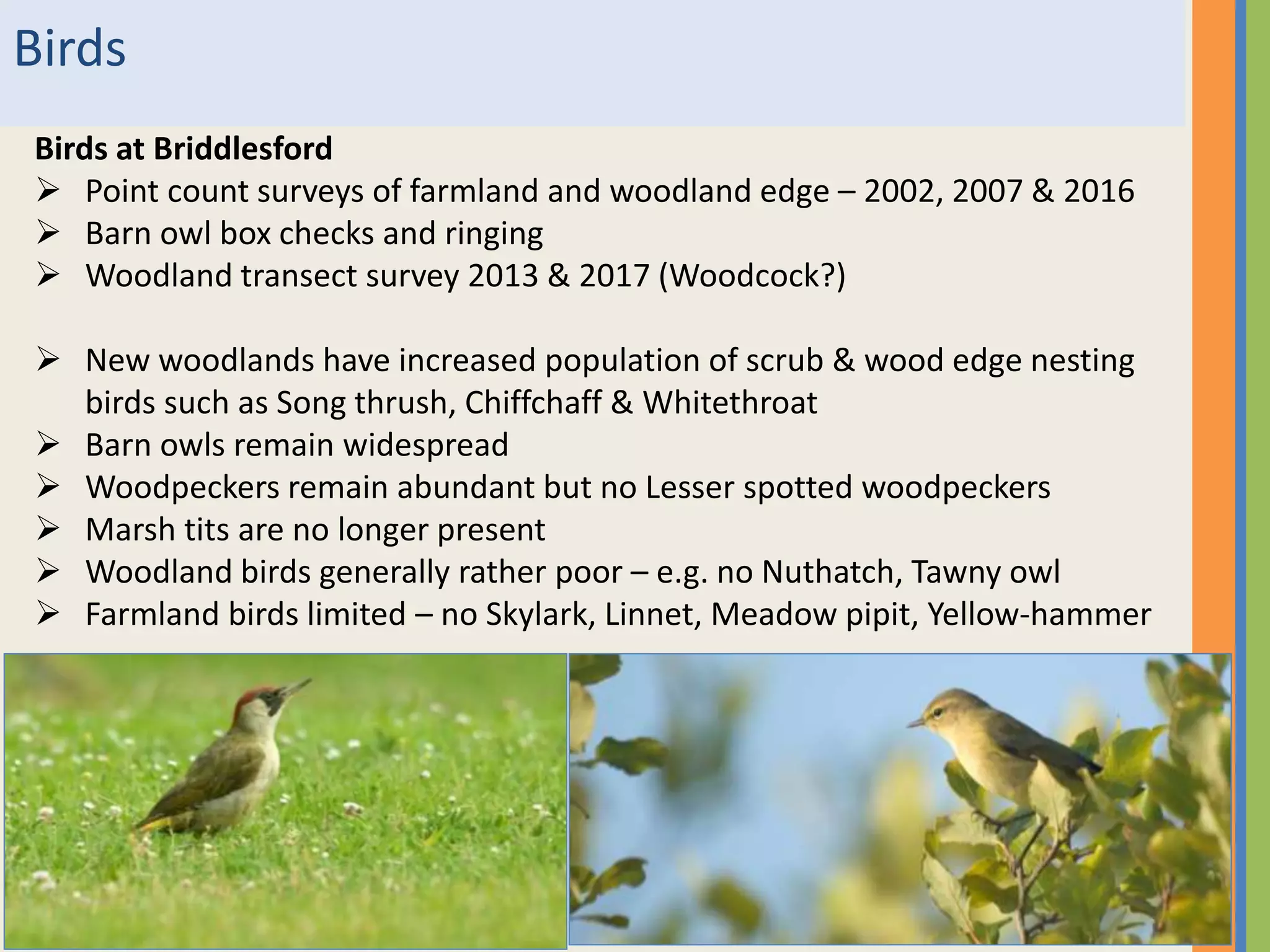
 New woodlands have increased population of scrub & wood edge nesting
birds such as Song thrush, Chiffchaff & Whitethroat
 Barn owls remain widespread
 Woodpeckers remain abundant but no Lesser spotted woodpeckers
 Marsh tits are no longer present
 Woodland birds generally rather poor – e.g. no Nuthatch, Tawny owl
 Farmland birds limited – no Skylark, Linnet, Meadow pipit, Yellow-hammer
Birds
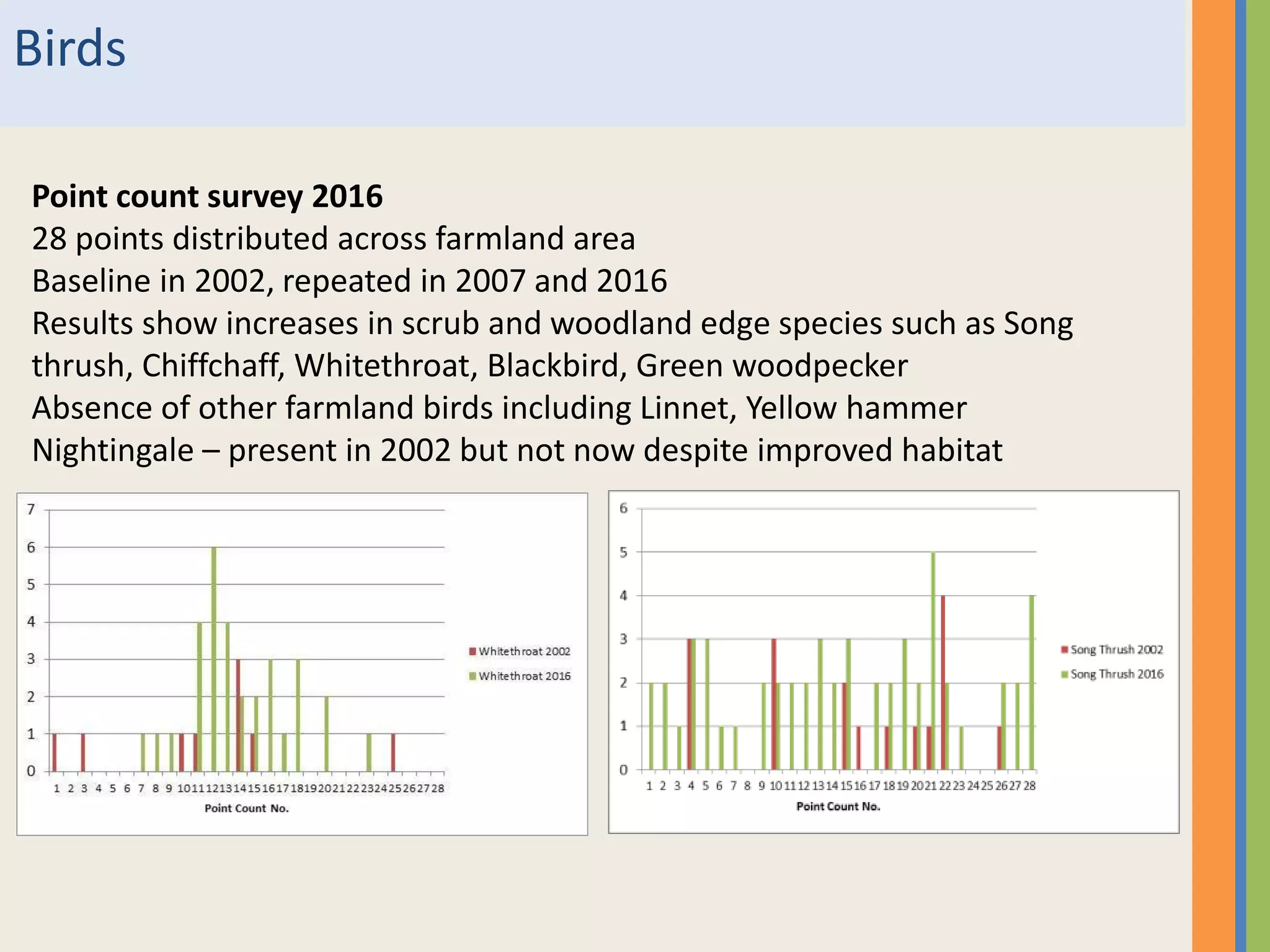
Point count survey 2016
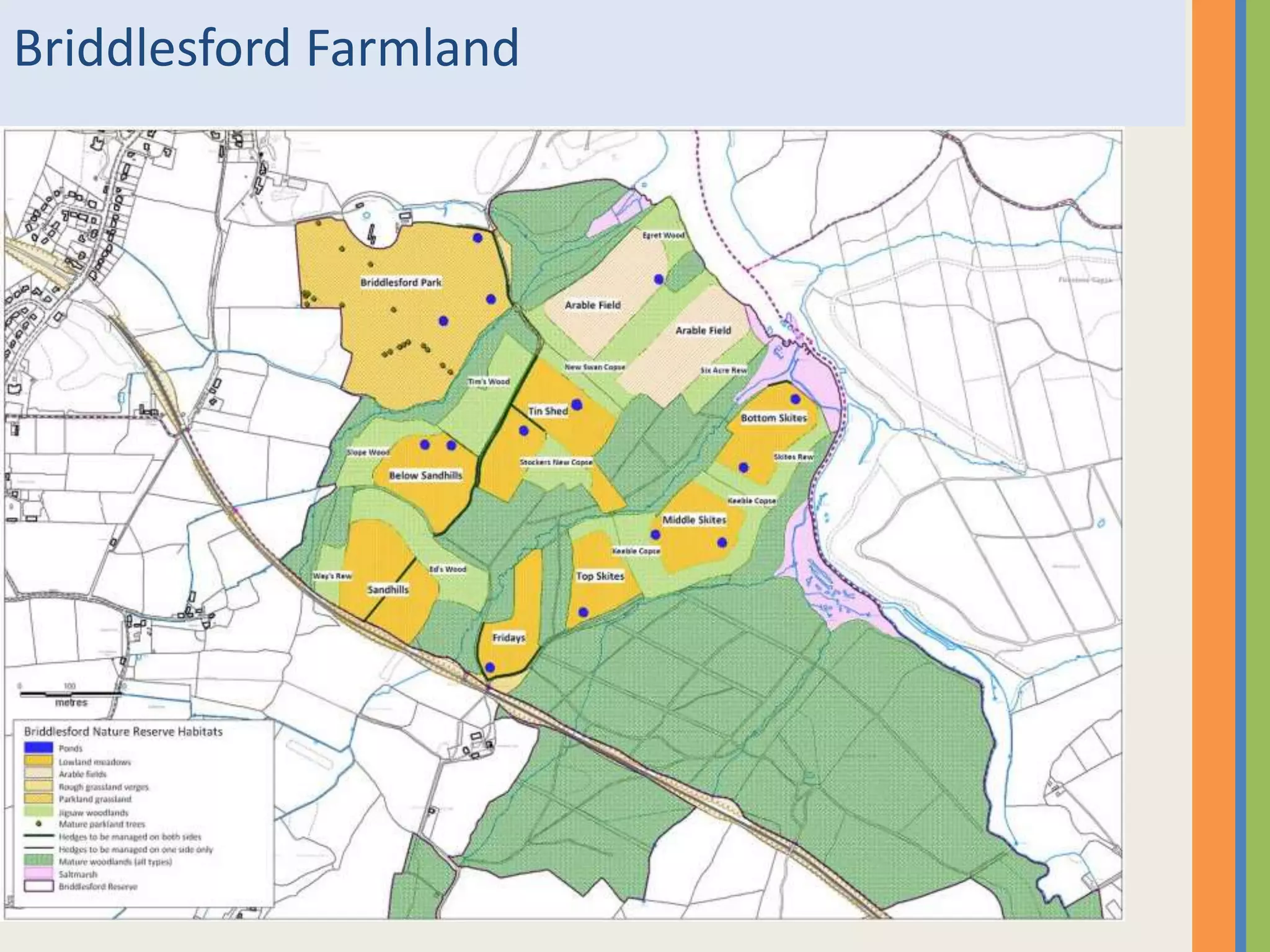
28 points distributed across farmland area
Baseline in 2002, repeated in 2007 and 2016
Results show increases in scrub and woodland edge species such as Song
thrush, Chiffchaff, Whitethroat, Blackbird, Green woodpecker
Absence of other farmland birds including Linnet, Yellow hammer
Nightingale – present in 2002 but not now despite improved habitat
Briddlesford Farmland
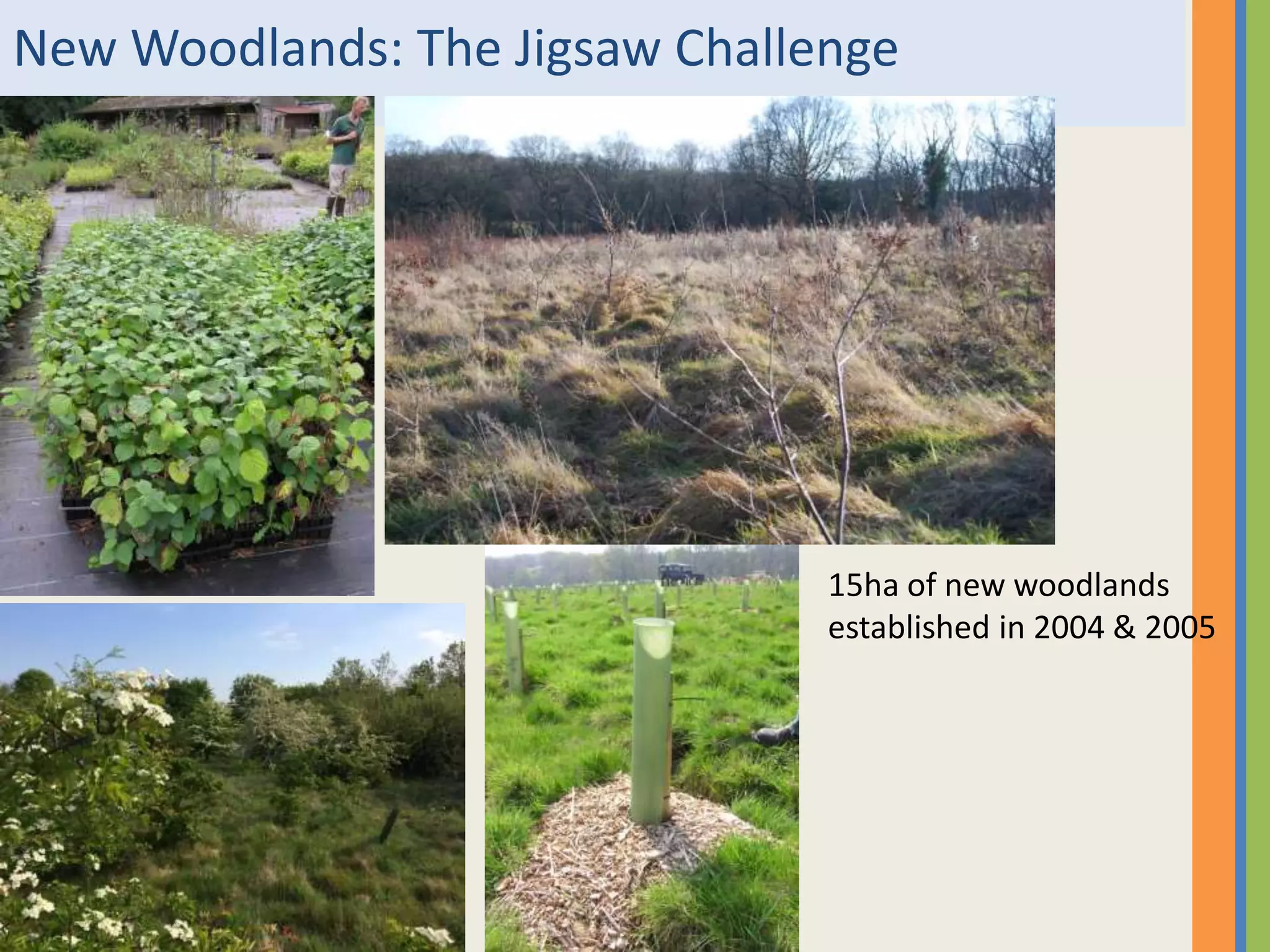
New Woodlands: The Jigsaw Challenge
15ha of new woodlands
established in 2004 & 2005
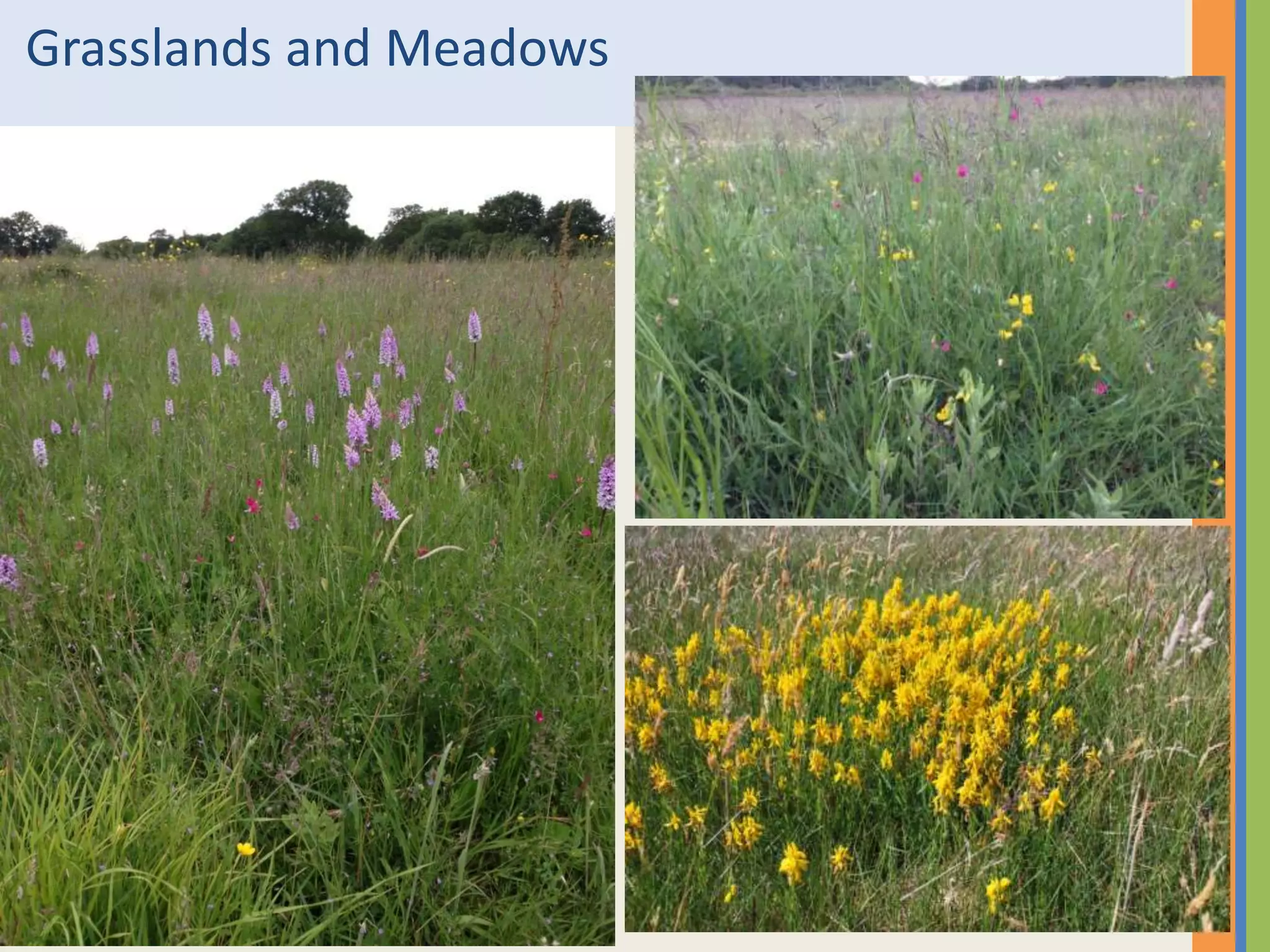
Grasslands and Meadows
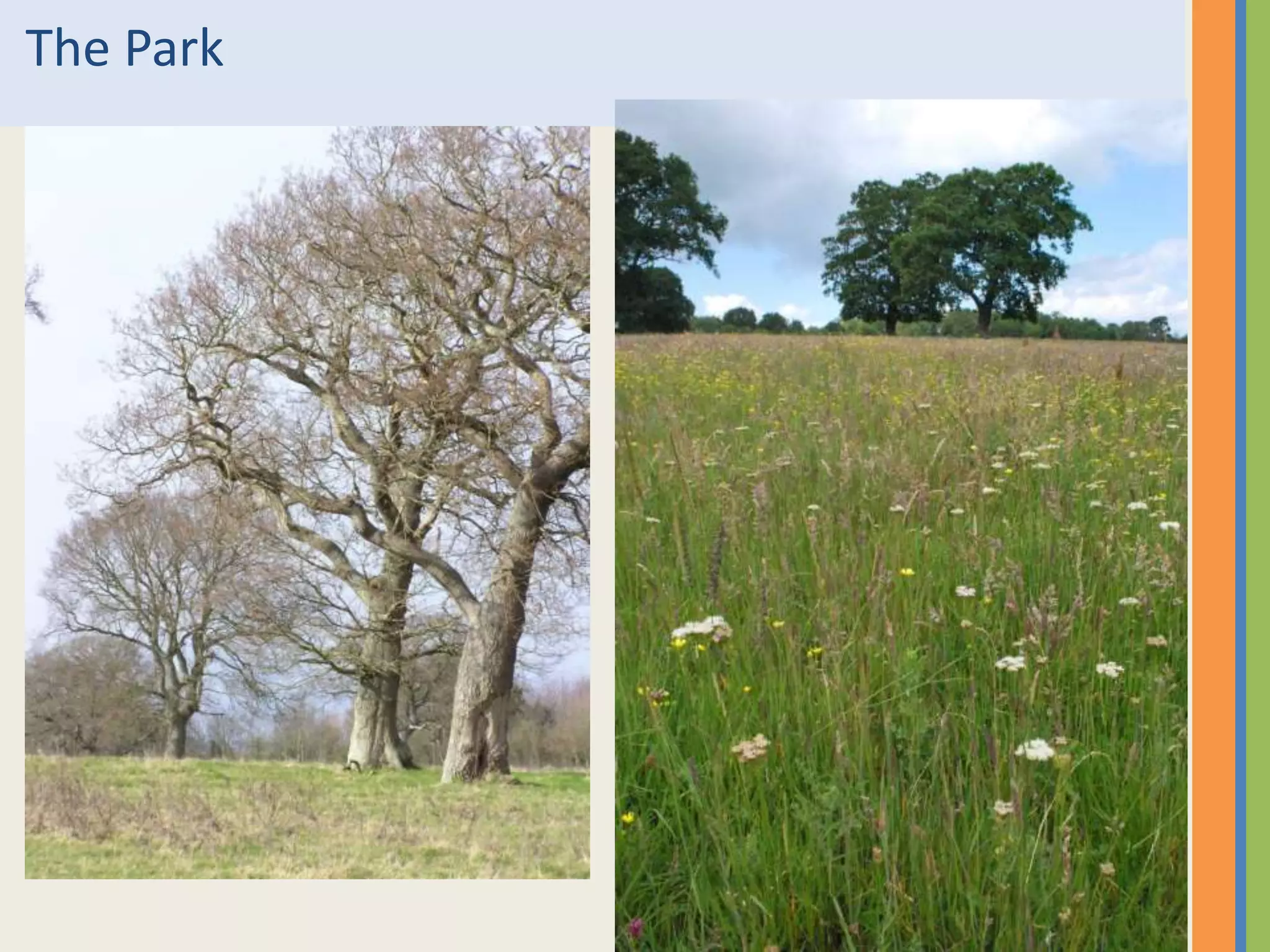
The Park
The Ponds
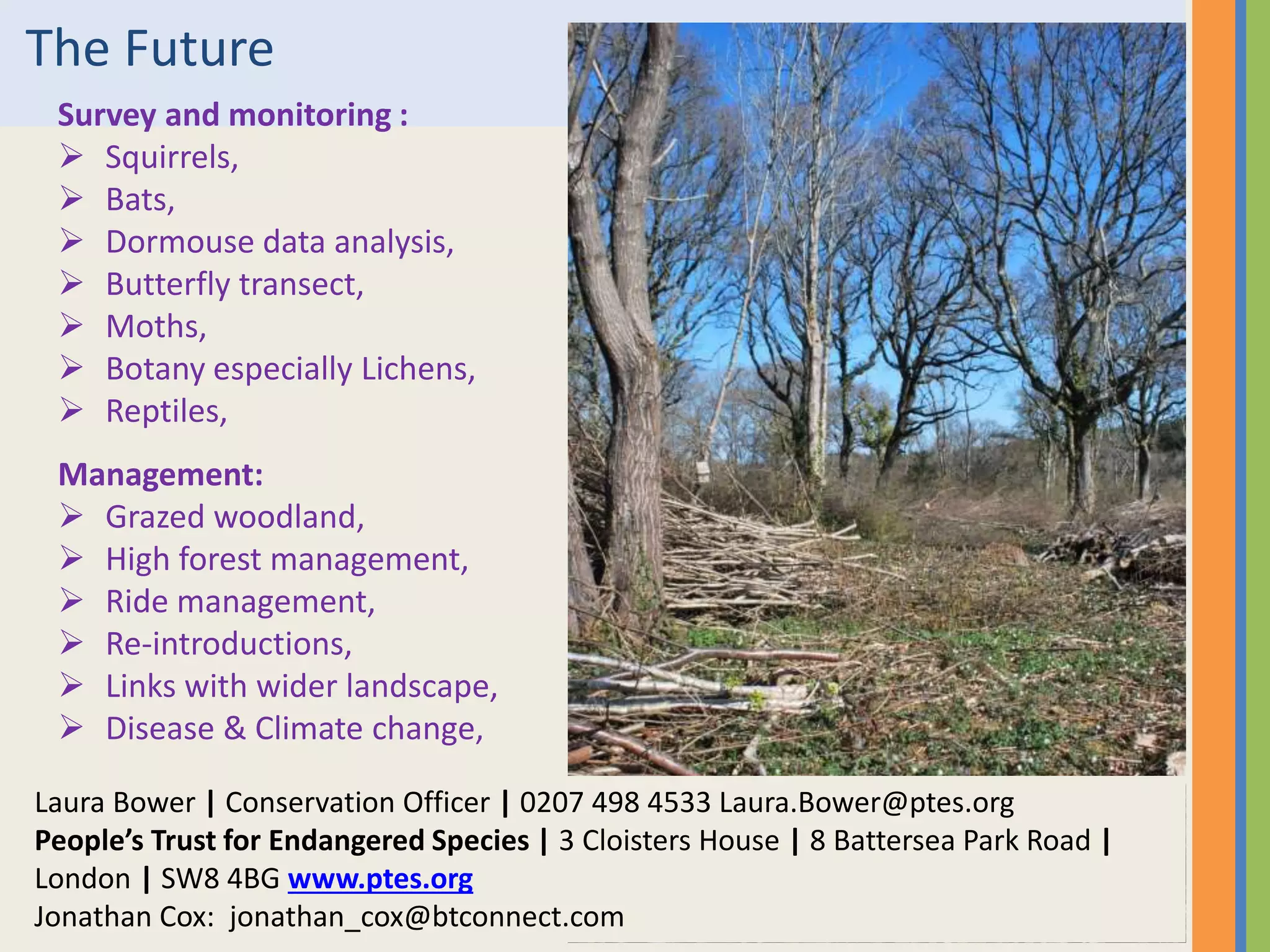
The Future
Survey and monitoring :
 Squirrels,
 Bats,
 Dormouse data analysis,
 Butterfly transect,
 Moths,
 Botany especially Lichens,
 Reptiles,
Management:
 Grazed woodland,
 High forest management,
 Ride management,
 Re-introductions,
 Links with wider landscape,
 Disease & Climate change,
Laura Bower | Conservation Officer | 0207 498 4533 Laura.Bower@ptes.org
People’s Trust for Endangered Species | 3 Cloisters House | 8 Battersea Park Road |
London | SW8 4BG www.ptes.org
Jonathan Cox: jonathan_cox@btconnect.com

Jonathan Cox, Isle of Wight Recorders Conference 2017

  • 1.
    Biological Recording andits influence on wildlife conservation at Briddlesford Jonathan Cox
  • 2.
    Briddlesford Location 158 ha(390 acres) 117 ha Woodland (incl. 15 ha of Jigsaw) 41 ha of Grassland & saltmarsh 95.56 ha SSSI/SAC (of total 167.5 ha)
  • 3.
    A History ofBiological Recording and Conservation Management  Vegetation & habitat survey and SSSI notification (the 1980s)  PTES purchase (the 1990s)  Woodland Management  Red squirrel and early dormouse research  Jigsaw woodlands (the 2000s)  Discovering bats – 2002 survey and effects on management  Botanical surveys and management  Bird surveys and management  Dormouse survey and the national network  How are the squirrels doing?  Invertebrate surveys and management
  • 4.
    Vegetation survey andSSSI notification SSSI Notified 1986 PTES purchase 1992, 1996, 2002 SAC designated 2003
  • 5.
    Ancient Woodlands? 1866 Mapof Briddlesford:.1793 Map of Briddlesford from survey of Captain William Mudge:
  • 6.
    Vegetation and florasurvey: Neil Sanderson (2007) The Sanderson survey identified a total of 19 Peterken stand types from the Briddlesford Copses within the ownership of the PTES – more than any other on the Island. ‘The woodland complex has a superb representation of the range of communities making up the lowland mixed Atlantic Bluebell Woods (Endymio – Carinetum in the Carpinion).’ ‘Floristically this survey demonstrated the woodland flora is among the richest in England for woodland vascular plants’. ‘A total of 65 (AWVP) have been recorded from the Briddlesford Copses owned by the PTES. This is one of the highest number of AWVP for any woodland in Britain. For example, of the 53 richest woods in south east England listed by Rose (1999) only six woods have more AWVP than the Briddlesford Copses. ‘ ‘Acid Sessile Oak woodland is rare on the Island and in Hampshire. Stands with ancient woodland mosses are even rarer.‘ ‘The ancient riverine woodland in Great Wood developing into old growth woodland is a very rare feature anywhere in the lowlands of western Europe.’
  • 7.
    Vegetation and florasurvey: Neil Sanderson (2007)
  • 8.
    Lichens The epiphytic lichenflora is probably the richest overall known on the Island. Enterographa sorediata
  • 9.
    How do wemanage the woodland? Coppicing: 25 ha since 1993
  • 10.
  • 11.
    High Forest Management 56ha of native broadleaved woodland high forest 9 ha thinned by 2014 Programme of increased rate of thinning planned
  • 12.
    Non-intervention 4 hectares alongthe river cliff fronting the Mill Pond known as Skites Copse 4.5 hectares comprising the riverine woodland
  • 13.
  • 14.
    The ‘Eco-Commune’  JessicaHolm PhD - early 1980s  “The Case of the Vanishing Squirrel” 1987  Pat Morris and the RHLU Students
  • 15.
    Red Squirrel Ecology– Key Points Squirrel density Walters Copes (WC) 0.3-0.7/ha Briddlesford Copse (BC) 1 – 1.6/ha. (mean = 0.85/ha or about 100 red squirrels in PTES woodland at Briddlesford) Fattingpark Copse (FC) 0.6-1.1/ha Food Hazel is by far the most important food source for squirrels in deciduous woodland. Determines the pattern of behaviour throughout the year. Squirrels were able to survive (at lower densities) in deciduous woodland where hazel was patchy. Oak provides a critical food source in mid winter when the fungi (Vuillemenia sp) is stripped from beneath the bark on the underside of dead and dying branches. Periods of activity In winter activity is limited to a relatively short period of the morning with peak just before noon. In summer bi-modal activity was recorded with peaks in morning and afternoon and a rest period in middle of the day. Range size Mean total adult male range = 5.7 ha (3.5 ha FC, 5.3 ha BC, 6.4 ha WC) Mean total adult female range = 3.6 ha (2.8 ha FC, 3.0 ha BC, 4.1 ha WC) Mean core adult male range = 1.1 ha (1.0 ha FC & BC, 1.5 ha WC) Mean core adult female range = 1.0 ha (0.8 ha FC, 1.0 ha BC, 1.1 ha WC)
  • 16.
    Red Squirrel Monitoring 0 0.5 1 1.5 2 2.5 3 3.5 SpringWinter 2002 2003 2004 2005 2006 2007 2008 2009 2010 2011 2012 Numbers of red squirrels observed on 1,200m transect (2002-2012)
  • 17.
    Dormouse monitoring  Dormicehave been surveyed since at least 1996.  Two dormouse survey areas established to contribute data to the National Dormouse Monitoring Programme (NDMP)  Briddlesford Copse (Site No 85) approximately 250 dormouse boxes  Smaller Copses (Site No. 7) approximately 280 boxes.
  • 18.
  • 19.
  • 20.
  • 21.
    The Bat Story Juvenile Nonbreeding adult femaleBreeding adult female Bat radio tracking: 4th, 5th and 6th of August 2013
  • 22.
    The Bat Story Survey in June 2002 has revealed one of the most important bat populations in the UK.  The colony of 57 Bechstein’s bats was one of only three confirmed maternity colonies in the UK.  Two Bechstein’s bat roosts were located during the survey and both in ash trees with woodpecker holes.  In the stocker’s hole roost site, the Bechstein’s maternity colony shared the same limb with a small colony of Noctule bats.  The roost sites were also surrounded by cluttered vegetation (hazel coppice).  Radio tagged Bechstein bats spent the majority of their foraging time within the canopy of trees within smaller woodlands around the main wooded area of Briddlesford Copse and over the Wootton Mill Pond.  Briddlesford designated SAC in 2003 because of its Bechstein’s bat population.
  • 23.
    Invertebrate Surveys  AdamWright Survey: 2002  Identified a particularly rich hoverfly fauna with 94 species being recorded including several old woodland indicator species some of which had not been previously recorded from the Island.  A total of 16 species of soldier beetle were recorded from Briddlesford in 2002 (almost 40% of the British list) many of these are restricted to woodland habitats.  Ten species of longhorn beetle were recorded. All these species are strongly associated with woodland with their larvae developing in rotting twigs, branches and stumps of trees. Didea fasciata Criorhina ranunculi Xylota abiens
  • 24.
    Invertebrate Surveys Keith Alexander:2012 Briddlesford was proven to be of special nature conservation interest for the following assemblage types:  Wood-decay (saproxylic) invertebrates – 150 species identified so far, and of SSSI quality in its own right; site condition appears favourable at present; And also of significance are:  Epiphyte invertebrates;  Ancient woodland molluscs;  Fungus associates, especially fungus gnats. And to a lesser extent:  Wetland vegetation along Wootton Creek and the stream valleys;  Bare ground and open grassland species associated mainly with the farmland track network;  Tree and shrub canopy fauna;  Woodland interior species of dappled-shade conditions;  Woodland seepages. Overall, a total of 395 invertebrate species were identified in Briddlesford Copses during 2012, bringing the grand total for known invertebrate species to 650.
  • 25.
    Invertebrate Surveys Fungus weevil Pseudeupariussepicola The Nationally Scarce (NS) false darkling beetle Abdera biflexuosa Inverts from the Park
  • 26.
    Invertebrate Surveys Other surveysand research  Niels Brouwers PhD Thesis on Wood Cricket Nemobius sylvestris at Briddlesford (2008)  Dave Dana – ongoing survey and monitoring dragonflies and damselflies found in the 13 ponds with useful notes on many other species  Butterfly Transects (we need help!)
  • 27.
    Invertebrate Surveys Moths atBriddlesford  In his 2012 survey report Keith Alexander stated; ‘It would seem likely that the reserve will be found to be of significant interest for lichen-feeding moths (macros and micros) in due course.’  Isle of Wight moth group survey in August and September 2013.  Discovered a remarkably rich moth fauna consisting of 16 Notable, Local and RDB species including Red Data Book listed Dark Crimson Underwing Catocala sponsa. Retain large tracts of mature and veteran oaks in open woodland situations. •Mature oak stands should be retained wherever possible as this habitat is of high conservation value and home to many important species. •Aim to provide a continuity of supply of mature oak trees, including mature oak in open conditions. •The adult moth is readily recorded at artificial bait and at sap runs, suggesting that sap runs may be important for this species in its natural habitat.
  • 28.
    Birds Birds at Briddlesford Point count surveys of farmland and woodland edge – 2002, 2007 & 2016  Barn owl box checks and ringing  Woodland transect survey 2013 & 2017 (Woodcock?)  New woodlands have increased population of scrub & wood edge nesting birds such as Song thrush, Chiffchaff & Whitethroat  Barn owls remain widespread  Woodpeckers remain abundant but no Lesser spotted woodpeckers  Marsh tits are no longer present  Woodland birds generally rather poor – e.g. no Nuthatch, Tawny owl  Farmland birds limited – no Skylark, Linnet, Meadow pipit, Yellow-hammer
  • 29.
    Birds Point count survey2016 28 points distributed across farmland area Baseline in 2002, repeated in 2007 and 2016 Results show increases in scrub and woodland edge species such as Song thrush, Chiffchaff, Whitethroat, Blackbird, Green woodpecker Absence of other farmland birds including Linnet, Yellow hammer Nightingale – present in 2002 but not now despite improved habitat
  • 30.
  • 31.
    New Woodlands: TheJigsaw Challenge 15ha of new woodlands established in 2004 & 2005
  • 32.
  • 33.
  • 34.
  • 35.
    The Future Survey andmonitoring :  Squirrels,  Bats,  Dormouse data analysis,  Butterfly transect,  Moths,  Botany especially Lichens,  Reptiles, Management:  Grazed woodland,  High forest management,  Ride management,  Re-introductions,  Links with wider landscape,  Disease & Climate change, Laura Bower | Conservation Officer | 0207 498 4533 Laura.Bower@ptes.org People’s Trust for Endangered Species | 3 Cloisters House | 8 Battersea Park Road | London | SW8 4BG www.ptes.org Jonathan Cox: jonathan_cox@btconnect.com

Editor's Notes