Resources available from the
       Opal project

                            Adam Bates
Geography, Earth and Environmental Sciences, The University of Birmingham,
                            Birmingham, UK


       Austin Court, Birmingham – 17th September 2011
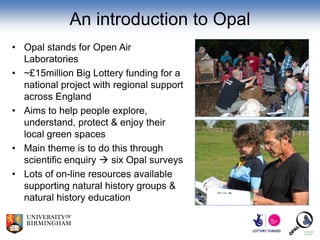
An introduction to Opal
• Opal stands for Open Air
  Laboratories
• ~£15million Big Lottery funding for a
  national project with regional support
  across England
• Aims to help people explore,
  understand, protect & enjoy their
  local green spaces
• Main theme is to do this through
  scientific enquiry  six Opal surveys
• Lots of on-line resources available
  supporting natural history groups &
  natural history education
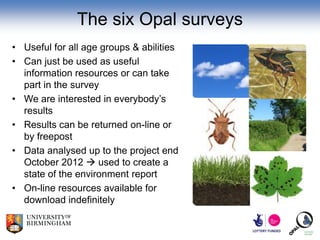
The six Opal surveys
• Useful for all age groups & abilities
• Can just be used as useful
  information resources or can take
  part in the survey
• We are interested in everybody’s
  results
• Results can be returned on-line or
  by freepost
• Data analysed up to the project end
  October 2012  used to create a
  state of the environment report
• On-line resources available for
  download indefinitely
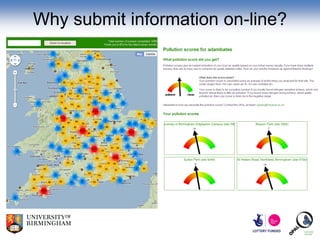
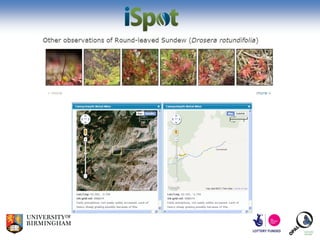
Why submit information on-line?
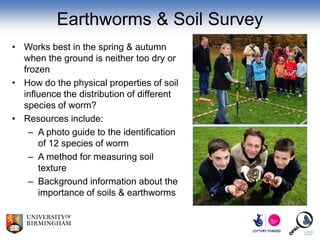
Earthworms & Soil Survey
• Works best in the spring & autumn
  when the ground is neither too dry or
  frozen
• How do the physical properties of soil
  influence the distribution of different
  species of worm?
• Resources include:
   – A photo guide to the identification
      of 12 species of worm
   – A method for measuring soil
      texture
   – Background information about the
      importance of soils & earthworms
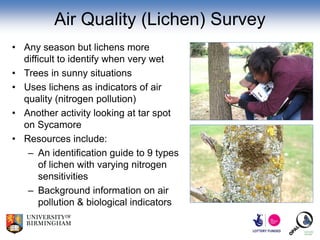
Air Quality (Lichen) Survey
• Any season but lichens more
  difficult to identify when very wet
• Trees in sunny situations
• Uses lichens as indicators of air
  quality (nitrogen pollution)
• Another activity looking at tar spot
  on Sycamore
• Resources include:
   – An identification guide to 9 types
       of lichen with varying nitrogen
       sensitivities
   – Background information on air
       pollution & biological indicators
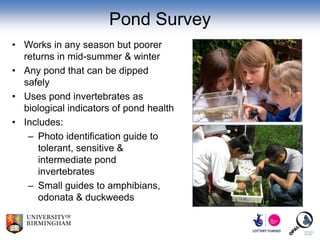
Pond Survey
• Works in any season but poorer
  returns in mid-summer & winter
• Any pond that can be dipped
  safely
• Uses pond invertebrates as
  biological indicators of pond health
• Includes:
   – Photo identification guide to
     tolerant, sensitive &
     intermediate pond
     invertebrates
   – Small guides to amphibians,
     odonata & duckweeds
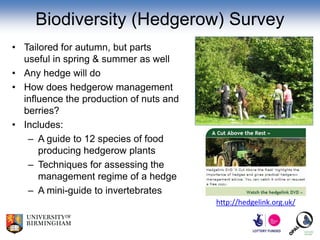
Biodiversity (Hedgerow) Survey
• Tailored for autumn, but parts
  useful in spring & summer as well
• Any hedge will do
• How does hedgerow management
  influence the production of nuts and
  berries?
• Includes:
   – A guide to 12 species of food
      producing hedgerow plants
   – Techniques for assessing the
      management regime of a hedge
   – A mini-guide to invertebrates
                                         http://hedgelink.org.uk/
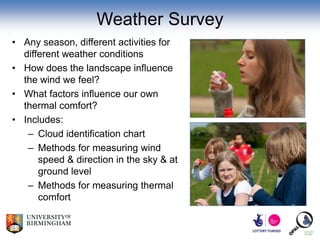
Weather Survey
• Any season, different activities for
  different weather conditions
• How does the landscape influence
  the wind we feel?
• What factors influence our own
  thermal comfort?
• Includes:
   – Cloud identification chart
   – Methods for measuring wind
      speed & direction in the sky & at
      ground level
   – Methods for measuring thermal
      comfort
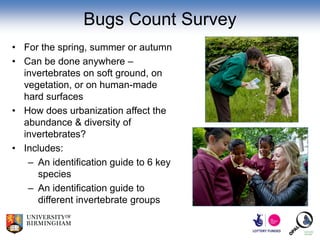
Bugs Count Survey
• For the spring, summer or autumn
• Can be done anywhere –
  invertebrates on soft ground, on
  vegetation, or on human-made
  hard surfaces
• How does urbanization affect the
  abundance & diversity of
  invertebrates?
• Includes:
   – An identification guide to 6 key
     species
   – An identification guide to
     different invertebrate groups
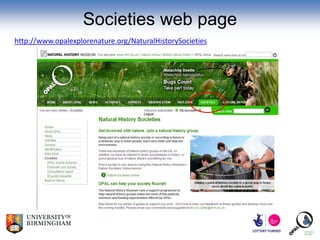
Societies web page
http://www.opalexplorenature.org/NaturalHistorySocieties
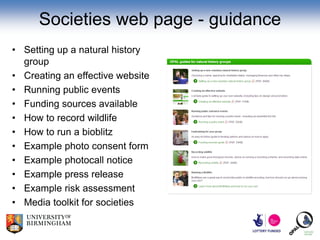
Societies web page - guidance
• Setting up a natural history
  group
• Creating an effective website
• Running public events
• Funding sources available
• How to record wildlife
• How to run a bioblitz
• Example photo consent form
• Example photocall notice
• Example press release
• Example risk assessment
• Media toolkit for societies
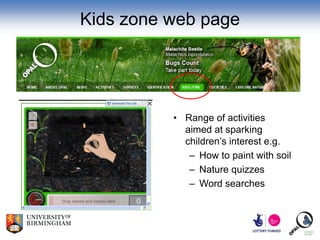
Kids zone web page


          • Range of activities
            aimed at sparking
            children’s interest e.g.
             – How to paint with soil
             – Nature quizzes
             – Word searches
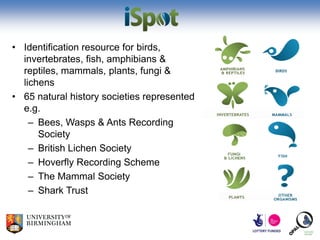
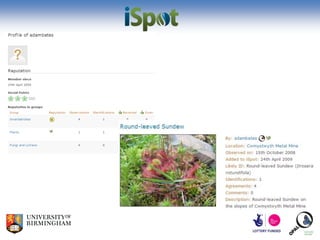
• Identification resource for birds,
  invertebrates, fish, amphibians &
  reptiles, mammals, plants, fungi &
  lichens
• 65 natural history societies represented
  e.g.
    – Bees, Wasps & Ants Recording
      Society
    – British Lichen Society
    – Hoverfly Recording Scheme
    – The Mammal Society
    – Shark Trust
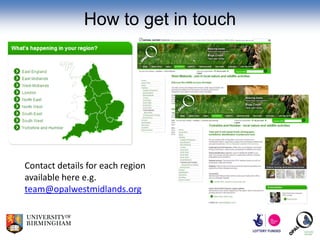
How to get in touch


Contact details for each region
available here e.g.
team@opalwestmidlands.org

Open air laboratories (opal)

  • 1.
    Resources available fromthe Opal project Adam Bates Geography, Earth and Environmental Sciences, The University of Birmingham, Birmingham, UK Austin Court, Birmingham – 17th September 2011
  • 2.
    An introduction toOpal • Opal stands for Open Air Laboratories • ~£15million Big Lottery funding for a national project with regional support across England • Aims to help people explore, understand, protect & enjoy their local green spaces • Main theme is to do this through scientific enquiry  six Opal surveys • Lots of on-line resources available supporting natural history groups & natural history education
  • 3.
    The six Opalsurveys • Useful for all age groups & abilities • Can just be used as useful information resources or can take part in the survey • We are interested in everybody’s results • Results can be returned on-line or by freepost • Data analysed up to the project end October 2012  used to create a state of the environment report • On-line resources available for download indefinitely
  • 4.
  • 5.
    Earthworms & SoilSurvey • Works best in the spring & autumn when the ground is neither too dry or frozen • How do the physical properties of soil influence the distribution of different species of worm? • Resources include: – A photo guide to the identification of 12 species of worm – A method for measuring soil texture – Background information about the importance of soils & earthworms
  • 6.
    Air Quality (Lichen)Survey • Any season but lichens more difficult to identify when very wet • Trees in sunny situations • Uses lichens as indicators of air quality (nitrogen pollution) • Another activity looking at tar spot on Sycamore • Resources include: – An identification guide to 9 types of lichen with varying nitrogen sensitivities – Background information on air pollution & biological indicators
  • 7.
    Pond Survey • Worksin any season but poorer returns in mid-summer & winter • Any pond that can be dipped safely • Uses pond invertebrates as biological indicators of pond health • Includes: – Photo identification guide to tolerant, sensitive & intermediate pond invertebrates – Small guides to amphibians, odonata & duckweeds
  • 8.
    Biodiversity (Hedgerow) Survey •Tailored for autumn, but parts useful in spring & summer as well • Any hedge will do • How does hedgerow management influence the production of nuts and berries? • Includes: – A guide to 12 species of food producing hedgerow plants – Techniques for assessing the management regime of a hedge – A mini-guide to invertebrates http://hedgelink.org.uk/
  • 9.
    Weather Survey • Anyseason, different activities for different weather conditions • How does the landscape influence the wind we feel? • What factors influence our own thermal comfort? • Includes: – Cloud identification chart – Methods for measuring wind speed & direction in the sky & at ground level – Methods for measuring thermal comfort
  • 10.
    Bugs Count Survey •For the spring, summer or autumn • Can be done anywhere – invertebrates on soft ground, on vegetation, or on human-made hard surfaces • How does urbanization affect the abundance & diversity of invertebrates? • Includes: – An identification guide to 6 key species – An identification guide to different invertebrate groups
  • 11.
  • 12.
    Societies web page- guidance • Setting up a natural history group • Creating an effective website • Running public events • Funding sources available • How to record wildlife • How to run a bioblitz • Example photo consent form • Example photocall notice • Example press release • Example risk assessment • Media toolkit for societies
  • 13.
    Kids zone webpage • Range of activities aimed at sparking children’s interest e.g. – How to paint with soil – Nature quizzes – Word searches
  • 14.
    • Identification resourcefor birds, invertebrates, fish, amphibians & reptiles, mammals, plants, fungi & lichens • 65 natural history societies represented e.g. – Bees, Wasps & Ants Recording Society – British Lichen Society – Hoverfly Recording Scheme – The Mammal Society – Shark Trust
  • 17.
    How to getin touch Contact details for each region available here e.g. team@opalwestmidlands.org