Chapter1
Concepts of TourGuiding
1.1. Definitions and Terms
Who is a tour guide?
A tour guide is an individual who, either as an employee or affiliate of a duly licensed travel
and tour agency, guides tourists, both foreign and domestic, for a fee, commission or any
other form of lawful remuneration on sightseeing tours and excursions.
A tour guide is one who shows the way and is the tourists’ hired conductor. He requires
having the broad knowledge of the places to be visited.
He acts as the “unofficial ambassador of his own country”.
A tour guide/a tourist guide/ provides assistance, information, historical and contemporary
heritage interpretation to people on organized tours, individual clients, educational
establishments, at religious and historical sites and at venues of other significant interest.
They (normally) have a recognized national or regional tourist guide qualifications.
The CEN (European committee for standardization) defined tourist guide as “a person who
guides visitors in the languageof their choice and interprets the cultural and natural heritage
of an area, which the person normally possesses an area-specific qualification usually issued
and/or recognized by the appropriate authority.
A tour guide is a person with an effective combination of enthusiasm, knowledge, personal
qualities and high standards of conduct and ethics who leads groups to the important sites
while providing interpretation and commentary.(Professional Tour Guide Association of
San Antonio)
A tour guide is a person who guides groups or individual visitors from abroad or from the
home country around the monuments, sites and museums of a city or region” to interpret in
inspiring and entertaining manner, in the language of the visitor’s choice, the cultural and
natural heritage and environment. (International Association of Tour Managers and the
European Federation of Tourist Guide Associations)
The art of tour guiding is a skill:
It is the skill of selecting information and varying it for different audiences;
It is the skill of presenting it (the information) in a simple and precise way;
It is the skill of allowing the visitor to see and to understand;
1
2.
It isa skill which, if well performed, is invisible.
A Tourist Guide, Tour Manager and Tour Operator
People often confuse the terms tourist guide, tour manager, tour operator and inbound tour
operator- and although there are opportunities for overlap, they also have quite distinct
responsibilities.
Tourist guides-accompany visitors on local tours and services and guide within a specific
country, region, area, city or site. They provide special information on matters relating to
such things as history, archeology, monuments and works of art, the environment, the
culture, and any general matter of interest to the visitor. The guide’s main role is to interpret
and deliver localized information in the language of the visitor.
A tour manager-is usually responsible for the operational aspects of managing the tour, and
is sometimes known as the tour organizer, tour director, tour conductor, tour leader, or tour
escort. The tour manager is the overall coordinator as the tour progresses, especially for
extended tour. The tour manager is also the on-site representative of the tour company and is
responsible for organizing and coordinating the tour. A tour manager will often accompany
an inbound tour group and in these situations they are often called a tour leader.
Tour operator-their role focuses onthe promotional, planning and other logistical details of
making a tour happen (they provide a package for the visitor by bringing together a range of
related tourism services and products-accommodation, transport, attractions, etc). A tour
operator will usually be responsible for managing several tour managers and/or tourist
guides, who are responsible for leading and /or managing the actual tour experience.
Inbound tour operators- are one of the major players in attracting overseas tourists to a
country, as they promote their packaged products to the inbound (overseas) market through
their relationships with overseas markets.
1.2. Historical development of tour guiding
The origins of tour guiding roles can be traced at least as far back as ancient Greece. At that
time, guides fell into two categories: theexegetai (explainer) and periegetai (leaders around).
Herodotus, writing around 490BC, noted the gullibility (innocence) of travelers and their
exploitation by many clearly less than professional guides. In middle ages, guides were
considered as pathfinders, protectors, or safety escorts.Later, the guide fulfilled the role of
tutors to those on the Grand Tour in the seventieth and eighteenth centuries, conducting their
2
3.
charges while pointingobjects of interest. In the grand tour, guides also start to stay with tourists
throughout the tour. England is one of the first countries to train guides by the help of Thomas
Cook Travel Agency.
Travel and tour originated from a Hebrew word:
• Travel-------------travail----------------trouble(difficult situations)
• Tour ---------------torah----------------learning, searching
Historically, tourist guiding is one of the oldest human activities. Scholars agree that guides are
as old as travel. Guides existed even two and a half millennia ago, but along with the beginning
of modern mass tourism, they have become an important factor of the travel industry ever since.
1.3. What a Tour Guide should know: Facts, Figures and Anecdotes
A tour guide is expected to know three things: facts, figures and anecdotes. In tour guiding,facts
means knowledge of a particular area, which has a basis to talk about, based on different aspects.
Figures are facts that are expressed in numbers. Anecdotes are stories that come out of your land
as legends or tales. A tour Guide is supposed to be well conversant and knowledgeable of the
tourist products of a country. S/he should have all the facts, figures and anecdotes as required of
an internationally sensitive Tour Guide. They should harbor the knowledge on regional, national
and international level apart from the core knowledge on the attractions of which s/he is a guide.
Tour Guides are especially trained by governments and national tourist organizations of
countries for the purpose of guiding and assisting tourists on the knowledge of places of tourist
importance or the complete tourist inventory of that country.
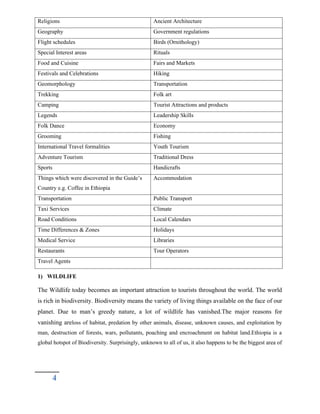
The tour guide should have significant knowledge related at least to the following areas. These
are just some of the areas but a successful tour guide should know more than this.
World Countries Etiquettes and Manners
Earth Facts Communication skills
History and Culture Tourist Psychology
Archaeology Tourist Behavior
Wildlife (Fauna) Travel Documentation
Plants (Flora) National Parks
Mountain ranges Lakes
Rivers Monuments
Foreign Languages Tribes
3
4.
Religions Ancient Architecture
GeographyGovernment regulations
Flight schedules Birds (Ornithology)
Special Interest areas Rituals
Food and Cuisine Fairs and Markets
Festivals and Celebrations Hiking
Geomorphology Transportation
Trekking Folk art
Camping Tourist Attractions and products
Legends Leadership Skills
Folk Dance Economy
Grooming Fishing
International Travel formalities Youth Tourism
Adventure Tourism Traditional Dress
Sports Handicrafts
Things which were discovered in the Guide’s
Country e.g. Coffee in Ethiopia
Accommodation
Transportation Public Transport
Taxi Services Climate
Road Conditions Local Calendars
Time Differences & Zones Holidays
Medical Service Libraries
Restaurants Tour Operators
Travel Agents
1) WILDLIFE
The Wildlife today becomes an important attraction to tourists throughout the world. The world
is rich in biodiversity. Biodiversity means the variety of living things available on the face of our
planet. Due to man’s greedy nature, a lot of wildlife has vanished.The major reasons for
vanishing areloss of habitat, predation by other animals, disease, unknown causes, and exploitation by
man, destruction of forests, wars, pollutants, poaching and encroachment on habitat land.Ethiopia is a
global hotspot of Biodiversity. Surprisingly, unknown to all of us, it also happens to be the biggest area of
4
5.
biodiversity in Africa.As a Tour Guide you should know the names of all the wild animals that occur in
Ethiopia.
1. Scientific Name: If possible the scientific name of wild animals in your area should be
known. A lot of tourists all over the world know the animals by their scientific names. The
scientific name of an animal is a two-word name. The first word or part is called as the Genus
and the second species.
Example: The scientific name of Lion is Panthera leo.
Genus – Panthera
Species - leo
The Genus name should always start with a capital letter and the species name with small letters
as indicated above.
2. Description: The Tour Guide should be well aware of what is the description of the animal so
as to explain it to the tourist. This generally includessize, weight, color, length and other
morphological characters.
3. Similar species – You should be aware of any similar animal which just looks like that as
there are possibilities of questions from a similar looking animal which they had seen earlier.
Most of the time, tourists get confused with the difference of Walya Ibex, domestic goat, grey
fox, the Ethiopian or Semien fox.
4. Habitat: Habitat is a place where the animal is found most of the time. In simple terms it is
the place where the animal lives most of the time and is characterized by its typical weather,
terrain and forest cover. It also refers to the place where the animals breed.
5. Range: Range is where the animal is found. Example: from Senegal to Ethiopia. The range
helps us in tracing the animal of his whereabouts in case it needs to be sighted for the purpose of
Wildlife viewing. The range is expressed necessarily in Geographical terms.
6. Camouflage: Camouflage is the way animals protect themselves from their predators. They
try to match with the way their environment is. For example, you may find an insect called leaf
insect which has wings like that of the leaves of the plant on which it resides. This principle
which occurs in nature is called as camouflaging. A well aware Wildlife guide will surely be able
to identify wildlife in its camouflaged stage.
7. Animal Description
Example: Nile crocodile
Scientific Name: Crocodylus niloticus
5
6.
Description: 10 to12 feet in length, Maximum 12 feet, long jaws, grayish yellow body.
Habitat: Large freshwater lakes, swamps and rivers.
Reasons of vanishing: This species has been totally wiped out of Sudan and Egypt where it was
found the most. It has been hunted extensively in these countries. So the tour guide should be
aware of the fact that though the range of finding this animal may be big but that it has been
hunted to extinction in some countries.
Breeding: lays around 40 eggs, eggs take 90 days to hatch, the mother crocodile then takes it
young from the bank of the water body to the water in the mouth exhibiting a high parental and
emotional attachment. The mother protects almost till they are 120 days old.
Range: Senegal to Ethiopia and south to Okavango delta in Botswana. Eliminated along Nile in
Sudan and Egypt and the Mediterranean coast. Also found in Madagascar. Restricted only to the
African continent. This species is of a special interest to all the tourists interested in the wildlife
and crocodiles are rare on other continents.
Additional Details: Apart from this, you should describe what is the status of this animal in
Ethiopia, like it is found in the Lake Tana and along the banks of the Nile especially in the Blue
Nile Gorge. What are the ways its being protected by legislation. What are the legislations
enacted by the government to protect this animal. You may also know some stories and
anecdotes related to them. You should also preferably know that there are Salt water crocodiles,
Fresh water crocodiles and Marsh water crocodiles.
Some Concepts: A wild animal which is not surviving in huge numbers is said to be at any of
the three stages as mentioned below in order.
Endangered
Threatened
Extinct
Endangered: An animal or a plant is said to be endangered when their number is big but
they are being lost on a big scale. E.g. in the year 2005 if there were 200,000 African
Elephants in the whole of Africa and in the year 2006 only 190,000 left then we can say that
the African Elephant is endangered.
Threatened: These are animals which have crossed the endangered stage and are now
surviving in few numbers. E.g. the Semien fox or the Ethiopian wolf is surviving in very few
numbers in its habitats. Such animals whose number is believed to be a very few in the wild
6
7.
are said tobe threatened. It means that at any moment they could be swiped out from the face
of the earth if they are not immediately protected.
Extinct: This is the last stage in survival for an animal in the wild. It occurs when the animal
is lost forever and no animal exists today in nature. E.g. the Indian cheetah became extinct in
India in 1972.Another example which is extinct is Dinosaur.
8. Organizations working for the Conservation and Protection of Wild Life
• IUCN – International Union for Conservation of Nature
• CITES – Convention on International trade in Endangered Species. (Through this
convention import and export of endangered animals is strictly illegal)
• UNEP – United Nations Environmental Program.
• WWF – world Wide Fund for Nature, formerly called as World Wildlife Fund.
• Ethiopian Natural History Society.
9. Legislation
The laws enacted on wildlife conservation should be significantly known by the tour guide. This
law enables the tour guide to explain to the tourist as to what kind of legislations exist to protect
a species.
10. Some other facts related that should be known by you on viewing of Wildlife in National
Parks and other protected areas.
A. Best Time to Visit: This is generally when it’s not raining which also happens to be the
breeding time for a lot of animals. On a logical scale, if you look at it makes sense to leave
the national park to be left on its own for a while so that it rejuvenates back to its wild best.
Also that the disturbance that is caused by the tourists all throughout the year won’t be a
welcome one. Moreover a lot of National parks are closed in this season. So this
arrangement is in the interest of the wildlife and its nature and that of Sustainable Tourism
practices.
B. ProminentWildlife: A list of animals which occur in that area should be known by you.
Example: If you are on a visit to the Semien National Park than it would be best advisable
that the guide has a big list of all the animals that occur in the park and the chances of
sighting them. The Chelada (Gelada) Baboons could be found in troops of 100’s but it will
be a rare sighting and by chance that a Rock Hyrax has been sighted or that a Klipspringer.
Hence a Tourist Guide should have an exhaustive knowledge of the wildlife in the area of
visit.
7
8.
C. Travel Informationand Getting there: This includes things like How far it is, How
Much time does it take to reach their, Do Helicopters fly there, is it an Excursion, How are
the road conditions, Are their gas stations on the way. A tour Guide shouldn’t be vague in
answering this question. If it takes 4 hours it means 4 only and not three hours.
A tour Guide is expected not to be imaginative in answering questions related to travel
information to the wildlife area.
D. Climate: The climate at wildlife destinations at some time is quite unpredictable, it may be
sunny and hot in the afternoon and may suddenly change to windy and chilly in the
evenings with occasional downpours.
E. Clothing: When you are out on wildlife watching you should take care that your clothes
camouflage with the environment of the area. Generally earthen colored or green colored
clothes are very much recommended. This is to avoid you being easily recognized by the
wild animal thus giving two benefits one that the wild animal doesn’t get disturbed and
second that you have more time to watch the animal as it has not identified you. Try to
incorporate all this principles into your clothing. So the clothing has to be in accordance
with the surroundings and dark gaudy and fluorescent colored clothes are strictly
discouraged. You may find that the Western tourists are very well aware of all this
fundamentals. Where not, the tour guide should live sustainable instructions of sort.
F. Where to stay: A lot of tourist may pose questions to you an accommodation and it is best
advisable that a lot of them would intend to camp or accommodate into an eco lodge in the
park itself. At such instances the tour guide should have a list of all the accommodation
available, their tariff and the contact telephone numbers. The information on where to stay
has to exact and precise.
Bird life and Ornithology: Bird watching is a taste of some tourists. They are countries which are
bestowed with rich bird varieties and Ethiopia is one of them. The tour guide should make an
effort to learn about the different birds with their names exactly in the same way wildlife is
described. A list and identification characteristics of all the birds should be available with the
tour guide. He should be well versed with all the common English and Scientific names of the
birds. With practice, this comes easily. Apart from this,s/he should get some knowledge on
Ornithology which is the study of the birds as there may be curious minds in your group on the
peculiarity and characters of some birds. A little knowledge on this front is very well
appreciated.
8
9.
INTERNATIONAL TRAVEL FORMALITIES
Thetour guide should have a firsthand knowledge of all the international formalities as he has to be with
the tourist and assist them in all this formalities if asked for. The tour guide should not be ignorant as it
will affect his/her overall performance.Travelers are subjected to international travel formalities.
Formalities are certain government regulations which a traveler or a tourist has to abide by
before the journey, during the journey and after the journey.
Some of the International Travel documentation which is used for international travel formalities
are as follows.
I. Passport:an official document issued by a government, certifying the holder's identity
and citizenship and entitling them to travel under its protection to and from foreign
countries. It should always accompany the foreign tourist as it may be demanded by any
authorities anytime. If the tour guide is going to accompany the tourist for a long time
then the best thing would be to have photocopies of passports done and kept with him.
II. Visa: A visa (from the Latin charta visa, meaning "paper that has been seen") is a
conditional authorization granted by a country to a foreigner, allowing them to enter,
remain within, or to leave that country. All foreign tourists should hold a valid and
appropriate visa and if the visa is to expire in midst of the tour, measures should be
taken by the tour guide to help extend the visa from the concerned immigration
authorities at the earliest. A tour guided should know that travelling on without or an
expired visa is illegal and also brings a bad name to a country as tourists will perceive
that everything is possible.
III. Insurance:an arrangement by which a company or the state undertakes to provide a
guarantee of compensation for specified loss, damage, illness, or death in return for
payment of a specified premium.Insurance is the foremost requirement and you will find
that before they depart from their country they would have a series of insurances done.
The insurance policies purchased by the tourist for different categories helps him sort
out his/her problem in case of any eventuality.
Some of the Insurance policies which the tourist can have are:
Medical care and hospitalization insurance
Personal accident insurance
9
10.
Delayed departureinsurance
Baggage loss or delayed insurance
Money loss insurance
Personal liability insurance.
IV. FOREX (Foreign Exchange) - The tour guide should harbor adequate knowledge on the
procedures which need to be carried out by the tourist in regards to money exchange. He
should be very well aware of the:-BANKING PROCEDURES, CURRENCY
REGULATIONS, IMEX (IMPORT EXPORT OF CURRENCY), CARDS – such as
Credit cards, Debit cards and ATM cards.Guide should be well aware of the limit of the
amount s/he can exchange with banking and other money exchange institutions.
He should be well aware of who is an Authorizes dealer, (AD) full-fledged Money
Changer(FFMC) and restricted money changer (RMC).
V. Customs: the official department that administers and collects the duties levied by a
government on imported goods. The customs regulate the unwanted illegal drugs,
explosives, insect – infested fruits from entering into the country. They have check
points at the port of entries where they regulate all sort of illegal transfer of goods to this
country. This should be especially considered for Ethiopia for the reason that a lot of
antiquities have been smuggled out of this country by traitors. The tourist guide should
think that the antiquities are the cultural legacy of his country and that they can’t be
removed by anyone.
VI. Birth Certificate, Marriage Certificate, Health Certificate, Voter Registration Card.
Any document out of the above or all of them if possessed by the tourists helps them in
processing of any travel documentation.
VII. Exit Restrictions: Many countries have imposed the law of exit restrictions such as you
need to take a visa if you have to go back. A tour guide should be conversant with such
rules if they were applied earlier and likely to be applicable in future. Ethiopia had exit
visa before a few years but no exit visa restriction exists now.
VIII. Baggage Rules
IX. Carrying Capacity- Many times it may be found that entry to an area is restricted on
the pretext of carrying capacity. The carrying capacity of a place should be accordingly
fitted into the itinerary of the Tourist.
X. Health Requirements– vaccinations and medications needed.
10
11.
XI. Controlled Tourism–Tourist may not be allowed to a country on certain time or to
certain areas or may be allowed only in groups.
XII. Taxes: Such as airport taxes, entertainment tax, vat, luxury tax, tipping, and service tax
if any.
XIII. Driving License: To drive in another country an International Driving License is
required which is possible to be obtained at the place of residence or the destination.
XIV. War/epidemics/catastrophes affected area/s
ANECDOTES
Anecdotes are tales, legends, fables and stories which a tour guide uses to supplement his/her
tour guiding technique. Anecdotes give the tourist the taste of the land by listening to the
ingredients of history and culture rooted into legends. Anecdotes also include proverbs and
sayings from local people. The guide who uses anecdotes to supplement his commentary can
mesmerize the tourists and they would always be wonderstruck and get attracted more into the
guide’s commentary. Anecdotes are instrumental in arousing the interest of the tourist. Hence
anecdotes can be about
Tales of Heroism _ from History or local community, related to local tribes or to kings or
Ministers or governments. Example: Tales related to Ethiopian emperors could be used.
Saddest Stories – Like the occupation by the fascist Italians and some stories connected
to them.
Haunted Stories: A tour guide should know a little on some stories which have been
created by the locals which are haunted stories. Haunted stories are always imaginative
and are related to imaginary ghosts and other types of haunts which local folks link to
monuments, old buildings, places and local culture. The haunted stories may not be true,
but are a treat for the tourists’ ears. These stories make the tourist about hauntedness of a
place. In Romania and England, you will find that most Castles are linked with stories of
that kind.
Assassination Stories: If you look at the stories which are created if anyone has been
assassinated are also taken by the tourists curiously. Example Assai nation of John F.
Kennedy. Abraham Lincoln or Mahatma Gandhi. In Ethiopia assassination of fascist
General Grazianni during the time of occupation.
Proverbs/ Sayings – The proverbs and sayings which are used by the local community are
very much an integral part of its learned people. Proverbs and Sayings come handy in
11
12.
tour guiding especiallywhen one finds that the tourists get bored with the monotonous
commentary of the tour guide. Proverbs also make the tourist feel the way the people
think in their host culture. This also gives an idea of what they believe into.
One Ethiopia Professor by the Name ‘Negussay Ayele’ has recently published a book called as
“WIT AND WISDOM OF ETHIOPIA” which has a collection of Ethiopian proverbs which are
very impressive e.g. ‘The center of the earth is where you are right now, if you doubt that,
measure it’. ‘Now that Ethiopia is the original habitat of the earliest hominids, every human
being is in effect an Ethiopian and therefore proudly claim the heritage of Ethiopia.
World Heritage Sites
UNESCO works with countries around the world to identify and protect cultural and natural
places that merit recognition as part of the common heritage of humankind. The WORLD
HERITAGE SITES were created by the UNESCO (United Nations Educational, Scientific and
Cultural Organization) through a convention in Paris on 16th
November, 1972. Since then, 185
countries have ratified the treaty, and 878 properties are inscribed (according to data in 2008-09)
on the list- 679 of which are cultural, 174 natural and 25 mixed (a combination of the two).
The world Heritage sites in Ethiopia are altogether eight and they are as follows:
1. Simien Mountains National park
2. Rock hewn churches-Lalibela
3. Fasil Ghebbi, Gondar
4. Lower valley of the Awash
5. Tiya
6. Aksum
7. Lower Omo Valley
8. Harar Jugol, the fortified historical town
9. Konso Cultural Landscape
10. Meskel Festival
11. Fiche Chembelala
12. Geda System
In Africa, the highest number of World Heritage Sites is in Ethiopia,which has 10, followed by
South Africa, Morocco and Tunisia which have 8 each. Italy has the highest number of World
12
13.
Heritage sites whichare 41, followed by Spain which has 39 (according to data in 2008-09).In
Asia the highest number of sites are in China (37) followed by India which has 27.
Archaeology
Archaeology is the scientific study of the remains of past human cultures. This study is done by
studying the objects which were used by the people of this culture. The objects which are
excavated or found for studies are generally include Buildings, Artwork, Tools, Bones and
Potteries.
What Archaeologists study?
1. How, where and when cultures developed.
2. Archaeological Evidence: Archaeological evidences are things which the archaeologist
finds out by excavating or accidental or known discoveries. Archaeological evidence is of
three types:
A. Artifacts – these are things made by the people and are Movable.Artifacts are the objects
that people have made or used. An artifact may be a stone tool of long ago, or broken
glass from the more recent past, old paintings, etc.
B. Features – They are non-movable and are usually big findings such as buildings. E.g.
Pyramids of Egypt, palace of Queen of Sheba, tombs of Kaleb and G/Meskel, etc.
C. Ecofacts – They are movable and generally include living things which have been dead.
E.g. Seeds, animal bones, fossils, etc.
Archaeological site is the place where all the archaeological evidence has been collected.
Archaeologists are people who study Archaeology. Excavation is when an Archaeologist digs up
an area on the ground for finding out remains of the past people.
Architecture
Architecture is the art and profession of designing buildings. In historical terms it may refer to
either the building style of a particular culture or to an artistic movement. The world famous
architectures are:
• Mesopotamian Architecture – on the plains of Iraq. They used bricks and clay so no much
archaeological evidence remains except a few.
13
14.
• Egyptian Architecture– This existed in present day Egypt and focused around the Kings. The
Egyptians treated their Kings as Gods and a lot of monuments are dedicated to them like the
tombs, sphinx and the pyramids.
• Chinese Architecture –includes buildings like that of a pagoda – which is a Buddhist Temple.
So this architecture is influenced by Buddhism.
• Japanese Architecture – again concentrates on Buddhism but is strictly influenced by Chinese
Architecture.
• Indian Architecture – India with the Taj Mahal as the highest culmination. It involved the
India and Persian designs.
• Islamic Architecture – generally revolves around ancient and present day mosques.
• Pre- Columbian Architecture – This existed in Peru and some Northern South A American
Countries. It included the Maya and Aztec civilization.
• Roman Architecture – perhaps the most famous of all. Today the largest numbers of world
heritage sites belong to the Roman Architecture in Italy, some parts of Europe and some
North African Countries. Sculptures and design were given a high preference and spectator
based buildings came into existence in this period. The sandstone and other rocks were
extensively used. The remains of the Roman Architecture are still surviving in their best
conditions.
• Greek Architecture – this revolved around the Greek Gods. The Greeks had Gods for
everything and named them. The Greeks made big open buildings with a lot of pillar and
column work and like the Romans they were great sculptors and made butts and figurines of
their Gods and Goddesses.
• Gothic Architecture – This was Architecture in Western Europe from 1100 to 1400
• Aksumite Architecture – This created the magnificent structures like the Obelisks.
• Gondarine Architecture – The best example is the Fasiledes Castle Enclosure. The Gondarine
art involved the Portuguese, Indian, Moorish and Ethiopian Architectural styles as evident
from the study of this monument.
Paleontology
It is the scientific study of animals, plants and other organisms which lived in ancient period.
Fossils are studied by paleontologist. Depending on the fossil of an animal or a plant,
paleontology is divided into Paleo-botany and Paleo-zoology.
14
15.
Etiquettes
Etiquette is acode of conduct or behavior that helps people get along with one another. A special
form of governmental etiquette is called protocol. It’s of primary importance for the tour guide
that s/he has the best idea on etiquettes and mannerism as expected internationally of a tour
guide. Some etiquetterelate to the following:
Introductions – Introductions should be simple and clear – “Mr. Zewdu, this is Mr. Daniel, Mr.
Daniel this is Mr. Zewdu”. Good Morning, My name is Tewodros and I am a tour guide here”.
They should be initiated with a good body frame and a firm handshake. The handshake is
welcome among men, in case of a man and a woman being introduced the first time, if the lady
forwards her hand for a handshake, then only the man should respond. This should be noted.
Names: Try to address everyone with prefixes such as Mr. Miss, Dr, President, Dean, Boss, etc.
Do not call anyone by their name unless they have asked you to do so. E.g. Mr. Moges or Ms.
Mekedes. Maintain the formalities till you are asked to break it and in most cases you will have
to maintain it all throughout.
Invitations: Can be sent in writing, email, fax or telephone. They can also be given in person.
All invitations should be answered as soon as possible depending upon the schedule of the
invitation. A 5 day reply period is normal. Please attend to all invitations, do not let your guest
wait for you. Where it is not possible to attend, please give honest excuse for the same. All
invitations it should be remembered and should be replied to.
Honor: All individuals of whatever age, creed, race, caste, sex or nationality should be addressed
and respected with due honor. You should make the person in front of you feel important. It’s
like ‘if you give honor you get honor’. Honor should especially be extended by the Tour guide to
the elderly and the women. E.g. a tour guide should stand up and receive a tourist and not receive
sitting on a chair.
Telephone manners: be low, precise and clear on the phone. The others should not hear your
conversation. The phone actually amplifies your sound; so please speak in low volume. Avoid
saying hello; it’s best to say Good Morning/ afternoon and Good Evening.
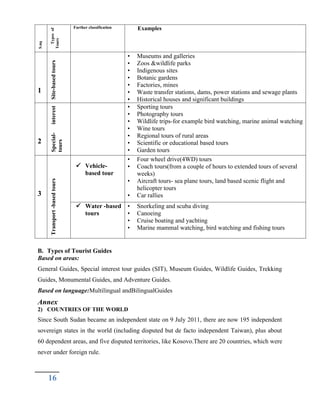
1.4. Types of Tours and Tourist Guides
A. Types of Tours
There are many types of tours including those that are based on a particular site, a special
interest, or on a type of transport.
15
16.
S.no
Types
of
Tours
Further classification Examples
1
Site-based
tours• Museums and galleries
• Zoos &wildlife parks
• Indigenous sites
• Botanic gardens
• Factories, mines
• Waste transfer stations, dams, power stations and sewage plants
• Historical houses and significant buildings
2
Special-
interest
tours
• Sporting tours
• Photography tours
• Wildlife trips-for example bird watching, marine animal watching
• Wine tours
• Regional tours of rural areas
• Scientific or educational based tours
• Garden tours
3
Transport
-based
tours
Vehicle-
based tour
• Four wheel drive(4WD) tours
• Coach tours(from a couple of hours to extended tours of several
weeks)
• Aircraft tours- sea plane tours, land based scenic flight and
helicopter tours
• Car rallies
Water -based
tours
• Snorkeling and scuba diving
• Canoeing
• Cruise boating and yachting
• Marine mammal watching, bird watching and fishing tours
B. Types of Tourist Guides
Based on areas:
General Guides, Special interest tour guides (SIT), Museum Guides, Wildlife Guides, Trekking
Guides, Monumental Guides, and Adventure Guides.
Based on language:Multilingual andBilingualGuides
Annex
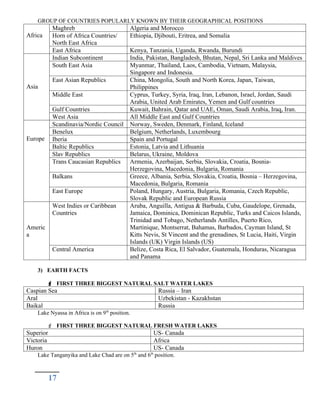
2) COUNTRIES OF THE WORLD
Since South Sudan became an independent state on 9 July 2011, there are now 195 independent
sovereign states in the world (including disputed but de facto independent Taiwan), plus about
60 dependent areas, and five disputed territories, like Kosovo.There are 20 countries, which were
never under foreign rule.
16
17.
GROUP OF COUNTRIESPOPULARLY KNOWN BY THEIR GEOGRAPHICAL POSITIONS
Africa
Maghreb Algeria and Morocco
Horn of Africa Countries/
North East Africa
Ethiopia, Djibouti, Eritrea, and Somalia
East Africa Kenya, Tanzania, Uganda, Rwanda, Burundi
Asia
Indian Subcontinent India, Pakistan, Bangladesh, Bhutan, Nepal, Sri Lanka and Maldives
South East Asia Myanmar, Thailand, Laos, Cambodia, Vietnam, Malaysia,
Singapore and Indonesia.
East Asian Republics China, Mongolia, South and North Korea, Japan, Taiwan,
Philippines
Middle East Cyprus, Turkey, Syria, Iraq, Iran, Lebanon, Israel, Jordan, Saudi
Arabia, United Arab Emirates, Yemen and Gulf countries
Gulf Countries Kuwait, Bahrain, Qatar and UAE, Oman, Saudi Arabia, Iraq, Iran.
West Asia All Middle East and Gulf Countries
Europe
Scandinavia/Nordic Council Norway, Sweden, Denmark, Finland, Iceland
Benelux Belgium, Netherlands, Luxembourg
Iberia Spain and Portugal
Baltic Republics Estonia, Latvia and Lithuania
Slav Republics Belarus, Ukraine, Moldova
Trans Caucasian Republics Armenia, Azerbaijan, Serbia, Slovakia, Croatia, Bosnia-
Herzegovina, Macedonia, Bulgaria, Romania
Balkans Greece, Albania, Serbia, Slovakia, Croatia, Bosnia – Herzegovina,
Macedonia, Bulgaria, Romania
East Europe Poland, Hungary, Austria, Bulgaria, Romania, Czech Republic,
Slovak Republic and European Russia
Americ
a
West Indies or Caribbean
Countries
Aruba, Anguilla, Antigua & Barbuda, Cuba, Gaudelope, Grenada,
Jamaica, Dominica, Dominican Republic, Turks and Caicos Islands,
Trinidad and Tobago, Netherlands Antilles, Puerto Rico,
Martinique, Montserrat, Bahamas, Barbados, Cayman Island, St
Kitts Nevis, St Vincent and the grenadines, St Lucia, Haiti, Virgin
Islands (UK) Virgin Islands (US)
Central America Belize, Costa Rica, El Salvador, Guatemala, Honduras, Nicaragua
and Panama
3) EARTH FACTS
FIRST THREE BIGGEST NATURAL SALT WATER LAKES
Caspian Sea Russia – Iran
Aral Uzbekistan - Kazakhstan
Baikal Russia
Lake Nyassa in Africa is on 9th
position.
FIRST THREE BIGGEST NATURAL FRESH WATER LAKES
Superior US- Canada
Victoria Africa
Huron US- Canada
Lake Tanganyika and Lake Chad are on 5th
and 6th
position.
17
18.
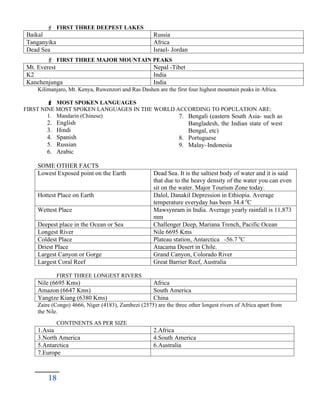
FIRST THREEDEEPEST LAKES
Baikal Russia
Tanganyika Africa
Dead Sea Israel- Jordan
FIRST THREE MAJOR MOUNTAIN PEAKS
Mt. Everest Nepal -Tibet
K2 India
Kanchenjunga India
Kilimanjaro, Mt. Kenya, Ruwenzori and Ras Dashen are the first four highest mountain peaks in Africa.
MOST SPOKEN LANGUAGES
FIRST NINE MOST SPOKEN LANGUAGES IN THE WORLD ACCORDING TO POPULATION ARE:
1. Mandarin (Chinese)
2. English
3. Hindi
4. Spanish
5. Russian
6. Arabic
7. Bengali (eastern South Asia- such as
Bangladesh, the Indian state of west
Bengal, etc)
8. Portuguese
9. Malay–Indonesia
SOME OTHER FACTS
Lowest Exposed point on the Earth Dead Sea. It is the saltiest body of water and it is said
that due to the heavy density of the water you can even
sit on the water. Major Tourism Zone today.
Hottest Place on Earth Dalol, Danakil Depression in Ethiopia. Average
temperature everyday has been 34.4 0
C
Wettest Place Mawsynram in India. Average yearly rainfall is 11,873
mm
Deepest place in the Ocean or Sea Challenger Deep, Mariana Trench, Pacific Ocean
Longest River Nile 6695 Kms
Coldest Place Plateau station, Antarctica -56.7 0
C
Driest Place Atacama Desert in Chile.
Largest Canyon or Gorge Grand Canyon, Colorado River
Largest Coral Reef Great Barrier Reef, Australia
FIRST THREE LONGEST RIVERS
Nile (6695 Kms) Africa
Amazon (6647 Kms) South America
Yangtze Kiang (6380 Kms) China
Zaire (Congo) 4666, Niger (4183), Zambezi (2575) are the three other longest rivers of Africa apart from
the Nile.
CONTINENTS AS PER SIZE
1.Asia 2.Africa
3.North America 4.South America
5.Antarctica 6.Australia
7.Europe
18
19.
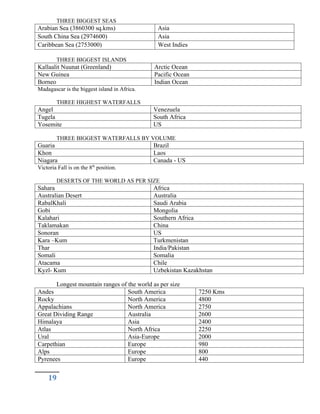
THREE BIGGEST SEAS
ArabianSea (3860300 sq.kms) Asia
South China Sea (2974600) Asia
Caribbean Sea (2753000) West Indies
THREE BIGGEST ISLANDS
Kallaalit Nuunat (Greenland) Arctic Ocean
New Guinea Pacific Ocean
Borneo Indian Ocean
Madagascar is the biggest island in Africa.
THREE HIGHEST WATERFALLS
Angel Venezuela
Tugela South Africa
Yosemite US
THREE BIGGEST WATERFALLS BY VOLUME
Guaria Brazil
Khon Laos
Niagara Canada - US
Victoria Fall is on the 8th
position.
DESERTS OF THE WORLD AS PER SIZE
Sahara Africa
Australian Desert Australia
RabalKhali Saudi Arabia
Gobi Mongolia
Kalahari Southern Africa
Taklamakan China
Sonoran US
Kara –Kum Turkmenistan
Thar India/Pakistan
Somali Somalia
Atacama Chile
Kyzl- Kum Uzbekistan Kazakhstan
Longest mountain ranges of the world as per size
Andes South America 7250 Kms
Rocky North America 4800
Appalachians North America 2750
Great Dividing Range Australia 2600
Himalaya Asia 2400
Atlas North Africa 2250
Ural Asia-Europe 2000
Carpethian Europe 980
Alps Europe 800
Pyrenees Europe 440
19
20.
Pamir Europe 225
Butthe highest numbers of peaks are in Himalayas.
RELIGIONS OF THE WORLD
Christianity Islam
Buddhism Hinduism
Shintoism Confucian
Judaism Sikhism
Jainism Bahiya
Animist Tribal
Pagan
20
21.
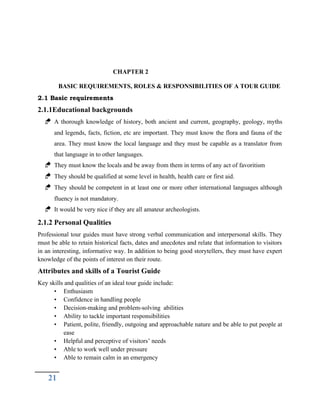
CHAPTER 2
BASIC REQUIREMENTS,ROLES & RESPONSIBILITIES OF A TOUR GUIDE
2.1 Basic requirements
2.1.1Educational backgrounds
A thorough knowledge of history, both ancient and current, geography, geology, myths
and legends, facts, fiction, etc are important. They must know the flora and fauna of the
area. They must know the local language and they must be capable as a translator from
that language in to other languages.
They must know the locals and be away from them in terms of any act of favoritism
They should be qualified at some level in health, health care or first aid.
They should be competent in at least one or more other international languages although
fluency is not mandatory.
It would be very nice if they are all amateur archeologists.
2.1.2 Personal Qualities
Professional tour guides must have strong verbal communication and interpersonal skills. They
must be able to retain historical facts, dates and anecdotes and relate that information to visitors
in an interesting, informative way. In addition to being good storytellers, they must have expert
knowledge of the points of interest on their route.
Attributes and skills of a Tourist Guide
Key skills and qualities of an ideal tour guide include:
• Enthusiasm
• Confidence in handling people
• Decision-making and problem-solving abilities
• Ability to tackle important responsibilities
• Patient, polite, friendly, outgoing and approachable nature and be able to put people at
ease
• Helpful and perceptive of visitors’ needs
• Able to work well under pressure
• Able to remain calm in an emergency
21
22.
• Able topay attention to detail
• Able to relate to people from a wide range of cultures and backgrounds
• A pleasing personality with proper grooming consciousness
• Dedicated, sensible and not afraid to make decisions
• Good health
• Maturity: physically and mentally. Age limits may apply.
• able to accept responsibility and trustworthy
• tact
• understanding and appreciating different cultures
• organizational ability
• problem solving skills and ability to think logically
• excellent communication, negotiation and conflict resolution skills
• Leadership and group management
• Creative and strategic thinking
• Research, planning, design, implementation and evaluation
• Emergency and incident management, first aid and ability to implement occupational
health and safety(OHS)procedures
• Navigation-map reading, routing, direction finding
• Flexibility
• Sound subject knowledge to support their commentaries, to satisfy question-answer
sessions and for general interaction with their audience.
• Understanding of the relationships between different subjects (for example they might
need to know about plants and their relationship with soil types; or the context of a
particular period in history.
• Tourist guides working for organizations might need to know mission statements and
relevant policies)
• Beyond skills and knowledge, guides are also expected to possess a range of personal
attributes such as enthusiasm, empathy, respect, diplomacy, inquisitiveness and
endurance, and cultural and environmental awareness.
• They need to be professional while being friendly; they need to ensure the safety of a
group while being relaxed; and they need to be serious while having fun.
Do you have all what it takes to be a tour guide?
Keri Belisle says that the most important personal and professional qualities for tour guides are
“patience (and more patience!), quick thinking, flexibility, organization, a sense of humor, a
pleasant personality, being knowledgeable, and the ability to project authority. There are so
22
23.
many aspects tothe job: getting along with others, keeping everyone happy, giving clear and
concise instructions, giving interesting narration, accounting, keeping things on schedule, and
common sense.”
To be a good tour guide, it is imperative that you genuinely enjoy talking in front of a group. If
you get nervous talking to large groups or don’t enjoy being with groups of people, this is
probably the wrong profession for you. Because you sometimes encounter tour group members
who are difficult or demanding, it is also important that you be a patient person who likes people.
Tour guides should also enjoy having fun and helping their group members enjoy themselves.
Another important trait is the ability to deal with unforeseen difficulties. If you hit traffic and
can’t be where you’re supposed to be at 3:00, do you go to pieces or do you improvise? If
someone gets sick on the tour, do you freak out, or do you deal with it? If you fall apart when
things don’t work out perfectly, this probably isn’t the career for you.
Leadership and a take-charge attitude are also necessary in this job, where guides are relied upon
to answer questions, deal with problems, and generally take care of travelers’ needs. There are so
many rewards and challenges on a daily basis. Just when you think you know it all, something
happens to change that”.
Finally, tour guides need to be willing and able to work long hours. During a tour, guides are
never really off duty, and this can mean phone calls in the middle of the night to resolve any
problem a guest is having. For a tour manager, a workweek of 85 hours is not uncommon.
2.1.3 Professional ethics in tour guiding
What is ethics?
• Ethics studies human conduct; it is concerned with questions such as “When is an act
right?”, “When is an act wrong?” and “What is the nature, or determining standard, of
good and bad?”
• Ethics is a branch of philosophy dealing with values relating to human conduct, with
respect to the rightness and wrongness of certain actions and to the goodness and badness
of the motives and ends of such actions.
The code of ethics for tour guides can go a long way in highlighting the need for displaying
honesty and integrity, selflessness and objectivity in their dealings with tourists or customers.
Some of the ethical principles that tour guides should follow in their relationships with different
stakeholders are discussed below:
Relationshipswith Fellow Guides
• Treat others as you would like to be treated.
• When taking visitors to crowded places, guides should be considerate with other guides
and groups who are waiting to see a site.
• Always share information that could be helpful to colleagues.
Relationships with Employers
• Always appear neat and clean with proper uniform and badge.
• Maintain a business-like and socially acceptable demeanor/manner. Avoid foul
language and excessive drinking.
23
24.
• Never sharea company’s trade secrets or internal problems with clients or with
employees of another company.
• Follow and complete the tour itinerary. When this becomes difficult because of
inclement/severe weather, queues, accidents during the tour, contact the employer
immediately.
• Never solicit work for oneself or another company through a company’s client.
Relationships with other Colleagues
• Attempt to learn more about other aspects of the industry.
• Always acknowledge a colleague’s excellent service by telling it to the individual
concerned, the individual’s supervisor or the travelers who have benefited from it.
• If a problem arises, discuss it privately, without being heard by clients.
• Avoid gossip about colleagues.
Relationships with Travelers
• Guides must treat all tour members with equal time, attention and dignity.
• Guides should give accurate and interesting information and strive to learn more.
• Guides should try to be very objective and diplomatic.
• Guides should keep their guests comfortable and safe.
• Guides should never look down on a tourist’s customs or consider them strange or
weird just because they are different from their own.
• Guides should never solicit tips.
Do’s and Don’ts of Tour Guiding
Avoid guess work and propaganda/misinformation
Avoid memorizing commentaries
Be honest and sincere
Be positive and patriotic
Be sensitive in the operating environment
Encourage responsible and sensitive behavior from the clients/tourists
Establish rapport with the clients
Establish rapport with the suppliers
Never solicit or ask for tips
Never initiate/promote patronization of souvenir shops and other places that practice
“kickback” payments to the guide or drivers or abuse complimentary meal privilege
offered by establishments.
Treat each tour as a serious commitment and cancel only when absolutely necessary and
with advance notice.
Cooperate with other tour groups and maintain ethical and professional conduct at all
times, cultivating positive relationship with all colleagues.
A Professional Guide’s Code of Ethics & Business Practice
1 A professional guide is expected to follow the rules and regulations, and act accordingly,
at all sites and facilities where he/she takes visitors.
2 A professional guide knows and follows the policies of the company for whom the guide
is working at the time. A guide does not accept or solicit a job from a client of the
24
25.
company that hashired him/her without the consent of the company, nor should a guide
attempt to divert to another person or company business from the company that has hired
him/her. All business related communication with the client should be made through the
company. It is the guide’s responsibility to inquire of the tour company regarding
continued service with a repeat client. Loyalty for and to the tour company should be
practiced during the entire tour.
3 A professional guide accepts each tour as a serious commitment and cancels only when
absolutely necessary and provides as much advance notice as possible.
4 A professional guide does not solicit gratuities.
5 A professional guide does not initiate or encourage patronage of souvenir shops and
other places that give commissions to the guide and/or drivers. A professional guide does
not abuse complimentary meal privileges offered by food establishments.
6 A professional guide cooperates with other tour groups and maintains ethical and
professional conduct at all times, cultivating a positive relationship with all colleagues.
7 A professional guide respects the research and intellectual property (copyrighted
material) of other guides by not recording or quoting it without permission; does not
plagiarize, or take as one’s own, another guide’s commentary or individual presentation
technique.
8 A professional guide provides skilled presentation of knowledge, interprets and
highlights surroundings, informs and maintains objectivity and enthusiasm in an
engaging manner.
9 A professional guide is prepared for each tour when the itinerary is furnished in advance.
A professional guide assumes responsibility for reporting on time and for meeting
appointments and all schedules within the guide’s control. A professional guide is
sensitive to the interests and values of the tour group and does not share his/her personal
views on controversial subjects such as sex, religion, and politics.
10 A professional guide has a wide range of knowledge of the city, including its history and
architecture, cultural and political life, and local folklore. A professional guide keeps
current on new exhibits, seasonal events, and other changes throughout the city. A
professional guide does not knowingly give out misinformation.
11 A professional guide is knowledgeable about the best routes for all tours. This includes
familiarity with the traffic laws as well as the habit of driving in the destination. A
professional guide informs the driver of the route in a calm, polite, and timely fashion.
12 A professional guide maintains good personal hygiene and uses proper judgment in
dressing appropriately for all tours.
(Source: Austin Tour Guide Association –ATGA-Columbia DRAFT – introduced April, 2006)
2.2. ROLES AND RESPONSIBILITIES OF A TOUR GUIDE
Advantages of a tour accompanied with a guide
25
26.
A tourguide provides sufficient information regarding the history, culture, customs and traditions
of a particular society or tourist site. So, access to such information might be difficult and
misunderstanding will happen if tourists do not use a tour guide for a tour.
A tour guide is problem solver and risk taker for what is happening in the tour. As result, tourists
can travel and experience the tour with free mind.
The nature and the amount of tip that a tourist is willing to give to those who serve him/her well
will vary from country to country. So, it is the tour guide who will advise them the appropriate
amount to be offered for hospitality staffs, etc.
The level of tourist satisfaction will rise as a result of accurate interpretation of the site by
tour guide and this enables to increase their length of stay, etc.
2.2.1 Roles of a Tour Guide
Tourist guides play a vital role in the tourism or visitor experience and are at the front line. They perform
a wide variety of roles that can include interpreting, communicating, role modeling appropriate behavior,
navigating, leading, managing the group, integrating the group, keeping good humor and morale, and
entertaining group members.
The roles that guides play in tourism experience will depend on a number of factors, including the setting
of the tour, the purpose of the tour, the motivation and experience of the tourists and the characteristics
and motivation of the guides themselves, and the expectations of the tour company or employer. Some of
the roles of tour guides are described below:
The tour guide is a Leader/ responsible for control of the group.
The tour guide is a watchdog/supervisory body for the Tour Operator.
The tour guide acts as a Public Relations Representative.
The tour guide is also a go-between/mediator/negotiator linking different parties.
A tour guide is also an Educator/Lecturer/information provider for the tourists. A tour guide is
responsible for dissemination of information to the tour participants. A tour guide is a store house
of information and has in depth knowledge of what he/she is talking about.
As a timekeeper, the tour guide makes sure that the services to be provided are delivered in a
timely fashion, including tour guide services first and foremost and within the scheduled time
frame.
A tour guide is a shepherdwho looks after the well-being of the flock, and makes sure the flock
moves in unison from one place to another without losing a single sheep. So, a tour guide should
protect them from theft or embezzlement by robbers.
A tour guide acts as an unofficialambassador for his/her country.
26
27.
Social Facilitator:More than other tourism workers, guides have the opportunity to
interact at a more personal level with tour groups. Guides have an important social role
within the group in which the guide is a social catalyst, encouraging interaction between
group members, and generally facilitating a positive social setting for the tour experience.
Cultural Host: The guide facilitates a relationship between tourists and host
community/culture. This might involve language interpretation through to cultural
interpretation, and providing information on appropriate social behavior and social norms,
along with local customs. Within such situations the guide is obviously responsible for
respecting the rights of the host community, and ensuring the appropriate behavior of the
tour group.
Interpreter of the natural and cultural environment, and motivator of appropriate
conservation values:
In this role, guides are seen as playing an important role in ‘educating people about the
vulnerabilities of their regions and the ways in which visitors can play a role in
preserving them’. Guides are seen as having some responsibility for the host
environment, encouraging the appropriate use of resources for tourism, and a
responsibility to monitor and minimize the adverse effects of visitor activities on the
environment so that natural ecosystems are used in a sustainable manner.
Many studies have identified the role of interpreter, which suggests it is universally
acknowledged as a key role of a guide irrespective of the tour setting. According to
Schmidt (1979), ‘an ideal guide should be competent in both knowledge and presentation,
integrating and involving the tourists in to the scene, role playing, and giving the tourists
a feel for the place. Part of this role is to tell stories, myths and local legends and translate
the unfamiliar’.
The increased use of interpretation, both face-to-face and non-face-to-face, by managers
of natural and cultural environments aims to encourage visitors to gain greater level of
understanding and appreciation of a particular site or event, and a resultant behavior
which supports its values and significance.
Entertainer: Tourists are there to relax or entertain. So, the tour guide needs to entertain
them via telling jokes, singing a song etc.
People mover:This includes the range of duties guides undertake to assist people moving between
varying locals such as:
• Meet-and- greets at airports and major transport terminuses
• Transfer to and from hotels and places of accommodation
• Assisting with check-ins, and
• Organizing and/or confirming travel details
Such duties are relevant for extended tours, especially if the guide’s duties extend to those of tour
manager and tour leader.
Record keeper:A tour guide should keep record of tourists such as (their name, nationality,
address, etc). This will help him to remember them if they come back and this helps him to
maintain agood relationship with them. Added to this, this information also helps for legal
27
28.
purpose. In addition,the tour guide should also keep records of any expenses incurred during the
tour, including unexpected expenses.Guides maintain written reports of daily activities.
Problem solver: Many problems may arise in the tour, for example tourists may quarrel each
other or there may be attitude change. So, a tour guide should bring them and solve accordingly.
Confidential:A tour guide should keep some secret of the host community and the nation at all and
keep refrain from telling it to the tourists.
Administrator:A tour guide should manage or deal with all the above roles well, and when s/he
does this, the guide can be considered as administrator.
2.2.2. Responsibilities of tour guide
Mobility and health related to physical needs: if tourists are handicapped or physically
impaired (unable to hear, walk, see, etc), a tourist guide should help them with their
physical needs.
Time constraint: whatever time constraint is there, as much as possible a tour guide
should show them the sites which are included in the tour itinerary.
Religious beliefs (don’t take sides): a tour guide should not take side towards his/her
own religion in any of the tour activity when delivering commentary to tourists, i.e.
should remain neutral.
Consideringexpectation of individuals: a tour guide is required to take the ideas of
minorities too and individual ideas should be supported. In other words, a tour guide
shouldn’t necessarily take ideas from the majority only.
Participants are treated with care and respect: the way you treat your guests should be
in a professional way and with care and respect. In addition to this, all tourists must be
treated equally regardless of sex, age, color and nationality.
Accurate information, skill, knowledge
Ethical behavior: trust and honesty
Meet promises on promotional materials: tour operators and travel agencies should put
the services on their promotional materials that they can offer only and shouldn’t promise
what they can’t offer.
Language consideration: whatever language a tour guide can speak, it should be the
choice of tourists to choose the language for communication, i.e., it shouldn’t be the
choice of the tour guide.
Considering age difference: a tour guide should consider the age category of the tourists
when delivering commentaries about the sites. This means that, a tour guide should use
different words, content, voice, pitch when interpreting the site for children, young, and
old tourists.
Considering socio-economic factors: a tour guide before taking tourists to different
accommodation establishments like hotels, entertainment areas, night clubs, first s/he
should consider the social, cultural and economic background of the tourists.
Opportunity to learn(no one is too learned not to learn): this means that a tour guide is
expected to learn more so as to keep his/her knowledge up-to-dateeither formally or
onsite from tourists’ experience.
28
29.
Chapter 3
Planning &Developing Tours
Chapter objectives: by the end of this chapter, students will be able to:
Plan, research and develop a structure for tours.
Plan and develop a tour to address the specific needs of an audience.
Identify and demonstrate the planning, management and evaluation activities required for
tours.
Identify and describe the stages of a tour.
Incorporate creative thinking in to the planning and delivery of tours.
4.1 Tour Structures & Stages
Tours are extremely varied in terms of their structure, purpose, audience group and the locales in
which they take place. One of the consequences of this diversity is that there is no standard way
of delivering a tour. The following model is one approach for structuring tours which can be
modified and adopted to suit most tour types. It follows the same structure as any good story, i.e.,
the tour has a beginning, middle and an end. And, like the building of any good story, it also
includes3 phases:
Planning & Designing the tour
Conducting the tour
Evaluating the tour
4.1.1 Planning& Designing the Tour
This stage is a stage of pre-tour preparation. There is absolutely no substitute for careful planning
and preparation for the tour. Review the entire program. One mistake could develop into a major
problem.
Pre-tour preparation is important for the following reasons:
• The tour manager’s work begins long before s/he meets clients.
• Advance preparation of a guide is the key corner stone up on which a successful tour is run.
• The better the preparation, the most smoothly the tour is run.
• No tour manager will establish him/herself a leader if s/he can’t answer the different
questions of tourists.
Therefore, pre-tour preparation helps the tour guide to:
Have the confidence to respond to any question. To have this confidence, one is supposed
to be organized, knowledgeable and prepared for any eventuality (possible event and
result). To be knowledgeable, the guide should study and make research on geographical
data, historical events, culture and economy.
29
30.
Have importantinformation on where clients will stay (accommodation establishments);
attraction sites within the city(e.g. fishing sites); religious places (e.g. at what time they are;
health centers and police stations; communication and recreation centers (e.g. swimming
pools, dancing halls, etc).
Give the best service to clients. Preparation enables the guide to entertain his/her clients
because one of our main objectives is entertaining clients.
Activities in pre-tour preparation
This stage includes all activities associated with the planning and preparation of the tour,and is
discussed as follows:
I. Reviewing the tour brief
Tour brief: Prior to commencement of a tour, the tour leader and other staff will have a briefing
with the tour designer and other office personnel directly connected with the tour. It can be
provided in a face-to-face meeting, over the phone or in written form such as faxes and
electronic copies. Its main purpose is to provide guides with the relevant information to plan and
deliver their tour. This information can include:
Procedures, itineraries and operational logistics of your tour (information on attractions,
optional tours, accommodation, necessary documents, modes of transport, etc);
Background and characteristics of the tour group (number of people, origins of travel,
whether they are travelling as part of a group, their socio-economic and cultural
background, language and interests, and whether there are any special needs and
expectations);
VIPs’ names and titles, with special handling requirements
Any special requirements for that particular tour;
Details of other people who might be involved in the tour;
Contact details for emergencies and procedures for the same.
Debriefing: After conducting the tour, you might also be required to attend a debriefing session
to assist with evaluating the tour. This might require you to complete a report which can be filled
out at the end of your tour or more frequently on extended tours (especially with respect to
reporting incidents which occur while the tour is in progress). These reports can document:
Compliments, complaints and/or any other feedback received by the guide;
Mishaps or incidents;
Deviations to scheduled itinerary and why these occurred;
Suggestions for improving the operation of the tour.
II. Developing tour objectives
Tours are conducted for variety of reasons, and knowing what these reasons provides
essential information when planning activities. To focus your planning efforts, answer the
following questions.
Why are you running this tour?
What is the aim of this tour?
What do you want to achieve?
30
31.
How wouldyou like your audience to be thinking, feeling, and behaving?
What would you like your audience to take away from your tour?
The responses to these questions help establish your objectives. Some of the benefits of
working with objectives include the following:
Objective provide a focus and direction of your tour planning and delivering efforts
on what it is you want to say, and on what you expect your audience to gain from the
tour
They provide a benchmark for evaluating the tour
They ensure you are developing the most effective theme and tour activities for the
needs of your tour
They provide a focus for the practical, logistical and operational perspectives of your
tour.
When writing your effective tour objective statements, you need to express them using
statements that show the objectives to be: measurable, observable, and written with verbs which
are clear and specific, realistic, written with positive statements (for example ‘will be able to’
and ‘to encourage’).
Example:
Objective A: people will have fun on my tour.
Objective B: I will provide a variety of humorous stories, games and interactive, light-
hearted activities.
The first objective (A) is weak. While you could observe ‘fun on your tour’, the objective is
difficult to measure; it lacks clarity and is not specific. However, the second objective (B)
addresses the criteria of an effective objective and is a much stronger and workable objective.
Some examples of objectives:
Knowledge objective: to describe the different habitats of a particular national park;
Behavioral/skill objective: to give people the skills to be able to identify the features of a
building and their associated architectural style;
Emotional objective: to encourage people to value the unique and significant
characteristics of the site;
Operational objective: to operate in a manner which is consistent with minimal impact
practices
The idea with objectives is not to create a long “wish list” but to create a tight “must-do list”-
activities which you consider to be essential to running your tour in an effective, efficient and
professional manner.
III. Designing the tour
It is related to finding about your audience and building the commentary.
Finding out about your audience: information about your audience might arrive
through a briefing sheet or booking sheet, or it may involve quite extensive research.
Whatever the degree of effort, you have to make sure that you find out as much as
possible about the needs, expectations, motivations and interests of people within your
audience. Your audience is an extremely varied group of people, and the more time you
31
32.
spend finding outabout these people, the more chance you have of building a tour
which will be relevant and enjoyable to each individual.
Building the commentary: this stage involves developing the commentary element of the
tour which occurs during the middle stage of your tour. A commentary works closely with
your tour objectives and itinerary, and incorporates the variety of activities you plan for
your audience. Considerations when developing your tour commentaries include the
following:
Have you developed a theme for your activity-a single statement that encapsulates what
the tour is about?
Why are you saying what you are saying?
Do you need to research any particular areas to improve your knowledge?
Will you be interspersing facts and statistics with stories, anecdotes and activities?
What resources and/or equipment and/or props and/or reference material can you bring
along on the tour?
What guiding techniques will you employ?
How will you be involving the group and encouraging interaction and participation?
The structure of an interpretive commentary should include:
A focus on a particular topic (focus on the place-landscape, buildings, vegetation;
people-historical characteristics , social times in past, present and future; events and
processes which have caused an area to change-colonial life, technology, indigenous
culture, erosion, evolution, etc.
Aparticular story-line(sequential development).
Information and activities which are relevant to your audience.
Information that is clear, concise, accurate and interesting.
IV. Researching and checking the activity route
This is when you are working with the environment and making sure the site is suitable for
conducting your activity. This might involve liaising with relevant organizations responsible for
managing the area(s) relevant to your tour route. Some of the questions you can ask include:
What is the route for the activity?
What are some of the significant features and characteristics of the site?
What sites will you be visiting, and are they interesting, adequate and relevant?
Is it suitable for the characteristics of your audience (their needs, expectations, interests,
and for the number of people?)
What is the accessibility like- are there provisions for people with special needs?
What services and comforts are there?
What safety concerns are there? Have you conducted a risk audit? What arrangements
you have made in case of emergencies?
V. The tour itinerary-incorporating activities in to your tour
Itineraries are your tour ‘blue print’. They provide the logistical and operational framework for
your tour and include details such as timings, dates, routes, stops, and length of stops,
information on the type of attractions and accommodation establishments. Make sure that all
32
33.
these details arecorrect, practical and relevant to your tour. The types of activities which you
include in your itinerary should support your theme and tour objectives, and work with your
timings. Ask yourself:
What activities have you planned? Where will the stops take place?
Can you mix up your transport options by including public transport with walking, or
arranging for coaches to pick up at different destinations?
What are some of the points of interest and highlights of the tour?
What resources or equipments and or props and or reference material can you bring along
the tour which will help you for accomplishing the itinerary?
Are the timings strict or do you have some flexibility to take advantage of spontaneous
moments?
VI. Prepare and check logistical elements
If you receive a tour brief, then you should check that you understand all the information
provided. You should also check that the information in the tour brief corresponds with that
provided in any promotional materials, and that it is accurate and relevant to your tour (e.g.
check the itinerary against that being provided to the visitor).You might also need to do the
following:
Reconfirm details of your tour
Finalize some aspects of the tour
Familiarize yourself with any optional tour
Ensure whether you have relevant contact details and sources of assistance in case of
emergencies
Prepare contingency plan for the unexpected and spontaneous
Check equipments and props. Props can include spotlights for evening walks,
reference books, old/new photos, anecdotes, poems/stories, magnifying glasses, etc.
Check weather map- especially for nature sensitive tourists
VII. Liaise with operators and other industry colleagues
Find out who else will be involved in your tour and undertake the proper liaison (e.g. coach
captains, tour operators, attraction staff and other guides).
VIII. Rest, meal and picture stops
Rest stops: a place where we choose for rest stop should be considered carefully. The
topography/ landscape should render a breath taking view. The overall cleanliness of
the area could make clients feel at ease. It is also advisable to make the rest stop in a
place where we could get lavatory (toilet) facilities.
Meal stop: whenever you get the opportunity, make a confirmation call to a hotel
(restaurant) where you stop for lunch.Even,we can order the menu to get ready ahead.
On arrival to the restaurant, make sure if or not the waiters or waitresses are really
ready to serve your clients’ as soon as possible. If not, advise your clients to visit
33
34.
what is worthvisiting according to your opinion. Advise your clients to take quick
service which helps them not to delay the next tour.
Picture stop: it is advisable to give picture stops (a place which is worth picturing)
where cultural, traditional and artistic properties are available. Areas rich in
fascinating natural scenery are commendable for picture stop. Like bread and butter,
tourists and cameras go together. There is a motto of tourists which says, ‘leave
nothing behind but your foot prints, take nothing away but your photos’. It is to say
that as tourism is ‘smokeless’ industry, we should drop nothing that may pollute the
area and tourists should not try to take treasures which are not allowed to cross
border, except photographs.
IX. The Tour guide’s/leader’s Travel Kit
There are a number of necessary documents that the tour manager should have in their
possession while on tour:
Name badges: These will be very helpful to the tour manager and the travelers, because
it’s much nicer to be able to call fellow travelers by name. Uniform luggage tags should
be distributed so it will be easy to identify the group’s luggage. It is also important that
each suitcase have a personal identification luggage tag.
Rooming List:Copies of the rooming list is excellent means of “control” and checking
and re-checking your clients into hotels.
Tour Vouchers:An important part of the Tour Company’s responsibility is to issue tour
vouchers for services to be rendered while managing a tour. The tour vouchers are used
for payment of services, confirmation of services, and advice on service required, client
identification, and recognition by the travel supplier.
Each Tour Company uses its own voucher system in order to maintain its image and serve the
needs of his/her own internal accounting procedures. These forms of payment usually have no
cash exchange value and are valid only for the dates and services shown. The tour voucher
identifies the tour group traveling and indicates prepaid confirmation or reservation of the
service request noted. Once the voucher has been redeemed for service by the client, the supplier
will be paid by the travel company.A copy of the tour voucher is e-mailed/mailed/express mailed
to the suppliers.
X. Reconfirmation calls- This refers to the calls to confirm for services.
Importance of confirmation calls and what we should do:
34
35.
True professionalismbecomes evident in the area of reconfirmation calls to any service
done by the guide.
Forgetting reconfirmation call is deceiving oneself and inviting to trouble.
Arriving at a hotel without reconfirmation call may result in no record of the group.
In general, reconfirmation is very crucial because the more you tell him/her, the easier it
will be to both the service supplier and to the service receiver.
Activities:
Each service must be confirmed by telephone, not later than 48 hours before arrival.
When you make a call to hotels for reconfirmation before 48 hours of arrival time, you
should:
• Have the voucher in front of you to check which services are refused and which
are accepted.
• Ask the name of the person who manages tour booking
• Speak to him/her clearly and with authority to show leadership of your group
• Give your name, the company’s name, the tour name or code
• Give detail of the actual needs of the tour written on the voucher (accommodation
and meal request)
• Inform the booking manager about changes, if any. This is because there appears
cancellation of reservation by clients.
• Tell your estimated time of arrival and some special needs of clients e.g.
vegetarians who do not eat meat.
XI. Wardrobe and packing
It is an important part of your pre-tour preparation. It means selecting material you use when you
are on a tour. Factors to be considered for wardrobe and packinginclude:
1. Type of tour- safari tour, skiing, mountain climbing, religious tour, etc.
2. Climate
3. Restriction/limitation by carriers- air transportation, surface transportations, etc.
To look fresh and well groomed all time, select clothing that is easy to care, keeps the shape and
has light weight as much as possible.
Wardrobes: Wardrobe refers to the collection of clothing belonging to one person. It is about
clothes and other materials that fit to your tour and climate, considering color, weight and
thicknesses. (For example, shoes with comfort especially for taking rain coats and umbrella,
toilet materials and medication materials, flight bags, etc)
Packing: Tour managers become proficient packers. Experienced tour guides can:
• pack surprising amount of clothes in luggages and flight bags
• Utilize every inch—packing socks inside shoes, rolling underwear, etc.
Use your flight bag for your toilet articles and for your night clothes and reading materials (to
tell up-to-date information). Every evening on tour, layout every preparation for the next day and
then pack your suitcase so that in the morningyou will pack only your flight bag.
35
36.
XII. Special eventsrequiring special preparation
There are special days that need special preparation. Some of these are:
Welcome party
Farewell party
Client occasions
Holidays
Welcome party
This is a party arranged by a tour operator to its clients to enhance the social side of the tour
(relation between and among each and every member of the group). The purpose is for the
members to get acquainted with each other and develop the sense of group. It also establishes a
good mood for the group to have a pleasing journey filled with fun and relaxation. Two
debatable aspects of the welcome party are:
i. Time and day- the second day is the best day to conduct the welcome party because
they feel tired on the first day.
ii. Cost overriding- it should be in a way they may not affect your company’s budget.
Procedures of welcome party
1. Inform your clients that your company will conduct a welcome party, and tell the exact
time and place. Give them enough time to get properly dressed.
2. Arrange or reserve a private place as much as possible.
3. To establish your leadership as a guide and to make sure that everything is ready, be at
the place at least half an hour before the party begins.
4. As a tour manager, you are the official host (responsible person) and toast master at the
party to start it. When the group gets assembled, welcome them on behalf of the company
and yourself. Thank them for their cooperation and wish them to have a nice time.
5. At a cocktail (drink) party, invite them to introduce themselves one by one, and have
circular sitting arrangement because this is good to create group sense.
6. During dinner time, have a sitting arrangement which is circular so that any one will see
each other for better acquaintance.
7. Make such that the clients have sufficient time to relax and enjoy.
8. In general, be helpful, cheerful and smiling, polite and available and get mingled well
with clients.
Farewell party: this is a party conducted at the end of the tour. The purpose of this party
includes to:
Create a sense of good feeling for clients (i.e. in case they are dissatisfied, this a good
opportunity to ask excuses)
Promote further tours (i.e. if they are satisfied with the farewell dinner party, they will
promote your company when they go back to their country).
Pave the way for your tourists to express their satisfaction/dissatisfaction.
Clients’ occasions: this refers to special occasions of tourists such as birthday party,
marriage anniversary and other situations. In such a situation, it is advisable to prepare a
simple preparation or gift to your clients. They will be surprised and happy with it.It is
something simple but very crucial to create deep happiness within your clients.
36
37.
Holidays
i. Plan carefullyto celebrate major national holidays without the knowledge of the
clients (surprise them).
ii. Prepare a special dinner festival.
iii. Make the arrangement before hand and advice clients not to go beyond normal.
iv. On X-mass and New Year’s Eve, arrange cocktail party.
v. As much as possible, try to get mingled; look smiling and participative for the overall
fulfillment of their holidays. This will entitle you with the guide’s ethics and
responsibilities.
4.1.2 Conducting the Tour
1. Beginning Stage
Pre-contact: this is the time spent before tourists arrive. It provides you with an
opportunity to warm up your vocal, check yourappearanceand equipment and generally
get yourself in to a relaxed state. Whenever possible, arrive at your activity site at least
half an hour before the scheduled meeting time.
Meet-and-greet: this period begins at the first moment of contact with any member of
your audience and continues as you gather the group for the start of the tour (this later
activity is often referred to as the staging of your group).This is the time for you and
your audience to know each other. Your audience will be getting to know you, and
assess your capabilities, attitudes and personality. Use the time to establish your
credibility, to create a warm and friendly atmosphere, to put people at ease, and to set
the scene for an enjoyable time.
Greet people as they arrive at the activity site.During this period, you might check
people against a passenger/booking sheet to ensure that all people who have booked
are present. You might also need to follow up on any missing persons. It might be at
this point that you need to speak to people if they are not suitably attired/wearing the
necessary cloth and shoes. It is an opportunity for both yourself and your audience to
confirm necessary logistical information about the tour, and to consider the
capabilities of your tour group.
Welcome and start of the activity: the welcome presentation component of your tour
begins at the staging area. It is here that you gather people together and welcome them
as a group. It is important that you start on time, even if you are still waiting for
latecomers or if there has been a hitch in operation.
37
38.
Let people knowwhat is going on. For example, ‘Hello everyone, it is 8:00 am which is the
starting time for our activity.We are still waiting on a few people, so I hope you will be okay if
we wait another five minutes before getting under way.’ This way, you have at least
acknowledged those people who did arrive on time. The practice of timeliness is even more
important with extended tours as you need to establish the habit early that being on time means
being on time, and when you say be back to the bus by 2:00 pm that you mean 2:00 pm.
As part of welcome presentation, mention your name, and also that of any other persons who
might be working with you on the tour (e.g. cooks/chefs, other guides and on-site staff). Give a
brief background of yourself, i.e. how long you have been working in this profession and in that
route/site. Outline how long the activity will take and when you are due back. You should also
make a head count.
It is also important to continue putting people at ease and building rapport between yourself and
the individuals, between yourself and the audience as a group, and among the individuals within
the audience.
2. Middle Stage
The middle stage of your tour is when you focus on the significance of this particular tour. It
occurs away from the starting point (welcome area). The middle stage of the tour has 3 periods –
introduction, body and conclusion.
Introduction – is when you begin to deliver your commentary and focus on the theme
of your tour. Whenever possible, begin the tour away from, but still within the site of
the staging area incase there are latecomers, and attempt to stop where there is an
interesting and relevant object to share with the group.
Body – this period of the tour can provide some of the most challenging yet rewarding
moments. During the body of the tour, you promote the theme of your tour and deliver
your key ideas and messages. You flesh out the tour with anecdotes and other stories,
facts and relevant activities.
You should also seek to involve and engage people by asking questions. In addition, people do
not just receive information from you. They are receiving a continual of information from the
environment during the periods between scheduled stops, so encourage environmental listening.
Give people ideas and activities to try between stops such as comparison between
areas.Complement the content of your tour with appropriate vocal variations and non-verbal
38
39.
expressions. In general,mix up the activities and content being delivered within the commentary.
Work with stories, bring along props, tell anecdotes and share stories.
Conclusion – this occurs before arriving at the activity exit point. Bring the
commentary to a close and wrap up any points of significance, especially the theme
and messages. Highlight key concepts made during the tour with a series of
points.Thank people for attending the activity.Provide initial closure for the activity.
3. End Stage
Farewell and goodbyes – this occurs either back at the starting point or activity exit point. It is
an opportunity to promote other activities and tours, answer questions, and thank people for
attending. Ask whether people enjoyed your activity and if so what specific elements they liked.
Generally, the end stage is the logistical wrap and final closure of the tour and includes your farewells,
and assisting people with forward arrangements.
4.1.3Evaluating the Tour
Once the tour is completed, you might need to complete any tour report forms, check and store
equipment, and undertake other logistical procedures. Information on the quality of the tour should be
forwarded to relevant people as soon as possible, for example, any minor accidents, any complaints,
potential hazards noted during the tour, suggestions for any improvements and any unusual incidents.
This occurs as soon as practical after the tour has been finished. It is when you spend time
reflecting on how the tour went. It is an extremely important period of any tour however short or
long. You ask questions which focus on both the positive and negative elements of your tour.
How did it go? What worked well? What didn’t work so well? What could be improved and
how? Did the tour achieve what you wanted it to achieve?Check your written objectives. Start a
reflective diary that is yours and yours alone- so you can be as truthful as you like.
Reasons for Evaluation
Evaluation is useful for a range of activities including:
Provides feedback that helps bring about improvements and maintain quality control;
Improves consistency of the level of service and enhances the level of service above
customer expectations;
Assesses the worth and value of a particular activity;
Provides ongoing information as environmental and operational elements change;
Enables to measure tour against objectives.
Areas to Evaluate
39
40.
There can bea number of areas which can be evaluated including:
Logistics surrounding the tour including bookings, liaison with audience and liaison with
colleagues;
Audience response and impressions of the tour
Guide’s response and impression of the tour
Assessment of equipment and resources (any defects or breakdowns, mishaps or positive
experiences)
XIII. Clerical work (additional works of the tour guide)
It is something that you record regarding the services that you will be given, and about the
expenses you make while you are on a tour. It also refers to a systematic way of recording the
information you need day by day during tours. Clerical work in general contains the following
forms and types:
Passenger questionnaire
General tour report
Daily report sheet or information chart
Tour manager’s time sheet
Report of missing services
Expense account report sheet
Accident report form
1. Passenger questionnaire: tour operators are interested in feedback from clients at a tour’s
end. Questionnaires are one of the best ways to obtain this information. These surveys guide
tour planners in redesigning tours and inform employers of how well the tour conductor is
doing his/her job. This kind of form should be distributed to the clients by the tour manager
either at the very first day of the tour or some three days before the tour is terminated.
40
WE HOPE YOU HAVE ENJOYED YOUR TOUR
May we ask your cooperation in taking a moment of your time to fill out this questionnaire?
Please return this form to your tour escort!
Outstanding Better than As Less than Needs
ExpectedExpected Expected Improvement
1. Your hotels
2. Your meals
3. Your car
4. Your tour escort
Entertainment
Information
41.
2. General tourreport:on this form, a tour conductor/leader reports delays, problems, or other
unusual occurrences. The tour leader also writes about the group on this form. Did the group
seem to enjoy themselves? Could something different have been done? Finally, a general tour
report usually asks a tour leader to evaluate services from the personnel at hotels, restaurants,
airlines, attractions, etc.
41
General tour report
Tour_________________________ Departure date __________________
Escort_______________________ No. of Passengers________________
Modes of transportation Car Train Plane other (specify)_______
Specific comments on modes of transportation equipment and personnel________________
__________________________________________________________________________
______________________________________________________________
42.
Fig 4.1 Samplegeneral tour report format
3. Daily tour report sheet/information sheet: some tour operators use such a form to report the
daily experiences of a tour. Assembled together, the daily tour reports may eliminate the need
for a general report or they may serve as a comprehensive backup to the less detailed general
tour report.
Example: Name of the company___________
Tour name ____________
Guide’s name ____________
Departure date __________
Day one: from A.A to Langano
Services rendered place time (arrival) comments
Hotel (____) Langano ___________ _________
Transport (____) _________ ___________ ________
Meal (____) ________ ___________ _________
42
43.
Day two: Langanoto Arba Minch
Services rendered place time (arrival/departure) comments
Hotel (____) Langano ___________ _________
Transport (____) _________ ___________ ________
Meal (____) ________ ___________ _________
When we fill daily report sheet, we should consider the following:
A. Hotel and accommodation facilities and services
Hotels are one of the hospitality places where clients entertain. While taking services at the hotel,
the tour manager should observe the following for evaluation purpose and to the wellbeing of
clients:
Quality of rooms (type, appearance, location and condition);
Cooperation of bell boys in handling luggage or taking proper care of them;
Dining room, coffee shops, bars and other service areas- their cleanliness
Customer contact employees’promptness of service towards the group, the tour manager,
the tour leader and overall.
B. Sightseeing trips and other facilities: This may include:
• Conditions of sightseeing facilities (e.g. availability of responsible figures to pay entrance
fees and to get necessary information)
• Display and arrangement of attractions/artifacts and others (e.g. sequenced arrangement
in museum)
• Attitude, cooperation, friendliness and punctuality of personnel at sightseeing places
C. Transportation: refers to the vehicle which you use and the necessary facilities in it.
The general overall mechanical condition of the car
Appearance of the vehicle-both inside and outside. Is it fitting for photographing or
not/
Proper mechanical operation (air conditioning, heating system, comfort and neatness)
General appearance of the driver (attitude towards tourists, cooperation with the tour
manager and ability to operate the vehicle and overall performance).
C. General efficiency of the tour operation:This could easily be assessed based on the service
rendered to clients by the tour operator since the arrival till the departure of clients at
different places .e.g. is every service as per the promise made in the itinerary?
D. Additional remark:This refers to things not included in the itinerary, but observed and
suggested by the guide while on a tour. This may include:
Any new hotel or recreation center
Any additional cost incurred by the tour guide (e.g. entrance fee which may be out
of itinerary)
Any event that the guide faces with his/her group at different places.
4. Tour manager’s time sheet
This is not actually effective in Ethiopia because guides are employed permanently,
seasonally or as a freelancer. The concept of this sheet internationally helps the tour guide to
43
44.
calculate the servicehours and per day salary. It is also important in international basis for
group leaders who come for research and who are to be paid seasonally.
Example:
Tour manager’s time sheet
Name of the group_____________pax________departure date___________
No Date Starting TimeFinishing TimeTotal Remark
1. 16/08/2011EC 8:00 am 5: 30 pm 9 hours 1 hr for LL
2.
Report of missing service sheet:
This sheet deals with missed service stated and indicated by the guide as a result of:
♦ Mechanical failure (e.g. vehicle breakdown)
♦ Strikes and conflicts at a destination
♦ Natural disaster/Act of God that is irreversible
♦ Other situations not anticipated by the company
The itinerary clearly tells clients what services should be rendered for them on the tour.
Unfortunately, because of the above factors, services may be missed. At this time, the guide as a
professional should think of an equivalent service (attraction site) that could substitute the
missed services. This could be done by holding discussions with the company and tourists.
5. Expense account report sheet
It is a form in which expenses associated to any tour are recorded. There are two kinds of
expense account report sheets:
i. Daily entry page: - this is similar to incidental charges. We register expenses of
telephone, fax, e-mail, etc. We register these expenses by forming categories
Example: Laundry ServicesCommunication Services
_____________ ______________
_____________ ______________
The amount spent on each item is entered. At last, all subtotals are tallied (summed up) and
deducted from the total amount taken from the company.
ii. An actual day by day estimate expenses as outlined in the itinerary
Transport Entrance
Airfare $1850 $50
Boat $750 $85
Road $1200 $100
6. Accident report sheet
It is a form when one of the clients or yourself sustains an accident (which occurs en route, at
hotels, at attraction sites, etc). When these occur:
♦ Take detailed part of each point, when an accident occurred, how it occurred and where it
occurred.
♦ Obtain names and addresses of witnesses
♦ Get the names of investigator police/traffic policeman and his/her report
♦ Get the name and address of the medical person who examined the injured
44
45.
♦ Include thereport in your daily report sheet. This will be helpful to present the case to the
embassy when Tour Company is questioned to explain how the individual got accident/
passed away.
Evaluation can be in the form of:
• Questionnaires
• Interviews
• Checklists
• Group feedback and discussion
• Observation of audience behavior
• Logs and itinerary checks
Chapter 4
Basic Tour Managing Procedures
5.1. Meetingup on arrival/ information provision
The tour manager’s work begins long before s/he meets clients and s/he is required to understand
their special needs, interests and motivations that push them to depart from their home and visit
the destination sites. Up on the guests’ arrival, by any modes of transportation, a tour manager is
responsible to meet and welcome them (either in the airport, railway station, bus station or sea
port) in a hospitable manner. As much as possible, the tour manger is required to arrive well in
45
46.
advance in thetransportation terminal to avoid the possible ups and downs of your clients before
they meet you. As the tour company’s representative, introduce yourself and welcome them
compassionately. Offer the required information about your tour company to the tourists either
verbally or with the help of a piece of promotional material. Let them get in to the arranged
vehicle by the tour company for transfer service and take them to the pre-arranged
accommodation center to take rest and relax.
5.2 Hotel procedure
In the course of a normal tour, you will stay at several different hotels. Depending up on the tour,
some will be big, inner city types, some will be resort hotels, and some may be motels.
Regardless of the type or location of the hotel, the basic operation of the tour guide as far as the
hotel procedure is concerned is similar. Your main concern with the hotel’s management will be:
♦ Evening announcement
♦ Checking in for tourists
♦ Checking out for the tourists
♦ When handling the incidental charges
1. Evening announcement
Approximately 45 minutes before arrival at the hotel where you spend the night, you should
begin your final announcement of the day. The announcement should include the following:
A summary of the day’s tour (e.g. about the positive and negative sides of the tour and to
improve the weak sides during the coming days).
Briefly review the itinerary for the next day adding information that might influence the
tour. (Dressing style, shoes, where and at what time to have lunch, picture stop and rest
stop.) E.g. tomorrow we will be having long journeys before lunch. This helps tourists to
make themselves ready in advance by having takeaways with them.It is good to tell them
about the general condition of the road and total feature of the area.
Tell them about any special needs (things) necessary for the coming day e.g. binocular
As you make the announcement, make an informed visit in the bus to solve
misunderstanding and identify how the tourists enjoyed the day’s tour.
Brief the tourists about the location of the hotel, and its amenities & recreational services
in the hotel where you spend the night. Also discuss hotel tipping practices with the
group. Tell tourists whether the hotel area is safe or not.
46
47.
Emphasize theneed to lock rooms and to place valuables in the hotel safe or in-room
safe, if one is available.
If you know that the hotel will have in-room mini-bars or refrigerators, do warn tourists
that anything consumed will be billed to them and probably at a high price. If you are not
sure about these considerations before you get to the hotel, ask when you arrive and tell
the group then.
As you get closer to the hotel, point out places tourists may enjoy visiting after dinner.
Be clear and precise and repeat vital information several times.
2. Arriving at the Hotel (Check-in)
The arrival at a hotel presents a dilemma. Should tourists remain on the bus while the tour
leader obtains the keys, or should they disembark, gather in the lobby, and receive their room
assignments there? There is no perfect answer. Each choice has certain advantages and
drawbacks. If the group stays on the bus, the tour manager can work out potential problems
with the front desk calmly and without distractions. You will not need to herd the group
together in the lobby to call out names and pass out keys- an undignified practice often
associated with everything that is wrong with touring. The controlled environment of the bus
is certainly a more suitable place to announce room assignments.
The disadvantages are also several. The bus may be monopolizing important parking space.
Tourists may become anxious watching their luggage being unloaded, no matter what
precautions are taken. Most of all, they will be immensely restless and want to move.
If you prefer this system/alternative (letting tourists stay in the bus), activities to be carried
out include:
Leave the group aboard the bus.
Go to the receptionist alone.
As you enter the lobby having list of names and types of room, ask the captain
(bellboy) and give him the luggage count. You may ask him the luggage unloads while
you are registering or filling the form.
Inform the bellboy about the time when he should collect the luggage for departure in
the next morning.
Collect the individual keys and arrange for the wake up calls for the next morning,i.e.,
tell the receptionist to wake up an hour before the departure time.
When you come back to the bus where tourists are, you:
47
48.
tell themabout the time of meals and wakeup.
tell them about the luggage ready time.
announce the departure time.
Call the names and pass keys by using your list.
Tell tourists that you will stay around the lobby (where the receptionist is) for half an
hour if there are problems.
Express your wish to spend a nice evening.
When they drop off, stay standing around the door of the bus to give help, especially for
elders.
When all dropped off, check for any object left in the bus.
The alternative, to disembark immediately upon arrival, must be handled just right. The tour
manager gets off first (presumably the driver will assist exiting tourists) and leads the tourists
directly in to the hotel lobby. S/he must then gather them together in one area before going
alone to the front desk. That area must be well away from the front desk so tourists will not
be able to look over the tour manager’s shoulder. Then the tour manager must carefully
review the hotel copy of the rooming list and correct all oversights. Have all special request
been honored? Were any last minute changes made to the rooming list that were not reflected
on the hotel’s copy?
The tour director is now ready to distribute the keys or room access cards, which hotel staff
usually place in envelopes marked with tourists’ names. If it is a card key, explain to the
group how it functions. Make sure to hand the keys randomly, so the person listed on the top
of the rooming list doesn’t get called first at each hotel. Before handing out the keys, you
should point out the locations of in-house restaurants, elevators and other amenities. Then
explain that you will be in the lobby for half hour in case problems arise. You may also
choose to announce your own room number.As a tour leader, you should be the last person
to leave for your room. Do not grab your bag and go to your room once the keys have been
handed out. Wait around the front desk, for reports of any keys not fitting and rooms not
prepared, or rooms too close to the elevator- just some of the complaints that will arise on
check-in.
A clever way around the on-coach off-coach dilemma is possible if you arrive at your
destination in the late afternoon or early evening. If practical, you and the driver can take the
group to dinner before going to the hotel. After ordering your meals, you and the driver leave
48
49.
the group, dropoff luggage at the hotel, pick up keys, sort out problems, then return to the
restaurant. Have your own dinner, then circulate among the tourists and distribute their
keys.When you return to the hotel, all luggages will have been delivered, tour members will
not have to wait, and most problems will have been solved already by hotel staff. You will
have to explain the advantages of this procedure to the group.
3. Hotel Checkout
It is a procedure in which a tour guide clears (the payment) and leaves the hotel.Checking out is
perhaps more frantic/frightening than checking in, since a departure deadline is involved. Careful
time management is a must.
The day before departure, the tour conductor should carefully go over departure morning
procedures with tour members. Review with them what time the wakeup call will take place; at
what time luggage must be ready for pickup; how breakfast will be handled; and what documents
will be needed. Also remind them to pay all incidentals that night, as the cashier will be busy in
the morning.
The evening before retiring, the tour manager must reconfirm everything necessary with those
people who are responsible to handle your departure such as the bellboy and front desk. The next
morning,you should start the check-out process some 30 minutes before or earlier than the rest of
the group.Ask the cashier to prepare the tour bill for you.Try to have breakfast a few minutes
before the group, if possible. Following breakfast, complete the check out procedure with the
cashier and present the voucher.During breakfast, checkout the dining area. Are any clients
noticeably absent? You may have to call their rooms. Greet every member of the tour as they
arrive in the lobby.Count and check the bags with the bellboy and have them locked. You can
lead the bags till your clients eat breakfast.At departure time, help the clients get onto the bus,
take or have a head count in warily to check whether or not someone is missing.Make sure all
keys are returned before the bus starts its journey.
4. Incidental charge
Incidentals are the small extra charges, such as those for telephone calls, laundry, etc that are
added to a client’s bill.These are non-tour costs that guests should be charged. Incidental
charges:
Are registered on a separate account and presented to the tour manager along with the
master tour bill.
49
50.
Should bedone after seeing the cashier. It is good to talk to the cashier when tourists
desire to get service that incurs extra charge.
Take a written document from the cashier stating that all incidental charges are cleared.
Attach a copy of it to the master bill.
5.3. Aboard the tour bus
Advantage of the tour bus:
The bus becomes the group’s private world.
It is in the bus that the tour leader or tour guide develops the feeling of group avoiding
individualism.
In the bus, communication can be delivered without attracting the attention of outsiders.
The tour members become well acquainted with each other through seat rotation,
conversation, group singing, etc.
Buses allow you to have flexible schedules. Hence, use the bus to impart information and
to make your daily announcement.
What are we supposed to do to make the tour bus enjoyable?
o Check the air condition of the bus.
o Check the public address system (the microphone).
o Cleanliness of windows and under seats.
o If everything is not up to standard, report it to the driver to correct it.
o Ask your clients whether they need the tape to be on or not.
o Try to apply fair way of doing seat rotation because everyone wants to have the front seat.
Seat Rotation: clients are terribly territorial. Given the chance, they will latch on a bus seat for
an entire trip, staking out their claim with sweaters, bags, and whatever else they can drape
across the seat when leaving the vehicle. Group members will surely begin to argue among
themselves or complain to you, because for every tourist who gets a good seat, another client will
not. Therefore, a fair seat rotation system is necessary, especially for intermodal tours that make
heavy use of vehicles or for purely vehicle trips.
Fair way of doing seat rotation
On the first day, let everybody chooses his/ her own seat.
On the first ride, announce that seat rotation is the company’s regulation.
50
51.
Inform thegroup the time interval that seat rotation will take place.
There is no single way of making seat rotation. A guide can use as many ways as
possible. Below are some of them:
o On each seat rotation of a typical length tour, have the tourist move one row
forward. If, for example, the rotation will take after lunch, take the tourists to take
their things and drop them off in the seat in front of them when they leave the
coach for their meal. Front row people will be going to the back either on the
same side or on the opposite side- it’s your choice. If you use name stickers, move
them forward after everyone leaves the coach or ask the tourists to do it for you.
o The other system requires tourists to move one row backward on each rotation.
However, this system is awkward and is psychologically negative.
o It is also possible to move tourists through the bus/coach in a clockwise fashion.
However, this system splits up friendly couples on the first rotation and is
needlessly complicated.
Calculate each seat rotation based on the time tourists spend in a given seat. It would not
be fair to rotate tourists out of the first row after a half-day morning tour in which they
have been mostly out of the bus, with almost no time spent in their seats. Explain to the
group that you will rotate rows after two or three hours of seat rotation. On multi-week
tours, you may wish to rotate only once every day. Don’t rotate tourists while the bus is
on motion.
Track the number of seat rotations on your seating chart, especially if you don’t use the
name stickers system. This helps you to correctly allocate seats in case tourists are
confused as where to seat.
Advantage of seat rotation
• To give clients additional opportunity to meet and chat with everyone on the tour so that
theyexchange ideas and views.
• To give everyone a view from both sides of the bus.
• To share any side effect of the bus such as sitting on a wheel, sun side and dust, if any.
The driver and the tour manager
One of the most important relations on the bus is the relationship between the guide and the
driver. The driver is responsible for the safe and smooth operation of the vehicle. The guide and
51
52.
the driver areworking partners. As a guide, go over the itinerary with the driver before you meet
(pick up) tourists. If there is a difference in opinion between you, try to solve through discussions
and share experience. If there is a major difference, discuss with your company’s manager. Your
assistance to the driver includes:
Be thoroughly familiar with the general safety rules and regulations.
Be familiar with the location and use of first aid kit on each bus.
Going for assistance at all costs is good while the driver tries to protect the vehicle and
the tourists from danger.
Assisting the driver and changing types/removing parts, which are not properly
functioning and other minor repairs, do have great contribution for the smooth running of
the tour.
Placing parcels (client’s packing and handling luggage property in luggage) rags should
be your responsibility.
Ensure whether or not windshields (curtails of windows)are clean including the glass
windows of the bus so that clients get nice view.
Dismount from the bus when the vehicle approaches difficult place to cross and lead your
driver on how best he could cross.
Try to keep your driver away from unnecessary conversation, especially a conversation
which may lead him to annoyance.
In general, be alert at all time, look out for general safety of the passengers throughout
the whole course of the tour.
5.4. Meeting group and individual needs
As tourists do possess diversified interest, it is common to face group and individual needs. But
what is important here is which one outweighs. As much as possible, it is good to try to fulfill
both group and individual needs. Otherwise, it is fair to be abided by the group’s needs. There is
a principle “the majority suppresses the minority”.We do not have to suppress the needs and
interests of a group for the sake of a single person. With regard to the individual, we can
approach him/her politely and convince him/her with excuse.
5.4.1 High expectations
Tour participants bring with them high expectations. To purchase a tour is a decision of great
consequence in the average person’s life. The dollars spent and decisions made lead vacationers
to expect a good time and value. Brochure descriptions, media ads and their friends’ positive
52
53.
experiences all serveto increase expectations. If the tourist has been on a previous tour, s/he will
expect this trip, and your performance to be as good as or better than what they have experienced
before. Tourists dream that every meal on their tour will be perfect, every flight on time and
every hotel an ideal home-away-from-home. This will be true even on a budget tour. And what
do tour members expect their tour manager to be? A supremely knowledgeable, infinitely
talented miracle worker, of course!
5.4.2 The flock factor
Tour participants quickly adapt to group thinking as they seek cues to correct behavior from
people around them. Peer pressure becomes a very real factor. If the complaint is not reasonable,
then you may have still to respond- up to a point. In managing a tour, there is what you call “a
rule-of-three” strategy:the first time a tourist complains, it may be justified; the second time may
be a warning signal; the third time probably indicates the problem is in the person, not in the
tour. What should you do with a chronic complainer? You must draw the line, and quickly. You
will have to be diplomatic but firm, explaining in a private and discreet moment that you have
done all that you can do and that the person will just have to accept the way things are. Some
people, after all, want to be told ‘no’.
You might choose to ignore the complaints, but this often leads to even worse predicaments. The
hidden purpose of the complainer may be to get attention, not to have the problem solved.
Ignoring the complaint may cause the complainer to escalate his/her efforts to get attention.
Disgruntled feelings often spread through a group like an infection. On the other hand, it is also
important that you should not let a chronic complainer monopolize your attention and color your
perception of the group. Concentrate instead on the 99% of tour members who are easy to be
with.
5.5 Provide information en route and onsite: the tour commentary
A commentary is information that you provide during the tour which supports the theme of the
tour and which highlights the message/s you are trying to promote.
5.5.1 Structure of your commentary
As discussed in the previous chapter, the commentary occurs within the middle section/stage of
your tour and builds on the credibility, rapport and audience interaction which you would have
established during the start of the tour. The middle stage of your tour has three segments: the
introduction, the body and the conclusion- with the commentary providing a unifying thread
throughout each segment.
The introduction
53
54.
Captures audienceattention;
Outlines the theme of the commentary and the tour;
Provides your audience with direction and an idea of what is coming up.
The body
Fleshes out the theme of your tour;
Introduces a chosen list of key ideas and messages and extends them.
The conclusion: wraps up the main points.
5.5.2 Building your commentary
Building a commentary is like cooking a meal by following a recipe.You first decide what type
of food you would like, you gather the necessary ingredients, you prepare and cook the
ingredients to your chosen recipe, you eat the meal and then you reminisce/ recall on how it
tasted.The structure of an interpretive commentary should include a focus on a particular topic;
a theme; a message; a particular story-line (that is, sequential development); information and
activities which are relevant to your audience; information that is clear, concise, accurate and
interesting; and opportunities to reveal, provoke and evoke.
A. Considerations in building your commentaries
The following are some of the contextual elements which you might consider when framing and
building your commentary:
Length of the tour and itineraries: there is a close relationship between itineraries, timings
and your commentary.
Audience characteristics-what they find interesting, useful and valuable (what would I
want to know if I were a member of the audience?)
Number of people and their mobility, educational levels, needs and interests
Purpose of the tour
Physical, social and environmental opportunities and constraints
B. Deciding on the commentary topic: The initial step in building your commentary is to
decide on the topic of your tour. Topics are broad subject areas which provide an initial focus
for the tour and which answer the simple question: what the tour is about?Topics can focus
on the place (physical characteristics), people, and processes.
C. Deciding on the commentary theme: The theme is the story-line and unifying thread for the
tour. It is the theme which frames your activity, and which organizes and connects the
various elements of your tour. The theme reveals the overall purpose of the tour. It reveals
what is unique and special about a particular site and/or event. The theme packages the
messages you want to promote to your audience, and it is these messages which people take
away. You plan on these messages being positive and hope that your audience will share
them with other people and/or apply them to other situations at later times. In this way, a
theme should be able to answerthe question “What sense of meaning do you want your
audience to gain from coming along on your tour?”
54
55.
By taking thetime to think through your commentary and construct a theme-based approach, you
are demonstrating your commitment to ensuring people have a great time, and that what you
have to say is worth thinking about.
Theme statements:themes are best expressed through theme statements. As an example, let us say
you are planning a tour of Aksum. You decide the topic to be “The Aksumite History”. To arrive
at your theme, you now ask “So what about the Aksumite history?” This could generate various
possible themes, one of which can be stated as follows:
The magnificent stelae, tombs and inscriptions for the significant periods of Aksumite history.
Selecting your theme: you can base the selection of your themes on a variety of criteria
including the following:
Assess and determine the significance of the area, and then decide on a theme which
would best highlight/promote this.
Choose an area of special interest.
Conduct a tour which remains true to any relevant promotional material.
What information would your audience find interesting, relevant and useful?
When building your commentary, the skill is in extracting information and focusing on that
information relevant to your tour, while leaving some opportunity for people to discover things
for themselves. The best guides are not those who are the most knowledgeable but rather those
who can bring the tour to life with a skilful use of communication and group management
techniques.
D. Thinking sequentially: Having sequence and logical flow to a commentary allows you to
refer to previous elements, while providing progression from one key point to the next. It
makes it easier for people to store, remember, process and organize information. This
increases the potential for keeping people’s interest- the more you can ensure people’s
understanding, the more chance you have that they will enjoy your commentary and find the
information interesting. You could develop your tour from:
A chronological viewpoint- past to present to future, future to present to past, or
movement through time periods such as seasons, months, days or ours.
Raw material to finished product.
Simple to complex
Spatial- near to far, narrow to wide, national to regional to local to site specific.
Cause to effect.
General to specific.
E. The beginning and end of your commentary: the beginning and end of your commentary
should be concise and serve to emphasize the main points made in the body of your
commentary. While the ending is a summation of the main points, the introduction would
provide a glimpse of what is in store. Try to be poetic and creative when writing your
introduction and conclusion.
5.5.3Delivery of your commentary
In delivering a commentary, ensure the following:
Information is accurate, relevant and takes in to account cultural and social sensitivities.
You use appropriate language.
55
56.
Your non-verbalssupport your presentation. This includes your grooming, facial
expressions, movements and other body language.
There is variety in your delivery, styles and vocal techniques.
You are enthusiastic, friendly and professional.
You are natural and relaxed in your delivery.
5.5.4 Evaluation of your commentary
It is important that you spend time evaluating your commentary. Note any question which people
ask, especially those you could not answer. Every time you don’t know an answer, treat it as a
learning opportunity. Be objective in your appraisal of how it went. Ask yourself:
Could you have incorporated any other props?
Was your delivery clear?
Was the commentary presented in a logical and sequential order?
Did your audience know your theme and take-home message?
5.5.5 Enriching your commentary
Whenever possible, strive to enrich your commentary by incorporating a variety of techniques
and approaches.This is essential within all interpretive activities as you seek to capture, engage
and involve your audience. It is best to try to avoid your commentary becoming a ‘gawk and
talk’ session, in which you rattle off a string of information while expecting the audience to
politely take it all in.Seeking and maintaining the involvement of your audience can be related to
the adage: ‘Don’t sell, create a desire to buy’.Some of the ways you can create this desire
include:
Capturing the attention of your audience;
Delivering information in a variety of forms;
Making your tour interesting, relevant and meaningful for your audience;
Incorporating props.
A. Capturing the attention of your Audience
To capture attention, you can incorporate subject matter which has some of the following
characteristics:
It is topical, has novelty value and includes provocative information.
It focuses on social information and human interest.
It includes mystery, suspense, drama and perhaps a shock element.
It relates to something that works, something that your audience can observe in action.
It is fascinating and/or unusual and/or challenges myths. For example, how long it took
an artist to paint a particular painting and how much paint was used, and the fact that
swifts fly for nine months without landing. In Ethiopia, there are many manuscripts
where a lot of skin has been used for their preparation.
It is entertaining, which does not necessarily mean it has to involve jokes.
It is interactive, for example asking questions, involving people in holding an object
while you are demonstrating how it works, or encouraging people to ‘have a go’ such as
using binoculars or playing a simple game or trying an activity.
You can also capture the attention of your audience by demonstrating a genuine and honest
interest in their wellbeing, in their interests, in satisfying their needs, and in providing
exceptional customer service.
B. Means of delivering information
Information can be delivered in a variety of forms including those listed below. The more
information you can incorporate information spices and variety in to your tours, the greater the
56
57.
opportunity to captureand maintain the involvement of your audience, and assist their
understanding of what it is you are going to communicate.
♦ Anecdotes and stories: anecdotes should be used as appropriate and not overused as too
many can overwhelm your audience. Include also personal experiences, oral histories,
myths and legends, and humorous tales.
♦ Ask questions and/or pose a problem.
♦ Dispersing facts and statistics and analogies and metaphors throughout your commentary.
♦ Mix up the ‘what’ elements within your presentation with descriptive words and active
phrasings, expressive verbs, short and long sentences, and varying adjectives and
adverbs.
♦ Mix up the senses-use as many senses as possible. The more you can engage the senses
of your audience, the more information you can work into your tour as a resource.
♦ Demonstrations: show people how things actually work.
♦ Example, illustrations and case studies.
♦ Games and quizzes: this can require you to ask people questions.
C. Incorporating props in to your commentary
Props are a great resource to enrich your commentary. They provide additional delivery strategy
which increases the chances of appealing to people with different learning styles. Props can
include:
Other speakers and guides/specialist speakers
Blindfolds (a blindfold is a cloth used to cover the eyes)
Magnifying glasses
Booklets and reference materials such as field guides
Telescopes (telescope is used as a magnifier of images of distant objects)
Audiovisuals (e.g. audiovisual presentations in museums)
Dioramas (diorama is a picture (or series of pictures) representing a continuous view)
Maps and diagrams
Music
Worksheets
Experiments
Chapter 5
Expecting the unexpected: Dealing with people and difficult
situations
5.1 Dealing with people
5.1.1Remembering People’s Names
A tour is a social activity. And a central element within any social activity is getting to know
people.
57
58.
Remembering People’s Names
Touristsarrive with a range of needs, expectations, interests, motivations. They also arrive on
your activity with a name. Most people love to have their name remembered during a
conversation and whenever they are the focus of attention, for example after asking a question:
‘Thanks for that question,Yohannes’. For those who did not hear, Yohannes just asked a question
about the Jesuits in Ethiopia.’Remembering names also helps when you need to call, instruct,
and gather people. It’s an art – blend of skill and needs and attitude. Remembering peoples name
also helps you to build the capabilities of your memory.
Attitude and rewarding your memory: Attitude is very vital –you need to want to remember a
person’s name as using your memory often involves work.You also need to reward your memory
when it does remember rather than give it a roasting when it forgets. It is simple to reward your
memory- simply praise it each time you remember something.Follow and practice the following
techniques to remember names:
Focus- make a point of wanting to remember a person’s name.
Repeat their name- when you hear the person’s name,repeat it aloud and then repeat it to
yourself.E.g. someone introduces himself as Paul. Your response:
Said aloud – ‘Hi, Paul, thanks for coming along.’
Silent – Paul is a biggish guy with big eyebrows
SEAM technique- in summary is as follows:
• Seek a feature– search for his/her interesting or unique or unusual physical features.
Paul eyebrows, ears, hair style, etc.
• Exaggerate the feature–now exaggerate one or more of these features. Paul’s big
eyebrows. You can exaggerate color, shape, size, composition, and texture.
• Add movement – this helps your memory in its task. E.g. Paul’s eyebrows growing
around his head and every time it reaches up to his face.
• Make a link in some way to the person’s name– e.g. Paul sounds like bell. Paul -Ball
Difficult names
Some names are difficult to pronounce let alone to remember. These suggestions help you remember
difficult names:
1. Break the name into phonetic groupings
2. Ask the person to repeat his or her name – if you are not sure
3. Do not become condescending
NB: Practice is a key skill/ element.
5.1.2Dealing with individualtourists, groups and different people
I. Dealing with Students
Number of educational tours is increasing and several schools incorporate tours to their
curricula;
Guide must be skillful in asking questions and use creative techniques like games,
activities or quizzes;
Must know the interests of young people to give an effective tour;
58
59.
Caring andact brotherly or fatherly to the members of the group as to give more advices
and instructions;
It is important to set clear ground rules and discipline among students (discussed with the
teacher or coordinator in charge);
Conduct the tour at the level of students’ understanding and not of that of the adults.
II. Dealing with Senior Citizens
Difficulty in hearing or walking is certainly greater as age increases;
All senses decline in the aging process;
Generally appreciative, curious, interested, attentive, eager for experience and willing to
contribute their own life experience;
Allow extra time for the tour as many activities will take longer, such as getting on and
off a motor coach, eating and walking;
Pause frequently and make several short stops on walking tours.
Be particularly attentive to fatigue or any sign of stress or illness. If a participant becomes
frightened or short of breath, allow him/her to sit and rest for at least a few minutes.
Pay close attention to special medical problems or difficulties and pay attention to their
status.
Since hearing and memory problems are more common on this age group, always repeat
instructions, especially meeting times.
Guides should not underestimate older people since most of them are incredibly wise and
guides can learn from them.
III. Dealing with Business Groups
Sightseeing is secondary to thesepeople;
Most of the time, tours are conducted in a formal way;
Give the overview rather than the in-depths of the tour; do not give too much
commentaries;
For meeting and convention tourists, tours are usually brief and structured.
IV. Dealing with Family Travelers
When conducting tours with parents and infants or toddlers, interpretation should be
directed towards the adults;
Guides give commentaries to the family, interact with them, ask them questions,
encourages them to talk about what they know and what they want to know about the
area.
V. Dealing with Foreign Tourists
Must know the traits and culture of the group/individual;
Must show greater hospitality and encouragement for site visits;
Expect questions
Basic Guidelines for those working with different cultures and languages:
Speak slowly and distinctly until the level of understanding is established.
Pay attention to voice volume.
Encourage listeners to question what they do not understand, or interrupt if they need to
have something repeated.
Encourage and reassure visitors in their use of the language.
59
60.
Be patient.
Speak in terms of positives rather than negatives.
In case an interpreter is present, talk to the listener and not to the interpreter.
Types of Behavior
There are three main categories of behavior when dealing with difficult situations:
1) Assertive Behavior: itis preferred to submissive or aggressive behavior. Whenever you are
dealing with difficult situations, it’s important that you remain in an assertive frame of mind.
This ensures that you do the following:
• Demonstrate a respect for your rights while respecting the rights of others.
• Provide others an opportunity to respect your rights.
• Say, think and feel without hesitations what the other person says, thinks and feels.
• Communicate and behave in a manner of responsibility.
2) Submissive Behavior- submissive people:
• Show lack of respect for their rights, sacrifice their thoughts and wants in favor of others
• Are often timid and reluctant to express their views
• Give permission for others to violate their ‘personal space’
• Meet the rights of others at own expense
3) Aggressive Behavior- aggressive people:
• Show little regards for rights of others, i.e. their rights are more important than those of
others.
• Express feelings and concerns at others’ expense.
• Often display rude, loud and abusive statements.
• Blame others for how they feel.
Steps in dealing/working with different behaviors in managing difficult situations
1. Ensure you are in an appropriate state.
Remain courteous, calm, impartial and sensitive.
Use a clear voice and attentive body language.
Do not become personally involved- often the conflict is not to do with you.
Do not become emotionally involved, do not argue.
Remain balanced & assertive.
2. Focus on the other person:This stage is concerned with building rapport and empathy with
the other person. Focus on, and address any feelings being expressed within, the situation.
Let the other person blow off steam-this often calms the person down. Reflect and
acknowledge the feelings and emotions of the person. You might need to pause and let
things come back into the context and focus. Throughout this stage, reassure the other
person but don’t patronize. Use the 4 Fs-be frank, be firm, be friendly, be flexible. Never
interrupt at inappropriate times.
3. Clarify the issue:As you continue to listen to the other person, make an assessment of what
you believe to be the nature, details and cause of the issue. Clarify the details of the
situation by asking: when, what, who, where and how.Summarize in your own words your
understanding and assessment of the situation. Listen beyond the emotive state to the
objective cause-what is motivating this person(s) to act in this way. Remember to always
focus on the reasoning behind an argument and never on the conclusion of an argument.
Clarify details of the situation by asking:
What happened?
60
61.
When didit happen?
Who did it?
4. Make an assessment and decision:Once you have gathered thoughts, ideas and other
information, you need to make a relevant assessment of the situation and decide on the
course of action. If you/your company has made a genuine mistake, and you are in an
appropriate position to do so, then apologize. We can’t always be perfect and mistakes are
inevitable-most people accept this, especially if you take prompt action to do something
about it.
Do you have the responsibility or authority to do something about this situation? Are there any
relevant and appropriate organizational guidelines and policies which can guide you in this
situation? Will you need to refer the matter to another person?
5. Evaluate the process:Evaluating the process of managing a difficult situation is an essential
step, during which you have the opportunity to debrief with colleagues and friends and
address any heightened feelings and emotions. You can also use it as a learning opportunity
for future situations. Ask:
How do you feel about the process? Was it satisfactory? Could you have done
anything different?
Did the person seem okay and satisfied?
During this step, you might also need to complete any necessary documentation/report.
Managing difficult situations – a wrap
When managing difficult situations(to handle tourists’ problems), ensure you do the following:
Go for the issue and not the person
Remain calm and not aggressive
Remain impartial and do not become emotionally involved
Remain open minded on all sides of the issue
Never criticize, attack or comment in a negative manner about a person’s identity, always
focus on behavior.
ATTITUDE, ATTITUDE, ATTITUDE – it is so important in these situations. You cannot always change or
influence another person’s behavior but you can change yours. You need to manage your
behavior, and the other person might just model you.Listen to people’s behavior and nip it in the
bud.
5.1.4 Dealing with difficult people
The chronically late:never cater to individuals who are repeatedly tardy. Otherwise the whole
group will resent the fact that their tour’s smooth structure is crumbling before them. Tourists
who are tardy must be given an ultimatum: be on time or we will leave you and you will have to
find your own way to the next destination. This essential rule can often be told to the entire
group in a humorous way: “please return from your rest stop by noon. If you return at 12:30 and
the bus is not here, don’t worry. We have another tour going through here next week at the same
time and they will be glad to pick you up”. Your point has been made.But what if the chronically
late continues to be tardy? Then you may have to make good on your promise. After waiting
61
62.
twenty minutes orso (if you work for a tour operator, there may be an official time limit), have
your on-time group members note the precise time (so the late/tardy tourists can’t claim that your
watch was fast) and leave.
Know-It-Alls:this will happen to you: you will be giving a tour and suddenly a tourist will amend,
add to, or outright contradict what you have said. There are people who pride themselves on their
knowledge and are genuinely informed. They offer you an opportunity to learn. Know-it-alls, on
the other hand, think they are better informed than you, even though they probably are not. Your
instinct will be to get into a debate with them. Avoid the temptation. Pretend to be interested, be
patient, and realize that the other tourists on the tour will soon begin admiring your composure.
Bores: some people are starved for attention. Their way of getting is to talk incessantly/constantly
to anyone too polite to escape their verbal grasp. This can be quite disruptive for a tour
conductor. It is your job to listen to tourists, but you also need to spread your attention around.
You often have more pressing things to attend to than listening to this one person. You will have
to give some attention to the person, but find excuses to eventually get away. (You may even tell
them that you must spread your attention around, even though you enjoy talking to them. This
usually works.)
Bores and know-it-alls are an annoyance. Chronic complainers can become extremely irritating.
But those rare tourists who drink too much alcohol, who seem to be on drugs, or who may be
stealing things cause problems that may severely disrupt a tour. As a last resort, you must invoke
the clause almost all tour companies print on their brochures: “The Company reserves the right
to terminate the tour of any person who is objectionable to other tourists or who disrupts the
operation of a tour.”
To drop someone from a tour is a serious matter, since it exposes you and the tour operator to a
possible lawsuit, but it may be necessary. Document the tourist’s actions carefully on paper, and
get the names and addresses of witnesses on the tourist’s behavior.
Continual interruption by an individual when working with groups:When this happens, ask
yourself the following questions:
Does the person attack me (the leader) continually; that is, is the person consistent?
Does the rest of the group acknowledge this/is there consensus?
Do I know of the person confronting other leaders and/or people; that is, is this
situationdistinct?
62
63.
If your answer‘yes’ to the 1st
and 2nd
questions above –you most likely are atroublemaker .If you
answer ‘ yes’ to at least the first two questions above, perhaps you need to reconsider your
actions and how well you are leading the tour. That is, not only is the person confronting you
but the group is right behind that person. While on tour, if you experience the situation of people
chatting in the background, keep in mind their rights as individuals. But when this right
compromises the rights of the group and has an adverse effect on the tour, you as a guide have
the responsibility to manage the situation.
People affected by drugs or alcohol:You need to manage the situation with
diplomacy/professionalism/discretion. If possible, liaise with other work colleagues (not
members of your group) to assist you in the situation. People affected by drugs and/or alcohol
need to be spoken to as soon as possible. Everyone loves a good time and you don’t want to be
seen to be a party pooper; but if their behavior is adversely affecting the group, it needs to be
dealt with. Speak to the person and try to confirm your suspicions. Try to do this in a non-
threatening manner. Are you okay? Or I have noticed that you seem to be having trouble keeping
up with the group; are you alright? Always maintain a professional attitude.
5.2 Dealing with Difficult Situations
Difficult situations can be considered to be a form of conflict- it is when there is a disagreement
between two or more parties (and where parties could include individuals, a group of people or
an organization). Difficult situations, customer complaints and conflicts are all normal within
any tour operation.What is important is how they are managed.
5.2.1 Types of Difficult Situations
Difficult situations can occur while managing a tour or liaising with colleagues or at any time in
your working/personal life.
With a tour group –Difficult situations can occur with a group when:
A person is dissatisfied with the quality of service or product
A person is dissatisfied with accommodation, meals and other arrangements
tour runs late
tour is full
tour might have to be cancelled
people might not have the appropriate equipment for a tourand/orassociated activities
a ‘group’ becomes rowdy and self-indulgent without concern for the rest of the tour group
a person is told one thing by one industry colleague and another (usually conflicting) thing
by another colleague
a person has just had a rude or discourteous experience
With Colleagues- occurs when:
deciding on shifts
63
64.
sharing equipments
discussing operational procedures
Universal(with colleagues or customers)
offensive body language, expressions and other non-verbals;
culturally insensitive language-racist and sexist remarks and jokes in poor taste;
racial and discriminating behavior
inappropriate levels of formality and respect
environmental pressures
different expectations
poor and ineffective communication, and communication barriers which get out of hand
clash of opinions, values and beliefs
lack of empathy and respect
need for attention
psychiatric disorders and intellectual disabilities
In all situations, people become:
• Angry/rude/overly demanding of time
• Verbose/talkative
• Negative and pessimistic
• Unhappy/anxious
The most common situations guides encounter are complaints about some aspects of the
tour – the hotel room is too small or the food is inadequate or schedule is too hectic.
Handling complaints requires patience and diplomacy. Since guides are mostly hired by tour
operators, they must speak on behalf of the company. Since majority of the companies
follow the saying “the customer is always right”, it is the guide’s duty to show genuine
concern to the visitor while at the same time defending the company.
In case of tourist complaints, guides should ask themselves these questions:
What exactly is the complaint?
Is the guest’s complaint valid?
Can the reason be resolved easily? If so, how?
5.2.2 Dealing with difficult questions
In general, the more experienced a guide is, the more likely s/he is to welcome questions,
especially challenging ones. New tour guides often fear questions or are caught off guard by
them. However, there are questions that are difficult for guides. These include:
1) Questions for which a guide does not have an answer
For many guides, particularly new guides, the most feared situation is being asked a question
they cannot answer. Several guides measure their success by how much information they have.
Thus, not knowing the answer to a question lessens their sense of professionalism. As every
guide eventually learns, there will always be questions that one cannot readily answer. Many of
the successful guides regard questions they cannot answer as an encouragement to learn
something new.
The appropriate answer to the question that a guide has no answer is “I don’t know but I’ll find
out.” The guide can then use his/her free time to look up the answer or consult someone else.
64
65.
Another solution isto say “I don’t know. Does anyone else know?” This will give a chance for
others to participate.
2) Questions whose answers are controversial
Guides are often asked questions about politics, religion, local scandals or pending
criminal cases. As much as possible, guides should avoid topics about politics and religion
since one can never be sure of the political view or affiliation of each individual in the
group. In democratic societies, everyone is entitled to his or her opinion; thus, guides can
share their own views, provided they make clear that their statements are their own opinion
and are open to the opinions of others. Guests usually appreciate a guide’s openness.
The suitable responses to controversial questions include: “That’s being debated here.
Some feel…. And others believe….” Another tactic is to return the question: “What do you
think?” Often this will end the discussion. If not, it will at least serve to invite other
opinions, and people generally enjoy giving their opinions. In cases where local scandals
have become national news, an individual or group will continuously ask for the guide’s
personal view.
In addition, a guide may say: “I don’t discuss my political views.” This statement will
provide an easy exit. Guides are not obliged to answer questions or to adopt the points of
view of each of their groups.
3) Questions that are too personal
There are questions that are very personal that no one should be asking and no one is obliged to
answer. Examples are “How much money do you make” or “Why don’t you have any children?”
Sometimes a question which the guide perceives as “too personal” maybe intended as a gesture
of concern or friendliness. Children often ask very personal questions. Certain questions are
considered “too personal” in one culture but “not too personal” in another culture.
One solution to personal questions is to respond with a depersonalized answer. For example,
questions regarding salary and working conditions, the appropriate answer maybe “The salary
range for guides in Ethiopia is from x to y while in Aksum, with high demand and high cost of
living, the scale is on the higher end”.
Another suitable answer to a personal question is “I prefer not to answer that,” and move on.
4) Questions that shed an unfavorable light on the guide or some aspect of the region
Very often, people ask questions just to see how a guide will respond. Guides are not frequently
given due credit for their commitments to their role of public relations’ representatives for their
regions. Local governments and businesses would be pleased to see the extent to which many
guides defend their region and attempt to present it in the most favorable way possible.
When a guide is asked a difficult question,s/he should not ignore the question but instead
acknowledge it and stress the positive points. For example, when asked how they can tolerate the
high humidity of a certain region, some guides will point the lush and green environment of the
region and add that they would not want to live anywhere else.
5) Complicated questions
In the case of a complicated question or one that is not interesting to everyone, it is best to divert
the question to a later time. The guide may say, “Maybe we can spare a few minutes later to talk
about that.”
The following factors are helpful in answering questions:
Welcome questions.
Be gracious/polite, even when the question is “difficult.”
Never regard a question as stupid or trivial.
Never feel obliged to answer personal questions.
Acknowledge a controversial question, and then move on to more positive points.
65
66.
Use humorwhen appropriate.
5.2.3 How to help tourists avoid problems
Two general types of mishaps can spoil tourists’ vacation experience: theft and sickness. Yet,
both can be averted if a tour member takes certain precautions. As a tour manager, it is your duty
to inform your group how to avoid such problems.
Money Matters: in many parts of the world, preying on vacationers has become a sinister/evil art
form. In some countries, a thief can strip a man of his wallet with the skill and speed of a
magician.
What can a person do? First, tourists should never carry money in a predictable place. A wallet is
better kept in a vest pocket and cash in a money belt. Some male tour managers even carry a
‘decoy’ wallet in the obvious back pocket. If that escort becomes a target for pick pocketing, the
thief gets an empty old wallet. The ‘real’ one is elsewhere. Second, valuables should not be kept
in a hotel room. Instead, they ought to be kept in a hotel safe deposit box. Third, tourists must
avoid dubious/uncertain neighborhoods and should be alert to anyone who bumps into them or
intentionally crowds them. Such precautions apply to tour leaders and tourists alike. A tour
manager should not allow group luggage to leave his/her sight (or that of the driver or hotel
personnel) for very long if at all.
Tour directors also have an obligation to steer tour members away from scams. Overpriced
souvenir shops, worthless attractions, black market money changers and the like are actually a
subtle form of thievery. So, too, are many ‘bargains’. A tourist may buy more for an article in a
certain destination than s/he could have paid at home. True bargains do exist, though.
Illness: illness can’t always be avoided. Certain precautions can, however, be taken to lessen the
chance that you and your tourists can suffer from medical hardships during a journey. Below are
some tips to keep tourists in good health.
Food poisoning can occur anywhere. Unfamiliar parasites and bacteria can contaminate
food or water, causing diarrhea in visitors who haven’t built immunity to them. To ward of
digestive stress, advise tourists to drink only purified water. Counsel tourists to eat only
fresh fruits that are intact, with no breaks in the skin, and avoid eating uncooked
vegetables. All meats and fish should be thoroughly cooked and, if possible, should be
eaten hot.
Many cosmetics, perfumes and medications increase the possibility of serious sunburn.
Insect repellents are important in hot areas-to avoid mosquito and other insects.
In addition to these, below are some other tips to minimizing the occurrence of difficult
situations:
Establish rapport and positive relationship.
Make aware of your expectations, relevant rules, regulations and procedures.
Confirm arrangements to ensure that what’s expected will be delivered.
Find out as much as possible about your audience so you can prepare for specific and
cultural interests to avoid any misunderstanding.
Observe and remain sensitive to the behavior of people on your group, and check situations
before they go out of hand.
66
67.
Set yourselfup as the leader- empathetic, fair and committed to the interests of all.
Be well prepared
5.2.4 What to do when things go awry: managing difficult situations
An ounce of prevention may be worth a pound of cure, but when a group has problem, it is time
for the tour manager to come up with a well-guided solution. The following is a general review
of things that go awry/wrong and what you should do. Remember that your tour company may
have firm, precise steps that you must take in certain situations. And don’t forget that by rising to
a challenge, you prove your true professionalism as a tour leader.
1. Theft and Losses
No greater nightmare/terrible can be imagined: someone steals your wallet or purse and with it
you lose your credit cards, driver’s license, passport, cash, traveler’s cheques, and all other
things that are necessary when you are away from home. Each item stolen or lost must be treated
differently.
A. Cash: money stolen is money gone. If the tourist still has credit cards and/or cheque books,
s/he may be able to get a cash advance from an ATM, a bank or the hotel. If cards and cheques
were stolen, the tourist can have family or friends wire new funds, if needed. You may need to
advance a little company or personal money to help out in the meantime-probably the only
situation in which lending money to a tourist is justified.
B. Credit cards: a person who loses a credit card is usually liable for up to $50 for fraudulent
use. But you must have the tourist call the issuing institution as soon as possible. Certain credit
card companies have local offices that can issue a temporary card within few hours. Most
companies, though, will not be able to get your tour member a new card until s/he arrives home.
C. Traveler’s Cheques: help tourists contact the issuing company immediately. Many operate
round-the-clock refund centers that can be reached by telephone. If the tourist has kept the
purchase receipt with serial numbers separate from the cheques (as the issuing company’s
directions advised), the company’s nearest refund location may be able to replace some or all of
the cheques on the spot. If the serial numbers have been lost, it may take up to a few days to
trace down the original purchase. These refund locations can also help contact issuing
companies.
D. Passport:loss or theft of a passport occurs more often than you might think. When someone loses
his/her passport, inform the local police immediately (a useful procedure for all stolen valuables)
and contact the issuing country’s embassy/consulate. The consular officer may request a copy of
the police report, ask for proof of citizenship or at least some form of identification, and require
that new passport photos be taken.
What if all identifying documents have been lost? Then the consular officials will contact the
home country to verify the tourist’s identity. They may trust the traveler and issue a passport
before receiving an answer. But it is more likely that there will be a delay of hours or even a day
or two.
If the person has to leave the tour to visit the relevant consulate, that person is usually
responsible for all expenses. This might vary between tours but check with your tour operator.As
the guide, assist that person with travel arrangementsand leave contact details so s/he can rejoin
the group.
67
68.
E. Driver’s license:on a domestic tour, the tourist may need a driver’s license to cash cheques.
Instruct the tourist to call the office issuing the license, which may then send a telegram
verifying that the person holds a valid license or may express mail a temporary license. You may
need to request that the hotel manager authorize limited cheque-cashing privileges for the tourist
at the hotel.
F. Airline Tickets: when a ticket is lost, the airline has usually the tourist fill out a Lost Ticket
Refund application. It then usually requires the tourist to buy a new, full-fare ticket (often via
credit card or cheque). If the ticket is found later or if it is not used by someone else, within a
certain period of time, say 60 days, the airline will refund the cost of the new ticket. If it has been
used by someone else, then the tourist must report it to his/her insurance company to receive
reimbursement. For example, tickets of Ethiopian airlines have refundable value only when
submitted within one year after the expiry date.
F. Lost Baggage:Most of the time, it happens during flight (although it can happen en route to hotels). So
follow normal airline procedures.The person might need to buy ancillary items while waiting for
baggage, especially if the wait will be extended. In these cases, you might need to assist the person
liaise with the relevant airline for some form of compensation.
G.Company Valuables: since they are professionals, tour managers are not expected to lose
briefcases, company credit cards, vouchers, tickets and similar items. However, no one is perfect.
If such a catastrophe happens to you, follow the above procedures and contact your company
immediately. To avoid such a problem, in the first place, put all company valuables in a hotel
safe when they are not in use.
2. Transportation Delays and Cancellations
Delayed or cancelled flights have become an all-too-common feature of the world’s air traffic
system. Weather, overbooking, late arriving flight crews, mechanical problems, overburdened
traffic controllers-all can change your group’s flight plan. Calmness with your tourists, patience
in the face of factors that can’t be controlled, and knowledge of your passengers’ rights are your
best weapons against the problems of delays and cancellations.
If the flight is delayed for any reason, communicate it for the tourists, and advise them to stay
cool, showing them that you and airline people are doing your best. In addition, if possible,
negotiate with employees of the airline to provide tourists something to enjoy and relax with,
such as a free drink service till flight starts. What if the delay turns in to an outright flight
cancellation? The air carrier must try to find space for tourists on an alternative flight (including
those of other airlines). If a next-day flight is the only option, it may offer rooms, meals and
transfer costs. However, an airline may also offer nothing. Usually, it is company, not
government, policy that determines what can be offered. In this case, you must be assertive: ask
for a supervisor and make it clear that you expect the airline to absorb all delay costs. If it
refuses, call your company immediately to find out what it can do to pressure the airline or
whether it is willing to pick up the costs.
3. One of the tourists becomes ill
What if a medical emergency occurs?It is also important to ask whether there is anyone in the
group with medical training. As a first aid, you may apply your own medical knowledge,
provided you are certified in first aid techniques. If the situation is serious, contact local police:
they will in turn lead you to a doctor, or you can find it yourself. Don’t use the bus to transport
68
69.
the patient toa medical facility unless there is no other choice. Follow up by alerting your
company, filling out a company accident/illness report form.If that person can’t continue with
the tour, make the necessary arrangements regarding forward bookings. You might need to
supply the person with a letter or other signed correspondence stating the relevant circumstances.
Any hospital and hotel bookings should be in the name of the person concerned and not in your
name or in the name of the company you are working for.
If a hospital stay is required,you will need to pack the sick person’s belongings (in the presence
of the driver, hotel staff or relevant personnel). Check whether the person had any belongings in
the hotel safety box. You might need storage of the belongings if not required at the hospital. If
the person is seriously ill, you might also need to contact the relevant consulate and notify next
of kin. It is best to be guided by the situation and the relevant medical staff.
4. Death
No occurrence can be more disturbing to tour manager and tourist alike-than the death of a
tourist. It happens rarely, but when it does, the tour conductor must take the following steps:
Notify the local police immediately.
Remain with the deceased until police or consular reports have been completed and
authorities have taken responsibility for the body. The tour may have to continue without
you for a half day or so, under the leadership of the driver or the step-on guide. Make sure
to be extra sensitive and sympathetic to the deceased’s travelling companions.
Call the tour company so it can inform the tourist’s relatives and friends, and follow up
with a letter of sympathy.
Do everything you can to comfort the rest of the group and get their minds back on the
vacation.
How to avoid things going awry: a summary
SITUATION SOLUTION
Person turns up:
Without water (for a
daylong walking tour)
Take extra water for the person to carry or offer alternatives
Without sunscreen Ensure you carry some in your car or backpack
Without proper
footwear
Discuss safety issues with the person. Suggest that the person
obtain appropriate footwear if it is possible within the time frame.
If there is apotential safety issue, inform the person s/he will not
be allowed to attend the activity. Suggest alternatives.
Without a hat As per water
Know -it
-alls/Hecklers/Continual
chatterers/smart people
Work with them/ask them questions/allocate a task/ talk to them as
individuals/never embarrass them/walk with them to discuss
relevant ideas and issues.
Outrageous expectations Explain expectations at the start of the activity.
Medical problems Talk with the person and make an assessment of the person’s
condition before the tour. Is it safe for the person to attend to
attend the tour? If not, inform him/her of your decision. If it is
okay, keep a check on the person throughout the tour.
Not fit for activity Ensure expectations are made clear. Offer alternatives
Questions for which you do Ask the audience/find out/respond with humorous comment –
69
70.
not know theanswer which is in good taste but obviously incorrect.
Risk Management
In essence, a tour is a contract between two or more parties – a tour provider (tour operator/tour
guide/tour leader), the audience (client/visitor/customer) and/or an attraction, site or other
organizations. This contract can be written or verbal and consists of stated and implied
obligations to ensure the following:
Safety and well-being of all parties is protected.
The tour delivers what it promises to deliver.
The tour is conducted within a legal and ethical framework.
All tour conditions which are stated in any operational and/or legal documents are
adhered to.
All people involved with the tour behave responsibly – it is important for your audience
to realize that they also have an obligation to themselves, to others, to you and your
organization.
The obligations of the tour provider include:
Manage occupational health and safety issues.
Liaise with relevant organizations to obtain appropriate approvals and operating
frameworks.
Implement a duty of care which includes adopting risk management procedures.
Manage liabilities which includes:
• Make audience aware of terms and conditions
• Ensure that there are no hidden extras
• Fulfill expectations
• Manage any unexpected incidents within the stated terms and conditions.
Contingency Plans
Tour operators have an obligation to deliver what they promise to deliver and guides play a
significant role in meeting this obligation. However, despite the best and most admirable efforts,
things can go astray. In such times, guides are in one of the most challenging positions as they
often need to manage the situation and this can be solved by having a contingency
plan.Contingency Plans can include the following details:
• Whom to contact in case of emergency;
• Emergency procedures relevant to the locale you will be operating in;
70
71.
• Outline ofoperating procedures for different areas;
• Consider everything which could possibly go wrong and develop a list of strategies
for how you would deal with these events.
Do all the good you can
By all the means you can
In all the ways you can
In all the places you can
At all the times you can
To all the people you can
As long as ever you can
John Wesley
Chapter 6
Improvisation and communication
The Communication Process:
Within any environment, an enormous wealth of information competes for your
intellectual and emotional attention. In any one day, you can be exposed to thousands
of commercials, events and interpersonal and social experiences. Experience and
process of mass of information creates many meanings through your unique frames of
reference.
The frames have many labels including paradigms; mindsets, perceptions and
viewpoints – and they are unique in the way you interact with the environment. No two
71
72.
people will eversee a tree in the same way, hear the same sound or touch the same
manner.
The aim of communication is to provide the opportunity for people to share the unique
meanings they create of the world.
When are Communication Skills Required?
Guides require communication skills throughout all aspects of their tour activities. They
liaise with the following industry colleagues:
• Tour operators and other Guides
• Coach captains and bus drivers
• Tourist Information Officers
• Staff from relevant government organizations
• Hospitality staff working at cafés and restaurants
• Accommodation managers and employees
• Airport staff
The liaison activities might be to:
• Confirm operational and logistical details
• Ensure the promised level of service and product qualities
• Facilitate the management of any mishaps
• Receive any updated and/or local information not provided in the tour briefing.
Guides service their audience by:
• Liaising with clients, visitors or customers
• Providing commentaries relevant to the tour
It is necessary for the professional tour guide to understand the importance of developing
basic communication skills. When tour guides act as hosts for their country, they are, in
fact, opening the door to their home. The guests (customers or clients) certainly will not feel
welcome if they are received by a host who fails to talk, listen, look them in the eye, or
prepare themselves for their arrival.
Effective communication strategies for delivering quality service in tour
guiding
John Donne wrote that ‘No man is an island”. Therefore, it is important that we engage in
communication activities to be part of this world. This section discusses the ways and processes
to communicate effectively with individuals and groups.
During a tour, you must use strategies to overcome communication barriers. Here are a few
essential effective strategies you should try.
Be an attentive listener: An important principle for effective communication is effective
listening. When your visitors are speaking to you, give them your undivided attention. You
must stop whatever you are doing, face them and keep eye contact with them. Nod to show
that you are listening, and verbally confirm that you have heard.
Ask for clarification: If a tourist is speaking to you and the message is not clear, ask for
clarification and again, confirm your interpretation of what has been said, to make sure
you have understood correctly. Also encourage tourists to ask questions. You will know
72
73.
that tourists haveunderstood your messages, if they give appropriate feedback and act on
your instructions. Repetition is a necessary element of tour guiding.
Be clear and concise: A clear message promotes understanding. Use correct language
structures, simple sentences and unambiguous words, and try to avoid unnecessary jargon
or local slang. Be comprehensive but concise and say exactly what you mean. Apply
standard grammatical rules in tour commentaries and ensure that your commentaries follow
a logical sequence. Work on your pronunciation of words and voice projection to make
sure the message carries across the group and reaches everyone.
Be consistent: Your body language should not contradict, but should confirm your verbal
message. It is important that you as the tour guide and therefore the leader of the tour group
should be consistent in your words and actions. Remember that your non-verbal cues are
often more convincing than your verbal messages.
Be confident and know your product: Remember that tourists research too, so when
addressing tourists, ensure that the information is correct. If it is not, tourists may lose
confidence in your ability to guide them. So make sure that the facts are accurate and up to
date. To do this, you should take information from reliable sources, such as from reputable
magazines, news media, promotional material, industry associations, experts, local
communities or from first hand experiences such as site visits. Knowing your product well,
will give you that boost that you need, so that if tourists ask questions you will be able to
give appropriate responses. This means that you must prepare well for a tour so that you are
confident in delivering the tour commentary and in answering questions from the group.
Effective Communication
Oral Communication is the dominant form of communication undertaken by Guides. Effective
Communication can be hard work but it can also be extremely rewarding. As a Guide, you are
working with people and help meet their needs, interests and expectations and assist them to
have a great time. Effective communication maximizes the opportunities in assisting people to
achieve these goals. When talking with two people, be sure to include both of them in the
discussion even though you may receive feedback from only one. Deal with couples extremely
carefully. Never flirt with tour members of the opposite sex. There are two forms (types) of
communications: verbal and non-verbal.
Verbal communication: it is communication in the form of words, words which are spoken.
Some tips in verbal communication include
Use tact (Consideration in dealing with others and avoiding giving offense).
Be precise.
Speak clearly.
Be enthusiastic.
Provide sufficient information to back up your statements.
Consider the listener’s background.
Non-Verbal Communication
It is stated in research that when delivering presentation by guides, 55% is non-verbal;
38% is vocal; and 7% is content. So how you communicate is far more important than
what you communicate. Within the guiding field, there is a tremendous temptation to
spend a disproportionate amount of time focusing on the ‘what component’– on
73
74.
researching facts andfigures and on getting the content perfect. But guides need also to
spend much time on the ‘how component of communication’ i.e., on the process of
communicating the content to their audience.
There are many forms of non-verbal communication:
I. Facial Expressions
Face is the most expressive part of the body.
Through face, micro expressions are picked up which are those subtle yet powerful
messages that reveal inner meanings.
Possible facial expressions maybe:
Surprise, conveyed by raised eye brows; wide eyes or a “wow” expression of the
mouth.
Happiness/joy, conveyed by corners of the mouth raised and turned up; soft eyes
and face.
When leading tours, as much as possible, be in a position that allows your audience to see
your face – minimize the use of sunglasses (while ensuring relevant safety considerations
for the eyes), be wary of hats which cover your face and if you have facial hair, keep it
trim and neat.
“The Face is the image of the soul.” Cicero (Roman Philosopher)
II. Eye Contact
Most engaging aspect of non-verbal communication
Should be relaxed, friendly, soft and non-threatening – never use eye contact to stare
down someone.
Encourage to look at the entire audience, although some cultures like indigenous
Australians and Asians keep their eyes lowered to show respect- but it doesn’t mean
that they are not listening.
III. Movement, Gestures and Mannerisms
Gesture is about motion of hands or body to emphasize or help to express a thought or feeling. It
is related to the use of movements (especially of the hands) to communicate. Mannerism is refers
to deliberate pretense or exaggerated display
Can enhance your messages or painful distractions for the audience
Appropriate actions for the situation
How often do you move? Repetitive/movement patterns/posture/energetic
Should be natural and relaxed
IV. Clothes you wear
Clothes form first impressions
Do a head-to-toe assessment:
Are you wearing appropriate clothing?
Does your clothing present a professional and proud image?
What message are you conveying through your clothes? E.g. safety, culture, etc.
Do jewelry accessories such as necklaces, rings and bracelets complement your
clothing and appearance?
Some companies provide uniforms
Badges are also provided, if not, make up your own.
Uniform should be neat, tidy and well-presented.
V. Good Grooming
74
75.
Grooming refers tothe activity of getting dressed; putting on clothes, and care for one's
external appearance.
Cleanliness and attention to personal hygiene
Well-shaven or well-trimmed facial hair
Clean and well-presented hair
Neat and tidy clothing
Frequent washing
Appropriate use of deodorants or perfumes
Fresh breath and either neutral or pleasant body odors
Clean and trimmed fingernails.
VI. Personal space
Although not quite a non-verbal characteristics, an awareness of personal space is
extremely important, and non verbal signals are the best way to manage personal
space.
It is a person’s personal territory. It varies between people depending on such factors
as culture (Mediterranean cultures accept being up close whereas Asian and Anglo-
Celtic cultures require a great distance).
VII. A note on Body Piercing
Generally, in tourism, body piercing is not allowed. This is not good representation
for you and for the company from the audience.
If into it, take a conservative approach and remove visible body piercing once in the
field/destination leading tourists.
Positive Non-Verbal Expressions include:
Facing the individual and group squarely;
Adopting a relaxed, attentive and open stance/standing posture;
Having friendly mannerisms with a relaxed smile and expressive facial features;
Avoiding distractive and annoying habits.
Negative Non-Verbal Expressions
Tightly crossing arms
Chewing gum or smoking
Continually rubbing face, eyes, hair and other areas of the body
Looking repeatedly at your watch when talking with a group and/or individuals
Shaking hands in a cold and weak manner
Pacing back and forth
Having hands on hips with legs placed spread-eagled
Crossing lower legs at the ankles;
Listening –Pathway to Understanding
Effective listening requires that you remain alert and sensitive to all the elements taking place in
the communication process. Listening and hearing are quite different. Hearing is the
physiological process by which sound vibrates our auditory sensory organs, while listening is the
process of seeking meaning within the communication process.
Common Listening Problems
Viewing a topic as uninteresting
Criticizing a speaker’s delivery or appearance
Listening only for facts
Faking attention
75
76.
Principles of EffectiveListening
Listen without interrupting the other person (unless to clarify certain points).
Remain focused on the other person and on what it is you are talking about.
Engage your non-verbal to demonstrate encouragement, sincerity and interest.
Respect personal space and other cultural considerations.
Listen with focus and empathy – picking the fluff from your clothes while listening to
someone does not demonstrate empathy and focus
Avoid distracting mannerisms and gestures, for example, flicking your hair, cleaning
your nails, looking at other people and answering your mobile phone.
Allow silences (if relevant and appropriate)
Encourage the other person by asking open-ended questions which can promote
conversation and providing vocal utterances (ahh-ahh, hmmm) and encouraging phrases
such as “That’s amazing”, “You’re kidding me” and “You did what”?
When appropriate, check in with the other person to make sure you are both on the same
track of conversation.
Make sure the environment is conducive to effective listening with minimal distractions
including noise.
Listen to behavior as this is where the real meaning: “Listen more to what I do and less to
what I say” and “Behavior provides more of a truthful insight.”
Whenever you are talking, listen for cues that the other person would like to speak, for
example, inhaling of breath, becoming tense and restless when previously being relaxed,
raising hands and shoulders and generally becoming more attentive. Noticing these cues
keeps you alert to the needs and interests of your group and provides opportunities to
receive their perspective of a situation.
Working with Questions
The process of listening often involves questions. Questions are a great tool you can use
to build empathy with your audience and to understand both the stated and implied
(unstated) needs of your audience.
Why Ask Questions
We ask questions:
• To motivate people by gaining their attention and interest;
• To find out more information about a particular person, situation or event;
• To get people thinking about a particular topic;
• To bring focus to a conversation and/or presentation, especially when people are
talking in generalities;
• To clarify and verify different perspectives; and
• To ensure we comprehend a situation.
When Asking Questions
Questions should be carefully worded. They should be:
• Simple and direct – avoid any ambiguous, trick, obscure or complex questions or
at least break them down so they become simple and clear;
• Asked one at a time;
• Well-defined – especially when dealing with diverse cultural groups, avoid
ambiguity;
76
77.
• Reasonable andrespectful;
• Relevant to the situation;
• Shared with the rest of the group, but if only relevant and appropriate.
Considerations when seeking to converse
1. Is this environment conducive to conversation?
2. Some people are shy and retiring and prefer the experience on their own
3. Remain alert to non–verbal signs which provide an insight into how the other person is
feeling and responding to the situation
Fear-dampening strategies
In some ways, guidespeak (tour commentary or narration) is a very different way of public
oration, one that is less fear provoking than traditional speaking. Below are certain proven
strategies to combat nervousness, and may be useful to you as a guide, as a tour director, or in
just about any situation where you must communicate to a group of people.
Focus on one person: good speakers often pick out one individual in the audience who
seems sympathetic. They talk to that person, then expand their attention to others so as
not to seem obvious to everyone else. Other common strategies-especially if having
everyone looking at you at once bothers you- are to unfocus your eyes, look at an area
just above your audience’s head, or even imagine your audience in their underwear.
Accept an audience’s desire to like you: people almost never take a tour in order to hate
a guide- they are on vacation to have good time. Explore that good will. Know that they
will be happy even with a modestly successful performance.
View nervousness as an ally:adrenalin may make you nervous, but it also energizes you,
makes you alert, and helps sharpen your commentary. Furthermore, the people who
surround you at a site or inside a buswill probably be totally unaware of the nervousness
that looms so large in your consciousness. Your tour participants would need a
magnifying glass to see that twitch that feels to like an earth quake.
Know that experience lessens fear: most guides and tour managers report that fear
diminishes dramatically after one or two tours and that after a week or two, it disappears
altogether.
Take the strength in the fact that you know more than your audience:fear of public
speaking is usually based on a dread of saying something wrong or stupid. Yet a guide
almost always knows more than the tourists to whom s/he is speaking. Why else would
they be there? Study and organize the points you want to make, the facts you wish to
convey, and the anecdotes you want to relate. Once that is done, there will be no valid
reason for fear. If someone should ask a question for which you don’t have the
answer,simply say so and promise to look it up.
Annex
Some cultural characteristics of major inbound tourist groups
The following cultural characteristics are generalities. There is the opportunity for immense
variety within cultural groups. Work with generalities but remain sensitive to the individual.
Japanese
♦ The method of greeting- with bow, and it is unusual to greet them with a handshake
♦ Speak indirectly and allow for silences
♦ Are polite to each other and not readily express their feelings, being reserved in their
mannerism, gestures and eye contact
77
78.
♦ Eyes keptlowered with extended eye contact being embarrassing (especially among
women)
♦ Enjoy a degree of personal space and consider people standing or sitting too closer to be
disrespectful
♦ To point something, use the entire hand rather than one finger
♦ Saying ‘NO’ is too abrupt and will express the negative in other ways
♦ They dress to very neat
♦ They are accustomed to attentive service , are punctual and expect service to be efficient
♦ The love shopping
Germans
♦ Come across as being ‘abrupt’ and ‘precise’ when they communicate, which can be
misunderstood as rudeness (it is their customary manner)
♦ They are orderly and well-groomed people and place a great deal of importance on neat
and tidy appearance
♦ Expect efficient and punctual service
♦ Go on holiday to relax, and be free from the stress of life back home
♦ Enjoy packaged tours as they enjoy seeing the sights and making sure they see what there
is to see
♦ Next to United States, Australia is one of the most popular travel destinations for
Germans
Koreans
♦ Eye contact and open communication styles are more acceptable between those of the
same age and with younger Koreans. But, the same might be considered rude with a
senior person
♦ They generally limit any special physical contact to a handshake
♦ They are extremely courteous, and consider a ‘Thank you’ (with a bow of the head) to be
extremely important
♦ They like to visit popular places despite the crowds, and expect the opportunity to engage
in a little shopping
♦ Within Korean society ‘4’ is unlucky number
♦ If you are writing a Korean a note never use red ink
♦ Avoid pointing or gesturing with one finger
Indonesians
♦ Indonesians are not a touching type culture (especially between strangers and women),
although handshakes are an accepted form of greeting
♦ Loud voices-offensive and maintain indirect eye contact
♦ Prolonged eye contact-seen as threatening or disrespectful
♦ Smiling is an important part in their culture
♦ Like other Asian cultures, facial expressions of Indonesians can be quite subtle and
difficult to interpret for people from western cultures
♦ Stance when talking with Indonesians is very important
♦ Standing with hands on hips and /or in pockets; and/or with arms crossed over the chest;
talking with sunglasses on; and pointing with your finger are all considered to be
disrespectful and rude
♦ They rarely disagree in public
78
79.
♦ When sharingitems with an Indonesian person, never hand or receive any item with the
left hand (similar with Muslim cultures and includes no eating of foods with the left
hand).
North Americans
♦ Extremely Strong sense of patriotism
♦ Expect a high level of service and friendliness
♦ People working in the hospitality industry within the united states need to supplement
their wages with tips, and therefore Provide the appropriate level of service to promote
tipping
♦ They like to ask questions and can be quite vocal
♦ They are generally informal, and love to laugh and have a good time
Characteristics of other cultures
♦ Not all cultures use ‘please’ or ‘thank you’
♦ It is impossible to whistle when among people from India
♦ Within Arab cultures it is disrespectful to be laid back with hands in pockets, and
adopting a slouching posture. at the same time they place a high importance on eye
contact, and men often greet in a manner similar to Mediterranean cultures (e.g. hug and
a kiss), while touching women is frowned up on.
♦ There is no touching of women from a Muslim culture
♦ Sniffing and spitting are acceptable in some cultures- these people might need to have it
pointed out in atactful and diplomatic manner that it is not acceptable in Australia
♦ Younger people from Asian countries must show great respect for older people
♦ Many Asian people do not blow their noses in front of others
♦ Vietnamese people have a tendency to smile when a situation becomes too stressful. Thus
an activity which we assume is going well might be the opposite for the Vietnamese
visitor
♦ With people from a Buddhist religion there is no touching on the head
♦ Many people from south East Asian countries are not used to personalized services, but
rather to a person servicing several people at once. This means they might interrupt while
you are talking with someone else
♦ People from many of Asian countries are sophisticated and experienced shoppers and like
to know of appropriate shopping districts.
Most Asians don’t perceive smoking to be a significant health hazard or a behavior that
should be controlled through legislation.
Tourists from Japan are not in the habit of tipping tour managers and drivers.
Pakistanis have their own idea of what assigned seating or rotation should be: the men sit
in the front and the women sit in the back.
Greetings
In some countries, especially those that are Muslim, women rarely shake hands.
In Asia, a bow often replaces the handshake.
In Europe, a hug and kiss (in the air, next to but not on-the cheek) is a standard greeting
between even casual friends.
Dining
In Egypt, eating all the food on the plate usually indicates you want more.
In Switzerland, asking for salt and pepper is an insult to the chef.
79
80.
In Australia,cutting fish with a regular knife is uncouth/ uncivilized.
Tipping: a tour guide must explain a country’s tipping practices.
In New Zealand and China, tipping a waiter is considered as unnecessary and even
gauche.
In much of Europe, a 15% gratuity is added directly to the bill.
In Italy, a waiter expects an additional tip over and above the 15% included in the bill.
Guides’ roles and responsibilities in risk management
A. General safety
Briefings on all aspects of safety.
Safety equipment: helmets, lifejackets, gloves, climbing gear, etc.
Avoiding disease, pathogens, dangerous plants and animals.
Safe travel skills: avoiding slips, falls, etc.
Cultural safety skills: how to behave appropriately in different societies.
B. Client supervision
Watching for exhaustion, discouragement
Watching for sunstroke, overheating, hypothermia
Watching for incipient/early or initial illness, minor injury
Watching for unfriendly interactions between clients
Checking clients have adequate skills for conditions
Deciding when clients need to rest, camp, eat, drink, etc.
C. First aid and medical
Arranging medical evacuation procedures
Checking for client allergies, medications, disabilities
Re-stocking and carrying first-aid or wilderness medical kits
80