Technology Audit


Technology
Audit
Training Course
PART I

By
Dr. MAGDY ELMESSIRY
KNOWLEDGE TRANSFER CENTER
  ALEXANDRIA UNIVERSITY


2011

1                           Dr. Magdy El Messiry
Technology Audit


Technology    Audits   Will    Help   Identify
Potential Issues That May Become Serious
Problems for Your Business If Left Unattended
While each organization should insure
an effective continuous auditing for
increase the generated income.


                   Dr. M.El Messiry


2                                     Dr. Magdy El Messiry
thousand miles
     begins with a
     single step"
 Technology Audit


                 "A trip of a thousand miles begins with a single step"


PREFACE
The main objectives of this booklet are to give the reader a survey of the different elements of
the Technology Auditing (TA), hence the TA is the only way for the organization to improve
their situation on the market. Technology audits will help identify potential issues that may
become serious problems for your business if left unattended. Technology auditing will be
recognized as the reliable and trusted source for the best application of relevant technology in the
industry. The continuous technology auditing will lead to the following;

       Establishing proven methodologies for technology assessments
       Establishing proven methodologies for quality control
       Establishing a network of reliable and brief information sources
       Establishing a periodic review and assessment of technology news and information
       Establishing a standard technology assessment model
       Establishing a secured database of reports and assessments
       Establishing and maintain business models for measuring return on investment and total
        cost of ownership

    To enhance the effectiveness of organization by providing the tools will be achieved through
    information concerning the latest technology and innovation relevant to the particular
    industrial fields that is the specific mission and goals of the organization.

The role of the Universities in implementing the Technology Auditing in the different
organizations can be accomplished through the specialists in the technology and other areas of a
globally competitive economy. Their function will be the assistance in:
    Promoting competitiveness and job creation.
    Enhancing the quality of life.
    Developing human resources.
    Working towards environmental sustainability.
    Promoting an information society.
    Producing more knowledge-embedded products and services.
    Developing innovation technologies that lead to increasing the number of patents.

The objective of this course is to give the specialists in the technology transfer
centers at the universities and the industrial organizations the basic concepts on
TECHNOLOGY AUDITING and to help them in building TA departments.


3                                                                    Dr. Magdy El Messiry
Technology Audit


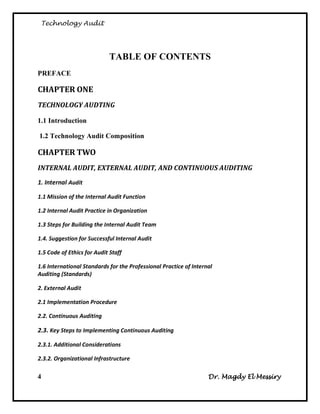
                             TABLE OF CONTENTS
PREFACE

CHAPTER ONE
TECHNOLOGY AUDTING

1.1 Introduction

1.2 Technology Audit Composition

CHAPTER TWO
INTERNAL AUDIT, EXTERNAL AUDIT, AND CONTINUOUS AUDITING
1. Internal Audit

1.1 Mission of the Internal Audit Function

1.2 Internal Audit Practice in Organization

1.3 Steps for Building the Internal Audit Team

1.4. Suggestion for Successful Internal Audit

1.5 Code of Ethics for Audit Staff

1.6 International Standards for the Professional Practice of Internal
Auditing (Standards)

2. External Audit

2.1 Implementation Procedure

2.2. Continuous Auditing

2.3. Key Steps to Implementing Continuous Auditing

2.3.1. Additional Considerations

2.3.2. Organizational Infrastructure

4                                                                  Dr. Magdy El Messiry
Technology Audit


2.3.3. Impact on Personnel

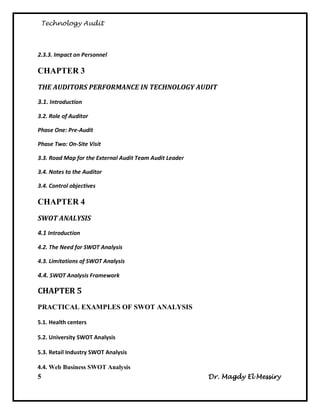
CHAPTER 3
THE AUDITORS PERFORMANCE IN TECHNOLOGY AUDIT
3.1. Introduction

3.2. Role of Auditor

Phase One: Pre-Audit

Phase Two: On-Site Visit

3.3. Road Map for the External Audit Team Audit Leader

3.4. Notes to the Auditor

3.4. Control objectives

CHAPTER 4
SWOT ANALYSIS
4.1 Introduction

4.2. The Need for SWOT Analysis

4.3. Limitations of SWOT Analysis

4.4. SWOT Analysis Framework

CHAPTER 5
PRACTICAL EXAMPLES OF SWOT ANALYSIS

5.1. Health centers

5.2. University SWOT Analysis

5.3. Retail Industry SWOT Analysis

4.4. Web Business SWOT Analysis
5                                                        Dr. Magdy El Messiry
Technology Audit


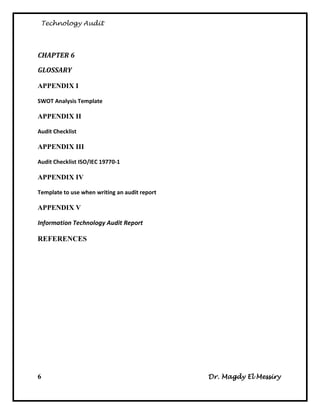
CHAPTER 6

GLOSSARY

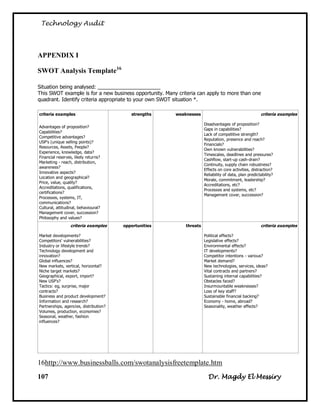
APPENDIX I

SWOT Analysis Template

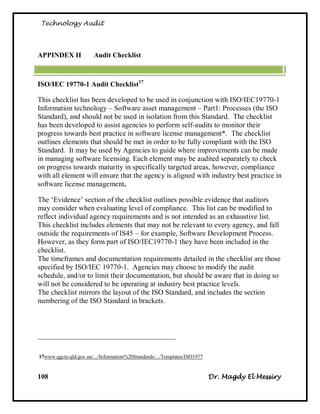
APPENDIX II

Audit Checklist

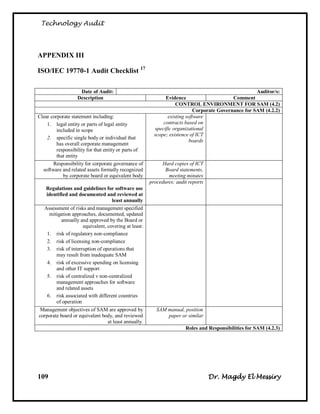
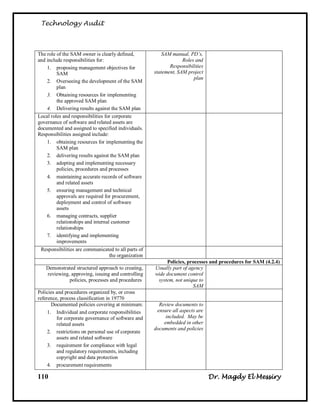
APPENDIX III

Audit Checklist ISO/IEC 19770-1

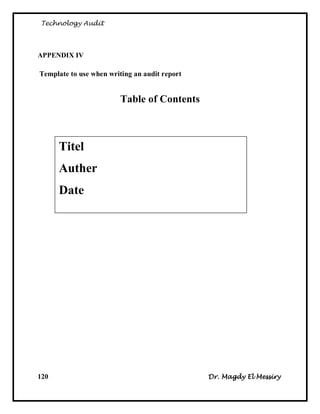
APPENDIX IV

Template to use when writing an audit report

APPENDIX V

Information Technology Audit Report

REFERENCES


6                                              Dr. Magdy El Messiry
Technology Audit


                                CHAPTER ONE
                            TECHNOLOGY AUDTING


1.1 Introduction

Today, the products‘ life cycle becomes gradually smaller. Actually in some
sectors such as the computer sector, technological devaluation of the products
occurs within a few months. Therefore it is a great competitive advantage for the
companies to be able to introduce new products to the market before their
competitors, gaining in this way significant sale shares. Today the companies must
be able to be constantly innovative to maintain or improve their position in the
market. In order to achieve this, they must know how to identify the innovation
needs of a business problem. The innovation management tools, which are utilized
for doing this, are Technology Audit and SWOT method1. Technology has become
an increasingly dynamic sector of the global economy. The critical task is now to
maintain a broad awareness of the nature and potential impact of emerging
technologies, the points of junction, and impact on market place trends on a
worldwide basis. Management of technology is an interdisciplinary field that
integrates science, engineering, and management knowledge and practice. The
focus is on technology as the primary factor in wealth creation. Wealth creation
involves more than just fiscal values and it may encompass factors such as
enhancement of knowledge, intellectual capital, effective exploitation of resources,
preservation of the natural environment, and other factors that may contribute to
raising the standard of living and quality of life.
The Technology Audit is a method for identifying the major company
requirements, needs, weaknesses and strengths on human resources and
infrastructure as well as opportunities that should be taken under consideration.
The Technology Audit is also a technique which identifies the management‘s view
of how the company performs as well as strong indications of what the company
really needs2.
The Technology Audit technique examines in tandem the External and Internal
environment of the company and identifies the human resources relation to
company‘s performance. Furthermore, it assists the company to discover the more
significant actions that it should adopt.


7                                                         Dr. Magdy El Messiry
Technology Audit


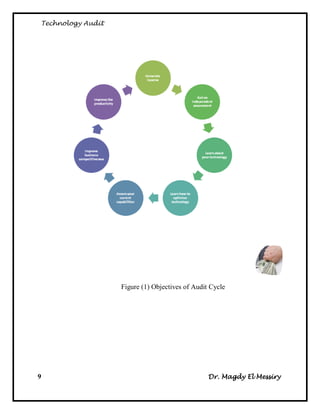
As shown in Figure (1), an organization can perform an audit in order to:

       Generate income (or more income) for the technology driven organizations (e.g.
        technology based enterprises, research centers, institutes) from their available technology.
       Improve the productivity of the technological factors.
       Improve business competitiveness and public administration's performance.
       Assess your current capabilities before making expensive changes.
       Learn how to optimize the use of current technology.
       Learn about your technology options.
       Get an independent assessment that can help convince your organizational partners of
        changes needed.

  An audit is merely a ―checkup.‖ As we gather more and more techno-devices
around us, we recognize the need to ensure that they are all accounted for, are
working properly, and are being employed for proper purposes, purposes that
advance the cause for our organizations. Consequently, a technology audit exists at
its very core as an activity that focuses our full attention upon improvement,
sustainable improvement and continuous innovation. Organizational survey and
technology audit will help in understanding the level of attention paid to
technology in the organization and facilitate the involvement of employees from
different departments of the organization in the technology management process.
The organizational survey and technology audit provides an instrument for
auditing the organization‘s technological capabilities and its awareness of
technology as means of improving competition. The organizational survey and
technology audit are used to assess whether the organization‘s management has the
appropriate level of understanding of technology and technology management, and
whether the required climate to use technology is in place.
Formulation of technology strategy addresses the issue of how to recognize the
critical technological needs and identifies the basic dimensions of a technology
strategy. It consists of three steps: technology assessment, technology selection,
and definition of the portfolio of technological projects, and strategic priorities and
actions3. The technology audit is equally applicable to manufacturing and service
firms. The firms should wish to create new products, incorporate new processes,
diversify their activities and be with growth potential. They should have capacity
to survive and innovate and competence for international cooperation. Technology
auditing should consider as means of ensuring business continuity in a
manufacturing organization.


8                                                                    Dr. Magdy El Messiry
Technology Audit


                   Figure (1) Objectives of Audit Cycle


9                                                Dr. Magdy El Messiry
Technology Audit


1.2 Technology Audit Composition

The implementation of the technology auditing starts with the answering to;
   What is the relationship between technology, business strategy and
      innovation in ensuring continuity of the organization?
   What does a technology audit consist of and what tools are available to help
      conduct the technology audit?
   What is the process flow of a technology audit?

The main steps of a technology audit process are 4:

Step 1: Company Decision for Technology Audit

The starting point of the technology audit process is the desire or wish of a firm to
carry out a technology audit.

Step 2: Initial phase

The initial phase is important to ensure that the audit proceeds smoothly and
effectively. It includes discussion at the management level to explain and agree
upon the purpose of the audit, to design the questionnaire and the framework for
the report to suit the organization and to select those to be interviewed. Initial
information about the organization (published and unpublished reports) is gathered
at this stage. Analysis of questionnaires should be done prior to the interviews and
might be done at an earlier stage, so that selection of those to be interviewed is
partly based on questionnaires.

Step 3: Interview and report phase

The company is being interviewed with a questionnaire, normally with
participation of the General Manager, aiming at:

        Collecting general company data
        Shaping company technology profile
        Performing SWOT Analysis
        Identifying technological areas for further analysis.

10                                                               Dr. Magdy El Messiry
Technology Audit


Technology Audit Tool consists of two parts, the questionnaires and the reports.
The results derived from the questionnaires generate the reports that can be easily
accessed by the General Manager of the company, but for a more accurate and less
biased diagnosis, an external specialized consultant is proposed.

Step 4: Technology Audit Report Framework


The final report of the technology audit should include:

         Subjects analyzed
         Methodology used
         Problem areas identified
         Solutions proposed for the problems
         Steps to be taken for implementing the solutions (action plan)


The expected results from a carefully conducted technology audit mainly concern4:

       Complete and comprehensive analysis and evaluation of the requirements of
      the organization for its sustainable growth
         Thoroughly objective SWOT Analysis
      Opportunity spotting for new products / new services / new technologies / new
      markets
         Networking with technology suppliers, technological sources, other companies
         Possible assessment of technology portfolio, intellectual property rights

There are five tasks within the audit process area:

1. Develop and implement a risk-based international audit standards (IS) audit
strategy for the organization in compliance with international audit standards,
guidelines and best practices.

2. Plan specific audits to ensure that IT and business systems are protected and
controlled.

3. Conduct audits in accordance with IS audit standards, guidelines and best practices
11                                                             Dr. Magdy El Messiry
Technology Audit


to meet planned audit objectives.

4. Communicate emerging issues, potential risks and audit results to key stakeholders.

5. Advise on the implementation of risk management and control practices within the
organization while maintaining independence.


12                                                         Dr. Magdy El Messiry
Technology Audit


                                  CHAPTER TWO


     INTERNAL AUDIT, EXTERNAL AUDIT, AND CONTINUOUS AUDITING

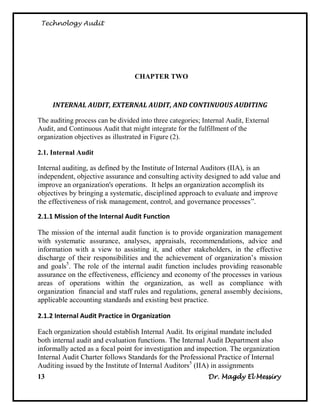
The auditing process can be divided into three categories; Internal Audit, External
Audit, and Continuous Audit that might integrate for the fulfillment of the
organization objectives as illustrated in Figure (2).

2.1. Internal Audit

Internal auditing, as defined by the Institute of Internal Auditors (IIA), is an
independent, objective assurance and consulting activity designed to add value and
improve an organization's operations. It helps an organization accomplish its
objectives by bringing a systematic, disciplined approach to evaluate and improve
the effectiveness of risk management, control, and governance processes‖.

2.1.1 Mission of the Internal Audit Function

The mission of the internal audit function is to provide organization management
with systematic assurance, analyses, appraisals, recommendations, advice and
information with a view to assisting it, and other stakeholders, in the effective
discharge of their responsibilities and the achievement of organization‘s mission
and goals5. The role of the internal audit function includes providing reasonable
assurance on the effectiveness, efficiency and economy of the processes in various
areas of operations within the organization, as well as compliance with
organization financial and staff rules and regulations, general assembly decisions,
applicable accounting standards and existing best practice.

2.1.2 Internal Audit Practice in Organization

Each organization should establish Internal Audit. Its original mandate included
both internal audit and evaluation functions. The Internal Audit Department also
informally acted as a focal point for investigation and inspection. The organization
Internal Audit Charter follows Standards for the Professional Practice of Internal
Auditing issued by the Institute of Internal Auditors5 (IIA) in assignments
13                                                           Dr. Magdy El Messiry
Technology Audit


performing audit. Audits are conducted in accordance with a detailed annual audit
plan that is developed based on an annual risk-based assessment of internal audit
needs for the whole of organization.


                       Figure (2) Types of Auditing Models


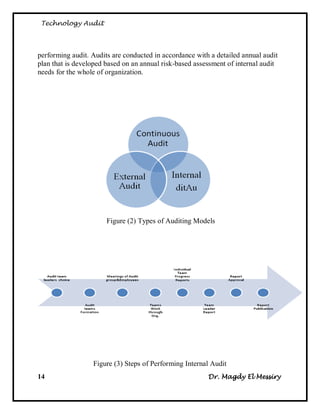
                  Figure (3) Steps of Performing Internal Audit
14                                                       Dr. Magdy El Messiry
Technology Audit


Risk-based annual audit plans are subject to regular revision, at least annually, in
order to be aligned with the strategic objectives of the organization. Audit needs
are estimated based on a thorough review of organization‘s business and other
systems and processes which make up the audit environment for the Internal
Organization Audit Department. The audit needs assessment is reviewed annually
at the same time as the detailed annual audit plan is set out.

For annual audit planning purposes in line with the new set of strategic goals set
for the Organization, the Internal Organization Audit Department strategy and
annual plans are re-aligned regularly to ensure:

        Due emphasis is put on the ―operational efficiency and effectiveness‖ aspect
         in the detailed work plans to the extent possible.
        Main organization business processes are reviewed to identify strengths and
         good practices, as well as gaps and deficiencies. Value adding
         recommendations are made to assist management in addressing these issues.
        Audit support is provided to key management and governance initiatives
         recognizing that the responsibility for such initiatives rests with the
         management in the case of a strong indication of any fraudulent activity
         found during an audit.
         Sufficient audit work is performed to gather factual evidence and the
         supporting documentation is handed over to the Investigation Section for
         further examination if need be.

2.1.3 Steps for Building the Internal Audit Team

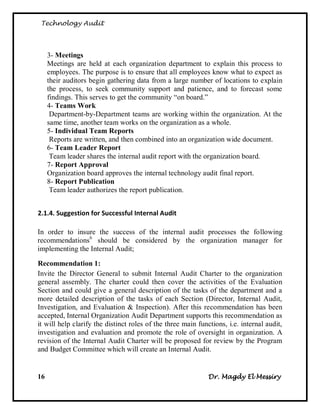
Figure (3) represents the steps for building the Internal Audit Team.

     1- Group Formation
     Local audit team leaders are chosen. They may appoint an individual to serve as
     overall coordinator, as well. The key here is to get the best leadership in place
     and functioning quickly.
     2- Audit teams
      Audit teams are formed and necessary documents needed to support the audit
     are gathered (Technology plan, facilities plan, personnel reports, etc.).


15                                                           Dr. Magdy El Messiry
Technology Audit


     3- Meetings
     Meetings are held at each organization department to explain this process to
     employees. The purpose is to ensure that all employees know what to expect as
     their auditors begin gathering data from a large number of locations to explain
     the process, to seek community support and patience, and to forecast some
     findings. This serves to get the community ―on board.‖
     4- Teams Work
      Department-by-Department teams are working within the organization. At the
     same time, another team works on the organization as a whole.
     5- Individual Team Reports
      Reports are written, and then combined into an organization wide document.
     6- Team Leader Report
      Team leader shares the internal audit report with the organization board.
     7- Report Approval
     Organization board approves the internal technology audit final report.
     8- Report Publication
      Team leader authorizes the report publication.


2.1.4. Suggestion for Successful Internal Audit

In order to insure the success of the internal audit processes the following
recommendations6 should be considered by the organization manager for
implementing the Internal Audit;

Recommendation 1:
Invite the Director General to submit Internal Audit Charter to the organization
general assembly. The charter could then cover the activities of the Evaluation
Section and could give a general description of the tasks of the department and a
more detailed description of the tasks of each Section (Director, Internal Audit,
Investigation, and Evaluation & Inspection). After this recommendation has been
accepted, Internal Organization Audit Department supports this recommendation as
it will help clarify the distinct roles of the three main functions, i.e. internal audit,
investigation and evaluation and promote the role of oversight in organization. A
revision of the Internal Audit Charter will be proposed for review by the Program
and Budget Committee which will create an Internal Audit.


16                                                           Dr. Magdy El Messiry
Technology Audit


Recommendation 2:
Director of Internal Organization Audit Department should draw up a list of the
training undertaken by all of his staff and update such a file as and when necessary.
This recommendation has been accepted. The recommendation will assist further
the tracking of the professional training being carried out.

Recommendation 3:
Invite the Director of Internal Organization Audit to develop a program (concept)
of quality assurance and improvement that includes documentation on periodic and
ongoing internal assessments of all areas of internal audit activity. Once
established, this concept should be included in the Internal Audit Manual. It seems
clear that ongoing assessments would only be suitable when the Internal Audit
Section has at least two qualified staff members. This recommendation has been
accepted. All audits are done in line with the Institute of Internal Auditors (IIA)
Standards and are subject to review and quality control. It is already Internal
Organization Audit Department‗s stated policy to have regular external and
internal quality assurance in accordance with the (IIA) 7 Standards.

Recommendation 4:
Invite Internal Organization Audit Department for the following:
a. to decide, during its annual planning, on precise audit themes which are then
mentioned in the final reports,
b. to continue to draw up a list of planned, completed and reported audits, which
should be updated as necessary, and
c. to implement long-term audit planning.

Recommendation 5:
The drafting of the audit manual should be completed and made it available to
organization staff and/or over the intranet. This manual should cover all the
essential elements specified in the Audit Standards**.

Recommendation 6:
Suggest that, from now on, Internal Organization Audit Department includes an
evaluation of the following in its reports:
a. exposure to significant risks and the corresponding controls,
b. subjects relating to governance, and
c. any other issue in response to a need or a request of the general management or
the Audit Committee.
17                                                         Dr. Magdy El Messiry
Technology Audit


Recommendation 7:
Invite Internal Organization Audit Department to review its strategy on planning
for audits involving medium to low risks in order to concentrate more on
engagements involving higher risks.

Recommendation 8:
The Internal Audit Section should:
a. clarify the work program by linking it with the risk analysis,
b. ensure that the work program includes the priorities and the resource allocation
for each subject to be audited,
c. ensure that the work program allows a connection to be made between the
working papers and the recommendations,
d. ensure that comments concerning the involvement and assignment of external
experts are highlighted in the audit plan, and
e. ensures that the signature of the Director of Internal Organization Audit
Department and the date of approval are systematically placed on the audit
program before the audit begins.

Recommendation 9:
Invite Internal Organization Audit Department:
a. to improve the formalization of working documentation so that a third party
audit professional is always able to compare the objectives of the engagement, the
content of the examinations carried out, the results, the auditor‘s opinion and the
recommendations. The standardization and organization of working papers could
go some way to achieving this,
b. to integrate into the Internal Audit Manual regulations relating to audit
documents, information to be archived and the period for which files must be kept;
rules on access by third parties to working papers should also be included,
c. to create audit notes that include a summary of the work carried out and allow
connections to be made between the work program, interviews, analyzed
documents and the notes and recommendations contained in the report,
d. to establish a system for reviewing working papers and dating and signing them,
and
e. to provide for the establishment of standards relating to documentation in the
audit manual.


18                                                       Dr. Magdy El Messiry
Technology Audit


Recommendation 10:

 In order to increase the visibility of the internal audit function within organization,
invite the Director of Internal Organization Audit Department to increase his
contact with the Organization General manger.


2.1.5 Code of Ethics for Audit Staff

The internal audit staff is expected to follow the internal audit function in conducting
audits as set out in the Audit Charter8.

        The Internal Auditor enjoys operational independence in the conduct of
         his/her duties. He/she has the authority to initiate, carry out and report on
         any action, which he/she considers necessary to fulfill his/her mandate.
        The Internal Auditor shall be independent of the programs, operations and
         activities he/she audits to ensure the impartiality and credibility of the audit
         work undertaken.


19                                                            Dr. Magdy El Messiry
Technology Audit


        Internal audit work shall be carried out in a professional, unbiased and
         impartial manner.
        The conclusions of the audits shall be shared with the managers concerned,
         who shall be given the opportunity to respond.
        Any situation of conflict of interest shall be avoided.
        The Internal Auditor shall have unrestricted, direct and prompt access to all
         organization records, officials or personnel holding any organization
         contractual status and to all the premises of the Organization.
        The Internal Auditor shall respect the confidential nature of information and
         shall use such information with discretion and only in so far as it is relevant
         to reach an audit opinion.


2.1.6 International Standards for the Professional Practice of Internal Auditing
(Standards)

The Institute of Internal Audit published the professional practice that includes
Introduction to the Standards, Attribute Standards, and Performance Standards*.
Internal auditing is conducted in diverse legal and cultural environments; within
organizations that vary in purpose, size, complexity, and structure; and by persons
within or outside the organization. While differences may affect the practice of
internal auditing in each environment, conformance with the IIA‘s International
Standards for the Professional Practice of Internal Auditing (Standards) is essential
in meeting the responsibilities of internal auditors and the internal audit activity.

The purpose of the Standards is to:

     1. Define basic principles that represent the practice of internal auditing.
     2. Provide a framework for performing and promoting a broad range of value-
        added internal auditing.
     3. Establish the basis for the evaluation of internal audit performance.
     4. Foster improved organizational processes and operations.

         The Standards are principles-focused, mandatory requirements consisting of:
20                                                            Dr. Magdy El Messiry
Technology Audit


      Statements of basic requirements for the professional practice of internal
       auditing and for evaluating the effectiveness of performance, which are
       internationally applicable at organizational and individual levels.
      Interpretations, which clarify terms or concepts within the Statements.

The structure of the Standards is divided between Attribute and Performance
Standards. Attribute Standards address the attributes of organizations and
individuals performing internal auditing. The Performance Standards describe the
nature of internal auditing and provide quality criteria against which the
performance of these services can be measured. The Attribute and Performance
Standards are also provided to apply to all internal audits.

Implementation Standards are also provided to expand upon the Attribute and
Performance standards, by providing the requirements applicable to assurance or
consulting activities. Assurance services involve the internal auditor‘s objective
assessment of evidence to provide an independent opinion or conclusions
regarding an entity, operation, function, process, system, or other subject matter.
The nature and scope of the assurance engagement are determined by the internal
auditor. There are generally three parties involved in assurance services:

1. the person or group directly involved with the entity, operation, function,
process, system, or other subject matter — the process owner,

2. the person or group making the assessment — the internal auditor,

3. the person or group using the assessment — the user.

Consulting services are advisory in nature, and are generally performed at the
specific request of an engagement client. The nature and scope of the consulting
engagement are subject to agreement with the engagement client. Consulting
services generally involve two parties:

1. the person or group offering the advice — the internal auditor,

2. the person or group seeking and receiving the advice — the engagement client.

 When performing consulting services the internal auditor should maintain
objectivity and not assume management responsibility.

21                                                          Dr. Magdy El Messiry
Technology Audit


2. External Audit

External assessments must be conducted at least once every five years by a
qualified, independent reviewer or review team from outside the organization. The
chief audit executive must discuss with the organization board the need for more
frequent external assessments and the qualifications and independence of the
external reviewer or review team, including any potential conflict of interest. A
qualified auditor or auditing team demonstrates competence in two areas: the
professional practice of internal auditing and the external assessment process.
Competence can be demonstrated through a mixture of experience and theoretical
learning. Experience gained in organizations of similar size, complexity, sector or
industry, and technical issues is more valuable than less relevant experience. In the
case of an auditing team, not all members of the team need to have all the
competencies; it is the team as a whole that is qualified. The chief audit executive
uses professional judgment when assessing whether an auditor or auditing team
demonstrates sufficient competence to be qualified. An independent auditor or
auditing team means not having either a real or an apparent conflict of interest and
not being a part of, or under the control of, the organization to which the internal
audit activity belongs.

2.1 Implementation Procedure
A schematic of the steps that are normally followed while carrying out a
technology audit is shown and described below. Partial techniques per step are the
tools used for the proper implementation of the technique.
STEP 1: Desire/Wish to Carry Out Technology Audit

Desire / wish of the organization to carry out technology audit, if the company
initiates the audit, no particular communication tool is used. However, if the
company is approached by the service provider, it should explain: Scope of
initiative, brief description of technique, potential benefits to the organization, and
main characteristics of the consultant / service provider.

STEP 2: Expert to Carry Out Technology Audit

Once common ground has been established between the organization and external
consultant/expert, the next step can follow.
22                                                          Dr. Magdy El Messiry
Technology Audit


STEP 3: First Contact/Visit of Expert for Preparation of Audit Plan

On the first contact / visit to the organization for the audit plan preparation the
expert should have:

o     a brochure / flow diagram on the steps to follow: list of benefits, list of other
      companies that carried out a TA, formal presentation using data show should
      help.
o     the audit plan which is devised together with top management. It establishes
      issues to investigate how to collect data and from whom, in what time span and
      at what cost, what is needed from management to successfully carry out the
      audit. The local team shares with auditors all documents gathered, as well as
      the internal audit report. Together, the auditors, the local audit team, work to
      establishing a strategy that will drive this formal audit. All parties agree upon a
      schedule/timeframe for the audit. All parties discuss some possible outcome
      objectives10. Auditors schedule date(s) for on-site visit(s). Auditors meet with
      focus groups and other constituencies, as needed.


STEP 4: Preparatory Work by Expert on Collecting Basic

 For preparatory work by expert on collecting basic information on the
organization & the sector for the organization: collection of data from published
information, brochures of company, economic data, employees, products, exports
etc.

 For the sector: published data on employment, turnover, trends, markets, on
company's products, introduction / use of new technologies.

A short report on the above findings would be handy and would be another step
into building a trusting relationship with the organization. Auditors study all
documents provided. Auditors schedule an on-site visit and make their
observations. It is a process whereby an in-depth evaluation of some aspect of an
organization is performed, and the results compared with representations made by
that organization. Due attentiveness is particularly important for business
transactions in technology-intensive markets, since there is a much higher risk of
misrepresentation or inappropriate application of emerging technologies. It is often
23                                                       Dr. Magdy El Messiry
Technology Audit


difficult to find individuals capable of assessing both the technological issues and
their business linkages*. The approach to be followed must be planned and agreed
upon. The process must include the selection of team members from the
organization who will participate11. The team must be multidisciplinary, and
include both business and technical experts familiar with the areas under
investigation. If staff expertise is lacking in a particular area, engage the services of
experts in that field. Depending on the results of the preliminary visits, different
approaches may be necessary for each organization12.

STEP 5: GENERAL SHORT DIAGNOSES

General short diagnosis use is made of a questionnaire, either in hard copy or
electronic, which should cover the following main points 13;

ORGANIZATION

Company information, strategy, development planning.

HUMAN RESOURCES

Capabilities, needs, strengths, weaknesses, training, performance, rewards.

TECHNOLOGICAL CAPABILITY

Technological resources, know how, assessment of technological level,
implementation of information technologies, new technologies.

TECHNOLOGICAL INNOVATION

Product development, procedures, new products - number - timeframe, research
and development (in house or external), resources allocated, areas of interest,
sources of acquiring technology.

INNOVATION CAPABILITY

Innovations introduced barriers to innovation, technology watch / searching /
technology diffusion, involvement in R&D joint projects.


24                                                            Dr. Magdy El Messiry
Technology Audit


PRODUCTS

Products / markets, production organization and management, production
equipment, walk through shop floor.

COOPERATION NETWORKING

With other companies / local abroad, with technology providers / sources,
participation in R&D programs.

TECHNOLOGICAL NEEDS

Demands for services / equipment / quality improvement, new technologies, access
to information / technology diffusion.

QUALITY

Quality control, products - raw materials, standards, relations with customers /
suppliers.

MARKETING

Markets, local/abroad, marketing plan / strategy.

ENVIRONMENT

Awareness / problems / needs.

STEP 6: DATA ANALYSIS BY EXPERT, REPORT ON FIRST DIAGNOSIS

Data analysis by the expert report on first diagnosis should be brief and should
contain:

- Executive summary

- Overview of company / activities (good for signposting to networks, etc.)

- Overview of sectors / markets

- Synthesis on: Strengths / weaknesses / opportunities / threats identified
25                                                         Dr. Magdy El Messiry
Technology Audit


- Potential suggestions (especially if the audit stops at this point) for resolving
problems and exploiting strengths & opportunities, mainly by indicating routes for
solutions with an action plan, isolation of specific areas / departments for further
diagnosis, proposal with justification.


STEP 7: PRESENTATION OF FIRST DIAGNOSIS REPORT TO GENERAL MANAGER AND
COMPANY MANAGEMENT

Presentation of first diagnosis report to General Manager and company management is
done with the handing out some time earlier of a hard copy of the report, the
main findings, and the finalization on whether to continue for further diagnosis and
the agreement on the subject(s) to analyze is also performed here.

STEP 8: ADDITIONAL VISITS/INTERVIEWS TO DEPARTMENT HEADS

Entail an in-depth investigation of key areas of the organization being assessed. A
full due diligence audit of an external company can take up to a week at a small
single-site company with a technical staff of 50 or less, several weeks at larger
companies with a localized development team, and even longer examining a larger
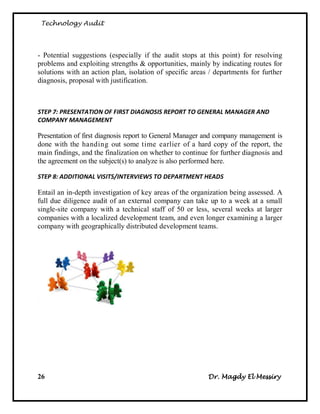
company with geographically distributed development teams.


26                                                        Dr. Magdy El Messiry
Technology Audit


Obviously, the relationship between company size and inspection effort is non-
linear. This is because a certain set of core elements, such as policies and
procedures, business plans, and infrastructure standards are centrally located.
Typical areas and themes that could be covered with either specific subject tools or
in a less structured way (if done by a specialist) could be:

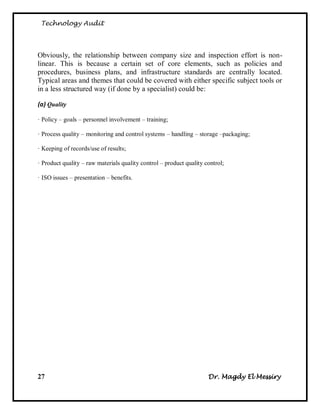
(a) Quality

· Policy – goals – personnel involvement – training;

· Process quality – monitoring and control systems – handling – storage –packaging;

· Keeping of records/use of results;

· Product quality – raw materials quality control – product quality control;

· ISO issues – presentation – benefits.


27                                                                   Dr. Magdy El Messiry
Technology Audit


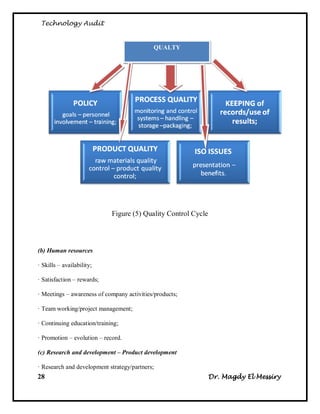
                                            QUALTY


                             Figure (5) Quality Control Cycle


(b) Human resources

· Skills – availability;

· Satisfaction – rewards;

· Meetings – awareness of company activities/products;

· Team working/project management;

· Continuing education/training;

· Promotion – evolution – record.

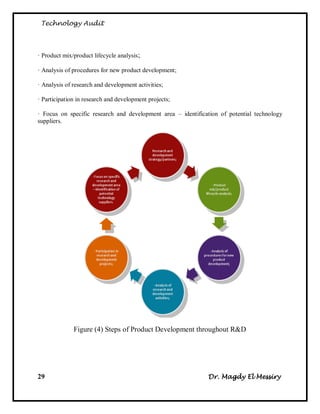
(c) Research and development – Product development

· Research and development strategy/partners;
28                                                              Dr. Magdy El Messiry
Technology Audit


· Product mix/product lifecycle analysis ;

· Analysis of procedures for new product development;

· Analysis of research and development activities;

· Participation in research and development projects;

· Focus on specific research and development area – identification of potential technology
suppliers.


              Figure (4) Steps of Product Development throughout R&D


29                                                            Dr. Magdy El Messiry
Technology Audit


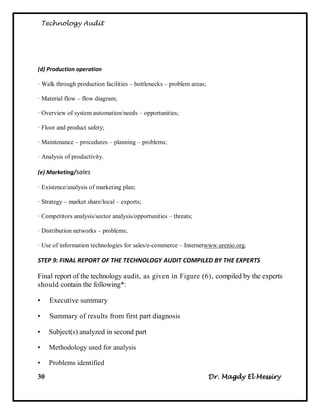
(d) Production operation

· Walk through production facilities – bottlenecks – problem areas;

· Material flow – flow diagram;

· Overview of system automation/needs – opportunities;

· Floor and product safety;

· Maintenance – procedures – planning – problems;

· Analysis of productivity.

(e) Marketing/sales

· Existence/analysis of marketing plan;

· Strategy – market share/local – exports;

· Competitors analysis/sector analysis/opportunities – threats;

· Distribution networks – problems;

· Use of information technologies for sales/e-commerce – Internetwww.urenio.org.

STEP 9: FINAL REPORT OF THE TECHNOLOGY AUDIT COMPILED BY THE EXPERTS

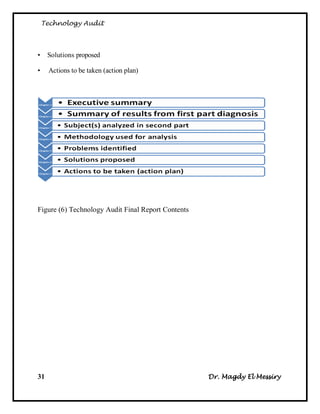
Final report of the technology audit, as given in Figure (6), compiled by the experts
should contain the following*:

•     Executive summary

•     Summary of results from first part diagnosis

•    Subject(s) analyzed in second part

•     Methodology used for analysis

•     Problems identified
30                                                                    Dr. Magdy El Messiry
Technology Audit


•    Solutions proposed

•    Actions to be taken (action plan)


Figure (6) Technology Audit Final Report Contents


31                                                  Dr. Magdy El Messiry
Technology Audit


The action plan

Should be:

a) Specific to the subject
b) With a time frame
c) With determined milestones
d) With an estimated budget
e) With the listing of expected results
f) With identification of potential problem solvers (technology or service providers)
g) With indications about provisional funding for implementing the solutions
(e.g. national and / or international R&D programs)
h) An implementation monitoring schedule, possibly to be done by the service provider.
The action plan should be specific to the subject, with a timeframe, with determined
milestones and with an estimated budget. The action plan must list the expected
results, identify potential problem solvers (technology or service providers) and
indicate provisional funding for implementing the solutions. An implementation,
monitoring-schedule must be done by the technology auditor in conjunction with a
project manager.


   STEP 10: PRESENTATION OF REPORT BY EXPERT TO COMPANY MANAGEMENT
At step 10 the report by the technology auditor to the organization must discuss
issues identified, solutions proposed, the proposed action plan and the monitoring
system that will be used.
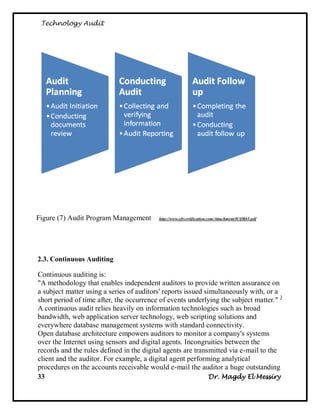
The systematic audit program includes initiating the audit, preparing for on-site
audit, conducting on site audit, report preparation and follow-up activities. The
follow-up activities in this context are the improvements activities result from the
audit finding. Figure (7) shows the stages of audit program management.


32                                                        Dr. Magdy El Messiry
Technology Audit


Figure (7) Audit Program Management        http://www.efrcertification.com/Attachment/ICQR65.pdf


2.3. Continuous Auditing

Continuous auditing is:
"A methodology that enables independent auditors to provide written assurance on
a subject matter using a series of auditors' reports issued simultaneously with, or a
short period of time after, the occurrence of eve nts underlying the subject matter." 3
A continuous audit relies heavily on information technologies such as broad
bandwidth, web application server technology, web scripting solutions and
everywhere database management systems with standard connectivity.
Open database architecture empowers auditors to monitor a company's systems
over the Internet using sensors and digital agents. Incongruities between the
records and the rules defined in the digital agents are transmitted via e-mail to the
client and the auditor. For example, a digital agent performing analytical
procedures on the accounts receivable would e-mail the auditor a huge outstanding
33                                                            Dr. Magdy El Messiry
Technology Audit


beyond the receivable parameters defined in the digital agent. Once an account
trigger has occurred, the digital agent would move to the transactional level to
verify the authenticity of the sale by seeking an e-mail of the sale organization and
acceptance of the goods/service by the customer.

The audit routine described above is done electronically and automatically on a
real-time basis as a part of continuous monitoring. Continuous audit takes off after
this when an auditor, empowered with data, carries out independent investigation
and collects corroborative evidence to arrive at his/her own deductions.


34                                                         Dr. Magdy El Messiry
Technology Audit


                           Figure (8) Steps of
                             Implementing
                           Continuous Audit


.


35                     Dr. Magdy El Messiry
Technology Audit


    2.3.1. KEY STEPS TO IMPLEMENTING CONTINUOUS AUDITING

    Once the issues above are understood by managers and auditors alike, the
    organization will be in a better position to begin using continuous auditing.
    Generally, the implementation of continuous auditing consists of six procedural
    steps, demonstrated in Figure (8), which are usually administered by a continuous
    audit manager. Knowing about these steps will enable auditors to better monitor
    the continuous audit process and provide recommendations for its improvement, if
    needed. These steps include:

    1.    Establishing priority areas.
    2.    Identifying monitoring and continuous audit rules.
    3.    Determining the process' frequency.
    4.    Configuring continuous audit parameters.
    5.    Following up.
    6.    Communicating results.

    Below is a description of each.

    1. Establishing Priority Areas
    The activity of choosing which organizational areas to audit should be integrated
    as part of the internal audit annual plan and the company's risk management
    program. Many Internal Audit Departments also integrate and coordinate with
    other compliance plans and activities, if applicable. (Steps 2-6 below are applicable
    to all of the priority areas and processes being monitoring as part of the continuous
    audit program.)
    Typically, when deciding priority areas to continuously audit, internal auditors and
    managers should:
           Identify the critical business processes that need to be audited by breaking
     down and rating risk areas.
           Understand the availability of continuous audit data for those risk areas.
           Evaluate the costs and benefits of implementing a continuous audit process
     for a particular risk area.
           Consider the corporate ramifications of continuously auditing the particular
     area or function.


    36                                                         Dr. Magdy El Messiry
Technology Audit


          Choose early applications to audit where rapid demonstration of results
     might be of great value to the organization. Long extended efforts tend to
     decrease support for continuous auditing.
          Once a demonstration project is successfully completed, negotiate with
     different auditors and internal audit areas, if needed, so that a longer term
     implementation plan is implemented.

    When performing the actions listed above, auditors need to consider the key
    objectives from each audit procedure. Objectives can be classified as one of four
    types: detective, deterrent (also known as preventive), financial, and compliance. A
    particular audit priority area may satisfy any one of these four objectives. For
    instance, it is not uncommon for an audit procedure that is put in place for
    preventive purposes to be reconfigured as a detective control once the audited
    activity's incidence of compliance failure decreases.

    2. Monitoring and Continuous Audit Rules
    The second step consists of determining the rules or analytics that will guide the
    continuous audit activity, which need to be programmed, repeated frequently, and
    reconfigured when needed. For example, banks can monitor all checking accounts
    nightly by extracting files that meet the criterion of having a debt balance that is 20
    percent larger than the loan threshold and in which the balance is more than US
    $1,000.
    In addition, monitoring and audit rules must take into consideration legal and
    environmental issues, as well as the objectives of the particular process. For
    instance, how quickly a management response is provided once an activity is
    flagged may depend on the speed of the clearance process (i.e., the environment)
    while the activity's overall monitoring approach may depend on the enforceability
    of legal actions and existing compliance requirements.

    3. Determining the Process' Frequency
    Although the process is called continuous auditing, the word continuous is in the
    eye of the beholder. Auditors need to consider the natural rhythm of the process
    being audited, including the timing of computer and business processes as well as
    the timing and availability of auditors trained or with experience in continuous
    auditing. For instance, although increased testing frequency has substantial
    benefits, extracting, processing, and following up on testing results might increase
    the costs of the continuous audit activity. Therefore, the cost-benefit ratio of
    continuously auditing a particular area must be considered prior to its monitoring.
    37                                                           Dr. Magdy El Messiry
Technology Audit


Furthermore, other tools used by the manager of the continuous audit function
include an audit control panel in which frequency and parameter variations can be
activated. Hence, the nature of other continuous audit objectives, such as
deterrence or prevention, may determine their frequency and variation.

4. Configuring Continuous Audit Parameters
Rules used in each audit area need to be configured before the continuous audit
procedure (CAP) is implemented. In addition, the frequency of each parameter
might need to be changed after its initial setup based on changes stemming from
the activity being audited. Hence, rules, initial parameters, and the activity's
frequency ― also a special type of parameter ― should be defined before the
continuous audit process begins and reconfigured based on the activity's
monitoring results.
When defining a CAP, auditors should consider the cost benefits of error detection
and audit and management follow-up activities. For instance, in the example of the
bank described earlier, the excess threshold of US $1,000 could lead to a number
of false negatives (e.g., values that were ignored when the balance was smaller
than US $1,000 but were identified as representing a problem) and a number of
false positives (e.g., values with balances above US $1,000 that were flagged but
were accurate). If the threshold is increased to US $2,000, there will be an increase
in false negatives and a decrease in false positives. Because follow up costs would
go up as the number of false positives increases and the presence of false negatives
may lead to high operational costs for the organization, internal auditors should
regularly reevaluate if error detection and follow-up activities need to be
continued, reconfigured, temporarily halted, or used on an ad hoc basis.
Furthermore, the stratification of audited data into sub-groups allows organizations
to better monitor the activity and reconfigure any parameters (e.g., auditors will be
notified when balances larger than 20 percent of the debt remain that are also
larger than US $5,000). However, the more complex the rule and its conditional
components, the more parameters that must be examined, monitored, and
sometimes reconfigured.

5. Following Up
Another type of parameter relates to the treatment of alarms and detected errors.
Questions such as who will receive the alarm (e.g., line managers, internal
auditors, or both ― usually the alarm is sent to the process manager, the manager's
immediate supervisor, or the auditor in charge of that CAP) and when the follow-

38                                                         Dr. Magdy El Messiry
Technology Audit


up activity must be completed, need to be addressed when establishing the
continuous audit process.
Additional follow-up procedures that should be performed as part of the
continuous audit activity include reconciling the alarm prior to following up by
looking at alternate sources of data and waiting for similar alarms to occur before
following up or performing established escalation guidelines. For instance, the
person receiving the alarm might wait to follow up on the issue if the alarm is
purely educational (i.e., the alarm verifies compliance but has no adverse economic
implications), there are no resources available for evaluation, or the area identified
is a low benefit area that is mainly targeted for deterrence.

6. Communicating Results
A final item to be considered is how to communicate with auditors. When
informing auditors of continuous audit activity results, it is important for the
exchange to be independent and consistent. For instance, if multiple system alarms
are issued and distributed to several auditors, it is crucial that steps 1-5 take place
prior to the communication exchange and that detailed guidelines for individual
factor considerations exist. In addition, the development and implementation of
communication guidelines and follow-up procedures must consider the risk of
collusion. Much of the work on fraud indicates that the majority of fraud is
collusive and can be performed by an internal or external party. For example, in
the case of dormant accounts, both the clerk that moves money and the manager
that receives the follow-up money may be in collusion since the manager's key
may have to be used for certain transactions.

ADDITIONAL CONSIDERATIONS

Besides the six steps described in the previous section, two additional issues that
emerge when implementing continuous auditing are the infrastructure needed for
the process to work and its impact on the workplace.

Organizational Infrastructure
Because continuous auditing is a part of the company's audit function, it must be
kept independent of management. Therefore, during the planning stages, auditors
need to keep in mind the process' independence when designing its structure. For
instance, a typical Internal Audit Departments structured so that areas of the
department focus on different cycles or business activities. In addition, the
department may be divided into financial and IT audit functions.
39                                                           Dr. Magdy El Messiry
Technology Audit


Sometimes, however, IT audit activities are incorporated as part of existing IT
operations. In organizations such as these, the development of continuous auditing
is usually delayed because the activity may not get the necessary development
priority. Regardless of whether IT audit activities are part of the organization's IT
or Internal Audit Department, the organization must maintain the process'
independence as well as allocate resources in support of continuous audit activities.

Impact on Personnel
In addition, the audit manager in charge of the continuous audit process should
have a more technical understanding of IT as well as extensive experience on the
activities being audited. However, hiring, training, and retaining auditors who can
implement and monitor continuous audit activities might be challenging due to the
scarcity of internal auditors with knowledge in the area. Furthermore, the
continuous audit process might create a daily stream of issues that need to be
resolved, which might prove stressful given current personnel resources, and might
require the continuous audit manager to exert adequate authority in moments of
exceptions.


40                                                         Dr. Magdy El Messiry
Technology Audit


                                   CHAPTER 3


                    PERFORMANCE IN TECHNOLOGY AUDIT


3.1. Introduction

Appointment of Auditor – auditors are usually appointed by the organization
mangers at the administration council meeting.

Terms of Engagement – an engagement letter provides written recognition of the
auditor‘s acceptance of appointment, sets out the scope of the audit plus auditors
and management responsibilities.

Audit Program – sets out the extent and type of audit procedures. Auditors work to
internationally agreed auditing standards. Auditors start by gaining an
understanding of the organization‘s activities. For each major activity listed in the
financial statements, auditors identify and assess risks that could have a significant
impact on the financial position or performance.
41                                                         Dr. Magdy El Messiry
Technology Audit


Detailed Examination – auditors perform testing and obtain evidence to satisfy the
requirements of the audit program. Testing may include compliance with the
organization‘s accounting policies, examining accounting records and verifying the
existence of tangible items such as plant and equipment.

Audit Report – contains the audit opinion on the financial report and basis of that
opinion. The scope of the audit plus auditors and management responsibilities are
also restated. The external auditor should maintain independence from
management and directors so that the tests and judgments are made objectively.
Auditors discuss the scope of the audit work with the organization. Auditors
determine the type and extent of the audit procedures they will perform depending
on the risks and controls they have identified. Auditors form an opinion on the
information in the final report. However, the external auditor should not look at
every transaction carried out by the organization, test the adequacy of all of the
organization‘s internal controls, identify all possible irregularities, audit other
information provided to the members of the organization – e.g. the directors‘
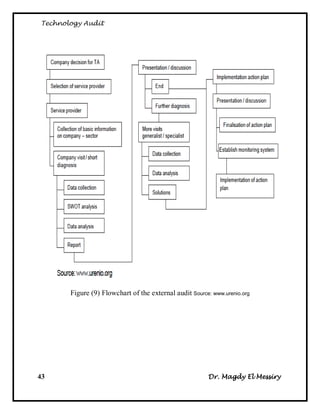
report. Figure (9) gives the flowchart of the external audit.


42                                                       Dr. Magdy El Messiry
Technology Audit


       Figure (9) Flowchart of the external audit Source: www.urenio.org


43                                                      Dr. Magdy El Messiry
Technology Audit


3.2. Audit team roles and responsibilities

An audit may be conducted by a single lead auditor or by an audit team consisting
of a lead auditor, one or more auditors and/or a technical adviser. The National
Code of Practice for Auditors and Technical Advisers describe the conditions that
an auditor and technical adviser must adhere to when fulfilling their roles during
audits.

Lead Auditor

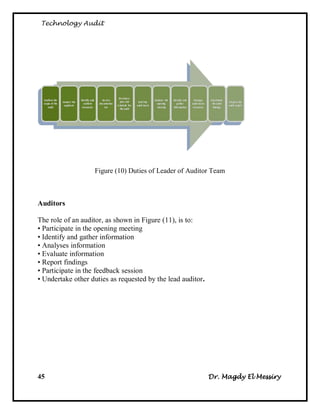
The role of the lead auditor, demonstrated in Figure (10), is to:
• Confirm the scope of the audit with the registering body
• Contact the applicant and make an appointment for the audit
• Identify and confirm resources (including audit team members and audit
documentation) required to conduct the audit
• Review documentation and develop a plan and schedule for the audit in
conjunction with the applicant and then confirm these arrangements
• Brief the audit team
• Conduct the opening meeting
• Identify and gather information
• Manage audit team resources by ensuring that there is effective communication
between the members of the audit team, and by working with the applicant‘s
representative to ensure that auditors and technical experts have access to the
materials, sites and personnel they require
• Coordinate the audit findings by meeting with the audit team to synthesize the
evidence collected
• Prepare the audit report with support from the audit team
• Conduct the feedback session with the applicant and confirm follow-up
• Provide information to the applicant about the complaints process and follow-up
action required
• Provide feedback to the audit team.
44                                                       Dr. Magdy El Messiry
Technology Audit


                   Figure (10) Duties of Leader of Auditor Team


Auditors

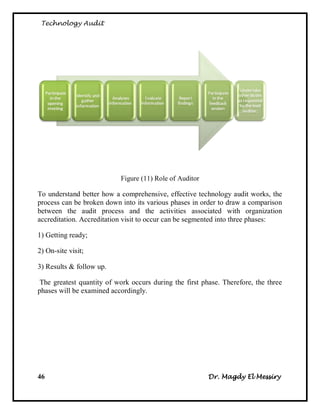
The role of an auditor, as shown in Figure (11), is to:
• Participate in the opening meeting
• Identify and gather information
• Analyses information
• Evaluate information
• Report findings
• Participate in the feedback session
• Undertake other duties as requested by the lead auditor.


45                                                           Dr. Magdy El Messiry
Technology Audit


                           Figure (11) Role of Auditor

To understand better how a comprehensive, effective technology audit works, the
process can be broken down into its various phases in order to draw a comparison
between the audit process and the activities associated with organization
accreditation. Accreditation visit to occur can be segmented into three phases:

1) Getting ready;

2) On-site visit;

3) Results & follow up.

 The greatest quantity of work occurs during the first phase. Therefore, the three
phases will be examined accordingly.


46                                                       Dr. Magdy El Messiry
Technology Audit


Phase One: Pre-Audit


Whether the technology audit has been triggered by the organization internal desire
to assess its accountability or whether the impetus has come from outside the
organization, the initial phase is the same. The organization must get ready for the
audit. Thus, this phase is sometimes called the ―pre-audit‖ stage. At a macro level,
the organization might want to establish a set of systems that can be put in place to
make auditors time more valuable, more efficient. Auditor may want to form a
group of teams to perform specific functions; a physical location may be specified
as a ―gathering point‖ for evidentiary documents; a series of focus group meetings
should be scheduled so organization leaders can encourage employees and
community members to voice their opinions and give their perspectives regarding
the organization‘s status; to create a system where all the hard work of engaged
people, the data and reports auditor collect, and the supporting systems can be
perpetuated.

 Enrolling team members - To make your technology audit a success, it is essential
to have high-quality teams. The teams will be made up of the specialized members.
The team leaders will ensure a strong and fluid cooperation among teams, all
working on a common end goal. Team building is a significant activity. All
organization leaders realize this fully. Best leaders who build and grow the best
teams so they will accomplish the best results.

The auditor team leader may clarify with organization employees by explaining to
them that a technology audit is coming and he wants to obtain their very best
thinking about some strategies that will assure success for the organization. During
this meeting, the auditor might want to engage in a simple brain storming activity,
asking everyone to call out, as fast as they can, all the areas where is the use of
technologies in the organization. Team leader might ask them to be frank and
candid in their comments, and then ask them to pinpoint areas where they perceive
that improvements could be made. If/when they mention some examples, the
auditor asks for substantiating evidence that may give the clues to other things
needing. The team leader tries to imagine how the auditors will see things/look at
things through their eyes. What would the auditors do? What would they say?
What would they seek? How would they interpret what you give them? What
would they recommend? As the leader and the team of advisors go through these
considerations, they will have prepared themselves well for what lies ahead, and
47                                                         Dr. Magdy El Messiry
Technology Audit


will no longer fear the technology audit, or consider it as a negative event. Rather,
they will see this as a profoundly important opportunity to engage in systemic
improvement, as well as great improvement at the individual level.

Phase Two: On-Site Visit

The time has come finally when auditors arrive at the organization and are
examining both the reports (data, information, and evidence) and the actual reality
of technology integration. This guideline is intended to help auditors conduct more
focused reviews of technology acquisitions by enabling them to quickly identify
significant areas of risk. Using these guidelines will help auditors identify critical
factors not addressed by management, make a general evaluation of any
procurement risks, and provide rapid feedback to agency officials so they can take
corrective action in a timely and efficient manner. Use of the guidelines should be
selectively tailored to the requirements of particular reviews and adapted to the
status of the acquisition. Auditors will need to exercise professional judgment in
assessing the significance of audit results or findings. Professional judgment is
necessary to evaluate this information and determine if the agency conducted an
adequate requirements analysis.

There are five tasks within the audit process area:

     1. Develop and implement a risk-based audit strategy for the organization in
compliance with audit standards, guidelines and best practices.

      2. Plan specific audits to ensure that IT and business systems are protected
and controlled.

       3. Conduct audits in accordance with audit standards, guidelines and best
practices to meet planned audit objectives.

      4. Communicate emerging issues, potential risks and audit results to key
stakeholders.

      5. Advise on the implementation of risk management and control practices
within the organization while maintaining independence.


48                                                         Dr. Magdy El Messiry
Technology Audit


3.3. Audit planning

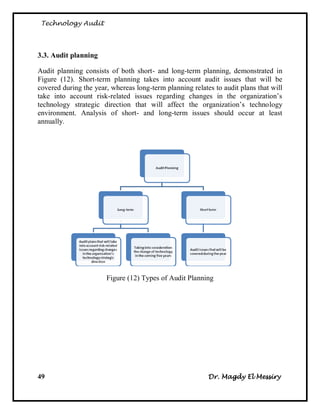
Audit planning consists of both short- and long-term planning, demonstrated in
Figure (12). Short-term planning takes into account audit issues that will be
covered during the year, whereas long-term planning relates to audit plans that will
take into account risk-related issues regarding changes in the organization‘s
technology strategic direction that will affect the organization‘s technology
environment. Analysis of short- and long-term issues should occur at least
annually.


                       Figure (12) Types of Audit Planning


49                                                        Dr. Magdy El Messiry
Technology Audit


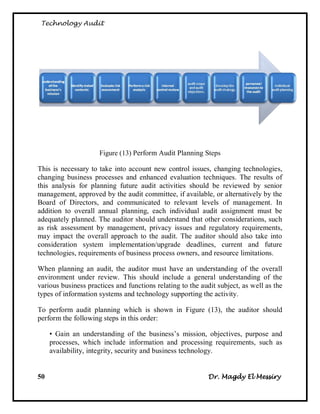
                     Figure (13) Perform Audit Planning Steps

This is necessary to take into account new control issues, changing technologies,
changing business processes and enhanced evaluation techniques. The results of
this analysis for planning future audit activities should be reviewed by senior
management, approved by the audit committee, if available, or alternatively by the
Board of Directors, and communicated to relevant levels of management. In
addition to overall annual planning, each individual audit assignment must be
adequately planned. The auditor should understand that other considerations, such
as risk assessment by management, privacy issues and regulatory requirements,
may impact the overall approach to the audit. The auditor should also take into
consideration system implementation/upgrade deadlines, current and future
technologies, requirements of business process owners, and resource limitations.

When planning an audit, the auditor must have an understanding of the overall
environment under review. This should include a general understanding of the
various business practices and functions relating to the audit subject, as well as the
types of information systems and technology supporting the activity.

To perform audit planning which is shown in Figure (13), the auditor should
perform the following steps in this order:

     • Gain an understanding of the business‘s mission, objectives, purpose and
     processes, which include information and processing requirements, such as
     availability, integrity, security and business technology.


50                                                         Dr. Magdy El Messiry
Technology Audit


     • Identify stated contents, such as policies, standards and required guidelines,
     procedures, and organization structure.

     • Evaluate risk assessment and any privacy impact analysis carried out by
     management.

     • Perform a risk analysis.

     • Conduct an internal control review.

     • Set the audit scope and audit objectives.

     • Develop the audit approach or audit strategy.

     • Assign personnel resources to the audit and address engagement logistics.

     • Audit planning
           – Short-term planning
           – Long-term planning
           – Things to consider
     •   New control issues
     •   Changing technologies
     •   Changing business processes
     •        Enhanced evaluation techniques
     • Individual audit planning
           – Understanding of overall environment
     •              Business practices and functions
     •              Information systems and technology


3.4. Road Map for the External Audit Team Audit Leader

The following are steps that the Team audit leader would perform to determine an
organization‘s level of compliance with external requirements:

• Identify those government or other relevant external requirements dealing with:

       – Electronic data, copyrights, e-commerce, e-signatures, etc.

51                                                         Dr. Magdy El Messiry
Technology Audit


      – Computer system practices and controls

      – The manner in which computers, programs and data are stored

      – The organization or the activities of the information services

• Document applicable laws and regulations

• Assess whether the management of the organization and the information systems
function have considered the relevant external requirements in making plans and in
setting policies, standards and procedures

• Review internal information systems department/function/activity documents that
address adherence to laws applicable to the industry

• Determine adherence to establishing procedures that address these requirements.

3.5. Notes to the Auditor

Auditor will not ask about any specific laws or regulations, but may question
about how one would audit for compliance with laws and regulations.

Auditor should be aware that it is important that the auditor understands the
relationships of control objectives and controls; control objectives and audit
objectives; criteria and sufficiency and competency of evidence; and audit
objective, criteria and audit procedures. Strong understanding of these elements is
a key for the auditor‘s performance.

Auditor is the importance of setting legal advice. There are two key aspects that
control needs to address, what the auditor should to achieve and what to avoid.

 Auditor addresses not only to internal controls business/operational objectives,
but need to address undesired events through preventing, detecting, and correcting
undesired events. Types of control;

• Internal accounting controls - Primarily directed at accounting operations, such as
the safeguarding of assets and the reliability of financial records


52                                                           Dr. Magdy El Messiry
Technology Audit


• Operational controls - Directed at the day-to-day operations, functions and
activities to ensure that the operation is meeting the business objectives

• Administrative controls - Concerned with operational efficiency in a functional
area and adherence to management policies including operational controls. These
can be described as supporting the operational controls specifically concerned with
operating efficiency and adherence to organizational policy.


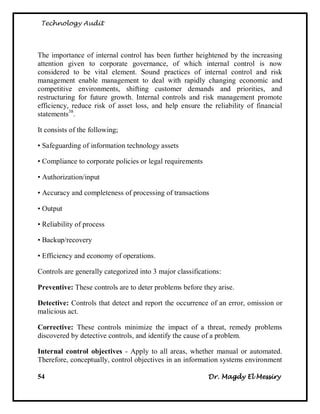
Figure (14) Elements to Development of Internal Control Manual

3.6. Control objectives

Every organization needs to have a sound internal control in place to keep the
organization on course toward profitability goals and achievement of its mission,
to minimize surprises along the way and to be able to realize its opportunities.
Elements to Development of Internal Control Manual are illustrated in Figure (14).


53                                                          Dr. Magdy El Messiry
Technology Audit


The importance of internal control has been further heightened by the increasing
attention given to corporate governance, of which internal control is now
considered to be vital element. Sound practices of internal control and risk
management enable management to deal with rapidly changing economic and
competitive environments, shifting customer demands and priorities, and
restructuring for future growth. Internal controls and risk management promote
efficiency, reduce risk of asset loss, and help ensure the reliability of financial
statements38.

It consists of the following;

• Safeguarding of information technology assets

• Compliance to corporate policies or legal requirements

• Authorization/input

• Accuracy and completeness of processing of transactions

• Output

• Reliability of process

• Backup/recovery

• Efficiency and economy of operations.

Controls are generally categorized into 3 major classifications:

Preventive: These controls are to deter problems before they arise.

Detective: Controls that detect and report the occurrence of an error, omission or
malicious act.

Corrective: These controls minimize the impact of a threat, remedy problems
discovered by detective controls, and identify the cause of a problem.

Internal control objectives - Apply to all areas, whether manual or automated.
Therefore, conceptually, control objectives in an information systems environment

54                                                         Dr. Magdy El Messiry
Technology Audit


remain unchanged from those of a manual environment. However, control features
may be different. Thus, internal control objectives need to be addressed in a
manner specific to related processes.


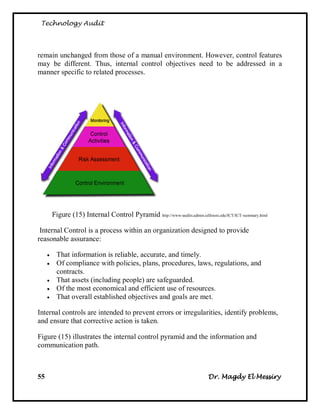
         Figure (15) Internal Control Pyramid http://www-audits.admin.uillinois.edu/ICT/ICT-summary.html

 Internal Control is a process within an organization designed to provide
reasonable assurance:

         That information is reliable, accurate, and timely.
         Of compliance with policies, plans, procedures, laws, regulations, and
          contracts.
         That assets (including people) are safeguarded.
         Of the most economical and efficient use of resources.
         That overall established objectives and goals are met.

Internal controls are intended to prevent errors or irregularities, identify problems,
and ensure that corrective action is taken.

Figure (15) illustrates the internal control pyramid and the information and
communication path.


55                                                                           Dr. Magdy El Messiry
Technology Audit


                                  CHAPTER 4

                              SWOT ANALYSIS
4.1 Introduction

SWOT Analysis is a business tool by which, a firm wishing to implement a
strategic analysis, analyses and recognizes it‘s corporate Strengths and Weaknesses
as well as the existed or forthcoming Opportunities and Threats from its external
environment.


Only when these four critical information elements are well elaborated and known,
the enterprise is able to formulate and implement the strategy leading to its
business aims.

4.2. The Need for SWOT Analysis

The SWOT Analysis is an extremely useful tool for understanding and decision-
making for all sorts of situations in business and organizations. SWOT Analysis is
a very effective way of identifying your Strengths and Weaknesses, and of
examining the Opportunities and Threats you face. Carrying out an analysis using
the SWOT framework helps you to focus your activities into areas where you are
strong and where the greatest opportunities lie. By creating a SWOT Analysis, you
can see all the important factors affecting your business together in one place. It‘s
easy to create, easy to read, and easy to communicate.


56                                                         Dr. Magdy El Messiry
Technology Audit


                      Figure (16) SWOT Analysis Framework14

4.3. Limitations of SWOT Analysis


SWOT Analysis is not free from its limitations*. It may cause organizations to
view circumstances as very simple because of which the organizations might
overlook certain key strategic contact which may occur. Moreover, categorizing
aspects as strengths, weaknesses, opportunities and threats might be very
subjective as there is great degree of uncertainty in market. SWOT Analysis does
stress upon the significance of these four aspects, but it does not tell how an
organization can identify these aspects for itself.
There are certain limitations of SWOT Analysis which are not in control of
management. These include:

     a.   Price increase;
     b.   Inputs/raw materials;
     c.   Government legislation;
     d.   Economic environment;
     e.   Searching a new market for the product which is not having overseas
57                                                       Dr. Magdy El Messiry
Technology Audit


         market due to import restrictions; etc.

Internal limitations may include:

     a. Insufficient research and development facilities;
     b. Faulty products due to poor quality control;
     c. Poor industrial relations;
     d. Lack of skilled and efficient labor; etc

     The SWOT Analysis is an extremely useful tool for understanding and
     decision-making for all sorts of situations in business and organizations. A
     company can use the SWOT Analysis while developing a strategic plan or
     planning a solution to a problem that takes into consideration many different
     internal and external factors, and maximizes the potential of the strengths and
     opportunities while minimizing the impact of the weaknesses and threats

4.4. SWOT Analysis Framework
Action checklist


1. Establishing the objectives
The first key step in any project is to be clear about what you are doing and why.
The purpose of conducting SWOT Analysis may be wide or narrow, general or
specific.

2. Allocate research and information-gathering tasks. Background preparation is a
vital stage for the subsequent analysis to be effective, and should be divided
among the SWOT participants. This preparation can be carried out in two stages:

        Exploratory, followed by data collection.
        Detailed, followed by a focused analysis. Gathering information on

58                                                          Dr. Magdy El Messiry
Technology Audit


      Strengths and Weaknesses should focus on the internal factors of skills,
      resources and assets, or lack of them. Gathering information on
      Opportunities and Threats should focus on the external factors.


3. Create a workshop environment
If compiling and recording the SWOT lists takes place in meetings, then do
exploit the benefits of workshop sessions. Encourage an atmosphere conducive to
the free flow of information and to participants saying what they feel to be
appropriate, free from blame. The leader/facilitator has a key role and should
allow time for free flow of thought, but not too much. Half an hour is often
enough to spend on Strengths, for example, before moving on. It is important to
be specific, evaluative and analytical at the stage of compiling and recording the
SWOT lists.

4. List Strengths, Weaknesses, Opportunities, Threats in the SWOT Matrix

5. Evaluate listed ideas against objectives.

With the lists compiled, sort and group facts and ideas in relation to the
objectives. It may be necessary for the SWOT participants to select from the list
in order to gain a wider view.
The SWOT Analysis template is normally presented as a grid, comprising four
sections, one for each of the SWOT headings: Strengths, Weaknesses,
Opportunities, and Threats. The SWOT template given in Chapter 5 includes
sample questions, whose answers are inserted into the relevant section of the
SWOT grid. The questions are examples, or discussion points, and obviously can
be altered depending on the subject of the SWOT Analysis.


59                                                       Dr. Magdy El Messiry
Technology Audit


               Figure (17 ) SWOT Analysis Framework


60                                             Dr. Magdy El Messiry
Technology Audit


                                  CHAPTER 5
         EXAMPLE OF FORMATION OF SWOT MATRIX PARAMETERS


                  Figure (18) SWOT Matrix Environment Analysis


5.1 Introduction
The analysis of the company situation starts by defining the strength, weakness,
opportunities and threats. Table below shows some common parameters which
may be considered.


61                                                        Dr. Magdy El Messiry
Technology Audit


 Strengths                                       Weaknesses

          Advantages of proposition?                 Disadvantages of proposition?
          Capabilities?                              Gaps in capabilities?
          Competitive advantages?                    Lack of competitive strength?
          USP's (unique selling points)?             Reputation, presence and reach?
          Resources, Assets, People?                 Financials?
          Experience, knowledge, data?               Own known vulnerabilities?
          Financial reserves, likely returns?        Timescales deadlines and
          Marketing - reach, distribution,          pressures?
         awareness?                                   Cash flow, start-up cash-drain?
          Innovative aspects?                        Continuity, supply chain
          Location and geographical?                robustness?

          Price, value, quality?                     Effects on core activities,
                                                     distraction?
          Accreditations, qualifications,
         certifications?                              Reliability of data, plan
                                                     predictability?
          Processes, systems, IT,
         communications?                              Moral, commitment, leadership?

          Cultural, attitudinal, behavioral?         Accreditations, etc?

          Management cover, succession?              Processes and systems, etc?
                                                      Management cover, succession?


62                                                             Dr. Magdy El Messiry
Technology Audit


 Opportunities                                  Threats

          Market developments?                     Political effects?
          Competitors' vulnerabilities?            Legislative effects?
          Industry or lifestyle trends?            Environmental effects?
          Technology development and               IT developments?
         innovation?                                Competitor intentions - various?
          Global influences?                       Market demand?
          New markets, vertical, horizontal?        New technologies, services,
          Niche target markets?                    ideas?
          Geographical, export, import?            Vital contracts and partners?
          Tactics - surprise, major                Sustaining internal capabilities?
         contracts, etc?                            Obstacles faced?
          Business and product                     Insurmountable weaknesses?
         development?
                                                    Loss of key staff?
          Information and research?
                                                    Sustainable financial backing?
          Partnerships, agencies,
         distribution?                              Economy - home, abroad?
          Volumes, production, economies?          Seasonality, weather effects?
          Seasonal, weather, fashion
         influences?


successful SWOT Analysis


63                                                           Dr. Magdy El Messiry
Technology Audit


5.2. Tips for Design Your SWOT Analysis

For the successes of the SWOT Analysis some constrictions depending on the
environment of the origination should be taken into consideration.
Following are some tips 15for the auditors;
     Top Tips                                        But remember …
1 Never copy an existing SWOT Analysis; it will You could use a standard
  influence your thinking. Start with a fresh   template to help the ideas flow
  piece of paper every time
2 Set aside enough time to complete it               You may need to come back to
                                                     it several times before you are
                                                     happy
3 The SWOT Analysis itself is NOT the result.        Before you begin any analysis,
  It‘s only a tool to help you analyze your          you should know what you
  business                                           intend to do with the results
4 A SWOT Analysis is not a business school fad. You need to be comfortable
  It is a proven technique used throughout the  working with it in your
  business community                            business
5 Keep your SWOT Analysis simple, readable,          It needs to make sense to
  short and sharp                                    outsiders (e.g. bank managers
                                                     or investors) so don’t use
                                                     phrases or acronyms that only
                                                     you understand
6 Make sure you create an action plan based on       You need to communicate this
  your SWOT Analysis                                 clearly to everyone involved
7 A SWOT Analysis only gives you insight at a        You need to review it –
  single point in time                               probably quarterly – to see
                                                     how the situation has changed
8 Don‘t over-analyze. Try not to worry if it isn‘t   If you are going to act on the
  perfect, just get the analysis done                results, it needs to be accurate

64                                                       Dr. Magdy El Messiry
Technology Audit


                                                      in all the important areas
The role of SWOT Analysis is to take the information from the environmental
analysis and separate it into internal issues (strengths and weaknesses) and external
issues (opportunities and threats). Once this is completed, SWOT Analysis
determines if the information indicates something that will assist the firm in
accomplishing its objectives (a strength or opportunity), or if it indicates an
obstacle that must be overcome or minimized to achieve desired results (weakness
or threat). When doing SWOT Analysis, remember that the S and W are
INTERNAL and the O and T are external.


Figure(19) http://www.taygro.co.za/aboutus.html


65                                                         Dr. Magdy El Messiry
Technology Audit


CHAPTER 5

PRACTICAL EXAMPLES OF SWOT ANALYSIS


5.1. Health centers

Subject of SWOT Analysis example: the achievement of a health centers mission.
The scenario is based on the SWOT Analysis 17, which has been performed by a
health centre in order to determine the forces that promoted or hindered the
achievement of its mission.
Starting position of the health centre:

     The staff lack of motivation
     The building was really small
     The facility was old
     There was a lot of paper work and bureaucracy

Those characteristics resulted in this health centre facing up to a lot of problems
with the accommodation of the patients. Moreover, the establishing of a new
advanced hospital in the city made the situation even worse. Therefore, they
decided to perform a SWOT Analysis in order to execute the best decision-making
for all the problems that they faced.
Step 1: Purpose of conducting SWOT Analysis - the achievement of a health
centers mission.

Step 2: The gathering of information on Strengths and Weaknesses focused on the
internal factors of skills, resources and assets, or lack of them. The gathering
information on Opportunities and Threats should focus on the external factors.


66                                                        Dr. Magdy El Messiry
Technology Audit


Step 3: The manager of the health centre encouraged all the staff members to
freely express their opinions about what they felt to be appropriate.

Step 4: SWOT matrix

Step 5: After completing the SWOT matrix the SWOT participants had a wider
view of the situation at the centre so they were able to propose the alternatives that
helped considerably in the operation of the health centre.

The alternatives where:

      training of the staff in interactive techniques of quality improvement
      coordination with other providers to cover all user needs
      remodeling of the facility with local government funds and international
     help
      cost recovery of drugs and lab supplies with user fees
      payment of incentives to staff based on performance
      review of procedures for decreasing costs and waiting times and increasing
     perceived quality.


Strengths:                                  Weaknesses:

      Willingness of staff to change             Staff lack of motivation
      Good location of the health centre         Building was really small
      Perception of quality services             Paper work and bureaucracy
                                                  Cultural differences with users


Opportunities:                              Threats:

      Support of local government                Low income of users

67                                                          Dr. Magdy El Messiry
Technology Audit


     High felt need of users                    Bad roads
     Internationally funded projects            Low salaries
                                                 Lack of budget
                                                 Paradigms of providers
                                                 High competition


This strategic analysis and planning
of the health centre had the below results:

     27% increase of patients
     reduction of waiting times to

     15minutes

     20% increase of staff performance
     remodeling of the facility


68                                                        Dr. Magdy El Messiry
Technology Audit


5.2. University SWOT Analysis

University strengths, weaknesses, opportunities and threats (SWOT Analysis) were
identified by members of University Strategic Goals and Priorities Committee
during a brain storming session. Administrators, faculties, and students reviewed
the analysis and provided input. Background information on the Organization is
opportunities and threats it faces can be useful in considering strategic issues.
The SWOT Analysis was used to develop the attached strategic questions. These
questions and others raised by participants at the workshop will help define
strategic directions important to the university in the next five year.


69                                                      Dr. Magdy El Messiry
Technology Audit


SWOT ANALYSIS
Strengths:                                     Weaknesses:

Positive reputation in the external            Distinguishing qualities and identity not well
community                                      known
- Positive experience with those who           - Operational structure/bureaucracy
interact with the campus                       - Sluggish responsiveness to student and
- Proactive Partnerships with other            community needs
universities, community colleges, and          - Fiscal uncertainty
corporations                                   - Lack of pride of internal community
- Past performance                             - Match between research expectation &
- Many Accredited Programs                     support
- Successful 6 year graduation rates           - High and unequal workloads faculty &
- Faculty and staff support the campus         staff
mission                                        - Ability to hire & retain faculty
- Proactive student support                    - Student preparedness at entrance
- Access to services                           - Adjusting to pressures of growth
- Faculty involvement with students            - Varying perceptions of appropriate
- Student leadership programs                  proportions of major employee categories
- Learning communities developing to           (faculty, staff, and administrators)
enhance learning and student-faculty           - Lack of strong, pervasive presence in the
interaction                                    external community
- Campus Characteristics                       - Limited resources for faculty and staff
- Medium size campus with small class size     development
-Facilities include new and well-maintained,   - Highly competitive market for diverse
attractive buildings and grounds with          faculty and staff
growth potential                               - Promulgating egalitarianism
- Potential for growth in Turlock and          - Reporting perceived as a ritual and
Stockton                                       meaningless
- Friendly and safe                            - Reporting requirements absorb a large
- Diverse student body, Hispanic Serving       percentage of resources
Institution
- Dedicated and Expert faculty
- Campus wide involvement in planning
- Healthy shared governance
- Strong, active external boards
- Residential Campus Development
- Artistic and Cultural Performances


70                                                                 Dr. Magdy El Messiry
Technology Audit


Opportunities:                                   Threats:

Partnerships in support of university            State budget crisis
initiatives                                      - Private, for-profit, and on-line universities¡¦
- Expanded possibilities for the workforce       responsiveness to program and student
- Diversity of region (students industry)        scheduling demands
- External Community and University              - Increase in reporting expected by
relationships                                    government and society
- Interest in academic program expansion         - Shift in focus on numerical achievement
- Interest in expansion of cultural activities   vs. qualitative achievement
- Interest in University services (Policy        - Negative public perception
Center, Bridge,                                  - Development of another university in the
- Growth potential                               area
- New construction                               - Societal and student perception of
- Societal trends                                education as solely a means to a job
- Increased value of higher education            - Reporting perceived as a ritual and
completion                                       meaningless
- Growing demand for graduates                   - Reporting requirements absorb a large
- Match between curricular & societal            percentage of resources.
interests                                        - Historical public perceptions/lack of
- Increase demand for mid-career                 knowledge about higher Education.
redirection and lifelong learning                - Historical lack of knowledge.
- Increased interest in global initiatives
- Technological advances
- Partnership opportunities
- Increased focus on higher education
- development of university park
- large student pool
- increased interest in university
connections


71                                                                    Dr. Magdy El Messiry
Technology Audit


SWOT ANALYSIS OF AUC37

I-Introduction:
  SWOT analysis: a method of analyzing an organization‘s competitive situation
that involves assessing organizational strengths (S), weaknesses (W),
environmental opportunities (O), and threats (T).
  Both strengths and weaknesses are internal factors, that are subject to change
from within the organization itself. Opportunities and threats are the conditions
within the external environment that affects the organization, such as:
technological, economic, legal-political, sociocultural, and the international
element.


II-SWOT ANALYSIS of AUC:

1-Strengths:

 a - Highly qualified full time, and part time faculty.
 b - Highly skilled students due to the highly competitive selection in admissions.
 c - Advanced technology in the University facilities; optic fiber network, ACS
server, well-equipped engineering, natural sciences, and computer labs (relative to
the Egyptian universities) , and research centers (Desert research center).
 d - Distinctive rank in the private universities market in Egypt, in comparison to
other universities,
 e - Continuous renovations either in facilities (New campuses in Falaki and New
Cairo), technology, and staff.
 f - Well defined managerial policy; well-defined hierarchy.
 g - Monopolizing the employment market of some majors, such as: construction
management and industrial engineering, business administration, political science,
and computer science.
 h - Private university, accredited by several authorities, such as: the Egyptian
ministry of education, Egyptian Syndicates, ABET (Accreditation Board of
Engineering and Technology), the higher council of universities in Egypt, MSA
(Commission on Higher education of the Middle States Association of colleges and
schools) and AACU (American Association for Colleges and Universities).
 i - An integrated modern library, containing books, microfilms, periodicals, and
other documents, arranged on the same model of the Congress library. Moreover,

72                                                        Dr. Magdy El Messiry
Technology Audit


the university has a special collection library, which is actually a fortune.
  j - Paying great care to social sciences research due to the presence in a good
field for research in the Middle East, and Egypt in specific.
  k - The university has a hostel, which serves all the international students.
  l - Absence of unemployment among AUC graduates due to the presence of
Career Advising and Placement Service (CAPS office).
  m - The university appreciates the extra-curricular activities and encourages them,
and that is what makes AUC graduates different.


2-Weaknesses:

  a - High tuition fee, relative to the other private universities in Egypt, and even to
the American state-universities.
  b - Unbalanced budget, where about 60% of the budget is composed of money
from tuition, while the rest comes through donations from companies, like Esso,
Shlumberger, Ford foundation, General Electric, USAID, etc.
  c - Absence of adequate facilities in the field of graduate research, in
comparison to other American Universities.
  d - The absence of an undergraduate research program.
  e - Weak image in the Egyptian society (market), because of the claim that AUC
westernizes the Egyptian students.
  f - Weak marketing techniques, limited to advertisement in the newspapers.
  g - The absence of financing source, other than tuition and donations, like
research centers.
  h - Currently before the new campuses end, the university suffers from an un-
limited problem of space, in addition to the parking area around the existing
campuses and the traffic from and to them.


3-Opportunities:

 a - Dominating the market of the private universities in Egypt with other
competing universities, like 6th of October Univ., and perhaps the Middle East,

73                                                            Dr. Magdy El Messiry
Technology Audit


like AUB and AUD, after the construction of the new campuses.
  b - The ability to serve more customers of students in the Under-grad, and Grad.
Levels after building the news campuses (Currently AUC serves 3,584 Under-grad,
and 592 Grad. )
  c - Attraction of more foreign students.
  d - The chance of finding more financial resources through fundraising, by the
newly appointed President.
  e - Establishment of well-equipped campus in Falaki that will serve as an
Engineering faculty that will include electronics engineering.
  f - The use of optic fibers network in the new Cairo campus to link all the
university through a powerful link.
  g - By strengthening the existence of AUC, the AUCians might get better image
and they might be accepted by the all the categories of the society.


4-Threats:

 a - Any expected political conflicts in the Middle East, either between Egypt and
Israel, or Egypt and USA itself, or even like Gulf War. This may drop admissions
to a destructive level. Moreover, the university might have to do without the
American faculty and employees, and most of the university supports might
withdraw their support. Thus the budget might be seriously harmed
 b - Any expected security or political problems in Egypt, either like terrorism or
any serious changes in the current regime. The admissions of international students
might drop to a serious level.
 c - Competition with other low cost competitors, like 6th October Univ., Misr
International Univ.
 d - Increase in the Egyptian cultural persistence, and their refusal of the
AUCians. Thus, AUC image continues to deteriorate.
 e - Increase in the number of offered AUC graduates to what the market demands.
Thus unemployment appears among the AUC graduates like any Egyptian
university
 f - Failure in the process of fundraising for the construction of the new campuses.


74                                                        Dr. Magdy El Messiry
Technology Audit


5.3. Retail Industry SWOT Analysis*


 This is an example of a SWOT Analysis for a Retail Business, whilst every effort
 has been made to ensure our examples are accurate, their accuracy depends on
 where you live in the world and what has changed since they were developed.
You may use our SWOT examples as a guide to indicate what your SWOT might
look like but please do not build a plan based on these examples without validating
their accuracy for your business in your region of the world.

The first of our SWOT Analysis examples is for a retail business, the business was
established by an entrepreneur stocks brand name clothing imported from
manufacturers around the world. The business currently only stocks 3 brands of
men‘s clothing, pitched at the 18 to 28 single young adult.


   SWOT Analysis Examples: Strengths
   Possible Strengths                 Response                 Is it strength?
   Tangible Strengths

     Consider your assets including    Assets are really                         No
     plant and equipment               only shop fittings
                                       and stock with two
                                       computers and
                                       software.

     Do you have long-term rental      3 + 3 + 3 year lease        No, same as our
     contracts for your business       in major shopping               competitors
     locations?                        center, location
                                       within the shop is at
                                       the will of the
                                       center, poor sales

75                                                          Dr. Magdy El Messiry
Technology Audit


                                       will result in a shift
                                       to a low foot traffic
                                       location.

     Are your products unique or       No, stock is the                        No
     market leading?                   same as our
                                       competitors. We
                                       can pick and choose
                                       what styles to stock.

     Have you got sufficient           No, we do trade                         No
     financial resources to fund any   profitably, but are
     changes you would like to         not able to fund an
     make?                             expansion to a
                                       larger footprint
                                       store.

     Do you have any cost              No, rents are all                       No
     advantages over your              pretty standard, you
     competitors?                      can save on rent but
                                       loose the foot
                                       traffic, so it is all
                                       relative.

     Do you use superior               No                                      No
     technology in your business?

     Is your business high volume?     No. We do sell a                        No
                                       lot, but not as much
                                       as some of the
                                       larger retail stores.
                                       Our product is high
                                       quality, high margin
                                       and low volume in
                                       comparison


76                                                              Dr. Magdy El Messiry
Technology Audit


     Can your scale up your volume    Not really, orders                      No
     if you need to?                  are placed in
                                      advance, shop size
                                      is restrictive.
                                                              Intangible Strengths
     Do you have or stock strong      Yes, though the                        Yes
     recognizable brands              brand space is
                                      becoming cluttered
                                      with more and more
                                      recognizable
                                      brands. Depleting
                                      the value of any one
                                      brand.

     Your reputation - are you        No.                                     No
     considered a market leader? or
     experts in you‘re filed?

     Do you have good relationship    Yes, we have a                         Yes
     with your customers?             good connection
     (Goodwill)                       with our customers,
                                      our email list grows
                                      and many
                                      customers advise
                                      they were referred
                                      to us by their mates.

                                      We get a lot of
                                      repeat customers.

     Do you have strong               Yes, though we are                     Yes
     relationships with your          just another
     suppliers                        supplier to them.
                                      We are able to
                                      differentiate from

77                                                         Dr. Magdy El Messiry
Technology Audit


                                      our competitors.
                                      We have long term
                                      agreements in place
                                      with some suppliers
                                      to be their sole
                                      representative in
                                      this region.

     Do you have a positive           Yes, though we          No, our
     relationship with your           only have a few         competitors also
     employees                        employees               have good
                                                              employee
                                                              relations

     Do you have any unique           No, maybe our                         No
     alliances with other             territory agreements
     businesses?                      with some
                                      suppliers.

     Do you own any patents or        No                                    No
     proprietary technology?

     Do you have a proven             Email news letter                     Yes
     advertising process that works   with specials and
     well?                            new stock, seems to
                                      work for retaining
                                      customers.
                                      Most new
                                      customers were
                                      attracted to the
                                      shopping complex.

     Do you have more experience      No                                    No
     in your field?

     Are you managers highly          No                                    No

78                                                          Dr. Magdy El Messiry
Technology Audit


     experienced?

     Do you have superior industry    No, though we do                     No
     knowledge?                       have a good set of
                                      sales skills,
                                      particularly up
                                      selling and forming
                                      relationships.
                                      People feel good
                                      coming by and
                                      seeing us.

     Are you involved with industry   No                                   No
     associations?

     Is your business Innovative?     No, only in sales                    No
                                      and relationship
                                      building.
                                                                Other Strengths
     Current location                 Current location in                  No
                                      the center has high
                                      traffic, in an area
                                      with several other
                                      shops targeting the
                                      same market which
                                      draws people to the
                                      area

                                      Our innovation is in                Yes
                                      our sales technique
                                      and point of sale
                                      displays


 Summary
79                                                          Dr. Magdy El Messiry
Technology Audit


 The key strengths for the business are

      1. Unique brands protected by sole supply agreements
      2. Successful relationship marketing, and
      3. Innovative sales techniques


 SWOT Analysis Examples: Weaknesses
    Possible Weaknesses                           Response       Is it a Weakness?
 Tangible Weaknesses
     Is your plant and          N/A                                         N/A
     equipment old or
     outdated?

     Is your product line too   Maybe, we only sell a few                Maybe
     narrow?                    of brands of men clothing,
                                we could stock more
                                accessories, but we don‘t
                                want to confuse the
                                customer about what line
                                of business we are in.

     Have you got               Yes, we often think about                    Yes
     insufficient financial     opening a bigger store, but
     resources to fund any      the rent would be an issue
     changes you would like     if we did not get immediate
     to make?                   sales

     Do you have a high         No                                           No
     overall unit cost
     relative to your
     competitors?

     Do you use inferior        No                                           No

80                                                            Dr. Magdy El Messiry
Technology Audit


     technology in your
     business?

     Do you have low           Yes, it may take a few              No, all retailers
     volume and are            weeks to replenish stock,           are in the same
     restricted in your        less early in the season.                  situation
     ability to scale up?      But late in the season our
                               suppliers are often out of
                               stock of the quick moving
                               products
 Intangible Weaknesses

     Do you have a weak or     Yes, maybe our shop name                          Yes
     unrecognizable brand?     is not a public recognizable
                               brand but our stock is.
                               Some of our competitors
                               are franchise and everyone
                               knows them

     Do you have a weak or     No, our shop frontage                              No
     unrecognizable image?     tends to draw people in

     Do you have a poor or     No, we have great                                  No
     impersonal relationship   relationships with our
     with your customers?      customers

     Do you have a poor        No                                                 No
     relationship with your
     suppliers?

     Do you have a poor        No                                                 No
     relationship with your
     employees?

     Is your marketing         No                                                 No
     failing to meet
81                                                            Dr. Magdy El Messiry
Technology Audit


     objectives?

     Are your managers         Yes, I have less than 2                          Yes
     inexperienced?            years in Retail

     Do you have low           n/a                                             N/A
     R&D?

     Do you lack industry      Yes, maybe                                       Yes
     knowledge?

     Do you lack innovative    No                                               No
     skills?
                                                               Other Weaknesses
     Specify                   None


 Summary
 The key weaknesses for the business are

      1. Small store size and inability to find an expansion, resulting in stocking
         a limited product range
      2. Shop name is not well known
      3. Manager has limited industry experience and industry knowledge


82                                                          Dr. Magdy El Messiry
Technology Audit


     SWOT Analysis Examples: Opportunities
     Possible Opportunities                         Response         Is it an
                                                               Opportunity?
                                                      Industry Opportunities
      Can you expand your      Yes, there are no                         Yes
      product range?           contractual restrictions to
                               us adding products to the
                               store, store size is an issue

      Can you diversify        Maybe, if we had the funds                 No
      your business
      interests?

      Can you expand into      No, the customer is the                    No
      your customer's field?   consumer

      Can you expand into      Yes, I don‘t have the skills              Yes
      your supplier's field?   to establish an import
                               business

      Can you expand your      Maybe, through internet                   Yes
      customer base?           sales and mail order,
      (Geographically or       maybe open another
      through new              location
      products)

      Do you have placid       Yes, there is not a lot of                Yes
      competitors?             competitive advertising in
                               our niche, and price is not
                               so much of an issue to our
                               customers

      Do you have any          No, we import                              No
      export opportunities?


83                                                           Dr. Magdy El Messiry
Technology Audit


     Will the total market      Yes, but not significantly                No
     for your products
     grow?
                                                        Macro Opportunities
     Are there any              No                                        No
     favorable changes to
     legislation pending

     Will there be any          No, almost all clothing is                No
     changes to any             imported there is little
     import/export              domestic production and a
     constraints that will      lack of ability for domestic
     be favorable for your      producers to scale up. Any
     business?                  changes will impact all
                                retail outlets equally.

     Is the economic            No, however this may play                 No
     outlook favorable?         favorably to our business
                                as our target market might
                                postpone larger expenses
                                as a result a greater share
                                of purse may be allocated
                                to clothing – this is yet to
                                be proven.

     Are there any              Due to increases in housing              Yes
     favorable cultural         prices our target customer
     shifts that will benefit   has opted to postpone
     you?                       taking on longer term
                                debit. Instead to remain in
                                the ―nest‖ for longer. This
                                trend increases their
                                customer life for our
                                products.


84                                                           Dr. Magdy El Messiry
Technology Audit


      Are there any            Use of internet to increase              Yes
      changes in the use of    marketing and online sales.
      technology that your
      business can utilize
      such as Ecommerce
      or Internet sales?
     Other Opportunities

     Summary
     The key opportunities for the business are

        1. Backward integration in the supply chain to include importing
           directly
        2. Increased geographic coverage
        3. Leverage the growth of the internet to enhance business
        4. Increase life of customer was 18 – 24 year old males, now 18 –
           29 year old males


     SWOT Analysis Examples: Threats
     Possible Threats                                   Response      Is it a
                                                                    threat?
     Industry Threats
      Will low cost imports        No, our shop appeals to the           No
      impact your business?     middle income bracket who are
                                      not interested in low cost
                                                    alternatives.
                                 Though high quality low cost
                                      imports will increase our
                                                        margin.

85                                                        Dr. Magdy El Messiry
Technology Audit


     Do consumers have a       Yes, many other products in the         No
     choice to use a                                category
     substitute product?

     Are substitute product     No more than ours, the market          No
     sales increasing?          share is reasonably consistent

     Is your market in             No, our market is relatively        No
     slow growth or in             stable, maybe slight growth
     decline?

     Is the power of your            No, maybe one supplier is         No
     customers or               trying to increase prices above
     suppliers growing,            CPI, but we can stop selling
     can they dictate price?    their stock and shift to another
                                   supplier of a similar quality
                                                         product

     Are the needs of your          Yes, every season fashion         Yes
     buyers changing?           changes, however the need for
                                     medium quality products
                                         remains unchanged.
                                                             Macro Threats

     Will foreign exchange           Yes, declining dollar will       Yes
     rate changes affect       impact us, and all others in our
     your imports or           industry, may also reduce sales
     exports?                  if we pass price on to customer

     Are there any changes     Maybe an increase in awareness          No
     in demographics that                about the behavior of
     will impact your                governments of low cost
     business                          producing nations may
                                 eventually impact our supply
                                                       chain.


86                                                       Dr. Magdy El Messiry
Technology Audit


      Is regulation in your                                    No         No
      industry increasing?
                                                                Other Threats
      Rent                          Rent can go up reducing our           Yes
                                                       margins

      Location                      Our rental contract allows the        Yes
                                     center to move our business
                                 location, if they believe another
                                   business will make them more
                                                           profits.
     Summary
     The key threats for the business are

        1. Changing fashion trends may shift consumer interest in our
           product range
        2. Exchange rate variation may impact costs
        3. Rents increasing above CPI putting pressure on our margins
        4. Center owner shifting us within the center


87                                                         Dr. Magdy El Messiry
Technology Audit


     SWOT Analysis Examples

     Summary – Retail Clothing Business
                                                                     Internal
                             Strengths                           Weaknesses
       1. Unique brands protected by       1. Small store size and inability
          sole supply agreements              to find an expansion, resulting
       2. Successful relationship             in stocking a limited product
          marketing, and                      range
       3. Innovative sales techniques      2. Manager has limited industry
                                              experience and industry
                                              knowledge

                                                                      External
                           Opportunities                               Threats
       1.   Backward integration in the    1.   Changing fashion trends may
            supply chain to include             shift consumer interest in our
            importing directly                  product range
       2.   Increased geographic           2.   Exchange rate variation may
            coverage                            impact costs
       3.   Leverage the growth of the     3.   Rents increasing above CPI
            internet to enhance business        putting pressure on our
       4.   Increase life of customer           margins
            was 18 – 24 year old males,    4.   Center owner shifting us
            now 18 – 29 year old males          within the center


*http://www.whatmakesagoodleader.com/swot_analysis_examples.html
88                                                        Dr. Magdy El Messiry
Technology Audit


4.4. Web Business SWOT Analysis

It is often said that the web is the great equalizer, so let‘s look at a SWOT for a
web business that sells toys online. (Fictional Business created for an MBA Class)


                                     Internal
                   Strengths                        Weaknesses
             1.     Global reach of             1.     No shop front to
             business                           accept returns
             2.     Low cost to maintain        2.     People need to find
             and enhance the site, not          our site, there is no other
             restricted by foot print           marketing
             3.     Stock is recognized         3.     Lack of shop brand
             brands                             recognition
             4.     Purchase price can          4.     Hard to scale up to
             be less than off line shops        respond to peaks and
             5.     Strong competition          troughs in demand
             for warehousing and                5.     Limited financial
             distribution keeps costs           capital to fund web site
             down                               optimization
             6.     Easy to remain in           6.     Larger or heavy toys
             touch and build                    have high delivery cost
             relationships with                 diminishing the online
             customers (Email, SMS,             price advantage.
             webzine)                           7.     Low web
             7.     Use existing                development skills in house
             distribution networks              we are reliant on
             (Postage)                          outsourcing

                                     External
                Opportunities                           Threats
             1.     Established traffic         1.      The internet has no
             and high number of repeat          barriers to entry which
             customers may enable               means a better financed
             increased sales through the        business or an established
             addition of complimentary          retail business may seek to

89                                                        Dr. Magdy El Messiry
Technology Audit


             product lines                      compete in this niche.
             2.     Increased use of the        2.     e'Bay and other
             internet for shopping with         online auction sites have
             the 18 to 35 age group             traders selling similar
             suggests that additional           products
             sales may come from                3.     Buyer reluctance to
             stocking toys for this age         shop over the net
             group                              (Diminishing)
             3.     Improve organic             4.     Quality issues from
             search ranking to reduce           overseas suppliers
             advertising costs                  damaging the reputation of
                                                brands we sell
                                                5.     Lager business with
                                                greater buying power may
                                                undercut our prices to gain
                                                online market share


                       Sample SWOT Analysis Summary
     Trading online has become quite competitive with Search Engine
     Optimization critical to a businesses online success, whilst internet
     business can undercut traditional retail businesses once the online
     business exceeds the ―run from home‖ size it begins to incur additional
     warehousing and distribution costs.
     Instead of large growth in traffic the business may prefer to look at
     slow growth combined with additional products to increase overall
     revenue per customer.

     The business would do well to identify multiple potential suppliers to
     offset any risk from their current suppliers.


90                                                       Dr. Magdy El Messiry
Technology Audit


CHAPTER 6
GLOSSARY


TECHNOLOGY

 “Technology is the knowledge applied to the creation of goods, provision of services, and
improvement of our stewardship of precious and finite resources.” Technology can also be
described as the means by which organizations apply understanding of the natural world to the
solution of practical problems. Technology is the combination of “hardware” such as buildings
and equipment and “software” consisting of skills, knowledge and experience. For technology to
be successful it must be applied and maintained.

CLASSIFICATION OF TECHNOLOGY

Technology can be classified in several ways. The following classifications are important in
establishing a common vocabulary.

New technology
New technology is any newly introduced or implemented technology that has an explicit impact
on the way an organization produces products or provides services. The technology does not
have to be new to the world, only to the organization. The technology could have been
developed years before and used by others, but it is classified as new whenever introduced for
the first time in a new situation. New technology has a profound effect on improving
productivity and maintaining a competitive business enterprise

Emerging technology
Emerging technology is any technology that is not yet fully commercialized but will become so
within about five years. This technology may be currently in limited use but is expected to evolve
significantly, for example genetic engineering, nano-technology, superconductivity, and the
Internet.
Emerging technologies create new industries and may make existing
industries obsolete. Emerging technologies have the potential of triggering large changes in
institutions and in society itself.

High technology
High technology refers to advanced or sophisticated technologies. High
technologies are utilized by a wide variety of industries having certain
characteristics. A company is classified as high-tech when it has the
following characteristics:

91                                                                  Dr. Magdy El Messiry
Technology Audit


· It employs highly educated people;
· Its technology is changing at a faster rate than that of other industries;
· It competes with technological innovation;
· It has high levels of research-and-development expenditure;
· It has the potential to use technology for rapid growth; and
· Its survival is threatened by the emergence of competing technology.

Low technology
Low technology refers to technologies that are used extensively by society.
Low technologies are utilized by a wide variety of industries and have the following
characteristics:
· They employ people with relatively low levels of education or skill;
· They use manual or semiautomatic operations;
· They have low levels of research expenditure;
· The technology base used is stable with little change; and
· Products produced are mostly of the type that satisfies basic human needs, such as food,
shelter, clothing, and basic human services.

Medium technology
Medium technology consists of a wide set of technologies that fall between high and low
technologies. It refers to mature technologies that are more amenable than others to
technology transfer. Examples of industries in this category are consumer products and the
automotive industry.

Appropriate technology
Appropriate technology is used to indicate a good match between the technology utilized and
the resources required for its optimal use. The technology could be on low, medium, or high
level. The use of use high technology when there is a lack of necessary infrastructure or skilled
personnel would not make sense. Utilizing the appropriate level of technology results in better
use of labor resources and better production efficiency.

Codified versus tacit technology
Technology in coded form can be preserved and effectively transferred among users. A
computer program of an optimization algorithm is a codified form that preserves and transmits
knowledge about that algorithm. Tacit technology is a non-articulated knowledge. It is based on
experiences and therefore remains within the minds of its developers. The technology
developers are the ones who have the knowledge in question. Tacit knowledge is transmitted by
demonstration or observation, followed by assimilation by those who seek the knowledge.
Transfer of tacit technology occurs by close contact and interaction between the sources and the
host. Codified technology allows people to know how technology works but not necessarily why
it works in a certain way. The brainwave is part of the tacit knowledge kept in the minds of

92                                                                    Dr. Magdy El Messiry
Technology Audit


developers and shaped by experiences during the development process. Transfer of technology
is easier when the technology is in a codified form. It is hard, less precise, and more time-
consuming to transfer tacit technology. A complete mastery of the technology requires an
understanding of both the explicit codified knowledge and the non-explicit tacit knowledge.

Stages Of Technology Development
Organized technological development follows a hierarchical progression:
(1) Basic research, (2) Applied research, (3) Development, and (4)
Technology enhancement.

COMPETITIVE ADVANTAGES
A business is said to have a competitive advantage when it has core competencies that are
difficult to imitate by the competition. Competitive advantages can be time bound as new
technology can narrow the gap between the organization and competition.

MANAGEMENT OF TECHNOLOGIES
Management of technologies is an interdisciplinary field that integrates
science, engineering and management knowledge and practice. The focus
is on technology as primary factor in the creation of wealth. Wealth is not
only money but is intellectual capital, effective exploitation of resources
and enhancement of knowledge.

TECHNOLOGY PLANNING
Technology planning is a component of corporate business planning.
Strategic information technology planning assists with the awareness,
evaluation, and deployment of current and evolving information technologies. Technology
planning are critical elements for the
organization.

DEFINITIONS OF TECHNOLOGY AUDITS
A technology audit is an analysis of a company's operations with the
purpose of identifying opportunities to increase profitability. The audit
accommodates the needs of individual manufacturers and emphasizes the
importance of appropriate technology and systems (www.reuters.com).
A technology audit is a thorough investigation into a particular technology. It will be an
independent and confidential review of a technology, which will allow the company to realize
the organization’s potential, select an appropriate exploitation route for the technology and find
appropriate sources of future funding (www.southwest-irc.org.uk).


93                                                                  Dr. Magdy El Messiry
Technology Audit


TECHNOLOGICAL STRATEGY

     In the process of designing a technological strategy it may come in handy to answer the
     following questions:

  What is the scope and frequency of technical activities? When can they be performed?
  Will the scheduled changes apply to product innovation, process innovation or both?
  Will the company adopt a pioneering or imitative strategy?
  What will be the primary source of innovation (company's own or from the surrounding
entities)?
  What is the feasible and economically justified level of expenditure for particular innovations
(financial sources – outside, inside)?
  To what extent should company's own research capabilities be developed?
  What will be the consequences of innovation and technology transfer for the organization
services, changes to production management and supply system?
  How will the company protect its intellectual and inventive property?

ADD VALUE

The internal audit activity adds value to the organization (and its stakeholders) when it provides
objective and relevant assurance, and contributes to the effectiveness and efficiency of
governance, risk management, and control processes.

ADEQUATE CONTROL

Adequate control present if management has planned and organized (designed) in a manner
that provides reasonable assurance that the organization's risks have been managed effectively
and that the organization's goals and objectives will be achieved efficiently and economically.

ASSURANCE SERVICES
An objective examination of evidence for the purpose of providing an independent assessment
on governance, risk management, and control processes for the organization. Examples may
include financial, performance, compliance, system security, and due diligence engagements.
 BOARD
A board is an organization's governing body, such as a board of directors, supervisory board,
head of an agency or legislative body, board of governors or trustees of a nonprofit
organization, or any other designated body of the organization, including the audit committee

94                                                                  Dr. Magdy El Messiry
Technology Audit


to whom the chief audit executive may functionally report.
 CHARTER
The internal audit charter is a formal document that defines the internal audit activity's
purpose, authority, and responsibility. The internal audit charter establishes the internal audit
activity's position within the organization; authorizes access to records, personnel, and physical
properties relevant to the performance of engagements; and defines the scope of internal audit
activities.

CHIEF AUDIT EXECUTIVE
Chief audit executive describes a person in a senior position responsible for effectively managing
the internal audit activity in accordance with the internal audit charter and the Definition of
Internal Auditing, the Code of Ethics, and the Standards. The chief audit executive or others
reporting to the chief audit executive will have appropriate professional certifications and
qualifications. The specific job title of the chief audit executive may vary across organizations.

CODE OF ETHICS

The Code of Ethics of The Institute of Internal Auditors (IIA) is Principles relevant to the
profession and practice of internal auditing, and Rules of Conduct that describe behavior
expected of internal auditors. The Code of Ethics applies to both parties and entities that provide
internal audit services. The purpose of the Code of Ethics is to promote an ethical culture in the
global                profession                of                internal               auditing.
 COMPLIANCE
Adherence to policies, plans, procedures, laws, regulations, contracts, or other requirements.

CONFLICT OF INTEREST
Any relationship that is, or appears to be, not in the best interest of the organization. A conflict
of interest would prejudice an individual's ability to perform his or her duties and responsibilities
objectively.

CONSULTING SERVICES
Advisory and related client service activities, the nature and scope of which are agreed with the
client, are intended to add value and improve an organization's governance, risk management,
and control processes without the internal auditor assuming management responsibility.

95                                                                    Dr. Magdy El Messiry
Technology Audit


Examples include counsel, advice, facilitation, and training.
CONTROL
Any action taken by management, the board, and other parties to manage risk and increase the
likelihood that established objectives and goals will be achieved. Management plans, organizes,
and directs the performance of sufficient actions to provide reasonable assurance that
objectives and goals will be achieved.

CONTROL ENVIRONMENT
The attitude and actions of the board and management regarding the importance of control
within the organization. The control environment provides the discipline and structure for the
achievement of the primary objectives of the system of internal control. The control
environment includes the following elements:

       Integrity and ethical values.
       Management's philosophy and operating style.
       Organizational structure.
       Assignment of authority and responsibility.
       Human resource policies and practices.
       Competence of personnel.

CONTROL PROCESSES
The policies, procedures, and activities that are part of a control framework, designed to ensure
that risks are contained within the risk tolerances established by the risk management process.

ENGAGEMENT
A specific internal audit assignment, task, or review activity, such as an internal audit, control
self-assessment review, fraud examination, or consultancy. An engagement may include
multiple tasks or activities designed to accomplish a specific set of related objectives.

ENGAGEMENT OBJECTIVES
Broad statements developed by internal auditors that define intended engagement
accomplishments.


96                                                                    Dr. Magdy El Messiry
Technology Audit


ENGAGEMENT WORK PROGRAM
A document that lists the procedures to be followed during an engagement, designed to achieve
the engagement plan.

EXTERNAL SERVICE PROVIDER
A person or organization outside of the organization that has special knowledge, skill, and
experience in a particular discipline.

FRAUD
Any illegal act characterized by deceit, concealment, or violation of trust. These acts are not
dependent upon the threat of violence or physical force. Frauds are perpetrated by parties and
organizations to obtain money, property, or services; to avoid payment or loss of services; or to
secure personal or business advantage.

GOVERNANCE
The combination of processes and structures implemented by the board to inform, direct,
manage, and monitor the activities of the organization toward the achievement of its
objectives.

IMPAIRMENT
Impairment to organizational independence and individual objectivity may include personal
conflict of interest, scope limitations, restrictions on access to records, personnel, and
properties, and resource limitations (funding).

INDEPENDENCE
The freedom from conditions that threaten the ability of the internal audit activity to carry out
internal audit responsibilities in an unbiased manner.

INFORMATION TECHNOLOGY CONTROLS
Controls that support business management and governance as well as provide general and
technical controls over information technology infrastructures such as applications, information,
infrastructure, and people.


97                                                                   Dr. Magdy El Messiry
Technology Audit


INFORMATION TECHNOLOGY GOVERNANCE
Consists of the leadership, organizational structures, and processes that ensure that the
enterprise's information technology supports the organization's strategies and objectives.

INTERNAL AUDIT ACTIVITY
A department, division, team of consultants, or other practitioner(s) that provides independent,
objective assurance and consulting services designed to add value and improve an
organization's operations. The internal audit activity helps an organization accomplish its
objectives by bringing a systematic, disciplined approach to evaluate and improve the
effectiveness of governance, risk management and control processes.

 INTERNATIONAL PROFESSIONAL PRACTICES FRAMEWORK
The conceptual framework that organizes the authoritative guidance promulgated by the IIA.
Authoritative Guidance is comprised of two categories –
(1) mandatory and
(2) strongly recommended.
MUST
The Standards use the word "must" to specify an unconditional requirement?
 OBJECTIVITY
An unbiased mental attitude that allows internal auditors to perform engagements in such a
manner that they believe in their work product and that no quality compromises are made.
Objectivity requires that internal auditors do not subordinate their judgment on audit matters to
others.
RESIDUAL RISK
The risk remaining after management takes action to reduce the impact and likelihood of an
adverse event, including control activities in responding to a risk.
RISK
The possibility of an event occurring that will have an impact on the achievement of objectives.
Risk is measured in terms of impact and likelihood.
 RISK APPETITE
The level of risk that an organization is willing to accept.


98                                                                 Dr. Magdy El Messiry
Technology Audit


RISK MANAGEMENT
Processes to identify, assess, manage, and control potential events or situations to provide
reasonable assurance regarding the achievement of the organization's objectives.
SHOULD
The Standards use the word "should" where conformance is expected unless, when applying
professional judgment, circumstances justify deviation.
 SIGNIFICANCE
The relative importance of a matter within the context in which it is being considered, including
quantitative and qualitative factors, such as magnitude, nature, effect, relevance, and impact.
Professional judgment assists internal auditors when evaluating the significance of matters
within the context of the relevant objectives.
 STANDARD
A professional pronouncement promulgated by the Internal Audit Standards Board that
delineates the requirements for performing a broad range of internal audit activities, and for
evaluating internal audit performance.
ASSESSMENT –– the evaluation process used to measure the performance or effectiveness of a
system and its elements. As used here, assessment is an all-inclusive term used to denote any of
the following: audit, performance evaluation, management review, peer review, inspection, or
surveillance.
AUDIT – a systematic and independent examination to determine whether quality activities and
related results comply with planned arrangements and whether these arrangements are
implemented effectively and are suitable to achieve objectives.
AUDITEE – the organization being assessed.
AUDITOR – a person qualified to perform audits.
AUDIT OF DATA QUALITY (ADQ) – an examination of data after they have been collected to
determine how well the measurement system performed with respect to the data quality goals
specified in the quality assurance project plan. ADQs entail tracing data through processing
steps and duplicating intermediate calculations and focus on identifying a clear, logical
connection between the steps.
BLIND SAMPLE – a subsample submitted for analysis with a composition and identity known to
the submitter but unknown to the analyst. Blind samples are used to test the analyst’s or
laboratory’s proficiency in the execution of the measurement process. Samples may be either
single blind (the analyst knows the sample is a PE sample but does not know what analyses at
what concentrations it contains) or double-blind (the analyst does not know the sample is a PE
sample).
CLIENT – any individual or organization for whom items or services are furnished or work is
performed in response to defined requirements and expectations. Compare with user below.
CONTRACTOR – any organization or individual that contracts to furnish services or items or
perform work; a supplier in a contractual situation.
99                                                                   Dr. Magdy El Messiry
Technology Audit


Final CORRECTIVE ACTION – an action taken to eliminate the causes of an existing
nonconformance, deficiency, or other undesirable situation in order to prevent recurrence.
DATA QUALITY ASSESSMENT (DQA) – a scientific and statistical evaluation of validated data to
determine if the data are of the right type, quality, and quantity to support their intended use.
DATA QUALITY INDICATORS (DQIS) – quantitative statistics and qualitative descriptors used to
interpret the degree of acceptability or utility of data to the user. The principal DQIs are bias,
precision, accuracy, comparability, completeness, and representativeness.
DATA QUALITY OBJECTIVES (DQOS) – qualitative and quantitative statements derived from the
DQO Process that clarify study technical and quality objectives, define the appropriate type of
data, and specify tolerable levels of potential decision errors that will be used as the basis for
establishing the quality and quantity of data needed to support.
DEFICIENCY – an unauthorized deviation from acceptable procedures or practices, or a defect in
an item.
ENVIRONMENTAL DATA – any measurement or information that describes environmental
processes, location, or conditions; ecological or health effects and consequences; or the
performance of environmental technology. For EPA, environmental data include information
collected directly from measurements, produced from models, and compiled from other sources
such as databases or the available literature. Aspects of the project, Such persons may be
referred to as project manager, project officer, work.
EXTRAMURAL AGREEMENT – a legal agreement between EPA and an organization outside EPA
for items or services to be provided. Such agreements include contracts, work assignments,
delivery orders, task orders, cooperative agreements, research grants, State and local grants,
and EPA funded interagency agreements.
FINDING – an assessment conclusion that identifies a condition having a significant effect on an
item or activity. An assessment finding may be positive or negative, and is normally
accompanied by specific examples of the observed condition.
GOOD LABORATORY PRACTICES (GLPS) – a quality system concerned with the organizational
process and the conditions under which nonclinical health and environmental safety studies are
planned, performed, monitored, archived, and reported.
GRADED APPROACH – the process of basing the level of application of managerial controls
applied to an item or work product according to the intended use of the results and the degree
of confidence needed in the quality of the results.
GUIDELINE – a suggested practice that is non-mandatory in programs intended to comply with
a standard.
INDEPENDENT ASSESSMENT – an assessment performed by a qualified individual, group, or
organization that is not a part of the organization directly performing and accountable for the
work being assessed.
INSPECTION – an examination such as measuring, examining, testing, or gauging one or more
characteristics of an entity and comparing the results with specified requirements in order to
establish whether conformance is achieved for each characteristic.
LEAD AUDITOR – an individual qualified to organize and direct a technical assessment, to report

100                                                                 Dr. Magdy El Messiry
Technology Audit


assessment findings and observations, and to evaluate corrective actions.
MANAGEMENT SYSTEM – a structured, nontechnical system describing the policies, objectives,
principles, organizational authority, responsibilities, accountability, and implementation plan of
an organization for conducting work and producing items and services.
NONCONFORMANCE – a deficiency in characteristic, documentation, or procedure that renders
the quality of an item or activity unacceptable or indeterminate; no fulfillment of a specified
requirement.
OBJECTIVE EVIDENCE – any documented statement of fact, other information, or record, either
quantitative or qualitative, pertaining to the quality of an item or activity, based on
observations, measurements, or tests which can be verified.
OBSERVATION – an assessment conclusion that identifies a condition (either positive or
negative) which does not represent a significant impact on an item or activity. An observation
may identify a condition which does not yet cause a degradation of quality.
ORGANIZATION – a company, corporation, firm, enterprise, or institution, or part thereof,
whether incorporated or not, public or private, that has its own functions and administration.
PEER REVIEW – a documented critical review of work by qualified individuals (or organizations)
who are independent of those who performed the work, but are collectively equivalent in
technical expertise. A peer review is conducted to ensure that activities are technically
adequate, competently performed, properly documented, and satisfy established technical and
quality requirements. The peer review is an in-depth assessment of the assumptions,
calculations, extrapolations, alternate interpretations, methodology, acceptance criteria, and
conclusions pertaining to specific work and of the documentation that supports them.
PERFORMANCE EVALUATION (PE) – a type of audit in which the quantitative data generated in
a measurement system are obtained independently and compared with routinely obtained data
to evaluate the proficiency of an analyst or laboratory.
PERFORMANCE EVALUATION (PE) SAMPLE – A sample that mimics actual samples in all
possible aspects, except that its composition is known to the auditor and unknown to the
auditee. PE samples are provided to test whether a measurement system can produce analytical
results within specified performance goals. See also BLIND SAMPLE AND PERFORMANCE
EVALUATION PROCESS – a set of interrelated resources and activities that transforms inputs
into outputs. Examples of processes include analysis, design, data collection, operation,
fabrication, and calculation.
PROGRAM – any work involving the environment, including characterization of environmental
processes and conditions; environmental monitoring; environmental research and development;
design, construction, and operation of environmental technologies; and laboratory operations
on environmental samples.
PROJECT – an organized set of activities within a program.
PROJECT MANAGER – the individual in the auditee who has responsibility and accountability for
planning and implementing the project and who has authority to implement corrective action.


101                                                                 Dr. Magdy El Messiry
Technology Audit


FINAL PROJECT QUALITY ASSURANCE MANAGER – the individual in the auditee who has
responsibility for planning, documenting, coordinating, and assessing the effectiveness of the
quality system for the auditee.
QUALITY – the totality of features and characteristics of a product or service that bears on its
ability to meet the stated or implied needs and expectations of the user.
QUALITY ASSURANCE (QA) – an integrated system of management activities involving planning,
implementation, documentation, assessment, reporting, and quality improvement to ensure
that a process, item, or service is of the type and quality needed and expected by the client.
QUALITY ASSURANCE MANAGER – the individual designated as the principal manager within
the organization having management oversight and responsibility for planning, documenting,
coordinating, and assessing the effectiveness of the quality system for the organization.
QUALITY ASSURANCE PROJECT PLAN – a document describing in comprehensive detail the
necessary QA and QC and other technical activities that must be implemented to ensure that the
results of the work performed will satisfy the stated performance criteria.
QUALITY CONTROL (QC) – the overall system of technical activities that measures the attributes
and performance of a process, item, or service against defined standards to verify that they
meet the stated requirements established by the customer; operational techniques and
activities that are used to fulfill requirements for quality.
QUALITY MANAGEMENT – that aspect of the overall management system of an organization
that determines and implements the quality policy. Quality management includes strategic
planning, allocation of resources, and other systematic activities (e.g., planning,
implementation, documentation, and assessment) pertaining to the quality system.
QUALITY MANAGEMENT PLAN (QMP) – a document that describes the quality system in terms
of the organizational structure, policy and procedures, functional responsibilities of
management and staff, lines of authority, and required interfaces for those planning,
implementing, documenting, and assessing all activities conducted.
QUALITY SYSTEM – a structured and documented management system describing the policies,
objectives, principles, organizational authority, responsibilities, accountability, and
implementation plan of an organization for ensuring quality in its work processes, products
(items), and services .The quality system provides the framework for planning, implementing,
documenting, and assessing work performed by the organization and for carrying out required
QA and QC activities.
FINAL QUALITY SYSTEM AUDIT– a documented activity performed to verify, by examination and
evaluation of objective evidence, that applicable elements of the quality system are suitable and
have been developed, documented, and effectively implemented in accordance with specified
requirements.
READINESS REVIEW – a systematic, documented review of the readiness of the start-up or
continued use of a facility, process, or activity. Readiness reviews are typically conducted before
proceeding beyond project milestones and prior to initiation of a major phase of work.
SAMPLING AND ANALYSIS PLAN (SAP) – a detailed document describing the procedures used to
collect, preserve, handle, ship, and analyze samples for detection or assessment monitoring

102                                                                 Dr. Magdy El Messiry
Technology Audit


parameters. The plan should detail all chain-of-custody and QA and QC measures that will be
implemented to ensure that sample collection, analysis, and data presentation activities meet
the prescribed requirements.
SELF-ASSESSMENT – an assessment of work conducted by individuals, groups, or organizations
directly responsible for overseeing and/or performing the work.
Standard operating procedure (SOP) – a written document that details the method for an
operation, analysis, or action with thoroughly prescribed techniques and steps; a procedure that
is officially approved as the method for performing certain routine or repetitive tasks.
SURVEILLANCE – continual or frequent monitoring and verification of the status of an entity and
the analysis of records to ensure that specified requirements are being fulfilled.
TECHNICAL ASSESSMENT – a systematic and objective examination of a project to determine
whether environmental data collection activities and related results comply with the project’s
QA Project Plan, whether the activities are implemented effectively, and whether they are
sufficient and adequate to achieve the QA Project Plan’s data quality goals. Technical
assessments document the implementation of the QA Project Plan.
TECHNICAL SPECIALIST – an active participant in a technical assessment who has specialized
technical knowledge of the project being assessed and basic knowledge of assessment
techniques and procedures.
TECHNICAL SYSTEMS AUDIT (TSA) – a thorough, systematic, on-site, qualitative audit of
facilities, equipment, personnel, training, procedures, recordkeeping, data validation, data
management, and reporting aspects of a system.
WEAKNESS – a negative assessment finding (i.e., a nonconformance) that does not necessarily
result in unacceptable data.
AUDIT CRITERIA – The auditor should clarify the specific explicit or implicit criteria against which
evidence collected will be evaluated. Criteria are explicit when they are clearly set out in policies,
manuals, standard operating procedures, standards, laws and/or regulations. Where
management has not yet established goals and objectives or determined the controls needed in
a particular area, it may be necessary to develop implicit criteria based on what management
considers to be satisfactory performance standards or industry best practices. The acceptability
of implicit criteria should always be confirmed with the audited entity. Conducting an audit
without agreeing the criteria may result in conclusions and recommendations that may not be
accepted by the audited entity and lead to wasted audit effort and fruitless arguments.
ANALYSIS AND EVALUATION OF DATA – After data is collected, it should be analyzed and
evaluated. Analysis means breaking down data/activities/processes into smaller, more
manageable parts to determine attributes, relationships, cause, effect, etc. and make inferences
or determine whether further examination is required. Evaluation is the systematic
determination of the merit, worth, or significance of the subject matter to arrive at a judgment
in terms of adequacy, efficiency or effectiveness.


103                                                                    Dr. Magdy El Messiry
Technology Audit


ANALYSIS OF OTHER DATA AND PROCESSES –
The principles applied in analyzing financial data can also be utilized in examining
other data, activities and processes. Directives, policies, contracts etc. may be analyzed to
determine their significant elements, and these assessed against best practices, standards or
benchmarks. The work of committees/teams/working groups may be analyzed to determine
their mandate, functions, areas of responsibility, reporting lines, frequency of meetings and how
decisions are implemented. By breaking activities into their composite elements, auditors may
conduct analyses by observing trends, making comparisons and isolating unusual transactions
and conditions for follow-up.

EVALUATION
Evaluation is a means of arriving at a professional judgment. As auditors compare
circumstances observed against relevant criteria, they evaluate the significance of any variance
and determine whether corrective action is necessary. The analysis and evaluation of evidence
obtained should give rise to issues (positive and negative), which OIOS wishes to report to
management. Auditors should draw conclusions for each audit objective.

RECORDING INFORMATION DURING THE AUDIT
Auditors should record all elements of the assignment in Auto Audit, in accordance with the
format

THE AUTOAUDIT FILE should be restricted to matters that are relevant to the audit. The file
should be detailed enough to enable an experienced auditor, having no previous connection
with the audit, to understand the (i) nature, timing, and extent of the audit procedures
performed; (ii) results of the procedures and the audit evidence obtained; and (iii) significant
matters arising during the audit and the conclusions

AUDIT FINDINGS
OIOS auditors should report audit findings i.e. significant deviations from relevant criteria, to
management so that corrective action can be taken. A reportable finding is a significant
condition which:

a. Warrants the attention of management;
b. Is documented by facts, not opinions, and by evidence that is sufficient, competent and
relevant;
c. Is objectively developed without bias or preconceived ideas;
d. Is relevant to the issue involved; and
e. Is convincing enough to compel action to correct the defective condition14.
Audit findings should contain the elements of criteria, condition, cause effect and
recommendation.


104                                                                Dr. Magdy El Messiry
Technology Audit


a. Criteria
The standards, measures, or expectations used in making an evaluation and/or verification
(what should exist). The criteria should be credible, convincing and objective. They should be
designed to meet a management goal
b. Condition
The factual evidence that the internal auditor found in the course of the examination (what does
exist). The condition should include sufficient information to promote an adequate
understanding of the matter(s) being reported.
c. Cause
The reason for the difference between the expected and actual conditions. i.e. why the
difference exists. The cause should be complete and go to the heart of the problem; not just the
symptom.
d. Effect The risk or exposure the organization and/or others encounter because the condition is
not consistent with the criteria (the impact of the difference). The effect should be logical and
likely to occur.
e. Recommendations
Recommendations are based on the internal auditor’s observations and conclusions. They call
for action to correct existing conditions or improve operations. Recommendations may suggest
general or specific approaches to correcting or enhancing performance as a guide for
management in achieving desired results. They should address the cause of the finding, be
implementable and capable of being monitored.

FORMULATING RECOMMENDATIONS


The main objective of an audit is to provide assurance as to the efficiency and effectiveness of
established internal controls, to develop recommendations for improving them, and to ensure
compliance with the Organization’s regulations, rules and policies.
Generally, audit recommendations are most effective and acceptable to the audited entity when
they are:
a. Constructive and directed at improved or enhanced performance;
b. Directed at correcting the cause of the problem identified;
c. Action oriented in that they suggest specific steps that should be taken to
change, modify, or otherwise perform some action;
d. Addressed to officials those are empowered to act;
e. Feasible, achievable, practical, cost effective;
f. Aiming to recover or save resources.


105                                                                Dr. Magdy El Messiry
Technology Audit


TECHNOLOGY-BASED AUDIT TECHNIQUES
Any automated audit tool, such as generalized audit software, test data generators,
computerized audit programs, specialized audit utilities, and computer-assisted audit
techniques.


106                                                                Dr. Magdy El Messiry
Technology Audit


APPENDIX I

SWOT Analysis Template16

Situation being analysed: ______________________
This SWOT example is for a new business opportunity. Many criteria can apply to more than one
quadrant. Identify criteria appropriate to your own SWOT situation *.

criteria examples                          strengths     weaknesses                                     criteria examples

                                                                       Disadvantages of proposition?
Advantages of proposition?
                                                                       Gaps in capabilities?
Capabilities?
                                                                       Lack of competitive strength?
Competitive advantages?
                                                                       Reputation, presence and reach?
USP's (unique selling points)?
                                                                       Financials?
Resources, Assets, People?
                                                                       Own known vulnerabilities?
Experience, knowledge, data?
                                                                       Timescales, deadlines and pressures?
Financial reserves, likely returns?
                                                                       Cashflow, start-up cash-drain?
Marketing - reach, distribution,
                                                                       Continuity, supply chain robustness?
awareness?
                                                                       Effects on core activities, distraction?
Innovative aspects?
                                                                       Reliability of data, plan predictability?
Location and geographical?
                                                                       Morale, commitment, leadership?
Price, value, quality?
                                                                       Accreditations, etc?
Accreditations, qualifications,
                                                                       Processes and systems, etc?
certifications?
                                                                       Management cover, succession?
Processes, systems, IT,
communications?
Cultural, attitudinal, behavioural?
Management cover, succession?
Philosophy and values?
                 criteria examples      opportunities        threats                                    criteria examples

Market developments?                                                   Political effects?
Competitors' vulnerabilities?                                          Legislative effects?
Industry or lifestyle trends?                                          Environmental effects?
Technology development and                                             IT developments?
innovation?                                                            Competitor intentions - various?
Global influences?                                                     Market demand?
New markets, vertical, horizontal?                                     New technologies, services, ideas?
Niche target markets?                                                  Vital contracts and partners?
Geographical, export, import?                                          Sustaining internal capabilities?
New USP's?                                                             Obstacles faced?
Tactics: eg, surprise, major                                           Insurmountable weaknesses?
contracts?                                                             Loss of key staff?
Business and product development?                                      Sustainable financial backing?
Information and research?                                              Economy - home, abroad?
Partnerships, agencies, distribution?                                  Seasonality, weather effects?
Volumes, production, economies?
Seasonal, weather, fashion
influences?


16http://www.businessballs.com/swotanalysisfreetemplate.htm
107                                                                      Dr. Magdy El Messiry
Technology Audit


I     AEDNI AA          Audit Checklist


ISO/IEC 19770-1 Audit Checklist17

This checklist has been developed to be used in conjunction with ISO/IEC19770-1
Information technology – Software asset management – Part1: Processes (the ISO
Standard), and should not be used in isolation from this Standard. The checklist
has been developed to assist agencies to perform self-audits to monitor their
progress towards best practice in software license management*. The checklist
outlines elements that should be met in order to be fully compliant with the ISO
Standard. It may be used by Agencies to guide where improvements can be made
in managing software licensing. Each element may be audited separately to check
on progress towards maturity in specifically targeted areas, however, compliance
with all element will ensure that the agency is aligned with industry best practice in
software license management.

The ‗Evidence‘ section of the checklist outlines possible evidence that auditors
may consider when evaluating level of compliance. This list can be modified to
reflect individual agency requirements and is not intended as an exhaustive list.
This checklist includes elements that may not be relevant to every agency, and fall
outside the requirements of IS45 – for example, Software Development Process.
However, as they form part of ISO/IEC19770-1 they have been included in the
checklist.
The timeframes and documentation requirements detailed in the checklist are those
specified by ISO/IEC 19770-1. Agencies may choose to modify the audit
schedule, and/or to limit their documentation, but should be aware that in doing so
will not be considered to be operating at industry best practice levels.
The checklist mirrors the layout of the ISO Standard, and includes the section
numbering of the ISO Standard in brackets.


________________________________________________


71www.qgcio.qld.gov.au/.../Information%20Standards/.../Templates/ISO1977


108                                                                        Dr. Magdy El Messiry
Technology Audit


APPENDIX III

ISO/IEC 19770-1 Audit Checklist 17

                    Date of Audit:                                                                   Auditor/s:
                   Description                               Evidence                      Comment
                                                                  CONTROL ENVIRONMENT FOR SAM (4.2)
                                                                           Corporate Governance for SAM (4.2.2)
Clear corporate statement including:                          existing software
    1. legal entity or parts of legal entity                contracts based on
         included in scope                              specific organizational
                                                        scope; existence of ICT
    2. specific single body or individual that
                                                                        boards
         has overall corporate management
         responsibility for that entity or parts of
         that entity
       Responsibility for corporate governance of          Hard copies of ICT
  software and related assets formally recognized           Board statements,
            by corporate board or equivalent body             meeting minutes
                                                      procedures; audit reports
   Regulations and guidelines for software use
   identified and documented and reviewed at
                                   least annually
  Assessment of risks and management specified
     mitigation approaches, documented, updated
          annually and approved by the Board or
                     equivalent, covering at least:
    1. risk of regulatory non-compliance
    2. risk of licensing non-compliance
    3. risk of interruption of operations that
        may result from inadequate SAM
    4. risk of excessive spending on licensing
        and other IT support
    5. risk of centralized v non-centralized
        management approaches for software
        and related assets
    6. risk associated with different countries
        of operation
Management objectives of SAM are approved by             SAM manual, position
corporate board or equivalent body, and reviewed             paper or similar
                                 at least annually.
                                                                      Roles and Responsibilities for SAM (4.2.3)


109                                                                               Dr. Magdy El Messiry
Technology Audit


The role of the SAM owner is clearly defined,             SAM manual, PD’s,
and include responsibilities for:                                  Roles and
    1. proposing management objectives for                   Responsibilities
         SAM                                          statement, SAM project
                                                                        plan
    2. Overseeing the development of the SAM
         plan
    3. Obtaining resources for implementing
         the approved SAM plan
    4. Delivering results against the SAM plan
Local roles and responsibilities for corporate
governance of software and related assets are
documented and assigned to specified individuals.
Responsibilities assigned include:
    1. obtaining resources for implementing the
         SAM plan
    2. delivering results against the SAM plan
    3. adopting and implementing necessary
         policies, procedures and processes
    4. maintaining accurate records of software
         and related assets
    5. ensuring management and technical
         approvals are required for procurement,
         deployment and control of software
         assets
    6. managing contracts, supplier
         relationships and internal customer
         relationships
    7. identifying and implementing
         improvements
 Responsibilities are communicated to all parts of
                                   the organization
                                                           Policies, processes and procedures for SAM (4.2.4)
    Demonstrated structured approach to creating,     Usually part of agency
    reviewing, approving, issuing and controlling     wide document control
              policies, processes and procedures       system, not unique to
                                                                        SAM
Policies and procedures organized by, or cross
reference, process classification in 19770
       Documented policies covering at minimum:         Review documents to
     1. Individual and corporate responsibilities      ensure all aspects are
         for corporate governance of software and          included. May be
         related assets                                   embedded in other
                                                      documents and policies
     2. restrictions on personal use of corporate
         assets and related software
     3. requirement for compliance with legal
         and regulatory requirements, including
         copyright and data protection
     4. procurement requirements

110                                                                             Dr. Magdy El Messiry
Technology Audit


    5.   approvals for software installation or use
         of software whether purchased or not
    6.   disciplinary implications of violation of
         these policies


Policies communicated to all personnel in a way       Documentation can be in
which:                                                any form of medium, and
    1. Reaches all new personnel when they              may be in consolidated
         start                                        documents, such as Code
                                                                   of Conduct
    2. Continuing personnel at least annually
    3. Requires positive acknowledgement
    4. Readily accessible at all times
                                                                                  Competence in SAM (4.2.5)
A review is documented and updated at least                   Review and audit
annually which covers the availability and uptake              records, training
of training and certification by personnel with        schedules and registers,
SAM responsibilities for:                               audit records, software
     1. SAM in general                                          licence registers
     2. Licensing for software manufacturers
          whose software is being used
                Annual review of ―proof of licence‖              Review records
       Personnel with SAM responsibilities receive       Training records and
          training in SAM and in relevant licensing         registers, roles and
           including both initial training and formal responsibilities registers
                      continuing education annually
       Annual review to ascertain what guidance is               Review records
  available from software manufacturers to enable
                     compliance with their licences.
                                            PLANNING AND IMPLEMENTATIOIN OF SAM PROCESSES (4.3)
                                                                                    Planning for SAM (4.3.2)
  Management objectives for SAM are developed           An appropriate level of
    and documented and updated at least annually,        automation should be
                                         and include:   implemented to ensure
     1. clear scope statement                             that processes do not
                                                      become inefficient, error
     2. clear specification of policies, processes
                                                        prone, or not followed.
          and procedures are required for assets in
                                                      Audit schedules, monthly
          scope
                                                             reports, scope and
     3. clear explanation of the approach to          specification documents,
          managing, auditing and improving SAM           implementation plans
     4. explanation of the approach to be used in
          identifying, assessing and managing
          issues and risks related to defined
          objectives
     5. schedules and responsibilities for
          periodic activities, including
          management reports and performance of
          verification and compliance activities

111                                                                              Dr. Magdy El Messiry
Technology Audit


    6.  identification of resources including
        budget
    7. performance measures for tracking
        accomplishment against SAM plan,
        including target measures
Plan approved by corporate body                             Implementation plan
                                                                                    Implementation of SAM (4.3.3)
Mechanisms in place to collect information about        Issues and risk registers
changes, issues and risks
Regular status reports (at least quarterly) detailing         Check reports go to
overall progress against SAM plan                             Board or equivalent
Follow-up on variances is prompt and                     Issues and risks reports,
documented                                                       corrective action
                                                              registers, or similar
                                                                               Monitoring and review of SAM (4.3.4)
Formal review conducted at least annually:                  Annual audit reports,
    1. Are management objectives for SAM                verification conformance
         and the SAM plan being achieved?                           reports, SLA’s
    2. Summarize performance against all
         performance measures specified in SAM
         plan and SLA‘s related to SAM
    3. summary of findings of Conformance
         verification
    4. check policies effectively disseminated
         and implemented throughout agency
    5. summarize exceptions and actions
    6. identify opportunities for improvement
        Continual Improvement of SAM (4.3.5)
Mechanism in place to collect and record
suggested improvements in SAM arising from all
sources throughout the year.
Suggestions for improvement are periodically
assessed, prioritized and approved for
incorporation in SAM implementation and
improvement plans
                                                                     INVENTORY PROCESSES FOR SAM (4.4)
                                                                           Software Asset Identification (4.4.2)
           Types of assets to be controlled and the
    information associated with them are formally
                                             defined.
A register of stores and inventories exists,
clarifying which stores and types of information
are held
                                                                   Software Asset Inventory Management (4.2.3)
Policies and procedures for management and                  Policy & procedure
maintenance of inventories and                           documents; access logs,
physical/electronic stores:                                         secure sites
    1. protection from unauthorized access,
         change or corruption

112                                                                                 Dr. Magdy El Messiry
Technology Audit


    2. disaster recovery
Inventories exist of:                                     Inventories, including
    1. All platforms on which software assets                 package versions,
         can be installed and run                         update/patch status of
                                                            software, platforms
    2. All authorized software
    3. Underlying licenses and effective full
         licenses held
                Inventories and physical stores for:         DSL should include
    1. Software (DSL)                                        master versions and
                                                       distribution copies, hard-
    2. Software builds and releases
                                                             copy and electronic
    3. Contracts relating to software assets                           contracts
Methods exist to determine license usage based             Inventories, metering
on criteria other than software installation              results and reports, pc
                                                         counts, number of users
                                                                              etc
Documented arrangements to ensure continued
availability of sources listed above
Inventory reports produced has clear description         Hard copies of reports
including identity, purpose, details of data source
                                                                                 Software Asset Control (4.2.4)
Audit trail is maintained of changes made to       Audit trail should include
software and related assets                                  change in status,
                                                      location, custodianship
                                                                  and version
Policies and procedures for development,                    Check Policy and
maintenance and management of software              procedures exist and are
versions, images/builds and releases                                   current
Policies and procedures for baseline of                    These policies and
appropriate assets is taken before release of        procedures must ensure
software to live environment                       that baseline is taken in a
                                                    manner that can be used
                                                    for subsequent checking
                                                                against actual
                                                                  deployment
                                          VERIFICATION AND COMPLIANCE PROCESSES FOR SAM (4.5)
                                                                      Software Asset Record Verification (4.5.2)
Procedures for software asset verification process      Check procedures are
include:                                            current; check inventory
     1. At least quarterly reconciliation              logs; corrective action
                                                     registers; check licence
     2. Hardware inventory including locations
                                                               pools, physical
         at least 6 monthly
                                                                  contractual
     3. Inventory of software programs verified            documentation for
         at least 6 monthly                                          accuracy
     4. Inventory of software builds verified at
         least 6 monthly
     5. Physical store of pool of proof of licence
         documentation verified at least annually
     6. Effective licenses verified at least

113                                                                                 Dr. Magdy El Messiry
Technology Audit


         annually
    7.   Physical store of contractual
         documentation verified at least annually
    8.   Contracts inventory verified at least
         annually
    9.   Follow up corrective actions on
         discrepancies or issues documented
                                                                         Software Licensing Compliance (4.5.3)
Procedures for software licensing compliance that       Ensure this included
include:                                                   particular license
     1. reconciliation at least quarterly between     requirements based on
         effective licenses and licenses owned           other than installed
                                                       copies, such as server
     2. discrepancies identified promptly
                                                      access rights inventory
         recorded, analyzed and root caused
                                                                         logs
         determined
       Follow up actions prioritized and executed     check corrective action
                                                            registers or similar
                                                                      Software Asset Security Compliance (4.5.4)
Actual practice against policy is reviewed at least     Should include access
annually                                                  controls on software
                                                    definitive master versions
                                                    and distribution copies of
                                                                      software;
                                                       installation/user rights
                                                     specified by user or user
                                                                          group
        Follow up actions prioritized and executed    check corrective action
                                                            registers or similar
                                                                       Conformance Verification for SAM (4.5.5)
Policies and procedures which ensure verification Internal Audit procedures
    at least on sample basis annually against ALL         should include SAM;
                            requirements specified.     audit schedules; audit
                                                                         reports
   Documentary evidence exists that demonstrates              Corrective action
  verification procedures are being performed and       registers and reports;
            corrective follow up action being taken      internal audit reports
                          OPERATIONS MANAGEMENT PROCESSES AND INTERFACES FOR SAM (4.6)
                                                      Relationship and Contract Management for SAM (4.6.2)
                   Policies and procedures include:         Check policies and
    1. Definitions of responsibilities for                procedures – may be
         supplier management                                 embedded in other
                                                                     processes.
    2. Ensure invitations to tender include
                                                    Check invitation to tender
         considerations for SAM
                                                                     documents
    3. Formal documented review at least 6              Check for documented
         monthly of supplier performance,              conclusions and follow
         achievements and issues                      up of reviews to include
                                                                  actions taken
                   Policies and procedures include:         Check policies and
    1. Responsibilities for managing customer-            procedures – may be

114                                                                           Dr. Magdy El Messiry
Technology Audit


         side business relationships with respect           embedded in other
         to software and related assets and                          processes.
         services                                       Check for documented
    2.   Formal review at least annually of             conclusions and follow
         current and future software requirements      up of reviews to include
         of customers and business                                actions taken
    3.   Formal documented reviews at least
         annually of service provider
         performance, customer satisfaction,
         achievements and issues
                  Policies and procedures include:            Check policies and
    1.   Ensuring contractual details are recorded          procedures – may be
         in an on-going contract management                   embedded in other
         system                                                        processes.
                                                          Check for documented
    2.   Hard copies of signed contractual
                                                         conclusions and follow
         documentation to be held securely in
                                                        up of reviews to include
         document management system
                                                                   actions taken.
    3.   Documented reviews at least 6 monthly          May be either a manual
         and also prior to contract expiry.                  or electronic system
                                                                             Financial Management for SAM (4.6.3)
   Definitions of financial information relevant to           Asset types used in
the management of software and related assets are         financial management
                           agreed and documented      should be aligned with or
                                                      mapped to the asset types
                                                         used in SAM if they are
                                                                         different
  Formal budgets are developed for acquisition of      ICT planning and budget
                                       software                        documents
         Actual expenditure on software assets is            This should include
                       accounted against budget       related infrastructure and
                                                                    support costs
     Software asset values financial information
              documented and readily available
 Formal documented reviews at least quarterly of
              actual expenditure against budget
                                                                      Service Level Management for SAM (4.6.4)
     SLAs and supporting agreements to include:          Check SLA’s, either in
    1. Services relating to software acquisition,       hardcopy or electronic
       installation, moves, and changes – with          These SLA’s may cover
       SL targets and workload characteristics          more than just the SAM
                                                                       elements
    2. Customer and user obligations and
       responsibilities defined or referenced
       from SLA
      Actual workloads and service levels against      Check reports, registers
   targets for SAM are reported at least quarterly
  and reasons for non-conformance documented
Reviews at least quarterly of performance against      Check reports, registers
                                    service levels
                                                                          Security Management for SAM (4.6.5)

115                                                                               Dr. Magdy El Messiry
Technology Audit


               Formal policy developed regarding
security/access restrictions to all SAM resources,
  including physical/electronic stores of software
 Access controls are specified, both physical and
  logical, to enforce the approval requirements of
                                     SAM policies
          Documentary evidence that controls are         Access logs, registers
                           implemented in practice
                                                       LIFECYCLE PROCESS INTERFACES FOR SAM (4.7)
                                                                     Change Management Process (4.7.2)
    Formal process for change management that
                                        includes:
   1. Change requests identified and recorded
   2. Change requests are assessed for
       possible impacts, prioritized and
       approved by the responsible
       management
   3. The change is made only in accordance
       with the approval
   4. All changes affecting software or related
       assets or services or SAM processes are
       recorded
   5. The success or failure of changes is
       documented and reviewed
                                                                                     Acquisition Process (4.7.3)
         Standard architectures are defined for the
                     provision of software services
 Standard software configurations are defined, as
are the criteria for deviating from those standards
   Policies and procedures for requisitioning and
     ordering software and related assets, include:
    1. How requirements are specified
    2. Management and technical approvals
         required
    3. Use/redeployment of existing licenses if
         available
    4. Recording future purchase requirements
         in those cases where software can be
         deployed before reporting and payment
   Policies and procedures for receipt processing             This may include
  functions related to software and related assets,    checking authenticity of
                                            include:           proof of license
    1. Processing invoices, reconciliations and         Include safe keeping of
         retention of copies for license                     both physical and
         management purposes                                  electronic copies
    2. Ensuring receipt and safe keeping of
         valid proof of license
    3. Processing incoming media –
         verification, record-keeping and safe
116                                                                               Dr. Magdy El Messiry
Technology Audit


         keeping
                                                                          Software Development Process (4.7.4)
   Formal process for software development that
                       includes consideration of:
   1. Standard architectures and standard
        configurations
   2. License constraints and dependencies
       Formal process for software development
     ensuring software products are placed under
                           software asset control
                                                                  Software Release Management Process (4.7.5)
Formal process for release management enduring:
   1. Controlled acceptance environment is
        used to build and test all proposed
        releases, including patches, prior to
        release
   2. Frequency and type of releases are
        planned and agreed with business and
        customers, including frequency of
        security patch release
   3. Planned release dates and deliverables
        are recorded with references to related
        change requests
   4. Release of software and related assets is
        approved by the responsible
        management
   5. Success or failure of releases is recorded
        and periodically reviewed
                                                                             Software Deployment Process (4.7.6)
         Policies and procedures for installing and          Check procedure
                      distributing software include:               documents
    1.   Distribution of software and related          Check deployment plans
         assets is approved by responsible                 and back out plans
         management                                    Check security logs and
                                                                      registers
    2.   Back out procedures or method of
                                                          DSL’s and registers
         remediation in place for each
                                                         Deployment sign offs
         deployment
                                                       Deployment logs (either
    3.   Security requirements are complied with         manual or electronic)
    4.   Changes to status of the relevant                          Audit logs
         software and related assets are recorded
         accurately and on a timely basis
    5.   Documented control to verify that what
         was deployed is the same as what was
         authorized.
    6.   Success or failure of deployments is
         recorded and periodically reviewed.
                                                                           Incident Management Process (4.7.7)
   Formal process of incident management which         This may be included as

117                                                                             Dr. Magdy El Messiry
Technology Audit


                                         includes:   part of a larger incident
  1.   All incidents that affect software or            management process
       related assets or SAM processes are
       recorded and classified as to their
       priority resolution
  2.   All such incidents are resolved in
       accordance with their priority for
       resolution, and resolution documented
                                                                          Problem Management Process (4.7.8)
 Formal process of problem management which
                                       includes:
  1. All incidents that affect software or
     related assets or services or SAM
     processed are recorded and classified as
     to their impact
  2. High priority and repeat incidents are
     analyzed for the underlying causes and
     prioritized for resolution
  3. Underlying causes are documented and
     communicated to incident management
  4. Problems are resolved in accordance
     with their priority, and resolution
     recorded and communicated to incident
     management
                                                                          Problem Management Process (4.7.9)
    Policies and procedures for securely retiring
     software or hardware on which software is
                               installed include:
  1. Deployed copies of software are
      removed from retired hardware
  2. Licenses and other assets which can be
      redeployed are identified for
      redeployment
  3. Any assets transferred to other parties
      take into account confidentiality,
      licensing or other contractual
      requirements
  4. Licensed and other assets which cannot
      be redeployed are properly disposed of
  5. Records are updated to reflect the
      changes and audit trails maintained


                                                       Corrective Action/Improvement Suggestions Raised:


118                                                                              Dr. Magdy El Messiry
Technology Audit


              No.                                                                       Details


                                                                                    Signature:
                             Auditor:
                                                                                    Signature:
               Responsible Manager:

                                                                  Document Details
        Document Name                                          ISO/IEC 19770-1 Audit Checklist

         Version Number                                                                      V0.1

                    Author                                                 SLM Program, QGCIO

          Contact Details                                               Iris Taylor (07) 3238 3597

        Document Status                   Draft    x      DPW Release               Final Version


                                                                   Version Control
         Version Number                           Date                           Reason/Comments
                      V0.1              14th March 2007                                  First Draft


119                                                           Dr. Magdy El Messiry
Technology Audit


APPENDIX IV

Template to use when writing an audit report


                         Table of Contents


      letiT
      IettiA
      Dtti


120                                            Dr. Magdy El Messiry
Technology Audit


1. Executive Summary
      A short abstract or executive summary here will help draw the reader‘s attention
      to important issues.
2. Background/Introduction
      Give the Background – Explain why you are doing an audit – was it a
      response to concern or complaint, personal interest, national guidance,
      repeat of previous audit etc. Give the criteria and standards that you are
      using – Explain if you are auditing to national standards, such as NICE, NSF
      etc or to established good practice or to a locally agreed standard. eg ―100%
      of A&E patients must be assessed within 4 hours (national standard)‖
3. Aims & Objectives
      This should state the aims and objectives of the audit and the question being
      asked of the audit. Objectives should be measurable, achievable, realistic
      and time limited.
4. Method
      Give the methodology of your audit –you will want to describe both the size
      of your audit and how you selected those who were involved. e.g. ―the first
                                     th
      10 patients attending the 13 May 2007 afternoon dental clinic were
      selected‖ or ―20 notes of patients admitted to the ward in August 2007 were
      selected at random”.
      Ideally, there should be sufficient information for a person reading your report to
      understand what you have done, and if need be, to repeat the audit themselves.
5. Results
      Displaying the results
      As a general rule the simplest ways of describing results are the best. Pie-
      charts to show the various proportions of responses or bar charts to compare
      one thing to another will work well. However, always give the raw numbers
      as well as the percentages otherwise it might be over-simplified to the point
      of being mis-leading.
      e.g. Remember the advertising slogan, ―8 out of 10 cats prefer it‖.
      This was a powerful statement indicating an 80% favourable rating,
      Missing data
      If you have missing data comment on why this happened. e.g.
      ―questionnaires were given to 10 patients in the waiting room. However one

121                                                       Dr. Magdy El Messiry
Technology Audit


      patient said he had felt unwell and didn‘t feel he could finish the
      questionnaire. Sections 9 and 10 are therefore blank for this patient‖

6. Conclusions
      Keep you conclusions short and too the          point e.g. 95% of patients were
      assessed within 48 hours
      If you have had any problems with the audit, note them here.
7. Recommendations and Action plans
      Make your suggestions as to how the service could be improved – either by
      yourself or others
8. Disseminating information and presenting results
      Give feedback to all concerned stakeholders. Ensure that all those that need
      to know, know. Give positive feedback to all those involved. How are you
      going to communicate your findings to others i.e. Circulate the report,
      Newsletter, Intranet, Presentations, Open forums etc…


References
Acknowledgements
Give the name and profession of those involved in the Audit project


      Appendix
Always attach your audit tool or questionnaire to your report as an appendix – this
will save a lot of explanation.


122                                                        Dr. Magdy El Messiry
Technology Audit


Appendix V

Information Technology Audit Report

Alpha Beta Gama (ABC) Co Ltd
Internal Audit Group Division 2009


Audit Objectives:
To assess [Name of Company] compliance with the [Name of Standard] Standard
Overall conclusion:
Based on our observation we noted that the degree of compliance with [Name of
Standard] varied among [Name of Company] and the three Institutes that we
looked at. With the exception of business continuity planning, [Name of Company]
is compliant with [Name of Standard]. However, the three Institutes were less
compliant in key areas such as risk management and the certification and
accreditation of their systems.
Summary of Findings:
The audit team noted a number of strengths with respect to compliance with [Name
of Standard]. For example, [Name of Company] has specified the roles and
responsibilities for managing IT security. It has also issued a comprehensive set of
policies, procedures and standards for managing this function and instituted a
security-awareness program for its employees. [Name of Company] screens staff to
determine who will have access to which sensitive information, and has employed
security zones. These zones partition the network and provide higher levels of
security, depending on the sensitivity of information.
Detailed Findings and Remediation:
Recommendation:
To institute better monitoring and oversight of IT security, [Name of Company]'s
senior management should designate an IT Security Coordinator for [Name of
Company] who has responsibility and authority for IT security throughout the
organization.
Management Response:
Agreed; an IT Security Coordinator for [Name of Company] with organization-
wide responsibility and authority for IT security will be appointed following
consultation with the Senior Executive Committee (SEC). However, such a role
will need to be supported by a strong IM/IT governance structure in general and a
robust information security governance framework in articular. IM/IT governance
123                                                       Dr. Magdy El Messiry
Technology Audit


will be addressed as part of a study that [Name of Company] has already initiated –
a comprehensive IM/IT review to examine the current IT service delivery model
and determine how [Name of Company] can enhance effectiveness and cost-
efficiencies in this area. More specifically, the study will be broad in scope,
encompassing all IM/IT services provided to [Name of Company] staff either
centrally by IMSB or locally by individual institutes, branches and programs.
Terms of Reference have been developed and approved by SEC; the Director
General for IMSB will co-lead this effort along with a Director General from a
research institute still to be determined. The issues around IT service delivery will
be examined and reported back to SEC by January 2008. Specific areas of
opportunity or concern will also be identified for further study in a subsequent
phase. It is anticipated that most of the audit recommendations will be addressed
within the context of this review.

Timelines and Deliverables:


124                                                        Dr. Magdy El Messiry
Technology Audit


Reference
      1.    http://www.technology4sme.com
      2.    http://www.access-ecom.info/article.cfm?id=63&xid=MN
      3.    http://www.oxin.co.uk/downloads/taudit.pdf
      4.    http://www.strategicinformation.com/audit.htm

      5.    http://www.newventuretools.net/technology_audit.html
      6.  http://www.asosai.org/R_P_auditquality/chapter2.htm
      7.   http://www.managementstudyguide.com/swot-analysis.htm
      8.  http://greenhousegas.nsw.gov.au/documents/syn39.asp
      9.  http://tep-   m.org/joomla_1.5.20/index.php?option=com_content&view=article&id=182:technology-
          audit-resources&catid=41:other-projects&Itemid=63
      10. http://www.theiia.org/guidance/standards-and-guidance/ippf/standards/glossary/
      11. http:// www.southwest-irc.org.uk
      12.   http://www.managementstudyguide.com/swot-analysis.htm
      13.   http://www.oxin.co.uk/downloads/taudit.pdf
      14.   http://www.adi.pt/docs/innoregio_techn_audits.pdf
      15.   http://www.theiia.org/guidance/standards-and-guidance/ippf/standards/full-standards/
      16.   http://www.businessballs.com/swotanalysisfreetemplate.htm
      17.   www.qgcio.qld.gov.au/.../Information%20Standards/.../Templates/ISO1977
      18.   http://www.nmmu.ac.za/documents/theses/VlokN.pdf
      19.   http://www.theiia.org/guidance/standards-and-guidance/ippf/code-of-ethics/
      20.   http://www.theiia.org
      21.   http://www.urenio.org
      22.   http://www.clarity-dev.com
      23.   http://www.clarity-dev.com
      24. http://www.newventuretools.net/technology_audit.html

      25. http://www.theiia.org/guidance/standards-and-guidance/ippf/standards/glossary/
      26. http://pw1.netcom.com/~jstorres/internalaudit/ic_def.html
      27. http://www.managementstudyguide.com/swot-analysis.htm
      28. http://www.hc-sc.gc.ca/ahc-asc/alt_formats/pdf/pubs/audit-verif/2011-02/mrap_2011-02_rpad-eng.pdf
      29. http://pw1.netcom.com/~jstorres/internalaudit/ic_def.html
      30. http://www.gliffy.com/examples/SWOT/
      31. http://www.managementstudyguide.com/swot-analysis.htm
      32. http://www.whatmakesagoodleader.com/swot_analysis_examples.html
      33. http://www.whnt.nhs.uk/document_uploads/CPRU/Auditreporttemp.pdf
      34. http://www.whnt.nhs.uk/document_uploads/CPRU/Auditreporttemp.pdf
      35. http://www.icsti.su/rus_ten3/1000ventures_e/business_guide
      36. http://www.nctp.com/survivor_sample.pdf
      37. http://biotsavart.tripod.com/swot.htm
      38. http://www.aajassociates.com/servicesContent.asp?p=29&id=42


125                                                                           Dr. Magdy El Messiry
Technology Audit


126                Dr. Magdy El Messiry

Technology audit by Magdy El messiry

  • 1.
    Technology Audit Technology Audit Training Course PARTI By Dr. MAGDY ELMESSIRY KNOWLEDGE TRANSFER CENTER ALEXANDRIA UNIVERSITY 2011 1 Dr. Magdy El Messiry
  • 2.
    Technology Audit Technology Audits Will Help Identify Potential Issues That May Become Serious Problems for Your Business If Left Unattended While each organization should insure an effective continuous auditing for increase the generated income. Dr. M.El Messiry 2 Dr. Magdy El Messiry
  • 3.
    thousand miles begins with a single step" Technology Audit "A trip of a thousand miles begins with a single step" PREFACE The main objectives of this booklet are to give the reader a survey of the different elements of the Technology Auditing (TA), hence the TA is the only way for the organization to improve their situation on the market. Technology audits will help identify potential issues that may become serious problems for your business if left unattended. Technology auditing will be recognized as the reliable and trusted source for the best application of relevant technology in the industry. The continuous technology auditing will lead to the following;  Establishing proven methodologies for technology assessments  Establishing proven methodologies for quality control  Establishing a network of reliable and brief information sources  Establishing a periodic review and assessment of technology news and information  Establishing a standard technology assessment model  Establishing a secured database of reports and assessments  Establishing and maintain business models for measuring return on investment and total cost of ownership To enhance the effectiveness of organization by providing the tools will be achieved through information concerning the latest technology and innovation relevant to the particular industrial fields that is the specific mission and goals of the organization. The role of the Universities in implementing the Technology Auditing in the different organizations can be accomplished through the specialists in the technology and other areas of a globally competitive economy. Their function will be the assistance in:  Promoting competitiveness and job creation.  Enhancing the quality of life.  Developing human resources.  Working towards environmental sustainability.  Promoting an information society.  Producing more knowledge-embedded products and services.  Developing innovation technologies that lead to increasing the number of patents. The objective of this course is to give the specialists in the technology transfer centers at the universities and the industrial organizations the basic concepts on TECHNOLOGY AUDITING and to help them in building TA departments. 3 Dr. Magdy El Messiry
  • 4.
    Technology Audit TABLE OF CONTENTS PREFACE CHAPTER ONE TECHNOLOGY AUDTING 1.1 Introduction 1.2 Technology Audit Composition CHAPTER TWO INTERNAL AUDIT, EXTERNAL AUDIT, AND CONTINUOUS AUDITING 1. Internal Audit 1.1 Mission of the Internal Audit Function 1.2 Internal Audit Practice in Organization 1.3 Steps for Building the Internal Audit Team 1.4. Suggestion for Successful Internal Audit 1.5 Code of Ethics for Audit Staff 1.6 International Standards for the Professional Practice of Internal Auditing (Standards) 2. External Audit 2.1 Implementation Procedure 2.2. Continuous Auditing 2.3. Key Steps to Implementing Continuous Auditing 2.3.1. Additional Considerations 2.3.2. Organizational Infrastructure 4 Dr. Magdy El Messiry
  • 5.
    Technology Audit 2.3.3. Impacton Personnel CHAPTER 3 THE AUDITORS PERFORMANCE IN TECHNOLOGY AUDIT 3.1. Introduction 3.2. Role of Auditor Phase One: Pre-Audit Phase Two: On-Site Visit 3.3. Road Map for the External Audit Team Audit Leader 3.4. Notes to the Auditor 3.4. Control objectives CHAPTER 4 SWOT ANALYSIS 4.1 Introduction 4.2. The Need for SWOT Analysis 4.3. Limitations of SWOT Analysis 4.4. SWOT Analysis Framework CHAPTER 5 PRACTICAL EXAMPLES OF SWOT ANALYSIS 5.1. Health centers 5.2. University SWOT Analysis 5.3. Retail Industry SWOT Analysis 4.4. Web Business SWOT Analysis 5 Dr. Magdy El Messiry
  • 6.
    Technology Audit CHAPTER 6 GLOSSARY APPENDIXI SWOT Analysis Template APPENDIX II Audit Checklist APPENDIX III Audit Checklist ISO/IEC 19770-1 APPENDIX IV Template to use when writing an audit report APPENDIX V Information Technology Audit Report REFERENCES 6 Dr. Magdy El Messiry
  • 7.
    Technology Audit CHAPTER ONE TECHNOLOGY AUDTING 1.1 Introduction Today, the products‘ life cycle becomes gradually smaller. Actually in some sectors such as the computer sector, technological devaluation of the products occurs within a few months. Therefore it is a great competitive advantage for the companies to be able to introduce new products to the market before their competitors, gaining in this way significant sale shares. Today the companies must be able to be constantly innovative to maintain or improve their position in the market. In order to achieve this, they must know how to identify the innovation needs of a business problem. The innovation management tools, which are utilized for doing this, are Technology Audit and SWOT method1. Technology has become an increasingly dynamic sector of the global economy. The critical task is now to maintain a broad awareness of the nature and potential impact of emerging technologies, the points of junction, and impact on market place trends on a worldwide basis. Management of technology is an interdisciplinary field that integrates science, engineering, and management knowledge and practice. The focus is on technology as the primary factor in wealth creation. Wealth creation involves more than just fiscal values and it may encompass factors such as enhancement of knowledge, intellectual capital, effective exploitation of resources, preservation of the natural environment, and other factors that may contribute to raising the standard of living and quality of life. The Technology Audit is a method for identifying the major company requirements, needs, weaknesses and strengths on human resources and infrastructure as well as opportunities that should be taken under consideration. The Technology Audit is also a technique which identifies the management‘s view of how the company performs as well as strong indications of what the company really needs2. The Technology Audit technique examines in tandem the External and Internal environment of the company and identifies the human resources relation to company‘s performance. Furthermore, it assists the company to discover the more significant actions that it should adopt. 7 Dr. Magdy El Messiry
  • 8.
    Technology Audit As shownin Figure (1), an organization can perform an audit in order to:  Generate income (or more income) for the technology driven organizations (e.g. technology based enterprises, research centers, institutes) from their available technology.  Improve the productivity of the technological factors.  Improve business competitiveness and public administration's performance.  Assess your current capabilities before making expensive changes.  Learn how to optimize the use of current technology.  Learn about your technology options.  Get an independent assessment that can help convince your organizational partners of changes needed. An audit is merely a ―checkup.‖ As we gather more and more techno-devices around us, we recognize the need to ensure that they are all accounted for, are working properly, and are being employed for proper purposes, purposes that advance the cause for our organizations. Consequently, a technology audit exists at its very core as an activity that focuses our full attention upon improvement, sustainable improvement and continuous innovation. Organizational survey and technology audit will help in understanding the level of attention paid to technology in the organization and facilitate the involvement of employees from different departments of the organization in the technology management process. The organizational survey and technology audit provides an instrument for auditing the organization‘s technological capabilities and its awareness of technology as means of improving competition. The organizational survey and technology audit are used to assess whether the organization‘s management has the appropriate level of understanding of technology and technology management, and whether the required climate to use technology is in place. Formulation of technology strategy addresses the issue of how to recognize the critical technological needs and identifies the basic dimensions of a technology strategy. It consists of three steps: technology assessment, technology selection, and definition of the portfolio of technological projects, and strategic priorities and actions3. The technology audit is equally applicable to manufacturing and service firms. The firms should wish to create new products, incorporate new processes, diversify their activities and be with growth potential. They should have capacity to survive and innovate and competence for international cooperation. Technology auditing should consider as means of ensuring business continuity in a manufacturing organization. 8 Dr. Magdy El Messiry
  • 9.
    Technology Audit Figure (1) Objectives of Audit Cycle 9 Dr. Magdy El Messiry
  • 10.
    Technology Audit 1.2 TechnologyAudit Composition The implementation of the technology auditing starts with the answering to;  What is the relationship between technology, business strategy and innovation in ensuring continuity of the organization?  What does a technology audit consist of and what tools are available to help conduct the technology audit?  What is the process flow of a technology audit? The main steps of a technology audit process are 4: Step 1: Company Decision for Technology Audit The starting point of the technology audit process is the desire or wish of a firm to carry out a technology audit. Step 2: Initial phase The initial phase is important to ensure that the audit proceeds smoothly and effectively. It includes discussion at the management level to explain and agree upon the purpose of the audit, to design the questionnaire and the framework for the report to suit the organization and to select those to be interviewed. Initial information about the organization (published and unpublished reports) is gathered at this stage. Analysis of questionnaires should be done prior to the interviews and might be done at an earlier stage, so that selection of those to be interviewed is partly based on questionnaires. Step 3: Interview and report phase The company is being interviewed with a questionnaire, normally with participation of the General Manager, aiming at:  Collecting general company data  Shaping company technology profile  Performing SWOT Analysis  Identifying technological areas for further analysis. 10 Dr. Magdy El Messiry
  • 11.
    Technology Audit Technology AuditTool consists of two parts, the questionnaires and the reports. The results derived from the questionnaires generate the reports that can be easily accessed by the General Manager of the company, but for a more accurate and less biased diagnosis, an external specialized consultant is proposed. Step 4: Technology Audit Report Framework The final report of the technology audit should include:  Subjects analyzed  Methodology used  Problem areas identified  Solutions proposed for the problems  Steps to be taken for implementing the solutions (action plan) The expected results from a carefully conducted technology audit mainly concern4:  Complete and comprehensive analysis and evaluation of the requirements of the organization for its sustainable growth  Thoroughly objective SWOT Analysis  Opportunity spotting for new products / new services / new technologies / new markets  Networking with technology suppliers, technological sources, other companies  Possible assessment of technology portfolio, intellectual property rights There are five tasks within the audit process area: 1. Develop and implement a risk-based international audit standards (IS) audit strategy for the organization in compliance with international audit standards, guidelines and best practices. 2. Plan specific audits to ensure that IT and business systems are protected and controlled. 3. Conduct audits in accordance with IS audit standards, guidelines and best practices 11 Dr. Magdy El Messiry
  • 12.
    Technology Audit to meetplanned audit objectives. 4. Communicate emerging issues, potential risks and audit results to key stakeholders. 5. Advise on the implementation of risk management and control practices within the organization while maintaining independence. 12 Dr. Magdy El Messiry
  • 13.
    Technology Audit CHAPTER TWO INTERNAL AUDIT, EXTERNAL AUDIT, AND CONTINUOUS AUDITING The auditing process can be divided into three categories; Internal Audit, External Audit, and Continuous Audit that might integrate for the fulfillment of the organization objectives as illustrated in Figure (2). 2.1. Internal Audit Internal auditing, as defined by the Institute of Internal Auditors (IIA), is an independent, objective assurance and consulting activity designed to add value and improve an organization's operations. It helps an organization accomplish its objectives by bringing a systematic, disciplined approach to evaluate and improve the effectiveness of risk management, control, and governance processes‖. 2.1.1 Mission of the Internal Audit Function The mission of the internal audit function is to provide organization management with systematic assurance, analyses, appraisals, recommendations, advice and information with a view to assisting it, and other stakeholders, in the effective discharge of their responsibilities and the achievement of organization‘s mission and goals5. The role of the internal audit function includes providing reasonable assurance on the effectiveness, efficiency and economy of the processes in various areas of operations within the organization, as well as compliance with organization financial and staff rules and regulations, general assembly decisions, applicable accounting standards and existing best practice. 2.1.2 Internal Audit Practice in Organization Each organization should establish Internal Audit. Its original mandate included both internal audit and evaluation functions. The Internal Audit Department also informally acted as a focal point for investigation and inspection. The organization Internal Audit Charter follows Standards for the Professional Practice of Internal Auditing issued by the Institute of Internal Auditors5 (IIA) in assignments 13 Dr. Magdy El Messiry
  • 14.
    Technology Audit performing audit.Audits are conducted in accordance with a detailed annual audit plan that is developed based on an annual risk-based assessment of internal audit needs for the whole of organization. Figure (2) Types of Auditing Models Figure (3) Steps of Performing Internal Audit 14 Dr. Magdy El Messiry
  • 15.
    Technology Audit Risk-based annualaudit plans are subject to regular revision, at least annually, in order to be aligned with the strategic objectives of the organization. Audit needs are estimated based on a thorough review of organization‘s business and other systems and processes which make up the audit environment for the Internal Organization Audit Department. The audit needs assessment is reviewed annually at the same time as the detailed annual audit plan is set out. For annual audit planning purposes in line with the new set of strategic goals set for the Organization, the Internal Organization Audit Department strategy and annual plans are re-aligned regularly to ensure:  Due emphasis is put on the ―operational efficiency and effectiveness‖ aspect in the detailed work plans to the extent possible.  Main organization business processes are reviewed to identify strengths and good practices, as well as gaps and deficiencies. Value adding recommendations are made to assist management in addressing these issues.  Audit support is provided to key management and governance initiatives recognizing that the responsibility for such initiatives rests with the management in the case of a strong indication of any fraudulent activity found during an audit.  Sufficient audit work is performed to gather factual evidence and the supporting documentation is handed over to the Investigation Section for further examination if need be. 2.1.3 Steps for Building the Internal Audit Team Figure (3) represents the steps for building the Internal Audit Team. 1- Group Formation Local audit team leaders are chosen. They may appoint an individual to serve as overall coordinator, as well. The key here is to get the best leadership in place and functioning quickly. 2- Audit teams Audit teams are formed and necessary documents needed to support the audit are gathered (Technology plan, facilities plan, personnel reports, etc.). 15 Dr. Magdy El Messiry
  • 16.
    Technology Audit 3- Meetings Meetings are held at each organization department to explain this process to employees. The purpose is to ensure that all employees know what to expect as their auditors begin gathering data from a large number of locations to explain the process, to seek community support and patience, and to forecast some findings. This serves to get the community ―on board.‖ 4- Teams Work Department-by-Department teams are working within the organization. At the same time, another team works on the organization as a whole. 5- Individual Team Reports Reports are written, and then combined into an organization wide document. 6- Team Leader Report Team leader shares the internal audit report with the organization board. 7- Report Approval Organization board approves the internal technology audit final report. 8- Report Publication Team leader authorizes the report publication. 2.1.4. Suggestion for Successful Internal Audit In order to insure the success of the internal audit processes the following recommendations6 should be considered by the organization manager for implementing the Internal Audit; Recommendation 1: Invite the Director General to submit Internal Audit Charter to the organization general assembly. The charter could then cover the activities of the Evaluation Section and could give a general description of the tasks of the department and a more detailed description of the tasks of each Section (Director, Internal Audit, Investigation, and Evaluation & Inspection). After this recommendation has been accepted, Internal Organization Audit Department supports this recommendation as it will help clarify the distinct roles of the three main functions, i.e. internal audit, investigation and evaluation and promote the role of oversight in organization. A revision of the Internal Audit Charter will be proposed for review by the Program and Budget Committee which will create an Internal Audit. 16 Dr. Magdy El Messiry
  • 17.
    Technology Audit Recommendation 2: Directorof Internal Organization Audit Department should draw up a list of the training undertaken by all of his staff and update such a file as and when necessary. This recommendation has been accepted. The recommendation will assist further the tracking of the professional training being carried out. Recommendation 3: Invite the Director of Internal Organization Audit to develop a program (concept) of quality assurance and improvement that includes documentation on periodic and ongoing internal assessments of all areas of internal audit activity. Once established, this concept should be included in the Internal Audit Manual. It seems clear that ongoing assessments would only be suitable when the Internal Audit Section has at least two qualified staff members. This recommendation has been accepted. All audits are done in line with the Institute of Internal Auditors (IIA) Standards and are subject to review and quality control. It is already Internal Organization Audit Department‗s stated policy to have regular external and internal quality assurance in accordance with the (IIA) 7 Standards. Recommendation 4: Invite Internal Organization Audit Department for the following: a. to decide, during its annual planning, on precise audit themes which are then mentioned in the final reports, b. to continue to draw up a list of planned, completed and reported audits, which should be updated as necessary, and c. to implement long-term audit planning. Recommendation 5: The drafting of the audit manual should be completed and made it available to organization staff and/or over the intranet. This manual should cover all the essential elements specified in the Audit Standards**. Recommendation 6: Suggest that, from now on, Internal Organization Audit Department includes an evaluation of the following in its reports: a. exposure to significant risks and the corresponding controls, b. subjects relating to governance, and c. any other issue in response to a need or a request of the general management or the Audit Committee. 17 Dr. Magdy El Messiry
  • 18.
    Technology Audit Recommendation 7: InviteInternal Organization Audit Department to review its strategy on planning for audits involving medium to low risks in order to concentrate more on engagements involving higher risks. Recommendation 8: The Internal Audit Section should: a. clarify the work program by linking it with the risk analysis, b. ensure that the work program includes the priorities and the resource allocation for each subject to be audited, c. ensure that the work program allows a connection to be made between the working papers and the recommendations, d. ensure that comments concerning the involvement and assignment of external experts are highlighted in the audit plan, and e. ensures that the signature of the Director of Internal Organization Audit Department and the date of approval are systematically placed on the audit program before the audit begins. Recommendation 9: Invite Internal Organization Audit Department: a. to improve the formalization of working documentation so that a third party audit professional is always able to compare the objectives of the engagement, the content of the examinations carried out, the results, the auditor‘s opinion and the recommendations. The standardization and organization of working papers could go some way to achieving this, b. to integrate into the Internal Audit Manual regulations relating to audit documents, information to be archived and the period for which files must be kept; rules on access by third parties to working papers should also be included, c. to create audit notes that include a summary of the work carried out and allow connections to be made between the work program, interviews, analyzed documents and the notes and recommendations contained in the report, d. to establish a system for reviewing working papers and dating and signing them, and e. to provide for the establishment of standards relating to documentation in the audit manual. 18 Dr. Magdy El Messiry
  • 19.
    Technology Audit Recommendation 10: In order to increase the visibility of the internal audit function within organization, invite the Director of Internal Organization Audit Department to increase his contact with the Organization General manger. 2.1.5 Code of Ethics for Audit Staff The internal audit staff is expected to follow the internal audit function in conducting audits as set out in the Audit Charter8.  The Internal Auditor enjoys operational independence in the conduct of his/her duties. He/she has the authority to initiate, carry out and report on any action, which he/she considers necessary to fulfill his/her mandate.  The Internal Auditor shall be independent of the programs, operations and activities he/she audits to ensure the impartiality and credibility of the audit work undertaken. 19 Dr. Magdy El Messiry
  • 20.
    Technology Audit  Internal audit work shall be carried out in a professional, unbiased and impartial manner.  The conclusions of the audits shall be shared with the managers concerned, who shall be given the opportunity to respond.  Any situation of conflict of interest shall be avoided.  The Internal Auditor shall have unrestricted, direct and prompt access to all organization records, officials or personnel holding any organization contractual status and to all the premises of the Organization.  The Internal Auditor shall respect the confidential nature of information and shall use such information with discretion and only in so far as it is relevant to reach an audit opinion. 2.1.6 International Standards for the Professional Practice of Internal Auditing (Standards) The Institute of Internal Audit published the professional practice that includes Introduction to the Standards, Attribute Standards, and Performance Standards*. Internal auditing is conducted in diverse legal and cultural environments; within organizations that vary in purpose, size, complexity, and structure; and by persons within or outside the organization. While differences may affect the practice of internal auditing in each environment, conformance with the IIA‘s International Standards for the Professional Practice of Internal Auditing (Standards) is essential in meeting the responsibilities of internal auditors and the internal audit activity. The purpose of the Standards is to: 1. Define basic principles that represent the practice of internal auditing. 2. Provide a framework for performing and promoting a broad range of value- added internal auditing. 3. Establish the basis for the evaluation of internal audit performance. 4. Foster improved organizational processes and operations. The Standards are principles-focused, mandatory requirements consisting of: 20 Dr. Magdy El Messiry
  • 21.
    Technology Audit  Statements of basic requirements for the professional practice of internal auditing and for evaluating the effectiveness of performance, which are internationally applicable at organizational and individual levels.  Interpretations, which clarify terms or concepts within the Statements. The structure of the Standards is divided between Attribute and Performance Standards. Attribute Standards address the attributes of organizations and individuals performing internal auditing. The Performance Standards describe the nature of internal auditing and provide quality criteria against which the performance of these services can be measured. The Attribute and Performance Standards are also provided to apply to all internal audits. Implementation Standards are also provided to expand upon the Attribute and Performance standards, by providing the requirements applicable to assurance or consulting activities. Assurance services involve the internal auditor‘s objective assessment of evidence to provide an independent opinion or conclusions regarding an entity, operation, function, process, system, or other subject matter. The nature and scope of the assurance engagement are determined by the internal auditor. There are generally three parties involved in assurance services: 1. the person or group directly involved with the entity, operation, function, process, system, or other subject matter — the process owner, 2. the person or group making the assessment — the internal auditor, 3. the person or group using the assessment — the user. Consulting services are advisory in nature, and are generally performed at the specific request of an engagement client. The nature and scope of the consulting engagement are subject to agreement with the engagement client. Consulting services generally involve two parties: 1. the person or group offering the advice — the internal auditor, 2. the person or group seeking and receiving the advice — the engagement client. When performing consulting services the internal auditor should maintain objectivity and not assume management responsibility. 21 Dr. Magdy El Messiry
  • 22.
    Technology Audit 2. ExternalAudit External assessments must be conducted at least once every five years by a qualified, independent reviewer or review team from outside the organization. The chief audit executive must discuss with the organization board the need for more frequent external assessments and the qualifications and independence of the external reviewer or review team, including any potential conflict of interest. A qualified auditor or auditing team demonstrates competence in two areas: the professional practice of internal auditing and the external assessment process. Competence can be demonstrated through a mixture of experience and theoretical learning. Experience gained in organizations of similar size, complexity, sector or industry, and technical issues is more valuable than less relevant experience. In the case of an auditing team, not all members of the team need to have all the competencies; it is the team as a whole that is qualified. The chief audit executive uses professional judgment when assessing whether an auditor or auditing team demonstrates sufficient competence to be qualified. An independent auditor or auditing team means not having either a real or an apparent conflict of interest and not being a part of, or under the control of, the organization to which the internal audit activity belongs. 2.1 Implementation Procedure A schematic of the steps that are normally followed while carrying out a technology audit is shown and described below. Partial techniques per step are the tools used for the proper implementation of the technique. STEP 1: Desire/Wish to Carry Out Technology Audit Desire / wish of the organization to carry out technology audit, if the company initiates the audit, no particular communication tool is used. However, if the company is approached by the service provider, it should explain: Scope of initiative, brief description of technique, potential benefits to the organization, and main characteristics of the consultant / service provider. STEP 2: Expert to Carry Out Technology Audit Once common ground has been established between the organization and external consultant/expert, the next step can follow. 22 Dr. Magdy El Messiry
  • 23.
    Technology Audit STEP 3:First Contact/Visit of Expert for Preparation of Audit Plan On the first contact / visit to the organization for the audit plan preparation the expert should have: o a brochure / flow diagram on the steps to follow: list of benefits, list of other companies that carried out a TA, formal presentation using data show should help. o the audit plan which is devised together with top management. It establishes issues to investigate how to collect data and from whom, in what time span and at what cost, what is needed from management to successfully carry out the audit. The local team shares with auditors all documents gathered, as well as the internal audit report. Together, the auditors, the local audit team, work to establishing a strategy that will drive this formal audit. All parties agree upon a schedule/timeframe for the audit. All parties discuss some possible outcome objectives10. Auditors schedule date(s) for on-site visit(s). Auditors meet with focus groups and other constituencies, as needed. STEP 4: Preparatory Work by Expert on Collecting Basic For preparatory work by expert on collecting basic information on the organization & the sector for the organization: collection of data from published information, brochures of company, economic data, employees, products, exports etc. For the sector: published data on employment, turnover, trends, markets, on company's products, introduction / use of new technologies. A short report on the above findings would be handy and would be another step into building a trusting relationship with the organization. Auditors study all documents provided. Auditors schedule an on-site visit and make their observations. It is a process whereby an in-depth evaluation of some aspect of an organization is performed, and the results compared with representations made by that organization. Due attentiveness is particularly important for business transactions in technology-intensive markets, since there is a much higher risk of misrepresentation or inappropriate application of emerging technologies. It is often 23 Dr. Magdy El Messiry
  • 24.
    Technology Audit difficult tofind individuals capable of assessing both the technological issues and their business linkages*. The approach to be followed must be planned and agreed upon. The process must include the selection of team members from the organization who will participate11. The team must be multidisciplinary, and include both business and technical experts familiar with the areas under investigation. If staff expertise is lacking in a particular area, engage the services of experts in that field. Depending on the results of the preliminary visits, different approaches may be necessary for each organization12. STEP 5: GENERAL SHORT DIAGNOSES General short diagnosis use is made of a questionnaire, either in hard copy or electronic, which should cover the following main points 13; ORGANIZATION Company information, strategy, development planning. HUMAN RESOURCES Capabilities, needs, strengths, weaknesses, training, performance, rewards. TECHNOLOGICAL CAPABILITY Technological resources, know how, assessment of technological level, implementation of information technologies, new technologies. TECHNOLOGICAL INNOVATION Product development, procedures, new products - number - timeframe, research and development (in house or external), resources allocated, areas of interest, sources of acquiring technology. INNOVATION CAPABILITY Innovations introduced barriers to innovation, technology watch / searching / technology diffusion, involvement in R&D joint projects. 24 Dr. Magdy El Messiry
  • 25.
    Technology Audit PRODUCTS Products /markets, production organization and management, production equipment, walk through shop floor. COOPERATION NETWORKING With other companies / local abroad, with technology providers / sources, participation in R&D programs. TECHNOLOGICAL NEEDS Demands for services / equipment / quality improvement, new technologies, access to information / technology diffusion. QUALITY Quality control, products - raw materials, standards, relations with customers / suppliers. MARKETING Markets, local/abroad, marketing plan / strategy. ENVIRONMENT Awareness / problems / needs. STEP 6: DATA ANALYSIS BY EXPERT, REPORT ON FIRST DIAGNOSIS Data analysis by the expert report on first diagnosis should be brief and should contain: - Executive summary - Overview of company / activities (good for signposting to networks, etc.) - Overview of sectors / markets - Synthesis on: Strengths / weaknesses / opportunities / threats identified 25 Dr. Magdy El Messiry
  • 26.
    Technology Audit - Potentialsuggestions (especially if the audit stops at this point) for resolving problems and exploiting strengths & opportunities, mainly by indicating routes for solutions with an action plan, isolation of specific areas / departments for further diagnosis, proposal with justification. STEP 7: PRESENTATION OF FIRST DIAGNOSIS REPORT TO GENERAL MANAGER AND COMPANY MANAGEMENT Presentation of first diagnosis report to General Manager and company management is done with the handing out some time earlier of a hard copy of the report, the main findings, and the finalization on whether to continue for further diagnosis and the agreement on the subject(s) to analyze is also performed here. STEP 8: ADDITIONAL VISITS/INTERVIEWS TO DEPARTMENT HEADS Entail an in-depth investigation of key areas of the organization being assessed. A full due diligence audit of an external company can take up to a week at a small single-site company with a technical staff of 50 or less, several weeks at larger companies with a localized development team, and even longer examining a larger company with geographically distributed development teams. 26 Dr. Magdy El Messiry
  • 27.
    Technology Audit Obviously, therelationship between company size and inspection effort is non- linear. This is because a certain set of core elements, such as policies and procedures, business plans, and infrastructure standards are centrally located. Typical areas and themes that could be covered with either specific subject tools or in a less structured way (if done by a specialist) could be: (a) Quality · Policy – goals – personnel involvement – training; · Process quality – monitoring and control systems – handling – storage –packaging; · Keeping of records/use of results; · Product quality – raw materials quality control – product quality control; · ISO issues – presentation – benefits. 27 Dr. Magdy El Messiry
  • 28.
    Technology Audit QUALTY Figure (5) Quality Control Cycle (b) Human resources · Skills – availability; · Satisfaction – rewards; · Meetings – awareness of company activities/products; · Team working/project management; · Continuing education/training; · Promotion – evolution – record. (c) Research and development – Product development · Research and development strategy/partners; 28 Dr. Magdy El Messiry
  • 29.
    Technology Audit · Productmix/product lifecycle analysis ; · Analysis of procedures for new product development; · Analysis of research and development activities; · Participation in research and development projects; · Focus on specific research and development area – identification of potential technology suppliers. Figure (4) Steps of Product Development throughout R&D 29 Dr. Magdy El Messiry
  • 30.
    Technology Audit (d) Productionoperation · Walk through production facilities – bottlenecks – problem areas; · Material flow – flow diagram; · Overview of system automation/needs – opportunities; · Floor and product safety; · Maintenance – procedures – planning – problems; · Analysis of productivity. (e) Marketing/sales · Existence/analysis of marketing plan; · Strategy – market share/local – exports; · Competitors analysis/sector analysis/opportunities – threats; · Distribution networks – problems; · Use of information technologies for sales/e-commerce – Internetwww.urenio.org. STEP 9: FINAL REPORT OF THE TECHNOLOGY AUDIT COMPILED BY THE EXPERTS Final report of the technology audit, as given in Figure (6), compiled by the experts should contain the following*: • Executive summary • Summary of results from first part diagnosis • Subject(s) analyzed in second part • Methodology used for analysis • Problems identified 30 Dr. Magdy El Messiry
  • 31.
    Technology Audit • Solutions proposed • Actions to be taken (action plan) Figure (6) Technology Audit Final Report Contents 31 Dr. Magdy El Messiry
  • 32.
    Technology Audit The actionplan Should be: a) Specific to the subject b) With a time frame c) With determined milestones d) With an estimated budget e) With the listing of expected results f) With identification of potential problem solvers (technology or service providers) g) With indications about provisional funding for implementing the solutions (e.g. national and / or international R&D programs) h) An implementation monitoring schedule, possibly to be done by the service provider. The action plan should be specific to the subject, with a timeframe, with determined milestones and with an estimated budget. The action plan must list the expected results, identify potential problem solvers (technology or service providers) and indicate provisional funding for implementing the solutions. An implementation, monitoring-schedule must be done by the technology auditor in conjunction with a project manager. STEP 10: PRESENTATION OF REPORT BY EXPERT TO COMPANY MANAGEMENT At step 10 the report by the technology auditor to the organization must discuss issues identified, solutions proposed, the proposed action plan and the monitoring system that will be used. The systematic audit program includes initiating the audit, preparing for on-site audit, conducting on site audit, report preparation and follow-up activities. The follow-up activities in this context are the improvements activities result from the audit finding. Figure (7) shows the stages of audit program management. 32 Dr. Magdy El Messiry
  • 33.
    Technology Audit Figure (7)Audit Program Management http://www.efrcertification.com/Attachment/ICQR65.pdf 2.3. Continuous Auditing Continuous auditing is: "A methodology that enables independent auditors to provide written assurance on a subject matter using a series of auditors' reports issued simultaneously with, or a short period of time after, the occurrence of eve nts underlying the subject matter." 3 A continuous audit relies heavily on information technologies such as broad bandwidth, web application server technology, web scripting solutions and everywhere database management systems with standard connectivity. Open database architecture empowers auditors to monitor a company's systems over the Internet using sensors and digital agents. Incongruities between the records and the rules defined in the digital agents are transmitted via e-mail to the client and the auditor. For example, a digital agent performing analytical procedures on the accounts receivable would e-mail the auditor a huge outstanding 33 Dr. Magdy El Messiry
  • 34.
    Technology Audit beyond thereceivable parameters defined in the digital agent. Once an account trigger has occurred, the digital agent would move to the transactional level to verify the authenticity of the sale by seeking an e-mail of the sale organization and acceptance of the goods/service by the customer. The audit routine described above is done electronically and automatically on a real-time basis as a part of continuous monitoring. Continuous audit takes off after this when an auditor, empowered with data, carries out independent investigation and collects corroborative evidence to arrive at his/her own deductions. 34 Dr. Magdy El Messiry
  • 35.
    Technology Audit Figure (8) Steps of Implementing Continuous Audit . 35 Dr. Magdy El Messiry
  • 36.
    Technology Audit 2.3.1. KEY STEPS TO IMPLEMENTING CONTINUOUS AUDITING Once the issues above are understood by managers and auditors alike, the organization will be in a better position to begin using continuous auditing. Generally, the implementation of continuous auditing consists of six procedural steps, demonstrated in Figure (8), which are usually administered by a continuous audit manager. Knowing about these steps will enable auditors to better monitor the continuous audit process and provide recommendations for its improvement, if needed. These steps include: 1. Establishing priority areas. 2. Identifying monitoring and continuous audit rules. 3. Determining the process' frequency. 4. Configuring continuous audit parameters. 5. Following up. 6. Communicating results. Below is a description of each. 1. Establishing Priority Areas The activity of choosing which organizational areas to audit should be integrated as part of the internal audit annual plan and the company's risk management program. Many Internal Audit Departments also integrate and coordinate with other compliance plans and activities, if applicable. (Steps 2-6 below are applicable to all of the priority areas and processes being monitoring as part of the continuous audit program.) Typically, when deciding priority areas to continuously audit, internal auditors and managers should:  Identify the critical business processes that need to be audited by breaking down and rating risk areas.  Understand the availability of continuous audit data for those risk areas.  Evaluate the costs and benefits of implementing a continuous audit process for a particular risk area.  Consider the corporate ramifications of continuously auditing the particular area or function. 36 Dr. Magdy El Messiry
  • 37.
    Technology Audit  Choose early applications to audit where rapid demonstration of results might be of great value to the organization. Long extended efforts tend to decrease support for continuous auditing.  Once a demonstration project is successfully completed, negotiate with different auditors and internal audit areas, if needed, so that a longer term implementation plan is implemented. When performing the actions listed above, auditors need to consider the key objectives from each audit procedure. Objectives can be classified as one of four types: detective, deterrent (also known as preventive), financial, and compliance. A particular audit priority area may satisfy any one of these four objectives. For instance, it is not uncommon for an audit procedure that is put in place for preventive purposes to be reconfigured as a detective control once the audited activity's incidence of compliance failure decreases. 2. Monitoring and Continuous Audit Rules The second step consists of determining the rules or analytics that will guide the continuous audit activity, which need to be programmed, repeated frequently, and reconfigured when needed. For example, banks can monitor all checking accounts nightly by extracting files that meet the criterion of having a debt balance that is 20 percent larger than the loan threshold and in which the balance is more than US $1,000. In addition, monitoring and audit rules must take into consideration legal and environmental issues, as well as the objectives of the particular process. For instance, how quickly a management response is provided once an activity is flagged may depend on the speed of the clearance process (i.e., the environment) while the activity's overall monitoring approach may depend on the enforceability of legal actions and existing compliance requirements. 3. Determining the Process' Frequency Although the process is called continuous auditing, the word continuous is in the eye of the beholder. Auditors need to consider the natural rhythm of the process being audited, including the timing of computer and business processes as well as the timing and availability of auditors trained or with experience in continuous auditing. For instance, although increased testing frequency has substantial benefits, extracting, processing, and following up on testing results might increase the costs of the continuous audit activity. Therefore, the cost-benefit ratio of continuously auditing a particular area must be considered prior to its monitoring. 37 Dr. Magdy El Messiry
  • 38.
    Technology Audit Furthermore, othertools used by the manager of the continuous audit function include an audit control panel in which frequency and parameter variations can be activated. Hence, the nature of other continuous audit objectives, such as deterrence or prevention, may determine their frequency and variation. 4. Configuring Continuous Audit Parameters Rules used in each audit area need to be configured before the continuous audit procedure (CAP) is implemented. In addition, the frequency of each parameter might need to be changed after its initial setup based on changes stemming from the activity being audited. Hence, rules, initial parameters, and the activity's frequency ― also a special type of parameter ― should be defined before the continuous audit process begins and reconfigured based on the activity's monitoring results. When defining a CAP, auditors should consider the cost benefits of error detection and audit and management follow-up activities. For instance, in the example of the bank described earlier, the excess threshold of US $1,000 could lead to a number of false negatives (e.g., values that were ignored when the balance was smaller than US $1,000 but were identified as representing a problem) and a number of false positives (e.g., values with balances above US $1,000 that were flagged but were accurate). If the threshold is increased to US $2,000, there will be an increase in false negatives and a decrease in false positives. Because follow up costs would go up as the number of false positives increases and the presence of false negatives may lead to high operational costs for the organization, internal auditors should regularly reevaluate if error detection and follow-up activities need to be continued, reconfigured, temporarily halted, or used on an ad hoc basis. Furthermore, the stratification of audited data into sub-groups allows organizations to better monitor the activity and reconfigure any parameters (e.g., auditors will be notified when balances larger than 20 percent of the debt remain that are also larger than US $5,000). However, the more complex the rule and its conditional components, the more parameters that must be examined, monitored, and sometimes reconfigured. 5. Following Up Another type of parameter relates to the treatment of alarms and detected errors. Questions such as who will receive the alarm (e.g., line managers, internal auditors, or both ― usually the alarm is sent to the process manager, the manager's immediate supervisor, or the auditor in charge of that CAP) and when the follow- 38 Dr. Magdy El Messiry
  • 39.
    Technology Audit up activitymust be completed, need to be addressed when establishing the continuous audit process. Additional follow-up procedures that should be performed as part of the continuous audit activity include reconciling the alarm prior to following up by looking at alternate sources of data and waiting for similar alarms to occur before following up or performing established escalation guidelines. For instance, the person receiving the alarm might wait to follow up on the issue if the alarm is purely educational (i.e., the alarm verifies compliance but has no adverse economic implications), there are no resources available for evaluation, or the area identified is a low benefit area that is mainly targeted for deterrence. 6. Communicating Results A final item to be considered is how to communicate with auditors. When informing auditors of continuous audit activity results, it is important for the exchange to be independent and consistent. For instance, if multiple system alarms are issued and distributed to several auditors, it is crucial that steps 1-5 take place prior to the communication exchange and that detailed guidelines for individual factor considerations exist. In addition, the development and implementation of communication guidelines and follow-up procedures must consider the risk of collusion. Much of the work on fraud indicates that the majority of fraud is collusive and can be performed by an internal or external party. For example, in the case of dormant accounts, both the clerk that moves money and the manager that receives the follow-up money may be in collusion since the manager's key may have to be used for certain transactions. ADDITIONAL CONSIDERATIONS Besides the six steps described in the previous section, two additional issues that emerge when implementing continuous auditing are the infrastructure needed for the process to work and its impact on the workplace. Organizational Infrastructure Because continuous auditing is a part of the company's audit function, it must be kept independent of management. Therefore, during the planning stages, auditors need to keep in mind the process' independence when designing its structure. For instance, a typical Internal Audit Departments structured so that areas of the department focus on different cycles or business activities. In addition, the department may be divided into financial and IT audit functions. 39 Dr. Magdy El Messiry
  • 40.
    Technology Audit Sometimes, however,IT audit activities are incorporated as part of existing IT operations. In organizations such as these, the development of continuous auditing is usually delayed because the activity may not get the necessary development priority. Regardless of whether IT audit activities are part of the organization's IT or Internal Audit Department, the organization must maintain the process' independence as well as allocate resources in support of continuous audit activities. Impact on Personnel In addition, the audit manager in charge of the continuous audit process should have a more technical understanding of IT as well as extensive experience on the activities being audited. However, hiring, training, and retaining auditors who can implement and monitor continuous audit activities might be challenging due to the scarcity of internal auditors with knowledge in the area. Furthermore, the continuous audit process might create a daily stream of issues that need to be resolved, which might prove stressful given current personnel resources, and might require the continuous audit manager to exert adequate authority in moments of exceptions. 40 Dr. Magdy El Messiry
  • 41.
    Technology Audit CHAPTER 3 PERFORMANCE IN TECHNOLOGY AUDIT 3.1. Introduction Appointment of Auditor – auditors are usually appointed by the organization mangers at the administration council meeting. Terms of Engagement – an engagement letter provides written recognition of the auditor‘s acceptance of appointment, sets out the scope of the audit plus auditors and management responsibilities. Audit Program – sets out the extent and type of audit procedures. Auditors work to internationally agreed auditing standards. Auditors start by gaining an understanding of the organization‘s activities. For each major activity listed in the financial statements, auditors identify and assess risks that could have a significant impact on the financial position or performance. 41 Dr. Magdy El Messiry
  • 42.
    Technology Audit Detailed Examination– auditors perform testing and obtain evidence to satisfy the requirements of the audit program. Testing may include compliance with the organization‘s accounting policies, examining accounting records and verifying the existence of tangible items such as plant and equipment. Audit Report – contains the audit opinion on the financial report and basis of that opinion. The scope of the audit plus auditors and management responsibilities are also restated. The external auditor should maintain independence from management and directors so that the tests and judgments are made objectively. Auditors discuss the scope of the audit work with the organization. Auditors determine the type and extent of the audit procedures they will perform depending on the risks and controls they have identified. Auditors form an opinion on the information in the final report. However, the external auditor should not look at every transaction carried out by the organization, test the adequacy of all of the organization‘s internal controls, identify all possible irregularities, audit other information provided to the members of the organization – e.g. the directors‘ report. Figure (9) gives the flowchart of the external audit. 42 Dr. Magdy El Messiry
  • 43.
    Technology Audit Figure (9) Flowchart of the external audit Source: www.urenio.org 43 Dr. Magdy El Messiry
  • 44.
    Technology Audit 3.2. Auditteam roles and responsibilities An audit may be conducted by a single lead auditor or by an audit team consisting of a lead auditor, one or more auditors and/or a technical adviser. The National Code of Practice for Auditors and Technical Advisers describe the conditions that an auditor and technical adviser must adhere to when fulfilling their roles during audits. Lead Auditor The role of the lead auditor, demonstrated in Figure (10), is to: • Confirm the scope of the audit with the registering body • Contact the applicant and make an appointment for the audit • Identify and confirm resources (including audit team members and audit documentation) required to conduct the audit • Review documentation and develop a plan and schedule for the audit in conjunction with the applicant and then confirm these arrangements • Brief the audit team • Conduct the opening meeting • Identify and gather information • Manage audit team resources by ensuring that there is effective communication between the members of the audit team, and by working with the applicant‘s representative to ensure that auditors and technical experts have access to the materials, sites and personnel they require • Coordinate the audit findings by meeting with the audit team to synthesize the evidence collected • Prepare the audit report with support from the audit team • Conduct the feedback session with the applicant and confirm follow-up • Provide information to the applicant about the complaints process and follow-up action required • Provide feedback to the audit team. 44 Dr. Magdy El Messiry
  • 45.
    Technology Audit Figure (10) Duties of Leader of Auditor Team Auditors The role of an auditor, as shown in Figure (11), is to: • Participate in the opening meeting • Identify and gather information • Analyses information • Evaluate information • Report findings • Participate in the feedback session • Undertake other duties as requested by the lead auditor. 45 Dr. Magdy El Messiry
  • 46.
    Technology Audit Figure (11) Role of Auditor To understand better how a comprehensive, effective technology audit works, the process can be broken down into its various phases in order to draw a comparison between the audit process and the activities associated with organization accreditation. Accreditation visit to occur can be segmented into three phases: 1) Getting ready; 2) On-site visit; 3) Results & follow up. The greatest quantity of work occurs during the first phase. Therefore, the three phases will be examined accordingly. 46 Dr. Magdy El Messiry
  • 47.
    Technology Audit Phase One:Pre-Audit Whether the technology audit has been triggered by the organization internal desire to assess its accountability or whether the impetus has come from outside the organization, the initial phase is the same. The organization must get ready for the audit. Thus, this phase is sometimes called the ―pre-audit‖ stage. At a macro level, the organization might want to establish a set of systems that can be put in place to make auditors time more valuable, more efficient. Auditor may want to form a group of teams to perform specific functions; a physical location may be specified as a ―gathering point‖ for evidentiary documents; a series of focus group meetings should be scheduled so organization leaders can encourage employees and community members to voice their opinions and give their perspectives regarding the organization‘s status; to create a system where all the hard work of engaged people, the data and reports auditor collect, and the supporting systems can be perpetuated. Enrolling team members - To make your technology audit a success, it is essential to have high-quality teams. The teams will be made up of the specialized members. The team leaders will ensure a strong and fluid cooperation among teams, all working on a common end goal. Team building is a significant activity. All organization leaders realize this fully. Best leaders who build and grow the best teams so they will accomplish the best results. The auditor team leader may clarify with organization employees by explaining to them that a technology audit is coming and he wants to obtain their very best thinking about some strategies that will assure success for the organization. During this meeting, the auditor might want to engage in a simple brain storming activity, asking everyone to call out, as fast as they can, all the areas where is the use of technologies in the organization. Team leader might ask them to be frank and candid in their comments, and then ask them to pinpoint areas where they perceive that improvements could be made. If/when they mention some examples, the auditor asks for substantiating evidence that may give the clues to other things needing. The team leader tries to imagine how the auditors will see things/look at things through their eyes. What would the auditors do? What would they say? What would they seek? How would they interpret what you give them? What would they recommend? As the leader and the team of advisors go through these considerations, they will have prepared themselves well for what lies ahead, and 47 Dr. Magdy El Messiry
  • 48.
    Technology Audit will nolonger fear the technology audit, or consider it as a negative event. Rather, they will see this as a profoundly important opportunity to engage in systemic improvement, as well as great improvement at the individual level. Phase Two: On-Site Visit The time has come finally when auditors arrive at the organization and are examining both the reports (data, information, and evidence) and the actual reality of technology integration. This guideline is intended to help auditors conduct more focused reviews of technology acquisitions by enabling them to quickly identify significant areas of risk. Using these guidelines will help auditors identify critical factors not addressed by management, make a general evaluation of any procurement risks, and provide rapid feedback to agency officials so they can take corrective action in a timely and efficient manner. Use of the guidelines should be selectively tailored to the requirements of particular reviews and adapted to the status of the acquisition. Auditors will need to exercise professional judgment in assessing the significance of audit results or findings. Professional judgment is necessary to evaluate this information and determine if the agency conducted an adequate requirements analysis. There are five tasks within the audit process area: 1. Develop and implement a risk-based audit strategy for the organization in compliance with audit standards, guidelines and best practices. 2. Plan specific audits to ensure that IT and business systems are protected and controlled. 3. Conduct audits in accordance with audit standards, guidelines and best practices to meet planned audit objectives. 4. Communicate emerging issues, potential risks and audit results to key stakeholders. 5. Advise on the implementation of risk management and control practices within the organization while maintaining independence. 48 Dr. Magdy El Messiry
  • 49.
    Technology Audit 3.3. Auditplanning Audit planning consists of both short- and long-term planning, demonstrated in Figure (12). Short-term planning takes into account audit issues that will be covered during the year, whereas long-term planning relates to audit plans that will take into account risk-related issues regarding changes in the organization‘s technology strategic direction that will affect the organization‘s technology environment. Analysis of short- and long-term issues should occur at least annually. Figure (12) Types of Audit Planning 49 Dr. Magdy El Messiry
  • 50.
    Technology Audit Figure (13) Perform Audit Planning Steps This is necessary to take into account new control issues, changing technologies, changing business processes and enhanced evaluation techniques. The results of this analysis for planning future audit activities should be reviewed by senior management, approved by the audit committee, if available, or alternatively by the Board of Directors, and communicated to relevant levels of management. In addition to overall annual planning, each individual audit assignment must be adequately planned. The auditor should understand that other considerations, such as risk assessment by management, privacy issues and regulatory requirements, may impact the overall approach to the audit. The auditor should also take into consideration system implementation/upgrade deadlines, current and future technologies, requirements of business process owners, and resource limitations. When planning an audit, the auditor must have an understanding of the overall environment under review. This should include a general understanding of the various business practices and functions relating to the audit subject, as well as the types of information systems and technology supporting the activity. To perform audit planning which is shown in Figure (13), the auditor should perform the following steps in this order: • Gain an understanding of the business‘s mission, objectives, purpose and processes, which include information and processing requirements, such as availability, integrity, security and business technology. 50 Dr. Magdy El Messiry
  • 51.
    Technology Audit • Identify stated contents, such as policies, standards and required guidelines, procedures, and organization structure. • Evaluate risk assessment and any privacy impact analysis carried out by management. • Perform a risk analysis. • Conduct an internal control review. • Set the audit scope and audit objectives. • Develop the audit approach or audit strategy. • Assign personnel resources to the audit and address engagement logistics. • Audit planning – Short-term planning – Long-term planning – Things to consider • New control issues • Changing technologies • Changing business processes • Enhanced evaluation techniques • Individual audit planning – Understanding of overall environment • Business practices and functions • Information systems and technology 3.4. Road Map for the External Audit Team Audit Leader The following are steps that the Team audit leader would perform to determine an organization‘s level of compliance with external requirements: • Identify those government or other relevant external requirements dealing with: – Electronic data, copyrights, e-commerce, e-signatures, etc. 51 Dr. Magdy El Messiry
  • 52.
    Technology Audit – Computer system practices and controls – The manner in which computers, programs and data are stored – The organization or the activities of the information services • Document applicable laws and regulations • Assess whether the management of the organization and the information systems function have considered the relevant external requirements in making plans and in setting policies, standards and procedures • Review internal information systems department/function/activity documents that address adherence to laws applicable to the industry • Determine adherence to establishing procedures that address these requirements. 3.5. Notes to the Auditor Auditor will not ask about any specific laws or regulations, but may question about how one would audit for compliance with laws and regulations. Auditor should be aware that it is important that the auditor understands the relationships of control objectives and controls; control objectives and audit objectives; criteria and sufficiency and competency of evidence; and audit objective, criteria and audit procedures. Strong understanding of these elements is a key for the auditor‘s performance. Auditor is the importance of setting legal advice. There are two key aspects that control needs to address, what the auditor should to achieve and what to avoid. Auditor addresses not only to internal controls business/operational objectives, but need to address undesired events through preventing, detecting, and correcting undesired events. Types of control; • Internal accounting controls - Primarily directed at accounting operations, such as the safeguarding of assets and the reliability of financial records 52 Dr. Magdy El Messiry
  • 53.
    Technology Audit • Operationalcontrols - Directed at the day-to-day operations, functions and activities to ensure that the operation is meeting the business objectives • Administrative controls - Concerned with operational efficiency in a functional area and adherence to management policies including operational controls. These can be described as supporting the operational controls specifically concerned with operating efficiency and adherence to organizational policy. Figure (14) Elements to Development of Internal Control Manual 3.6. Control objectives Every organization needs to have a sound internal control in place to keep the organization on course toward profitability goals and achievement of its mission, to minimize surprises along the way and to be able to realize its opportunities. Elements to Development of Internal Control Manual are illustrated in Figure (14). 53 Dr. Magdy El Messiry
  • 54.
    Technology Audit The importanceof internal control has been further heightened by the increasing attention given to corporate governance, of which internal control is now considered to be vital element. Sound practices of internal control and risk management enable management to deal with rapidly changing economic and competitive environments, shifting customer demands and priorities, and restructuring for future growth. Internal controls and risk management promote efficiency, reduce risk of asset loss, and help ensure the reliability of financial statements38. It consists of the following; • Safeguarding of information technology assets • Compliance to corporate policies or legal requirements • Authorization/input • Accuracy and completeness of processing of transactions • Output • Reliability of process • Backup/recovery • Efficiency and economy of operations. Controls are generally categorized into 3 major classifications: Preventive: These controls are to deter problems before they arise. Detective: Controls that detect and report the occurrence of an error, omission or malicious act. Corrective: These controls minimize the impact of a threat, remedy problems discovered by detective controls, and identify the cause of a problem. Internal control objectives - Apply to all areas, whether manual or automated. Therefore, conceptually, control objectives in an information systems environment 54 Dr. Magdy El Messiry
  • 55.
    Technology Audit remain unchangedfrom those of a manual environment. However, control features may be different. Thus, internal control objectives need to be addressed in a manner specific to related processes. Figure (15) Internal Control Pyramid http://www-audits.admin.uillinois.edu/ICT/ICT-summary.html Internal Control is a process within an organization designed to provide reasonable assurance:  That information is reliable, accurate, and timely.  Of compliance with policies, plans, procedures, laws, regulations, and contracts.  That assets (including people) are safeguarded.  Of the most economical and efficient use of resources.  That overall established objectives and goals are met. Internal controls are intended to prevent errors or irregularities, identify problems, and ensure that corrective action is taken. Figure (15) illustrates the internal control pyramid and the information and communication path. 55 Dr. Magdy El Messiry
  • 56.
    Technology Audit CHAPTER 4 SWOT ANALYSIS 4.1 Introduction SWOT Analysis is a business tool by which, a firm wishing to implement a strategic analysis, analyses and recognizes it‘s corporate Strengths and Weaknesses as well as the existed or forthcoming Opportunities and Threats from its external environment. Only when these four critical information elements are well elaborated and known, the enterprise is able to formulate and implement the strategy leading to its business aims. 4.2. The Need for SWOT Analysis The SWOT Analysis is an extremely useful tool for understanding and decision- making for all sorts of situations in business and organizations. SWOT Analysis is a very effective way of identifying your Strengths and Weaknesses, and of examining the Opportunities and Threats you face. Carrying out an analysis using the SWOT framework helps you to focus your activities into areas where you are strong and where the greatest opportunities lie. By creating a SWOT Analysis, you can see all the important factors affecting your business together in one place. It‘s easy to create, easy to read, and easy to communicate. 56 Dr. Magdy El Messiry
  • 57.
    Technology Audit Figure (16) SWOT Analysis Framework14 4.3. Limitations of SWOT Analysis SWOT Analysis is not free from its limitations*. It may cause organizations to view circumstances as very simple because of which the organizations might overlook certain key strategic contact which may occur. Moreover, categorizing aspects as strengths, weaknesses, opportunities and threats might be very subjective as there is great degree of uncertainty in market. SWOT Analysis does stress upon the significance of these four aspects, but it does not tell how an organization can identify these aspects for itself. There are certain limitations of SWOT Analysis which are not in control of management. These include: a. Price increase; b. Inputs/raw materials; c. Government legislation; d. Economic environment; e. Searching a new market for the product which is not having overseas 57 Dr. Magdy El Messiry
  • 58.
    Technology Audit market due to import restrictions; etc. Internal limitations may include: a. Insufficient research and development facilities; b. Faulty products due to poor quality control; c. Poor industrial relations; d. Lack of skilled and efficient labor; etc The SWOT Analysis is an extremely useful tool for understanding and decision-making for all sorts of situations in business and organizations. A company can use the SWOT Analysis while developing a strategic plan or planning a solution to a problem that takes into consideration many different internal and external factors, and maximizes the potential of the strengths and opportunities while minimizing the impact of the weaknesses and threats 4.4. SWOT Analysis Framework Action checklist 1. Establishing the objectives The first key step in any project is to be clear about what you are doing and why. The purpose of conducting SWOT Analysis may be wide or narrow, general or specific. 2. Allocate research and information-gathering tasks. Background preparation is a vital stage for the subsequent analysis to be effective, and should be divided among the SWOT participants. This preparation can be carried out in two stages:  Exploratory, followed by data collection.  Detailed, followed by a focused analysis. Gathering information on 58 Dr. Magdy El Messiry
  • 59.
    Technology Audit Strengths and Weaknesses should focus on the internal factors of skills, resources and assets, or lack of them. Gathering information on Opportunities and Threats should focus on the external factors. 3. Create a workshop environment If compiling and recording the SWOT lists takes place in meetings, then do exploit the benefits of workshop sessions. Encourage an atmosphere conducive to the free flow of information and to participants saying what they feel to be appropriate, free from blame. The leader/facilitator has a key role and should allow time for free flow of thought, but not too much. Half an hour is often enough to spend on Strengths, for example, before moving on. It is important to be specific, evaluative and analytical at the stage of compiling and recording the SWOT lists. 4. List Strengths, Weaknesses, Opportunities, Threats in the SWOT Matrix 5. Evaluate listed ideas against objectives. With the lists compiled, sort and group facts and ideas in relation to the objectives. It may be necessary for the SWOT participants to select from the list in order to gain a wider view. The SWOT Analysis template is normally presented as a grid, comprising four sections, one for each of the SWOT headings: Strengths, Weaknesses, Opportunities, and Threats. The SWOT template given in Chapter 5 includes sample questions, whose answers are inserted into the relevant section of the SWOT grid. The questions are examples, or discussion points, and obviously can be altered depending on the subject of the SWOT Analysis. 59 Dr. Magdy El Messiry
  • 60.
    Technology Audit Figure (17 ) SWOT Analysis Framework 60 Dr. Magdy El Messiry
  • 61.
    Technology Audit CHAPTER 5 EXAMPLE OF FORMATION OF SWOT MATRIX PARAMETERS Figure (18) SWOT Matrix Environment Analysis 5.1 Introduction The analysis of the company situation starts by defining the strength, weakness, opportunities and threats. Table below shows some common parameters which may be considered. 61 Dr. Magdy El Messiry
  • 62.
    Technology Audit Strengths Weaknesses  Advantages of proposition?  Disadvantages of proposition?  Capabilities?  Gaps in capabilities?  Competitive advantages?  Lack of competitive strength?  USP's (unique selling points)?  Reputation, presence and reach?  Resources, Assets, People?  Financials?  Experience, knowledge, data?  Own known vulnerabilities?  Financial reserves, likely returns?  Timescales deadlines and  Marketing - reach, distribution, pressures? awareness?  Cash flow, start-up cash-drain?  Innovative aspects?  Continuity, supply chain  Location and geographical? robustness?  Price, value, quality?  Effects on core activities, distraction?  Accreditations, qualifications, certifications?  Reliability of data, plan predictability?  Processes, systems, IT, communications?  Moral, commitment, leadership?  Cultural, attitudinal, behavioral?  Accreditations, etc?  Management cover, succession?  Processes and systems, etc?  Management cover, succession? 62 Dr. Magdy El Messiry
  • 63.
    Technology Audit Opportunities Threats  Market developments?  Political effects?  Competitors' vulnerabilities?  Legislative effects?  Industry or lifestyle trends?  Environmental effects?  Technology development and  IT developments? innovation?  Competitor intentions - various?  Global influences?  Market demand?  New markets, vertical, horizontal?  New technologies, services,  Niche target markets? ideas?  Geographical, export, import?  Vital contracts and partners?  Tactics - surprise, major  Sustaining internal capabilities? contracts, etc?  Obstacles faced?  Business and product  Insurmountable weaknesses? development?  Loss of key staff?  Information and research?  Sustainable financial backing?  Partnerships, agencies, distribution?  Economy - home, abroad?  Volumes, production, economies?  Seasonality, weather effects?  Seasonal, weather, fashion influences? successful SWOT Analysis 63 Dr. Magdy El Messiry
  • 64.
    Technology Audit 5.2. Tipsfor Design Your SWOT Analysis For the successes of the SWOT Analysis some constrictions depending on the environment of the origination should be taken into consideration. Following are some tips 15for the auditors; Top Tips But remember … 1 Never copy an existing SWOT Analysis; it will You could use a standard influence your thinking. Start with a fresh template to help the ideas flow piece of paper every time 2 Set aside enough time to complete it You may need to come back to it several times before you are happy 3 The SWOT Analysis itself is NOT the result. Before you begin any analysis, It‘s only a tool to help you analyze your you should know what you business intend to do with the results 4 A SWOT Analysis is not a business school fad. You need to be comfortable It is a proven technique used throughout the working with it in your business community business 5 Keep your SWOT Analysis simple, readable, It needs to make sense to short and sharp outsiders (e.g. bank managers or investors) so don’t use phrases or acronyms that only you understand 6 Make sure you create an action plan based on You need to communicate this your SWOT Analysis clearly to everyone involved 7 A SWOT Analysis only gives you insight at a You need to review it – single point in time probably quarterly – to see how the situation has changed 8 Don‘t over-analyze. Try not to worry if it isn‘t If you are going to act on the perfect, just get the analysis done results, it needs to be accurate 64 Dr. Magdy El Messiry
  • 65.
    Technology Audit in all the important areas The role of SWOT Analysis is to take the information from the environmental analysis and separate it into internal issues (strengths and weaknesses) and external issues (opportunities and threats). Once this is completed, SWOT Analysis determines if the information indicates something that will assist the firm in accomplishing its objectives (a strength or opportunity), or if it indicates an obstacle that must be overcome or minimized to achieve desired results (weakness or threat). When doing SWOT Analysis, remember that the S and W are INTERNAL and the O and T are external. Figure(19) http://www.taygro.co.za/aboutus.html 65 Dr. Magdy El Messiry
  • 66.
    Technology Audit CHAPTER 5 PRACTICALEXAMPLES OF SWOT ANALYSIS 5.1. Health centers Subject of SWOT Analysis example: the achievement of a health centers mission. The scenario is based on the SWOT Analysis 17, which has been performed by a health centre in order to determine the forces that promoted or hindered the achievement of its mission. Starting position of the health centre:  The staff lack of motivation  The building was really small  The facility was old  There was a lot of paper work and bureaucracy Those characteristics resulted in this health centre facing up to a lot of problems with the accommodation of the patients. Moreover, the establishing of a new advanced hospital in the city made the situation even worse. Therefore, they decided to perform a SWOT Analysis in order to execute the best decision-making for all the problems that they faced. Step 1: Purpose of conducting SWOT Analysis - the achievement of a health centers mission. Step 2: The gathering of information on Strengths and Weaknesses focused on the internal factors of skills, resources and assets, or lack of them. The gathering information on Opportunities and Threats should focus on the external factors. 66 Dr. Magdy El Messiry
  • 67.
    Technology Audit Step 3:The manager of the health centre encouraged all the staff members to freely express their opinions about what they felt to be appropriate. Step 4: SWOT matrix Step 5: After completing the SWOT matrix the SWOT participants had a wider view of the situation at the centre so they were able to propose the alternatives that helped considerably in the operation of the health centre. The alternatives where:  training of the staff in interactive techniques of quality improvement  coordination with other providers to cover all user needs  remodeling of the facility with local government funds and international help  cost recovery of drugs and lab supplies with user fees  payment of incentives to staff based on performance  review of procedures for decreasing costs and waiting times and increasing perceived quality. Strengths: Weaknesses:  Willingness of staff to change  Staff lack of motivation  Good location of the health centre  Building was really small  Perception of quality services  Paper work and bureaucracy  Cultural differences with users Opportunities: Threats:  Support of local government  Low income of users 67 Dr. Magdy El Messiry
  • 68.
    Technology Audit  High felt need of users  Bad roads  Internationally funded projects  Low salaries  Lack of budget  Paradigms of providers  High competition This strategic analysis and planning of the health centre had the below results:  27% increase of patients  reduction of waiting times to 15minutes  20% increase of staff performance  remodeling of the facility 68 Dr. Magdy El Messiry
  • 69.
    Technology Audit 5.2. UniversitySWOT Analysis University strengths, weaknesses, opportunities and threats (SWOT Analysis) were identified by members of University Strategic Goals and Priorities Committee during a brain storming session. Administrators, faculties, and students reviewed the analysis and provided input. Background information on the Organization is opportunities and threats it faces can be useful in considering strategic issues. The SWOT Analysis was used to develop the attached strategic questions. These questions and others raised by participants at the workshop will help define strategic directions important to the university in the next five year. 69 Dr. Magdy El Messiry
  • 70.
    Technology Audit SWOT ANALYSIS Strengths: Weaknesses: Positive reputation in the external Distinguishing qualities and identity not well community known - Positive experience with those who - Operational structure/bureaucracy interact with the campus - Sluggish responsiveness to student and - Proactive Partnerships with other community needs universities, community colleges, and - Fiscal uncertainty corporations - Lack of pride of internal community - Past performance - Match between research expectation & - Many Accredited Programs support - Successful 6 year graduation rates - High and unequal workloads faculty & - Faculty and staff support the campus staff mission - Ability to hire & retain faculty - Proactive student support - Student preparedness at entrance - Access to services - Adjusting to pressures of growth - Faculty involvement with students - Varying perceptions of appropriate - Student leadership programs proportions of major employee categories - Learning communities developing to (faculty, staff, and administrators) enhance learning and student-faculty - Lack of strong, pervasive presence in the interaction external community - Campus Characteristics - Limited resources for faculty and staff - Medium size campus with small class size development -Facilities include new and well-maintained, - Highly competitive market for diverse attractive buildings and grounds with faculty and staff growth potential - Promulgating egalitarianism - Potential for growth in Turlock and - Reporting perceived as a ritual and Stockton meaningless - Friendly and safe - Reporting requirements absorb a large - Diverse student body, Hispanic Serving percentage of resources Institution - Dedicated and Expert faculty - Campus wide involvement in planning - Healthy shared governance - Strong, active external boards - Residential Campus Development - Artistic and Cultural Performances 70 Dr. Magdy El Messiry
  • 71.
    Technology Audit Opportunities: Threats: Partnerships in support of university State budget crisis initiatives - Private, for-profit, and on-line universities¡¦ - Expanded possibilities for the workforce responsiveness to program and student - Diversity of region (students industry) scheduling demands - External Community and University - Increase in reporting expected by relationships government and society - Interest in academic program expansion - Shift in focus on numerical achievement - Interest in expansion of cultural activities vs. qualitative achievement - Interest in University services (Policy - Negative public perception Center, Bridge, - Development of another university in the - Growth potential area - New construction - Societal and student perception of - Societal trends education as solely a means to a job - Increased value of higher education - Reporting perceived as a ritual and completion meaningless - Growing demand for graduates - Reporting requirements absorb a large - Match between curricular & societal percentage of resources. interests - Historical public perceptions/lack of - Increase demand for mid-career knowledge about higher Education. redirection and lifelong learning - Historical lack of knowledge. - Increased interest in global initiatives - Technological advances - Partnership opportunities - Increased focus on higher education - development of university park - large student pool - increased interest in university connections 71 Dr. Magdy El Messiry
  • 72.
    Technology Audit SWOT ANALYSISOF AUC37 I-Introduction: SWOT analysis: a method of analyzing an organization‘s competitive situation that involves assessing organizational strengths (S), weaknesses (W), environmental opportunities (O), and threats (T). Both strengths and weaknesses are internal factors, that are subject to change from within the organization itself. Opportunities and threats are the conditions within the external environment that affects the organization, such as: technological, economic, legal-political, sociocultural, and the international element. II-SWOT ANALYSIS of AUC: 1-Strengths: a - Highly qualified full time, and part time faculty. b - Highly skilled students due to the highly competitive selection in admissions. c - Advanced technology in the University facilities; optic fiber network, ACS server, well-equipped engineering, natural sciences, and computer labs (relative to the Egyptian universities) , and research centers (Desert research center). d - Distinctive rank in the private universities market in Egypt, in comparison to other universities, e - Continuous renovations either in facilities (New campuses in Falaki and New Cairo), technology, and staff. f - Well defined managerial policy; well-defined hierarchy. g - Monopolizing the employment market of some majors, such as: construction management and industrial engineering, business administration, political science, and computer science. h - Private university, accredited by several authorities, such as: the Egyptian ministry of education, Egyptian Syndicates, ABET (Accreditation Board of Engineering and Technology), the higher council of universities in Egypt, MSA (Commission on Higher education of the Middle States Association of colleges and schools) and AACU (American Association for Colleges and Universities). i - An integrated modern library, containing books, microfilms, periodicals, and other documents, arranged on the same model of the Congress library. Moreover, 72 Dr. Magdy El Messiry
  • 73.
    Technology Audit the universityhas a special collection library, which is actually a fortune. j - Paying great care to social sciences research due to the presence in a good field for research in the Middle East, and Egypt in specific. k - The university has a hostel, which serves all the international students. l - Absence of unemployment among AUC graduates due to the presence of Career Advising and Placement Service (CAPS office). m - The university appreciates the extra-curricular activities and encourages them, and that is what makes AUC graduates different. 2-Weaknesses: a - High tuition fee, relative to the other private universities in Egypt, and even to the American state-universities. b - Unbalanced budget, where about 60% of the budget is composed of money from tuition, while the rest comes through donations from companies, like Esso, Shlumberger, Ford foundation, General Electric, USAID, etc. c - Absence of adequate facilities in the field of graduate research, in comparison to other American Universities. d - The absence of an undergraduate research program. e - Weak image in the Egyptian society (market), because of the claim that AUC westernizes the Egyptian students. f - Weak marketing techniques, limited to advertisement in the newspapers. g - The absence of financing source, other than tuition and donations, like research centers. h - Currently before the new campuses end, the university suffers from an un- limited problem of space, in addition to the parking area around the existing campuses and the traffic from and to them. 3-Opportunities: a - Dominating the market of the private universities in Egypt with other competing universities, like 6th of October Univ., and perhaps the Middle East, 73 Dr. Magdy El Messiry
  • 74.
    Technology Audit like AUBand AUD, after the construction of the new campuses. b - The ability to serve more customers of students in the Under-grad, and Grad. Levels after building the news campuses (Currently AUC serves 3,584 Under-grad, and 592 Grad. ) c - Attraction of more foreign students. d - The chance of finding more financial resources through fundraising, by the newly appointed President. e - Establishment of well-equipped campus in Falaki that will serve as an Engineering faculty that will include electronics engineering. f - The use of optic fibers network in the new Cairo campus to link all the university through a powerful link. g - By strengthening the existence of AUC, the AUCians might get better image and they might be accepted by the all the categories of the society. 4-Threats: a - Any expected political conflicts in the Middle East, either between Egypt and Israel, or Egypt and USA itself, or even like Gulf War. This may drop admissions to a destructive level. Moreover, the university might have to do without the American faculty and employees, and most of the university supports might withdraw their support. Thus the budget might be seriously harmed b - Any expected security or political problems in Egypt, either like terrorism or any serious changes in the current regime. The admissions of international students might drop to a serious level. c - Competition with other low cost competitors, like 6th October Univ., Misr International Univ. d - Increase in the Egyptian cultural persistence, and their refusal of the AUCians. Thus, AUC image continues to deteriorate. e - Increase in the number of offered AUC graduates to what the market demands. Thus unemployment appears among the AUC graduates like any Egyptian university f - Failure in the process of fundraising for the construction of the new campuses. 74 Dr. Magdy El Messiry
  • 75.
    Technology Audit 5.3. RetailIndustry SWOT Analysis* This is an example of a SWOT Analysis for a Retail Business, whilst every effort has been made to ensure our examples are accurate, their accuracy depends on where you live in the world and what has changed since they were developed. You may use our SWOT examples as a guide to indicate what your SWOT might look like but please do not build a plan based on these examples without validating their accuracy for your business in your region of the world. The first of our SWOT Analysis examples is for a retail business, the business was established by an entrepreneur stocks brand name clothing imported from manufacturers around the world. The business currently only stocks 3 brands of men‘s clothing, pitched at the 18 to 28 single young adult. SWOT Analysis Examples: Strengths Possible Strengths Response Is it strength? Tangible Strengths Consider your assets including Assets are really No plant and equipment only shop fittings and stock with two computers and software. Do you have long-term rental 3 + 3 + 3 year lease No, same as our contracts for your business in major shopping competitors locations? center, location within the shop is at the will of the center, poor sales 75 Dr. Magdy El Messiry
  • 76.
    Technology Audit will result in a shift to a low foot traffic location. Are your products unique or No, stock is the No market leading? same as our competitors. We can pick and choose what styles to stock. Have you got sufficient No, we do trade No financial resources to fund any profitably, but are changes you would like to not able to fund an make? expansion to a larger footprint store. Do you have any cost No, rents are all No advantages over your pretty standard, you competitors? can save on rent but loose the foot traffic, so it is all relative. Do you use superior No No technology in your business? Is your business high volume? No. We do sell a No lot, but not as much as some of the larger retail stores. Our product is high quality, high margin and low volume in comparison 76 Dr. Magdy El Messiry
  • 77.
    Technology Audit Can your scale up your volume Not really, orders No if you need to? are placed in advance, shop size is restrictive. Intangible Strengths Do you have or stock strong Yes, though the Yes recognizable brands brand space is becoming cluttered with more and more recognizable brands. Depleting the value of any one brand. Your reputation - are you No. No considered a market leader? or experts in you‘re filed? Do you have good relationship Yes, we have a Yes with your customers? good connection (Goodwill) with our customers, our email list grows and many customers advise they were referred to us by their mates. We get a lot of repeat customers. Do you have strong Yes, though we are Yes relationships with your just another suppliers supplier to them. We are able to differentiate from 77 Dr. Magdy El Messiry
  • 78.
    Technology Audit our competitors. We have long term agreements in place with some suppliers to be their sole representative in this region. Do you have a positive Yes, though we No, our relationship with your only have a few competitors also employees employees have good employee relations Do you have any unique No, maybe our No alliances with other territory agreements businesses? with some suppliers. Do you own any patents or No No proprietary technology? Do you have a proven Email news letter Yes advertising process that works with specials and well? new stock, seems to work for retaining customers. Most new customers were attracted to the shopping complex. Do you have more experience No No in your field? Are you managers highly No No 78 Dr. Magdy El Messiry
  • 79.
    Technology Audit experienced? Do you have superior industry No, though we do No knowledge? have a good set of sales skills, particularly up selling and forming relationships. People feel good coming by and seeing us. Are you involved with industry No No associations? Is your business Innovative? No, only in sales No and relationship building. Other Strengths Current location Current location in No the center has high traffic, in an area with several other shops targeting the same market which draws people to the area Our innovation is in Yes our sales technique and point of sale displays Summary 79 Dr. Magdy El Messiry
  • 80.
    Technology Audit Thekey strengths for the business are 1. Unique brands protected by sole supply agreements 2. Successful relationship marketing, and 3. Innovative sales techniques SWOT Analysis Examples: Weaknesses Possible Weaknesses Response Is it a Weakness? Tangible Weaknesses Is your plant and N/A N/A equipment old or outdated? Is your product line too Maybe, we only sell a few Maybe narrow? of brands of men clothing, we could stock more accessories, but we don‘t want to confuse the customer about what line of business we are in. Have you got Yes, we often think about Yes insufficient financial opening a bigger store, but resources to fund any the rent would be an issue changes you would like if we did not get immediate to make? sales Do you have a high No No overall unit cost relative to your competitors? Do you use inferior No No 80 Dr. Magdy El Messiry
  • 81.
    Technology Audit technology in your business? Do you have low Yes, it may take a few No, all retailers volume and are weeks to replenish stock, are in the same restricted in your less early in the season. situation ability to scale up? But late in the season our suppliers are often out of stock of the quick moving products Intangible Weaknesses Do you have a weak or Yes, maybe our shop name Yes unrecognizable brand? is not a public recognizable brand but our stock is. Some of our competitors are franchise and everyone knows them Do you have a weak or No, our shop frontage No unrecognizable image? tends to draw people in Do you have a poor or No, we have great No impersonal relationship relationships with our with your customers? customers Do you have a poor No No relationship with your suppliers? Do you have a poor No No relationship with your employees? Is your marketing No No failing to meet 81 Dr. Magdy El Messiry
  • 82.
    Technology Audit objectives? Are your managers Yes, I have less than 2 Yes inexperienced? years in Retail Do you have low n/a N/A R&D? Do you lack industry Yes, maybe Yes knowledge? Do you lack innovative No No skills? Other Weaknesses Specify None Summary The key weaknesses for the business are 1. Small store size and inability to find an expansion, resulting in stocking a limited product range 2. Shop name is not well known 3. Manager has limited industry experience and industry knowledge 82 Dr. Magdy El Messiry
  • 83.
    Technology Audit SWOT Analysis Examples: Opportunities Possible Opportunities Response Is it an Opportunity? Industry Opportunities Can you expand your Yes, there are no Yes product range? contractual restrictions to us adding products to the store, store size is an issue Can you diversify Maybe, if we had the funds No your business interests? Can you expand into No, the customer is the No your customer's field? consumer Can you expand into Yes, I don‘t have the skills Yes your supplier's field? to establish an import business Can you expand your Maybe, through internet Yes customer base? sales and mail order, (Geographically or maybe open another through new location products) Do you have placid Yes, there is not a lot of Yes competitors? competitive advertising in our niche, and price is not so much of an issue to our customers Do you have any No, we import No export opportunities? 83 Dr. Magdy El Messiry
  • 84.
    Technology Audit Will the total market Yes, but not significantly No for your products grow? Macro Opportunities Are there any No No favorable changes to legislation pending Will there be any No, almost all clothing is No changes to any imported there is little import/export domestic production and a constraints that will lack of ability for domestic be favorable for your producers to scale up. Any business? changes will impact all retail outlets equally. Is the economic No, however this may play No outlook favorable? favorably to our business as our target market might postpone larger expenses as a result a greater share of purse may be allocated to clothing – this is yet to be proven. Are there any Due to increases in housing Yes favorable cultural prices our target customer shifts that will benefit has opted to postpone you? taking on longer term debit. Instead to remain in the ―nest‖ for longer. This trend increases their customer life for our products. 84 Dr. Magdy El Messiry
  • 85.
    Technology Audit Are there any Use of internet to increase Yes changes in the use of marketing and online sales. technology that your business can utilize such as Ecommerce or Internet sales? Other Opportunities Summary The key opportunities for the business are 1. Backward integration in the supply chain to include importing directly 2. Increased geographic coverage 3. Leverage the growth of the internet to enhance business 4. Increase life of customer was 18 – 24 year old males, now 18 – 29 year old males SWOT Analysis Examples: Threats Possible Threats Response Is it a threat? Industry Threats Will low cost imports No, our shop appeals to the No impact your business? middle income bracket who are not interested in low cost alternatives. Though high quality low cost imports will increase our margin. 85 Dr. Magdy El Messiry
  • 86.
    Technology Audit Do consumers have a Yes, many other products in the No choice to use a category substitute product? Are substitute product No more than ours, the market No sales increasing? share is reasonably consistent Is your market in No, our market is relatively No slow growth or in stable, maybe slight growth decline? Is the power of your No, maybe one supplier is No customers or trying to increase prices above suppliers growing, CPI, but we can stop selling can they dictate price? their stock and shift to another supplier of a similar quality product Are the needs of your Yes, every season fashion Yes buyers changing? changes, however the need for medium quality products remains unchanged. Macro Threats Will foreign exchange Yes, declining dollar will Yes rate changes affect impact us, and all others in our your imports or industry, may also reduce sales exports? if we pass price on to customer Are there any changes Maybe an increase in awareness No in demographics that about the behavior of will impact your governments of low cost business producing nations may eventually impact our supply chain. 86 Dr. Magdy El Messiry
  • 87.
    Technology Audit Is regulation in your No No industry increasing? Other Threats Rent Rent can go up reducing our Yes margins Location Our rental contract allows the Yes center to move our business location, if they believe another business will make them more profits. Summary The key threats for the business are 1. Changing fashion trends may shift consumer interest in our product range 2. Exchange rate variation may impact costs 3. Rents increasing above CPI putting pressure on our margins 4. Center owner shifting us within the center 87 Dr. Magdy El Messiry
  • 88.
    Technology Audit SWOT Analysis Examples Summary – Retail Clothing Business Internal Strengths Weaknesses 1. Unique brands protected by 1. Small store size and inability sole supply agreements to find an expansion, resulting 2. Successful relationship in stocking a limited product marketing, and range 3. Innovative sales techniques 2. Manager has limited industry experience and industry knowledge External Opportunities Threats 1. Backward integration in the 1. Changing fashion trends may supply chain to include shift consumer interest in our importing directly product range 2. Increased geographic 2. Exchange rate variation may coverage impact costs 3. Leverage the growth of the 3. Rents increasing above CPI internet to enhance business putting pressure on our 4. Increase life of customer margins was 18 – 24 year old males, 4. Center owner shifting us now 18 – 29 year old males within the center *http://www.whatmakesagoodleader.com/swot_analysis_examples.html 88 Dr. Magdy El Messiry
  • 89.
    Technology Audit 4.4. WebBusiness SWOT Analysis It is often said that the web is the great equalizer, so let‘s look at a SWOT for a web business that sells toys online. (Fictional Business created for an MBA Class) Internal Strengths Weaknesses 1. Global reach of 1. No shop front to business accept returns 2. Low cost to maintain 2. People need to find and enhance the site, not our site, there is no other restricted by foot print marketing 3. Stock is recognized 3. Lack of shop brand brands recognition 4. Purchase price can 4. Hard to scale up to be less than off line shops respond to peaks and 5. Strong competition troughs in demand for warehousing and 5. Limited financial distribution keeps costs capital to fund web site down optimization 6. Easy to remain in 6. Larger or heavy toys touch and build have high delivery cost relationships with diminishing the online customers (Email, SMS, price advantage. webzine) 7. Low web 7. Use existing development skills in house distribution networks we are reliant on (Postage) outsourcing External Opportunities Threats 1. Established traffic 1. The internet has no and high number of repeat barriers to entry which customers may enable means a better financed increased sales through the business or an established addition of complimentary retail business may seek to 89 Dr. Magdy El Messiry
  • 90.
    Technology Audit product lines compete in this niche. 2. Increased use of the 2. e'Bay and other internet for shopping with online auction sites have the 18 to 35 age group traders selling similar suggests that additional products sales may come from 3. Buyer reluctance to stocking toys for this age shop over the net group (Diminishing) 3. Improve organic 4. Quality issues from search ranking to reduce overseas suppliers advertising costs damaging the reputation of brands we sell 5. Lager business with greater buying power may undercut our prices to gain online market share Sample SWOT Analysis Summary Trading online has become quite competitive with Search Engine Optimization critical to a businesses online success, whilst internet business can undercut traditional retail businesses once the online business exceeds the ―run from home‖ size it begins to incur additional warehousing and distribution costs. Instead of large growth in traffic the business may prefer to look at slow growth combined with additional products to increase overall revenue per customer. The business would do well to identify multiple potential suppliers to offset any risk from their current suppliers. 90 Dr. Magdy El Messiry
  • 91.
    Technology Audit CHAPTER 6 GLOSSARY TECHNOLOGY “Technology is the knowledge applied to the creation of goods, provision of services, and improvement of our stewardship of precious and finite resources.” Technology can also be described as the means by which organizations apply understanding of the natural world to the solution of practical problems. Technology is the combination of “hardware” such as buildings and equipment and “software” consisting of skills, knowledge and experience. For technology to be successful it must be applied and maintained. CLASSIFICATION OF TECHNOLOGY Technology can be classified in several ways. The following classifications are important in establishing a common vocabulary. New technology New technology is any newly introduced or implemented technology that has an explicit impact on the way an organization produces products or provides services. The technology does not have to be new to the world, only to the organization. The technology could have been developed years before and used by others, but it is classified as new whenever introduced for the first time in a new situation. New technology has a profound effect on improving productivity and maintaining a competitive business enterprise Emerging technology Emerging technology is any technology that is not yet fully commercialized but will become so within about five years. This technology may be currently in limited use but is expected to evolve significantly, for example genetic engineering, nano-technology, superconductivity, and the Internet. Emerging technologies create new industries and may make existing industries obsolete. Emerging technologies have the potential of triggering large changes in institutions and in society itself. High technology High technology refers to advanced or sophisticated technologies. High technologies are utilized by a wide variety of industries having certain characteristics. A company is classified as high-tech when it has the following characteristics: 91 Dr. Magdy El Messiry
  • 92.
    Technology Audit · Itemploys highly educated people; · Its technology is changing at a faster rate than that of other industries; · It competes with technological innovation; · It has high levels of research-and-development expenditure; · It has the potential to use technology for rapid growth; and · Its survival is threatened by the emergence of competing technology. Low technology Low technology refers to technologies that are used extensively by society. Low technologies are utilized by a wide variety of industries and have the following characteristics: · They employ people with relatively low levels of education or skill; · They use manual or semiautomatic operations; · They have low levels of research expenditure; · The technology base used is stable with little change; and · Products produced are mostly of the type that satisfies basic human needs, such as food, shelter, clothing, and basic human services. Medium technology Medium technology consists of a wide set of technologies that fall between high and low technologies. It refers to mature technologies that are more amenable than others to technology transfer. Examples of industries in this category are consumer products and the automotive industry. Appropriate technology Appropriate technology is used to indicate a good match between the technology utilized and the resources required for its optimal use. The technology could be on low, medium, or high level. The use of use high technology when there is a lack of necessary infrastructure or skilled personnel would not make sense. Utilizing the appropriate level of technology results in better use of labor resources and better production efficiency. Codified versus tacit technology Technology in coded form can be preserved and effectively transferred among users. A computer program of an optimization algorithm is a codified form that preserves and transmits knowledge about that algorithm. Tacit technology is a non-articulated knowledge. It is based on experiences and therefore remains within the minds of its developers. The technology developers are the ones who have the knowledge in question. Tacit knowledge is transmitted by demonstration or observation, followed by assimilation by those who seek the knowledge. Transfer of tacit technology occurs by close contact and interaction between the sources and the host. Codified technology allows people to know how technology works but not necessarily why it works in a certain way. The brainwave is part of the tacit knowledge kept in the minds of 92 Dr. Magdy El Messiry
  • 93.
    Technology Audit developers andshaped by experiences during the development process. Transfer of technology is easier when the technology is in a codified form. It is hard, less precise, and more time- consuming to transfer tacit technology. A complete mastery of the technology requires an understanding of both the explicit codified knowledge and the non-explicit tacit knowledge. Stages Of Technology Development Organized technological development follows a hierarchical progression: (1) Basic research, (2) Applied research, (3) Development, and (4) Technology enhancement. COMPETITIVE ADVANTAGES A business is said to have a competitive advantage when it has core competencies that are difficult to imitate by the competition. Competitive advantages can be time bound as new technology can narrow the gap between the organization and competition. MANAGEMENT OF TECHNOLOGIES Management of technologies is an interdisciplinary field that integrates science, engineering and management knowledge and practice. The focus is on technology as primary factor in the creation of wealth. Wealth is not only money but is intellectual capital, effective exploitation of resources and enhancement of knowledge. TECHNOLOGY PLANNING Technology planning is a component of corporate business planning. Strategic information technology planning assists with the awareness, evaluation, and deployment of current and evolving information technologies. Technology planning are critical elements for the organization. DEFINITIONS OF TECHNOLOGY AUDITS A technology audit is an analysis of a company's operations with the purpose of identifying opportunities to increase profitability. The audit accommodates the needs of individual manufacturers and emphasizes the importance of appropriate technology and systems (www.reuters.com). A technology audit is a thorough investigation into a particular technology. It will be an independent and confidential review of a technology, which will allow the company to realize the organization’s potential, select an appropriate exploitation route for the technology and find appropriate sources of future funding (www.southwest-irc.org.uk). 93 Dr. Magdy El Messiry
  • 94.
    Technology Audit TECHNOLOGICAL STRATEGY In the process of designing a technological strategy it may come in handy to answer the following questions:  What is the scope and frequency of technical activities? When can they be performed?  Will the scheduled changes apply to product innovation, process innovation or both?  Will the company adopt a pioneering or imitative strategy?  What will be the primary source of innovation (company's own or from the surrounding entities)?  What is the feasible and economically justified level of expenditure for particular innovations (financial sources – outside, inside)?  To what extent should company's own research capabilities be developed?  What will be the consequences of innovation and technology transfer for the organization services, changes to production management and supply system?  How will the company protect its intellectual and inventive property? ADD VALUE The internal audit activity adds value to the organization (and its stakeholders) when it provides objective and relevant assurance, and contributes to the effectiveness and efficiency of governance, risk management, and control processes. ADEQUATE CONTROL Adequate control present if management has planned and organized (designed) in a manner that provides reasonable assurance that the organization's risks have been managed effectively and that the organization's goals and objectives will be achieved efficiently and economically. ASSURANCE SERVICES An objective examination of evidence for the purpose of providing an independent assessment on governance, risk management, and control processes for the organization. Examples may include financial, performance, compliance, system security, and due diligence engagements. BOARD A board is an organization's governing body, such as a board of directors, supervisory board, head of an agency or legislative body, board of governors or trustees of a nonprofit organization, or any other designated body of the organization, including the audit committee 94 Dr. Magdy El Messiry
  • 95.
    Technology Audit to whomthe chief audit executive may functionally report. CHARTER The internal audit charter is a formal document that defines the internal audit activity's purpose, authority, and responsibility. The internal audit charter establishes the internal audit activity's position within the organization; authorizes access to records, personnel, and physical properties relevant to the performance of engagements; and defines the scope of internal audit activities. CHIEF AUDIT EXECUTIVE Chief audit executive describes a person in a senior position responsible for effectively managing the internal audit activity in accordance with the internal audit charter and the Definition of Internal Auditing, the Code of Ethics, and the Standards. The chief audit executive or others reporting to the chief audit executive will have appropriate professional certifications and qualifications. The specific job title of the chief audit executive may vary across organizations. CODE OF ETHICS The Code of Ethics of The Institute of Internal Auditors (IIA) is Principles relevant to the profession and practice of internal auditing, and Rules of Conduct that describe behavior expected of internal auditors. The Code of Ethics applies to both parties and entities that provide internal audit services. The purpose of the Code of Ethics is to promote an ethical culture in the global profession of internal auditing. COMPLIANCE Adherence to policies, plans, procedures, laws, regulations, contracts, or other requirements. CONFLICT OF INTEREST Any relationship that is, or appears to be, not in the best interest of the organization. A conflict of interest would prejudice an individual's ability to perform his or her duties and responsibilities objectively. CONSULTING SERVICES Advisory and related client service activities, the nature and scope of which are agreed with the client, are intended to add value and improve an organization's governance, risk management, and control processes without the internal auditor assuming management responsibility. 95 Dr. Magdy El Messiry
  • 96.
    Technology Audit Examples includecounsel, advice, facilitation, and training. CONTROL Any action taken by management, the board, and other parties to manage risk and increase the likelihood that established objectives and goals will be achieved. Management plans, organizes, and directs the performance of sufficient actions to provide reasonable assurance that objectives and goals will be achieved. CONTROL ENVIRONMENT The attitude and actions of the board and management regarding the importance of control within the organization. The control environment provides the discipline and structure for the achievement of the primary objectives of the system of internal control. The control environment includes the following elements: Integrity and ethical values. Management's philosophy and operating style. Organizational structure. Assignment of authority and responsibility. Human resource policies and practices. Competence of personnel. CONTROL PROCESSES The policies, procedures, and activities that are part of a control framework, designed to ensure that risks are contained within the risk tolerances established by the risk management process. ENGAGEMENT A specific internal audit assignment, task, or review activity, such as an internal audit, control self-assessment review, fraud examination, or consultancy. An engagement may include multiple tasks or activities designed to accomplish a specific set of related objectives. ENGAGEMENT OBJECTIVES Broad statements developed by internal auditors that define intended engagement accomplishments. 96 Dr. Magdy El Messiry
  • 97.
    Technology Audit ENGAGEMENT WORKPROGRAM A document that lists the procedures to be followed during an engagement, designed to achieve the engagement plan. EXTERNAL SERVICE PROVIDER A person or organization outside of the organization that has special knowledge, skill, and experience in a particular discipline. FRAUD Any illegal act characterized by deceit, concealment, or violation of trust. These acts are not dependent upon the threat of violence or physical force. Frauds are perpetrated by parties and organizations to obtain money, property, or services; to avoid payment or loss of services; or to secure personal or business advantage. GOVERNANCE The combination of processes and structures implemented by the board to inform, direct, manage, and monitor the activities of the organization toward the achievement of its objectives. IMPAIRMENT Impairment to organizational independence and individual objectivity may include personal conflict of interest, scope limitations, restrictions on access to records, personnel, and properties, and resource limitations (funding). INDEPENDENCE The freedom from conditions that threaten the ability of the internal audit activity to carry out internal audit responsibilities in an unbiased manner. INFORMATION TECHNOLOGY CONTROLS Controls that support business management and governance as well as provide general and technical controls over information technology infrastructures such as applications, information, infrastructure, and people. 97 Dr. Magdy El Messiry
  • 98.
    Technology Audit INFORMATION TECHNOLOGYGOVERNANCE Consists of the leadership, organizational structures, and processes that ensure that the enterprise's information technology supports the organization's strategies and objectives. INTERNAL AUDIT ACTIVITY A department, division, team of consultants, or other practitioner(s) that provides independent, objective assurance and consulting services designed to add value and improve an organization's operations. The internal audit activity helps an organization accomplish its objectives by bringing a systematic, disciplined approach to evaluate and improve the effectiveness of governance, risk management and control processes. INTERNATIONAL PROFESSIONAL PRACTICES FRAMEWORK The conceptual framework that organizes the authoritative guidance promulgated by the IIA. Authoritative Guidance is comprised of two categories – (1) mandatory and (2) strongly recommended. MUST The Standards use the word "must" to specify an unconditional requirement? OBJECTIVITY An unbiased mental attitude that allows internal auditors to perform engagements in such a manner that they believe in their work product and that no quality compromises are made. Objectivity requires that internal auditors do not subordinate their judgment on audit matters to others. RESIDUAL RISK The risk remaining after management takes action to reduce the impact and likelihood of an adverse event, including control activities in responding to a risk. RISK The possibility of an event occurring that will have an impact on the achievement of objectives. Risk is measured in terms of impact and likelihood. RISK APPETITE The level of risk that an organization is willing to accept. 98 Dr. Magdy El Messiry
  • 99.
    Technology Audit RISK MANAGEMENT Processesto identify, assess, manage, and control potential events or situations to provide reasonable assurance regarding the achievement of the organization's objectives. SHOULD The Standards use the word "should" where conformance is expected unless, when applying professional judgment, circumstances justify deviation. SIGNIFICANCE The relative importance of a matter within the context in which it is being considered, including quantitative and qualitative factors, such as magnitude, nature, effect, relevance, and impact. Professional judgment assists internal auditors when evaluating the significance of matters within the context of the relevant objectives. STANDARD A professional pronouncement promulgated by the Internal Audit Standards Board that delineates the requirements for performing a broad range of internal audit activities, and for evaluating internal audit performance. ASSESSMENT –– the evaluation process used to measure the performance or effectiveness of a system and its elements. As used here, assessment is an all-inclusive term used to denote any of the following: audit, performance evaluation, management review, peer review, inspection, or surveillance. AUDIT – a systematic and independent examination to determine whether quality activities and related results comply with planned arrangements and whether these arrangements are implemented effectively and are suitable to achieve objectives. AUDITEE – the organization being assessed. AUDITOR – a person qualified to perform audits. AUDIT OF DATA QUALITY (ADQ) – an examination of data after they have been collected to determine how well the measurement system performed with respect to the data quality goals specified in the quality assurance project plan. ADQs entail tracing data through processing steps and duplicating intermediate calculations and focus on identifying a clear, logical connection between the steps. BLIND SAMPLE – a subsample submitted for analysis with a composition and identity known to the submitter but unknown to the analyst. Blind samples are used to test the analyst’s or laboratory’s proficiency in the execution of the measurement process. Samples may be either single blind (the analyst knows the sample is a PE sample but does not know what analyses at what concentrations it contains) or double-blind (the analyst does not know the sample is a PE sample). CLIENT – any individual or organization for whom items or services are furnished or work is performed in response to defined requirements and expectations. Compare with user below. CONTRACTOR – any organization or individual that contracts to furnish services or items or perform work; a supplier in a contractual situation. 99 Dr. Magdy El Messiry
  • 100.
    Technology Audit Final CORRECTIVEACTION – an action taken to eliminate the causes of an existing nonconformance, deficiency, or other undesirable situation in order to prevent recurrence. DATA QUALITY ASSESSMENT (DQA) – a scientific and statistical evaluation of validated data to determine if the data are of the right type, quality, and quantity to support their intended use. DATA QUALITY INDICATORS (DQIS) – quantitative statistics and qualitative descriptors used to interpret the degree of acceptability or utility of data to the user. The principal DQIs are bias, precision, accuracy, comparability, completeness, and representativeness. DATA QUALITY OBJECTIVES (DQOS) – qualitative and quantitative statements derived from the DQO Process that clarify study technical and quality objectives, define the appropriate type of data, and specify tolerable levels of potential decision errors that will be used as the basis for establishing the quality and quantity of data needed to support. DEFICIENCY – an unauthorized deviation from acceptable procedures or practices, or a defect in an item. ENVIRONMENTAL DATA – any measurement or information that describes environmental processes, location, or conditions; ecological or health effects and consequences; or the performance of environmental technology. For EPA, environmental data include information collected directly from measurements, produced from models, and compiled from other sources such as databases or the available literature. Aspects of the project, Such persons may be referred to as project manager, project officer, work. EXTRAMURAL AGREEMENT – a legal agreement between EPA and an organization outside EPA for items or services to be provided. Such agreements include contracts, work assignments, delivery orders, task orders, cooperative agreements, research grants, State and local grants, and EPA funded interagency agreements. FINDING – an assessment conclusion that identifies a condition having a significant effect on an item or activity. An assessment finding may be positive or negative, and is normally accompanied by specific examples of the observed condition. GOOD LABORATORY PRACTICES (GLPS) – a quality system concerned with the organizational process and the conditions under which nonclinical health and environmental safety studies are planned, performed, monitored, archived, and reported. GRADED APPROACH – the process of basing the level of application of managerial controls applied to an item or work product according to the intended use of the results and the degree of confidence needed in the quality of the results. GUIDELINE – a suggested practice that is non-mandatory in programs intended to comply with a standard. INDEPENDENT ASSESSMENT – an assessment performed by a qualified individual, group, or organization that is not a part of the organization directly performing and accountable for the work being assessed. INSPECTION – an examination such as measuring, examining, testing, or gauging one or more characteristics of an entity and comparing the results with specified requirements in order to establish whether conformance is achieved for each characteristic. LEAD AUDITOR – an individual qualified to organize and direct a technical assessment, to report 100 Dr. Magdy El Messiry
  • 101.
    Technology Audit assessment findingsand observations, and to evaluate corrective actions. MANAGEMENT SYSTEM – a structured, nontechnical system describing the policies, objectives, principles, organizational authority, responsibilities, accountability, and implementation plan of an organization for conducting work and producing items and services. NONCONFORMANCE – a deficiency in characteristic, documentation, or procedure that renders the quality of an item or activity unacceptable or indeterminate; no fulfillment of a specified requirement. OBJECTIVE EVIDENCE – any documented statement of fact, other information, or record, either quantitative or qualitative, pertaining to the quality of an item or activity, based on observations, measurements, or tests which can be verified. OBSERVATION – an assessment conclusion that identifies a condition (either positive or negative) which does not represent a significant impact on an item or activity. An observation may identify a condition which does not yet cause a degradation of quality. ORGANIZATION – a company, corporation, firm, enterprise, or institution, or part thereof, whether incorporated or not, public or private, that has its own functions and administration. PEER REVIEW – a documented critical review of work by qualified individuals (or organizations) who are independent of those who performed the work, but are collectively equivalent in technical expertise. A peer review is conducted to ensure that activities are technically adequate, competently performed, properly documented, and satisfy established technical and quality requirements. The peer review is an in-depth assessment of the assumptions, calculations, extrapolations, alternate interpretations, methodology, acceptance criteria, and conclusions pertaining to specific work and of the documentation that supports them. PERFORMANCE EVALUATION (PE) – a type of audit in which the quantitative data generated in a measurement system are obtained independently and compared with routinely obtained data to evaluate the proficiency of an analyst or laboratory. PERFORMANCE EVALUATION (PE) SAMPLE – A sample that mimics actual samples in all possible aspects, except that its composition is known to the auditor and unknown to the auditee. PE samples are provided to test whether a measurement system can produce analytical results within specified performance goals. See also BLIND SAMPLE AND PERFORMANCE EVALUATION PROCESS – a set of interrelated resources and activities that transforms inputs into outputs. Examples of processes include analysis, design, data collection, operation, fabrication, and calculation. PROGRAM – any work involving the environment, including characterization of environmental processes and conditions; environmental monitoring; environmental research and development; design, construction, and operation of environmental technologies; and laboratory operations on environmental samples. PROJECT – an organized set of activities within a program. PROJECT MANAGER – the individual in the auditee who has responsibility and accountability for planning and implementing the project and who has authority to implement corrective action. 101 Dr. Magdy El Messiry
  • 102.
    Technology Audit FINAL PROJECTQUALITY ASSURANCE MANAGER – the individual in the auditee who has responsibility for planning, documenting, coordinating, and assessing the effectiveness of the quality system for the auditee. QUALITY – the totality of features and characteristics of a product or service that bears on its ability to meet the stated or implied needs and expectations of the user. QUALITY ASSURANCE (QA) – an integrated system of management activities involving planning, implementation, documentation, assessment, reporting, and quality improvement to ensure that a process, item, or service is of the type and quality needed and expected by the client. QUALITY ASSURANCE MANAGER – the individual designated as the principal manager within the organization having management oversight and responsibility for planning, documenting, coordinating, and assessing the effectiveness of the quality system for the organization. QUALITY ASSURANCE PROJECT PLAN – a document describing in comprehensive detail the necessary QA and QC and other technical activities that must be implemented to ensure that the results of the work performed will satisfy the stated performance criteria. QUALITY CONTROL (QC) – the overall system of technical activities that measures the attributes and performance of a process, item, or service against defined standards to verify that they meet the stated requirements established by the customer; operational techniques and activities that are used to fulfill requirements for quality. QUALITY MANAGEMENT – that aspect of the overall management system of an organization that determines and implements the quality policy. Quality management includes strategic planning, allocation of resources, and other systematic activities (e.g., planning, implementation, documentation, and assessment) pertaining to the quality system. QUALITY MANAGEMENT PLAN (QMP) – a document that describes the quality system in terms of the organizational structure, policy and procedures, functional responsibilities of management and staff, lines of authority, and required interfaces for those planning, implementing, documenting, and assessing all activities conducted. QUALITY SYSTEM – a structured and documented management system describing the policies, objectives, principles, organizational authority, responsibilities, accountability, and implementation plan of an organization for ensuring quality in its work processes, products (items), and services .The quality system provides the framework for planning, implementing, documenting, and assessing work performed by the organization and for carrying out required QA and QC activities. FINAL QUALITY SYSTEM AUDIT– a documented activity performed to verify, by examination and evaluation of objective evidence, that applicable elements of the quality system are suitable and have been developed, documented, and effectively implemented in accordance with specified requirements. READINESS REVIEW – a systematic, documented review of the readiness of the start-up or continued use of a facility, process, or activity. Readiness reviews are typically conducted before proceeding beyond project milestones and prior to initiation of a major phase of work. SAMPLING AND ANALYSIS PLAN (SAP) – a detailed document describing the procedures used to collect, preserve, handle, ship, and analyze samples for detection or assessment monitoring 102 Dr. Magdy El Messiry
  • 103.
    Technology Audit parameters. Theplan should detail all chain-of-custody and QA and QC measures that will be implemented to ensure that sample collection, analysis, and data presentation activities meet the prescribed requirements. SELF-ASSESSMENT – an assessment of work conducted by individuals, groups, or organizations directly responsible for overseeing and/or performing the work. Standard operating procedure (SOP) – a written document that details the method for an operation, analysis, or action with thoroughly prescribed techniques and steps; a procedure that is officially approved as the method for performing certain routine or repetitive tasks. SURVEILLANCE – continual or frequent monitoring and verification of the status of an entity and the analysis of records to ensure that specified requirements are being fulfilled. TECHNICAL ASSESSMENT – a systematic and objective examination of a project to determine whether environmental data collection activities and related results comply with the project’s QA Project Plan, whether the activities are implemented effectively, and whether they are sufficient and adequate to achieve the QA Project Plan’s data quality goals. Technical assessments document the implementation of the QA Project Plan. TECHNICAL SPECIALIST – an active participant in a technical assessment who has specialized technical knowledge of the project being assessed and basic knowledge of assessment techniques and procedures. TECHNICAL SYSTEMS AUDIT (TSA) – a thorough, systematic, on-site, qualitative audit of facilities, equipment, personnel, training, procedures, recordkeeping, data validation, data management, and reporting aspects of a system. WEAKNESS – a negative assessment finding (i.e., a nonconformance) that does not necessarily result in unacceptable data. AUDIT CRITERIA – The auditor should clarify the specific explicit or implicit criteria against which evidence collected will be evaluated. Criteria are explicit when they are clearly set out in policies, manuals, standard operating procedures, standards, laws and/or regulations. Where management has not yet established goals and objectives or determined the controls needed in a particular area, it may be necessary to develop implicit criteria based on what management considers to be satisfactory performance standards or industry best practices. The acceptability of implicit criteria should always be confirmed with the audited entity. Conducting an audit without agreeing the criteria may result in conclusions and recommendations that may not be accepted by the audited entity and lead to wasted audit effort and fruitless arguments. ANALYSIS AND EVALUATION OF DATA – After data is collected, it should be analyzed and evaluated. Analysis means breaking down data/activities/processes into smaller, more manageable parts to determine attributes, relationships, cause, effect, etc. and make inferences or determine whether further examination is required. Evaluation is the systematic determination of the merit, worth, or significance of the subject matter to arrive at a judgment in terms of adequacy, efficiency or effectiveness. 103 Dr. Magdy El Messiry
  • 104.
    Technology Audit ANALYSIS OFOTHER DATA AND PROCESSES – The principles applied in analyzing financial data can also be utilized in examining other data, activities and processes. Directives, policies, contracts etc. may be analyzed to determine their significant elements, and these assessed against best practices, standards or benchmarks. The work of committees/teams/working groups may be analyzed to determine their mandate, functions, areas of responsibility, reporting lines, frequency of meetings and how decisions are implemented. By breaking activities into their composite elements, auditors may conduct analyses by observing trends, making comparisons and isolating unusual transactions and conditions for follow-up. EVALUATION Evaluation is a means of arriving at a professional judgment. As auditors compare circumstances observed against relevant criteria, they evaluate the significance of any variance and determine whether corrective action is necessary. The analysis and evaluation of evidence obtained should give rise to issues (positive and negative), which OIOS wishes to report to management. Auditors should draw conclusions for each audit objective. RECORDING INFORMATION DURING THE AUDIT Auditors should record all elements of the assignment in Auto Audit, in accordance with the format THE AUTOAUDIT FILE should be restricted to matters that are relevant to the audit. The file should be detailed enough to enable an experienced auditor, having no previous connection with the audit, to understand the (i) nature, timing, and extent of the audit procedures performed; (ii) results of the procedures and the audit evidence obtained; and (iii) significant matters arising during the audit and the conclusions AUDIT FINDINGS OIOS auditors should report audit findings i.e. significant deviations from relevant criteria, to management so that corrective action can be taken. A reportable finding is a significant condition which: a. Warrants the attention of management; b. Is documented by facts, not opinions, and by evidence that is sufficient, competent and relevant; c. Is objectively developed without bias or preconceived ideas; d. Is relevant to the issue involved; and e. Is convincing enough to compel action to correct the defective condition14. Audit findings should contain the elements of criteria, condition, cause effect and recommendation. 104 Dr. Magdy El Messiry
  • 105.
    Technology Audit a. Criteria Thestandards, measures, or expectations used in making an evaluation and/or verification (what should exist). The criteria should be credible, convincing and objective. They should be designed to meet a management goal b. Condition The factual evidence that the internal auditor found in the course of the examination (what does exist). The condition should include sufficient information to promote an adequate understanding of the matter(s) being reported. c. Cause The reason for the difference between the expected and actual conditions. i.e. why the difference exists. The cause should be complete and go to the heart of the problem; not just the symptom. d. Effect The risk or exposure the organization and/or others encounter because the condition is not consistent with the criteria (the impact of the difference). The effect should be logical and likely to occur. e. Recommendations Recommendations are based on the internal auditor’s observations and conclusions. They call for action to correct existing conditions or improve operations. Recommendations may suggest general or specific approaches to correcting or enhancing performance as a guide for management in achieving desired results. They should address the cause of the finding, be implementable and capable of being monitored. FORMULATING RECOMMENDATIONS The main objective of an audit is to provide assurance as to the efficiency and effectiveness of established internal controls, to develop recommendations for improving them, and to ensure compliance with the Organization’s regulations, rules and policies. Generally, audit recommendations are most effective and acceptable to the audited entity when they are: a. Constructive and directed at improved or enhanced performance; b. Directed at correcting the cause of the problem identified; c. Action oriented in that they suggest specific steps that should be taken to change, modify, or otherwise perform some action; d. Addressed to officials those are empowered to act; e. Feasible, achievable, practical, cost effective; f. Aiming to recover or save resources. 105 Dr. Magdy El Messiry
  • 106.
    Technology Audit TECHNOLOGY-BASED AUDITTECHNIQUES Any automated audit tool, such as generalized audit software, test data generators, computerized audit programs, specialized audit utilities, and computer-assisted audit techniques. 106 Dr. Magdy El Messiry
  • 107.
    Technology Audit APPENDIX I SWOTAnalysis Template16 Situation being analysed: ______________________ This SWOT example is for a new business opportunity. Many criteria can apply to more than one quadrant. Identify criteria appropriate to your own SWOT situation *. criteria examples strengths weaknesses criteria examples Disadvantages of proposition? Advantages of proposition? Gaps in capabilities? Capabilities? Lack of competitive strength? Competitive advantages? Reputation, presence and reach? USP's (unique selling points)? Financials? Resources, Assets, People? Own known vulnerabilities? Experience, knowledge, data? Timescales, deadlines and pressures? Financial reserves, likely returns? Cashflow, start-up cash-drain? Marketing - reach, distribution, Continuity, supply chain robustness? awareness? Effects on core activities, distraction? Innovative aspects? Reliability of data, plan predictability? Location and geographical? Morale, commitment, leadership? Price, value, quality? Accreditations, etc? Accreditations, qualifications, Processes and systems, etc? certifications? Management cover, succession? Processes, systems, IT, communications? Cultural, attitudinal, behavioural? Management cover, succession? Philosophy and values? criteria examples opportunities threats criteria examples Market developments? Political effects? Competitors' vulnerabilities? Legislative effects? Industry or lifestyle trends? Environmental effects? Technology development and IT developments? innovation? Competitor intentions - various? Global influences? Market demand? New markets, vertical, horizontal? New technologies, services, ideas? Niche target markets? Vital contracts and partners? Geographical, export, import? Sustaining internal capabilities? New USP's? Obstacles faced? Tactics: eg, surprise, major Insurmountable weaknesses? contracts? Loss of key staff? Business and product development? Sustainable financial backing? Information and research? Economy - home, abroad? Partnerships, agencies, distribution? Seasonality, weather effects? Volumes, production, economies? Seasonal, weather, fashion influences? 16http://www.businessballs.com/swotanalysisfreetemplate.htm 107 Dr. Magdy El Messiry
  • 108.
    Technology Audit I AEDNI AA Audit Checklist ISO/IEC 19770-1 Audit Checklist17 This checklist has been developed to be used in conjunction with ISO/IEC19770-1 Information technology – Software asset management – Part1: Processes (the ISO Standard), and should not be used in isolation from this Standard. The checklist has been developed to assist agencies to perform self-audits to monitor their progress towards best practice in software license management*. The checklist outlines elements that should be met in order to be fully compliant with the ISO Standard. It may be used by Agencies to guide where improvements can be made in managing software licensing. Each element may be audited separately to check on progress towards maturity in specifically targeted areas, however, compliance with all element will ensure that the agency is aligned with industry best practice in software license management. The ‗Evidence‘ section of the checklist outlines possible evidence that auditors may consider when evaluating level of compliance. This list can be modified to reflect individual agency requirements and is not intended as an exhaustive list. This checklist includes elements that may not be relevant to every agency, and fall outside the requirements of IS45 – for example, Software Development Process. However, as they form part of ISO/IEC19770-1 they have been included in the checklist. The timeframes and documentation requirements detailed in the checklist are those specified by ISO/IEC 19770-1. Agencies may choose to modify the audit schedule, and/or to limit their documentation, but should be aware that in doing so will not be considered to be operating at industry best practice levels. The checklist mirrors the layout of the ISO Standard, and includes the section numbering of the ISO Standard in brackets. ________________________________________________ 71www.qgcio.qld.gov.au/.../Information%20Standards/.../Templates/ISO1977 108 Dr. Magdy El Messiry
  • 109.
    Technology Audit APPENDIX III ISO/IEC19770-1 Audit Checklist 17 Date of Audit: Auditor/s: Description Evidence Comment CONTROL ENVIRONMENT FOR SAM (4.2) Corporate Governance for SAM (4.2.2) Clear corporate statement including: existing software 1. legal entity or parts of legal entity contracts based on included in scope specific organizational scope; existence of ICT 2. specific single body or individual that boards has overall corporate management responsibility for that entity or parts of that entity Responsibility for corporate governance of Hard copies of ICT software and related assets formally recognized Board statements, by corporate board or equivalent body meeting minutes procedures; audit reports Regulations and guidelines for software use identified and documented and reviewed at least annually Assessment of risks and management specified mitigation approaches, documented, updated annually and approved by the Board or equivalent, covering at least: 1. risk of regulatory non-compliance 2. risk of licensing non-compliance 3. risk of interruption of operations that may result from inadequate SAM 4. risk of excessive spending on licensing and other IT support 5. risk of centralized v non-centralized management approaches for software and related assets 6. risk associated with different countries of operation Management objectives of SAM are approved by SAM manual, position corporate board or equivalent body, and reviewed paper or similar at least annually. Roles and Responsibilities for SAM (4.2.3) 109 Dr. Magdy El Messiry
  • 110.
    Technology Audit The roleof the SAM owner is clearly defined, SAM manual, PD’s, and include responsibilities for: Roles and 1. proposing management objectives for Responsibilities SAM statement, SAM project plan 2. Overseeing the development of the SAM plan 3. Obtaining resources for implementing the approved SAM plan 4. Delivering results against the SAM plan Local roles and responsibilities for corporate governance of software and related assets are documented and assigned to specified individuals. Responsibilities assigned include: 1. obtaining resources for implementing the SAM plan 2. delivering results against the SAM plan 3. adopting and implementing necessary policies, procedures and processes 4. maintaining accurate records of software and related assets 5. ensuring management and technical approvals are required for procurement, deployment and control of software assets 6. managing contracts, supplier relationships and internal customer relationships 7. identifying and implementing improvements Responsibilities are communicated to all parts of the organization Policies, processes and procedures for SAM (4.2.4) Demonstrated structured approach to creating, Usually part of agency reviewing, approving, issuing and controlling wide document control policies, processes and procedures system, not unique to SAM Policies and procedures organized by, or cross reference, process classification in 19770 Documented policies covering at minimum: Review documents to 1. Individual and corporate responsibilities ensure all aspects are for corporate governance of software and included. May be related assets embedded in other documents and policies 2. restrictions on personal use of corporate assets and related software 3. requirement for compliance with legal and regulatory requirements, including copyright and data protection 4. procurement requirements 110 Dr. Magdy El Messiry
  • 111.
    Technology Audit 5. approvals for software installation or use of software whether purchased or not 6. disciplinary implications of violation of these policies Policies communicated to all personnel in a way Documentation can be in which: any form of medium, and 1. Reaches all new personnel when they may be in consolidated start documents, such as Code of Conduct 2. Continuing personnel at least annually 3. Requires positive acknowledgement 4. Readily accessible at all times Competence in SAM (4.2.5) A review is documented and updated at least Review and audit annually which covers the availability and uptake records, training of training and certification by personnel with schedules and registers, SAM responsibilities for: audit records, software 1. SAM in general licence registers 2. Licensing for software manufacturers whose software is being used Annual review of ―proof of licence‖ Review records Personnel with SAM responsibilities receive Training records and training in SAM and in relevant licensing registers, roles and including both initial training and formal responsibilities registers continuing education annually Annual review to ascertain what guidance is Review records available from software manufacturers to enable compliance with their licences. PLANNING AND IMPLEMENTATIOIN OF SAM PROCESSES (4.3) Planning for SAM (4.3.2) Management objectives for SAM are developed An appropriate level of and documented and updated at least annually, automation should be and include: implemented to ensure 1. clear scope statement that processes do not become inefficient, error 2. clear specification of policies, processes prone, or not followed. and procedures are required for assets in Audit schedules, monthly scope reports, scope and 3. clear explanation of the approach to specification documents, managing, auditing and improving SAM implementation plans 4. explanation of the approach to be used in identifying, assessing and managing issues and risks related to defined objectives 5. schedules and responsibilities for periodic activities, including management reports and performance of verification and compliance activities 111 Dr. Magdy El Messiry
  • 112.
    Technology Audit 6. identification of resources including budget 7. performance measures for tracking accomplishment against SAM plan, including target measures Plan approved by corporate body Implementation plan Implementation of SAM (4.3.3) Mechanisms in place to collect information about Issues and risk registers changes, issues and risks Regular status reports (at least quarterly) detailing Check reports go to overall progress against SAM plan Board or equivalent Follow-up on variances is prompt and Issues and risks reports, documented corrective action registers, or similar Monitoring and review of SAM (4.3.4) Formal review conducted at least annually: Annual audit reports, 1. Are management objectives for SAM verification conformance and the SAM plan being achieved? reports, SLA’s 2. Summarize performance against all performance measures specified in SAM plan and SLA‘s related to SAM 3. summary of findings of Conformance verification 4. check policies effectively disseminated and implemented throughout agency 5. summarize exceptions and actions 6. identify opportunities for improvement Continual Improvement of SAM (4.3.5) Mechanism in place to collect and record suggested improvements in SAM arising from all sources throughout the year. Suggestions for improvement are periodically assessed, prioritized and approved for incorporation in SAM implementation and improvement plans INVENTORY PROCESSES FOR SAM (4.4) Software Asset Identification (4.4.2) Types of assets to be controlled and the information associated with them are formally defined. A register of stores and inventories exists, clarifying which stores and types of information are held Software Asset Inventory Management (4.2.3) Policies and procedures for management and Policy & procedure maintenance of inventories and documents; access logs, physical/electronic stores: secure sites 1. protection from unauthorized access, change or corruption 112 Dr. Magdy El Messiry
  • 113.
    Technology Audit 2. disaster recovery Inventories exist of: Inventories, including 1. All platforms on which software assets package versions, can be installed and run update/patch status of software, platforms 2. All authorized software 3. Underlying licenses and effective full licenses held Inventories and physical stores for: DSL should include 1. Software (DSL) master versions and distribution copies, hard- 2. Software builds and releases copy and electronic 3. Contracts relating to software assets contracts Methods exist to determine license usage based Inventories, metering on criteria other than software installation results and reports, pc counts, number of users etc Documented arrangements to ensure continued availability of sources listed above Inventory reports produced has clear description Hard copies of reports including identity, purpose, details of data source Software Asset Control (4.2.4) Audit trail is maintained of changes made to Audit trail should include software and related assets change in status, location, custodianship and version Policies and procedures for development, Check Policy and maintenance and management of software procedures exist and are versions, images/builds and releases current Policies and procedures for baseline of These policies and appropriate assets is taken before release of procedures must ensure software to live environment that baseline is taken in a manner that can be used for subsequent checking against actual deployment VERIFICATION AND COMPLIANCE PROCESSES FOR SAM (4.5) Software Asset Record Verification (4.5.2) Procedures for software asset verification process Check procedures are include: current; check inventory 1. At least quarterly reconciliation logs; corrective action registers; check licence 2. Hardware inventory including locations pools, physical at least 6 monthly contractual 3. Inventory of software programs verified documentation for at least 6 monthly accuracy 4. Inventory of software builds verified at least 6 monthly 5. Physical store of pool of proof of licence documentation verified at least annually 6. Effective licenses verified at least 113 Dr. Magdy El Messiry
  • 114.
    Technology Audit annually 7. Physical store of contractual documentation verified at least annually 8. Contracts inventory verified at least annually 9. Follow up corrective actions on discrepancies or issues documented Software Licensing Compliance (4.5.3) Procedures for software licensing compliance that Ensure this included include: particular license 1. reconciliation at least quarterly between requirements based on effective licenses and licenses owned other than installed copies, such as server 2. discrepancies identified promptly access rights inventory recorded, analyzed and root caused logs determined Follow up actions prioritized and executed check corrective action registers or similar Software Asset Security Compliance (4.5.4) Actual practice against policy is reviewed at least Should include access annually controls on software definitive master versions and distribution copies of software; installation/user rights specified by user or user group Follow up actions prioritized and executed check corrective action registers or similar Conformance Verification for SAM (4.5.5) Policies and procedures which ensure verification Internal Audit procedures at least on sample basis annually against ALL should include SAM; requirements specified. audit schedules; audit reports Documentary evidence exists that demonstrates Corrective action verification procedures are being performed and registers and reports; corrective follow up action being taken internal audit reports OPERATIONS MANAGEMENT PROCESSES AND INTERFACES FOR SAM (4.6) Relationship and Contract Management for SAM (4.6.2) Policies and procedures include: Check policies and 1. Definitions of responsibilities for procedures – may be supplier management embedded in other processes. 2. Ensure invitations to tender include Check invitation to tender considerations for SAM documents 3. Formal documented review at least 6 Check for documented monthly of supplier performance, conclusions and follow achievements and issues up of reviews to include actions taken Policies and procedures include: Check policies and 1. Responsibilities for managing customer- procedures – may be 114 Dr. Magdy El Messiry
  • 115.
    Technology Audit side business relationships with respect embedded in other to software and related assets and processes. services Check for documented 2. Formal review at least annually of conclusions and follow current and future software requirements up of reviews to include of customers and business actions taken 3. Formal documented reviews at least annually of service provider performance, customer satisfaction, achievements and issues Policies and procedures include: Check policies and 1. Ensuring contractual details are recorded procedures – may be in an on-going contract management embedded in other system processes. Check for documented 2. Hard copies of signed contractual conclusions and follow documentation to be held securely in up of reviews to include document management system actions taken. 3. Documented reviews at least 6 monthly May be either a manual and also prior to contract expiry. or electronic system Financial Management for SAM (4.6.3) Definitions of financial information relevant to Asset types used in the management of software and related assets are financial management agreed and documented should be aligned with or mapped to the asset types used in SAM if they are different Formal budgets are developed for acquisition of ICT planning and budget software documents Actual expenditure on software assets is This should include accounted against budget related infrastructure and support costs Software asset values financial information documented and readily available Formal documented reviews at least quarterly of actual expenditure against budget Service Level Management for SAM (4.6.4) SLAs and supporting agreements to include: Check SLA’s, either in 1. Services relating to software acquisition, hardcopy or electronic installation, moves, and changes – with These SLA’s may cover SL targets and workload characteristics more than just the SAM elements 2. Customer and user obligations and responsibilities defined or referenced from SLA Actual workloads and service levels against Check reports, registers targets for SAM are reported at least quarterly and reasons for non-conformance documented Reviews at least quarterly of performance against Check reports, registers service levels Security Management for SAM (4.6.5) 115 Dr. Magdy El Messiry
  • 116.
    Technology Audit Formal policy developed regarding security/access restrictions to all SAM resources, including physical/electronic stores of software Access controls are specified, both physical and logical, to enforce the approval requirements of SAM policies Documentary evidence that controls are Access logs, registers implemented in practice LIFECYCLE PROCESS INTERFACES FOR SAM (4.7) Change Management Process (4.7.2) Formal process for change management that includes: 1. Change requests identified and recorded 2. Change requests are assessed for possible impacts, prioritized and approved by the responsible management 3. The change is made only in accordance with the approval 4. All changes affecting software or related assets or services or SAM processes are recorded 5. The success or failure of changes is documented and reviewed Acquisition Process (4.7.3) Standard architectures are defined for the provision of software services Standard software configurations are defined, as are the criteria for deviating from those standards Policies and procedures for requisitioning and ordering software and related assets, include: 1. How requirements are specified 2. Management and technical approvals required 3. Use/redeployment of existing licenses if available 4. Recording future purchase requirements in those cases where software can be deployed before reporting and payment Policies and procedures for receipt processing This may include functions related to software and related assets, checking authenticity of include: proof of license 1. Processing invoices, reconciliations and Include safe keeping of retention of copies for license both physical and management purposes electronic copies 2. Ensuring receipt and safe keeping of valid proof of license 3. Processing incoming media – verification, record-keeping and safe 116 Dr. Magdy El Messiry
  • 117.
    Technology Audit keeping Software Development Process (4.7.4) Formal process for software development that includes consideration of: 1. Standard architectures and standard configurations 2. License constraints and dependencies Formal process for software development ensuring software products are placed under software asset control Software Release Management Process (4.7.5) Formal process for release management enduring: 1. Controlled acceptance environment is used to build and test all proposed releases, including patches, prior to release 2. Frequency and type of releases are planned and agreed with business and customers, including frequency of security patch release 3. Planned release dates and deliverables are recorded with references to related change requests 4. Release of software and related assets is approved by the responsible management 5. Success or failure of releases is recorded and periodically reviewed Software Deployment Process (4.7.6) Policies and procedures for installing and Check procedure distributing software include: documents 1. Distribution of software and related Check deployment plans assets is approved by responsible and back out plans management Check security logs and registers 2. Back out procedures or method of DSL’s and registers remediation in place for each Deployment sign offs deployment Deployment logs (either 3. Security requirements are complied with manual or electronic) 4. Changes to status of the relevant Audit logs software and related assets are recorded accurately and on a timely basis 5. Documented control to verify that what was deployed is the same as what was authorized. 6. Success or failure of deployments is recorded and periodically reviewed. Incident Management Process (4.7.7) Formal process of incident management which This may be included as 117 Dr. Magdy El Messiry
  • 118.
    Technology Audit includes: part of a larger incident 1. All incidents that affect software or management process related assets or SAM processes are recorded and classified as to their priority resolution 2. All such incidents are resolved in accordance with their priority for resolution, and resolution documented Problem Management Process (4.7.8) Formal process of problem management which includes: 1. All incidents that affect software or related assets or services or SAM processed are recorded and classified as to their impact 2. High priority and repeat incidents are analyzed for the underlying causes and prioritized for resolution 3. Underlying causes are documented and communicated to incident management 4. Problems are resolved in accordance with their priority, and resolution recorded and communicated to incident management Problem Management Process (4.7.9) Policies and procedures for securely retiring software or hardware on which software is installed include: 1. Deployed copies of software are removed from retired hardware 2. Licenses and other assets which can be redeployed are identified for redeployment 3. Any assets transferred to other parties take into account confidentiality, licensing or other contractual requirements 4. Licensed and other assets which cannot be redeployed are properly disposed of 5. Records are updated to reflect the changes and audit trails maintained Corrective Action/Improvement Suggestions Raised: 118 Dr. Magdy El Messiry
  • 119.
    Technology Audit No. Details Signature: Auditor: Signature: Responsible Manager: Document Details Document Name ISO/IEC 19770-1 Audit Checklist Version Number V0.1 Author SLM Program, QGCIO Contact Details Iris Taylor (07) 3238 3597 Document Status Draft x DPW Release Final Version Version Control Version Number Date Reason/Comments V0.1 14th March 2007 First Draft 119 Dr. Magdy El Messiry
  • 120.
    Technology Audit APPENDIX IV Templateto use when writing an audit report Table of Contents letiT IettiA Dtti 120 Dr. Magdy El Messiry
  • 121.
    Technology Audit 1. ExecutiveSummary A short abstract or executive summary here will help draw the reader‘s attention to important issues. 2. Background/Introduction Give the Background – Explain why you are doing an audit – was it a response to concern or complaint, personal interest, national guidance, repeat of previous audit etc. Give the criteria and standards that you are using – Explain if you are auditing to national standards, such as NICE, NSF etc or to established good practice or to a locally agreed standard. eg ―100% of A&E patients must be assessed within 4 hours (national standard)‖ 3. Aims & Objectives This should state the aims and objectives of the audit and the question being asked of the audit. Objectives should be measurable, achievable, realistic and time limited. 4. Method Give the methodology of your audit –you will want to describe both the size of your audit and how you selected those who were involved. e.g. ―the first th 10 patients attending the 13 May 2007 afternoon dental clinic were selected‖ or ―20 notes of patients admitted to the ward in August 2007 were selected at random”. Ideally, there should be sufficient information for a person reading your report to understand what you have done, and if need be, to repeat the audit themselves. 5. Results Displaying the results As a general rule the simplest ways of describing results are the best. Pie- charts to show the various proportions of responses or bar charts to compare one thing to another will work well. However, always give the raw numbers as well as the percentages otherwise it might be over-simplified to the point of being mis-leading. e.g. Remember the advertising slogan, ―8 out of 10 cats prefer it‖. This was a powerful statement indicating an 80% favourable rating, Missing data If you have missing data comment on why this happened. e.g. ―questionnaires were given to 10 patients in the waiting room. However one 121 Dr. Magdy El Messiry
  • 122.
    Technology Audit patient said he had felt unwell and didn‘t feel he could finish the questionnaire. Sections 9 and 10 are therefore blank for this patient‖ 6. Conclusions Keep you conclusions short and too the point e.g. 95% of patients were assessed within 48 hours If you have had any problems with the audit, note them here. 7. Recommendations and Action plans Make your suggestions as to how the service could be improved – either by yourself or others 8. Disseminating information and presenting results Give feedback to all concerned stakeholders. Ensure that all those that need to know, know. Give positive feedback to all those involved. How are you going to communicate your findings to others i.e. Circulate the report, Newsletter, Intranet, Presentations, Open forums etc… References Acknowledgements Give the name and profession of those involved in the Audit project Appendix Always attach your audit tool or questionnaire to your report as an appendix – this will save a lot of explanation. 122 Dr. Magdy El Messiry
  • 123.
    Technology Audit Appendix V InformationTechnology Audit Report Alpha Beta Gama (ABC) Co Ltd Internal Audit Group Division 2009 Audit Objectives: To assess [Name of Company] compliance with the [Name of Standard] Standard Overall conclusion: Based on our observation we noted that the degree of compliance with [Name of Standard] varied among [Name of Company] and the three Institutes that we looked at. With the exception of business continuity planning, [Name of Company] is compliant with [Name of Standard]. However, the three Institutes were less compliant in key areas such as risk management and the certification and accreditation of their systems. Summary of Findings: The audit team noted a number of strengths with respect to compliance with [Name of Standard]. For example, [Name of Company] has specified the roles and responsibilities for managing IT security. It has also issued a comprehensive set of policies, procedures and standards for managing this function and instituted a security-awareness program for its employees. [Name of Company] screens staff to determine who will have access to which sensitive information, and has employed security zones. These zones partition the network and provide higher levels of security, depending on the sensitivity of information. Detailed Findings and Remediation: Recommendation: To institute better monitoring and oversight of IT security, [Name of Company]'s senior management should designate an IT Security Coordinator for [Name of Company] who has responsibility and authority for IT security throughout the organization. Management Response: Agreed; an IT Security Coordinator for [Name of Company] with organization- wide responsibility and authority for IT security will be appointed following consultation with the Senior Executive Committee (SEC). However, such a role will need to be supported by a strong IM/IT governance structure in general and a robust information security governance framework in articular. IM/IT governance 123 Dr. Magdy El Messiry
  • 124.
    Technology Audit will beaddressed as part of a study that [Name of Company] has already initiated – a comprehensive IM/IT review to examine the current IT service delivery model and determine how [Name of Company] can enhance effectiveness and cost- efficiencies in this area. More specifically, the study will be broad in scope, encompassing all IM/IT services provided to [Name of Company] staff either centrally by IMSB or locally by individual institutes, branches and programs. Terms of Reference have been developed and approved by SEC; the Director General for IMSB will co-lead this effort along with a Director General from a research institute still to be determined. The issues around IT service delivery will be examined and reported back to SEC by January 2008. Specific areas of opportunity or concern will also be identified for further study in a subsequent phase. It is anticipated that most of the audit recommendations will be addressed within the context of this review. Timelines and Deliverables: 124 Dr. Magdy El Messiry
  • 125.
    Technology Audit Reference 1. http://www.technology4sme.com 2. http://www.access-ecom.info/article.cfm?id=63&xid=MN 3. http://www.oxin.co.uk/downloads/taudit.pdf 4. http://www.strategicinformation.com/audit.htm 5. http://www.newventuretools.net/technology_audit.html 6. http://www.asosai.org/R_P_auditquality/chapter2.htm 7. http://www.managementstudyguide.com/swot-analysis.htm 8. http://greenhousegas.nsw.gov.au/documents/syn39.asp 9. http://tep- m.org/joomla_1.5.20/index.php?option=com_content&view=article&id=182:technology- audit-resources&catid=41:other-projects&Itemid=63 10. http://www.theiia.org/guidance/standards-and-guidance/ippf/standards/glossary/ 11. http:// www.southwest-irc.org.uk 12. http://www.managementstudyguide.com/swot-analysis.htm 13. http://www.oxin.co.uk/downloads/taudit.pdf 14. http://www.adi.pt/docs/innoregio_techn_audits.pdf 15. http://www.theiia.org/guidance/standards-and-guidance/ippf/standards/full-standards/ 16. http://www.businessballs.com/swotanalysisfreetemplate.htm 17. www.qgcio.qld.gov.au/.../Information%20Standards/.../Templates/ISO1977 18. http://www.nmmu.ac.za/documents/theses/VlokN.pdf 19. http://www.theiia.org/guidance/standards-and-guidance/ippf/code-of-ethics/ 20. http://www.theiia.org 21. http://www.urenio.org 22. http://www.clarity-dev.com 23. http://www.clarity-dev.com 24. http://www.newventuretools.net/technology_audit.html 25. http://www.theiia.org/guidance/standards-and-guidance/ippf/standards/glossary/ 26. http://pw1.netcom.com/~jstorres/internalaudit/ic_def.html 27. http://www.managementstudyguide.com/swot-analysis.htm 28. http://www.hc-sc.gc.ca/ahc-asc/alt_formats/pdf/pubs/audit-verif/2011-02/mrap_2011-02_rpad-eng.pdf 29. http://pw1.netcom.com/~jstorres/internalaudit/ic_def.html 30. http://www.gliffy.com/examples/SWOT/ 31. http://www.managementstudyguide.com/swot-analysis.htm 32. http://www.whatmakesagoodleader.com/swot_analysis_examples.html 33. http://www.whnt.nhs.uk/document_uploads/CPRU/Auditreporttemp.pdf 34. http://www.whnt.nhs.uk/document_uploads/CPRU/Auditreporttemp.pdf 35. http://www.icsti.su/rus_ten3/1000ventures_e/business_guide 36. http://www.nctp.com/survivor_sample.pdf 37. http://biotsavart.tripod.com/swot.htm 38. http://www.aajassociates.com/servicesContent.asp?p=29&id=42 125 Dr. Magdy El Messiry
  • 126.
    Technology Audit 126 Dr. Magdy El Messiry