Pharmaceutical Analysis
By
Mr. Lokesh Mahajan
Assistant Professor
The Royal Gondwana College of Pharmacy
M. Pharm
(Pharmaceutical Chemistry)
Definition
• Pharmaceutical Analysis is a branch of science, which deals with the
qualitative, quantitative and semi- quantitative estimation of given
pharmaceutical sample.
• It is of prime importance to gain information about the qualitative
and quantitative composition of substances and chemical species,
that is , to find out what.
Types of Analysis
Qualitative analysis
• It may be define as “which analyte present in the given sample”
Quantitative Analysis
• It may be define as “How much amount of analyte present in the
given sample”
Semi- quantitative Analysis
• It is the type of analysis which only describe whether the quantity of
impurity present in given sample is below or above the specified limit
such as limit tests
Scope of Analysis
1) Biological sample estimation
2) Food determination
3) Dairy product estimation
4) Soil study
5) Forensic determination
6) Pesticide estimation in food and vegetable
7) Environmental pollutant determination
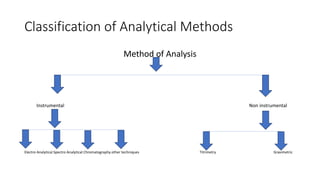
Classification of Analytical Methods
Method of Analysis
Instrumental Non instrumental
Electro Analytical Spectro Analytical Chromatography other techniques Titrimetry Gravimetric
Classical Methods
Gravimetric Methods
Include determination of mass of analyte or some compounds produce
from analyte
Titrimetric Methods
Include the determination of the volume or weight of standard of
standard reagent required to react completely
Classical Methods
Advantages
 Procedures are accurate and Simple
 The equipment needed is cheap
 Methods are absolute
 Specialized training is usually not required
Limitation
 Chemical environment is critical
 There is a lack of versatility
 Accuracy decreased with decreased amount
 Procedure is time consuming
Instrumental Methods
Electro Analytical methods
• Modification of chemical methods
• In which the reaction progress and end point are determined by electric measurement
Spectro analytical method
• They give results in the form of an interpretable spectrum
Chromatographic Method
• Used for the determination of complex mixtures or mixture of components by separating them
into individuals
Other method
• RIA, ELISA
Instrumental Methods
Advantages
1. Small amount of samples are required for analysis
2. High sensitivity is obtained
3. Measurements obtained are reliable
4. The determination is very fast
5. Even complex samples can be handled esily
Instrumental Methods
Limitations
1. An initial calibration is needed
2. Final accuracy is often in the region of +_5%
3. Initial cost and upkeep of complex equipment is high
4. Concentration range is limited
5. Sizeable space is usually required
6. Specialization training is needed

Pharmaceutical Analysis.pptx

  • 1.
    Pharmaceutical Analysis By Mr. LokeshMahajan Assistant Professor The Royal Gondwana College of Pharmacy M. Pharm (Pharmaceutical Chemistry)
  • 2.
    Definition • Pharmaceutical Analysisis a branch of science, which deals with the qualitative, quantitative and semi- quantitative estimation of given pharmaceutical sample. • It is of prime importance to gain information about the qualitative and quantitative composition of substances and chemical species, that is , to find out what.
  • 3.
    Types of Analysis Qualitativeanalysis • It may be define as “which analyte present in the given sample” Quantitative Analysis • It may be define as “How much amount of analyte present in the given sample” Semi- quantitative Analysis • It is the type of analysis which only describe whether the quantity of impurity present in given sample is below or above the specified limit such as limit tests
  • 4.
    Scope of Analysis 1)Biological sample estimation 2) Food determination 3) Dairy product estimation 4) Soil study 5) Forensic determination 6) Pesticide estimation in food and vegetable 7) Environmental pollutant determination
  • 5.
    Classification of AnalyticalMethods Method of Analysis Instrumental Non instrumental Electro Analytical Spectro Analytical Chromatography other techniques Titrimetry Gravimetric
  • 6.
    Classical Methods Gravimetric Methods Includedetermination of mass of analyte or some compounds produce from analyte Titrimetric Methods Include the determination of the volume or weight of standard of standard reagent required to react completely
  • 7.
    Classical Methods Advantages  Proceduresare accurate and Simple  The equipment needed is cheap  Methods are absolute  Specialized training is usually not required Limitation  Chemical environment is critical  There is a lack of versatility  Accuracy decreased with decreased amount  Procedure is time consuming
  • 8.
    Instrumental Methods Electro Analyticalmethods • Modification of chemical methods • In which the reaction progress and end point are determined by electric measurement Spectro analytical method • They give results in the form of an interpretable spectrum Chromatographic Method • Used for the determination of complex mixtures or mixture of components by separating them into individuals Other method • RIA, ELISA
  • 9.
    Instrumental Methods Advantages 1. Smallamount of samples are required for analysis 2. High sensitivity is obtained 3. Measurements obtained are reliable 4. The determination is very fast 5. Even complex samples can be handled esily
  • 10.
    Instrumental Methods Limitations 1. Aninitial calibration is needed 2. Final accuracy is often in the region of +_5% 3. Initial cost and upkeep of complex equipment is high 4. Concentration range is limited 5. Sizeable space is usually required 6. Specialization training is needed