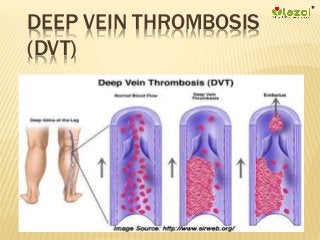
"When a blood clot is formed in a deep vein, often in
the leg, the condition is termed as deep vein
thrombosis (DVT). The other name of the condition is
deep venous thrombosis.
WHAT IS DEEPVEIN THROMBOSIS (DVT)?
Deep vein thrombosis occurs when a blood clot forms deep
inside a part of the body.
Deep vein thrombosis can typically form in the thigh and lower
leg, but sometimes it can form in the arm and pelvis area.
Deep vein thrombosis itself is not dangerous, but it can be life-
threatening when the piece of the blood clot breaks of and travel
through the circulating system known as embolism reaching to
the heart and pulmonary artery and getting lodged there.
This can prevent blood from flowing properly through the lung and
decreasing the amount of oxygen absorbed and distributed back
to the body which is known as pulmonary embolism.
Embolism can travel and get lodged in any part of the body in
heart, lungs, brain or any other area.
3.
CAUSES OF DEEPVEIN THROMBOSIS:
Prolonged travel or sitting, such as of long airplane,
car or train travel.
Thrombophilia-An abnormality in blood coagulation
that increases the risk of blood thrombosis.
Venous statis-An condition of slow blood flow in the
vein, usually in the legs, which can cause thrombosis
in legs.
Surgery can lead to high risk of deep vein thrombosis
and mainly surgery in the lower extremist such as
that of knee replacement surgery.
Pregnancy-Change in the level of the hormones, and
slower blood flow as the uterus expands increase the
risk of DVT.
4.
RISK FACTORS OFDVT:
Adults above the age of 60 are mostly at the
highest risk of having DVT.
Having an injury that damages the veins
Being overweight, which puts more pressure
on the veins of the legs and pelvis
Having a family history of DVT
Having a catheter placed in a vein
Taking birth control pills or undergoing
hormone therapy
smoking (especially heavy usage)
5.
SYMPTOMS OF DVT:
Swelling of foot, ankle, or leg, usually on
one side
Cramping pain in the affected leg
Severe, unexplained pain in your foot and
ankle
An area of skin that feels warmer than the
skin on the surrounding areas
Skin over the affected area turning pale or a
reddish or bluish color
6.
DIAGNOSIS OF DVT:
The primary test for the diagnosis is done by a
physical test.
The two foremost technique needed for the diagnosis
of DVT are:
D-dimer blood test -D-dimer is a blood test that may
be used as a screening test to determine if a blood
clot exists. A positive test may not mean a DVT is
present. Any blood clot will give positive results.
Ultrasonography-It is the standard method to
determine DVT.USG would be able to show different
DVT in any part of the body. But clot in chest or pelvis
may not be identified by Ultrasound.
7.
CONTINUE: DIAGNOSIS OFDVT:
There are other certain blood tests which can show an
increase chance in blood clot. They are-
Activated protein C resistance (checks for the Factor V
Leiden mutation)
Antithrombin levels
Antiphospholipid antibodies
Complete blood count (CBC
Genetic testing to look for mutations that make you more
likely to develop blood clots, such as the prothrombin
G20210A mutation
Lupus anticoagulant
Protein C and protein S levels
8.
TREATMENTS OF DVT:
Medication-Anticoagulants prevent further formation of
blood clot and can stop an embolus to reach to lungs or
other part of the body.
Heparin-It is an anticoagulant and it may be given
depending on the history and severity of the patient.
Warfarin-A blood thinning drug is given with heparin,
which blocks blood clotting factors.
Pressure stocking- A pressure stocking improves blood
flow in your legs and reduces your risk for complications
from blood clots.
Filters-If any patient is not able to take blood thinners, the
filters can be placed inside the vena cava, this prevents
pulmonary embolism by preventing the blood from
entering into the lungs. This is often placed after surgery.
9.
CONNECT WITH US
Logonto
www.lazoi.com
Like us on facebook
https://www.facebook.com/LazoiTheLife
Follow us on Twitter
https://twitter.com/lazoithelife
Follow us on Pinterest
https://in.pinterest.com/lazoithe