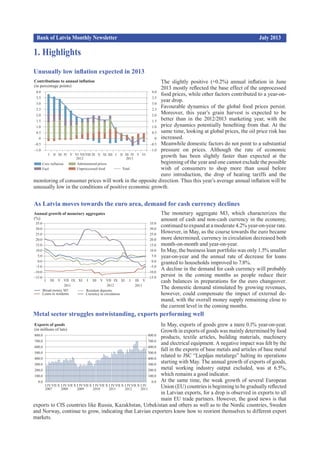
The slightly positive (+0.2%) annual inflation in June
2013 mostly reflected the base effect of the unprocessed
food prices, while other factors contributed to a year-on-
year drop.
Favourable dynamics of the global food prices persist.
Moreover, this year’s grain harvest is expected to be
better than in the 2012/2013 marketing year, with the
price dynamics potentially benefiting from that. At the
same time, looking at global prices, the oil price risk has
increased.
Meanwhile domestic factors do not point to a substantial
pressure on prices. Although the rate of economic
growth has been slightly faster than expected at the
beginning of the year and one cannot exclude the possible
wish of consumers to shop more than usual before
euro introduction, the drop of heating tariffs and the
monitoring of consumer prices will work in the opposite direction. Thus this year’s average annual inflation will be
unusually low in the conditions of positive economic growth.
1. Highlights
Bank of Latvia Monthly Newsletter				 		 July 2013
In May, exports of goods grew a mere 0.1% year-on-year.
Growth in exports of goods was mainly determined by food
products, textile articles, building materials, machinery
and electrical equipment. A negative impact was felt by the
fall in the exports of base metals and articles of base metal
related to JSC “Liepājas metalurgs” halting its operations
starting with May. The annual growth of exports of goods,
metal working industry output excluded, was at 6.5%,
which remains a good indicator.
At the same time, the weak growth of several European
Union (EU) countries is beginning to be gradually reflected
in Latvian exports, for a drop is observed in exports to all
main EU trade partners. However, the good news is that
exports to CIS countries like Russia, Kazakhstan, Uzbekistan and others as well as to the Nordic countries, Sweden
and Norway, continue to grow, indicating that Latvian exporters know how to reorient themselves to different export
markets.
Unusually low inflation expected in 2013
Metal sector struggles notwistanding, exports performing well
The monetary aggregate M3, which characterizes the
amount of cash and non-cash currency in the economy,
continued to expand at a moderate 4.2% year-on-year rate.
However, in May, as the course towards the euro became
more determined, currency in circulation decreased both
month-on-month and year-on-year.
In May, the business loan portfolio was only 1.5% smaller
year-on-year and the annual rate of decrease for loans
granted to households improved to 7.8%.
A decline in the demand for cash currency will probably
persist in the coming months as people reduce their
cash balances in preparations for the euro changeover.
The domestic demand stimulated by growing revenues,
however, could compensate the impact of external de­
mand, with the overall money supply remaining close to
the current level in the coming months.
As Latvia moves towards the euro area, demand for cash currency declines
2. Macroeconomic Data
Reporting
period
Data (%)
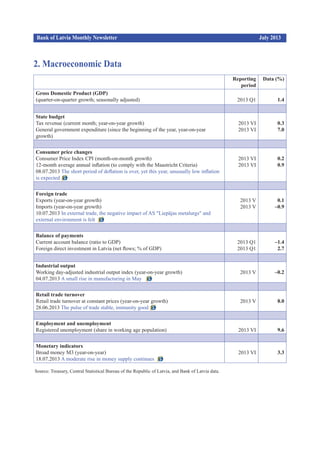
Gross Domestic Product (GDP)
(quarter-on-quarter growth; seasonally adjusted) 2013 Q1 1.4
State budget
Tax revenue (current month; year-on-year growth)
General government expenditure (since the beginning of the year, year-on-year
growth)
2013 VI
2013 VI
0.3
7.0
Consumer price changes
Consumer Price Index CPI (month-on-month growth)
12-month average annual inflation (to comply with the Maastricht Criteria)
08.07.2013 The short period of deflation is over, yet this year, unusually low inflation
is expected
2013 VI
2013 VI
0.2
0.9
Foreign trade
Exports (year-on-year growth)
Imports (year-on-year growth)
10.07.2013 In external trade, the negative impact of AS "Liepājas metalurgs" and
external environment is felt
2013 V
2013 V
0.1
–0.9
Balance of payments
Current account balance (ratio to GDP)
Foreign direct investment in Latvia (net flows; % of GDP)
2013 Q1
2013 Q1
–1.4
2.7
Industrial output
Working day-adjusted industrial output index (year-on-year growth)
04.07.2013 A small rise in manufacturing in May
2013 V –0.2
Retail trade turnover
Retail trade turnover at constant prices (year-on-year growth)
28.06.2013 The pulse of trade stable, immunity good
2013 V 8.0
Employment and unemployment
Registered unemployment (share in working age population) 2013 VI 9.6
Monetary indicators
Broad money M3 (year-on-year)
18.07.2013 A moderate rise in money supply continues
2013 VI 3.3
Source: Treasury, Central Statistical Bureau of the Republic of Latvia, and Bank of Latvia data.
Bank of Latvia Monthly Newsletter				 		 July 2013
3. In Focus
Bank of Latvia Monthly Newsletter				 		 July 2013
Latvia to join the euro area as of January 2014
With the ECOFIN decision of 9 July Latvia has been invited to join the euro area as its 18th full-fledged
member on 1 January 2014. The current exchange rate of the lats to the euro, set by the Bank of Latvia
already in 2005, i.e. 0.702804, has been approved to be the irrevocably fixed exchange rate for the euro
changeover. Consequently, as the Bank of Latvia has already notified before, the changeover to the euro
as of 1 January 2014 will be based on the cur­rent exchange rate of the lats to the euro.
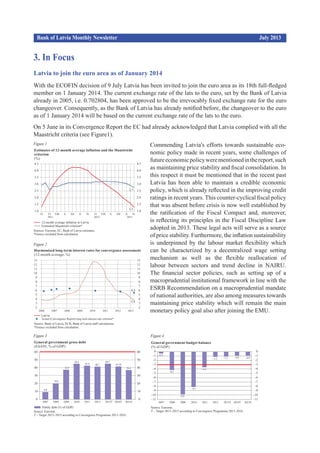
On 5 June in its Convergence Report the EC had al­ready acknowledged that Latvia complied with all the
Maastricht criteria (see Figure1).
Commending Latvia's efforts towards sustainable eco­
nomic policy made in recent years, some chal­lenges of
futureeconomicpolicywerementionedinthereport,such
as maintaining price stability and fiscal consolidation. In
this respect it must be men­tioned that in the recent past
Latvia has been able to maintain a credible economic
policy, which is al­ready reflected in the improving credit
ratings in recent years. This counter-cyclical fiscal policy
that was absent before crisis is now well established by
the ratification of the Fiscal Compact and, moreover,
is reflecting its principles in the Fiscal Discipline Law
adopted in 2013. These legal acts will serve as a source
of price stability. Furthermore, the infla­tion sustainability
is underpinned by the labour market flexibility which
can be characterized by a de­centralized wage setting
mechanism as well as the flexible reallocation of
labour between sectors and trend decline in NAIRU.
The financial sector po­licies, such as setting up of a
macroprudential insti­tutional framework in line with the
ESRB Re­com­mendation on a macroprudential mandate
of national authorities, are also among measures towards
maintaining price stability which will re­main the main
monetary policy goal also after joining the EMU.
Figure 3 Figure 4
Figure 2
Figure 1

Monthly Newsletter 7/2013

  • 2.
    The slightly positive(+0.2%) annual inflation in June 2013 mostly reflected the base effect of the unprocessed food prices, while other factors contributed to a year-on- year drop. Favourable dynamics of the global food prices persist. Moreover, this year’s grain harvest is expected to be better than in the 2012/2013 marketing year, with the price dynamics potentially benefiting from that. At the same time, looking at global prices, the oil price risk has increased. Meanwhile domestic factors do not point to a substantial pressure on prices. Although the rate of economic growth has been slightly faster than expected at the beginning of the year and one cannot exclude the possible wish of consumers to shop more than usual before euro introduction, the drop of heating tariffs and the monitoring of consumer prices will work in the opposite direction. Thus this year’s average annual inflation will be unusually low in the conditions of positive economic growth. 1. Highlights Bank of Latvia Monthly Newsletter July 2013 In May, exports of goods grew a mere 0.1% year-on-year. Growth in exports of goods was mainly determined by food products, textile articles, building materials, machinery and electrical equipment. A negative impact was felt by the fall in the exports of base metals and articles of base metal related to JSC “Liepājas metalurgs” halting its operations starting with May. The annual growth of exports of goods, metal working industry output excluded, was at 6.5%, which remains a good indicator. At the same time, the weak growth of several European Union (EU) countries is beginning to be gradually reflected in Latvian exports, for a drop is observed in exports to all main EU trade partners. However, the good news is that exports to CIS countries like Russia, Kazakhstan, Uzbekistan and others as well as to the Nordic countries, Sweden and Norway, continue to grow, indicating that Latvian exporters know how to reorient themselves to different export markets. Unusually low inflation expected in 2013 Metal sector struggles notwistanding, exports performing well The monetary aggregate M3, which characterizes the amount of cash and non-cash currency in the economy, continued to expand at a moderate 4.2% year-on-year rate. However, in May, as the course towards the euro became more determined, currency in circulation decreased both month-on-month and year-on-year. In May, the business loan portfolio was only 1.5% smaller year-on-year and the annual rate of decrease for loans granted to households improved to 7.8%. A decline in the demand for cash currency will probably persist in the coming months as people reduce their cash balances in preparations for the euro changeover. The domestic demand stimulated by growing revenues, however, could compensate the impact of external de­ mand, with the overall money supply remaining close to the current level in the coming months. As Latvia moves towards the euro area, demand for cash currency declines
  • 3.
    2. Macroeconomic Data Reporting period Data(%) Gross Domestic Product (GDP) (quarter-on-quarter growth; seasonally adjusted) 2013 Q1 1.4 State budget Tax revenue (current month; year-on-year growth) General government expenditure (since the beginning of the year, year-on-year growth) 2013 VI 2013 VI 0.3 7.0 Consumer price changes Consumer Price Index CPI (month-on-month growth) 12-month average annual inflation (to comply with the Maastricht Criteria) 08.07.2013 The short period of deflation is over, yet this year, unusually low inflation is expected 2013 VI 2013 VI 0.2 0.9 Foreign trade Exports (year-on-year growth) Imports (year-on-year growth) 10.07.2013 In external trade, the negative impact of AS "Liepājas metalurgs" and external environment is felt 2013 V 2013 V 0.1 –0.9 Balance of payments Current account balance (ratio to GDP) Foreign direct investment in Latvia (net flows; % of GDP) 2013 Q1 2013 Q1 –1.4 2.7 Industrial output Working day-adjusted industrial output index (year-on-year growth) 04.07.2013 A small rise in manufacturing in May 2013 V –0.2 Retail trade turnover Retail trade turnover at constant prices (year-on-year growth) 28.06.2013 The pulse of trade stable, immunity good 2013 V 8.0 Employment and unemployment Registered unemployment (share in working age population) 2013 VI 9.6 Monetary indicators Broad money M3 (year-on-year) 18.07.2013 A moderate rise in money supply continues 2013 VI 3.3 Source: Treasury, Central Statistical Bureau of the Republic of Latvia, and Bank of Latvia data. Bank of Latvia Monthly Newsletter July 2013
  • 4.
    3. In Focus Bankof Latvia Monthly Newsletter July 2013 Latvia to join the euro area as of January 2014 With the ECOFIN decision of 9 July Latvia has been invited to join the euro area as its 18th full-fledged member on 1 January 2014. The current exchange rate of the lats to the euro, set by the Bank of Latvia already in 2005, i.e. 0.702804, has been approved to be the irrevocably fixed exchange rate for the euro changeover. Consequently, as the Bank of Latvia has already notified before, the changeover to the euro as of 1 January 2014 will be based on the cur­rent exchange rate of the lats to the euro. On 5 June in its Convergence Report the EC had al­ready acknowledged that Latvia complied with all the Maastricht criteria (see Figure1). Commending Latvia's efforts towards sustainable eco­ nomic policy made in recent years, some chal­lenges of futureeconomicpolicywerementionedinthereport,such as maintaining price stability and fiscal consolidation. In this respect it must be men­tioned that in the recent past Latvia has been able to maintain a credible economic policy, which is al­ready reflected in the improving credit ratings in recent years. This counter-cyclical fiscal policy that was absent before crisis is now well established by the ratification of the Fiscal Compact and, moreover, is reflecting its principles in the Fiscal Discipline Law adopted in 2013. These legal acts will serve as a source of price stability. Furthermore, the infla­tion sustainability is underpinned by the labour market flexibility which can be characterized by a de­centralized wage setting mechanism as well as the flexible reallocation of labour between sectors and trend decline in NAIRU. The financial sector po­licies, such as setting up of a macroprudential insti­tutional framework in line with the ESRB Re­com­mendation on a macroprudential mandate of national authorities, are also among measures towards maintaining price stability which will re­main the main monetary policy goal also after joining the EMU. Figure 3 Figure 4 Figure 2 Figure 1