GAS INSTALLATION
Submitted by
Kushagra Goel
INTRODUCTION
In this topic we are going to learn about the two gases which are used in the household and
commercial purposes:
■ Biogas
– Biogas plant
–Types of biogas plant
– Locations
■ LPG
– Source
– Equipment
– Location of equipment
And how the same are transferred to the desired location and the requirements needed to be
fulfilled to do the same
BIOGAS
Now the biogas is a naturally produced gas from organic materials like dung, stale food etc.The
gas requires a biogas plant to be produced. Biogas plant is either connected to a rubber pipe or
a steel pipe (as in PNG) to carry gas to desired place.
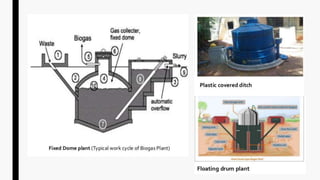
The plant are of 3 types:
■ Fixed dome:This type is made up of bricks, cement mortar, concrete (30mm aggregate).All
slabs are of 10 cm thickness.
■ Floating drum:The top part of the plant is a steel drum placed over the well. It delivers a
constant gas pressure.
■ Plastic covered ditch:This is the small version of the floating drum and is made up of plastic.
It doesn’t requires a well to be dug.
The biogas plant is always kept outside at the rear end of the premises. It should be away from
the traffic areas.
TERMINOLOGY
■ APPLIANCEVALVE—A device that will shut-off the gas supply to the bumer(s).
■ APPROVEDAGENCY — Person or agency or a corporate body approved by
competent authority or distribution company to execute the job of designing, erection
and maintenance of multi cylinder installation.
■ AUTHORITY HAVING JURISDICTION—TheAuthority which has been created by a
statute and which, for the purpose of administering the Code/Part, may authorize a
committee or an official to act on its behalf; hereinafter called the ‘Authority’.
■ COMPETENTAUTHORITY—TheAuthority designated or otherwise recognized under
Gas Cylinder Rules, 2004 for approving LPG cylinders, valves and regulators.
■ CUSTOMER’S/CONSUMER’SCONNECTION — Piping tapped on riser to supply each
individual customer/ consumer.
TERMINOLOGY
■ PRESSURE REGULATOR—A device designed to lower the pressure of gas coming from
the distribution mam and to maintain it practically constants downstream.This normal
operation pressure shall be practically in all cases that of the gas appliances used.
■ PURGE —To free a gas conduit of air or gas or a mixture of gas and air.
■ DISTRIBUTION/DISTRIBUTING COMPANY —The company which is in the field of
marketing LPG and PNG, and is the owner of LPG cylinders.
■ GAS FITTER — A qualified personnel of the authorized gas supplying organization.
■ INSTALLATION —A designated premises in an establishment where the complete multi-
cylinder- system comprising cylinder, piping manifold, vaporizers, etc, is installed.
■ MANIFOLD — A pipe header provided with several opening to which the cylinders are
connected by using suitable pipe fittings.
■ PILOT—A small flame which is utilized to ignite the gas at the main bumer(s).
TERMINOLOGY
■ QUALIFIED INSTALLING AGENCY — An individual, firm or agency which either in person
or through a representative is engaged in and is responsible for the installation or
replacement of gas piping on the outlet side of the gas meter, or the connection,
installation or repair of gas supply piping and appliances within a building, and who is
experienced in such work, familiar with all precautions required, and who has complied
with all the requirements as to qualification, registration, licensing, etc., of the Authority.
■ RISER — Piping usually vertical on most of its length that supplies gas from the service to
the various storeys of the building.
■ SERVICE PIPE — Pipe that runs between the distribution main in the street and the riser in
the case of multistoried building or the meter in the case of an individual house.
■ SERVICE SHUT-OFFVALVE (ISOLATION VALVE) — A device installed outside the
premises to cut-off the main supply of gas from pipeline by the supplier.
■ VENT PIPE — A safety device to which certain regulators are connected to evacuate
outside gas that may escape from the normal circuit when some part of system gets
damaged or malfunctions or a safety valve is open.
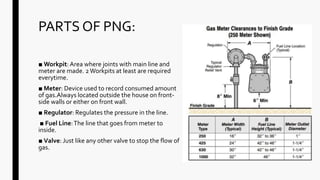
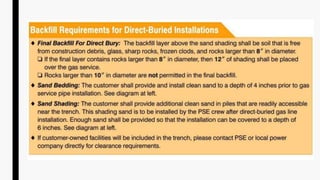
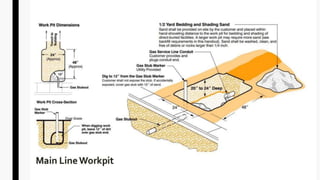
PARTS OF PNG:
■ Workpit: Area where joints with main line and
meter are made. 2 Workpits at least are required
everytime.
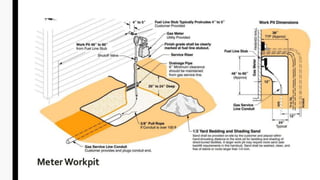
■ Meter: Device used to record consumed amount
of gas.Always located outside the house on front-
side walls or either on front wall.
■ Regulator: Regulates the pressure in the line.
■ Fuel Line:The line that goes from meter to
inside.
■ Valve: Just like any other valve to stop the flow of
gas.
PRESSURE REGULATIONS
■ Pressure regulation is required to economize the sizing of piping system.
■ The pressure regulators to be used can be from 400 kN/m2 upstream pressure to 2.1
kN/m2 for domestic consumers
■ For commercial consumers 10 kN/m2, 30 kN/m2, 200 kN/m2
IF LOCATED INSIDE A BUILDING,THE REQUIRED REGULATOR
SHALL COMPLY WITHTHE FOLLOWING:
■ If any of the diaphragms of the regulator ruptures, the gas shall be sent to an outlet vent
pipe made of brass or plastic in order to ventilate or drain the gas out of the building.The
vent pipe will, however, lead to outer air about 1 m above the topmost storey of the
building. Means shall be employed to prevent water from entering this pipe and also to
prevent stoppage of it by insects or other foreign bodies.
■ b) If the gas pressure at the outlet of the regulator falls below 50 percent of the operating
gas pressure o rrises above twice the operating gas pressure, the gas input to the pressure
regulator shall be cut off.
■ c) In the event of malfunctioning of this safety device, a supplementary device shall
connect the low pressure circuit to the outlet circuit (vent pipe) as soon as the exit pressure
reaches 7 kN/m2.
SERVICE SHUT-OFFVALVES
■ Service shut-off valves shall be installed on all new services including replacements in a readily
accessible location.
■ Service shut-off valves shall be located upstream of the meter if there is no regulator or upstream of
the regulator, if there is one.
■ Service shut-off valves shall be located in the upstream of the meter, if a single regulator is supplying
more than one consumer and each such stream shall have one additional shut-off valve upstream of
regulator.
■ All gas services operating at pressure greater than 7 kN/m2 shall be equipped with an approved
service shut-off valve located on the service pipe outside the building.
■ Underground shut-off valves shall be located in a covered durable curb box, manhole, vault or stand
pipe which is designed to pennit ready operation of the valve and the covers of which shall be clearly
marked ‘Gas’.
INSTALLATION OF GAS PIPES
PIPING
■ Piping shall be of wrought iron, steel, copper, stainless steel or cast iron when the gas
pressure is less than 7 kN/m2; with higher gas pressure use of cast iron shall be
prohibited.
■ SS 316/304/321 and flexible PE coated flexible pipe in rolls shall be permitted in low
pressure system provided the pipe meets the required standard, to avoid the bends,
fittings and leakages from the joint which are potential leakage points.
■ Heavy rubber flexible tube shall be permitted only as direct connection to burner from
appliance valve.
SIZE OF GAS PIPING
■ Allowable loss in pressure from meter or service regulator, when a meter is not provided, to
appliance;
■ Maximum consumption to be provided;
■ Length of piping and number of fittings; and
■ Specific gravity of gas.
■ No gas pipe smaller than 8 mm shall be used.
■ As far as possible, straight lengths of piping should be used.Where there are bends in the
pipe line, these should have a radius of at least five times the diameter of the pipe.
■ For any thread joint proper sealant shall be used on male threads only.
■ The gas piping shall be of the colour stipulated by explosive authority to distinguish it from
other piping and the piping shall be painted silver grey with red band of 150 mm width.
■ The gas pipeline shall be painted canary yellow in case of natural gas.
PIPING UNDERGROUND
PROTECTION OF PIPING
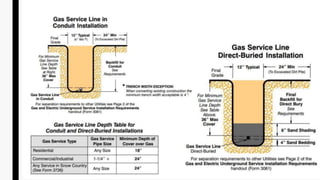
■ Piping shall be buried to a minimum depth of 1 m or covered in a manner so as to protect the piping
from physical damage.
PROTECTIONAGAINST CORROSION
■ Generally all the piping within the premises where it has to run on the wall shall be exposed and
should not be in contact with wall to ensure that no corrosion takes place.
■ Epoxy sealant or polyethylene conduit shall be used to ensure no contact of pipe with the wall in the
situation of pipe crossing the wall.
■ Underground or concealed gas pipeline in contact with earth or other materials which may corrode
the piping shall be protected against corrosion by application of adequate corrosion resistant coating
backed up by cathodic protection system.
■ The building shall not be weakened by the installation of any gas piping.
■ Gas piping in building shall be supported with pipe hooks, metal pipe straps, bonds or hangers
suitable for the size of piping and of adequate strength and quality and located at proper intervals so
that the piping may not be moved accidentally from the installed position.
PROHIBITED DEVICES
■ No device shall be placed inside the gas piping or fittings that will reduce the cross-sectional area or
otherwise obstruct the free flow of gas.
■ Piping shall be electrically continuous throughout its length and properly earthed except in stretches
where cathodic protection system is used for protection against corrosion. It shall not, however, be
used to earth any electrical equipment.
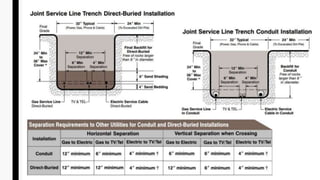
■ The distance between gas piping and electrical wiring system shall be at least 60 mm and, where
necessary, they shall be securely fixed to prevent contact due to movement.The gas piping should
run above the electrical wiring.The distance between the gas piping and steam piping, if running
parallel, shall be at least 150 mm.The gas piping should preferably run below the steam piping.
■ Piping installation shall be thoroughly gastight.
■ Smoking shall not be permitted when working on piping which contains or has contaminated gas.
■ Meters shall be installed in such a way that there shall be no load transfer from the pipeline to the
inlet/ outlet of the meter and shall be easily accessible.
INSPECTIONOF SERVICES
TEST OF PIPING FORTIGHTNESS
■ The piping shall stand a pressure of at least 20 kN/m2 measured with a manometer or
slope gauge, for a period of not less than 10 min without showing any drop in pressure.
■ 9When the gas pressure exceeds 7 kN/m2, the piping shall withstand a pressure of 0.6
MN/m2 for 4 h (this test is For piping designed for working pressure less than 0.4
MN/m2).
■ The Authority shall, within a reasonable time after being requested to do so, inspect
and test a system of gas piping that is ready for such inspection and test, and if the
work is found satisfactory and test requirements are complied with, it shall issue the
certificate.
Guidelines for Pipeline Inside Premise and/or
Kitchen of Individual Customer
■ The gas meter shall be installed in an area with adequate ventilation and at a proper location to
facilitate safe and convenient meter reading and maintenance activities in future.
■ A minimum ventilation area of 2 percent of the internal floor area of the room shall be provided in the
room where the gas meter is located.
■ In case pipe work is required to be laid in solid floors inside the kitchen, adequate provisions (in the
shortest possible route and a minimum of 75 mm screed to provide an approximate cover of at least
50 mm over the gas pipe) shall be provided to protect the pipeline against corrosion and failure
caused by movement.
■ Installation pipe work shall not be placed within the cavity of a cavity wall. Every pipe passing through
a cavity wall shall take the shortest possible practicable route and shall be sleeved.
■ In case of provision of sleeve, the same should be of a diameter that provides a sliding fit to the pipe
allowing normal pipe expansion/contraction.
LOCATION OF METER
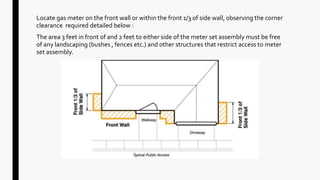
Locate gas meter on the front wall or within the front 1/3 of side wall, observing the corner
clearance required detailed below :
The area 3 feet in front of and 2 feet to either side of the meter set assembly must be free
of any landscaping (bushes , fences etc.) and other structures that restrict access to meter
set assembly.
Outside Corners
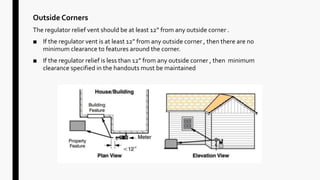
The regulator relief vent should be at least 12” from any outside corner .
■ If the regulator vent is at least 12” from any outside corner , then there are no
minimum clearance to features around the corner.
■ If the regulator relief is less than 12” from any outside corner , then minimum
clearance specified in the handouts must be maintained
INSIDE CORNER
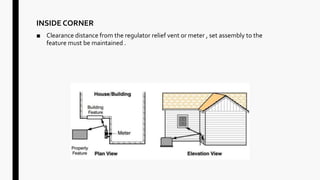
■ Clearance distance from the regulator relief vent or meter , set assembly to the
feature must be maintained .
WORKPIT
LIQUEFIED PETROLEUM GAS (LPG)
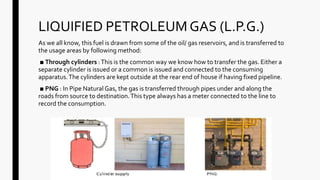
LIQUIFIED PETROLEUM GAS (L.P.G.)
As we all know, this fuel is drawn from some of the oil/ gas reservoirs, and is transferred to
the usage areas by following method:
■ Through cylinders :This is the common way we know how to transfer the gas. Either a
separate cylinder is issued or a common is issued and connected to the consuming
apparatus.The cylinders are kept outside at the rear end of house if having fixed pipeline.
■ PNG : In Pipe Natural Gas, the gas is transferred through pipes under and along the
roads from source to destination.This type always has a meter connected to the line to
record the consumption.
GENERAL RECOMMENDATIONS
■ Those responsible for the installation of cylinders, equipment and piping should
understand the characteristics of LPG and be trained in good practice of
handling, installing and maintaining installations.
■ The jointing compound used at different joints in the system shall be decided by
the Qualified InstallingAgency. Hemp and similar materials shall not be used at
the joint.
■ In any joint in which the thread provides a gastight seal jointing compound shall
be used only on the male thread.
■ Fire extinguishers of dry powder type or carbon dioxide type conforming to
accepted standards shall be provided in places where LPG cylinder installations
are situated and shall be located near such installations.
■ Two buckets filled with sand and two with water shall also be installed nearby.
■ The number, type and size of the fire extinguishers shall be as follows:
CYLINDER LOCATION
STATIONARY INSTALLATIONS
a) Stationary installation not exceeding 50 kg of LPG may be installed indoors on any floor.
b) Stationary installations each not exceeding 50 kg of LPG may be installed indoors on any floor and within the same workspace
provided the minimum distance between two such installations is 3 m, the proportion of such installations to floor area is one
installation per 5 m2 and the aggregate quantity' of gas of all such installations does not exceed 200 kg.
c) Stationary installation not exceeding 100 kg of LPG may be installed indoors on any floor provided the floor area for such an
installation is not less than 12 m2.
d) Stationary installations each not exceeding 100 kg of LPG may be installed indoors on any floor and within the same
workspace provided the minimum distance between two such installations is 3 m, the proportion of such installations to floor
area is one installation per 12 m2 and the aggregate quantity of gas of all such installations does not exceed 200 kg.
e) Stationary installation not exceeding 400 kg of LPG may be installed indoors in an enclosed section of a building or a room
reserved exclusively for this purpose and ventilated at low level directly to the outside air.
f) Stationary installations above 400 kg [200 kg in case provision as in (e) is not possible] but not exceeding 1 000 kg shall be
installed outdoors on ground floor level only. A minimum distance of 3 m shall be maintained between an installation and any
building, public place, roadways, and other surroundings.The installation shall be protected from excessive weathering by sun,
rain, etc., and from tampering by unauthorized persons. A lean-to roof with expanded metal on angle-iron framework on the
sides is considered suitable for this purpose. In any case, adequate ventilation at ground level to the outside air shall be provided.
g) If the storage per installation is more than 1 000 kg, installations in multiples of 1 000 kg with
manifold, safety devices, change over mechanism may be provided with minimum inter
distance of 3 m from all sides.Total number of such installations shall not exceed 4 including
stand by installation. If more than two installations are used, then number of cylinders per
installations should not exceed 30.
h) For storage installations of 1 000 kg or installations in multiple of 1 000 kg the number of
cylinders to be connected per manifold shall not exceed 15 and for each 1000 kg installation
two such manifolds shall be provided.
j) Cylinders shall be installed upright with the valves uppermost.
k) Cylinder containing more than 20 kg of gas shall not be located on floors above ground level.
m) Cylinders shall be located on a concrete or brick floor, preferably raised in case of outdoor
installations.
n) In order to prevent the hazardous collection of gas, cylinders shall be placed at least 1 m
away from culverts, depressions, or openings leading to below ground level compartment and
drains.
p) Cylinders which have safety relief valves or similar devices incorporated in them shall be so
positioned so that if the relief device operates, escaping gas is not hazardous. e a minimum
floor area of 5 m2 for such an installation.
PORTABLE INSTALLATIONS
a)The sum total of capacity of the cylinders connected to each manifold shall not exceed
100 kg of LPG.The total quantity of gas thus installed in a workspace shall not exceed 200
kg.
b) If cylinders are mounted on a trolley, the trolley shall be stable.Where necessary, the
cylinders shall be secured to prevent them from falling.
c)The regulator shall be connected directly to the cylinder valve or to a manifold which
shall be connected to the cylinder valves by means of rigid connections to give adequate
support to the regulator.The only exception to this requirement is where cylinders are
mounted on a trolley and the manifold is rigidly supported on the trolley. In such a case
flexible or semi-flexible connections may be used between the cylinder valves and the
manifold but not between the manifold and the regulator.
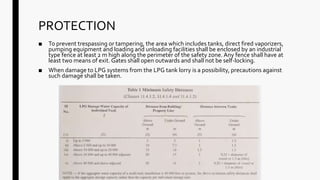
PROTECTION
■ To prevent trespassing or tampering, the area which includes tanks, direct fired vaporizers,
pumping equipment and loading and unloading facilities shall be enclosed by an industrial
type fence at least 2 m high along the perimeter of the safety zone. Any fence shall have at
least two means of exit. Gates shall open outwards and shall not be self-locking.
■ When damage to LPG systems from the LPG tank lorry is a possibility, precautions against
such damage shall be taken.
Underground tanks shall be protected from above ground loading by providing a suitable curb to prevent
a possible accidental damage to the tank and its fittings by LPG tank lorry.
GRASS AND WEED REMOVAL
■ Road ignitable material, such as weeds, long grass or any combustible material shall be removed from
an area within 3 m from the shell of any LPG tank of up to 2 000 liter water capacity, and within 6 m
from the shell of larger tanks. If weed killers are used, chemicals which are a potential source of fire
hazard shall not be selected for this purpose.
WARNING SIGNS
■ No smoking or naked flames shall be permitted within the safety zone of the installation. Prominent
notices to this effect shall be posted at access point. From accessibility point of view, the signs shall
be in accordance with 13 of Part 3 ‘Development Control Rules and General Building Requirements’ of
theCode.
FIRE PROTECTION
■ The possibility of a major fire outbreak, leading to direct flame impingement of the storage tank, shall
be minimized by sound engineering in plant design and layout, good operating practice, and proper
education and training of personnel on both routine operations and on action to be taken in an
emergency.
WATER SUPPLY
■ Provision shall be made for an adequate supply of water and fire protection in the
storage area according to the local hoses and mobile equipment, fixed monitors or by
fixed spray systems which may be automatic. Control of water flow should be possible
from outside any danger area.
FIRE EXTINGUISHERS
■ At least two dry chemical powder type fire extinguishers of 9 kg capacity each,
conforming to the quality requirements in accordance with the accepted standards
shall be installed at points of access to the storage installations.The fire extinguishers
shall be mounted keeping in view the ease of accessibility in accordance with good
practice
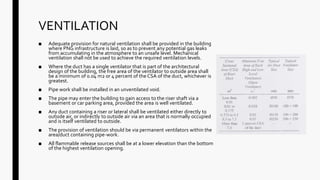
VENTILATION
■ Adequate provision for natural ventilation shall be provided in the building
where PNG infrastructure is laid, so as to prevent any potential gas leaks
from accumulating in the atmosphere to an unsafe level. Mechanical
ventilation shall not be used to achieve the required ventilation levels.
■ Where the duct has a single ventilator that is part of the architectural
design of the building, the free area of the ventilator to outside area shall
be a minimum of 0.04 m2 or 4 percent of the CSA of the duct, whichever is
greatest.
■ Pipe work shall be installed in an unventilated void.
■ The pipe may enter the building to gain access to the riser shaft via a
basement or car parking area, provided the area is well ventilated.
■ Any duct containing a riser or lateral shall be ventilated either directly to
outside air, or indirectly to outside air via an area that is normally occupied
and is itself ventilated to outside.
■ The provision of ventilation should be via permanent ventilators within the
area/duct containing pipe-work.
■ All flammable release sources shall be at a lower elevation than the bottom
of the highest ventilation opening.
VENTILATION
■ Pipes may run in the same duct (subject to availability of adequate clearance from other utilities
and ventilation) as most other services, including hot and cold water services, heating pipes,
electrical conduits and cables and pipes containing other fuels. However, the following services
shall not be installed in the same duct as gas pipes:
a)Ventilation ducts and vacuum pipes that operate at sub-atmospheric pressure and that are
not of all-welded or all-brazed construction; and
b) Services containing oxidizing or corrosive fluids.
■ There shall be provision for installing risers and laterals such that a minimum distance of 300 mm
is ensured from any electrical equipment or installations and associated excess current control
boxes of fuse boxes, and 25 mm is ensured from the electricity supply and distribution cables and
other metal piped services.
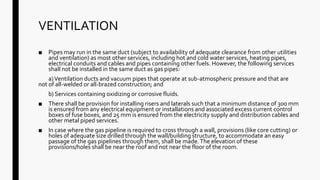
■ In case where the gas pipeline is required to cross through a wall, provisions (like core cutting) or
holes of adequate size drilled through the wall/building structure, to accommodate an easy
passage of the gas pipelines through them, shall be made.The elevation of these
provisions/holes shall be near the roof and not near the floor of the room.

Gas Installation

  • 1.
  • 2.
    INTRODUCTION In this topicwe are going to learn about the two gases which are used in the household and commercial purposes: ■ Biogas – Biogas plant –Types of biogas plant – Locations ■ LPG – Source – Equipment – Location of equipment And how the same are transferred to the desired location and the requirements needed to be fulfilled to do the same
  • 3.
    BIOGAS Now the biogasis a naturally produced gas from organic materials like dung, stale food etc.The gas requires a biogas plant to be produced. Biogas plant is either connected to a rubber pipe or a steel pipe (as in PNG) to carry gas to desired place. The plant are of 3 types: ■ Fixed dome:This type is made up of bricks, cement mortar, concrete (30mm aggregate).All slabs are of 10 cm thickness. ■ Floating drum:The top part of the plant is a steel drum placed over the well. It delivers a constant gas pressure. ■ Plastic covered ditch:This is the small version of the floating drum and is made up of plastic. It doesn’t requires a well to be dug. The biogas plant is always kept outside at the rear end of the premises. It should be away from the traffic areas.
  • 5.
    TERMINOLOGY ■ APPLIANCEVALVE—A devicethat will shut-off the gas supply to the bumer(s). ■ APPROVEDAGENCY — Person or agency or a corporate body approved by competent authority or distribution company to execute the job of designing, erection and maintenance of multi cylinder installation. ■ AUTHORITY HAVING JURISDICTION—TheAuthority which has been created by a statute and which, for the purpose of administering the Code/Part, may authorize a committee or an official to act on its behalf; hereinafter called the ‘Authority’. ■ COMPETENTAUTHORITY—TheAuthority designated or otherwise recognized under Gas Cylinder Rules, 2004 for approving LPG cylinders, valves and regulators. ■ CUSTOMER’S/CONSUMER’SCONNECTION — Piping tapped on riser to supply each individual customer/ consumer.
  • 6.
    TERMINOLOGY ■ PRESSURE REGULATOR—Adevice designed to lower the pressure of gas coming from the distribution mam and to maintain it practically constants downstream.This normal operation pressure shall be practically in all cases that of the gas appliances used. ■ PURGE —To free a gas conduit of air or gas or a mixture of gas and air. ■ DISTRIBUTION/DISTRIBUTING COMPANY —The company which is in the field of marketing LPG and PNG, and is the owner of LPG cylinders. ■ GAS FITTER — A qualified personnel of the authorized gas supplying organization. ■ INSTALLATION —A designated premises in an establishment where the complete multi- cylinder- system comprising cylinder, piping manifold, vaporizers, etc, is installed. ■ MANIFOLD — A pipe header provided with several opening to which the cylinders are connected by using suitable pipe fittings. ■ PILOT—A small flame which is utilized to ignite the gas at the main bumer(s).
  • 7.
    TERMINOLOGY ■ QUALIFIED INSTALLINGAGENCY — An individual, firm or agency which either in person or through a representative is engaged in and is responsible for the installation or replacement of gas piping on the outlet side of the gas meter, or the connection, installation or repair of gas supply piping and appliances within a building, and who is experienced in such work, familiar with all precautions required, and who has complied with all the requirements as to qualification, registration, licensing, etc., of the Authority. ■ RISER — Piping usually vertical on most of its length that supplies gas from the service to the various storeys of the building. ■ SERVICE PIPE — Pipe that runs between the distribution main in the street and the riser in the case of multistoried building or the meter in the case of an individual house. ■ SERVICE SHUT-OFFVALVE (ISOLATION VALVE) — A device installed outside the premises to cut-off the main supply of gas from pipeline by the supplier. ■ VENT PIPE — A safety device to which certain regulators are connected to evacuate outside gas that may escape from the normal circuit when some part of system gets damaged or malfunctions or a safety valve is open.
  • 8.
    PARTS OF PNG: ■Workpit: Area where joints with main line and meter are made. 2 Workpits at least are required everytime. ■ Meter: Device used to record consumed amount of gas.Always located outside the house on front- side walls or either on front wall. ■ Regulator: Regulates the pressure in the line. ■ Fuel Line:The line that goes from meter to inside. ■ Valve: Just like any other valve to stop the flow of gas.
  • 9.
    PRESSURE REGULATIONS ■ Pressureregulation is required to economize the sizing of piping system. ■ The pressure regulators to be used can be from 400 kN/m2 upstream pressure to 2.1 kN/m2 for domestic consumers ■ For commercial consumers 10 kN/m2, 30 kN/m2, 200 kN/m2
  • 10.
    IF LOCATED INSIDEA BUILDING,THE REQUIRED REGULATOR SHALL COMPLY WITHTHE FOLLOWING: ■ If any of the diaphragms of the regulator ruptures, the gas shall be sent to an outlet vent pipe made of brass or plastic in order to ventilate or drain the gas out of the building.The vent pipe will, however, lead to outer air about 1 m above the topmost storey of the building. Means shall be employed to prevent water from entering this pipe and also to prevent stoppage of it by insects or other foreign bodies. ■ b) If the gas pressure at the outlet of the regulator falls below 50 percent of the operating gas pressure o rrises above twice the operating gas pressure, the gas input to the pressure regulator shall be cut off. ■ c) In the event of malfunctioning of this safety device, a supplementary device shall connect the low pressure circuit to the outlet circuit (vent pipe) as soon as the exit pressure reaches 7 kN/m2.
  • 11.
    SERVICE SHUT-OFFVALVES ■ Serviceshut-off valves shall be installed on all new services including replacements in a readily accessible location. ■ Service shut-off valves shall be located upstream of the meter if there is no regulator or upstream of the regulator, if there is one. ■ Service shut-off valves shall be located in the upstream of the meter, if a single regulator is supplying more than one consumer and each such stream shall have one additional shut-off valve upstream of regulator. ■ All gas services operating at pressure greater than 7 kN/m2 shall be equipped with an approved service shut-off valve located on the service pipe outside the building. ■ Underground shut-off valves shall be located in a covered durable curb box, manhole, vault or stand pipe which is designed to pennit ready operation of the valve and the covers of which shall be clearly marked ‘Gas’.
  • 12.
  • 13.
    PIPING ■ Piping shallbe of wrought iron, steel, copper, stainless steel or cast iron when the gas pressure is less than 7 kN/m2; with higher gas pressure use of cast iron shall be prohibited. ■ SS 316/304/321 and flexible PE coated flexible pipe in rolls shall be permitted in low pressure system provided the pipe meets the required standard, to avoid the bends, fittings and leakages from the joint which are potential leakage points. ■ Heavy rubber flexible tube shall be permitted only as direct connection to burner from appliance valve.
  • 14.
    SIZE OF GASPIPING ■ Allowable loss in pressure from meter or service regulator, when a meter is not provided, to appliance; ■ Maximum consumption to be provided; ■ Length of piping and number of fittings; and ■ Specific gravity of gas. ■ No gas pipe smaller than 8 mm shall be used. ■ As far as possible, straight lengths of piping should be used.Where there are bends in the pipe line, these should have a radius of at least five times the diameter of the pipe. ■ For any thread joint proper sealant shall be used on male threads only. ■ The gas piping shall be of the colour stipulated by explosive authority to distinguish it from other piping and the piping shall be painted silver grey with red band of 150 mm width. ■ The gas pipeline shall be painted canary yellow in case of natural gas.
  • 15.
    PIPING UNDERGROUND PROTECTION OFPIPING ■ Piping shall be buried to a minimum depth of 1 m or covered in a manner so as to protect the piping from physical damage. PROTECTIONAGAINST CORROSION ■ Generally all the piping within the premises where it has to run on the wall shall be exposed and should not be in contact with wall to ensure that no corrosion takes place. ■ Epoxy sealant or polyethylene conduit shall be used to ensure no contact of pipe with the wall in the situation of pipe crossing the wall. ■ Underground or concealed gas pipeline in contact with earth or other materials which may corrode the piping shall be protected against corrosion by application of adequate corrosion resistant coating backed up by cathodic protection system. ■ The building shall not be weakened by the installation of any gas piping. ■ Gas piping in building shall be supported with pipe hooks, metal pipe straps, bonds or hangers suitable for the size of piping and of adequate strength and quality and located at proper intervals so that the piping may not be moved accidentally from the installed position.
  • 16.
    PROHIBITED DEVICES ■ Nodevice shall be placed inside the gas piping or fittings that will reduce the cross-sectional area or otherwise obstruct the free flow of gas. ■ Piping shall be electrically continuous throughout its length and properly earthed except in stretches where cathodic protection system is used for protection against corrosion. It shall not, however, be used to earth any electrical equipment. ■ The distance between gas piping and electrical wiring system shall be at least 60 mm and, where necessary, they shall be securely fixed to prevent contact due to movement.The gas piping should run above the electrical wiring.The distance between the gas piping and steam piping, if running parallel, shall be at least 150 mm.The gas piping should preferably run below the steam piping. ■ Piping installation shall be thoroughly gastight. ■ Smoking shall not be permitted when working on piping which contains or has contaminated gas. ■ Meters shall be installed in such a way that there shall be no load transfer from the pipeline to the inlet/ outlet of the meter and shall be easily accessible.
  • 17.
    INSPECTIONOF SERVICES TEST OFPIPING FORTIGHTNESS ■ The piping shall stand a pressure of at least 20 kN/m2 measured with a manometer or slope gauge, for a period of not less than 10 min without showing any drop in pressure. ■ 9When the gas pressure exceeds 7 kN/m2, the piping shall withstand a pressure of 0.6 MN/m2 for 4 h (this test is For piping designed for working pressure less than 0.4 MN/m2). ■ The Authority shall, within a reasonable time after being requested to do so, inspect and test a system of gas piping that is ready for such inspection and test, and if the work is found satisfactory and test requirements are complied with, it shall issue the certificate.
  • 18.
    Guidelines for PipelineInside Premise and/or Kitchen of Individual Customer ■ The gas meter shall be installed in an area with adequate ventilation and at a proper location to facilitate safe and convenient meter reading and maintenance activities in future. ■ A minimum ventilation area of 2 percent of the internal floor area of the room shall be provided in the room where the gas meter is located. ■ In case pipe work is required to be laid in solid floors inside the kitchen, adequate provisions (in the shortest possible route and a minimum of 75 mm screed to provide an approximate cover of at least 50 mm over the gas pipe) shall be provided to protect the pipeline against corrosion and failure caused by movement. ■ Installation pipe work shall not be placed within the cavity of a cavity wall. Every pipe passing through a cavity wall shall take the shortest possible practicable route and shall be sleeved. ■ In case of provision of sleeve, the same should be of a diameter that provides a sliding fit to the pipe allowing normal pipe expansion/contraction.
  • 19.
  • 20.
    Locate gas meteron the front wall or within the front 1/3 of side wall, observing the corner clearance required detailed below : The area 3 feet in front of and 2 feet to either side of the meter set assembly must be free of any landscaping (bushes , fences etc.) and other structures that restrict access to meter set assembly.
  • 21.
    Outside Corners The regulatorrelief vent should be at least 12” from any outside corner . ■ If the regulator vent is at least 12” from any outside corner , then there are no minimum clearance to features around the corner. ■ If the regulator relief is less than 12” from any outside corner , then minimum clearance specified in the handouts must be maintained
  • 22.
    INSIDE CORNER ■ Clearancedistance from the regulator relief vent or meter , set assembly to the feature must be maintained .
  • 23.
  • 29.
  • 30.
    LIQUIFIED PETROLEUM GAS(L.P.G.) As we all know, this fuel is drawn from some of the oil/ gas reservoirs, and is transferred to the usage areas by following method: ■ Through cylinders :This is the common way we know how to transfer the gas. Either a separate cylinder is issued or a common is issued and connected to the consuming apparatus.The cylinders are kept outside at the rear end of house if having fixed pipeline. ■ PNG : In Pipe Natural Gas, the gas is transferred through pipes under and along the roads from source to destination.This type always has a meter connected to the line to record the consumption.
  • 31.
    GENERAL RECOMMENDATIONS ■ Thoseresponsible for the installation of cylinders, equipment and piping should understand the characteristics of LPG and be trained in good practice of handling, installing and maintaining installations. ■ The jointing compound used at different joints in the system shall be decided by the Qualified InstallingAgency. Hemp and similar materials shall not be used at the joint. ■ In any joint in which the thread provides a gastight seal jointing compound shall be used only on the male thread. ■ Fire extinguishers of dry powder type or carbon dioxide type conforming to accepted standards shall be provided in places where LPG cylinder installations are situated and shall be located near such installations. ■ Two buckets filled with sand and two with water shall also be installed nearby. ■ The number, type and size of the fire extinguishers shall be as follows:
  • 32.
    CYLINDER LOCATION STATIONARY INSTALLATIONS a)Stationary installation not exceeding 50 kg of LPG may be installed indoors on any floor. b) Stationary installations each not exceeding 50 kg of LPG may be installed indoors on any floor and within the same workspace provided the minimum distance between two such installations is 3 m, the proportion of such installations to floor area is one installation per 5 m2 and the aggregate quantity' of gas of all such installations does not exceed 200 kg. c) Stationary installation not exceeding 100 kg of LPG may be installed indoors on any floor provided the floor area for such an installation is not less than 12 m2. d) Stationary installations each not exceeding 100 kg of LPG may be installed indoors on any floor and within the same workspace provided the minimum distance between two such installations is 3 m, the proportion of such installations to floor area is one installation per 12 m2 and the aggregate quantity of gas of all such installations does not exceed 200 kg. e) Stationary installation not exceeding 400 kg of LPG may be installed indoors in an enclosed section of a building or a room reserved exclusively for this purpose and ventilated at low level directly to the outside air. f) Stationary installations above 400 kg [200 kg in case provision as in (e) is not possible] but not exceeding 1 000 kg shall be installed outdoors on ground floor level only. A minimum distance of 3 m shall be maintained between an installation and any building, public place, roadways, and other surroundings.The installation shall be protected from excessive weathering by sun, rain, etc., and from tampering by unauthorized persons. A lean-to roof with expanded metal on angle-iron framework on the sides is considered suitable for this purpose. In any case, adequate ventilation at ground level to the outside air shall be provided.
  • 33.
    g) If thestorage per installation is more than 1 000 kg, installations in multiples of 1 000 kg with manifold, safety devices, change over mechanism may be provided with minimum inter distance of 3 m from all sides.Total number of such installations shall not exceed 4 including stand by installation. If more than two installations are used, then number of cylinders per installations should not exceed 30. h) For storage installations of 1 000 kg or installations in multiple of 1 000 kg the number of cylinders to be connected per manifold shall not exceed 15 and for each 1000 kg installation two such manifolds shall be provided. j) Cylinders shall be installed upright with the valves uppermost. k) Cylinder containing more than 20 kg of gas shall not be located on floors above ground level. m) Cylinders shall be located on a concrete or brick floor, preferably raised in case of outdoor installations. n) In order to prevent the hazardous collection of gas, cylinders shall be placed at least 1 m away from culverts, depressions, or openings leading to below ground level compartment and drains. p) Cylinders which have safety relief valves or similar devices incorporated in them shall be so positioned so that if the relief device operates, escaping gas is not hazardous. e a minimum floor area of 5 m2 for such an installation.
  • 34.
    PORTABLE INSTALLATIONS a)The sumtotal of capacity of the cylinders connected to each manifold shall not exceed 100 kg of LPG.The total quantity of gas thus installed in a workspace shall not exceed 200 kg. b) If cylinders are mounted on a trolley, the trolley shall be stable.Where necessary, the cylinders shall be secured to prevent them from falling. c)The regulator shall be connected directly to the cylinder valve or to a manifold which shall be connected to the cylinder valves by means of rigid connections to give adequate support to the regulator.The only exception to this requirement is where cylinders are mounted on a trolley and the manifold is rigidly supported on the trolley. In such a case flexible or semi-flexible connections may be used between the cylinder valves and the manifold but not between the manifold and the regulator.
  • 35.
    PROTECTION ■ To preventtrespassing or tampering, the area which includes tanks, direct fired vaporizers, pumping equipment and loading and unloading facilities shall be enclosed by an industrial type fence at least 2 m high along the perimeter of the safety zone. Any fence shall have at least two means of exit. Gates shall open outwards and shall not be self-locking. ■ When damage to LPG systems from the LPG tank lorry is a possibility, precautions against such damage shall be taken.
  • 36.
    Underground tanks shallbe protected from above ground loading by providing a suitable curb to prevent a possible accidental damage to the tank and its fittings by LPG tank lorry. GRASS AND WEED REMOVAL ■ Road ignitable material, such as weeds, long grass or any combustible material shall be removed from an area within 3 m from the shell of any LPG tank of up to 2 000 liter water capacity, and within 6 m from the shell of larger tanks. If weed killers are used, chemicals which are a potential source of fire hazard shall not be selected for this purpose. WARNING SIGNS ■ No smoking or naked flames shall be permitted within the safety zone of the installation. Prominent notices to this effect shall be posted at access point. From accessibility point of view, the signs shall be in accordance with 13 of Part 3 ‘Development Control Rules and General Building Requirements’ of theCode. FIRE PROTECTION ■ The possibility of a major fire outbreak, leading to direct flame impingement of the storage tank, shall be minimized by sound engineering in plant design and layout, good operating practice, and proper education and training of personnel on both routine operations and on action to be taken in an emergency.
  • 37.
    WATER SUPPLY ■ Provisionshall be made for an adequate supply of water and fire protection in the storage area according to the local hoses and mobile equipment, fixed monitors or by fixed spray systems which may be automatic. Control of water flow should be possible from outside any danger area. FIRE EXTINGUISHERS ■ At least two dry chemical powder type fire extinguishers of 9 kg capacity each, conforming to the quality requirements in accordance with the accepted standards shall be installed at points of access to the storage installations.The fire extinguishers shall be mounted keeping in view the ease of accessibility in accordance with good practice
  • 38.
    VENTILATION ■ Adequate provisionfor natural ventilation shall be provided in the building where PNG infrastructure is laid, so as to prevent any potential gas leaks from accumulating in the atmosphere to an unsafe level. Mechanical ventilation shall not be used to achieve the required ventilation levels. ■ Where the duct has a single ventilator that is part of the architectural design of the building, the free area of the ventilator to outside area shall be a minimum of 0.04 m2 or 4 percent of the CSA of the duct, whichever is greatest. ■ Pipe work shall be installed in an unventilated void. ■ The pipe may enter the building to gain access to the riser shaft via a basement or car parking area, provided the area is well ventilated. ■ Any duct containing a riser or lateral shall be ventilated either directly to outside air, or indirectly to outside air via an area that is normally occupied and is itself ventilated to outside. ■ The provision of ventilation should be via permanent ventilators within the area/duct containing pipe-work. ■ All flammable release sources shall be at a lower elevation than the bottom of the highest ventilation opening.
  • 39.
    VENTILATION ■ Pipes mayrun in the same duct (subject to availability of adequate clearance from other utilities and ventilation) as most other services, including hot and cold water services, heating pipes, electrical conduits and cables and pipes containing other fuels. However, the following services shall not be installed in the same duct as gas pipes: a)Ventilation ducts and vacuum pipes that operate at sub-atmospheric pressure and that are not of all-welded or all-brazed construction; and b) Services containing oxidizing or corrosive fluids. ■ There shall be provision for installing risers and laterals such that a minimum distance of 300 mm is ensured from any electrical equipment or installations and associated excess current control boxes of fuse boxes, and 25 mm is ensured from the electricity supply and distribution cables and other metal piped services. ■ In case where the gas pipeline is required to cross through a wall, provisions (like core cutting) or holes of adequate size drilled through the wall/building structure, to accommodate an easy passage of the gas pipelines through them, shall be made.The elevation of these provisions/holes shall be near the roof and not near the floor of the room.