THE FILIPINO VALUES
THE FILIPINO VALUES
Values are shared assumption of what is right, good,
or important. Values actually guide man’s behavior
and action as he relates himself in most situations in
life. The Filipino values can best be seen from the
aspects of personal and social relationships.
Personally, the Filipinos value more their honor and
status than anything else. Majority of them takes care
of their honor (karangalan) rather than wealth. In
decision making, the Filipinos usually consult and take
into consideration the consensus of the family
members as the feelings of those who are to be
affected.
THE FILIPINO VALUES
Socially, the Filipinos give more emphasis on social
relationships. This can be seen through the hospitality
they give to their visitors and friends. They love to
mingle with people particularly with friends and
relatives. They engage themselves in mutual
cooperation, which is best pictured through the
“bayanihan”.
In terms of emotion, the Filipinos are friendly. They
smile at people, even with strangers when they are
approach. They are warm and simple. Women in the
Philippines are highly regarded and respected and can
be relied upon when it comes to family affairs.
POSITIVE FILIPINO VALUES
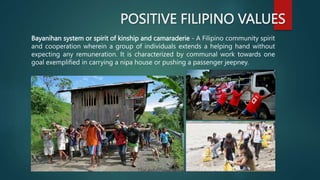
Bayanihan system or spirit of kinship and camaraderie - A Filipino community spirit
and cooperation wherein a group of individuals extends a helping hand without
expecting any remuneration. It is characterized by communal work towards one
goal exemplified in carrying a nipa house or pushing a passenger jeepney.
POSITIVE FILIPINO VALUES
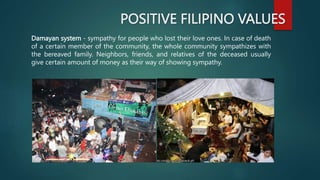
Damayan system - sympathy for people who lost their love ones. In case of death
of a certain member of the community, the whole community sympathizes with
the bereaved family. Neighbors, friends, and relatives of the deceased usually
give certain amount of money as their way of showing sympathy.
POSITIVE FILIPINO VALUES
Familism or close family relations - a Filipino trait of giving highest importance to
family above other thing. A trait wherein family members should be taken care
and supported regardless of whether he/she did something wrong, a family
member must given attention and should not be abandoned.
POSITIVE FILIPINO VALUES
Fun-loving trait - a trait found in most Filipinos, a trait that makes them unique
that even in time of calamities and other challenges in life, they always have
something to be happy about, a reason to celebrate.
POSITIVE FILIPINO VALUES
Hospitality - a Filipino trait of being receptive and generous to guests.
POSITIVE FILIPINO VALUES
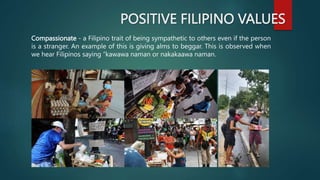
Compassionate - a Filipino trait of being sympathetic to others even if the person
is a stranger. An example of this is giving alms to beggar. This is observed when
we hear Filipinos saying “kawawa naman or nakakaawa naman.
POSITIVE FILIPINO VALUES
Friendly - a trait found in most Filipinos. They are sincere, loyal, kind and sociable
person.
POSITIVE FILIPINO VALUES
Flexible or magaling makibagay - the ability of Filipinos to ride on or adjust to
the norms of other group jut to attain smooth and harmonious relationship.
Example: OFW
POSITIVE FILIPINO VALUES
Respect to elders - a Filipino trait of being courteous both in words and in
actions to the people of older people.
POSITIVE FILIPINO VALUES
Remedyo attitude - a Filipino trait of being creative and resourceful. The ability to
do things that are next to impossible. Example in fixing appliances that look
impossible to repair.
POSITIVE FILIPINO VALUES
Matiyaga - Filipinos re known for their tenacity and strong determination in every
undertaking.
NEGATIVE FILIPINO VALUES
Bahala na atitude - a Filipino trait characterized by retreating or withdrawal from
certain undertaking and leaving everything to God to interfere and determine
the outcome of his deeds.
NEGATIVE FILIPINO VALUES
Colonial complex or blue-seal mentality - a Filipino value of showing high
admiration and preference to foreign produced goods over local ones.
NEGATIVE FILIPINO VALUES
Crab mentality - a Filipino attitude characterized by an attempt to “pull down”
someone who has achieved success beyond the others. This I done out of
jealousy and insecurity.
NEGATIVE FILIPINO VALUES
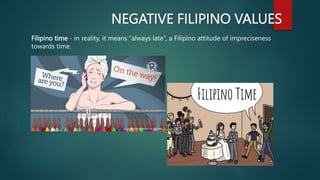
Filipino time - in reality, it means “always late”, a Filipino attitude of impreciseness
towards time.
NEGATIVE FILIPINO VALUES
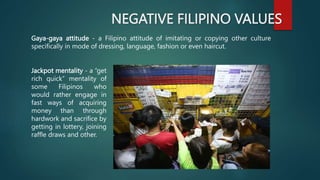
Gaya-gaya attitude - a Filipino attitude of imitating or copying other culture
specifically in mode of dressing, language, fashion or even haircut.
Jackpot mentality - a “get
rich quick” mentality of
some Filipinos who
would rather engage in
fast ways of acquiring
money than through
hardwork and sacrifice by
getting in lottery, joining
raffle draws and other.
NEGATIVE FILIPINO VALUES
Kapalaran values - a Filipino trait of accepting his fate by believing that
everything is written in his palm. Such traits contributes to lack initiative and
perseverance among Filipinos.
Mañana habit - delaying or setting aside a certain task assigned on the next day
although it can be done today.
NEGATIVE FILIPINO VALUES
Ningas-cogon - being enthusiastic only during the start of new undertaking but
ends dismally in accomplishing nothing. A common practice observed in some
politicians who are visible only during the start of certain endeavor.
NEGATIVE FILIPINO VALUES
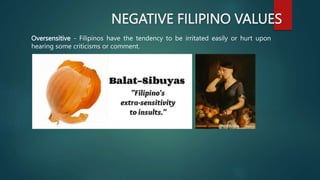
Oversensitive - Filipinos have the tendency to be irritated easily or hurt upon
hearing some criticisms or comment.
NEGATIVE FILIPINO VALUES
Lack of sportsmanship - not accepting defeat in competitions but rather putting
the blame either to their opponents or to the sport officials.
NEGATIVE FILIPINO VALUES
Tsamba lang attitude - simplicity by declaring that his/her accomplishments are
results of luck and not from perseverance and ability.
THE FILIPINO VALUES
 Utang-na-loob
It is a technique of reciprocity of debt of gratitude to others
within the family circle or primary group, sometimes unlimited
in nature, emotional rather than financial or rational. It is a
sign of marginal economy where no place is available for
bargaining, formal agreements, written contracts, specific
rights, and responsibilities.
Inability to repay “utang-na-loob”will result in the individual
being labeled as “walang utang-na-loob” or “walang-hiya.”
THE FILIPINO VALUES
 Pakikisama
This is closely related to utang-na-loob. It is the value of
belongingness and loyalty to the small in-group with
sensitivity to the feelings of others on the principle of
“give and take.” Pakikisama is a folk concept of good
public relations and avoidance of conflict with the leader
or majority of the groups.
THE FILIPINO VALUES
 Hiya
This controls to a large extent the behavior of the
individual and most likely, is generally dependent on what
others will think, say, and do. Because of hiya, a Filipino
cannot say “NO” even if it is against his will to do what is
being requested.
THE FILIPINO VALUES
 Bahala Na
A common expression among Filipinos in this rest on the
fatalistic outlook and strong dependence on the “spirits’ who
will take care of everything if they are really meant for a
person.
 Individualism
It is a pattern of behavior which characterizes the Filipino as a
self-centered. The desire to make a name for himself becomes
the primary motivation for success.
THE FILIPINO VALUES
Amor-propio
it is the individuals highly emotional reaction to protect
his honor and dignity when they are threatened or
questioned and to retaliate. Common forms of amor-
propio are “helehelebago quire,” or “pakipot” which shows
at the outset a person initially refusing an offer even if he
really wants very much to accept it.
Thank you!
Prepared by:
Kristian Eric S. Curay

Filipino Values.pptx

  • 1.
  • 2.
    THE FILIPINO VALUES Valuesare shared assumption of what is right, good, or important. Values actually guide man’s behavior and action as he relates himself in most situations in life. The Filipino values can best be seen from the aspects of personal and social relationships. Personally, the Filipinos value more their honor and status than anything else. Majority of them takes care of their honor (karangalan) rather than wealth. In decision making, the Filipinos usually consult and take into consideration the consensus of the family members as the feelings of those who are to be affected.
  • 3.
    THE FILIPINO VALUES Socially,the Filipinos give more emphasis on social relationships. This can be seen through the hospitality they give to their visitors and friends. They love to mingle with people particularly with friends and relatives. They engage themselves in mutual cooperation, which is best pictured through the “bayanihan”. In terms of emotion, the Filipinos are friendly. They smile at people, even with strangers when they are approach. They are warm and simple. Women in the Philippines are highly regarded and respected and can be relied upon when it comes to family affairs.
  • 4.
    POSITIVE FILIPINO VALUES Bayanihansystem or spirit of kinship and camaraderie - A Filipino community spirit and cooperation wherein a group of individuals extends a helping hand without expecting any remuneration. It is characterized by communal work towards one goal exemplified in carrying a nipa house or pushing a passenger jeepney.
  • 5.
    POSITIVE FILIPINO VALUES Damayansystem - sympathy for people who lost their love ones. In case of death of a certain member of the community, the whole community sympathizes with the bereaved family. Neighbors, friends, and relatives of the deceased usually give certain amount of money as their way of showing sympathy.
  • 6.
    POSITIVE FILIPINO VALUES Familismor close family relations - a Filipino trait of giving highest importance to family above other thing. A trait wherein family members should be taken care and supported regardless of whether he/she did something wrong, a family member must given attention and should not be abandoned.
  • 7.
    POSITIVE FILIPINO VALUES Fun-lovingtrait - a trait found in most Filipinos, a trait that makes them unique that even in time of calamities and other challenges in life, they always have something to be happy about, a reason to celebrate.
  • 8.
    POSITIVE FILIPINO VALUES Hospitality- a Filipino trait of being receptive and generous to guests.
  • 9.
    POSITIVE FILIPINO VALUES Compassionate- a Filipino trait of being sympathetic to others even if the person is a stranger. An example of this is giving alms to beggar. This is observed when we hear Filipinos saying “kawawa naman or nakakaawa naman.
  • 10.
    POSITIVE FILIPINO VALUES Friendly- a trait found in most Filipinos. They are sincere, loyal, kind and sociable person.
  • 11.
    POSITIVE FILIPINO VALUES Flexibleor magaling makibagay - the ability of Filipinos to ride on or adjust to the norms of other group jut to attain smooth and harmonious relationship. Example: OFW
  • 12.
    POSITIVE FILIPINO VALUES Respectto elders - a Filipino trait of being courteous both in words and in actions to the people of older people.
  • 13.
    POSITIVE FILIPINO VALUES Remedyoattitude - a Filipino trait of being creative and resourceful. The ability to do things that are next to impossible. Example in fixing appliances that look impossible to repair.
  • 14.
    POSITIVE FILIPINO VALUES Matiyaga- Filipinos re known for their tenacity and strong determination in every undertaking.
  • 15.
    NEGATIVE FILIPINO VALUES Bahalana atitude - a Filipino trait characterized by retreating or withdrawal from certain undertaking and leaving everything to God to interfere and determine the outcome of his deeds.
  • 16.
    NEGATIVE FILIPINO VALUES Colonialcomplex or blue-seal mentality - a Filipino value of showing high admiration and preference to foreign produced goods over local ones.
  • 17.
    NEGATIVE FILIPINO VALUES Crabmentality - a Filipino attitude characterized by an attempt to “pull down” someone who has achieved success beyond the others. This I done out of jealousy and insecurity.
  • 18.
    NEGATIVE FILIPINO VALUES Filipinotime - in reality, it means “always late”, a Filipino attitude of impreciseness towards time.
  • 19.
    NEGATIVE FILIPINO VALUES Gaya-gayaattitude - a Filipino attitude of imitating or copying other culture specifically in mode of dressing, language, fashion or even haircut. Jackpot mentality - a “get rich quick” mentality of some Filipinos who would rather engage in fast ways of acquiring money than through hardwork and sacrifice by getting in lottery, joining raffle draws and other.
  • 20.
    NEGATIVE FILIPINO VALUES Kapalaranvalues - a Filipino trait of accepting his fate by believing that everything is written in his palm. Such traits contributes to lack initiative and perseverance among Filipinos. Mañana habit - delaying or setting aside a certain task assigned on the next day although it can be done today.
  • 21.
    NEGATIVE FILIPINO VALUES Ningas-cogon- being enthusiastic only during the start of new undertaking but ends dismally in accomplishing nothing. A common practice observed in some politicians who are visible only during the start of certain endeavor.
  • 22.
    NEGATIVE FILIPINO VALUES Oversensitive- Filipinos have the tendency to be irritated easily or hurt upon hearing some criticisms or comment.
  • 23.
    NEGATIVE FILIPINO VALUES Lackof sportsmanship - not accepting defeat in competitions but rather putting the blame either to their opponents or to the sport officials.
  • 24.
    NEGATIVE FILIPINO VALUES Tsambalang attitude - simplicity by declaring that his/her accomplishments are results of luck and not from perseverance and ability.
  • 25.
    THE FILIPINO VALUES Utang-na-loob It is a technique of reciprocity of debt of gratitude to others within the family circle or primary group, sometimes unlimited in nature, emotional rather than financial or rational. It is a sign of marginal economy where no place is available for bargaining, formal agreements, written contracts, specific rights, and responsibilities. Inability to repay “utang-na-loob”will result in the individual being labeled as “walang utang-na-loob” or “walang-hiya.”
  • 26.
    THE FILIPINO VALUES Pakikisama This is closely related to utang-na-loob. It is the value of belongingness and loyalty to the small in-group with sensitivity to the feelings of others on the principle of “give and take.” Pakikisama is a folk concept of good public relations and avoidance of conflict with the leader or majority of the groups.
  • 27.
    THE FILIPINO VALUES Hiya This controls to a large extent the behavior of the individual and most likely, is generally dependent on what others will think, say, and do. Because of hiya, a Filipino cannot say “NO” even if it is against his will to do what is being requested.
  • 28.
    THE FILIPINO VALUES Bahala Na A common expression among Filipinos in this rest on the fatalistic outlook and strong dependence on the “spirits’ who will take care of everything if they are really meant for a person.  Individualism It is a pattern of behavior which characterizes the Filipino as a self-centered. The desire to make a name for himself becomes the primary motivation for success.
  • 29.
    THE FILIPINO VALUES Amor-propio itis the individuals highly emotional reaction to protect his honor and dignity when they are threatened or questioned and to retaliate. Common forms of amor- propio are “helehelebago quire,” or “pakipot” which shows at the outset a person initially refusing an offer even if he really wants very much to accept it.
  • 31.