1/6
Intrusion Prevention Through Optimal Stopping
Digital Futures Machine Learning Day
Kim Hammar & Rolf Stadler
kimham@kth.se & stadler@kth.se
Division of Network and Systems Engineering
KTH Royal Institute of Technology
Jan 17, 2022
2/6
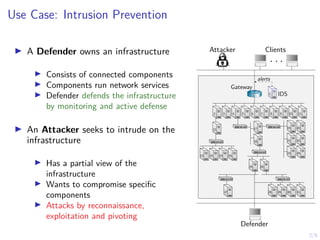
Use Case: Intrusion Prevention
I A Defender owns an infrastructure
I Consists of connected components
I Components run network services
I Defender defends the infrastructure
by monitoring and active defense
I An Attacker seeks to intrude on the
infrastructure
I Has a partial view of the
infrastructure
I Wants to compromise specific
components
I Attacks by reconnaissance,
exploitation and pivoting
Attacker Clients
. . .
Defender
1 IDS
1
alerts
Gateway
7 8 9 10 11
6
5
4
3
2
12
13 14 15 16
17
18
19
21
23
20
22
24
25 26
27 28 29 30 31
3/6
Use Case: Intrusion Prevention
I A Defender owns an infrastructure
I Consists of connected components
I Components run network services
I Defender defends the infrastructure
by monitoring and active defense
I An Attacker seeks to intrude on the
infrastructure
I Has a partial view of the
infrastructure
I Wants to compromise specific
components
I Attacks by reconnaissance,
exploitation and pivoting
Attacker Clients
. . .
Defender
1 IDS
1
alerts
Gateway
7 8 9 10 11
6
5
4
3
2
12
13 14 15 16
17
18
19
21
23
20
22
24
25 26
27 28 29 30 31
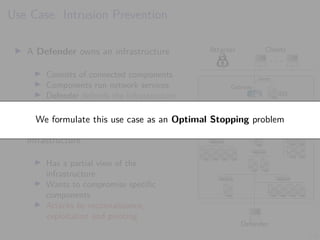
We formulate this use case as an Optimal Stopping problem
4/6
Formulating Intrusion Prevention as a Stopping Problem
Intrusion event
time-step t = 1 Intrusion ongoing
t
t = T
Episode
Attacker Clients
. . .
Defender
1 IDS
1
alerts
Gateway
7 8 9 10 11
6
5
4
3
2
12
13 14 15 16
17
18
19
21
23
20
22
24
25 26
27 28 29 30 31
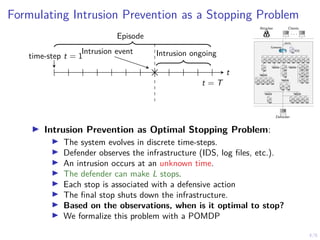
I Intrusion Prevention as Optimal Stopping Problem:
I The system evolves in discrete time-steps.
I Defender observes the infrastructure (IDS, log files, etc.).
I An intrusion occurs at an unknown time.
I The defender can make L stops.
I Each stop is associated with a defensive action
I The final stop shuts down the infrastructure.
I Based on the observations, when is it optimal to stop?
I We formalize this problem with a POMDP
4/6
Threshold Properties of the Optimal Defender Policy
b(1)
0 1
belief space B = [0, 1]
S 1
S 2
.
.
.
S L
α∗
1
α∗
2
α∗
L
. . .
5/6
Our Method for Finding Effective Security Strategies
s1,1 s1,2 s1,3 . . . s1,n
s2,1 s2,2 s2,3 . . . s2,n
.
.
.
.
.
.
.
.
.
.
.
.
.
.
.
Emulation System
Target
Infrastructure
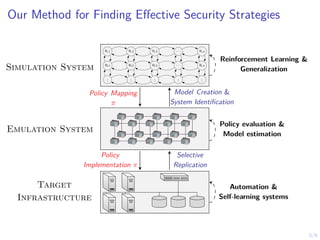
Model Creation &
System Identification
Policy Mapping
π
Selective
Replication
Policy
Implementation π
Simulation System
Reinforcement Learning &
Generalization
Policy evaluation &
Model estimation
Automation &
Self-learning systems
6/6
Conclusions
I We develop a method to learn automated security prevention
policies
1. emulation system;
2. system identification;
3. simulation system;
4. reinforcement learning
5. domain randomization and generalization.
I We apply the method to an intrusion prevention use case.
I We formulate intrusion prevention as a multiple stopping
problem
I We model it as a POMDP
I We apply the stopping theory to establish structural results of
the optimal policy

Intrusion Prevention through Optimal Stopping

  • 1.
    1/6 Intrusion Prevention ThroughOptimal Stopping Digital Futures Machine Learning Day Kim Hammar & Rolf Stadler kimham@kth.se & stadler@kth.se Division of Network and Systems Engineering KTH Royal Institute of Technology Jan 17, 2022
  • 2.
    2/6 Use Case: IntrusionPrevention I A Defender owns an infrastructure I Consists of connected components I Components run network services I Defender defends the infrastructure by monitoring and active defense I An Attacker seeks to intrude on the infrastructure I Has a partial view of the infrastructure I Wants to compromise specific components I Attacks by reconnaissance, exploitation and pivoting Attacker Clients . . . Defender 1 IDS 1 alerts Gateway 7 8 9 10 11 6 5 4 3 2 12 13 14 15 16 17 18 19 21 23 20 22 24 25 26 27 28 29 30 31
  • 3.
    3/6 Use Case: IntrusionPrevention I A Defender owns an infrastructure I Consists of connected components I Components run network services I Defender defends the infrastructure by monitoring and active defense I An Attacker seeks to intrude on the infrastructure I Has a partial view of the infrastructure I Wants to compromise specific components I Attacks by reconnaissance, exploitation and pivoting Attacker Clients . . . Defender 1 IDS 1 alerts Gateway 7 8 9 10 11 6 5 4 3 2 12 13 14 15 16 17 18 19 21 23 20 22 24 25 26 27 28 29 30 31 We formulate this use case as an Optimal Stopping problem
  • 4.
    4/6 Formulating Intrusion Preventionas a Stopping Problem Intrusion event time-step t = 1 Intrusion ongoing t t = T Episode Attacker Clients . . . Defender 1 IDS 1 alerts Gateway 7 8 9 10 11 6 5 4 3 2 12 13 14 15 16 17 18 19 21 23 20 22 24 25 26 27 28 29 30 31 I Intrusion Prevention as Optimal Stopping Problem: I The system evolves in discrete time-steps. I Defender observes the infrastructure (IDS, log files, etc.). I An intrusion occurs at an unknown time. I The defender can make L stops. I Each stop is associated with a defensive action I The final stop shuts down the infrastructure. I Based on the observations, when is it optimal to stop? I We formalize this problem with a POMDP
  • 5.
    4/6 Threshold Properties ofthe Optimal Defender Policy b(1) 0 1 belief space B = [0, 1] S 1 S 2 . . . S L α∗ 1 α∗ 2 α∗ L . . .
  • 6.
    5/6 Our Method forFinding Effective Security Strategies s1,1 s1,2 s1,3 . . . s1,n s2,1 s2,2 s2,3 . . . s2,n . . . . . . . . . . . . . . . Emulation System Target Infrastructure Model Creation & System Identification Policy Mapping π Selective Replication Policy Implementation π Simulation System Reinforcement Learning & Generalization Policy evaluation & Model estimation Automation & Self-learning systems
  • 7.
    6/6 Conclusions I We developa method to learn automated security prevention policies 1. emulation system; 2. system identification; 3. simulation system; 4. reinforcement learning 5. domain randomization and generalization. I We apply the method to an intrusion prevention use case. I We formulate intrusion prevention as a multiple stopping problem I We model it as a POMDP I We apply the stopping theory to establish structural results of the optimal policy