




1 of 26
FORECASTING IN REGULATED MARKETS
(US & UK)
Kaustubh V. Kokane
Summer Trainee- Supply Chain
Mentor- Mr. Umang Gandhi (GM- Supply Chain)
27th June, 2013
Thursday
2 of 26
Flow of Presentation
 Forecasting
 Industry best practices
 US forecasting
 Forecasting process
 Pros & cons
 Challenges
 Suggestions for improvement
 UK Forecasting
 Forecasting process
 Pros & cons
 Challenges
 Suggestions for improvement
3 of 26
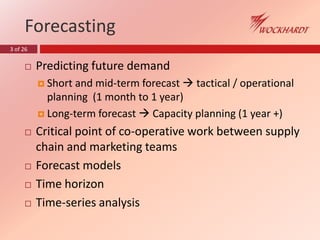
Forecasting
 Predicting future demand
 Short and mid-term forecast  tactical / operational
planning (1 month to 1 year)
 Long-term forecast  Capacity planning (1 year +)
 Critical point of co-operative work between supply
chain and marketing teams
 Forecast models
 Time horizon
 Time-series analysis
4 of 26
Maturity-wise Forecasting
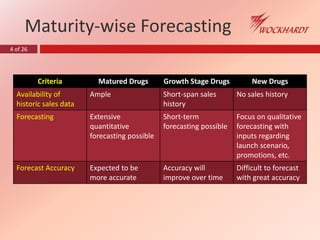
Criteria Matured Drugs Growth Stage Drugs New Drugs
Availability of
historic sales data
Ample Short-span sales
history
No sales history
Forecasting Extensive
quantitative
forecasting possible
Short-term
forecasting possible
Focus on qualitative
forecasting with
inputs regarding
launch scenario,
promotions, etc.
Forecast Accuracy Expected to be
more accurate
Accuracy will
improve over time
Difficult to forecast
with great accuracy
5 of 26
Branded v/s Generics
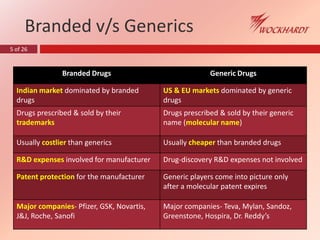
Branded Drugs Generic Drugs
Indian market dominated by branded
drugs
US & EU markets dominated by generic
drugs
Drugs prescribed & sold by their
trademarks
Drugs prescribed & sold by their generic
name (molecular name)
Usually costlier than generics Usually cheaper than branded drugs
R&D expenses involved for manufacturer Drug-discovery R&D expenses not involved
Patent protection for the manufacturer Generic players come into picture only
after a molecular patent expires
Major companies- Pfizer, GSK, Novartis,
J&J, Roche, Sanofi
Major companies- Teva, Mylan, Sandoz,
Greenstone, Hospira, Dr. Reddy’s
6 of 26
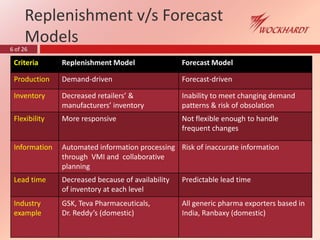
Replenishment v/s Forecast
Models
Criteria Replenishment Model Forecast Model
Production Demand-driven Forecast-driven
Inventory Decreased retailers’ &
manufacturers’ inventory
Inability to meet changing demand
patterns & risk of obsolation
Flexibility More responsive Not flexible enough to handle
frequent changes
Information Automated information processing
through VMI and collaborative
planning
Risk of inaccurate information
Lead time Decreased because of availability
of inventory at each level
Predictable lead time
Industry
example
GSK, Teva Pharmaceuticals,
Dr. Reddy’s (domestic)
All generic pharma exporters based in
India, Ranbaxy (domestic)
7 of 26
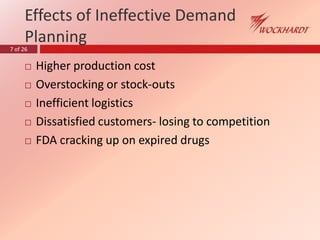
Effects of Ineffective Demand
Planning
 Higher production cost
 Overstocking or stock-outs
 Inefficient logistics
 Dissatisfied customers- losing to competition
 FDA cracking up on expired drugs
8 of 26
INDUSTRY BEST PRACTICES
9 of 26
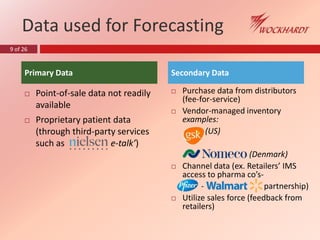
Data used for Forecasting
Primary Data
 Point-of-sale data not readily
available
 Proprietary patient data
(through third-party services
such as e-talk’)
Secondary Data
 Purchase data from distributors
(fee-for-service)
 Vendor-managed inventory
examples:
(US)
(Denmark)
 Channel data (ex. Retailers’ IMS
access to pharma co’s-
- partnership)
 Utilize sales force (feedback from
retailers)
10 of 26
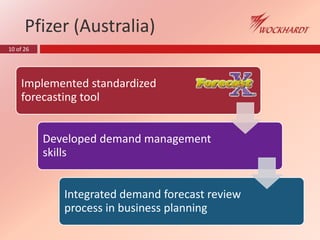
Pfizer (Australia)
Implemented standardized
forecasting tool
Developed demand management
skills
Integrated demand forecast review
process in business planning
11 of 26
Teva Pharmaceuticals, UK
 Was relying on stand-alone Excel sheets for
forecasting large no. of SKU’s (till 2009)
 Laborious and time-consuming process
 Implemented customized demand management
tool- RefleX to forecast & plan demand
 Forecast accuracy improved from 65% to 80%
 Seamless business integration thereafter
12 of 26
FORECASTING @ WOCKHARDT
13 of 26
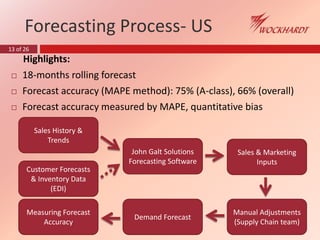
Forecasting Process- US
Manual Adjustments
(Supply Chain team)
Customer Forecasts
& Inventory Data
(EDI)
John Galt Solutions
Forecasting Software
Sales & Marketing
Inputs
Demand Forecast
Sales History &
Trends
Measuring Forecast
Accuracy
Highlights:
 18-months rolling forecast
 Forecast accuracy (MAPE method): 75% (A-class), 66% (overall)
 Forecast accuracy measured by MAPE, quantitative bias
14 of 26
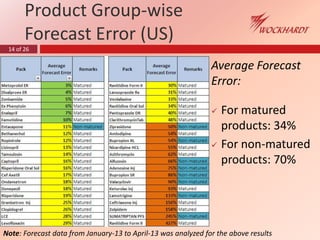
Product Group-wise
Forecast Error (US)
Average Forecast
Error:
 For matured
products: 34%
 For non-matured
products: 70%
Note: Forecast data from January-13 to April-13 was analyzed for the above results
15 of 26
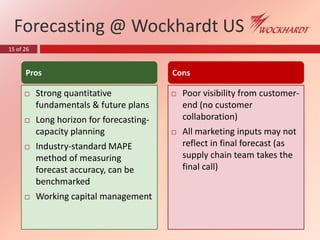
 Strong quantitative
fundamentals & future plans
 Long horizon for forecasting-
capacity planning
 Industry-standard MAPE
method of measuring
forecast accuracy, can be
benchmarked
 Working capital management
 Poor visibility from customer-
end (no customer
collaboration)
 All marketing inputs may not
reflect in final forecast (as
supply chain team takes the
final call)
Pros Cons
Forecasting @ Wockhardt US
16 of 26
Challenges- US
 Controllable:
 Lack of visibility (customer side)
 Penalties related to tendering
 Non-controllable:
 Demand volatility
 Sales concentration- top 3 wholesalers
 Market is very sensitive to short-supplies
17 of 26
Suggestions
 ‘Bias’-based forecast accuracy monitoring
 Consistently lower or higher forecast than actual sales
 In April 2013 (forecasted over 4 months):
 30% SKU’s – Under-forecasted
 18% SKU’s – Over-forecasted
 Causes:
 Undetected patterns
 “Beat the numbers” approach
 Weighted bias / size-based bias
18 of 26
Suggestions
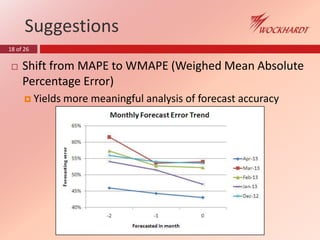
 Shift from MAPE to WMAPE (Weighed Mean Absolute
Percentage Error)
 Yields more meaningful analysis of forecast accuracy
19 of 26
Suggestions
 Consensus forecasting:
 Particularly for non-matured drugs (high uncertainty)
 Concurrent forecasting team with SC and marketing
executives (S&OP)
 Review supply and demand requirements frequently
20 of 26
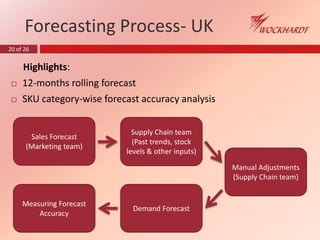
Forecasting Process- UK
Sales Forecast
(Marketing team)
Supply Chain team
(Past trends, stock
levels & other inputs)
Manual Adjustments
(Supply Chain team)
Demand Forecast
Measuring Forecast
Accuracy
Highlights:
 12-months rolling forecast
 SKU category-wise forecast accuracy analysis
21 of 26
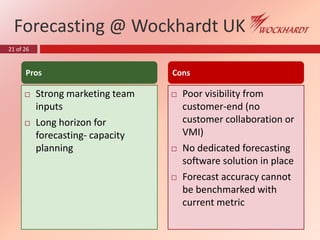
 Strong marketing team
inputs
 Long horizon for
forecasting- capacity
planning
 Poor visibility from
customer-end (no
customer collaboration or
VMI)
 No dedicated forecasting
software solution in place
 Forecast accuracy cannot
be benchmarked with
current metric
Forecasting @ Wockhardt UK
Pros Cons
22 of 26
Challenges- UK
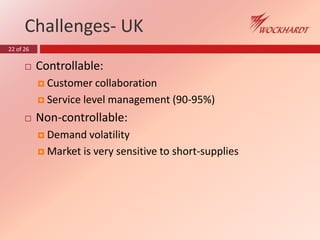
 Controllable:
 Customer collaboration
 Service level management (90-95%)
 Non-controllable:
 Demand volatility
 Market is very sensitive to short-supplies
23 of 26
Suggestions
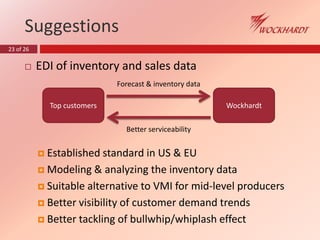
 EDI of inventory and sales data
 Established standard in US & EU
 Modeling & analyzing the inventory data
 Suitable alternative to VMI for mid-level producers
 Better visibility of customer demand trends
 Better tackling of bullwhip/whiplash effect
Top customers Wockhardt
Forecast & inventory data
Better serviceability
24 of 26
Suggestions
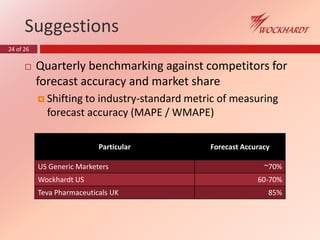
 Quarterly benchmarking against competitors for
forecast accuracy and market share
 Shifting to industry-standard metric of measuring
forecast accuracy (MAPE / WMAPE)
Particular Forecast Accuracy
US Generic Marketers ~70%
Wockhardt US 60-70%
Teva Pharmaceuticals UK 85%
25 of 26
Suggestions
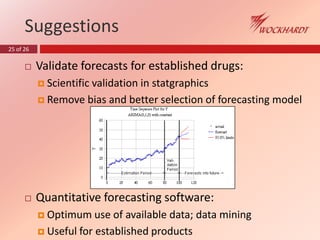
 Validate forecasts for established drugs:
 Scientific validation in statgraphics
 Remove bias and better selection of forecasting model
 Quantitative forecasting software:
 Optimum use of available data; data mining
 Useful for established products
26 of 26
Kaustubh V. Kokane
Summer Trainee- Supply Chain
Mentor- Mr. Umang Gandhi (GM- Supply Chain)
Institute-
Prin. L. N. Welingkar Institute of Management, Mumbai
Thank You !

Forecasting @ Wockhardt

  • 1.
    1 of 26 FORECASTINGIN REGULATED MARKETS (US & UK) Kaustubh V. Kokane Summer Trainee- Supply Chain Mentor- Mr. Umang Gandhi (GM- Supply Chain) 27th June, 2013 Thursday
  • 2.
    2 of 26 Flowof Presentation  Forecasting  Industry best practices  US forecasting  Forecasting process  Pros & cons  Challenges  Suggestions for improvement  UK Forecasting  Forecasting process  Pros & cons  Challenges  Suggestions for improvement
  • 3.
    3 of 26 Forecasting Predicting future demand  Short and mid-term forecast  tactical / operational planning (1 month to 1 year)  Long-term forecast  Capacity planning (1 year +)  Critical point of co-operative work between supply chain and marketing teams  Forecast models  Time horizon  Time-series analysis
  • 4.
    4 of 26 Maturity-wiseForecasting Criteria Matured Drugs Growth Stage Drugs New Drugs Availability of historic sales data Ample Short-span sales history No sales history Forecasting Extensive quantitative forecasting possible Short-term forecasting possible Focus on qualitative forecasting with inputs regarding launch scenario, promotions, etc. Forecast Accuracy Expected to be more accurate Accuracy will improve over time Difficult to forecast with great accuracy
  • 5.
    5 of 26 Brandedv/s Generics Branded Drugs Generic Drugs Indian market dominated by branded drugs US & EU markets dominated by generic drugs Drugs prescribed & sold by their trademarks Drugs prescribed & sold by their generic name (molecular name) Usually costlier than generics Usually cheaper than branded drugs R&D expenses involved for manufacturer Drug-discovery R&D expenses not involved Patent protection for the manufacturer Generic players come into picture only after a molecular patent expires Major companies- Pfizer, GSK, Novartis, J&J, Roche, Sanofi Major companies- Teva, Mylan, Sandoz, Greenstone, Hospira, Dr. Reddy’s
  • 6.
    6 of 26 Replenishmentv/s Forecast Models Criteria Replenishment Model Forecast Model Production Demand-driven Forecast-driven Inventory Decreased retailers’ & manufacturers’ inventory Inability to meet changing demand patterns & risk of obsolation Flexibility More responsive Not flexible enough to handle frequent changes Information Automated information processing through VMI and collaborative planning Risk of inaccurate information Lead time Decreased because of availability of inventory at each level Predictable lead time Industry example GSK, Teva Pharmaceuticals, Dr. Reddy’s (domestic) All generic pharma exporters based in India, Ranbaxy (domestic)
  • 7.
    7 of 26 Effectsof Ineffective Demand Planning  Higher production cost  Overstocking or stock-outs  Inefficient logistics  Dissatisfied customers- losing to competition  FDA cracking up on expired drugs
  • 8.
    8 of 26 INDUSTRYBEST PRACTICES
  • 9.
    9 of 26 Dataused for Forecasting Primary Data  Point-of-sale data not readily available  Proprietary patient data (through third-party services such as e-talk’) Secondary Data  Purchase data from distributors (fee-for-service)  Vendor-managed inventory examples: (US) (Denmark)  Channel data (ex. Retailers’ IMS access to pharma co’s- - partnership)  Utilize sales force (feedback from retailers)
  • 10.
    10 of 26 Pfizer(Australia) Implemented standardized forecasting tool Developed demand management skills Integrated demand forecast review process in business planning
  • 11.
    11 of 26 TevaPharmaceuticals, UK  Was relying on stand-alone Excel sheets for forecasting large no. of SKU’s (till 2009)  Laborious and time-consuming process  Implemented customized demand management tool- RefleX to forecast & plan demand  Forecast accuracy improved from 65% to 80%  Seamless business integration thereafter
  • 12.
  • 13.
    13 of 26 ForecastingProcess- US Manual Adjustments (Supply Chain team) Customer Forecasts & Inventory Data (EDI) John Galt Solutions Forecasting Software Sales & Marketing Inputs Demand Forecast Sales History & Trends Measuring Forecast Accuracy Highlights:  18-months rolling forecast  Forecast accuracy (MAPE method): 75% (A-class), 66% (overall)  Forecast accuracy measured by MAPE, quantitative bias
  • 14.
    14 of 26 ProductGroup-wise Forecast Error (US) Average Forecast Error:  For matured products: 34%  For non-matured products: 70% Note: Forecast data from January-13 to April-13 was analyzed for the above results
  • 15.
    15 of 26 Strong quantitative fundamentals & future plans  Long horizon for forecasting- capacity planning  Industry-standard MAPE method of measuring forecast accuracy, can be benchmarked  Working capital management  Poor visibility from customer- end (no customer collaboration)  All marketing inputs may not reflect in final forecast (as supply chain team takes the final call) Pros Cons Forecasting @ Wockhardt US
  • 16.
    16 of 26 Challenges-US  Controllable:  Lack of visibility (customer side)  Penalties related to tendering  Non-controllable:  Demand volatility  Sales concentration- top 3 wholesalers  Market is very sensitive to short-supplies
  • 17.
    17 of 26 Suggestions ‘Bias’-based forecast accuracy monitoring  Consistently lower or higher forecast than actual sales  In April 2013 (forecasted over 4 months):  30% SKU’s – Under-forecasted  18% SKU’s – Over-forecasted  Causes:  Undetected patterns  “Beat the numbers” approach  Weighted bias / size-based bias
  • 18.
    18 of 26 Suggestions Shift from MAPE to WMAPE (Weighed Mean Absolute Percentage Error)  Yields more meaningful analysis of forecast accuracy
  • 19.
    19 of 26 Suggestions Consensus forecasting:  Particularly for non-matured drugs (high uncertainty)  Concurrent forecasting team with SC and marketing executives (S&OP)  Review supply and demand requirements frequently
  • 20.
    20 of 26 ForecastingProcess- UK Sales Forecast (Marketing team) Supply Chain team (Past trends, stock levels & other inputs) Manual Adjustments (Supply Chain team) Demand Forecast Measuring Forecast Accuracy Highlights:  12-months rolling forecast  SKU category-wise forecast accuracy analysis
  • 21.
    21 of 26 Strong marketing team inputs  Long horizon for forecasting- capacity planning  Poor visibility from customer-end (no customer collaboration or VMI)  No dedicated forecasting software solution in place  Forecast accuracy cannot be benchmarked with current metric Forecasting @ Wockhardt UK Pros Cons
  • 22.
    22 of 26 Challenges-UK  Controllable:  Customer collaboration  Service level management (90-95%)  Non-controllable:  Demand volatility  Market is very sensitive to short-supplies
  • 23.
    23 of 26 Suggestions EDI of inventory and sales data  Established standard in US & EU  Modeling & analyzing the inventory data  Suitable alternative to VMI for mid-level producers  Better visibility of customer demand trends  Better tackling of bullwhip/whiplash effect Top customers Wockhardt Forecast & inventory data Better serviceability
  • 24.
    24 of 26 Suggestions Quarterly benchmarking against competitors for forecast accuracy and market share  Shifting to industry-standard metric of measuring forecast accuracy (MAPE / WMAPE) Particular Forecast Accuracy US Generic Marketers ~70% Wockhardt US 60-70% Teva Pharmaceuticals UK 85%
  • 25.
    25 of 26 Suggestions Validate forecasts for established drugs:  Scientific validation in statgraphics  Remove bias and better selection of forecasting model  Quantitative forecasting software:  Optimum use of available data; data mining  Useful for established products
  • 26.
    26 of 26 KaustubhV. Kokane Summer Trainee- Supply Chain Mentor- Mr. Umang Gandhi (GM- Supply Chain) Institute- Prin. L. N. Welingkar Institute of Management, Mumbai Thank You !

Editor's Notes

  • #7 DRL- Symphony software support for pull-based replenishment
  • #11 ForecastX is a forecasting tool from John Galt solutions.
  • #14 US forecast accuracy data valid from Apr-12 to Mar-13A-class SKU- 42Total SKU- 180
  • #20 Collaborative forecasting
  • #24 Competitors like Teva are implementing customer collaboration strategies while servicing VMI model. In case of Wockhardt, FFS model would be a realistic alternative.
  • #25 Teva’s forecast accuracy was 65% in 2009. They implemented a sophisticated customized demand planning tool- FOREX to forecast and plan for demand which improved their forecast accuracy to 85%