Please Note:

The images included in this presentation, some of which are copyrighted,
 are being used under the “fair use” provision (for educational purposes)
         of the U.S. law governing usage of copyrighted material.
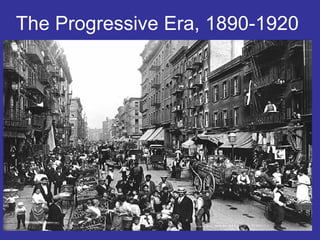
The Progressive Era, 1890-1920


© Edward T. O’Donnell, 2006
My Approach to Teaching History

• Conflict: Finding and Exploring Conflict and Debate

• Agency: Recognizing How People Shape Their Era

• Choices: History is the study of Choices - Nothing is
  inevitable!

• Relevance: Make Connections (carefully) to the
  Present

• Documents and Images
The Progressive Era
•   Defined
•   Background to the Progressive Era
•   Three Main Ideas of Progressivism
•   Who Were the Progressives
•   Key Progressive Era Reforms
•   The Darker Side of Progressivism
•   When Did the Progressive Era End?
The Progressive Era
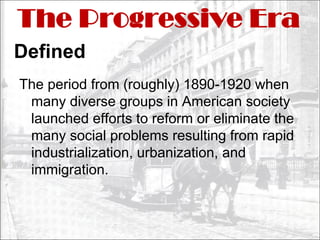
Defined
The period from (roughly) 1890-1920 when
 many diverse groups in American society
 launched efforts to reform or eliminate the
 many social problems resulting from rapid
 industrialization, urbanization, and
 immigration.
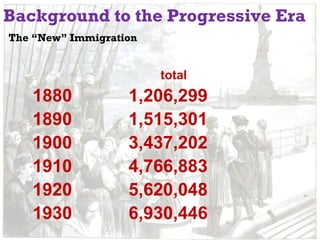
Background to the Progressive Era
The “New” Immigration


                        total
   1880            1,206,299
   1890            1,515,301
   1900            3,437,202
   1910            4,766,883
   1920            5,620,048
   1930            6,930,446
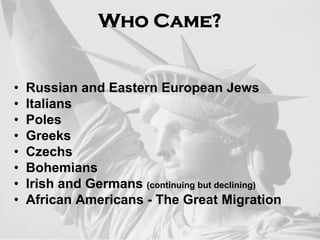
Who Came?


•   Russian and Eastern European Jews
•   Italians
•   Poles
•   Greeks
•   Czechs
•   Bohemians
•   Irish and Germans (continuing but declining)
•   African Americans - The Great Migration
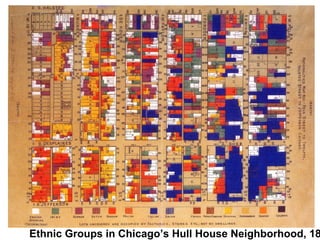
Ethnic Groups in Chicago’s Hull House Neighborhood, 18
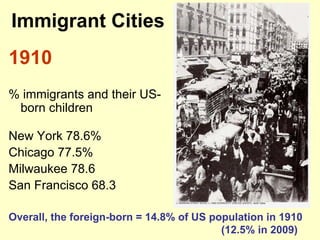
Immigrant Cities
1910
% immigrants and their US-
 born children

New York 78.6%
Chicago 77.5%
Milwaukee 78.6
San Francisco 68.3

Overall, the foreign-born = 14.8% of US population in 1910
                                          (12.5% in 2009)
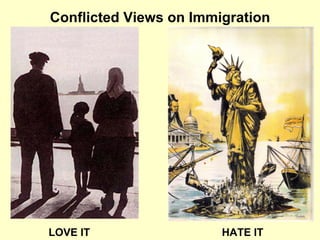
Conflicted Views on Immigration


LOVE IT                 HATE IT
Many
     Types
       of
    Nativism
• Disease
• Superstition
• Poverty
• Anarchy
• Sabbath
  desecration
• Intemperance
• Crime          The Immigrant: The Stranger at Our Gate from The Ram’s Horn April 25, 1896
                 Source: www.projects.vassar.edu/1896/0425ramshorn.html
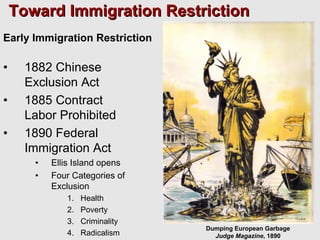
Toward Immigration Restriction
Early Immigration Restriction

•    1882 Chinese
     Exclusion Act
•    1885 Contract
     Labor Prohibited
•    1890 Federal
     Immigration Act
       •   Ellis Island opens
       •   Four Categories of
           Exclusion
              1.   Health
              2.   Poverty
              3.   Criminality
                                 Dumping European Garbage
              4.   Radicalism      Judge Magazine, 1890
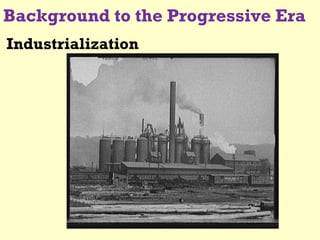
Background to the Progressive Era
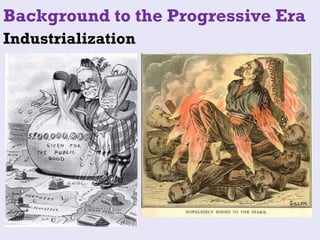
Industrialization
Background to the Progressive Era
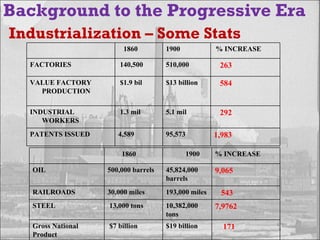
Industrialization – Some Stats
                         1860         1900            % INCREASE

  FACTORIES            140,500        510,000          263

  VALUE FACTORY        $1.9 bil       $13 billion      584
    PRODUCTION

  INDUSTRIAL           1.3 mil        5.1 mil          292
     WORKERS
  PATENTS ISSUED       4,589          95,573          1,983

                        1860                   1900   % INCREASE

   OIL              500,000 barrels   45,824,000      9,065
                                      barrels
   RAILROADS        30,000 miles      193,000 miles    543
   STEEL            13,000 tons       10,382,000      7,9762
                                      tons
   Gross National   $7 billion        $19 billion       171
   Product
Background to the Progressive Era
Industrialization
Background to the Progressive Era
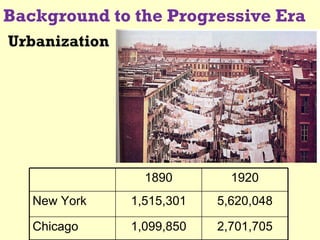
Urbanization


                 1890        1920
   New York    1,515,301   5,620,048

   Chicago     1,099,850   2,701,705
Background to the Progressive Era
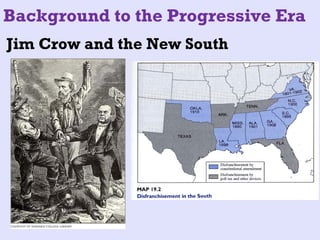
Jim Crow and the New South
Background to the Progressive Era
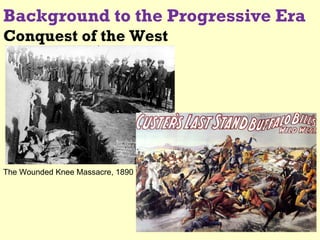
Conquest of the West


The Wounded Knee Massacre, 1890
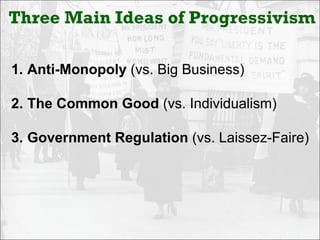
Three Main Ideas of Progressivism

1. Anti-Monopoly (vs. Big Business)

2. The Common Good (vs. Individualism)

3. Government Regulation (vs. Laissez-Faire)
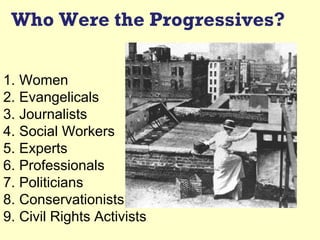
Who Were the Progressives?


1. Women
2. Evangelicals
3. Journalists
4. Social Workers
5. Experts
6. Professionals
7. Politicians
8. Conservationists
9. Civil Rights Activists
Key Progressive Era Reforms
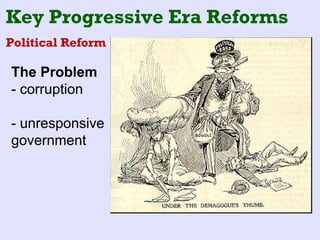
Political Reform

The Problem
- corruption

- unresponsive
government
Key Progressive Era Reforms
Political Reform

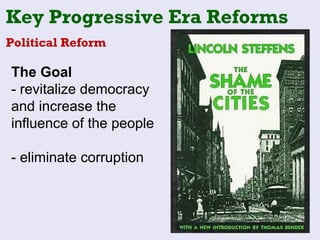
The Goal
- revitalize democracy
and increase the
influence of the people

- eliminate corruption
Key Progressive Era Reforms
Political Reform
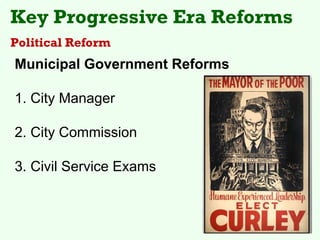
Municipal Government Reforms

1. City Manager

2. City Commission

3. Civil Service Exams
Key Progressive Era Reforms
Political Reform

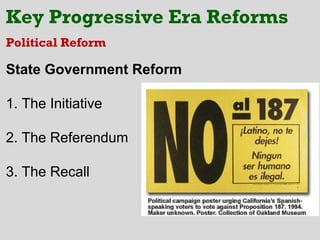
State Government Reform

1. The Initiative

2. The Referendum

3. The Recall
Key Progressive Era Reforms
Political Reform
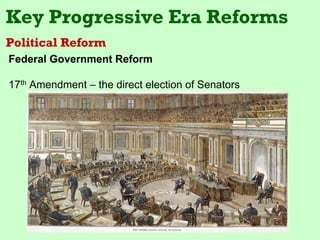
Federal Government Reform

17th Amendment – the direct election of Senators
Key Progressive Era Reforms
Economic Reform
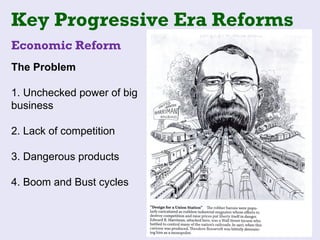
The Problem

1. Unchecked power of big
business

2. Lack of competition

3. Dangerous products

4. Boom and Bust cycles
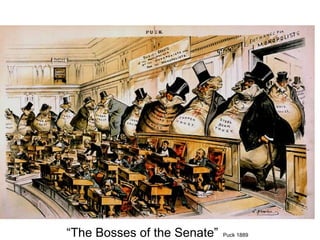
“The Bosses of the Senate”   Puck 1889
“What A Strange Little Government”
The Verdict Jan 22 1900 [source: Andrist_The Confident Years]
Key Progressive Era Reforms
Economic Reform
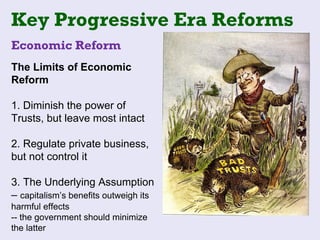
The Limits of Economic
Reform

1. Diminish the power of
Trusts, but leave most intact

2. Regulate private business,
but not control it

3. The Underlying Assumption
– capitalism’s benefits outweigh its
harmful effects
-- the government should minimize
the latter
Key Progressive Era Reforms
Economic Reform

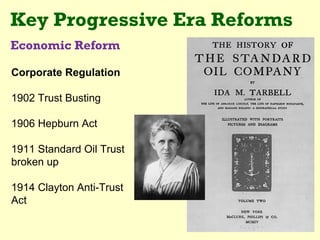
Corporate Regulation

1902 Trust Busting

1906 Hepburn Act

1911 Standard Oil Trust
broken up

1914 Clayton Anti-Trust
Act
Key Progressive Era Reforms
Economic Reform

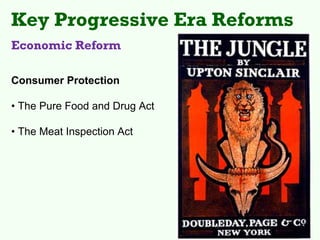
Consumer Protection

• The Pure Food and Drug Act

• The Meat Inspection Act
Key Progressive Era Reforms
Economic Reform

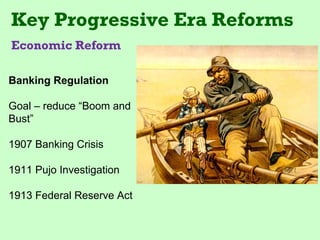
Banking Regulation

Goal – reduce “Boom and
Bust”

1907 Banking Crisis

1911 Pujo Investigation

1913 Federal Reserve Act
Key Progressive Era Reforms
Economic Reform

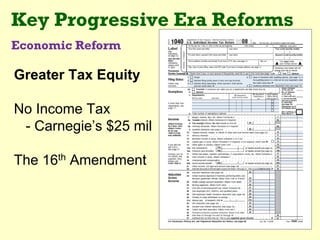
Greater Tax Equity

No Income Tax
 - Carnegie’s $25 mil

The 16th Amendment
Growing Economic Disparity
         1890
           –Top 1% of pop owned 51% of all
            wealth
           –Lower 44% of pop owned 1.2% of
            all wealth
           –Top 12% owned 86% of all wealth
           –Remaining 88% owned just 14% of
            all wealth
Source: Walter Licht, Industrializing America, p 183
Key Progressive Era Reforms
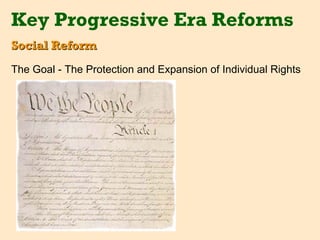
Social Reform
The Goal - The Protection and Expansion of Individual Rights
Key Progressive Era Reforms
Social Reform

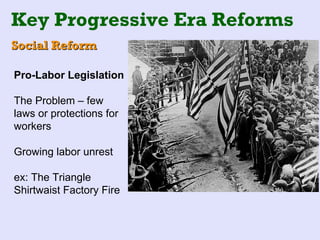
Pro-Labor Legislation

The Problem – few
laws or protections for
workers

Growing labor unrest

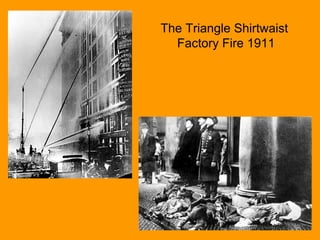
ex: The Triangle
Shirtwaist Factory Fire
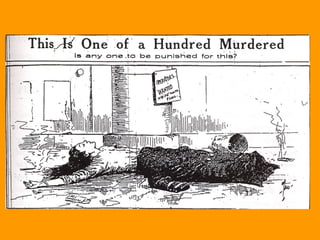
The Triangle Shirtwaist
  Factory Fire 1911
Key Progressive Era Reforms
Social Reform
Pro-Labor Legislation

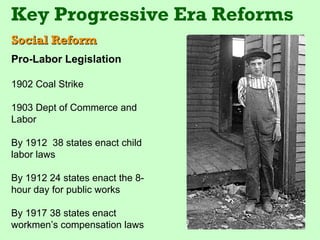
1902 Coal Strike

1903 Dept of Commerce and
Labor

By 1912 38 states enact child
labor laws

By 1912 24 states enact the 8-
hour day for public works

By 1917 38 states enact
workmen’s compensation laws
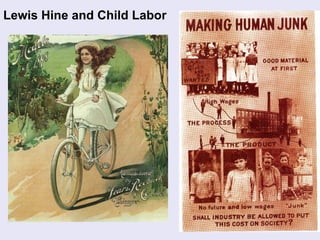
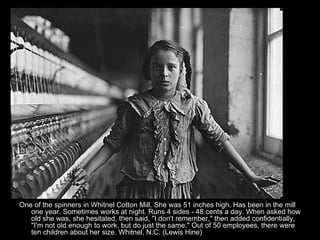
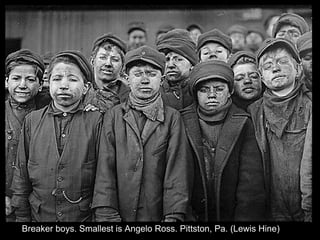
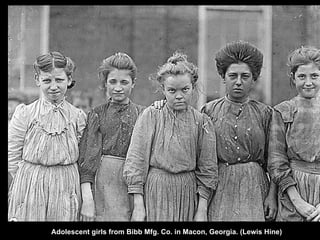
Lewis Hine and Child Labor
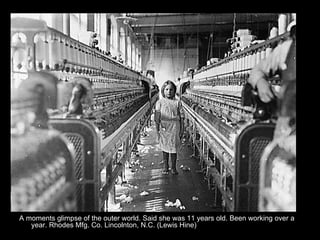
A moments glimpse of the outer world. Said she was 11 years old. Been working over a
   year. Rhodes Mfg. Co. Lincolnton, N.C. (Lewis Hine)
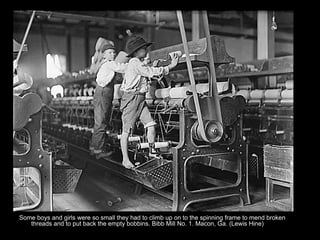
Some boys and girls were so small they had to climb up on to the spinning frame to mend broken
   threads and to put back the empty bobbins. Bibb Mill No. 1. Macon, Ga. (Lewis Hine)
One of the spinners in Whitnel Cotton Mill. She was 51 inches high. Has been in the mill
   one year. Sometimes works at night. Runs 4 sides - 48 cents a day. When asked how
   old she was, she hesitated, then said, "I don't remember," then added confidentially,
   "I'm not old enough to work, but do just the same." Out of 50 employees, there were
   ten children about her size. Whitnel, N.C. (Lewis Hine)
Breaker boys. Smallest is Angelo Ross. Pittston, Pa. (Lewis Hine)
Adolescent girls from Bibb Mfg. Co. in Macon, Georgia. (Lewis Hine)
Key Progressive Era Reforms
Social Reform
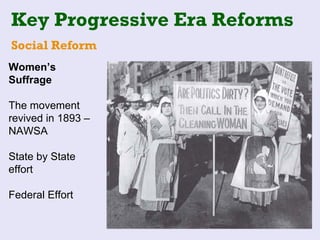
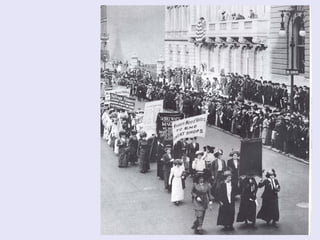
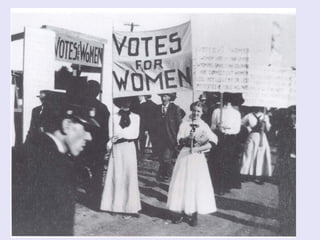
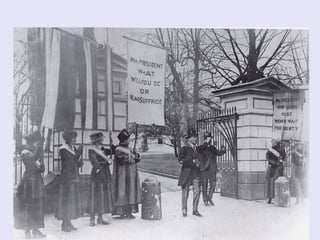
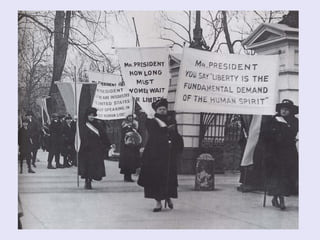
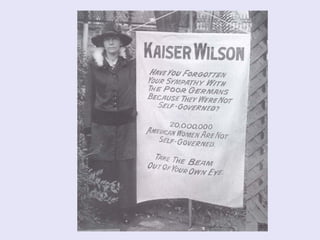
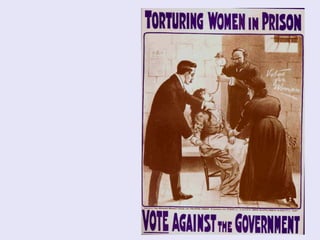
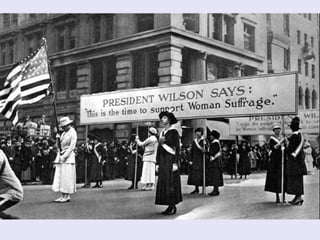
Women’s
Suffrage

The movement
revived in 1893 –
NAWSA

State by State
effort

Federal Effort
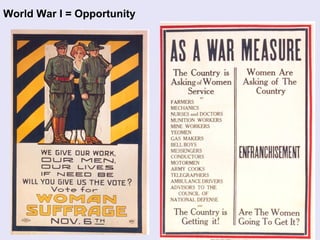
World War I = Opportunity
Key Progressive Era Reforms
Social Reform
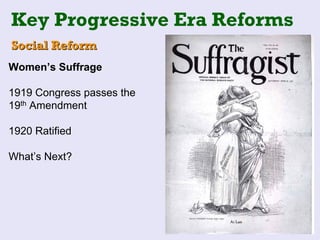
Women’s Suffrage

1919 Congress passes the
19th Amendment

1920 Ratified

What’s Next?
Key Progressive Era Reforms
Social Reform
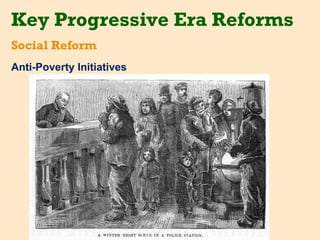
Anti-Poverty Initiatives
Traditional Views of the Poor


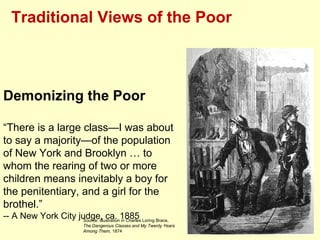
Demonizing the Poor

“There is a large class—I was about
to say a majority—of the population
of New York and Brooklyn … to
whom the rearing of two or more
children means inevitably a boy for
the penitentiary, and a girl for the
brothel.”
-- A New York City judge, ca. 1885 Loring Brace,
                     Source: Illustration in Charles
                         The Dangerous Classes and My Twenty Years
                         Among Them, 1874
Traditional Views of the Poor
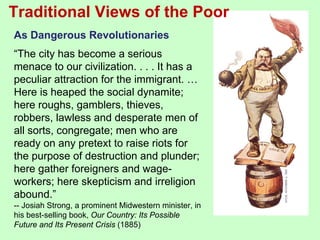
As Dangerous Revolutionaries
“The city has become a serious
menace to our civilization. . . . It has a
peculiar attraction for the immigrant. …
Here is heaped the social dynamite;
here roughs, gamblers, thieves,
robbers, lawless and desperate men of
all sorts, congregate; men who are
ready on any pretext to raise riots for
the purpose of destruction and plunder;
here gather foreigners and wage-
workers; here skepticism and irreligion
abound.”
-- Josiah Strong, a prominent Midwestern minister, in
his best-selling book, Our Country: Its Possible
Future and Its Present Crisis (1885)
Traditional Views of the Poor
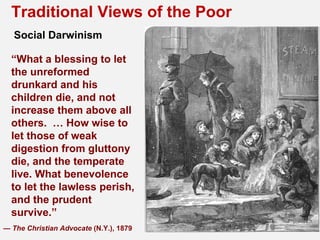
   Social Darwinism

  “What a blessing to let
  the unreformed
  drunkard and his
  children die, and not
  increase them above all
  others. … How wise to
  let those of weak
  digestion from gluttony
  die, and the temperate
  live. What benevolence
  to let the lawless perish,
  and the prudent
  survive.”
— The Christian Advocate (N.Y.), 1879
Key Progressive Era Reforms
Social Reform


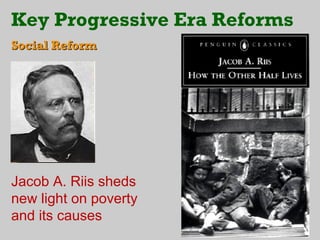
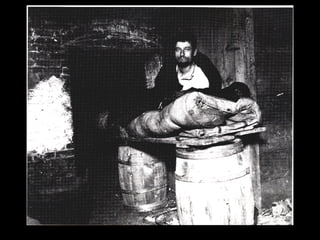
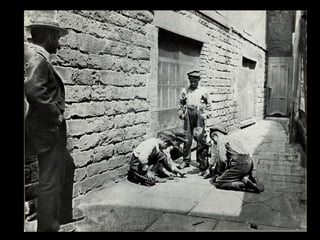
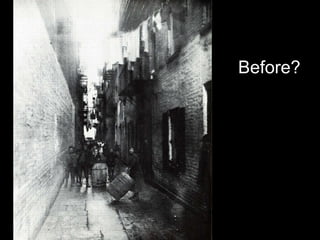
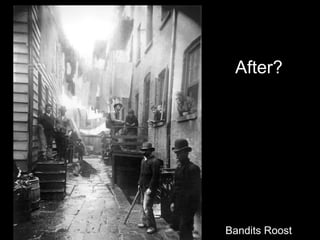
Jacob A. Riis sheds
new light on poverty
and its causes
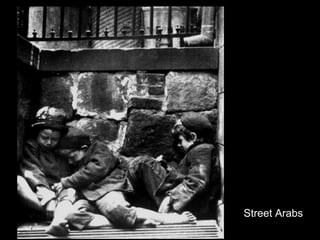
Street Arabs
Before?
After?


Bandits Roost
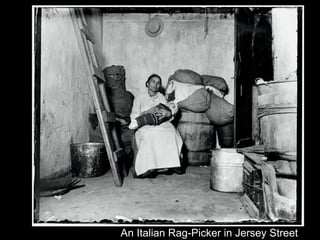
How to Read a Historical Image

S   scan for important details
I   identify the conflict or tension
G   guess the creator’s intent or message
H   hear the voices
T   talk about your observations


      S.I.G.H.T. tm © 2008 Edward T. O’Donnell
An Italian Rag-Picker in Jersey Street
Key Progressive Era Reforms
Social Reform
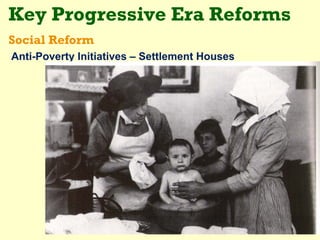
Anti-Poverty Initiatives – Settlement Houses
Key Progressive Era Reforms
Social Reform
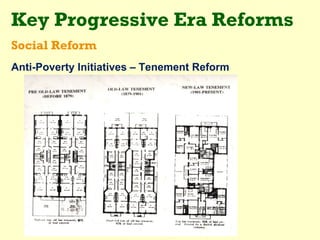
Anti-Poverty Initiatives – Tenement Reform
Key Progressive Era Reforms
Social Reform
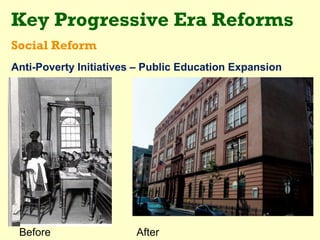
Anti-Poverty Initiatives – Public Education Expansion


 Before                 After
Key Progressive Era Reforms
 Social Reform
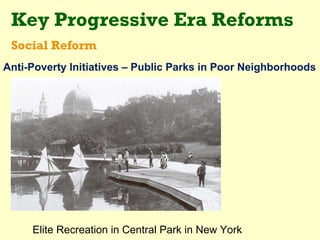
Anti-Poverty Initiatives – Public Parks in Poor Neighborhoods


     Elite Recreation in Central Park in New York
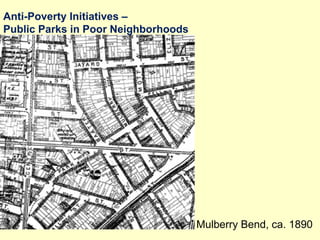
Anti-Poverty Initiatives –
Public Parks in Poor Neighborhoods


                                     Mulberry Bend, ca. 1890
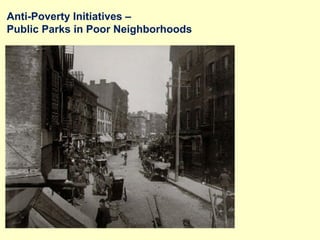
Anti-Poverty Initiatives –
Public Parks in Poor Neighborhoods
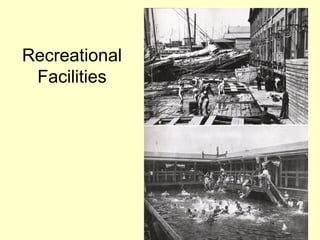
Recreational
 Facilities
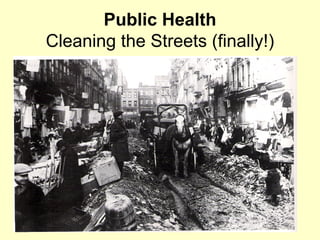
Public Health
Cleaning the Streets (finally!)
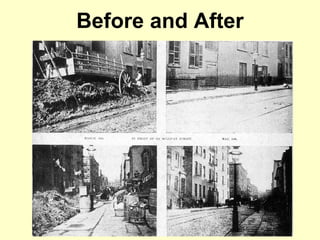
Before and After
Key Progressive Era Reforms
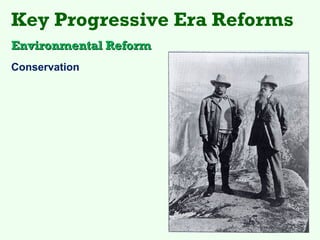
Environmental Reform
Conservation
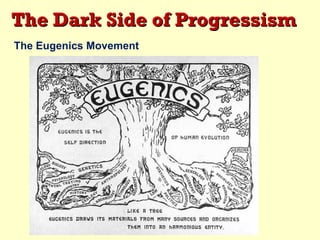
The Dark Side of Progressism
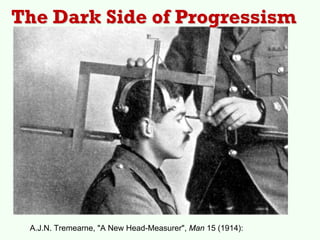
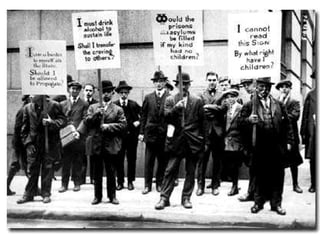
The Eugenics Movement
The Dark Side of Progressism


 A.J.N. Tremearne, "A New Head-Measurer", Man 15 (1914):
The Dark Side of Progressism


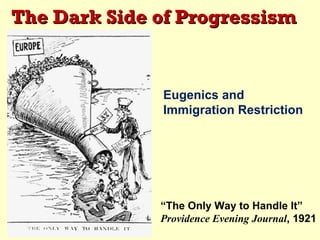
              Eugenics and
              Immigration Restriction


              “The Only Way to Handle It”
              Providence Evening Journal, 1921
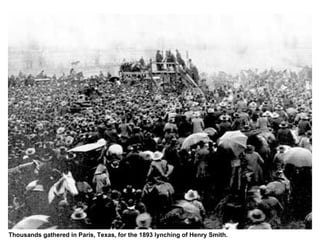
The Dark Side of Progressism
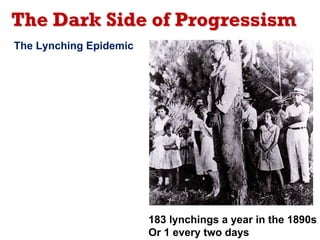
The Lynching Epidemic


                        183 lynchings a year in the 1890s
                        Or 1 every two days
Thousands gathered in Paris, Texas, for the 1893 lynching of Henry Smith.
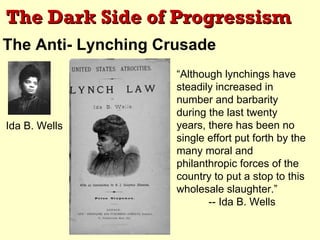
The Dark Side of Progressism
The Anti- Lynching Crusade
                     “Although lynchings have
                     steadily increased in
                     number and barbarity
                     during the last twenty
Ida B. Wells         years, there has been no
                     single effort put forth by the
                     many moral and
                     philanthropic forces of the
                     country to put a stop to this
                     wholesale slaughter.”
                            -- Ida B. Wells
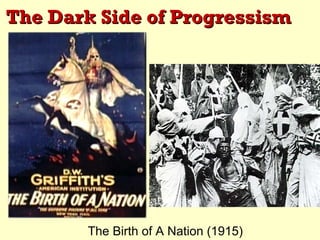
The Dark Side of Progressism


        The Birth of A Nation (1915)
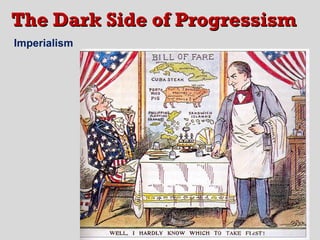
The Dark Side of Progressism
Imperialism
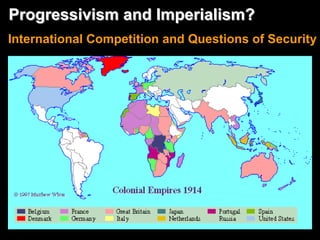
Progressivism and Imperialism?
International Competition and Questions of Security
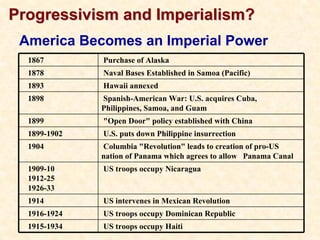
Progressivism and Imperialism?
 America Becomes an Imperial Power
  1867        Purchase of Alaska
  1878        Naval Bases Established in Samoa (Pacific)
  1893        Hawaii annexed
  1898        Spanish-American War: U.S. acquires Cuba,
              Philippines, Samoa, and Guam
  1899        "Open Door" policy established with China
  1899-1902   U.S. puts down Philippine insurrection
  1904        Columbia "Revolution" leads to creation of pro-US
              nation of Panama which agrees to allow Panama Canal
  1909-10     US troops occupy Nicaragua
  1912-25
  1926-33
  1914        US intervenes in Mexican Revolution
  1916-1924   US troops occupy Dominican Republic
  1915-1934   US troops occupy Haiti
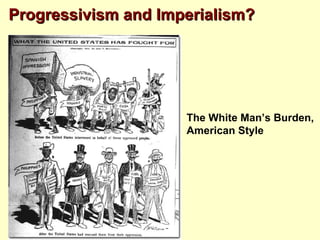
Progressivism and Imperialism?


                     The White Man’s Burden,
                     American Style
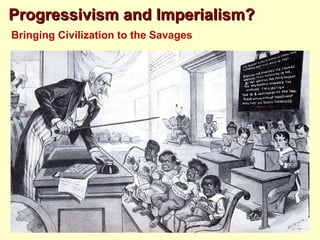
Progressivism and Imperialism?
Bringing Civilization to the Savages
Progressivism and Imperialism?


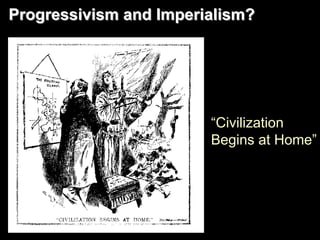
                        “Civilization
                        Begins at Home”
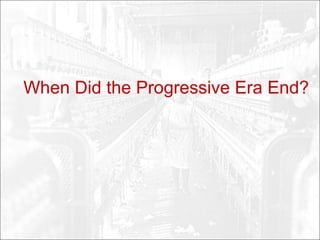
When Did the Progressive Era End?
Teaching American
       History
“Who dares to teach must
  never cease to learn”
   -- Librarian and Educator, John Cotton Dana


   “Trying to plan for the future
     without knowing the past
is like trying to plant cut flowers.”
                 -- Historian Daniel Boorstin
How to Read a Historical Image

S   scan for important details
I   identify the conflict or tension
G   guess the creator’s intent or message
H   hear the voices
T   talk about your observations


      S.I.G.H.T. tm © 2008 Edward T. O’Donnell
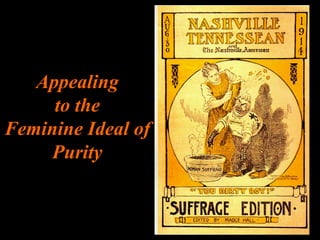
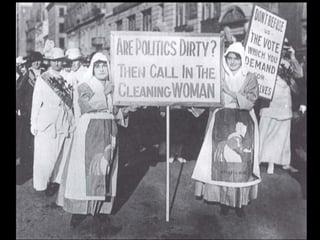
Appealing
     to the
Feminine Ideal of
    Purity
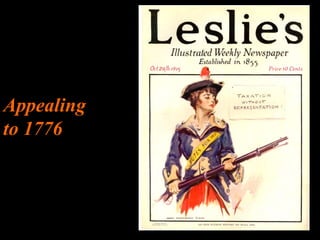
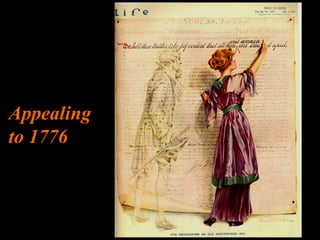
Appealing
to 1776
Appealing
to 1776
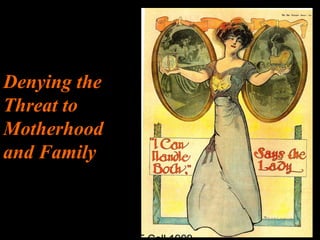
Denying the
Threat to
Motherhood
and Family
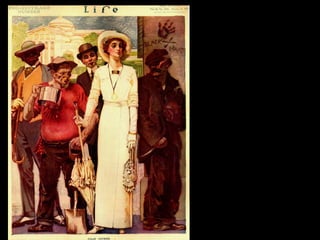
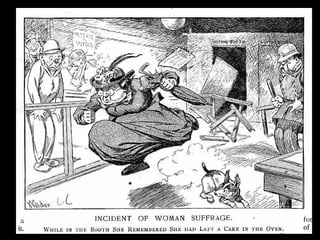
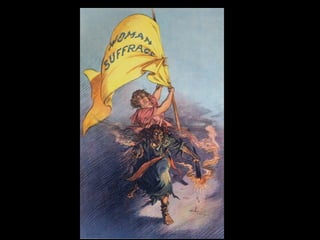
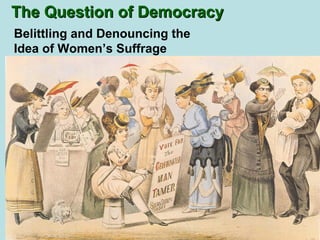
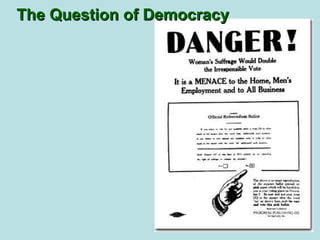
The Question of Democracy
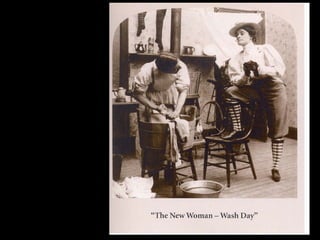
Belittling and Denouncing the
Idea of Women’s Suffrage
The Question of Democracy
The Progressive Era 1890-1920

The Progressive Era 1890-1920

  • 1.
    Please Note: The imagesincluded in this presentation, some of which are copyrighted, are being used under the “fair use” provision (for educational purposes) of the U.S. law governing usage of copyrighted material.
  • 2.
    The Progressive Era,1890-1920 © Edward T. O’Donnell, 2006
  • 3.
    My Approach toTeaching History • Conflict: Finding and Exploring Conflict and Debate • Agency: Recognizing How People Shape Their Era • Choices: History is the study of Choices - Nothing is inevitable! • Relevance: Make Connections (carefully) to the Present • Documents and Images
  • 4.
    The Progressive Era • Defined • Background to the Progressive Era • Three Main Ideas of Progressivism • Who Were the Progressives • Key Progressive Era Reforms • The Darker Side of Progressivism • When Did the Progressive Era End?
  • 5.
    The Progressive Era Defined Theperiod from (roughly) 1890-1920 when many diverse groups in American society launched efforts to reform or eliminate the many social problems resulting from rapid industrialization, urbanization, and immigration.
  • 6.
    Background to theProgressive Era The “New” Immigration total 1880 1,206,299 1890 1,515,301 1900 3,437,202 1910 4,766,883 1920 5,620,048 1930 6,930,446
  • 7.
    Who Came? • Russian and Eastern European Jews • Italians • Poles • Greeks • Czechs • Bohemians • Irish and Germans (continuing but declining) • African Americans - The Great Migration
  • 8.
    Ethnic Groups inChicago’s Hull House Neighborhood, 18
  • 9.
    Immigrant Cities 1910 % immigrantsand their US- born children New York 78.6% Chicago 77.5% Milwaukee 78.6 San Francisco 68.3 Overall, the foreign-born = 14.8% of US population in 1910 (12.5% in 2009)
  • 10.
    Conflicted Views onImmigration LOVE IT HATE IT
  • 11.
    Many Types of Nativism • Disease • Superstition • Poverty • Anarchy • Sabbath desecration • Intemperance • Crime The Immigrant: The Stranger at Our Gate from The Ram’s Horn April 25, 1896 Source: www.projects.vassar.edu/1896/0425ramshorn.html
  • 12.
    Toward Immigration Restriction EarlyImmigration Restriction • 1882 Chinese Exclusion Act • 1885 Contract Labor Prohibited • 1890 Federal Immigration Act • Ellis Island opens • Four Categories of Exclusion 1. Health 2. Poverty 3. Criminality Dumping European Garbage 4. Radicalism Judge Magazine, 1890
  • 13.
    Background to theProgressive Era Industrialization
  • 14.
    Background to theProgressive Era Industrialization – Some Stats 1860 1900 % INCREASE FACTORIES 140,500 510,000 263 VALUE FACTORY $1.9 bil $13 billion 584 PRODUCTION INDUSTRIAL 1.3 mil 5.1 mil 292 WORKERS PATENTS ISSUED 4,589 95,573 1,983 1860 1900 % INCREASE OIL 500,000 barrels 45,824,000 9,065 barrels RAILROADS 30,000 miles 193,000 miles 543 STEEL 13,000 tons 10,382,000 7,9762 tons Gross National $7 billion $19 billion 171 Product
  • 15.
    Background to theProgressive Era Industrialization
  • 16.
    Background to theProgressive Era Urbanization 1890 1920 New York 1,515,301 5,620,048 Chicago 1,099,850 2,701,705
  • 17.
    Background to theProgressive Era Jim Crow and the New South
  • 18.
    Background to theProgressive Era Conquest of the West The Wounded Knee Massacre, 1890
  • 19.
    Three Main Ideasof Progressivism 1. Anti-Monopoly (vs. Big Business) 2. The Common Good (vs. Individualism) 3. Government Regulation (vs. Laissez-Faire)
  • 20.
    Who Were theProgressives? 1. Women 2. Evangelicals 3. Journalists 4. Social Workers 5. Experts 6. Professionals 7. Politicians 8. Conservationists 9. Civil Rights Activists
  • 21.
    Key Progressive EraReforms Political Reform The Problem - corruption - unresponsive government
  • 22.
    Key Progressive EraReforms Political Reform The Goal - revitalize democracy and increase the influence of the people - eliminate corruption
  • 23.
    Key Progressive EraReforms Political Reform Municipal Government Reforms 1. City Manager 2. City Commission 3. Civil Service Exams
  • 24.
    Key Progressive EraReforms Political Reform State Government Reform 1. The Initiative 2. The Referendum 3. The Recall
  • 25.
    Key Progressive EraReforms Political Reform Federal Government Reform 17th Amendment – the direct election of Senators
  • 26.
    Key Progressive EraReforms Economic Reform The Problem 1. Unchecked power of big business 2. Lack of competition 3. Dangerous products 4. Boom and Bust cycles
  • 27.
    “The Bosses ofthe Senate” Puck 1889
  • 28.
    “What A StrangeLittle Government” The Verdict Jan 22 1900 [source: Andrist_The Confident Years]
  • 29.
    Key Progressive EraReforms Economic Reform The Limits of Economic Reform 1. Diminish the power of Trusts, but leave most intact 2. Regulate private business, but not control it 3. The Underlying Assumption – capitalism’s benefits outweigh its harmful effects -- the government should minimize the latter
  • 30.
    Key Progressive EraReforms Economic Reform Corporate Regulation 1902 Trust Busting 1906 Hepburn Act 1911 Standard Oil Trust broken up 1914 Clayton Anti-Trust Act
  • 31.
    Key Progressive EraReforms Economic Reform Consumer Protection • The Pure Food and Drug Act • The Meat Inspection Act
  • 32.
    Key Progressive EraReforms Economic Reform Banking Regulation Goal – reduce “Boom and Bust” 1907 Banking Crisis 1911 Pujo Investigation 1913 Federal Reserve Act
  • 33.
    Key Progressive EraReforms Economic Reform Greater Tax Equity No Income Tax - Carnegie’s $25 mil The 16th Amendment
  • 34.
    Growing Economic Disparity 1890 –Top 1% of pop owned 51% of all wealth –Lower 44% of pop owned 1.2% of all wealth –Top 12% owned 86% of all wealth –Remaining 88% owned just 14% of all wealth Source: Walter Licht, Industrializing America, p 183
  • 35.
    Key Progressive EraReforms Social Reform The Goal - The Protection and Expansion of Individual Rights
  • 36.
    Key Progressive EraReforms Social Reform Pro-Labor Legislation The Problem – few laws or protections for workers Growing labor unrest ex: The Triangle Shirtwaist Factory Fire
  • 37.
    The Triangle Shirtwaist Factory Fire 1911
  • 39.
    Key Progressive EraReforms Social Reform Pro-Labor Legislation 1902 Coal Strike 1903 Dept of Commerce and Labor By 1912 38 states enact child labor laws By 1912 24 states enact the 8- hour day for public works By 1917 38 states enact workmen’s compensation laws
  • 40.
    Lewis Hine andChild Labor
  • 41.
    A moments glimpseof the outer world. Said she was 11 years old. Been working over a year. Rhodes Mfg. Co. Lincolnton, N.C. (Lewis Hine)
  • 42.
    Some boys andgirls were so small they had to climb up on to the spinning frame to mend broken threads and to put back the empty bobbins. Bibb Mill No. 1. Macon, Ga. (Lewis Hine)
  • 43.
    One of thespinners in Whitnel Cotton Mill. She was 51 inches high. Has been in the mill one year. Sometimes works at night. Runs 4 sides - 48 cents a day. When asked how old she was, she hesitated, then said, "I don't remember," then added confidentially, "I'm not old enough to work, but do just the same." Out of 50 employees, there were ten children about her size. Whitnel, N.C. (Lewis Hine)
  • 44.
    Breaker boys. Smallestis Angelo Ross. Pittston, Pa. (Lewis Hine)
  • 45.
    Adolescent girls fromBibb Mfg. Co. in Macon, Georgia. (Lewis Hine)
  • 46.
    Key Progressive EraReforms Social Reform Women’s Suffrage The movement revived in 1893 – NAWSA State by State effort Federal Effort
  • 53.
    World War I= Opportunity
  • 55.
    Key Progressive EraReforms Social Reform Women’s Suffrage 1919 Congress passes the 19th Amendment 1920 Ratified What’s Next?
  • 56.
    Key Progressive EraReforms Social Reform Anti-Poverty Initiatives
  • 57.
    Traditional Views ofthe Poor Demonizing the Poor “There is a large class—I was about to say a majority—of the population of New York and Brooklyn … to whom the rearing of two or more children means inevitably a boy for the penitentiary, and a girl for the brothel.” -- A New York City judge, ca. 1885 Loring Brace, Source: Illustration in Charles The Dangerous Classes and My Twenty Years Among Them, 1874
  • 58.
    Traditional Views ofthe Poor As Dangerous Revolutionaries “The city has become a serious menace to our civilization. . . . It has a peculiar attraction for the immigrant. … Here is heaped the social dynamite; here roughs, gamblers, thieves, robbers, lawless and desperate men of all sorts, congregate; men who are ready on any pretext to raise riots for the purpose of destruction and plunder; here gather foreigners and wage- workers; here skepticism and irreligion abound.” -- Josiah Strong, a prominent Midwestern minister, in his best-selling book, Our Country: Its Possible Future and Its Present Crisis (1885)
  • 59.
    Traditional Views ofthe Poor Social Darwinism “What a blessing to let the unreformed drunkard and his children die, and not increase them above all others. … How wise to let those of weak digestion from gluttony die, and the temperate live. What benevolence to let the lawless perish, and the prudent survive.” — The Christian Advocate (N.Y.), 1879
  • 60.
    Key Progressive EraReforms Social Reform Jacob A. Riis sheds new light on poverty and its causes
  • 61.
  • 65.
  • 66.
  • 67.
    How to Reada Historical Image S scan for important details I identify the conflict or tension G guess the creator’s intent or message H hear the voices T talk about your observations S.I.G.H.T. tm © 2008 Edward T. O’Donnell
  • 68.
    An Italian Rag-Pickerin Jersey Street
  • 70.
    Key Progressive EraReforms Social Reform Anti-Poverty Initiatives – Settlement Houses
  • 71.
    Key Progressive EraReforms Social Reform Anti-Poverty Initiatives – Tenement Reform
  • 72.
    Key Progressive EraReforms Social Reform Anti-Poverty Initiatives – Public Education Expansion Before After
  • 73.
    Key Progressive EraReforms Social Reform Anti-Poverty Initiatives – Public Parks in Poor Neighborhoods Elite Recreation in Central Park in New York
  • 74.
    Anti-Poverty Initiatives – PublicParks in Poor Neighborhoods Mulberry Bend, ca. 1890
  • 75.
    Anti-Poverty Initiatives – PublicParks in Poor Neighborhoods
  • 76.
  • 77.
    Public Health Cleaning theStreets (finally!)
  • 78.
  • 79.
    Key Progressive EraReforms Environmental Reform Conservation
  • 80.
    The Dark Sideof Progressism The Eugenics Movement
  • 81.
    The Dark Sideof Progressism A.J.N. Tremearne, "A New Head-Measurer", Man 15 (1914):
  • 83.
    The Dark Sideof Progressism Eugenics and Immigration Restriction “The Only Way to Handle It” Providence Evening Journal, 1921
  • 84.
    The Dark Sideof Progressism The Lynching Epidemic 183 lynchings a year in the 1890s Or 1 every two days
  • 85.
    Thousands gathered inParis, Texas, for the 1893 lynching of Henry Smith.
  • 86.
    The Dark Sideof Progressism The Anti- Lynching Crusade “Although lynchings have steadily increased in number and barbarity during the last twenty Ida B. Wells years, there has been no single effort put forth by the many moral and philanthropic forces of the country to put a stop to this wholesale slaughter.” -- Ida B. Wells
  • 87.
    The Dark Sideof Progressism The Birth of A Nation (1915)
  • 88.
    The Dark Sideof Progressism Imperialism
  • 89.
    Progressivism and Imperialism? InternationalCompetition and Questions of Security
  • 90.
    Progressivism and Imperialism? America Becomes an Imperial Power 1867 Purchase of Alaska 1878 Naval Bases Established in Samoa (Pacific) 1893 Hawaii annexed 1898 Spanish-American War: U.S. acquires Cuba, Philippines, Samoa, and Guam 1899 "Open Door" policy established with China 1899-1902 U.S. puts down Philippine insurrection 1904 Columbia "Revolution" leads to creation of pro-US nation of Panama which agrees to allow Panama Canal 1909-10 US troops occupy Nicaragua 1912-25 1926-33 1914 US intervenes in Mexican Revolution 1916-1924 US troops occupy Dominican Republic 1915-1934 US troops occupy Haiti
  • 91.
    Progressivism and Imperialism? The White Man’s Burden, American Style
  • 92.
    Progressivism and Imperialism? BringingCivilization to the Savages
  • 93.
    Progressivism and Imperialism? “Civilization Begins at Home”
  • 94.
    When Did theProgressive Era End?
  • 95.
    Teaching American History “Who dares to teach must never cease to learn” -- Librarian and Educator, John Cotton Dana “Trying to plan for the future without knowing the past is like trying to plant cut flowers.” -- Historian Daniel Boorstin
  • 97.
    How to Reada Historical Image S scan for important details I identify the conflict or tension G guess the creator’s intent or message H hear the voices T talk about your observations S.I.G.H.T. tm © 2008 Edward T. O’Donnell
  • 99.
    Appealing to the Feminine Ideal of Purity
  • 100.
  • 101.
  • 102.
  • 107.
    The Question ofDemocracy Belittling and Denouncing the Idea of Women’s Suffrage
  • 108.
    The Question ofDemocracy