Polygons in Nature
Mathematics is one of the most fundamental of all the sciences governing our universe. Imagine
our own world without mathematics, if we didn’t know about addition and subtraction and the
various calculations, none of the worlds would have been the way it is. It the mathematics that
has made mankind learn so much about the universe, ocean depths, and earthquake intensities.
Diverse opinions exist in this regard. Some believe mathematics was developed by man
intentionally with the purpose of understanding this giant network laid by god. The reason for
them to think this way is if mathematics was part of nature, then man would have been born
with a natural understanding for it but man instead, has to take classes and think and learn
mathematics.
Geometric shapes are what most people think of as shapes. Circles, squares,
triangles, diamonds are made up of regular patterns that are easily recognizable. This regularity
suggests organization and efficiency. It suggests structure. Geometric shapes tend to be
symmetrical further suggesting order. The concept of ‘Mathematics in Nature’ is as innate as a
person taking their first breath. Most would agree that our conception of math in its basic form
has been derived as a means to describe aspects of our environment as an element of a much
larger sociological agreement. So to say that “mathematics exists in nature” is as redundant a
statement as saying that humans themselves exist in nature.
Angles
An angle is made up of two line segments. Angles can be found in corners, desks, everywhere
and anywhere. All right angles are 90 degrees. An obtuse angles is more than 90 degrees but less
than 180 degrees. An acute angle are less than 90 degrees but more than 1 degree. And a straight
angle is 180 degrees.
There are eight (8) different angles. They are adjacent, straight, acute, right, obtuse, and
alternate and exterior angles. There are alternate interior angles, vertical angles, and
complementary angles. Adjacent angles are two angles that share a ray, thereby being directly
next to each other. Alternate exterior angles are angles located outside a set of parallel lines
and on opposite sides of a transversal. Straight angles are just a straight line that is always 180
degrees and it never changes. Alternate interior angles located inside set of parallel lines and on
opposite sides of the transversal. Vertical angles are the two non- adjacent angles formed when
two straight lines intersect.
Triangles
A triangle is a polygon with three edges and three vertices. It is one of the
basic shapes in geometry. In Euclidean geometry any three points, when non-collinear,
determine a unique triangle and simultaneously, a unique plane. In other words, there is only
one plane that contains that triangle, and every triangle is contained in some plane. If the entire
geometry is only the Euclidean plane, there is only one plane and all triangles are contained in it.
The first geometric shapes that can be created with the least amount of lines or points are
Triangles. This representation of 3 can be found widely in natural forms from leaf forms to
vegetables on our dinner plate, a natural triangle is probably seen every day.
The significance of the number three is present as well. Then understand
that tridents and trinities all embody strength and power. Strength of the triangle 4 triangles
together can make a tetrahedron which is universally known as a ‘Building block’ because of its
inherent properties of strength, which is due to the presence of triangles in its make-up.
Triangular shapes are everywhere in Nature. They show up in geology, biology, chemistry and
physics and many fields.
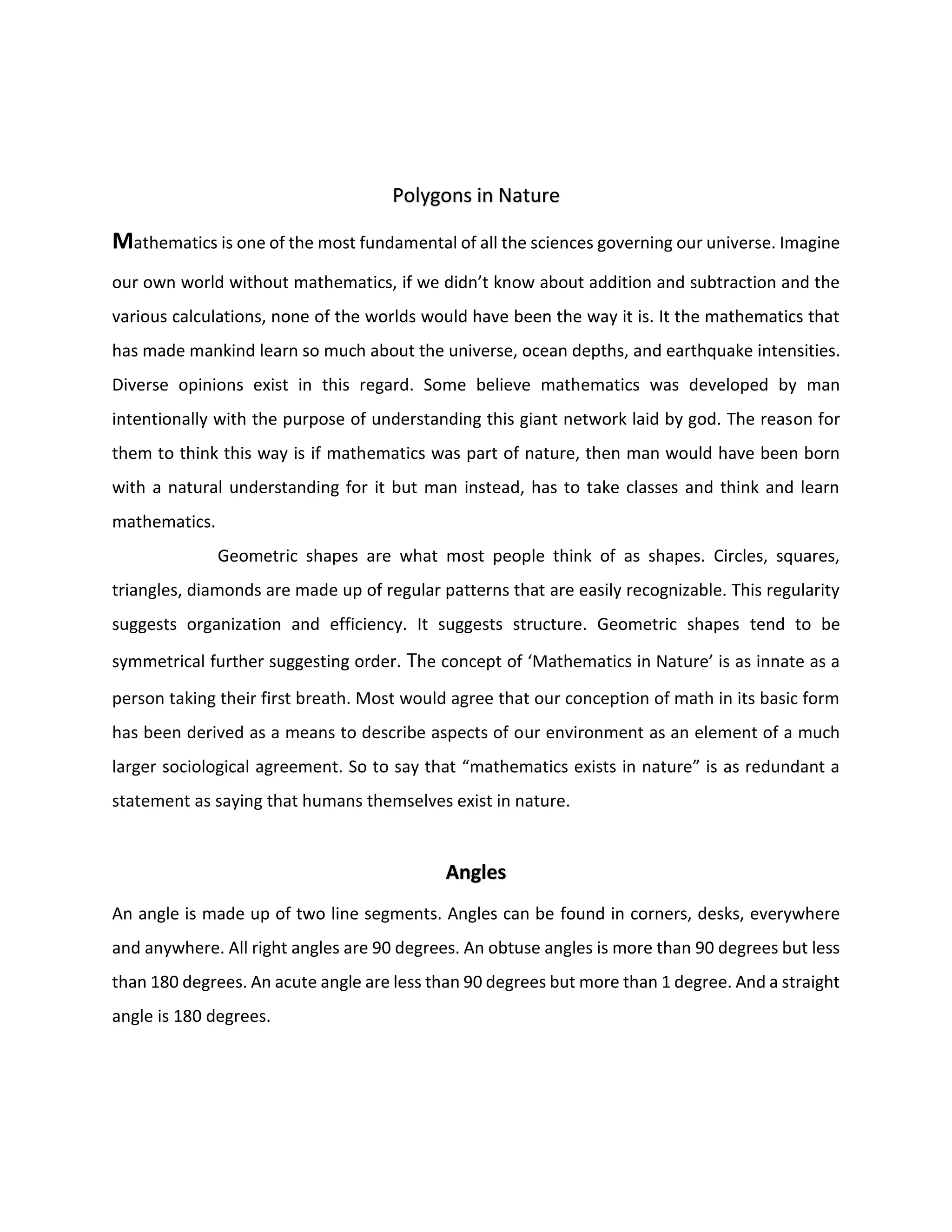
The finest examples are ones most difficult to reconcile with accepted theories. Mountains, rise
and fall subject to tectonic movement, seismic vibration, upheaval, and faulting, freezing,
thawing, lightning, wind and water erosion. A mountain form results from a potpourri of random
effects spanning millions of years.
Good lord, there’s triangles everywhere. Not kind of triangular, but sharp-edged and consistently
angled, that repeat over and over. And to think this could happen from millions of independent,
random forces acting over millions of years.
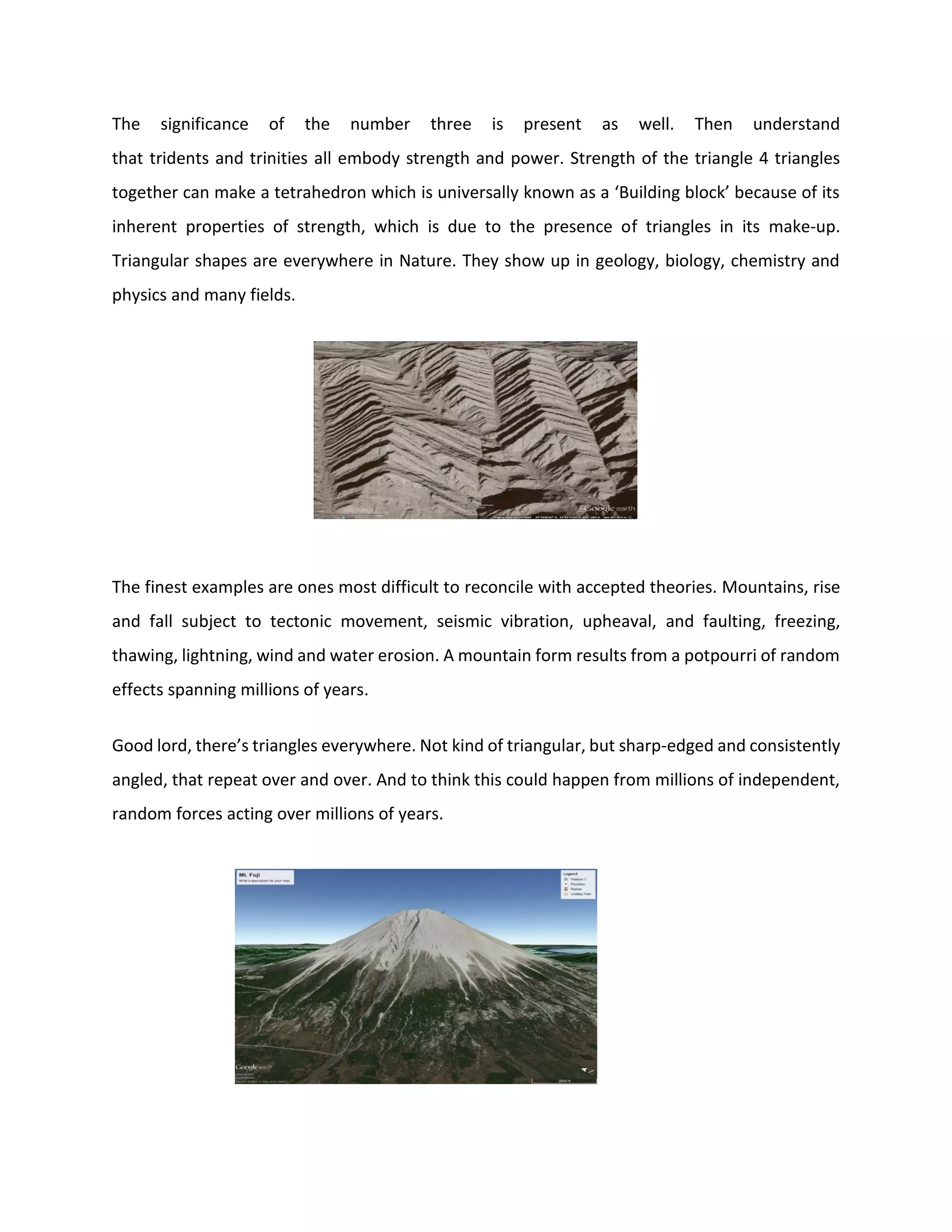
Geologists say the cause is mainly erosion. Water follows faults, and cracks, carrying away soil,
and rock. Rain collects into runnels that collect into streams, and funnel into ever narrower
channels of flow, leaving triangular pyramids between canyons. Look at these volcanoes. Their
flanks are no different than mountains, and they certainly show water erosion.
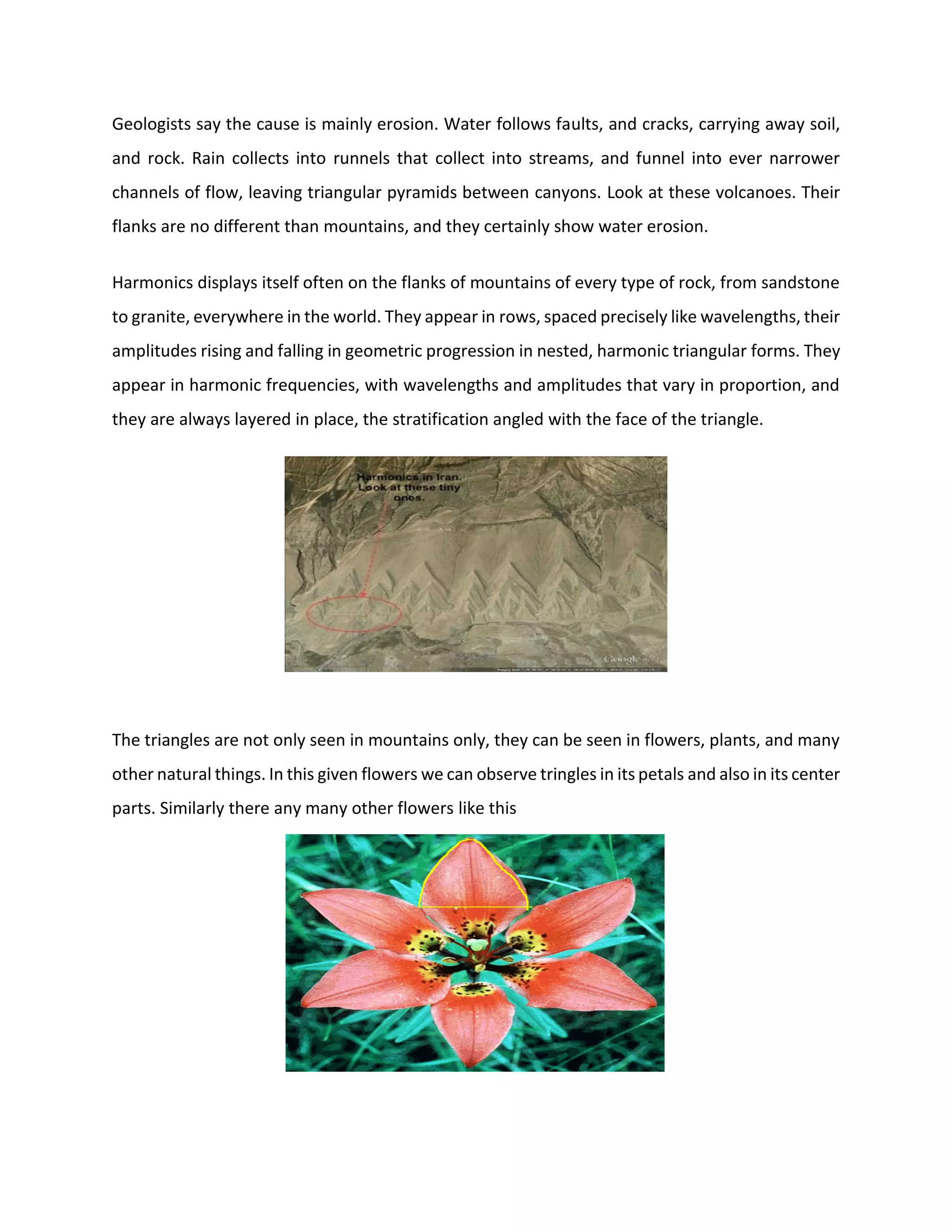
Harmonics displays itself often on the flanks of mountains of every type of rock, from sandstone
to granite, everywhere in the world. They appear in rows, spaced precisely like wavelengths, their
amplitudes rising and falling in geometric progression in nested, harmonic triangular forms. They
appear in harmonic frequencies, with wavelengths and amplitudes that vary in proportion, and
they are always layered in place, the stratification angled with the face of the triangle.
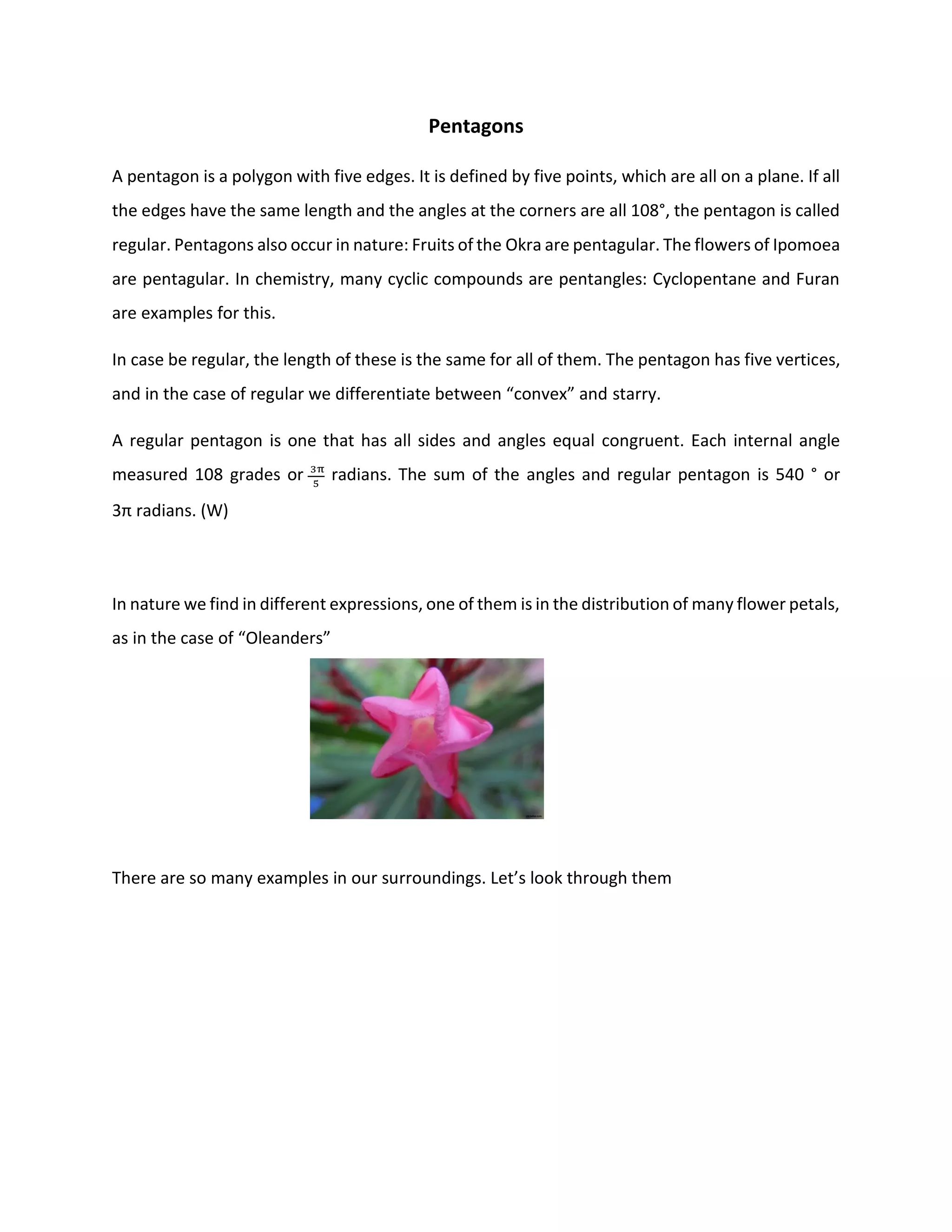
The triangles are not only seen in mountains only, they can be seen in flowers, plants, and many
other natural things. In this given flowers we can observe tringles in its petals and also in its center
parts. Similarly there any many other flowers like this
Trillium and Spiderwort flowers form with 3 petals in a triangle arrangement. Oxalis or Clover display tri
form leaves and many seed pods form into triangular shapes.
Not only in flowers triangles can also been seen in grass and in fields also
Quadrilaterals
In Euclidean plane geometry, a rectangle is a quadrilateral with four right angles. It can also be
defined as an equiangular quadrilateral, since equiangular means that all of its angles are equal
(360°/4 = 90°). It can also be defined as a parallelogram containing a right angle. A rectangle with
four sides of equal length is a square. The term oblong is occasionally used to refer to a non-
square rectangle. A rectangle with vertices ABCD would be denoted as ABCD.
The word rectangle comes from the Latin rectangulus, which is a combination of rectus (as an
adjective, right, proper) and angulus (angle).
A crossed rectangle is a crossed (self-intersecting) quadrilateral which consists of two opposite
sides of a rectangle along with the two diagonals. It is a special case of an antiparallelogram, and
its angles are not right angles. Other geometries, such as spherical, elliptic, and hyperbolic, have
so-called rectangles with opposite sides equal in length and equal angles that are not right angles.
What force formed the boxes is very likely to form the quadrilateral and other shapes around it.
They are mostly the same material, height and thickness. We can also see quadrilaterals in many
places of our nature
Pentagons
A pentagon is a polygon with five edges. It is defined by five points, which are all on a plane. If all
the edges have the same length and the angles at the corners are all 108°, the pentagon is called
regular. Pentagons also occur in nature: Fruits of the Okra are pentagular. The flowers of Ipomoea
are pentagular. In chemistry, many cyclic compounds are pentangles: Cyclopentane and Furan
are examples for this.
In case be regular, the length of these is the same for all of them. The pentagon has five vertices,
and in the case of regular we differentiate between “convex” and starry.
A regular pentagon is one that has all sides and angles equal congruent. Each internal angle
measured 108 grades or 3π
5
radians. The sum of the angles and regular pentagon is 540 ° or
3π radians. (W)
In nature we find in different expressions, one of them is in the distribution of many flower petals,
as in the case of “Oleanders”
There are so many examples in our surroundings. Let’s look through them
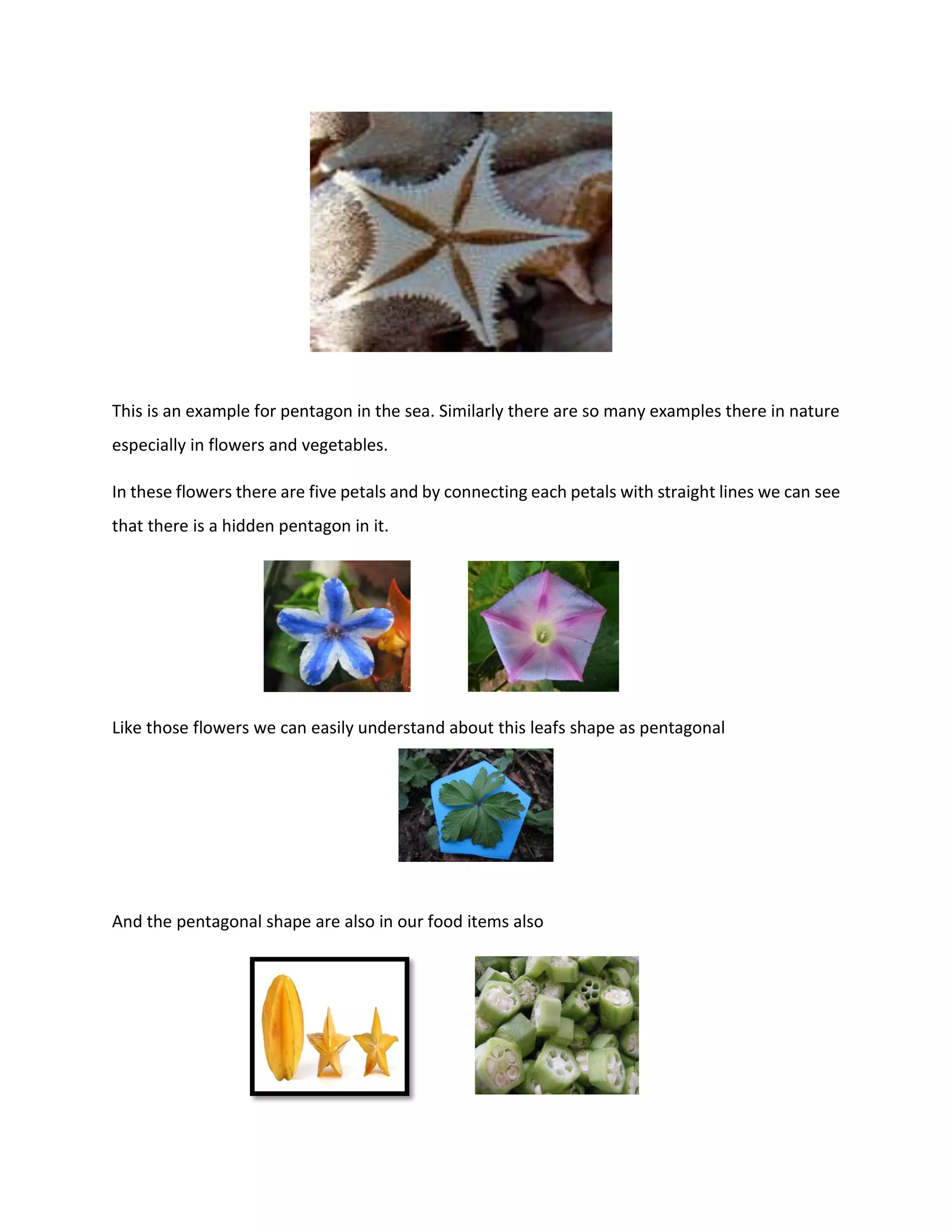
This is an example for pentagon in the sea. Similarly there are so many examples there in nature
especially in flowers and vegetables.
In these flowers there are five petals and by connecting each petals with straight lines we can see
that there is a hidden pentagon in it.
Like those flowers we can easily understand about this leafs shape as pentagonal
And the pentagonal shape are also in our food items also
Hexagons
In geometry, a hexagon is a six sided polygon or 6-gon. The total of the internal angles of any
hexagon is 720°.
The Checkerboard Wrasse found in the waters of the Arabian Peninsula
Hexagonal honey comb
Air bubbles in liquid solutions
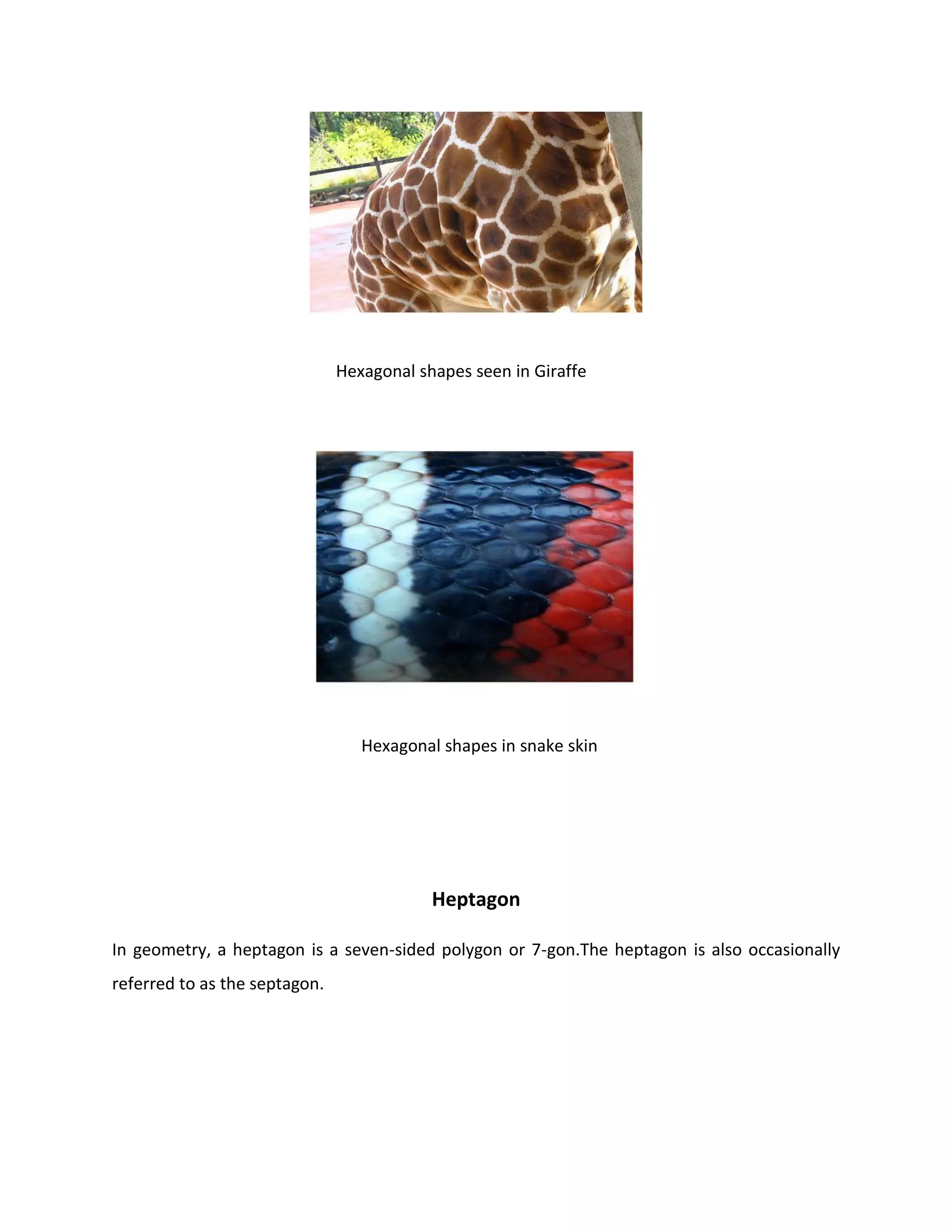
Hexagonal shapes seen in Giraffe
Hexagonal shapes in snake skin
Heptagon
In geometry, a heptagon is a seven-sided polygon or 7-gon.The heptagon is also occasionally
referred to as the septagon.
using "sept-" (an elision of septua-, a Latin-derived numerical prefix, rather than hepta-, a Greek
derived numerical prefix) together with the Greek suffix "-agon" meaning angle. A regular
heptagon, in which all sides and all angles are equal, has internal angles of 5π/7 radians (1284/7
degrees).
Octagon
In geometry, an octagon is an eight-sided polygon or 8-gon.The sum of all the internal angles of
any octagon is 1080°. As with all polygons, the external angles total 360°.
Nonagon
All sides of a regular nonagon are the same length. Each corner is 147.27°. All corners added
together equal 6840°.
Through observing this plants leaf there are nine leafs in number. We can connect the tips of the
leafs by using a straight line it will form a nonagon
Here we can observe cracks on earth and the shape is nonagon
Decagons
A regular decagon has all sides of equal length and each internal angle will always be equal to
144°.All corners added together equal 1440°.
The flower have ten edges while connecting with straight lines throught the tip of the petals
In this vegitale also there is the shape of decagon in it.
Natural cracks are also have decagons on it
Dodecahedron
A pomegranate is mostly seeds, packed tightly under the skin. All surrounded in a juicy bag of
sweetness, but what is interesting is the way they stack. The way all the seeds fit together.
Similarly we can see the shape in bubbles also
Conclusion
We can observe so many patterns, shapes and mathematically related things in our
surroundings. The only reason for that is because mathematics is everywhere around us. Thus
we can say the previously derived truth that mathematics is the language of the Universe.so
many mathematicians are proved many things on the basis of these natural ideas. Mainly we can
say that those ideas are formed through the hints provided by the nature. Thus mathematics
dependent on nature and Mathematics is in nature.
References:
 Kritchlow, K., Islamic Patterns, Thames and Hudson: London, 1976.
 Pope, A. U., and Ackerman, P. (ed.), A Survey of Persian Art: from Prehistoric Times to the
Present, 6 Vols, Oxford University Press: London and New York, 1938, (and 3rd edn. 1965).
 Plato, Republic (trs. Robin Waterfield), Oxford University Press: Oxford, 1993
 Dunbabin, Katherine M. D. (2006). Mosaics of the Greek and Roman world. Cambridge
University Press. p. 280.
 www.Wikipedia.com
 www.Pinterest.com
 www.slideshare.com

Polygons in nature

  • 1.
    Polygons in Nature Mathematicsis one of the most fundamental of all the sciences governing our universe. Imagine our own world without mathematics, if we didn’t know about addition and subtraction and the various calculations, none of the worlds would have been the way it is. It the mathematics that has made mankind learn so much about the universe, ocean depths, and earthquake intensities. Diverse opinions exist in this regard. Some believe mathematics was developed by man intentionally with the purpose of understanding this giant network laid by god. The reason for them to think this way is if mathematics was part of nature, then man would have been born with a natural understanding for it but man instead, has to take classes and think and learn mathematics. Geometric shapes are what most people think of as shapes. Circles, squares, triangles, diamonds are made up of regular patterns that are easily recognizable. This regularity suggests organization and efficiency. It suggests structure. Geometric shapes tend to be symmetrical further suggesting order. The concept of ‘Mathematics in Nature’ is as innate as a person taking their first breath. Most would agree that our conception of math in its basic form has been derived as a means to describe aspects of our environment as an element of a much larger sociological agreement. So to say that “mathematics exists in nature” is as redundant a statement as saying that humans themselves exist in nature. Angles An angle is made up of two line segments. Angles can be found in corners, desks, everywhere and anywhere. All right angles are 90 degrees. An obtuse angles is more than 90 degrees but less than 180 degrees. An acute angle are less than 90 degrees but more than 1 degree. And a straight angle is 180 degrees.
  • 2.
    There are eight(8) different angles. They are adjacent, straight, acute, right, obtuse, and alternate and exterior angles. There are alternate interior angles, vertical angles, and complementary angles. Adjacent angles are two angles that share a ray, thereby being directly next to each other. Alternate exterior angles are angles located outside a set of parallel lines and on opposite sides of a transversal. Straight angles are just a straight line that is always 180 degrees and it never changes. Alternate interior angles located inside set of parallel lines and on opposite sides of the transversal. Vertical angles are the two non- adjacent angles formed when two straight lines intersect.
  • 3.
    Triangles A triangle isa polygon with three edges and three vertices. It is one of the basic shapes in geometry. In Euclidean geometry any three points, when non-collinear, determine a unique triangle and simultaneously, a unique plane. In other words, there is only one plane that contains that triangle, and every triangle is contained in some plane. If the entire geometry is only the Euclidean plane, there is only one plane and all triangles are contained in it. The first geometric shapes that can be created with the least amount of lines or points are Triangles. This representation of 3 can be found widely in natural forms from leaf forms to vegetables on our dinner plate, a natural triangle is probably seen every day.
  • 4.
    The significance ofthe number three is present as well. Then understand that tridents and trinities all embody strength and power. Strength of the triangle 4 triangles together can make a tetrahedron which is universally known as a ‘Building block’ because of its inherent properties of strength, which is due to the presence of triangles in its make-up. Triangular shapes are everywhere in Nature. They show up in geology, biology, chemistry and physics and many fields. The finest examples are ones most difficult to reconcile with accepted theories. Mountains, rise and fall subject to tectonic movement, seismic vibration, upheaval, and faulting, freezing, thawing, lightning, wind and water erosion. A mountain form results from a potpourri of random effects spanning millions of years. Good lord, there’s triangles everywhere. Not kind of triangular, but sharp-edged and consistently angled, that repeat over and over. And to think this could happen from millions of independent, random forces acting over millions of years.
  • 5.
    Geologists say thecause is mainly erosion. Water follows faults, and cracks, carrying away soil, and rock. Rain collects into runnels that collect into streams, and funnel into ever narrower channels of flow, leaving triangular pyramids between canyons. Look at these volcanoes. Their flanks are no different than mountains, and they certainly show water erosion. Harmonics displays itself often on the flanks of mountains of every type of rock, from sandstone to granite, everywhere in the world. They appear in rows, spaced precisely like wavelengths, their amplitudes rising and falling in geometric progression in nested, harmonic triangular forms. They appear in harmonic frequencies, with wavelengths and amplitudes that vary in proportion, and they are always layered in place, the stratification angled with the face of the triangle. The triangles are not only seen in mountains only, they can be seen in flowers, plants, and many other natural things. In this given flowers we can observe tringles in its petals and also in its center parts. Similarly there any many other flowers like this
  • 6.
    Trillium and Spiderwortflowers form with 3 petals in a triangle arrangement. Oxalis or Clover display tri form leaves and many seed pods form into triangular shapes. Not only in flowers triangles can also been seen in grass and in fields also
  • 7.
    Quadrilaterals In Euclidean planegeometry, a rectangle is a quadrilateral with four right angles. It can also be defined as an equiangular quadrilateral, since equiangular means that all of its angles are equal (360°/4 = 90°). It can also be defined as a parallelogram containing a right angle. A rectangle with four sides of equal length is a square. The term oblong is occasionally used to refer to a non- square rectangle. A rectangle with vertices ABCD would be denoted as ABCD. The word rectangle comes from the Latin rectangulus, which is a combination of rectus (as an adjective, right, proper) and angulus (angle). A crossed rectangle is a crossed (self-intersecting) quadrilateral which consists of two opposite sides of a rectangle along with the two diagonals. It is a special case of an antiparallelogram, and its angles are not right angles. Other geometries, such as spherical, elliptic, and hyperbolic, have so-called rectangles with opposite sides equal in length and equal angles that are not right angles. What force formed the boxes is very likely to form the quadrilateral and other shapes around it. They are mostly the same material, height and thickness. We can also see quadrilaterals in many places of our nature
  • 8.
    Pentagons A pentagon isa polygon with five edges. It is defined by five points, which are all on a plane. If all the edges have the same length and the angles at the corners are all 108°, the pentagon is called regular. Pentagons also occur in nature: Fruits of the Okra are pentagular. The flowers of Ipomoea are pentagular. In chemistry, many cyclic compounds are pentangles: Cyclopentane and Furan are examples for this. In case be regular, the length of these is the same for all of them. The pentagon has five vertices, and in the case of regular we differentiate between “convex” and starry. A regular pentagon is one that has all sides and angles equal congruent. Each internal angle measured 108 grades or 3π 5 radians. The sum of the angles and regular pentagon is 540 ° or 3π radians. (W) In nature we find in different expressions, one of them is in the distribution of many flower petals, as in the case of “Oleanders” There are so many examples in our surroundings. Let’s look through them
  • 9.
    This is anexample for pentagon in the sea. Similarly there are so many examples there in nature especially in flowers and vegetables. In these flowers there are five petals and by connecting each petals with straight lines we can see that there is a hidden pentagon in it. Like those flowers we can easily understand about this leafs shape as pentagonal And the pentagonal shape are also in our food items also
  • 10.
    Hexagons In geometry, ahexagon is a six sided polygon or 6-gon. The total of the internal angles of any hexagon is 720°. The Checkerboard Wrasse found in the waters of the Arabian Peninsula Hexagonal honey comb Air bubbles in liquid solutions
  • 11.
    Hexagonal shapes seenin Giraffe Hexagonal shapes in snake skin Heptagon In geometry, a heptagon is a seven-sided polygon or 7-gon.The heptagon is also occasionally referred to as the septagon.
  • 12.
    using "sept-" (anelision of septua-, a Latin-derived numerical prefix, rather than hepta-, a Greek derived numerical prefix) together with the Greek suffix "-agon" meaning angle. A regular heptagon, in which all sides and all angles are equal, has internal angles of 5π/7 radians (1284/7 degrees). Octagon In geometry, an octagon is an eight-sided polygon or 8-gon.The sum of all the internal angles of any octagon is 1080°. As with all polygons, the external angles total 360°.
  • 13.
    Nonagon All sides ofa regular nonagon are the same length. Each corner is 147.27°. All corners added together equal 6840°. Through observing this plants leaf there are nine leafs in number. We can connect the tips of the leafs by using a straight line it will form a nonagon
  • 14.
    Here we canobserve cracks on earth and the shape is nonagon Decagons A regular decagon has all sides of equal length and each internal angle will always be equal to 144°.All corners added together equal 1440°. The flower have ten edges while connecting with straight lines throught the tip of the petals
  • 15.
    In this vegitalealso there is the shape of decagon in it. Natural cracks are also have decagons on it
  • 16.
    Dodecahedron A pomegranate ismostly seeds, packed tightly under the skin. All surrounded in a juicy bag of sweetness, but what is interesting is the way they stack. The way all the seeds fit together. Similarly we can see the shape in bubbles also
  • 17.
    Conclusion We can observeso many patterns, shapes and mathematically related things in our surroundings. The only reason for that is because mathematics is everywhere around us. Thus we can say the previously derived truth that mathematics is the language of the Universe.so many mathematicians are proved many things on the basis of these natural ideas. Mainly we can say that those ideas are formed through the hints provided by the nature. Thus mathematics dependent on nature and Mathematics is in nature. References:  Kritchlow, K., Islamic Patterns, Thames and Hudson: London, 1976.  Pope, A. U., and Ackerman, P. (ed.), A Survey of Persian Art: from Prehistoric Times to the Present, 6 Vols, Oxford University Press: London and New York, 1938, (and 3rd edn. 1965).  Plato, Republic (trs. Robin Waterfield), Oxford University Press: Oxford, 1993  Dunbabin, Katherine M. D. (2006). Mosaics of the Greek and Roman world. Cambridge University Press. p. 280.  www.Wikipedia.com  www.Pinterest.com  www.slideshare.com