John NewquistDraft 9 28 2020
Noise and Hearing
Conservation
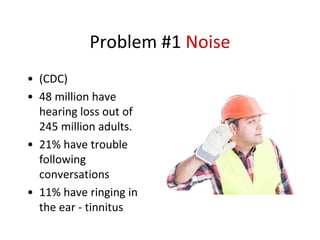
Problem #1 Noise
• (CDC)
• 48 million have
hearing loss out of
245 million adults.
• 21% have trouble
following
conversations
• 11% have ringing in
the ear - tinnitus
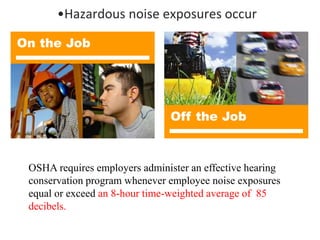
•Hazardous noise exposures occur
On the Job
Off the Job
OSHA requires employers administer an effective hearing
conservation program whenever employee noise exposures
equal or exceed an 8-hour time-weighted average of 85
decibels.
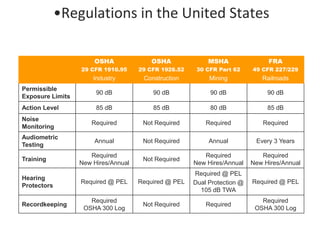
•Regulations in the United States
OSHA
29 CFR 1910.95
Industry
OSHA
29 CFR 1926.52
Construction
MSHA
30 CFR Part 62
Mining
FRA
49 CFR 227/229
Railroads
Permissible
Exposure Limits
90 dB 90 dB 90 dB 90 dB
Action Level 85 dB 85 dB 80 dB 85 dB
Noise
Monitoring
Required Not Required Required Required
Audiometric
Testing
Annual Not Required Annual Every 3 Years
Training
Required
New Hires/Annual
Not Required
Required
New Hires/Annual
Required
New Hires/Annual
Hearing
Protectors
Required @ PEL Required @ PEL
Required @ PEL
Dual Protection @
105 dB TWA
Required @ PEL
Recordkeeping
Required
OSHA 300 Log
Not Required Required
Required
OSHA 300 Log
Factors
• Genetics
• Age
• Health status
• Route of entry
• Frequency and
duration of exposure
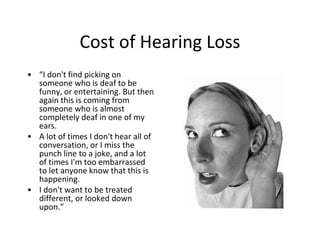
Cost of Hearing Loss
• “I don't find picking on
someone who is deaf to be
funny, or entertaining. But then
again this is coming from
someone who is almost
completely deaf in one of my
ears.
• A lot of times I don't hear all of
conversation, or I miss the
punch line to a joke, and a lot
of times I'm too embarrassed
to let anyone know that this is
happening.
• I don't want to be treated
different, or looked down
upon.”
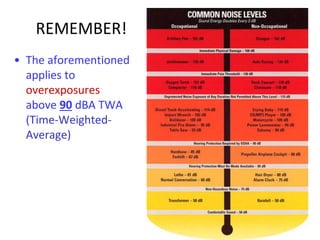
REMEMBER!
• The aforementioned
applies to
overexposures
above 90 dBA TWA
(Time-Weighted-
Average)
Acute Exposure
• Acute exposures and acute effects
generally involve short-term, high
concentrations, and immediate or prompt
health effects (illness, irritation, or death).
Chronic Exposure
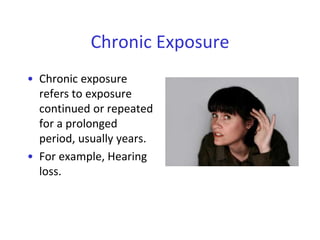
• Chronic exposure
refers to exposure
continued or repeated
for a prolonged
period, usually years.
• For example, Hearing
loss.
Tinnitis
–Noise-Induced Hearing Loss
•Causes no pain
•Causes no visible trauma
•Leaves no visible scars
•Is unnoticeable in its earliest stages
•Accumulates with each overexposure
•Takes years to notice a change
Is Permanent + 100% Preventable
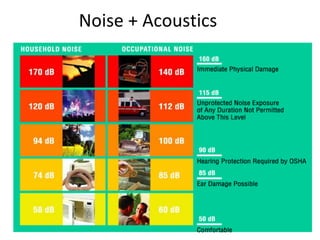
Noise + Acoustics
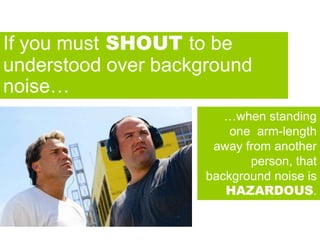
Noise + AcousticsIf you must SHOUT to be
understood over background
noise…
…when standing
one arm-length
away from another
person, that
background noise is
HAZARDOUS.
Noise + AcousticsDo jets, stereos, my neighbor’s
dog, air conditioner or mobile
phones cause NIHL?
• To damage hearing, noise must be of
sufficient intensity and duration
• Annoyance noises generally do not have
the same intensity or duration to cause
damage
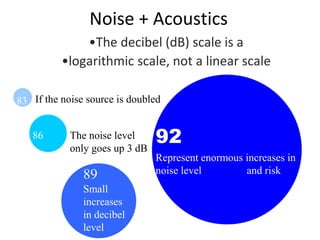
Noise + Acoustics
•The decibel (dB) scale is a
•logarithmic scale, not a linear scale
89
Small
increases
in decibel
level
The noise level
only goes up 3 dB
86
83 If the noise source is doubled
92
Represent enormous increases in
noise level and risk
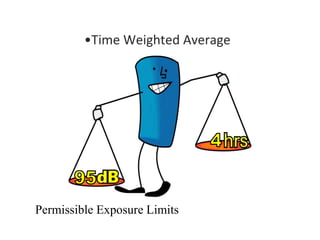
•Time Weighted Average
Permissible Exposure Limits
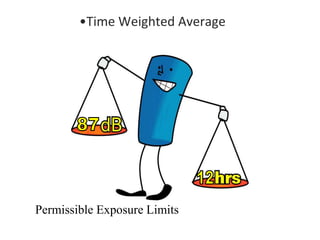
•Time Weighted Average
Permissible Exposure Limits
•Time Weighted Average
Permissible Exposure Limits
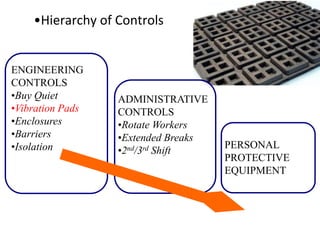
ADMINISTRATIVE
CONTROLS
•Rotate Workers
•Extended Breaks
•2nd/3rd Shift
ENGINEERING
CONTROLS
•Buy Quiet
•Vibration Pads
•Enclosures
•Barriers
•Isolation PERSONAL
PROTECTIVE
EQUIPMENT
Noise + Acoustics
•Hierarchy of Controls
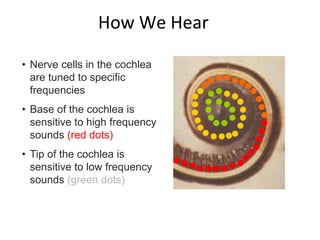
How We Hear
• Nerve cells in the cochlea
are tuned to specific
frequencies
• Base of the cochlea is
sensitive to high frequency
sounds (red dots)
• Tip of the cochlea is
sensitive to low frequency
sounds (green dots)
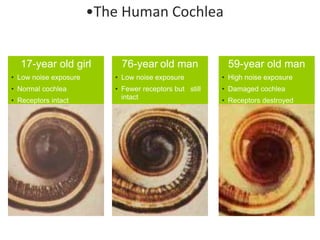
17-year old girl
• Low noise exposure
• Normal cochlea
• Receptors intact
76-year old man
• Low noise exposure
• Fewer receptors but still
intact
59-year old man
• High noise exposure
• Damaged cochlea
• Receptors destroyed
•The Human Cochlea
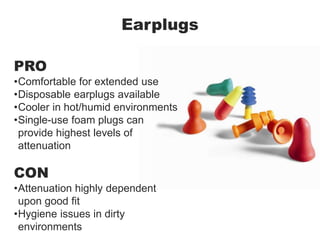
Earplugs
PRO
•Comfortable for extended use
•Disposable earplugs available
•Cooler in hot/humid environments
•Single-use foam plugs can
provide highest levels of
attenuation
CON
•Attenuation highly dependent
upon good fit
•Hygiene issues in dirty
environments
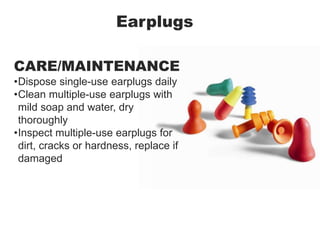
Earplugs
CARE/MAINTENANCE
•Dispose single-use earplugs daily
•Clean multiple-use earplugs with
mild soap and water, dry
thoroughly
•Inspect multiple-use earplugs for
dirt, cracks or hardness, replace if
damaged
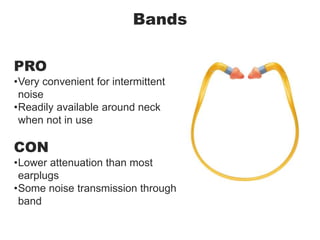
Bands
PRO
•Very convenient for intermittent
noise
•Readily available around neck
when not in use
CON
•Lower attenuation than most
earplugs
•Some noise transmission through
band
Bands
CARE/MAINTENANCE
•Clean and replace pods regularly
•Do not overstretch band
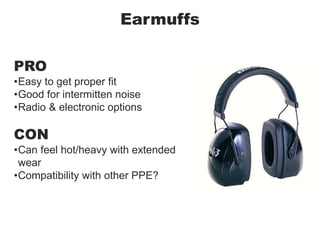
Earmuffs
PRO
•Easy to get proper fit
•Good for intermitten noise
•Radio & electronic options
CON
•Can feel hot/heavy with extended
wear
•Compatibility with other PPE?
Earmuffs
CARE/MAINTENANCE
•Clean ear cushions and
headband regularly with mild soap
and water
•Replace ear cushions and foam
inserts every 4-6 months with
normal wear, more often with
heavy use/extreme conditions
•Do not overstretch headband
Comfort
Noise Reduction
Size
Communication
Job Requirements
Hygiene
Use with Other PPE
Hearing Protection Selection Factors
• The right hearing
protector should feel
comfortable
• One protector may
not satisfy all workers
• Offer a variety of
earplugs or earmuffs
to meet varying
worker needs and
preferences
• Selecting HPDs with
suitable attenuation
for noise environment
• Avoid overprotection
in marginal noise
environments
• Consider banded
earplugs for
intermittent noise or
electronic earmuffs for
impact noise.
• Every ear canal has
its own shape and
size
• Ensure proper fit with
variety of earplug
sizes and shapes
• Sized multiple-use
earplugs
• Low-pressure foam
earplugs for smaller
ear canals
• Keep workers
connected to their
environment
• Uniform attenuation
allows speech/signals
to be hear more
naturally
• Sound amplification
earmuffs for workers
with hearing
impairment
• Consider job
requirements in HPD
selection
• Detectable earplugs
for process industries
• Hi-visibility earmuffs
for dark/high traffic
areas
• Dielectric HPDs for
electrical
environments
• Proper care and
maintenance can
extend life and
performance of HPDs
• Examine and clean
all multiple-use
earplugs daily
• Clean and replace
ear cushions on
earmuffs every 4-6
months
• Select HPDs that can
work with other PPE
without compromise
• Cap-mounted
earmuffs for hard
hats
• Multiple-position
earmuffs for full-brim
hard hats
• Ultraslim neckband
earmuffs with welding
shields
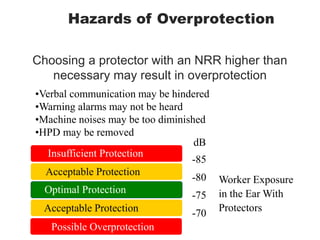
Choosing a protector with an NRR higher than
necessary may result in overprotection
Insufficient Protection
Optimal Protection
Acceptable Protection
Possible Overprotection
-85
-80
-75
-70
Worker Exposure
in the Ear With
Protectors
dB
-85
-80
-75
-70
dB
•Verbal communication may be hindered
•Warning alarms may not be heard
•Machine noises may be too diminished
•HPD may be removed
Hazards of Overprotection
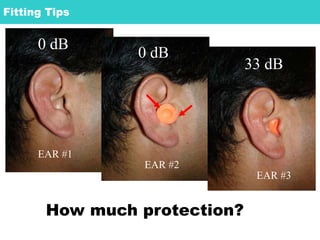
How much protection?
0 dB
0 dB
33 dB
EAR #1
EAR #2
EAR #3
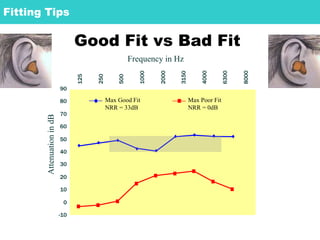
Fitting Tips
-10
125
250
500
1000
2000
3150
4000
6300
8000
Frequency in Hz
90
80
70
60
50
40
30
20
10
0
AttenuationindB
Max Poor Fit
NRR = 0dB
Max Good Fit
NRR = 33dB
Good Fit vs Bad Fit
Fitting Tips
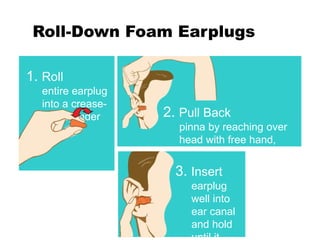
Roll-Down Foam Earplugs
2. Pull Back
pinna by reaching over
head with free hand,
gently pull top of ear up
and out
1. Roll
entire earplug
into a crease-
free cylinder
3. Insert
earplug
well into
ear canal
and hold
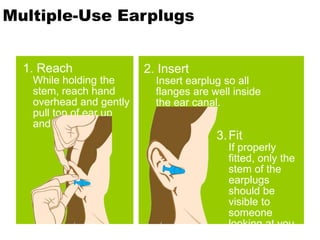
Multiple-Use Earplugs
1. Reach
While holding the
stem, reach hand
overhead and gently
pull top of ear up
and back.
2. Insert
Insert earplug so all
flanges are well inside
the ear canal.
3.Fit
If properly
fitted, only the
stem of the
earplugs
should be
visible to
someone
looking at you
from the front.
Visual + Acoustical Checks
2. Acoustical Check
Cup hands over ears
and release. Earplugs
should block enough
noise so that covering
your ears with hands
should not result in a
significant noise
difference.
1. Visual Check
The earplug should sit
well inside the ear canal
and not stick out.
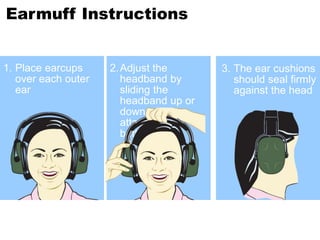
Earmuff Instructions
1. Place earcups
over each outer
ear
2.Adjust the
headband by
sliding the
headband up or
down at the
attachment
buttons
3. The ear cushions
should seal firmly
against the head
Top Cited #1
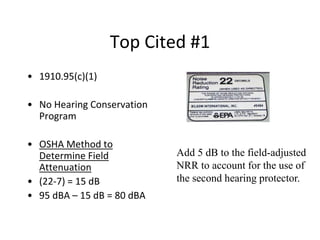
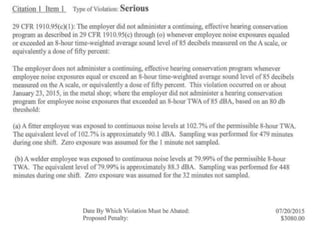
• 1910.95(c)(1)
• No Hearing Conservation
Program
• OSHA Method to
Determine Field
Attenuation
• (22-7) = 15 dB
• 95 dBA – 15 dB = 80 dBA
Add 5 dB to the field-adjusted
NRR to account for the use of
the second hearing protector.
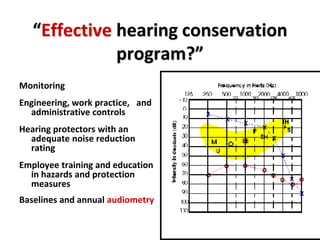
“Effective hearing conservation
program?”
Monitoring
Engineering, work practice, and
administrative controls
Hearing protectors with an
adequate noise reduction
rating
Employee training and education
in hazards and protection
measures
Baselines and annual audiometry
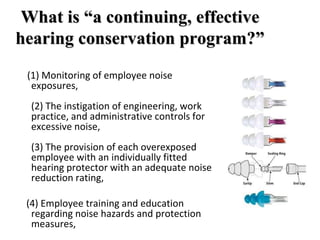
What is “a continuing, effective
hearing conservation program?”
(1) Monitoring of employee noise
exposures,
(2) The instigation of engineering, work
practice, and administrative controls for
excessive noise,
(3) The provision of each overexposed
employee with an individually fitted
hearing protector with an adequate noise
reduction rating,
(4) Employee training and education
regarding noise hazards and protection
measures,
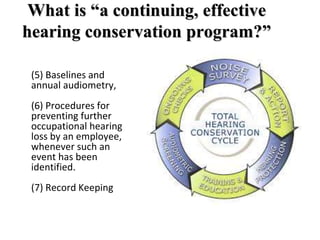
What is “a continuing, effective
hearing conservation program?”
(5) Baselines and
annual audiometry,
(6) Procedures for
preventing further
occupational hearing
loss by an employee,
whenever such an
event has been
identified.
(7) Record Keeping
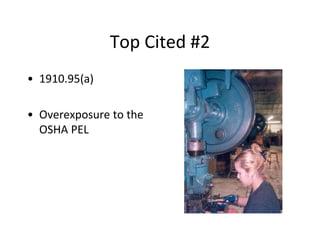
Top Cited #2
• 1910.95(a)
• Overexposure to the
OSHA PEL
Sampling
• Qualified person
• Appropriate
instrument
• Duration of sampling
• Pre and post
calibration
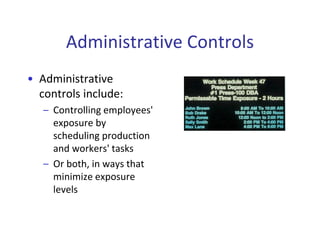
Administrative Controls
• Administrative
controls include:
– Controlling employees'
exposure by
scheduling production
and workers' tasks
– Or both, in ways that
minimize exposure
levels
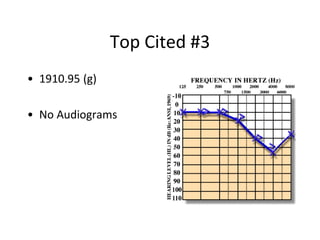
Top Cited #3
• 1910.95 (g)
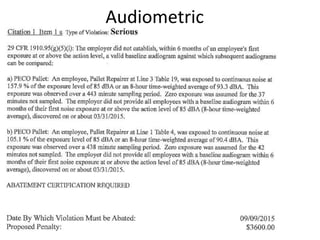
• No Audiograms
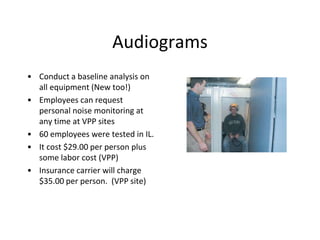
Audiograms
• Conduct a baseline analysis on
all equipment (New too!)
• Employees can request
personal noise monitoring at
any time at VPP sites
• 60 employees were tested in IL.
• It cost $29.00 per person plus
some labor cost (VPP)
• Insurance carrier will charge
$35.00 per person. (VPP site)
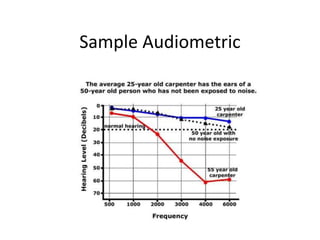
Audiometric
Sample Audiometric
Top Cited #4
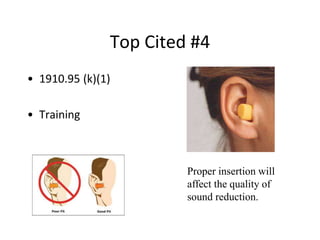
• 1910.95 (k)(1)
• Training
Proper insertion will
affect the quality of
sound reduction.
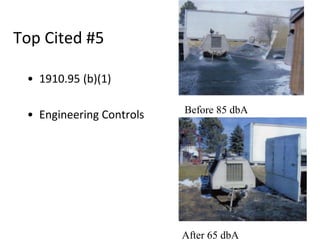
Top Cited #5
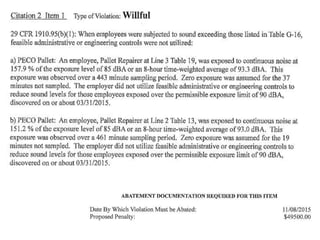
• 1910.95 (b)(1)
• Engineering Controls Before 85 dbA
After 65 dbA
Engineering Controls
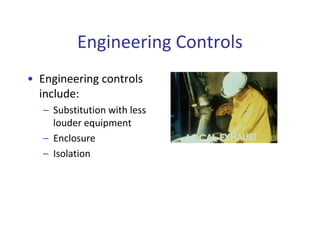
• Engineering controls
include:
– Substitution with less
louder equipment
– Enclosure
– Isolation
Top Cited #6
• 1910.95 (L)(1)
• Access to the standard
and posting of the noise
standard.
• The intent of this
requirement to post a
copy of the noise
standard is to ensure that
employees are able to
read the standard without
having to ask for it
Worker Compensation
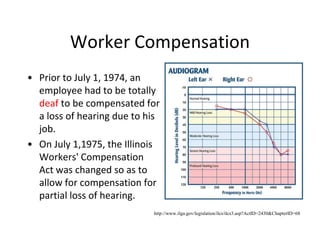
• Prior to July 1, 1974, an
employee had to be totally
deaf to be compensated for
a loss of hearing due to his
job.
• On July 1,1975, the Illinois
Workers' Compensation
Act was changed so as to
allow for compensation for
partial loss of hearing.
http://www.ilga.gov/legislation/ilcs/ilcs3.asp?ActID=2430&ChapterID=68
Worker Compensation
• First, the employee must
establish that he was exposed to
loud noise over a period of time.
• Second, there is usually the
subjective sign of sounds in the
ear after work, (Tinnitus).
• Next, there is a test of the
hearing loss by an audiologist to
indicate that there is a loss of
hearing.
• Loss over 30 Dba over 1000,
2000, 3000 hrz is compensible.
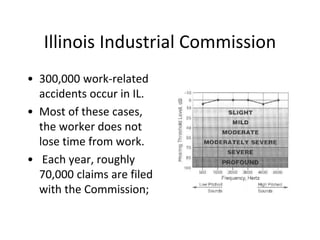
Illinois Industrial Commission
• 300,000 work-related
accidents occur in IL.
• Most of these cases,
the worker does not
lose time from work.
• Each year, roughly
70,000 claims are filed
with the Commission;
Illinois Industrial Commission
• The hearing of one ear:
• Due to an accident or
trauma 50 weeks paid
• Due to an occupational
disease 100 weeks paid
• The hearing of both ears
200 weeks paid
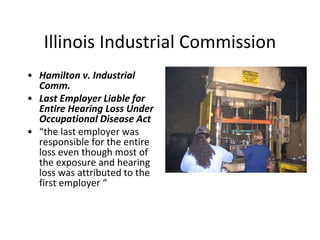
Illinois Industrial Commission
• Hamilton v. Industrial
Comm.
• Last Employer Liable for
Entire Hearing Loss Under
Occupational Disease Act
• “the last employer was
responsible for the entire
loss even though most of
the exposure and hearing
loss was attributed to the
first employer “
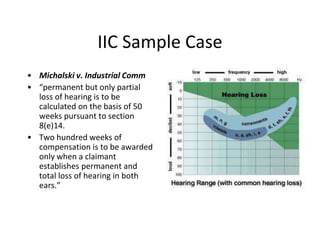
IIC Sample Case
• Michalski v. Industrial Comm
• “permanent but only partial
loss of hearing is to be
calculated on the basis of 50
weeks pursuant to section
8(e)14.
• Two hundred weeks of
compensation is to be awarded
only when a claimant
establishes permanent and
total loss of hearing in both
ears.”
Benefits of a Hearing
Conservation Program
Hearing Loss
Affects Safety
Program
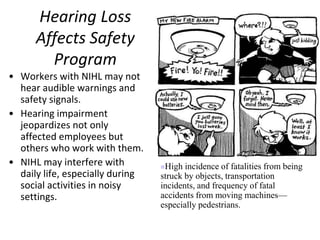
• Workers with NIHL may not
hear audible warnings and
safety signals.
• Hearing impairment
jeopardizes not only
affected employees but
others who work with them.
• NIHL may interfere with
daily life, especially during
social activities in noisy
settings.
High incidence of fatalities from being
struck by objects, transportation
incidents, and frequency of fatal
accidents from moving machines—
especially pedestrians.
Hearing Loss Affects
Safety Program
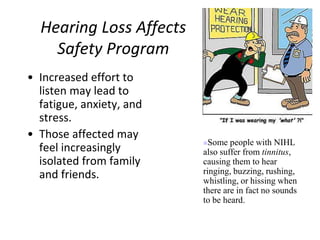
• Increased effort to
listen may lead to
fatigue, anxiety, and
stress.
• Those affected may
feel increasingly
isolated from family
and friends.
Some people with NIHL
also suffer from tinnitus,
causing them to hear
ringing, buzzing, rushing,
whistling, or hissing when
there are in fact no sounds
to be heard.
Comments• “Audiogram cost was
minimal”
• “Cost is the easy part.”
• “Was not hard to do
except the time to do
dosimetry”
• “Insurance companies
will often do
monitoring”
• “Program was easily
accomplished using a
safety consultant”
Comments
(continued)
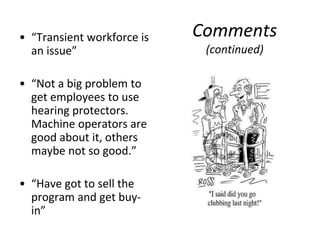
• “Transient workforce is
an issue”
• “Not a big problem to
get employees to use
hearing protectors.
Machine operators are
good about it, others
maybe not so good.”
• “Have got to sell the
program and get buy-
in”
Summary• 1. Conduct employee noise
monitoring,
• 2. Reduce noise levels with
feasible controls if employees’ 8-
hour average noise level exceeds
90 decibels,
• 3. Make sure employees wear
hearing protection when exposed
to 8-hour average noise levels of
85 decibels or greater,
• 4. Train employees about the
effects of noise and use of
hearing protection,
• 5. Periodically check employee’s
hearing with audiometric testing,
• 6. Post warning signs at high
noise areas above 115 decibels.

Noise and Hearing Conservation 2020

  • 1.
    John NewquistDraft 928 2020 Noise and Hearing Conservation
  • 2.
    Problem #1 Noise •(CDC) • 48 million have hearing loss out of 245 million adults. • 21% have trouble following conversations • 11% have ringing in the ear - tinnitus
  • 3.
    •Hazardous noise exposuresoccur On the Job Off the Job OSHA requires employers administer an effective hearing conservation program whenever employee noise exposures equal or exceed an 8-hour time-weighted average of 85 decibels.
  • 4.
    •Regulations in theUnited States OSHA 29 CFR 1910.95 Industry OSHA 29 CFR 1926.52 Construction MSHA 30 CFR Part 62 Mining FRA 49 CFR 227/229 Railroads Permissible Exposure Limits 90 dB 90 dB 90 dB 90 dB Action Level 85 dB 85 dB 80 dB 85 dB Noise Monitoring Required Not Required Required Required Audiometric Testing Annual Not Required Annual Every 3 Years Training Required New Hires/Annual Not Required Required New Hires/Annual Required New Hires/Annual Hearing Protectors Required @ PEL Required @ PEL Required @ PEL Dual Protection @ 105 dB TWA Required @ PEL Recordkeeping Required OSHA 300 Log Not Required Required Required OSHA 300 Log
  • 6.
    Factors • Genetics • Age •Health status • Route of entry • Frequency and duration of exposure
  • 7.
    Cost of HearingLoss • “I don't find picking on someone who is deaf to be funny, or entertaining. But then again this is coming from someone who is almost completely deaf in one of my ears. • A lot of times I don't hear all of conversation, or I miss the punch line to a joke, and a lot of times I'm too embarrassed to let anyone know that this is happening. • I don't want to be treated different, or looked down upon.”
  • 8.
    REMEMBER! • The aforementioned appliesto overexposures above 90 dBA TWA (Time-Weighted- Average)
  • 9.
    Acute Exposure • Acuteexposures and acute effects generally involve short-term, high concentrations, and immediate or prompt health effects (illness, irritation, or death).
  • 10.
    Chronic Exposure • Chronicexposure refers to exposure continued or repeated for a prolonged period, usually years. • For example, Hearing loss.
  • 11.
  • 12.
    –Noise-Induced Hearing Loss •Causesno pain •Causes no visible trauma •Leaves no visible scars •Is unnoticeable in its earliest stages •Accumulates with each overexposure •Takes years to notice a change Is Permanent + 100% Preventable
  • 13.
  • 14.
    Noise + AcousticsIfyou must SHOUT to be understood over background noise… …when standing one arm-length away from another person, that background noise is HAZARDOUS.
  • 15.
    Noise + AcousticsDojets, stereos, my neighbor’s dog, air conditioner or mobile phones cause NIHL? • To damage hearing, noise must be of sufficient intensity and duration • Annoyance noises generally do not have the same intensity or duration to cause damage
  • 16.
    Noise + Acoustics •Thedecibel (dB) scale is a •logarithmic scale, not a linear scale 89 Small increases in decibel level The noise level only goes up 3 dB 86 83 If the noise source is doubled 92 Represent enormous increases in noise level and risk
  • 17.
  • 18.
  • 19.
  • 20.
    ADMINISTRATIVE CONTROLS •Rotate Workers •Extended Breaks •2nd/3rdShift ENGINEERING CONTROLS •Buy Quiet •Vibration Pads •Enclosures •Barriers •Isolation PERSONAL PROTECTIVE EQUIPMENT Noise + Acoustics •Hierarchy of Controls
  • 21.
    How We Hear •Nerve cells in the cochlea are tuned to specific frequencies • Base of the cochlea is sensitive to high frequency sounds (red dots) • Tip of the cochlea is sensitive to low frequency sounds (green dots)
  • 22.
    17-year old girl •Low noise exposure • Normal cochlea • Receptors intact 76-year old man • Low noise exposure • Fewer receptors but still intact 59-year old man • High noise exposure • Damaged cochlea • Receptors destroyed •The Human Cochlea
  • 23.
    Earplugs PRO •Comfortable for extendeduse •Disposable earplugs available •Cooler in hot/humid environments •Single-use foam plugs can provide highest levels of attenuation CON •Attenuation highly dependent upon good fit •Hygiene issues in dirty environments
  • 24.
    Earplugs CARE/MAINTENANCE •Dispose single-use earplugsdaily •Clean multiple-use earplugs with mild soap and water, dry thoroughly •Inspect multiple-use earplugs for dirt, cracks or hardness, replace if damaged
  • 25.
    Bands PRO •Very convenient forintermittent noise •Readily available around neck when not in use CON •Lower attenuation than most earplugs •Some noise transmission through band
  • 26.
    Bands CARE/MAINTENANCE •Clean and replacepods regularly •Do not overstretch band
  • 27.
    Earmuffs PRO •Easy to getproper fit •Good for intermitten noise •Radio & electronic options CON •Can feel hot/heavy with extended wear •Compatibility with other PPE?
  • 28.
    Earmuffs CARE/MAINTENANCE •Clean ear cushionsand headband regularly with mild soap and water •Replace ear cushions and foam inserts every 4-6 months with normal wear, more often with heavy use/extreme conditions •Do not overstretch headband
  • 29.
    Comfort Noise Reduction Size Communication Job Requirements Hygiene Usewith Other PPE Hearing Protection Selection Factors • The right hearing protector should feel comfortable • One protector may not satisfy all workers • Offer a variety of earplugs or earmuffs to meet varying worker needs and preferences • Selecting HPDs with suitable attenuation for noise environment • Avoid overprotection in marginal noise environments • Consider banded earplugs for intermittent noise or electronic earmuffs for impact noise. • Every ear canal has its own shape and size • Ensure proper fit with variety of earplug sizes and shapes • Sized multiple-use earplugs • Low-pressure foam earplugs for smaller ear canals • Keep workers connected to their environment • Uniform attenuation allows speech/signals to be hear more naturally • Sound amplification earmuffs for workers with hearing impairment • Consider job requirements in HPD selection • Detectable earplugs for process industries • Hi-visibility earmuffs for dark/high traffic areas • Dielectric HPDs for electrical environments • Proper care and maintenance can extend life and performance of HPDs • Examine and clean all multiple-use earplugs daily • Clean and replace ear cushions on earmuffs every 4-6 months • Select HPDs that can work with other PPE without compromise • Cap-mounted earmuffs for hard hats • Multiple-position earmuffs for full-brim hard hats • Ultraslim neckband earmuffs with welding shields
  • 30.
    Choosing a protectorwith an NRR higher than necessary may result in overprotection Insufficient Protection Optimal Protection Acceptable Protection Acceptable Protection Possible Overprotection -85 -80 -75 -70 Worker Exposure in the Ear With Protectors dB -85 -80 -75 -70 dB •Verbal communication may be hindered •Warning alarms may not be heard •Machine noises may be too diminished •HPD may be removed Hazards of Overprotection
  • 31.
    How much protection? 0dB 0 dB 33 dB EAR #1 EAR #2 EAR #3 Fitting Tips
  • 32.
    -10 125 250 500 1000 2000 3150 4000 6300 8000 Frequency in Hz 90 80 70 60 50 40 30 20 10 0 AttenuationindB MaxPoor Fit NRR = 0dB Max Good Fit NRR = 33dB Good Fit vs Bad Fit Fitting Tips
  • 33.
    Roll-Down Foam Earplugs 2.Pull Back pinna by reaching over head with free hand, gently pull top of ear up and out 1. Roll entire earplug into a crease- free cylinder 3. Insert earplug well into ear canal and hold
  • 34.
    Multiple-Use Earplugs 1. Reach Whileholding the stem, reach hand overhead and gently pull top of ear up and back. 2. Insert Insert earplug so all flanges are well inside the ear canal. 3.Fit If properly fitted, only the stem of the earplugs should be visible to someone looking at you from the front.
  • 35.
    Visual + AcousticalChecks 2. Acoustical Check Cup hands over ears and release. Earplugs should block enough noise so that covering your ears with hands should not result in a significant noise difference. 1. Visual Check The earplug should sit well inside the ear canal and not stick out.
  • 36.
    Earmuff Instructions 1. Placeearcups over each outer ear 2.Adjust the headband by sliding the headband up or down at the attachment buttons 3. The ear cushions should seal firmly against the head
  • 37.
    Top Cited #1 •1910.95(c)(1) • No Hearing Conservation Program • OSHA Method to Determine Field Attenuation • (22-7) = 15 dB • 95 dBA – 15 dB = 80 dBA Add 5 dB to the field-adjusted NRR to account for the use of the second hearing protector.
  • 39.
    “Effective hearing conservation program?” Monitoring Engineering,work practice, and administrative controls Hearing protectors with an adequate noise reduction rating Employee training and education in hazards and protection measures Baselines and annual audiometry
  • 40.
    What is “acontinuing, effective hearing conservation program?” (1) Monitoring of employee noise exposures, (2) The instigation of engineering, work practice, and administrative controls for excessive noise, (3) The provision of each overexposed employee with an individually fitted hearing protector with an adequate noise reduction rating, (4) Employee training and education regarding noise hazards and protection measures,
  • 41.
    What is “acontinuing, effective hearing conservation program?” (5) Baselines and annual audiometry, (6) Procedures for preventing further occupational hearing loss by an employee, whenever such an event has been identified. (7) Record Keeping
  • 42.
    Top Cited #2 •1910.95(a) • Overexposure to the OSHA PEL
  • 43.
    Sampling • Qualified person •Appropriate instrument • Duration of sampling • Pre and post calibration
  • 44.
    Administrative Controls • Administrative controlsinclude: – Controlling employees' exposure by scheduling production and workers' tasks – Or both, in ways that minimize exposure levels
  • 45.
    Top Cited #3 •1910.95 (g) • No Audiograms
  • 46.
    Audiograms • Conduct abaseline analysis on all equipment (New too!) • Employees can request personal noise monitoring at any time at VPP sites • 60 employees were tested in IL. • It cost $29.00 per person plus some labor cost (VPP) • Insurance carrier will charge $35.00 per person. (VPP site)
  • 47.
  • 48.
  • 49.
    Top Cited #4 •1910.95 (k)(1) • Training Proper insertion will affect the quality of sound reduction.
  • 50.
    Top Cited #5 •1910.95 (b)(1) • Engineering Controls Before 85 dbA After 65 dbA
  • 51.
    Engineering Controls • Engineeringcontrols include: – Substitution with less louder equipment – Enclosure – Isolation
  • 53.
    Top Cited #6 •1910.95 (L)(1) • Access to the standard and posting of the noise standard. • The intent of this requirement to post a copy of the noise standard is to ensure that employees are able to read the standard without having to ask for it
  • 54.
    Worker Compensation • Priorto July 1, 1974, an employee had to be totally deaf to be compensated for a loss of hearing due to his job. • On July 1,1975, the Illinois Workers' Compensation Act was changed so as to allow for compensation for partial loss of hearing. http://www.ilga.gov/legislation/ilcs/ilcs3.asp?ActID=2430&ChapterID=68
  • 55.
    Worker Compensation • First,the employee must establish that he was exposed to loud noise over a period of time. • Second, there is usually the subjective sign of sounds in the ear after work, (Tinnitus). • Next, there is a test of the hearing loss by an audiologist to indicate that there is a loss of hearing. • Loss over 30 Dba over 1000, 2000, 3000 hrz is compensible.
  • 56.
    Illinois Industrial Commission •300,000 work-related accidents occur in IL. • Most of these cases, the worker does not lose time from work. • Each year, roughly 70,000 claims are filed with the Commission;
  • 57.
    Illinois Industrial Commission •The hearing of one ear: • Due to an accident or trauma 50 weeks paid • Due to an occupational disease 100 weeks paid • The hearing of both ears 200 weeks paid
  • 58.
    Illinois Industrial Commission •Hamilton v. Industrial Comm. • Last Employer Liable for Entire Hearing Loss Under Occupational Disease Act • “the last employer was responsible for the entire loss even though most of the exposure and hearing loss was attributed to the first employer “
  • 59.
    IIC Sample Case •Michalski v. Industrial Comm • “permanent but only partial loss of hearing is to be calculated on the basis of 50 weeks pursuant to section 8(e)14. • Two hundred weeks of compensation is to be awarded only when a claimant establishes permanent and total loss of hearing in both ears.”
  • 60.
    Benefits of aHearing Conservation Program
  • 61.
    Hearing Loss Affects Safety Program •Workers with NIHL may not hear audible warnings and safety signals. • Hearing impairment jeopardizes not only affected employees but others who work with them. • NIHL may interfere with daily life, especially during social activities in noisy settings. High incidence of fatalities from being struck by objects, transportation incidents, and frequency of fatal accidents from moving machines— especially pedestrians.
  • 62.
    Hearing Loss Affects SafetyProgram • Increased effort to listen may lead to fatigue, anxiety, and stress. • Those affected may feel increasingly isolated from family and friends. Some people with NIHL also suffer from tinnitus, causing them to hear ringing, buzzing, rushing, whistling, or hissing when there are in fact no sounds to be heard.
  • 63.
    Comments• “Audiogram costwas minimal” • “Cost is the easy part.” • “Was not hard to do except the time to do dosimetry” • “Insurance companies will often do monitoring” • “Program was easily accomplished using a safety consultant”
  • 64.
    Comments (continued) • “Transient workforceis an issue” • “Not a big problem to get employees to use hearing protectors. Machine operators are good about it, others maybe not so good.” • “Have got to sell the program and get buy- in”
  • 65.
    Summary• 1. Conductemployee noise monitoring, • 2. Reduce noise levels with feasible controls if employees’ 8- hour average noise level exceeds 90 decibels, • 3. Make sure employees wear hearing protection when exposed to 8-hour average noise levels of 85 decibels or greater, • 4. Train employees about the effects of noise and use of hearing protection, • 5. Periodically check employee’s hearing with audiometric testing, • 6. Post warning signs at high noise areas above 115 decibels.