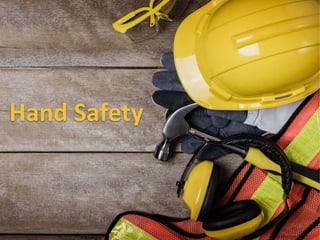
Hand Safety
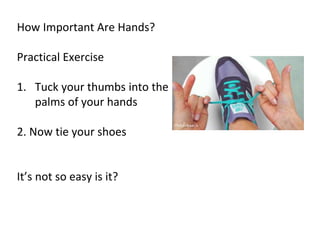
How Important Are Hands?
Practical Exercise
1. Tuck your thumbs into the
palms of your hands
2. Now tie your shoes
It’s not so easy is it?
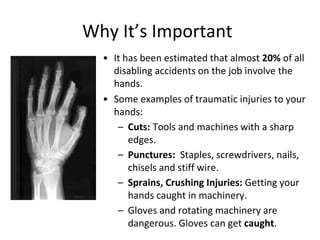
Why It’s Important
• It has been estimated that almost 20% of all
disabling accidents on the job involve the
hands.
• Some examples of traumatic injuries to your
hands:
– Cuts: Tools and machines with a sharp
edges.
– Punctures: Staples, screwdrivers, nails,
chisels and stiff wire.
– Sprains, Crushing Injuries: Getting your
hands caught in machinery.
– Gloves and rotating machinery are
dangerous. Gloves can get caught.
July 2015
• An employee was interacting
with a table saw when the
employee's hand became
entangled.
• Multiple fingers were
amputated.
• 321999 - All Other
Miscellaneous Wood Product
Manufacturing
April 2015
• An employee was adjusting the
height of the finger jointer machine
when the carriage came forward
and amputated the tip of his right
middle finger.
• Menzner Lumber and Supply
• 321999 - All Other Miscellaneous
Wood Product Manufacturing
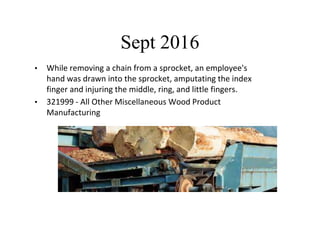
Sept 2016
• While removing a chain from a sprocket, an employee's
hand was drawn into the sprocket, amputating the index
finger and injuring the middle, ring, and little fingers.
• 321999 - All Other Miscellaneous Wood Product
Manufacturing
Nov 2016
• An employee was running a piece of
wood through a wood edger machine
when an excess piece (called a stick)
was created.
• The employee turned off the machine
to retrieve the stick.
• As he reached for it, the machine's
saw blade lacerated his left hand and
forearm, requiring hospitalization.
• 321999 - All Other Miscellaneous
Wood Product Manufacturing
Apr 2016
• An employee was removing a
piece of jammed wood from the
chop saw when his right-hand
pinky finger was amputated by
the blade.
• 321999 - All Other
Miscellaneous Wood Product
Manufacturing
What is Hand Protection PPE?
• Companies should use
engineering and work practice
controls to protect workers
from potential hand injuries
• PPE should be used to provide
additional protection
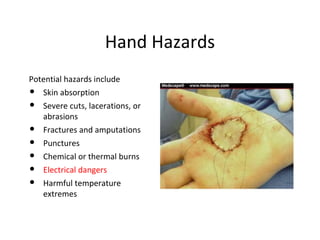
Hand Hazards
Potential hazards include
• Skin absorption
• Severe cuts, lacerations, or
abrasions
• Fractures and amputations
• Punctures
• Chemical or thermal burns
• Electrical dangers
• Harmful temperature
extremes
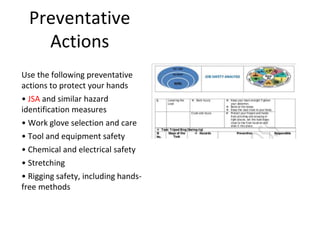
Preventative
Actions
Use the following preventative
actions to protect your hands
• JSA and similar hazard
identification measures
• Work glove selection and care
• Tool and equipment safety
• Chemical and electrical safety
• Stretching
• Rigging safety, including hands-
free methods
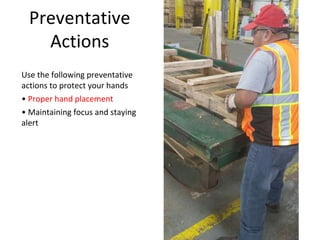
Preventative
Actions
Use the following preventative
actions to protect your hands
• Proper hand placement
• Maintaining focus and staying
alert
Preventative
Actions
Use the following preventative
actions to protect your hands
• Proper hand placement
• Maintaining focus and staying
alert
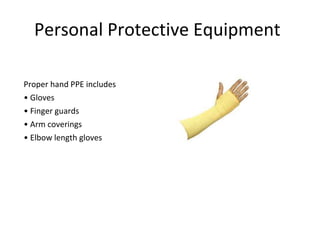
Personal Protective Equipment
Proper hand PPE includes
• Gloves
• Finger guards
• Arm coverings
• Elbow length gloves
Gloves
There are many types of gloves
• The nature of the hazard and
operation involved will affect
glove selection
• Workers must use gloves
specifically designed for the
hazards and tasks found in their
workplace
• Wearing the wrong type of glove
for a job can result in serious
injury
Gloves
Some factors that may influence
glove selection include
• Type of chemicals handled
• Nature of contact – Total
immersion, splash, etc.
• Duration of contact
• Area requiring protection –
Hand only, forearm, arm
Gloves
Some factors that may influence
glove selection include
• Grip requirements – Dry, wet,
oily
• Thermal protection
• Size and comfort
• Abrasion or resistance
requirements
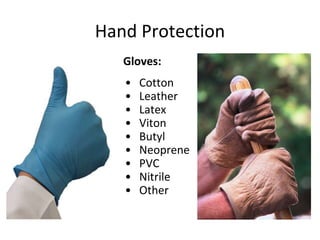
Hand Protection
Gloves:
• Cotton
• Leather
• Latex
• Viton
• Butyl
• Neoprene
• PVC
• Nitrile
• Other
Gloves
Rubber gloves include gloves made
out of rubber, neoprene, vinyl, or
latex
• Rubber gloves – Must be worn
when working with chemicals
–Must be worn when providing first
aid
– Must be kept clean and free of
holes
– Should be designed for use with
chemicals
– Must not be used for protection
against electricity
Gloves
• Cloth gloves
– Used to protect hands against light
abrasion and solid particulate
material
– Must fit well to help avoid
accidents
– Should not be worn when using
rotating machinery
Gloves
• High visibility gloves – Come in
highly visible colors
– Make the workers more aware of
their hand placement
Gloves
Insulated rubber gloves are used for
electrical work
• Cut resistant gloves
– Usually made from Kevlar and
metal mesh
– Designed for workers who
routinely perform cutting tasks with
knives or other devices
Gloves
Proper glove use
• Gloves should always be worn on
the correct hand
• Select appropriately sized gloves
– Loose gloves can cause accidents –
Tight gloves can cause discomfort
• Put on and remove gloves carefully
– Roughly pulling off gloves can
damage the material
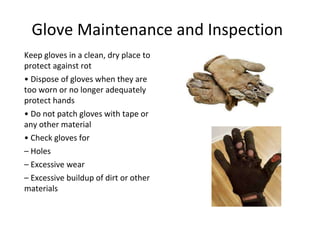
Glove Maintenance and Inspection
Keep gloves in a clean, dry place to
protect against rot
• Dispose of gloves when they are
too worn or no longer adequately
protect hands
• Do not patch gloves with tape or
any other material
• Check gloves for
– Holes
– Excessive wear
– Excessive buildup of dirt or other
materials
Preventing Hand Injuries
To avoid hand injuries, observe the
following
• Use the right glove for the job
• Do not use hands as tools
— get the correct tool for the job
• Position your body, hands, and
fingers correctly
• Secure your work
• Use lockout/tagout whenever
appropriate
• Use a push stick when using saws
• Be aware of pinch points and
other hand hazards
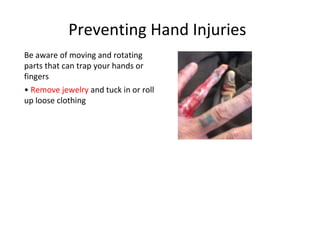
Preventing Hand Injuries
Be aware of moving and rotating
parts that can trap your hands or
fingers
• Remove jewelry and tuck in or roll
up loose clothing
Preventing Hand Injuries
Be aware of moving and rotating
parts that can trap your hands or
fingers
• Do not wear gloves when working
with gears or machinery that could
catch and pull your fingers or hand
into the machinery
Preventing Hand Injuries
• Be aware of areas with built-in
heaters or machinery parts that build
up heat that can cause serious burns
• Be aware of other hand hazards
such as crushed fingers or hands in
door jams or when pulling a load
through a doorway or tight area
• Maintain control of a lifted load;
losing control can cause loads to
shift or drop
Preventing Hand Injuries
• Be aware of other hand hazards
such as crushed fingers or hands in
door jams or when pulling a load
through a doorway or tight area.
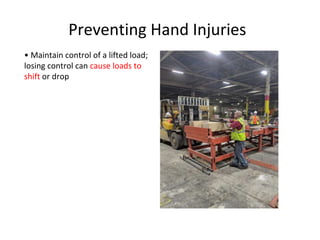
Preventing Hand Injuries
• Maintain control of a lifted load;
losing control can cause loads to
shift or drop
Most Cited
• No written respirator program.
• No medical evaluation for
respirator use.
• No PPE assessment certification.
• No PPE assessment conducted.
• No Eye Protection.
• No PPE used when hazard present.
• Voluntary use of respirators – App. D
• No Respirator fit test.
• Inadequate / no respirator training.
• No Hand Protection.
Payment
• Employers pay for almost all
personal protective equipment
(PPE) required by OSHA’s
general industry standards.
➥Metatarsal foot protection;
➥Rubber boots with steel
toes;
➥Non-prescription eye
protection;
➥Hard hats/Bump Caps;
➥Hearing Protection;
➥Personal fall protection; and
➥Reflective work vests.
• OSHA standards do not require
employer payment for uniforms,
items worn to keep clean, or
other items that are not PPE.
➥Sturdy work shoes;
➥Non-specialty slip-resistant,
non-safety-toe footwear;
➥Items worn for patient safety
and health, not employee
safety and health; and
➥Uniforms, caps or other
clothing worn solely to
identify a person as an
employee.
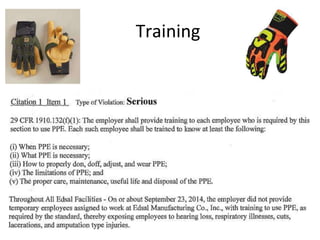
Training
Arm and Hand Protection
Gloves - More Caveats
• No glove is good against all
hazards; consult the glove
manufacturer for glove
selection chart.
• Gloves have a finite lifespan
and must be periodically
replaced.
• When donning gloves, examine
them for signs of tears, cracks,
holes and dry rot.
• Hands should always be
washed after removing gloves.
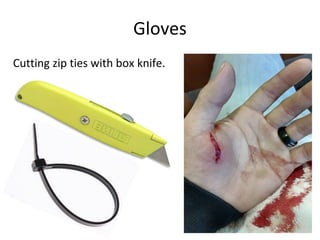
● One company.
● Two employees
suffered box knife
cuts.
● One was stripping
cable.
● Another was cutting
open a box toward
himself.
January 2015
Cutting zip ties with box knife.
Gloves
January 2015
• One company
• Two box knife cuts
• One stripping cable
• Another cutting open
a box toward him
10 Rules Summary
• Beware of pinch points.
• Expect the unexpected
resistance
• Inspect tools.
• Do not work on moving
equipment unnecessarily.
• Replace machine guards
following repairs that require
removal of guards.
• Be mindful of equipment that
starts automatically.
• Avoid touching lines,
equipment, or surfaces that
may be hot.
• Be mindful when closing doors
and other hinged devices
• Use gloves to protect your
hands during all work
activities which involve
handling of materials or tools.
• Use a tool for the job instead
of your hand.

Hand Safety 2020

  • 1.
  • 2.
    How Important AreHands? Practical Exercise 1. Tuck your thumbs into the palms of your hands 2. Now tie your shoes It’s not so easy is it?
  • 3.
    Why It’s Important •It has been estimated that almost 20% of all disabling accidents on the job involve the hands. • Some examples of traumatic injuries to your hands: – Cuts: Tools and machines with a sharp edges. – Punctures: Staples, screwdrivers, nails, chisels and stiff wire. – Sprains, Crushing Injuries: Getting your hands caught in machinery. – Gloves and rotating machinery are dangerous. Gloves can get caught.
  • 4.
    July 2015 • Anemployee was interacting with a table saw when the employee's hand became entangled. • Multiple fingers were amputated. • 321999 - All Other Miscellaneous Wood Product Manufacturing
  • 5.
    April 2015 • Anemployee was adjusting the height of the finger jointer machine when the carriage came forward and amputated the tip of his right middle finger. • Menzner Lumber and Supply • 321999 - All Other Miscellaneous Wood Product Manufacturing
  • 6.
    Sept 2016 • Whileremoving a chain from a sprocket, an employee's hand was drawn into the sprocket, amputating the index finger and injuring the middle, ring, and little fingers. • 321999 - All Other Miscellaneous Wood Product Manufacturing
  • 7.
    Nov 2016 • Anemployee was running a piece of wood through a wood edger machine when an excess piece (called a stick) was created. • The employee turned off the machine to retrieve the stick. • As he reached for it, the machine's saw blade lacerated his left hand and forearm, requiring hospitalization. • 321999 - All Other Miscellaneous Wood Product Manufacturing
  • 8.
    Apr 2016 • Anemployee was removing a piece of jammed wood from the chop saw when his right-hand pinky finger was amputated by the blade. • 321999 - All Other Miscellaneous Wood Product Manufacturing
  • 9.
    What is HandProtection PPE? • Companies should use engineering and work practice controls to protect workers from potential hand injuries • PPE should be used to provide additional protection
  • 10.
    Hand Hazards Potential hazardsinclude • Skin absorption • Severe cuts, lacerations, or abrasions • Fractures and amputations • Punctures • Chemical or thermal burns • Electrical dangers • Harmful temperature extremes
  • 11.
    Preventative Actions Use the followingpreventative actions to protect your hands • JSA and similar hazard identification measures • Work glove selection and care • Tool and equipment safety • Chemical and electrical safety • Stretching • Rigging safety, including hands- free methods
  • 12.
    Preventative Actions Use the followingpreventative actions to protect your hands • Proper hand placement • Maintaining focus and staying alert
  • 13.
    Preventative Actions Use the followingpreventative actions to protect your hands • Proper hand placement • Maintaining focus and staying alert
  • 14.
    Personal Protective Equipment Properhand PPE includes • Gloves • Finger guards • Arm coverings • Elbow length gloves
  • 15.
    Gloves There are manytypes of gloves • The nature of the hazard and operation involved will affect glove selection • Workers must use gloves specifically designed for the hazards and tasks found in their workplace • Wearing the wrong type of glove for a job can result in serious injury
  • 16.
    Gloves Some factors thatmay influence glove selection include • Type of chemicals handled • Nature of contact – Total immersion, splash, etc. • Duration of contact • Area requiring protection – Hand only, forearm, arm
  • 17.
    Gloves Some factors thatmay influence glove selection include • Grip requirements – Dry, wet, oily • Thermal protection • Size and comfort • Abrasion or resistance requirements
  • 18.
    Hand Protection Gloves: • Cotton •Leather • Latex • Viton • Butyl • Neoprene • PVC • Nitrile • Other
  • 19.
    Gloves Rubber gloves includegloves made out of rubber, neoprene, vinyl, or latex • Rubber gloves – Must be worn when working with chemicals –Must be worn when providing first aid – Must be kept clean and free of holes – Should be designed for use with chemicals – Must not be used for protection against electricity
  • 20.
    Gloves • Cloth gloves –Used to protect hands against light abrasion and solid particulate material – Must fit well to help avoid accidents – Should not be worn when using rotating machinery
  • 21.
    Gloves • High visibilitygloves – Come in highly visible colors – Make the workers more aware of their hand placement
  • 22.
    Gloves Insulated rubber glovesare used for electrical work • Cut resistant gloves – Usually made from Kevlar and metal mesh – Designed for workers who routinely perform cutting tasks with knives or other devices
  • 23.
    Gloves Proper glove use •Gloves should always be worn on the correct hand • Select appropriately sized gloves – Loose gloves can cause accidents – Tight gloves can cause discomfort • Put on and remove gloves carefully – Roughly pulling off gloves can damage the material
  • 24.
    Glove Maintenance andInspection Keep gloves in a clean, dry place to protect against rot • Dispose of gloves when they are too worn or no longer adequately protect hands • Do not patch gloves with tape or any other material • Check gloves for – Holes – Excessive wear – Excessive buildup of dirt or other materials
  • 25.
    Preventing Hand Injuries Toavoid hand injuries, observe the following • Use the right glove for the job • Do not use hands as tools — get the correct tool for the job • Position your body, hands, and fingers correctly • Secure your work • Use lockout/tagout whenever appropriate • Use a push stick when using saws • Be aware of pinch points and other hand hazards
  • 26.
    Preventing Hand Injuries Beaware of moving and rotating parts that can trap your hands or fingers • Remove jewelry and tuck in or roll up loose clothing
  • 27.
    Preventing Hand Injuries Beaware of moving and rotating parts that can trap your hands or fingers • Do not wear gloves when working with gears or machinery that could catch and pull your fingers or hand into the machinery
  • 28.
    Preventing Hand Injuries •Be aware of areas with built-in heaters or machinery parts that build up heat that can cause serious burns • Be aware of other hand hazards such as crushed fingers or hands in door jams or when pulling a load through a doorway or tight area • Maintain control of a lifted load; losing control can cause loads to shift or drop
  • 29.
    Preventing Hand Injuries •Be aware of other hand hazards such as crushed fingers or hands in door jams or when pulling a load through a doorway or tight area.
  • 30.
    Preventing Hand Injuries •Maintain control of a lifted load; losing control can cause loads to shift or drop
  • 31.
    Most Cited • Nowritten respirator program. • No medical evaluation for respirator use. • No PPE assessment certification. • No PPE assessment conducted. • No Eye Protection. • No PPE used when hazard present. • Voluntary use of respirators – App. D • No Respirator fit test. • Inadequate / no respirator training. • No Hand Protection.
  • 32.
    Payment • Employers payfor almost all personal protective equipment (PPE) required by OSHA’s general industry standards. ➥Metatarsal foot protection; ➥Rubber boots with steel toes; ➥Non-prescription eye protection; ➥Hard hats/Bump Caps; ➥Hearing Protection; ➥Personal fall protection; and ➥Reflective work vests. • OSHA standards do not require employer payment for uniforms, items worn to keep clean, or other items that are not PPE. ➥Sturdy work shoes; ➥Non-specialty slip-resistant, non-safety-toe footwear; ➥Items worn for patient safety and health, not employee safety and health; and ➥Uniforms, caps or other clothing worn solely to identify a person as an employee.
  • 33.
  • 34.
    Arm and HandProtection
  • 35.
    Gloves - MoreCaveats • No glove is good against all hazards; consult the glove manufacturer for glove selection chart. • Gloves have a finite lifespan and must be periodically replaced. • When donning gloves, examine them for signs of tears, cracks, holes and dry rot. • Hands should always be washed after removing gloves.
  • 36.
    ● One company. ●Two employees suffered box knife cuts. ● One was stripping cable. ● Another was cutting open a box toward himself. January 2015
  • 37.
    Cutting zip tieswith box knife. Gloves
  • 38.
    January 2015 • Onecompany • Two box knife cuts • One stripping cable • Another cutting open a box toward him
  • 39.
    10 Rules Summary •Beware of pinch points. • Expect the unexpected resistance • Inspect tools. • Do not work on moving equipment unnecessarily. • Replace machine guards following repairs that require removal of guards. • Be mindful of equipment that starts automatically. • Avoid touching lines, equipment, or surfaces that may be hot. • Be mindful when closing doors and other hinged devices • Use gloves to protect your hands during all work activities which involve handling of materials or tools. • Use a tool for the job instead of your hand.