©2016 McGraw-Hill Education. Confidential and proprietary. Not for redistribution.
Learning Science Platforms
©2016 McGraw-Hill Education. Confidential and proprietary. Not for redistribution.
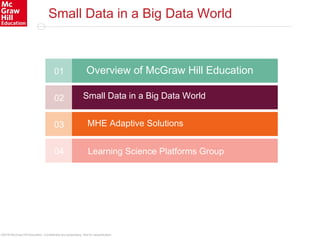
Small Data in a Big Data World
01
Small Data in a Big Data World02
MHE Adaptive Solutions03
04 Learning Science Platforms Group
Overview of McGraw Hill Education
3
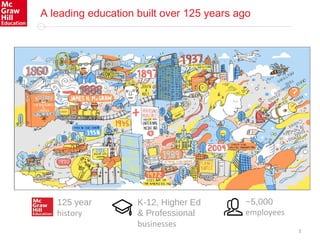
A leading education built over 125 years ago
~5,000
employees
125 year
history
K-12, Higher Ed
& Professional
businesses
©2016 McGraw-Hill Education. Confidential and proprietary. Not for redistribution.
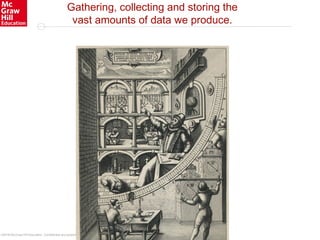
Gathering, collecting and storing the
vast amounts of data we produce.
©2016 McGraw-Hill Education. Confidential and proprietary. Not for redistribution.
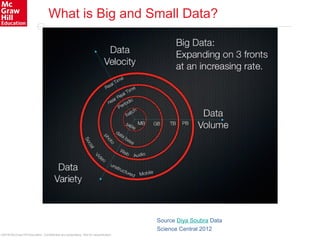
What is Big and Small Data?
Source Diya Soubra Data
Science Central 2012
©2016 McGraw-Hill Education. Confidential and proprietary. Not for redistribution.
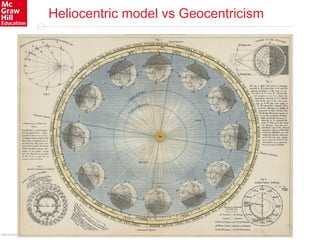
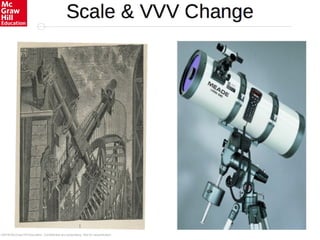
Heliocentric model vs Geocentricism
©2016 McGraw-Hill Education. Confidential and proprietary. Not for redistribution.
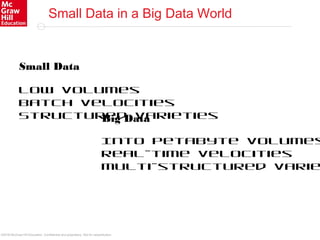
Small Data in a Big Data World
Small Data
Low Volumes
Batch Velocities
Structured VarietiesBig Data
Into Petabyte Volumes
Real-time Velocities
Multi-structured Varie
©2016 McGraw-Hill Education. Confidential and proprietary. Not for redistribution.
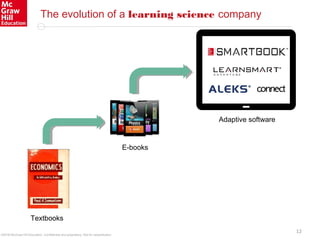
The evolution of a learning science company
Textbooks
E-books
Adaptive software
12
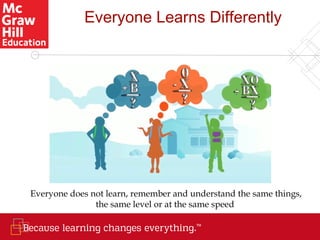
Everyone Learns Differently
Everyone does not learn, remember and understand the same things,
the same level or at the same speed
©2016 McGraw-Hill Education. Confidential and proprietary. Not for redistribution.
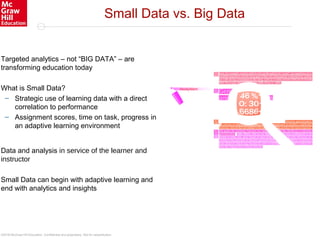
Small Data vs. Big Data
Targeted analytics – not “BIG DATA” – are
transforming education today
What is Small Data?
– Strategic use of learning data with a direct
correlation to performance
– Assignment scores, time on task, progress in
an adaptive learning environment
Data and analysis in service of the learner and
instructor
Small Data can begin with adaptive learning and
end with analytics and insights
©2016 McGraw-Hill Education. Confidential and proprietary. Not for redistribution.
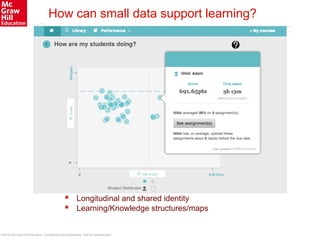
How can small data support learning?
 Longitudinal and shared identity
 Learning/Knowledge structures/maps
©2016 McGraw-Hill Education. Confidential and proprietary. Not for redistribution.
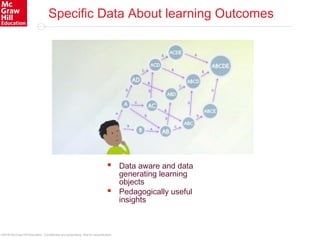
Specific Data About learning Outcomes
 Data aware and data
generating learning
objects
 Pedagogically useful
insights
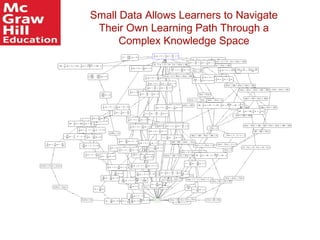
Small Data Allows Learners to Navigate
Their Own Learning Path Through a
Complex Knowledge Space
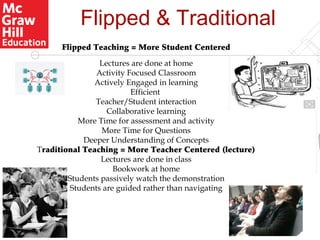
Flipped Teaching = More Student Centered
Lectures are done at home
Activity Focused Classroom
Actively Engaged in learning
Efficient
Teacher/Student interaction
Collaborative learning
More Time for assessment and activity
More Time for Questions
Deeper Understanding of Concepts
Traditional Teaching = More Teacher Centered (lecture)
Lectures are done in class
Bookwork at home
Students passively watch the demonstration
Students are guided rather than navigating
Flipped & Traditional
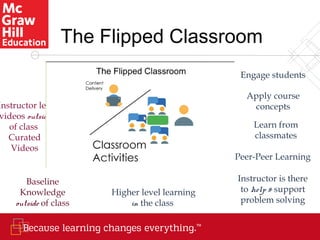
Instructor led
videos outside
of class
Curated
Videos
The Flipped Classroom
Engage students
Apply course
concepts
Learn from
classmates
Peer-Peer Learning
Instructor is there
to help & support
problem solving
Higher level learning
in the class
Baseline
Knowledge
outside of class
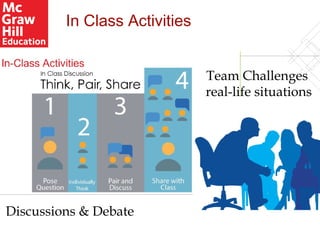
In Class Activities
Team Challenges
real-life situations
Discussions & Debate
©2016 McGraw-Hill Education. Confidential and proprietary. Not for redistribution.
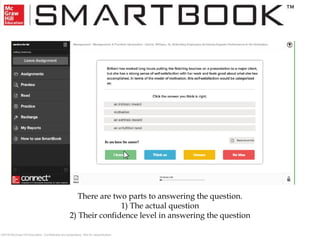
There are two parts to answering the question.
1) The actual question
2) Their confidence level in answering the question
Title
LO
Chap
20
Chap
10
Chap 1
LO LO
1
LO 2 LO
89
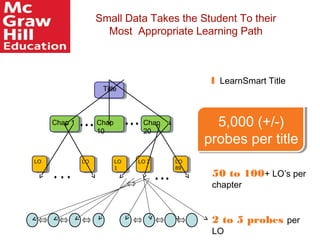
1 LearnSmart Title
X Chapters / Title
50 to 100+ LO’s per
chapter
2 to 5 probes per
LO
5,000 (+/-)
probes per title
Small Data Takes the Student To their
Most Appropriate Learning Path
LO LO
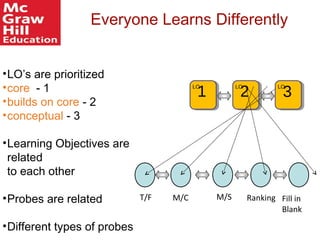
‱LO’s are prioritized
‱core - 1
‱builds on core - 2
‱conceptual - 3
‱Learning Objectives are
related
to each other
‱Probes are related
‱Different types of probes
Fill in
Blank
T/F M/C RankingM/S
LO
1 2 3
Everyone Learns Differently
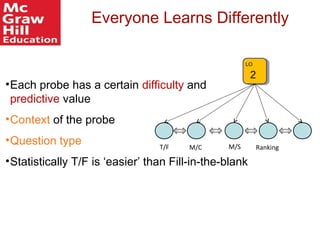
‱Each probe has a certain difficulty and
predictive value
‱Context of the probe
‱Question type
‱Statistically T/F is ‘easier’ than Fill-in-the-blank
LO
T/F M/C RankingM/S
2
Everyone Learns Differently
©2016 McGraw-Hill Education. Confidential and proprietary. Not for redistribution.
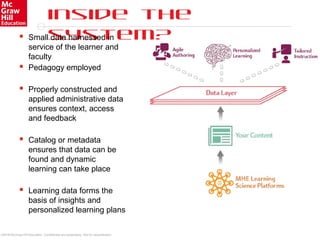
inside the
system? Small data harnessed in
service of the learner and
faculty
 Pedagogy employed
 Properly constructed and
applied administrative data
ensures context, access
and feedback
 Catalog or metadata
ensures that data can be
found and dynamic
learning can take place
 Learning data forms the
basis of insights and
personalized learning plans
©2016 McGraw-Hill Education. Confidential and proprietary. Not for redistribution.
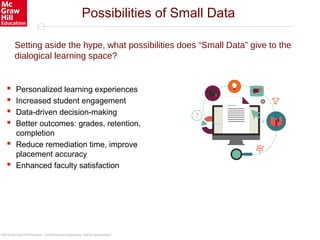
Setting aside the hype, what possibilities does “Small Data” give to the
dialogical learning space?
 Personalized learning experiences
 Increased student engagement
 Data-driven decision-making
 Better outcomes: grades, retention,
completion
 Reduce remediation time, improve
placement accuracy
 Enhanced faculty satisfaction
Possibilities of Small Data
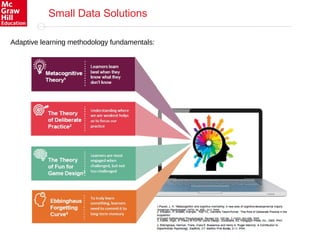
Small Data Solutions
Adaptive learning methodology fundamentals:
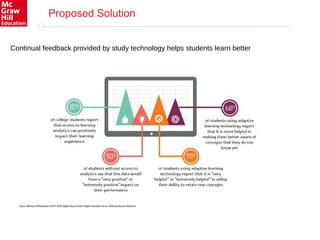
Proposed Solution
Continual feedback provided by study technology helps students learn better
©2016 McGraw-Hill Education. Confidential and proprietary. Not for redistribution.
Small Data in a Big Data World
Data flows without commercial boundaries
Data belongs to the students, faculty and institution
Configuration is in the hands of the user
–Better user experience for students and instructors
Technology seamlessly fades into the background
TexThank you!

Small Data in a Big Data World

  • 1.
    ©2016 McGraw-Hill Education.Confidential and proprietary. Not for redistribution. Learning Science Platforms
  • 2.
    ©2016 McGraw-Hill Education.Confidential and proprietary. Not for redistribution. Small Data in a Big Data World 01 Small Data in a Big Data World02 MHE Adaptive Solutions03 04 Learning Science Platforms Group Overview of McGraw Hill Education
  • 3.
    3 A leading educationbuilt over 125 years ago ~5,000 employees 125 year history K-12, Higher Ed & Professional businesses
  • 4.
    ©2016 McGraw-Hill Education.Confidential and proprietary. Not for redistribution. Gathering, collecting and storing the vast amounts of data we produce.
  • 5.
    ©2016 McGraw-Hill Education.Confidential and proprietary. Not for redistribution. What is Big and Small Data? Source Diya Soubra Data Science Central 2012
  • 6.
    ©2016 McGraw-Hill Education.Confidential and proprietary. Not for redistribution. Heliocentric model vs Geocentricism
  • 7.
    ©2016 McGraw-Hill Education.Confidential and proprietary. Not for redistribution.
  • 8.
    ©2016 McGraw-Hill Education.Confidential and proprietary. Not for redistribution.
  • 9.
    ©2016 McGraw-Hill Education.Confidential and proprietary. Not for redistribution.
  • 10.
    ©2016 McGraw-Hill Education.Confidential and proprietary. Not for redistribution.
  • 11.
    ©2016 McGraw-Hill Education.Confidential and proprietary. Not for redistribution. Small Data in a Big Data World Small Data Low Volumes Batch Velocities Structured VarietiesBig Data Into Petabyte Volumes Real-time Velocities Multi-structured Varie
  • 12.
    ©2016 McGraw-Hill Education.Confidential and proprietary. Not for redistribution. The evolution of a learning science company Textbooks E-books Adaptive software 12
  • 13.
    Everyone Learns Differently Everyonedoes not learn, remember and understand the same things, the same level or at the same speed
  • 14.
    ©2016 McGraw-Hill Education.Confidential and proprietary. Not for redistribution. Small Data vs. Big Data Targeted analytics – not “BIG DATA” – are transforming education today What is Small Data? – Strategic use of learning data with a direct correlation to performance – Assignment scores, time on task, progress in an adaptive learning environment Data and analysis in service of the learner and instructor Small Data can begin with adaptive learning and end with analytics and insights
  • 15.
    ©2016 McGraw-Hill Education.Confidential and proprietary. Not for redistribution. How can small data support learning?  Longitudinal and shared identity  Learning/Knowledge structures/maps
  • 16.
    ©2016 McGraw-Hill Education.Confidential and proprietary. Not for redistribution. Specific Data About learning Outcomes  Data aware and data generating learning objects  Pedagogically useful insights
  • 17.
    Small Data AllowsLearners to Navigate Their Own Learning Path Through a Complex Knowledge Space
  • 18.
    Flipped Teaching =More Student Centered Lectures are done at home Activity Focused Classroom Actively Engaged in learning Efficient Teacher/Student interaction Collaborative learning More Time for assessment and activity More Time for Questions Deeper Understanding of Concepts Traditional Teaching = More Teacher Centered (lecture) Lectures are done in class Bookwork at home Students passively watch the demonstration Students are guided rather than navigating Flipped & Traditional
  • 19.
    Instructor led videos outside ofclass Curated Videos The Flipped Classroom Engage students Apply course concepts Learn from classmates Peer-Peer Learning Instructor is there to help & support problem solving Higher level learning in the class Baseline Knowledge outside of class
  • 20.
    In Class Activities TeamChallenges real-life situations Discussions & Debate
  • 21.
    ©2016 McGraw-Hill Education.Confidential and proprietary. Not for redistribution. There are two parts to answering the question. 1) The actual question 2) Their confidence level in answering the question
  • 22.
    Title LO Chap 20 Chap 10 Chap 1 LO LO 1 LO2 LO 89 1 LearnSmart Title X Chapters / Title 50 to 100+ LO’s per chapter 2 to 5 probes per LO 5,000 (+/-) probes per title Small Data Takes the Student To their Most Appropriate Learning Path
  • 23.
    LO LO ‱LO’s areprioritized ‱core - 1 ‱builds on core - 2 ‱conceptual - 3 ‱Learning Objectives are related to each other ‱Probes are related ‱Different types of probes Fill in Blank T/F M/C RankingM/S LO 1 2 3 Everyone Learns Differently
  • 24.
    ‱Each probe hasa certain difficulty and predictive value ‱Context of the probe ‱Question type ‱Statistically T/F is ‘easier’ than Fill-in-the-blank LO T/F M/C RankingM/S 2 Everyone Learns Differently
  • 26.
    ©2016 McGraw-Hill Education.Confidential and proprietary. Not for redistribution. inside the system? Small data harnessed in service of the learner and faculty  Pedagogy employed  Properly constructed and applied administrative data ensures context, access and feedback  Catalog or metadata ensures that data can be found and dynamic learning can take place  Learning data forms the basis of insights and personalized learning plans
  • 27.
    ©2016 McGraw-Hill Education.Confidential and proprietary. Not for redistribution. Setting aside the hype, what possibilities does “Small Data” give to the dialogical learning space?  Personalized learning experiences  Increased student engagement  Data-driven decision-making  Better outcomes: grades, retention, completion  Reduce remediation time, improve placement accuracy  Enhanced faculty satisfaction Possibilities of Small Data
  • 28.
    Small Data Solutions Adaptivelearning methodology fundamentals:
  • 29.
    Proposed Solution Continual feedbackprovided by study technology helps students learn better
  • 30.
    ©2016 McGraw-Hill Education.Confidential and proprietary. Not for redistribution. Small Data in a Big Data World Data flows without commercial boundaries Data belongs to the students, faculty and institution Configuration is in the hands of the user –Better user experience for students and instructors Technology seamlessly fades into the background
  • 31.

Editor's Notes

  • #4 + info about MHE as a company: 6,000 employees spread across the world, X offfices, Global ready + Born after sale of Education assets of MH Companies to Apollo Global Management in 2013, founded 1888 C6000 employees,53 offices in 44 countries, selling directly into 142 countries Focused on the HE/Professional business globally and US K-12 and assessment domestically (US)
  • #24 You know how sometimes instructors might say things like Can I get a list of all the probes? Can I turn off some probes? Can I add or edit probes? No! Because they are related to each other and are presented to the learner by adaptive algorithms
  • #25 So what does this mean? In order to determine mastery of a certain LO, LS will continuously adjust the difficulty of probes based on strenghts and weaknesses and will continue to do so until learner has shown mastery of that LO by succeeding in the most difficult probes