PROJECT ECO
Environmental Forestry Protection
by Utilizing Wireless Camera and
Sensor Detection as Outlook-
Monitoring System
CATHLEEN JEAN ESTEBAN
JESSA MAE SIARES
FRANCES VINCENT DECENA
PROBLEM
• The seed of deforestation has begun to sprout and take shape—
morphing into a global catastrophe that continues to plague the
world for years and further on. From climate change, soil erosion,
and desertification, to flooding and lesser yields, deforestation has
been the root of all that and more.
The researchers orchestrated a device that can accurately detect illicit
activities that target our forestry—for instance, illegal logging and
kaingin—which are ground zeroes of deforestation. The researchers
used a wireless camera and an enhanced sensor-detection system to
monitor events in the forest. This study, entitled “Project ECO:
Environmental Forestry Protection By Utilizing Wireless Camera And
Sensor Detection As Outlook-Monitoring System,” was conceptualized
to become a temporary antidote to the prevailing environmental
disease that is deforestation.
STATEMENT OF THE PROBLEM
GENERAL
This study aimed to bring humanity in the light of deforestation by
engineering a device that can monitor illicit activities in the forest. Its
system of sensor-detection and wireless camera will guarantee to
protecting the countless ecosystems and biodiversity that thrive in
forests, to preserving the forests’ neat structure, and to controlling
human recklessness that, for long years, have mutilated and disfigured
our forests.
SPECIFIC:
1. What are the designs of Project ECO along:
a.) Software b.) Hardware
2. How effective is the device’s use of senor detection and wireless
camera in terms of functionality, structure and design, and safety
measures?
3. Is there a significant difference among the various sensors used—
smoke sensor, temperature sensor, flex sensors, and vibration
sensors—in terms of the device’s stability?
SIGNIFICANCE OF THE STUDY
This study contributes to the following:
• Environment
• Community
• Government
• Future Researchers
CONCEPTUAL FRAMEWORK
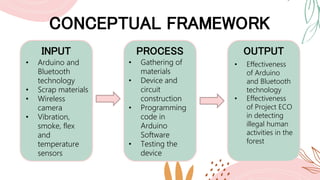
INPUT PROCESS OUTPUT
• Arduino and
Bluetooth
technology
• Scrap materials
• Wireless
camera
• Vibration,
smoke, flex
and
temperature
sensors
• Gathering of
materials
• Device and
circuit
construction
• Programming
code in
Arduino
Software
• Testing the
device
• Effectiveness
of Arduino
and Bluetooth
technology
• Effectiveness
of Project ECO
in detecting
illegal human
activities in the
forest
METHODOLOGY
RESEARCH DESIGN
A quantitative research design in the form of an experimental design was
used in this study in order to assess the device’s effectiveness. It was used to
shed more data in controlling deforestation, to test the accuracy of Project
ECO, and to examine whether the system has met the criteria. The conductors
used tables, graphs to gather intel of the performance of the Temperature,
Flex, Smoke and Vibration sensors. To write the conclusion, the gathered data
from it was used.
METHODOLOGY
COMPONENTS AND MATERIALS
PROCEDURE
MAKING THE FRAMEWORKS
PROCEDURE
MAKING THE DEVICE
MAKING THE CIRCUIT OF THE DEVICE
STEP 1: Connecting the Bluetooth
Module to the Arduino Board
STEP 2: Connecting Temperature
Sensor to the Arduino Board
STEP 3:
Connecting Flex
Sensor to the
Arduino Board
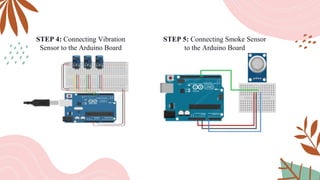
STEP 5: Connecting Smoke Sensor
to the Arduino Board
STEP 4: Connecting Vibration
Sensor to the Arduino Board
PROGRAMMING THE CODES IN THE SOFTWARE
RESEARCH INSTRUMENTS
The data was collected using a scale and checklist to assess the
device’s effectiveness in terms of functionality, structure and design,
and system safety measures. The researchers used T-test and
ANOVA to test the effectiveness of Project ECO through the use of
Sensor Detection and Wireless Camera in terms of efficiency.
FLOWCHART
FLOWCHART ON
HOW THE
DEVICE WORK
PROJECT ECO
Environmental Forestry
Protection By Utilizing Wireless
Camera And Sensor Detection As
Outlook-Monitoring System
PILI NATIONAL HIGH SCHOOL
PAWILI, LAPAZ, CAMARINES SUR
NAME OF THE RESEARCHERS:
CATHLEEN JEAN ESTEBAN
JESSA MAE SIARES
FRANCES VINCENT DECENA
THANK YOU FOR
LISTENING!

PROJECT ECO PROPOSAL.pptx

  • 1.
    PROJECT ECO Environmental ForestryProtection by Utilizing Wireless Camera and Sensor Detection as Outlook- Monitoring System CATHLEEN JEAN ESTEBAN JESSA MAE SIARES FRANCES VINCENT DECENA
  • 2.
    PROBLEM • The seedof deforestation has begun to sprout and take shape— morphing into a global catastrophe that continues to plague the world for years and further on. From climate change, soil erosion, and desertification, to flooding and lesser yields, deforestation has been the root of all that and more.
  • 3.
    The researchers orchestrateda device that can accurately detect illicit activities that target our forestry—for instance, illegal logging and kaingin—which are ground zeroes of deforestation. The researchers used a wireless camera and an enhanced sensor-detection system to monitor events in the forest. This study, entitled “Project ECO: Environmental Forestry Protection By Utilizing Wireless Camera And Sensor Detection As Outlook-Monitoring System,” was conceptualized to become a temporary antidote to the prevailing environmental disease that is deforestation.
  • 4.
    STATEMENT OF THEPROBLEM GENERAL This study aimed to bring humanity in the light of deforestation by engineering a device that can monitor illicit activities in the forest. Its system of sensor-detection and wireless camera will guarantee to protecting the countless ecosystems and biodiversity that thrive in forests, to preserving the forests’ neat structure, and to controlling human recklessness that, for long years, have mutilated and disfigured our forests.
  • 5.
    SPECIFIC: 1. What arethe designs of Project ECO along: a.) Software b.) Hardware 2. How effective is the device’s use of senor detection and wireless camera in terms of functionality, structure and design, and safety measures? 3. Is there a significant difference among the various sensors used— smoke sensor, temperature sensor, flex sensors, and vibration sensors—in terms of the device’s stability?
  • 6.
    SIGNIFICANCE OF THESTUDY This study contributes to the following: • Environment • Community • Government • Future Researchers
  • 7.
    CONCEPTUAL FRAMEWORK INPUT PROCESSOUTPUT • Arduino and Bluetooth technology • Scrap materials • Wireless camera • Vibration, smoke, flex and temperature sensors • Gathering of materials • Device and circuit construction • Programming code in Arduino Software • Testing the device • Effectiveness of Arduino and Bluetooth technology • Effectiveness of Project ECO in detecting illegal human activities in the forest
  • 8.
    METHODOLOGY RESEARCH DESIGN A quantitativeresearch design in the form of an experimental design was used in this study in order to assess the device’s effectiveness. It was used to shed more data in controlling deforestation, to test the accuracy of Project ECO, and to examine whether the system has met the criteria. The conductors used tables, graphs to gather intel of the performance of the Temperature, Flex, Smoke and Vibration sensors. To write the conclusion, the gathered data from it was used.
  • 9.
  • 10.
  • 11.
  • 12.
    MAKING THE CIRCUITOF THE DEVICE STEP 1: Connecting the Bluetooth Module to the Arduino Board STEP 2: Connecting Temperature Sensor to the Arduino Board STEP 3: Connecting Flex Sensor to the Arduino Board
  • 13.
    STEP 5: ConnectingSmoke Sensor to the Arduino Board STEP 4: Connecting Vibration Sensor to the Arduino Board
  • 14.
    PROGRAMMING THE CODESIN THE SOFTWARE
  • 15.
    RESEARCH INSTRUMENTS The datawas collected using a scale and checklist to assess the device’s effectiveness in terms of functionality, structure and design, and system safety measures. The researchers used T-test and ANOVA to test the effectiveness of Project ECO through the use of Sensor Detection and Wireless Camera in terms of efficiency.
  • 16.
  • 17.
    PROJECT ECO Environmental Forestry ProtectionBy Utilizing Wireless Camera And Sensor Detection As Outlook-Monitoring System PILI NATIONAL HIGH SCHOOL PAWILI, LAPAZ, CAMARINES SUR NAME OF THE RESEARCHERS: CATHLEEN JEAN ESTEBAN JESSA MAE SIARES FRANCES VINCENT DECENA
  • 18.