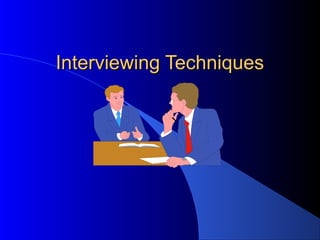
Interviewing TechniquesInterviewing Techniques
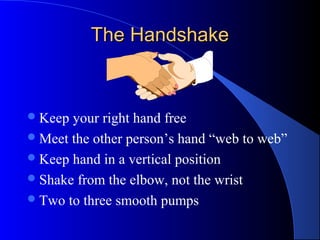
The HandshakeThe Handshake
Keep your right hand free
Meet the other person’s hand “web to web”
Keep hand in a vertical position
Shake from the elbow, not the wrist
Two to three smooth pumps
Workshop TopicsWorkshop Topics
Purpose of the Interview
Preparing for the Interview
Typical Structure of the Interview
Typical Questions
After the Interview
Purpose of the InterviewPurpose of the Interview
The Candidate
– Clarify responsibilities of the position
– Determine if you can/will do the job
– Determine “fit”
The Interviewer
– Evaluate candidate based on qualifications and
employer needs
– Determine “fit”
QuestionsQuestions
WhenWhen
SchedulingScheduling
How long will the interview last?
How many candidates will be interviewing?
With whom will I be interviewing?
Is there anything I should bring with me?
Know the EmployerKnow the Employer
Product or Service
Sales/Assets
Competition
History
Field Offices
Industry Trends
Chain of Command
Size
Resources forResources for
Researching theResearching the
EmployerEmployer CRC
– Planning Job Choices: How to Research
Companies
– Florida Business Directory
– Hoover’s Handbook of American Business
– Career Information Library - Employer Files
 Internet
 Journals
Know YourselfKnow Yourself
Why do you want to work for the firm?
What can you do for the company?
Your accomplishments/experience
Your strengths/weaknesses
Your initiative, goals and attitudes
Your responses should be unique and
specific
What to Bring to the InterviewWhat to Bring to the Interview
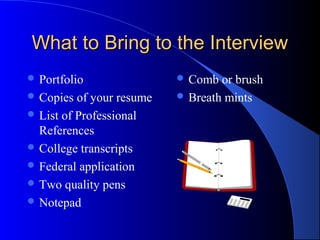
 Portfolio
 Copies of your resume
 List of Professional
References
 College transcripts
 Federal application
 Two quality pens
 Notepad
 Comb or brush
 Breath mints
Dress for SuccessDress for Success
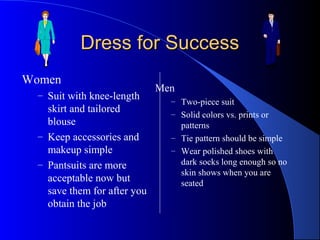
Women
– Suit with knee-length
skirt and tailored
blouse
– Keep accessories and
makeup simple
– Pantsuits are more
acceptable now but
save them for after you
obtain the job
Men
– Two-piece suit
– Solid colors vs. prints or
patterns
– Tie pattern should be simple
– Wear polished shoes with
dark socks long enough so no
skin shows when you are
seated
Ten TipsTen Tips
 Arrive on time
 Introduce yourself in a
courteous manner
 Read company
literature while you
wait
 Use body language to
show interest
 Listen
 Smile, nod, give
nonverbal feedback
 Ask about the next
step in the process
 Thank the interviewer
 Obtain a business card
 Write a thank-you
letter to anyone you
have spoken to
Typical Structure of anTypical Structure of an
InterviewInterview
Small talk
“Tell me about yourself!”
Discussion of your background and how it
relates to the position
Your opportunity to ask questions
Conclusion
Five Tough InterviewFive Tough Interview
QuestionsQuestions
The tell-all question: “Tell me about
yourself.”
The surprise question: “What’s your
passion?”
Strengths and weaknesses questions
Questions about the future: “What are your
long-term goals?”
Scenario questions: “What if…?”
Questions to Ask in anQuestions to Ask in an
InterviewInterview
 What will my duties entail?
 What kind of work can I expect to be doing? Can
you describe a typical day?
 Where does this job fit into the organizational
structure of the company?
 Who would I report to? Who would I be working
with?
 What is the size of the department I would be
working in? What is its structure? How is it
organized? May I see it?
More Questions to AskMore Questions to Ask
 Does the company offer any training
opportunities?
 How would you describe the ideal candidate for
this position? What qualities do you want in the
person who fills this job?
 What do you feel would be the greatest challenge
for me?
 What is the selection process/timeline from here?
 May I contact you if I have any further questions?
After the InterviewAfter the Interview
Write a thank-you letter to anyone with
whom you have spoken
– Use standard business letter format
– Thank the interviewer
– Reference a point of conversation which was of
mutual interest
– Recap how your skills and qualifications fit the
position based on your interview conversation
– Communicate your continued interest in the
position
Practice, Practice, Practice!Practice, Practice, Practice!
Mock interview
Internet
NEGOTIATINGNEGOTIATING
TOPICS FOR DISCUSSIONTOPICS FOR DISCUSSION
Understanding The Process
The Interview
The Offer
The Negotiation Process
UNDERSTANDING THEUNDERSTANDING THE
PROCESSPROCESS
What It Is Not
– saying “I want more money”
What It Is
– Meeting and discussing a subject
– Mutual agreement of issues
UNDERSTANDING THEUNDERSTANDING THE
PROCESSPROCESS
When does negotiation begin
– Telling about yourself
– With the initial interview
Don’t reveal your salary requirements too
early in the negotiation process.
UNDERSTANDING THEUNDERSTANDING THE
PROCESSPROCESS
Evaluation
– Answer these questions:
What is the Salary range?
What is the lowest salary that I will consider?
What makes me worth a higher salary?
UNDERSTANDING THE PROCESSUNDERSTANDING THE PROCESS
Where To Get Salary Information
– National Association of Colleges and
Employers
– Career Resource Center
– Libraries
– Trade associations and trade publications
– Internet
– People working in the industry
UNDERSTANDING THE PROCESSUNDERSTANDING THE PROCESS
Some Employer Objections To Your
Request For More Money
– You don’t have enough experience
– Other employees aren’t making more
– The budget won’t permit
– That’s what we are paying new hires
UNDERSTANDING THE PROCESSUNDERSTANDING THE PROCESS
 Your Positive Response To An Objection To
Pay You More
– In response to the “other employees aren’t making
more” statement, you might give a response such as:
“I see. (short pause) What is the range for this position?
What would it take to get to that higher level within
that range?
Remember, you are asking questions not delivering
an ultimatum.
The InterviewThe Interview
 Some Ideas To Help You During The Interview
Process As It Pertains To The Salary Issue
– Good listening skills
– Try not to be the first to mention money
– If asked what salary you are looking for, say you have a
range but that it really will depend on the total package
– If pushed, have a range in mind
– If asked what your current pay is, tell the truth
THE OFFERTHE OFFER
– Give answer in 24 hours unless you are
considering other options. Or ask for a
window of time.
– Ask about other important fringe benefits
before accepting the job
– Avoid telephone negotiations
THE NEGOTIATION PROCESSTHE NEGOTIATION PROCESS
 Here Are Some Examples Of How A Salary Discussion
Might Go
Company: “We would like to offer you a salary of
Rs.55,000/year.”
You: Alternative answer #1: “I’m delighted that you are
interested in me. Based upon my experience and also
because of a variety of expenses associated with the cost of
living in (this city), I would like to make around
Rs.60,000. How do you feel about that?
THE NEGOTIATION PROCESSTHE NEGOTIATION PROCESS
Alternative answer #2: “I like the opportunity, and I know
that I could contribute, but I have several other
opportunities that are in the $60,000 range. Is there a way
we could work this out?”
Alternative answer #3: “I’ve completed a very valuable
education and anticipated Rs.60,000 as a minimum. Is
there a way we can work that out? I love the opportunity
and would like to work here if I can get that amount. What
do you think?”
THE NEGOTIATION PROCESSTHE NEGOTIATION PROCESS
– Ask if you can get periodic reviews to let your
future employer know that you are concerned
with providing the highest level of service.
– Before asking for more money, mention
positive statement that reflects your skills and
why you are qualified for the job.

Interview techniques

  • 1.
  • 2.
    The HandshakeThe Handshake Keepyour right hand free Meet the other person’s hand “web to web” Keep hand in a vertical position Shake from the elbow, not the wrist Two to three smooth pumps
  • 3.
    Workshop TopicsWorkshop Topics Purposeof the Interview Preparing for the Interview Typical Structure of the Interview Typical Questions After the Interview
  • 4.
    Purpose of theInterviewPurpose of the Interview The Candidate – Clarify responsibilities of the position – Determine if you can/will do the job – Determine “fit” The Interviewer – Evaluate candidate based on qualifications and employer needs – Determine “fit”
  • 5.
    QuestionsQuestions WhenWhen SchedulingScheduling How long willthe interview last? How many candidates will be interviewing? With whom will I be interviewing? Is there anything I should bring with me?
  • 6.
    Know the EmployerKnowthe Employer Product or Service Sales/Assets Competition History Field Offices Industry Trends Chain of Command Size
  • 7.
    Resources forResources for ResearchingtheResearching the EmployerEmployer CRC – Planning Job Choices: How to Research Companies – Florida Business Directory – Hoover’s Handbook of American Business – Career Information Library - Employer Files  Internet  Journals
  • 8.
    Know YourselfKnow Yourself Whydo you want to work for the firm? What can you do for the company? Your accomplishments/experience Your strengths/weaknesses Your initiative, goals and attitudes Your responses should be unique and specific
  • 9.
    What to Bringto the InterviewWhat to Bring to the Interview  Portfolio  Copies of your resume  List of Professional References  College transcripts  Federal application  Two quality pens  Notepad  Comb or brush  Breath mints
  • 10.
    Dress for SuccessDressfor Success Women – Suit with knee-length skirt and tailored blouse – Keep accessories and makeup simple – Pantsuits are more acceptable now but save them for after you obtain the job Men – Two-piece suit – Solid colors vs. prints or patterns – Tie pattern should be simple – Wear polished shoes with dark socks long enough so no skin shows when you are seated
  • 11.
    Ten TipsTen Tips Arrive on time  Introduce yourself in a courteous manner  Read company literature while you wait  Use body language to show interest  Listen  Smile, nod, give nonverbal feedback  Ask about the next step in the process  Thank the interviewer  Obtain a business card  Write a thank-you letter to anyone you have spoken to
  • 12.
    Typical Structure ofanTypical Structure of an InterviewInterview Small talk “Tell me about yourself!” Discussion of your background and how it relates to the position Your opportunity to ask questions Conclusion
  • 13.
    Five Tough InterviewFiveTough Interview QuestionsQuestions The tell-all question: “Tell me about yourself.” The surprise question: “What’s your passion?” Strengths and weaknesses questions Questions about the future: “What are your long-term goals?” Scenario questions: “What if…?”
  • 14.
    Questions to Askin anQuestions to Ask in an InterviewInterview  What will my duties entail?  What kind of work can I expect to be doing? Can you describe a typical day?  Where does this job fit into the organizational structure of the company?  Who would I report to? Who would I be working with?  What is the size of the department I would be working in? What is its structure? How is it organized? May I see it?
  • 15.
    More Questions toAskMore Questions to Ask  Does the company offer any training opportunities?  How would you describe the ideal candidate for this position? What qualities do you want in the person who fills this job?  What do you feel would be the greatest challenge for me?  What is the selection process/timeline from here?  May I contact you if I have any further questions?
  • 16.
    After the InterviewAfterthe Interview Write a thank-you letter to anyone with whom you have spoken – Use standard business letter format – Thank the interviewer – Reference a point of conversation which was of mutual interest – Recap how your skills and qualifications fit the position based on your interview conversation – Communicate your continued interest in the position
  • 17.
    Practice, Practice, Practice!Practice,Practice, Practice! Mock interview Internet
  • 18.
  • 19.
    TOPICS FOR DISCUSSIONTOPICSFOR DISCUSSION Understanding The Process The Interview The Offer The Negotiation Process
  • 20.
    UNDERSTANDING THEUNDERSTANDING THE PROCESSPROCESS WhatIt Is Not – saying “I want more money” What It Is – Meeting and discussing a subject – Mutual agreement of issues
  • 21.
    UNDERSTANDING THEUNDERSTANDING THE PROCESSPROCESS Whendoes negotiation begin – Telling about yourself – With the initial interview Don’t reveal your salary requirements too early in the negotiation process.
  • 22.
    UNDERSTANDING THEUNDERSTANDING THE PROCESSPROCESS Evaluation –Answer these questions: What is the Salary range? What is the lowest salary that I will consider? What makes me worth a higher salary?
  • 23.
    UNDERSTANDING THE PROCESSUNDERSTANDINGTHE PROCESS Where To Get Salary Information – National Association of Colleges and Employers – Career Resource Center – Libraries – Trade associations and trade publications – Internet – People working in the industry
  • 24.
    UNDERSTANDING THE PROCESSUNDERSTANDINGTHE PROCESS Some Employer Objections To Your Request For More Money – You don’t have enough experience – Other employees aren’t making more – The budget won’t permit – That’s what we are paying new hires
  • 25.
    UNDERSTANDING THE PROCESSUNDERSTANDINGTHE PROCESS  Your Positive Response To An Objection To Pay You More – In response to the “other employees aren’t making more” statement, you might give a response such as: “I see. (short pause) What is the range for this position? What would it take to get to that higher level within that range? Remember, you are asking questions not delivering an ultimatum.
  • 26.
    The InterviewThe Interview Some Ideas To Help You During The Interview Process As It Pertains To The Salary Issue – Good listening skills – Try not to be the first to mention money – If asked what salary you are looking for, say you have a range but that it really will depend on the total package – If pushed, have a range in mind – If asked what your current pay is, tell the truth
  • 27.
    THE OFFERTHE OFFER –Give answer in 24 hours unless you are considering other options. Or ask for a window of time. – Ask about other important fringe benefits before accepting the job – Avoid telephone negotiations
  • 28.
    THE NEGOTIATION PROCESSTHENEGOTIATION PROCESS  Here Are Some Examples Of How A Salary Discussion Might Go Company: “We would like to offer you a salary of Rs.55,000/year.” You: Alternative answer #1: “I’m delighted that you are interested in me. Based upon my experience and also because of a variety of expenses associated with the cost of living in (this city), I would like to make around Rs.60,000. How do you feel about that?
  • 29.
    THE NEGOTIATION PROCESSTHENEGOTIATION PROCESS Alternative answer #2: “I like the opportunity, and I know that I could contribute, but I have several other opportunities that are in the $60,000 range. Is there a way we could work this out?” Alternative answer #3: “I’ve completed a very valuable education and anticipated Rs.60,000 as a minimum. Is there a way we can work that out? I love the opportunity and would like to work here if I can get that amount. What do you think?”
  • 30.
    THE NEGOTIATION PROCESSTHENEGOTIATION PROCESS – Ask if you can get periodic reviews to let your future employer know that you are concerned with providing the highest level of service. – Before asking for more money, mention positive statement that reflects your skills and why you are qualified for the job.